




Abstract
Companies may be confused by consumers’ perceptions of hypocrisy related to corporate social responsibility activities. This study investigates the mechanism of consumer response to perceived hypocrisy and determines that internal attribution and negative emotion play vital roles. The findings may be summarized as follows. First, the consumers’ internal attribution of corporate hypocrisy increases the perceived hypocrisy. Second, the consumers’ internal attribution of corporate hypocrisy also increases their negative emotions. Third, consumers’ perceptions of hypocrisy intensify their negative emotions. Fourth, the negative emotions of consumers negatively influence their attitude toward companies. Finally, consumers’ negative emotions increase their negative behavior. The findings demonstrate that the influence of perceived hypocrisy on consumers’ attitude and behavior is affected by negative emotion. Consumers’ internal attribution of corporate hypocrisy affects their perceptions of hypocrisy, prompting negative emotions. The psychological and behavioral mechanism of consumer response to perceived hypocrisy is discussed, thus contributing to the study of corporate hypocrisy.
Keywords
Introduction
Research on corporate social responsibility (CSR) has shown that CSR activities can enhance a company’s image (Chernev & Blair, 2015), incur a positive response from consumers (Luo & Bhattacharya, 2006), and improve the market performance of the enterprise (Brammer & Pavelin, 2007; Mcwilliams & Siegel, 2001). Therefore, many companies are eager to utilize CSR to achieve a positive customer response, improve their reputation, and enhance their performance through CSR activities. However, instead of benefiting enterprises, some CSR activities have led to a negative customer response and have been criticized by the public. The case of NongFu Spring (a Chinese mineral water producer) is an example of this. NongFu Spring launched a promotional public benefits activity in 2002. In the promotion, the company promised to donate a small portion of its revenue to public welfare programs whenever a bottle of water was sold. This activity was questioned by the public because the actual donation was lower than the amount they had promised according to the company’s actual sale volume. Similarly, in 2008, Vanke (a famous Chinese real estate company) donated 2 million RMB to the disaster area of Wenchuan (a Chinese town destroyed by a strong earthquake in 2008). The Chinese public was angered by the lukewarm show of support to victims of the severe disaster. Consumers who are not impressed by CSR activities may think that companies do not want to truly undertake social responsibility. Thus, in 2009, Wagner introduced the concept of corporate hypocrisy in the Journal of Marketing and explored the formation and influence of corporate hypocrisy (Wagner et al., 2009). If consumers interpret CSR activities as hypocritical behaviors, they will respond negatively to any company they perceive to be hypocritical. The consumers’ skepticism of NongFu Spring’s public welfare program led to the perception that the company’s kindness had been a deception, and consumers refused to buy NongFu Spring products. Even after Vanke contributed an additional 100 million RMB to the disaster area, consumers still boycotted the company’s products and stocks. Thus far, research on consumer response to CSR has mainly discussed how CSR activities exercise a positive effect on consumer perception (Klein & Dawar, 2004; Tian et al., 2011). However, journals have begun to publish studies of consumer perception of corporate hypocrisy and relevant negative effects on the enterprise (Jiang & Zhao, 2016; Wagner et al., 2009). When consumers perceive a company’s CSR activities as hypocritical, their response mechanism necessarily differs from their response mechanism in a similar situation where they perceive no hypocrisy. The consumers’ attribution of hypocrisy and negative emotions play crucial roles in their response mechanism. The purpose of this study is to explore the mechanism of consumers’ perceptions of hypocrisy related to CSR activities. The study focuses on the role of consumers’ attribution of hypocrisy and their negative emotions and proceeds to discuss the response mechanism that appears due to the consumer’s perception of corporate hypocrisy. This discussion can provide guidance for enterprises to successfully implement CSR activities without prompting consumer perceptions of hypocrisy and corresponding negative behavior.
Literature Review and Conceptual Framework
Literature Review
Since 2001, research on corporate hypocrisy has gradually proliferated. These studies discuss four general aspects: the definition of corporate hypocrisy, the classification of corporate hypocrisy, the motivation of corporate hypocrisy, and the consumers’ response to corporate hypocrisy.
Wagner defined corporate hypocrisy as a company’s promotion of the concept of social responsibility and simultaneous adoption of practical actions that are inconsistent with this concept (Wagner et al., 2009). Corporate hypocrisy refers to the actual actions of the company that contradict its commitment to or propaganda about social responsibility (Cour & Kromann, 2011). Enterprise hypocrisy is also the inconsistency occurring when what a company does is different from what it says in its social responsibility initiatives (Yin et al., 2016). Enterprises hope to achieve a win–win situation by balancing their own development with social interests through charity, but the result is only to realize their own interests. The behavior is hypocrisy (Cheng & Hu, 2014).
Regarding the classification of corporate hypocrisy, studies have divided the concept into seven categories: ideal, sincere, rational, bounded rational, opportunistic, hypocritical, and conspiracy through the “sincere/false index” (Fassin & Buelens, 2012). Organizational behavior researchers divide hypocrisy into two types: internal hypocrisy and external hypocrisy. Internal hypocrisy refers to when the organization deceives its members, whereas external hypocrisy refers to when the organization deceives its external stakeholders (Seeliger, 1989). Companies may divorce words and deeds for subjective causes or objective causes. Corporate hypocrisy can also be divided into active hypocrisy and passive hypocrisy. Active hypocrisy refers to hypocritical conduct that the enterprise actively formulates for its own motives. Passive hypocrisy refers to when the enterprise does not have hypocritical motives and it actively assumes social responsibility, but due to objective reasons, its words are not matched by its deeds (Chen, 2016).
Researchers believe that the main causes of corporate hypocrisy include stakeholder factors, economic factors, organizational factors, and media factors (Fan et al., 2014). Enterprises must balance the demands of different stakeholders, so hypocrisy occurs (Chaoyuan, 2019). Because of the pressure from stakeholders, corporations may choose a symbolic CSR strategy (Zhao & Zhou, 2017). Driven by short-term economic interests (Rynes et al., 2003) and corporate financial pressure (Freeman, 1984), companies will also adopt hypocritical activities. Organizational factors such as reward rules (Nishat et al., 2019), management methods (Fassin, 2005), reputation (Lyon, 2008), and legitimacy (Lammers et al., 2010) can also lead to corporate hypocrisy, which appears when what the corporation does is different from what its publicity expresses (Fan et al., 2014). When a corporation and its publicity differ in corporate mission statement and performance, concerns (Fassin et al., 2011), and understanding (Fassin & Buelens, 2012) of CSR activities, it will be regarded as hypocritical by the public.
Regarding consumer response to corporate hypocrisy, Wagner discusses the effect of hypocrisy perception on consumer CSR beliefs and attitudes toward corporations. The study of Zhou demonstrated that Chinese consumers tend to boycott products or services from companies with hypocritical activities (Zhou et al., 2007). Therefore, enterprise hypocrisy not only undermines consumers’ trust in a company (Lichtenstein et al., 2004), but also leads to negative responses such as boycotts of the company’s products (Trudel & Cotte, 2009). When consumers have perceived hypocrisy in the company, they will avoid the enterprise (Janney & Gove, 2011), end their loyalty, and spread negative word-of-mouth feedback on the company (Zhao & Zhou, 2017).
From the current studies, we can find that corporate hypocrisy has begun to attract increasing numbers of scholarly publications. The ensuing studies have developed the concept, classification, and motivation of the consumers’ response mechanism. Current research has confirmed that consumers’ perception of hypocrisy can lead to negative responses, including reduction of trust, changes in attitude, decline of loyalty, and product boycotts. However, studies have yet to address how consumer hypocrisy perception leads to these responses or how it influences the mechanisms of such responses. These questions require further study. When consumers perceive CSR activities as hypocritical, their response mechanisms will tend to make exceptions. Attribution of motives to the activities and negative emotion of consumers will play vital roles (Wang & Wang, 2014). Hypocrisy is identified based upon perceptions of impure motives for corporate charity, so consumers’ attribution of CSR activities will affect their hypocrisy perception (Wang & Wang, 2014). When consumers perceive corporate hypocrisy, their negative emotions will emerge (Wang & Wang, 2014), leading to irrational responses (Wang & Wang, 2014). This study further investigates the psychological mechanisms for the formation of and response to consumers’ perceptions of hypocrisy. Our study continues to promote research on corporate hypocrisy and explains how consumer hypocrisy perception triggers consumer response.
Conceptual Framework
Wagner proposed the concept of consumer’s perception of hypocrisy in 2009. He believed that corporate hypocrisy tended to affect consumers’ faith in and attitudes toward the company (Wagner et al., 2009). Consumers’ perceptions of hypocrisy tend to be affected by their attribution of motives to the company’s behavior, and negative emotions will be triggered when they perceive dishonest motives (Wang & Wang, 2014). Such negative emotions will directly lead to consumers’ irrational behaviors. For example, when consumers perceive that a company has behaved hypocritically, they will analyze whether such hypocritical behaviors were intentional or else caused by objective reasons outside of the company’s control. When consumers perceive hypocrisy from a company, they will feel deceived, which will lead to negative emotions, including hate, anger, and contempt. Furthermore, this perception will decrease their affection for the company and prompt actions that are unfavorable to the business, such as negative comments, complaints, and product boycotts. To better understand how consumers’ perceptions of hypocrisy trigger their behavioral responses, it is necessary to examine the psychological and behavioral mechanisms of these perceptions and their corresponding responses.
From the perspective of consumers, this study constructs a model to explore the roles of consumer attribution and negative emotions in the hypocrisy perception response mechanism.
Figure 1 shows the conceptual model of this research. In this model, the consumers’ internal attribution of corporate hypocrisy affects their hypocrisy perception level and simultaneously triggers negative emotions, attitude changes, and negative behaviors. Consumers’ perceptions of hypocrisy can trigger their negative emotions and change their attitudes toward the company and trigger negative behaviors. Besides, the negative emotions of consumers can also lead to changes in their attitudes toward the company and trigger their negative behavior. Internal attribution refers to whether the consumer regards the hypocritical behavior of the enterprise as intentional (active hypocrisy). This is the judgment by the consumer on the cause of the hypocrisy, which can affect psychological and behavioral responses. Negative emotions include three dimensions: contempt, anger, and hate, which are triggered by consumers’ internal attribution of the corporate hypocrisy. Consumers’ attitudes and behaviors can be influenced by their negative emotions. Negative behaviors include three dimensions: negative comments, complaints, and boycotts, which are crucial outcome variables caused by consumers’ perceptions of corporate hypocrisy.

Conceptual model.
Hypotheses
Internal attribution
Internal attribution and hypocrisy perception
Attribution refers to the process of analyzing the behavior of oneself or others and identifying or inferring its causes. To attribute a motive to a person’s action is to explain and speculate the process of human behavior or the cause of one’s own behavior (Zhang et al., 2000). People’s attribution can affect their perceptions. Studies on mental illness have found that genetic attribution to mental illness leads to an increased risk of disease perception (Lee et al., 2014). Attribution theory was introduced to the study of CSR to explain consumer responses to CSR. Consumers’ attribution of CSR activities can influence their attitudes, perceived quality, product attitudes, purchasing intentions (Lu & Powpaka, 2010), brand attitudes (Tian & Yuan, 2013) perceived performance of CSR, and CSR satisfaction (Lu & Powpaka, 2010) with the company. The process of consumers’ attribution can affect their perceptions of a company (L. B. Karen et al., 2006). Consumers’ attributions (internal or external) of the mistakes made by the company can also influence their perceptions of product quality (Victor, 2009). Accordingly, the perception of corporate hypocrisy will be affected by consumer attribution. If a consumer attributes corporate hypocrisy to internal factors, leading to the belief that the hypocritical behavior of the enterprise was due to the unworthy motivations of the corporate decision-makers, the consumer’s perception level of corporate hypocrisy will be relatively high. Therefore, the following hypothesis is proposed:
Internal attribution and consumer response
Research on consumer behavior suggests that attribution can affect consumer behavior. Consumers’ judgments of attribution can influence changes in brand preference (Mazursky et al., 1987), attitude (Kelley & Michela, 1980), and purchase intention (Weiner, 1985). Researchers Lu and Powpaka (2010) observed that consumers’ attribution of CSR activities led to corresponding responses in matters such as attitudes and purchase intention. Consumers’ attribution regarding product-harm crises in the context of CSR may also influence their brand evaluations (Klein & Dawar, 2004). In the service industry, consumers’ attribution of severe service failure can prompt them to share their negative experiences through word-of-mouth, and further affect purchase decisions (Hsin et al., 2015). Similarly, the attribution of hypocritical behavior can also affect their attitudes and behaviors and produce corresponding behavioral responses. Xie et al. (2015) concluded that an enterprise’s irresponsible behavior with regard to the environment will lead to negative consumer behaviors, namely, negative comments, complaints, and boycotts. If consumers’ attribute corporate hypocrisy to internal reasons, believing that the hypocrisy is caused by dishonest company personnel, their attitude toward the company will be negative. Thus, they will adopt behaviors that are unfavorable to company. Therefore, the following hypotheses are proposed:
Internal attribution and negative emotions
James Lance’s emotional theory holds that emotion is a psychological response to cognitive interpretation (Coleman & Snarey, 2011). Numerous studies have shown that attribution has a significant effect (Folkes et al., 1987) on consumers’ emotion, and attribution of game outcomes can affect the emotional response of the audience. When the audience feels that the outcome of the game is caused by external factors, they will have negative emotions (Mcauley et al., 1983). Shoppers’ attribution of motives (attribution to the store or internal attribution) to an event that influenced their past feelings can influence their future emotions (A. Karen et al., 2001). Consumers’ psychological processes play a critical role in their response to service failure, with emotion exercising a mediating effect between service failure attribution and consumer complaint behavior (Wen et al., 2011). The attribution of corporate hypocrisy will also affect their level of negative emotions. If consumers believe that corporate hypocrisy is caused by internal factors (such as deliberate deception, lack of effort, speculation, etc.), they will experience negative emotions. According to Xie’s et al. (2015) study, the consumers’ negative emotions caused by a company’s irresponsible behavior have three dimensions: contempt, anger, and hate. Therefore, the following hypothesis is proposed:
Consumers’ perceptions of corporate hypocrisy
Hypocrisy perception and consumer response
Research on CSR suggests that consumers’ perceptions of CSR activities can affect their behaviors (Peloza & Shang, 2011). Consumers’ perceptions of CSR activities can influence their perceptions of the company’s reputation, their trust in the firm, and their loyalty to the company (Andrea et al., 2011). Consumers’ perceptions of CSR initiatives, in terms of fit, motivation, and timing, can affect their beliefs, attitudes, and purchase intention (L. B. Karen et al., 2006). Similarly, consumer perceptions of hypocrisy can lead to corresponding behavioral responses. Both Wagner’s and Shim’s studies have illustrated that consumer perceptions of hypocrisy can affect their attitudes toward the company (Shim & Kim, 2015; Wagner et al., 2009). Xiao et al. (2013) observed that the consequences of corporate hypocrisy may include serious company boycotts. Other studies have indicated that consumers do not buy products and services from “hypocritical” companies (Amélie, 2019; Zhou et al., 2007). Therefore, the following hypotheses are proposed:
Hypocrisy perception and negative emotion
Consumers’ perception of a company’s behaviors can affect their emotions. Consumers’ perception of environment derived from smell can influence their emotion and behavior (Ramona & Delane, 2019). Consumers’ perception of food quality derived from physical surroundings in usage situations can influences their pleasure-feeling and arousal-level of emotion (Torben, 2008). Accordingly, consumers’ negative perception toward the company can induce their negative emotion. Research in psychology has shown that moral transgressions can stimulate people’s negative emotions. Consumers’ perception of irresponsible behavior of companies causes them to feel that the company is immoral, resulting in corresponding emotional reactions. A study by Xie et al. (2015) demonstrated that an enterprise’s irresponsible behavior leads to negative emotions, including contempt, anger, and hate. Consumers’ perceptions of hypocrisy will be accompanied by negative emotions (Wang & Wang, 2014), resulting in the feeling of having been fooled by an irresponsible and hypocritical company and triggering corresponding negative emotions. Therefore, the following hypothesis is proposed:
Negative emotions and consumer response
Negative emotions refer to the complex forms of emotions caused by major inconsistencies in the consumer’s emotional experience (Diener et al., 1995; Tronvoll, 2011), which reflect the individual’s information perception based on the environment or a restricted mental state caused by poor service, which falls short of expectations (Bower et al., 1981). Studies in psychology have suggested that moral transgressions can cause negative emotional reactions, which link the violation of moral standards with ethical behavior (Haidt & Graham, 2007). Consumers’ emotions can affect their attitudes and behaviors. Kotler’s study indicated that positive emotions have a positive effect on consumer buying behavior (Kotler, 1974). Research has also verified that consumers’ emotions significantly influence purchasing behavior (Dapeng et al., 2019). Porat and Tractinsky (2012) observed that consumers’ emotions affect their attitudes through research in online store design.
Few studies have used negative emotions to examine consumer responses to irresponsible business behavior or hypocritical behavior. Irresponsible behavior related to environmental issues can be regarded as a moral transgression; therefore, it causes negative emotions in consumers, which affect their attitudes and trigger negative behaviors, including negative comments, complaints, and boycotts (Xie et al., 2015). However, negative consumer emotion caused by irresponsible corporate behavior will be moderated by factors such as fair social value, resonance, moral identity, relationship self, and collective self. Therefore, the following hypotheses are proposed:
Research Method
Research Design
The study explores the response mechanism of consumers’ perceptions of hypocrisy through a simulated scenario experimental method: 2 (two kinds of consumer internal attribution levels) × 3 (three types of hypocritical behaviors) × 3 (three industries of hypocritical behaviors). The design of multiple situations ensures that the research results are not affected by a specific background and guarantees a distribution of exogenous variables at different levels. This method is modeled after the research design adopted by Wagner et al. (2009). Participants completed a questionnaire requiring them to first read a simulated reading material about corporate hypocrisy and then answer the corresponding questions, which addressed their internal attribution of the corporate hypocrisy, perception of the hypocrisy, negative emotions, attitudes toward the company, and negative behaviors.
Variable Measurement
The measurement scales for the relevant variables were compiled from the maturity scales from previously published studies. The research team first collected relevant scales, then adjusted the items according to the research context, and finally determined the scales. The study measures five variables: internal attribution, hypocrisy perception, negative emotions, attitudes, and negative behaviors. Negative emotions and negative behaviors are second-order variables. The scales for these variables are all based on a 7-point Likert-type scale, with 1 being strongly disagree and 7 being strongly agree.
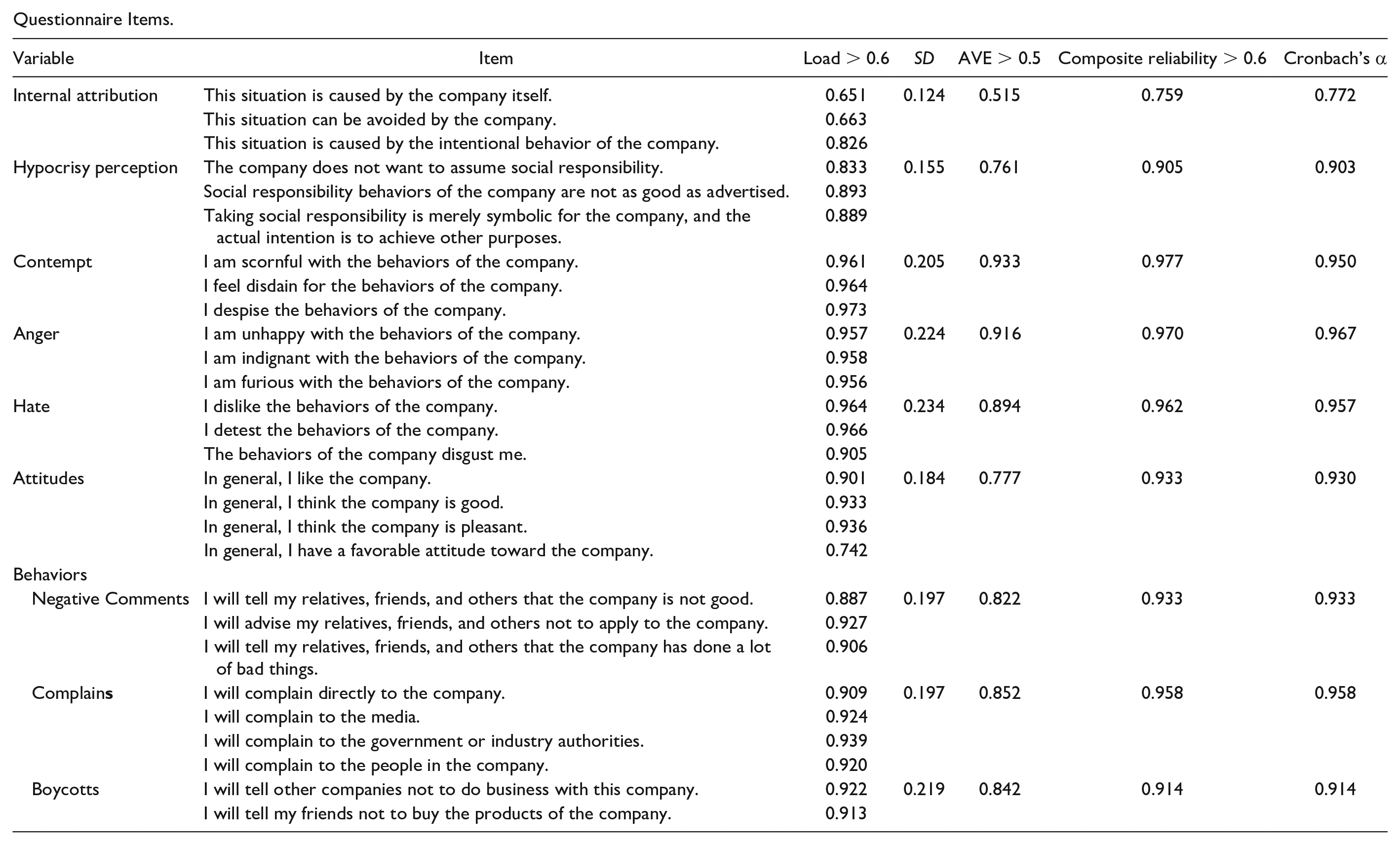
Internal attribution is measured according to the scale developed by Grégoire et al. (2010), including the enterprise’s own reasons, the enterprise’s avoidable reasons, and the enterprise’s intentional reasons. Hypocrisy perception utilizes Wagner’s et al. (2009) scale, which measures three items: a lack of social responsibility, inconsistent propaganda, and ulterior motives. Attitude is also measured according to Wagner’s (2009) scale, using four positive items: “I like the company,” “I think the company is good,” “The company is pleasant,” and “I have a favorable attitude towards the company.” Xie’s et al. (2015) scale is utilized to measure three dimensions of negative emotions: contempt, anger, and hate. Each emotion was then further divided into three items. Contempt measured scorn, disdain, and despising; anger measured unhappiness, indignation, and fury; and hate measured dislike, detestation, and disgust. Negative behaviors are also measured according to Xie’s et al. (2015) scale, which includes negative comments, complaints, and boycotts. The negative comments include three items: “I tell acquaintance the company is not good,”“I recommend against working for the company,” and “I tell others that the company is not doing well.”Complaints include four items: complaining to the company, complaining to the media, complaining to the relevant department, and complaining to the employees of the company. Boycotts include two items: “I suggest people avoid doing business with the company” and “I suggest people avoid buying the company’s products. The specific items of the scales are listed in Table 2.
Data Collection
Data collection was completed through a questionnaire of real consumers. To improve the recovery rate and ensure the quality of the data, a face-to-face survey method was adopted to distribute and collect the questionnaire. A total of 350 questionnaires were distributed and 326 questionnaires were collected, of which 302 were valid questionnaires, resulting in a recovery rate of 93.1% and an effective rate of 92.6%.
During the survey, the gender and age of the recipients were noted, as was the timing of distribution between working days and weekends and working hours and rest hours, to improve the representativeness of the sample. The composition of the sample of surveyed consumers is reported in Table 1.
Composition of Recipients.

Data Analysis
The data analysis is divided into four sections. Section “Introduction” tests the reliability and validity of the measurement model with confirmatory factor analysis (CFA). Section “Literature Review and Conceptual Framework” tests the reliability and validity of the measurement of negative emotions independently because it is a second-order variable. Section “Research Method” tests the reliability and validity of the measurement of negative behaviors independently, for it is also a second-order variable. Section “Data Analysis” tests all hypotheses using structural equation modeling (SEM) as the statistical analysis technique.
Measurement Model CFA
The reliability and validity of the data were verified by CFA using AMOS 16.0 software. The results indicate that the measurement model demonstrates acceptable goodness of fit: χ2(302) = 487.317, χ2/df = 1.614, root mean square residual = 0.067, goodness of fit index (GFI) = 0.982, adjusted goodness of fit index (AGFI) = 0.866, Tucker–Lewis Index (TLI) = 0.977, comparative fit index (CFI) = 0.982, root mean square error of approximation (RMSEA) = 0.045. As illustrated in Appendix 1 and Table 2, the combined reliability of all variables exceeds the recommended level of 0.6, and the average variance extracted (AVE) is also higher than the recommended level of 0.50, thus indicating that the measurement of related variables is highly reliable. The normalized factor load of the structural variables is above 0.6 and is significant at the level of α = 0.01, indicating that the scale has a high degree of convergent validity. In addition, the square root of all AVEs is greater than the correlation coefficient of its rows and columns, which indicates that the scale has a high discriminant validity.
Latent Variable Relationship Table.

Note. Diagonal data is sq-rt (ave).
p < .05. **p < .01.
CFA of Negative Emotions
Analysis of first-order confirmatory factors
Descriptive statistical analysis shows that the data can be used for further high-order analysis. Because negative emotion is assumed to be a high-order concept composed of three dimensions, we first develop the analysis of first-order confirmatory factors.
Based on the maximum likelihood estimation (MLE), the results in Table 3 indicate that contempt, anger, and hate clearly constitute a reliable and efficient measurement model, and they fit the collected data well. The table shows several additional parameters, including the loadings, combination reliability (CR), and AVE of the nine items. The normalized factor loadings range from 0.971 to 0.905 (p < .001), confirming that the nine items were suitable. In addition, each item displays good internal consistency, and the CR is higher than the 0.70 threshold. Referring to the suggestion of Fornell and Larcker, the data of the combined reliability and squared variance can be used to analyze the convergent validity between factors, and the discriminant validity can be tested by comparing the square root of the AVE value with the correlation coefficient among corresponding factors. The CR of each factor is greater than 0.70, and the squared difference is <0.50, indicating good convergent validity among the three factors. Moreover, the square roots of the AVE values of the three factors (ranging from 0.967 to 0.936) are greater than the correlation coefficients (0.966 to 0.928), indicating good discriminant validity among the three factors. Finally, in the model of first-order confirmatory factors, the values of commonly used fitting indices also conform to the standard. The analysis shows that the three factors, namely contempt, anger, and hate, are both related and independent, and they can constitute another higher order latent variable.
Analysis Results of First-Order Confirmatory Factors of Negative Emotions.

Note. The bold number in () is the square root of the AVE value, and the rest is the correlation coefficient among the factors. CR = combination reliability; AVE = average variance extracted; CFI = comparative fit index; TLI = Tucker–Lewis Index; RMSEA = root mean square error of approximation; NNFI = non-normed fir index.
p < .05. **p < .01.
Analysis of second-order confirmatory factors
MLE is also adopted for this portion of the analysis. Table 4 displays the results of second-order CFA of negative emotions: the normalized factors (contempt, anger, and hate) are ranged from 0.998 to 0.963 (p < .001), suggesting that all were empirically noteworthy components of negative emotion. Moreover, each item demonstrated a significant contribution to the corresponding factor, which is consistent with the first-order CFA result. For the second-order confirmatory model of negative emotions, the values of the commonly used fitting indicators also conform to the relevant standards, even better than the first-order CFA results.
Analysis Results of Second-Order Confirmatory Factors of Negative Emotions.

CFI = comparative fit index; TLI = Tucker–Lewis Index; RMSEA = root mean square error of approximation; NNFI = non-normed fir index.
CFA of Negative Behaviors
Analysis of first-order confirmatory factors
The results of Table 5 were obtained by performing first-order CFA on negative behavior. Negative comments, complaints, and boycotts constitute a credible and effective measurement model that fits well with the collected data. The table shows data including loadings, CR, and AVE. The normalized factor loadings ranged from 0.940 to 0.874 (p < .001), confirming that the nine items are suitable. In addition, the internal consistency of each item is good, and the CR is higher than the threshold of 0.70. Referring to Fornell and Larcker, the data of the CR and squared variance can be used to analyze the convergent validity between factors, and the discriminant validity can be tested by comparing the square root of the AVE value with the correlation coefficient. The combined reliability of each factor is greater than 0.70, and the squared difference is greater than 0.50, indicating good convergent validity between the three factors. Moreover, the square roots of the AVE values of the three factors (ranging from 0.957 to 0.906) are greater than the correlation coefficients among them (0.915–0.883), indicating a good discriminant validity between the three factors. Finally, in the first-order confirmatory factors model, the values of the commonly used fitting indicators also conform to the standard.
Analysis Results of First-Order Confirmatory Factors of Negative Behaviors.

Note. The bold number in () is the square root of the AVE value, and the rest is the correlation coefficient among the factors. CR = combination reliability; AVE = average variance extracted; CFI = comparative fit index; TLI = Tucker–Lewis Index; RMSEA = root mean square error of approximation; NNFI = non-normed fir index.
Analysis of second-order confirmatory factors
Table 6 shows the results of second-order CFA of negative behaviors: normalized factor loads of Negative comments, complaints, and boycotts range from 0.971 to 0.932 (p < .001), all of which were vital components of negative behaviors. Moreover, each item has a significant contribution to the corresponding factor, which is consistent with the first-order CFA result. For the second-order confirmatory negative behavior model, the values of the common fitting indicators also conform to the relevant standards.
Analysis Results of Second-Order Confirmatory Factors of Negative Behaviors.
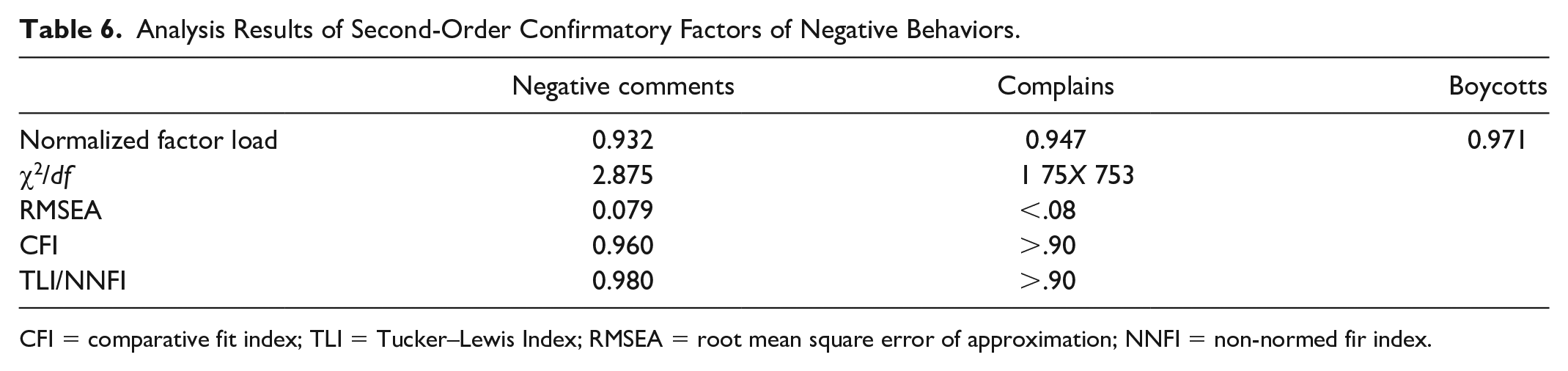
CFI = comparative fit index; TLI = Tucker–Lewis Index; RMSEA = root mean square error of approximation; NNFI = non-normed fir index.
Test of Structural Models
We use the structural equation model to test Figure 1 and explore the response mechanism of consumer hypocrisy perception. The results are illustrated in Figure 2. goodness of fit: χ2(302) = 567.567, χ2/df = 1.699, GFI = 0.928, AGFI = 0.902, TLI = 0.974, CFI = 0.977, RMSEA = 0.048. These statistics indicate that the structural model fits well.

Path analysis results of structural equation model.
The standardized path coefficients of the structural model are displayed in Figure 2. First, consumers’ internal attribution of corporate hypocrisy has a significant effect on their hypocrisy perception (γ = 0.672, p < .01) and also has a significant effect on their negative emotions (γ = 0.189, p < .05). However, internal attribution has no significant effect on the attitudes (γ = 0.124, p > .05) and negative behaviors of consumers (γ = 0.098, p > .05). Consumers’ hypocrisy perception has a significant influence on their negative emotions (γ = 0.560, p < .01) but not on their attitudes (γ = −0.152, p > .05) or negative behaviors (γ = 0.006, p > .05). Consumers’ negative emotions have a negative effect on their attitudes (γ = −0.226, p < .01) and a significant influence on negative behaviors (γ = 0.806, p < .01). In summary, the analysis suggests that H1, H4, H7, H8, and H9 are supported by the data, whereas H2, H3, H5, and H6 are not supported.
Research Conclusion and Discussion
Research Conclusion
The consumers’ hypocrisy perception on CSR has a negative impact on the outcome of CSR strategies, so how hypocrisy perception of consumers emerges should be explored to find methods to avoid the appearance of consumers’ hypocrisy perception. This research explores the psychology and behavioral mechanism of consumers’ response to hypocritical behaviors through the model of hypocrisy perception and response mechanism by focusing on the role of consumers’ negative emotions and attribution of hypocritical behavior.
The study finds that the negative influence of consumers’ hypocrisy perception on their attitudes and behaviors occurs mainly through their negative emotions, and their attribution of corporate hypocrisy can influence their hypocrisy perception level. These findings lead to several conclusions. First, consumers’ internal attribution of corporate hypocrisy enhances their hypocrisy perception level. Second, consumers’ internal attribution of corporate hypocrisy triggers their negative emotions. Third, consumers’ perceptions of hypocrisy significantly increase their negative emotions. Fourth, consumers’ negative emotions cause negative attitudes toward the company. Fifth, consumers’ negative emotions significantly increase their negative behaviors. These conclusions suggest that the negative effects of consumers’ perceptions of corporate hypocrisy on their attitudes and behaviors are based on negative emotions. Consumers’ attribution to corporate hypocrisy is also crucial, because the attribution of corporate hypocrisy can affect consumers’ hypocrisy perception and negative emotions.
Discussion
Apart from its internal impact on employees (Qamar et al., 2019), CSR strategy can influence consumers’ attitude and behavior toward the company (Sara, Sankar, et al., 2019). Consumers’ responses to CSR initiatives include greater loyalty, better customer-company identification (Yaoqi et al., 2019), superior brand advocacy behavior (Xie et al., 2019), beneficial purchasing decision (Flavio et al., 2019), more favorable judgment of the brand (Soyoung et al., 2019), and choice of products (Kuokkanen & Sun, 2019). Our study is consistent with previously published research, confirming that a company’s CSR activities can influence the attitude and behavior of consumers. However, in our study, the response of consumers to corporate CSR strategy differs dramatically from previously published studies due to a context of perceived hypocrisy. Usually, corporate CSR activities can lead to a positive consumer response, but in our study, consumers respond negatively to the company’s CSR activities within the context of perceived hypocrisy. The negative responses include worsening attitudes toward the company as well as negative comments, complaints, and boycotts. Therefore, this study proposes a new type of consumer response (a negative response) to CSR activities within a new context (that of perceived hypocrisy).
Articles in the literature have discussed consumers’ responses to the CSR activities of company. Their responses have been divided into two categories, namely attitude and behavior (Xie et al., 2019; Yaoqi et al., 2019). According to previously published research, consumers were assumed to have no emotional response to CSR activities because their positive attitude and behavior could be induced directly by companies’ CSR activities. Although our study confirms consumers’ attitudes and behaviors can be influenced by a company’s CSR activities, consumers’ emotional response to CSR becomes relevant in the context of perceived hypocrisy, a finding that is distinct from those of previously published studies. Within the context of perceived hypocrisy, consumers experience the feeling of being cheated, leading to an intense emotional response, particularly a negative emotional response. The emotional response is a newly explored type of consumer response to CSR activities apart from attitude and behavior response.
Regarding consumers’ perception of CSR initiatives, earlier research indicated that consumers’ perceptions of CSR could be affected by factors such as the manner of CSR communication (Sora, 2019), type of CSR activities (Sara, Lan, et al., 2019), orientation of CSR (Diehl et al., 2015), attributes of stakeholders engagement (Boadi et al., 2019), individual company’s reputation (Paula, 2019), human values (Rosario et al., 2019), and quality of ethics statements (Andrea et al., 2011). Besides, the factors of cultural environment, such as religion (Farooq et al., 2019), and practices (Farooq et al., 2019) can also affect consumers’ perception of CSR, for cross-cultural differences will lead to different CSR perception of consumers (Rosario et al., 2019). These factors can be divided into three categories, namely company behaviors, consumers’ personal, and context factors. Our study confirms that the manner in which consumers comprehend the CSR activities of a company can influence their perceptions of the company and its CSR activities further. Unlike previously published studies, our study discusses the effect of consumers’ attribution of CSR hypocrisy on their perception of CSR activities. If consumers attribute the mistakes in CSR activities to the company, their perceptions of hypocrisy in will increase. Thus, this study identifies a new factor influencing consumers’ perceptions of CSR.
Theoretical Contribution
The theoretical contributions of this study are as follows: First, this study provides an in-depth understanding of the psychological and behavioral mechanisms of consumers’ perceptions of corporate hypocrisy as well as their resulting responses. Previously published studies have confirmed that consumers’ hypocrisy perceptions can influence their attitudes and behaviors (Wagner et al., 2009), but the psychological mechanisms of such attitudes and behavioral changes have not yet been explored. The discussion of psychological mechanisms clarifies the path of consumers’ hypocritical perception response. Second, the introduction of emotional variables into hypocrisy research reveals the key role of negative emotions. Although previously published studies have confirmed that consumer hypocrisy perception will be accompanied by negative emotions (Wang & Wang, 2014), the role of these negative emotions has not been explored in depth. As mediators, negative emotions connect consumers’ hypocrisy perceptions with changes in their attitudes and behaviors. Consumers’ hypocrisy perception does not directly trigger changes in their attitudes and behaviors, but it ultimately leads to such changes by triggering their negative emotions. Third, this research introduces consumer’s negative behaviors into the research of consumer’s hypocrisy perception and response and elaborates on the types of consumer response behaviors. In the past, the research on consumer hypocrisy response has taken corporate attitudes (Wagner et al., 2009), evaluations (Fan & Tian, 2017), and purchase intentions (Jiang & Zhao, 2016) as dependent variables, but published research has neglected to consider negative consumer behaviors as dependent variables. Consumer hypocrisy perception is accompanied by negative behaviors (Wang & Wang, 2014), so the negative behaviors of consumers are included in the model to study and improve the types of response behaviors.
Management Implications
CSR activities are increasingly valued by companies, and many companies are implementing CSR strategies to gain competitive advantage and attract consumers. However, due to improper implementation of CSR strategies, companies may fail to make a positive impression on consumers, triggering the perception of hypocrisy. In this situation, the losses outweigh the gains. How can companies avoid triggering such perceptions when implementing CSR strategies? How many companies respond to hypocrisy perceptions to mitigate losses? The results of this study offer the following ideas: first, enterprises must implement CSR activities from the perspective of solving social problems. They should not overlap with other non-social responsibility factors, to avoid consumers’ perception that their CSR activities are selfishly motivated. Second, companies must be cautious when implementing CSR strategies. They should carefully plan their initiatives and inform their customers of these activities in a timely manner to avoid unnecessary misunderstandings. Third, when consumers perceive the implementation of a CSR strategy as hypocritical, the company must communicate with customers promptly to explain that the CSR initiative was improperly implemented because of the limitations of objective conditions rather than the subjective will of the company, thereby reducing misunderstanding. Fourth, when consumers perceive hypocrisy and their negative emotions are triggered, companies must first appease consumers to reduce their emotional reactions. To do so, the company should increase its commitment to CSR implementation, compensate its consumers, and continue to implement CSR strategies in an appropriate manner, thereby discouraging consumers from further adverse behaviors due to their negative emotions.
Research Limitations and Future Directions
This study explored the response mechanism of consumer hypocrisy through a questionnaire, focusing on the roles of consumer attribution and negative emotions. Due to time constraints, the study had three limitations, which are relevant to future research. First of all, to avoid the influence of a specific brand, brand names were not included in the questionnaire, according to widespread scholarly practice. However, in reality, consumer behaviors will vary from company to company. Therefore, what role does corporate brand plays in the mechanism of consumer’s hypocrisy perception? This question warrants more research in the future. Second, the data collection of this study was mainly carried out in Wuhan. The findings should be verified in a larger geographical area in the future to determine whether the response mechanism of consumers’ hypocrisy perception in different regions is the same. Finally, from the perspective of attribution theory, this paper explores the role of consumers’ attribution of corporate hypocrisy in the hypocrisy perception response mechanism. However, other psychological factors beyond attribution may also play a role. Future research may explore the roles of additional psychological factors in the response mechanisms of consumers’ hypocrisy perception.
Footnotes
Appendix
Questionnaire Items.
| Variable | Item | Load > 0.6 | SD | AVE > 0.5 | Composite reliability > 0.6 | Cronbach’s α |
|---|---|---|---|---|---|---|
| Internal attribution | This situation is caused by the company itself. | 0.651 | 0.124 | 0.515 | 0.759 | 0.772 |
| This situation can be avoided by the company. | 0.663 | |||||
| This situation is caused by the intentional behavior of the company. | 0.826 | |||||
| Hypocrisy perception | The company does not want to assume social responsibility. | 0.833 | 0.155 | 0.761 | 0.905 | 0.903 |
| Social responsibility behaviors of the company are not as good as advertised. | 0.893 | |||||
| Taking social responsibility is merely symbolic for the company, and the actual intention is to achieve other purposes. | 0.889 | |||||
| Contempt | I am scornful with the behaviors of the company. | 0.961 | 0.205 | 0.933 | 0.977 | 0.950 |
| I feel disdain for the behaviors of the company. | 0.964 | |||||
| I despise the behaviors of the company. | 0.973 | |||||
| Anger | I am unhappy with the behaviors of the company. | 0.957 | 0.224 | 0.916 | 0.970 | 0.967 |
| I am indignant with the behaviors of the company. | 0.958 | |||||
| I am furious with the behaviors of the company. | 0.956 | |||||
| Hate | I dislike the behaviors of the company. | 0.964 | 0.234 | 0.894 | 0.962 | 0.957 |
| I detest the behaviors of the company. | 0.966 | |||||
| The behaviors of the company disgust me. | 0.905 | |||||
| Attitudes | In general, I like the company. | 0.901 | 0.184 | 0.777 | 0.933 | 0.930 |
| In general, I think the company is good. | 0.933 | |||||
| In general, I think the company is pleasant. | 0.936 | |||||
| In general, I have a favorable attitude toward the company. | 0.742 | |||||
| Behaviors | ||||||
| Negative Comments | I will tell my relatives, friends, and others that the company is not good. | 0.887 | 0.197 | 0.822 | 0.933 | 0.933 |
| I will advise my relatives, friends, and others not to apply to the company. | 0.927 | |||||
| I will tell my relatives, friends, and others that the company has done a lot of bad things. | 0.906 | |||||
| I will complain directly to the company. | 0.909 | 0.197 | 0.852 | 0.958 | 0.958 | |
| I will complain to the media. | 0.924 | |||||
| I will complain to the government or industry authorities. | 0.939 | |||||
| I will complain to the people in the company. | 0.920 | |||||
| I will tell other companies not to do business with this company. | 0.922 | 0.219 | 0.842 | 0.914 | 0.914 | |
| I will tell my friends not to buy the products of the company. | 0.913 | |||||
Acknowledgements
This manuscript was edited by Wallace Academic Editing.
Declaration of Conflicting Interests
The author(s) declared no potential conflicts of interest with respect to the research, authorship, and/or publication of this article.
Funding
The author(s) received no financial support for the research, authorship, and/or publication of this article.
