




Abstract
Based on an exploration of the marketing strategies employed in senior citizens’ communities of practice (CoPs), this study proposes that the concept of co-construction derived from learning theory is indispensable in Marketing 4.0, which builds on offline and online interaction between and among consumers and the providers of particular goods and services to create a sense of community. Adopting a qualitative approach, the researchers visited 15 Senior Citizens Learning Centers (SCLCs) in Taiwan, and employed semi-structured interview methods to probe selected interviewees’ insights. This resulted in the identification of four key strategies for CoPs’ marketing efforts, all of which work best if governed by a quality process known as legislating peripheral participation (LPP), which is grounded in co-construction. Specifically, it was found that an SCLC with a unique and high-quality LPP process can not only attract senior citizens’ participation, but also transform their roles from customers to volunteers. The study also assesses whether and how well the four identified strategies can be implemented simultaneously, along with their implications for Marketing 4.0 and for the management of senior citizen–specific CoPs. On a theoretical level, this study highlights the differences between the educational concept of co-construction and the Marketing 4.0 concept of co-creation: with the former being a mutual engagement that integrates buyers and sellers into a cooperative interaction. This process, which takes into account the growth of group identity, individuals’ sense of meaning, and marketing potential, is an important force in Marketing 4.0 that transforms customers into advocates.
Keywords
Introduction
The mainstream of marketing techniques is very much a product of its time, but its evolution to date can be usefully divided into four main phases. As explained by Kotler, Kartajaya, and Setiawan (2010), these are Marketing 1.0, which is product-driven; Marketing 2.0, the customer-centric provision of both tangible and intangible products to fit customers’ needs; Marketing 3.0, a human-centric approach that associates products with varied emotional components that connect customers and businesses; and Marketing 4.0, which highlights connectivity and technology, through which sellers do not try to promote their products to particular individual customers, but instead create a community that includes existing customers, potential customers, and themselves. Development from Marketing 3.0 to Marketing 4.0, while not representing a radical break, has been rapid, and combines not only physical and virtual markets, but also online and offline marketing approaches (Kotler, Kartajaya, & Setiawan, 2017).
Within the type of community fostered by Marketing 4.0, sellers and buyers are bound together not by formal membership rules but by a sense of belonging and by shared meanings, which they co-create alongside products, ideas, feelings, and visions (Kotler, Kartajaya, & Setiawan, 2017). Therefore, in the era of Marketing 4.0, a business cannot merely convey its own meaning, values, and contributions to the public; rather, it must experience a deep process of co-construction—amounting to partnership—with its customers, their friends, families, Facebook friends, Twitter followers, and so on (Krauss, 2017).
Varey and McKie (2010) adopted postmodernism and poststructuralism to describe the shift from Marketing 3.0 to Marketing 4.0, and argued that after it, enterprises should attach more importance to the collaborative relationships among individuals, society, and nature when devising and using marketing strategies. More recently, Wu and Liu (2018) claimed that Marketing 4.0 enables sellers and buyers to mutually co-create products that meet each other’s needs, with social media and the concept of community both playing the roles of catalysts to this the process. Importantly, however, Mukherjee (2017) has argued that both Marketing 3.0 and Marketing 4.0 are still at the conceptual stage; that the feasibility of many skills, strategies, and tools derived from these concepts still stands in need of empirical verification; and that practical cases of co-creation in marketing contexts remain rare (Tarabasz, 2013).
Krauss (2017) made the further argument that practitioners of Marketing 4.0 should not merely seek attention, but transform consumers into propagandists for their enterprises or products after experiencing them. In other words, this type of marketing is, ideally, democratic, holistic, and altruistic, rather than just focusing on customers’ interests or pocketbooks. Although this sounds inspiring, or even enlightening, the leap from acknowledging such possibilities to actually implementing them remains a difficult one, with most scholarship consisting entirely of description and conceptualization (e.g., Senkus, 2013).
In the spirit of positivism and in contrast to the research literature cited above, therefore, the present researcher conducted interviews with marketing practitioners aimed at developing a clearer understanding of whether and how this theorized altruistic approach operates in the real world, and whether/how customers are transformed into propagandists for a product. Specifically, it focuses on the case of Senior Citizens Learning Centers (SCLCs), further conceived of as senior citizens’ communities of practice (CoPs; Wenger, 1998). Defined as a group of older adults who share a common interest, a senior citizens’ CoP has members who spontaneously and frequently gather to engage in shared practices, such as learning activities, to improve their understanding of that common interest (Gau, 2016). Due to the special nature of senior-citizen CoPs, a process known as legitimating peripheral participation (LPP; Lave & Wenger, 1991), derived from the field of human resource development (HRD), has emerged as an important foundation for their marketing efforts, which embody value-creation activities with a humanistic spirit. It is therefore expected that a detailed understanding of the marketing strategies used by senior citizens’ CoPs will help illuminate Marketing 4.0 on both a theoretical and a practical level.
Literature Review
Marketing 4.0 and the 5As Process
To keep pace with the times, marketing strategy has steadily moved toward an integration of the real and the virtual. Marketing 4.0 marks the culmination of this evolution from a commodity to a community orientation, via intermediate stages that focused on customers as individuals and on the spirit of humanity in general (Kotler, Kartajaya, & Setiawan, 2017; Senkus, 2013). As such, it not only unites various features of the previous stages, but also highlights the experiences and feelings that arise when consumers and producers co-create products (Tarabasz, 2013; Wu & Liu, 2018). Verhoef, Beckers, and van Doorn (2013) have pointed out that around half of co-creation activities end in failure, often because customers “kidnap” their ideas; nevertheless, Marketing 4.0 has enabled marketers to redefine the meaning of marketing and to reflect deeply on established concepts of consumerism and social media usage (Varey & McKie, 2010). Such reflections have led them to valorize the concept of community, not only as a means of prompting specific groups of people to buy particular products, but also as a way of developing word-of-mouth marketing strategies whereby loyal customers promote brands through online and offline communities (Kotler, Kartajaya, & Hooi, 2017).
Unsurprisingly, in the Marketing 4.0 era, special attention is paid to comments made both within such communities and by third parties about them. Customers and potential customers use online tools and consult fellow netizens to find favorite products, while also communicating with brands’ communicators, and thus co-creating marketing channels of their own (Tarabasz, 2013). However, customers report that the information they obtain from online communities is more valuable than that obtained directly from product producers and service providers (Kotler, Kartajaya, & Setiawan, 2017). Under Marketing 4.0 conditions, then, consumers not only go through all four phases of the attention, interest, desire, action (AIDA) model first proposed by Lewis in 1898 (Hadiyati, 2016), but also those of the 5A model (Kotler, Kartajaya, & Setiawan, 2017), meaning that, beyond their purchase of a product or service, they are willing to endorse and promote it. The historical development of this transformation in purchasing processes is set forth in Table 1.
Chronology of Models of Customers’ Purchasing Processes.
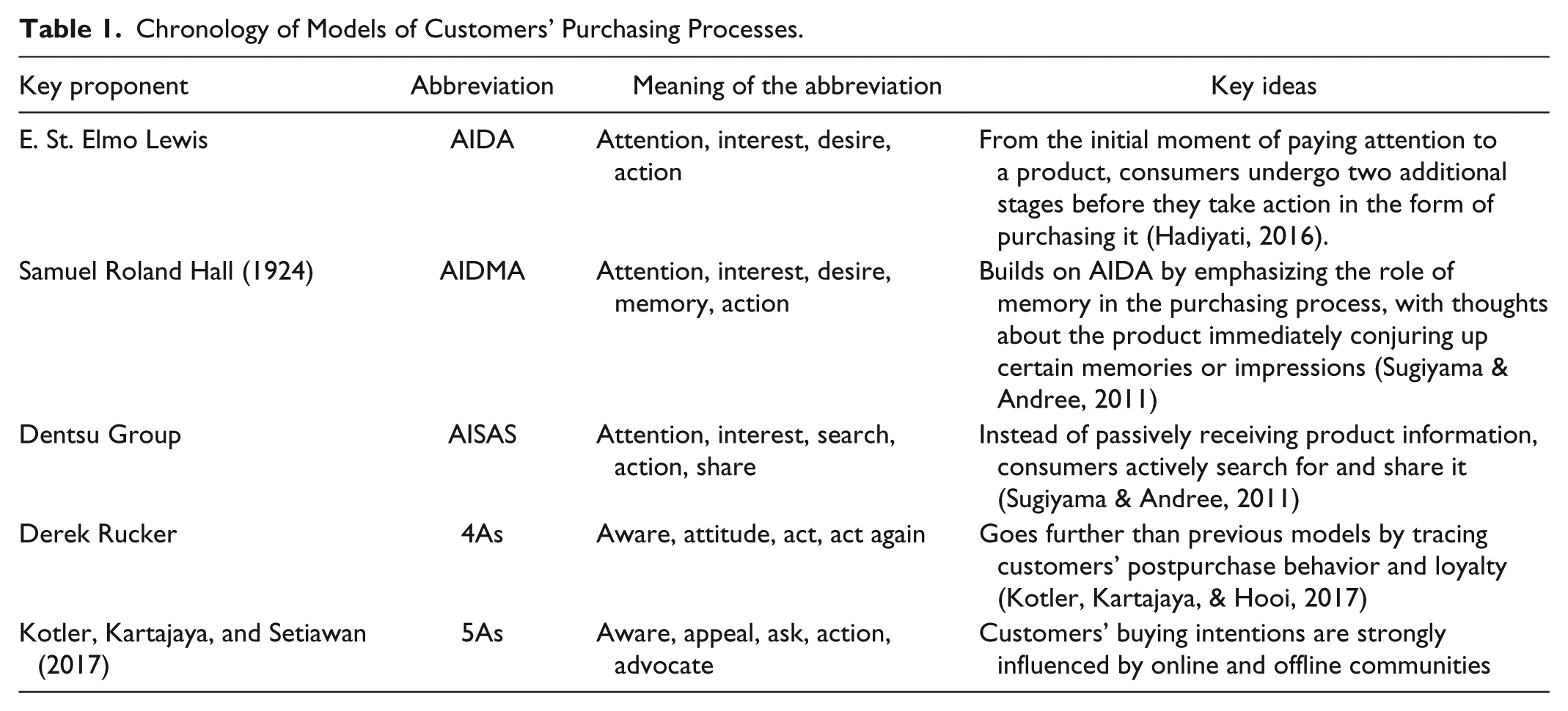
AIDA, proposed in the late 19th century by American advertising scholar Elias St. Elmo Lewis, holds that advertisements and sales rhetoric must be able to attract customers’ attention, arouse their interest, strengthen their desire to own the product, and finally, prompt them to take action aimed at acquiring it (Hadiyati, 2016). However, the implications of this model’s integration into the general marketing process quickly expanded and transformed it: for example, into AIDMA (attention, interest, desire, memory, action), via with the addition of the concept of memory as a marketing tool (Wei & Lu, 2013). Considerably later, the Dentsu company in Japan developed the attention, interest, search, action, share (AISAS) model, which holds that, as well as taking the initiative to search for products after their interest is captured, consumers will share their postpurchase experience on the Internet (Kono, 2009). Tien, Rivas, and Liao (2018) echoed this analysis of the important effects of online discussion and reported that perceived persuasiveness, perceived informativeness, and source expertise were all useful predictors of the impact of word-of-mouth Internet marketing, while perceived usefulness and credibility together enhanced the likelihood that a customer would adopt a message discussed within an online community.
Moreover, whether a person will buy is a quite separate matter from whether he or she will become a loyal repeat purchaser. Therefore, Derek Rucker further modified the AIDA model into the 4As model, comprising aware, attitude, act, and act again (Kotler, Kartajaya, & Setiawan, 2017). AIDA’s interest and desire were combined into attitude, while the act-again stage was added to emphasize the importance of repurchasing activity, that is, customer loyalty (Kotler, Kartajaya, & Hooi, 2017). Finally, to suit the age of Marketing 4.0, Kotler, Kartajaya, and Setiawan (2017) proposed the 5As model, consisting of aware, appeal, ask, action, and advocate. Its second stage, appeal, implies taking advantage of one’s brand or the distinguishing features of one’s product or service to vivify and deepen consumers’ and potential consumers’ impressions of it. It further holds that, because of the vividness or such impressions, customers search for the product, service, or brand through both online and offline communities, during which process their desire to acquire it increases. Then, after such acquisition occurs, if the customers feel the quality is good, they will talk about their purchase experience in both the above-mentioned types of communities and thus become propagandists for the product or service. Given these circumstances, customers interact with the brand through their experience of consumption and after-sales services. This process therefore requires that brands communicate and otherwise engage with their customers to ensure that they retain full autonomy and have positive and memorable experiences.
As the above literature review indicates, purchasing interactions since the beginning of the 21st century have gradually attached greater importance to customer loyalty, customer-directed searching for information, and sharing of consumer experiences in online communities and elsewhere on the Internet. As such, the focus of marketing activity seems to be shifting from the seller to the buyer. However, due to a relative absence of empirical work, the degree to which this theoretical conspectus reflects the reality of Marketing 4.0 remains an open question. This study proposes that the LPP learning process that occurs within CoPs, integrating concepts such as autonomy, co-creation, and community (Wenger, 1998), enables their members to gradually transform their roles from outsiders to insiders, amid a barrier-free atmosphere of knowledge sharing (Umino & Benson, 2016). This general phenomenon is expected to help illuminate many of the seemingly disparate phenomena that Marketing 4.0 exhibits.
CoPs, Senior Citizens, and LPP
Around the globe, scholars’ and practitioners’ interest in various kinds of CoPs has been increasing steadily. As defined by Wenger, Trayner, and de Laat (2011), a CoP gathers members with a common interest in a particular knowledge domain, who deepen their understanding of that domain via sharing their practical experiences with one another. Therefore, CoP members are involved in a collaborative learning journey that enables them to improve themselves by engaging in shared practices. CoPs are often used for both formal and informal knowledge exchange within organizations (Schwen & Hara, 2003). In the medical field, for example, patient CoPs enhance their knowledge of health care and their views on disease and life (Watson-Gegeo, 2005) or their health outcomes (Bot, Xue, Petegem, & Wieringen, 2015), although they are also formed by doctors (Cantillon, D’Eath, De Grave, & Dornan, 2016) and health care administrators (Sims, 2018). In all of these cases, the CoP fosters trust among its members through online or offline interactive communication and problem-solving practices, which informally gather isolated members together, thus triggering their collective and individual ability to create and share knowledge. Importantly, however, participating in CoPs has been found to provide various types of stakeholders with different benefits at different specific stages (Bot et al., 2015; Cantillon et al., 2016; Sims, 2018).
CoPs formed by the elderly are also relatively diverse. For example, to strengthen their cognition regarding health care, maintain interpersonal relationships, and enrich their social lives, HIV patients’ CoPs have been organized by senior citizens in Finland (Nobre, Kylma, Kirsi, & Pereira, 2015). The many learning-oriented and service-oriented senior citizens’ CoPs, meanwhile, have included ones focused on computing in Korea (Kim & Merriam, 2010), Chinese music (Gau, 2016), and intergenerational learning (Gau, 2011).
Taiwan’s SCLCs can be viewed as a sort of CoP, run by volunteers of mixed ages and providing older adults with learning services. In addition to these volunteers, however, they receive some sponsorship from the country’s Ministry of Education, and guidance from universities. This means that SCLCs are unlike either British U3As, which are entirely self-funded and self-directed, and have an autonomous development process (U3A ACT, 2018), or French U3As, which are funded, designed, managed, and developed by universities or other educational institutions (Marcinkiewicz, 2011). In other words, SCLCs are a mixture of top-down and bottom-up structures.
In general, as noted above, CoPs’ members gather because of a common interest or mission, and in these circumstances, professional practices tend to be sharpened through peer debates and discussions. These sense-making activities, including co-construction and mutual rivalry, imply team recognition and organizational commitment, and enable a novice to be transformed into a skilled veteran, and this journey was fundamental to Lave and Wenger’s (1991) concept of LPP. That is, LPP is a process that allows outsiders to gradually swim from the edge to the core of a community through participating in its ongoing activities. As such, it is a process of professional development, through which the individual and the organization come to identify with each other, thus creating a sense of belonging for the former.
Scholars have examined the LPP process in many fields. Ethnographers Stephens and Delamont (2010), who explored its operation in a Capoeira dance community in Britain, found that it was through a series of rituals that a novice teacher observed senior dancers’ or teachers’ performances, and thus gradually involved him- or herself in the process of merging with rhythm, music, and their rituals. The embedding of the individual in group activities via the LPP process also enables him or her to develop a sense of belonging, along with shared meanings and humor. Y. C. Liu and Xu (2013) explored teachers’ CoPs aimed at education reform, and reported that the participants experienced their transformations in distinct stages, including being invited, dealing with identity crises, and confronting self-exclusion, among others. They concluded that a newcomer must always adjust him- or herself to changes related to the distribution of power. Overseas students’ learning journeys can also be examined through the lens LPP. For instance, Umino and Benson (2016) found that Indonesian students underwent the LPP process to completely merge themselves into Japanese communities, and that this not only improved their professional competence, but also expanded their local interpersonal networks.
As the present study will demonstrate, in the specific case of SCLCs, LPP is also a process of transforming participants from customers into volunteers. Most LPP literature has focused on how LPP facilitates members’ group identity and professional development, with very few studies relating the construct to Marketing 4.0 in general, or the 5As in particular. Explaining the 5As from the angle of LPP may clarify aspects of their effective implementation, whereas examining LPP within the context of CoPs may also suggest new horizons for the development of Marketing 4.0.
Marketing Strategies for Promoting Senior-Citizen Groups
Although the members of any CoP tend to be strongly motivated to participate in its organized activities, this does not fully absolve CoPs of the requirement to devise and execute marketing strategies. For example, some senior citizens’ leisure clubs (Parnell et al., 2015), learning groups (Luyt, Chow, Ng, & Lim, 2011), and volunteer groups (Corwin, Bates, Cohan, Bragg, & Roberts, 2007) also use marketing strategies to attract more participants to join them. As its participants join it freely, any CoP’s sustainability depends on such individuals’ willingness to participate continuously in it.
Most senior-citizen CoPs conduct marketing campaigns by word of mouth: for example, the senior citizens’ football club studied by Parnell et al. (2015) and the Singapore book club discussed by Luyt et al. (2011). Moreover, for senior citizens, mass media and social media campaigns seem to work less well than their interpersonal networks do (Luyt et al., 2011). However, in the specific case of senior citizens in Taiwan, Yu and Lin (2010) found that advertisements and other promotional activities could be highly influential, provided that they were uncomplicated, easy to engage with, and not overloaded with information. The same study reported that Taiwanese senior citizens could also be persuaded by appropriate spokespeople or credible experiments. More generally, promotion of a senior citizens’ volunteer group should highlight the sense of meaning, as senior-citizen volunteers who feel their role is meaningful will spontaneously invite their friends to join their group or form their own (Corwin et al., 2007). In addition, Sellon (2014) has suggested that an appropriate environment can help senior-citizen volunteers develop their potential and professional skills, and therefore the cultivation of such an environment may attract them to join.
Marketing practices within the senior-citizen CoPs studied in the prior literature seem to relate not only to the 5As process, but also to foundational aspects of both Marketing 3.0, including customers’ minds, hearts, and spirits (Gómez-Suárez, Martínez-Ruiz, & Martínez-Caraballo, 2017; Kotler, Kartajaya, & Setiawan, 2010), and of Marketing 4.0, such as social media, community, co-creation, and human-centric approaches (Kotler, Kartajaya, & Setiawan, 2017). Because there has been little research on marketing strategies in senior-citizen CoPs, the current study’s exploration of such strategies, based on the case of SCLCs in Taiwan, is expected to yield important new insights for the fields of marketing strategy and gerontology. It will be guided by the following research questions:
Research Design
Every resident of Taiwan aged at least 55 years is eligible to apply for SCLC membership. In 2018, 368 SCLCs across Taiwan were known to have been partly sponsored by the Ministry of Education and were very widely distributed, with roughly one per town (Executive Yuan, 2018). Each SCLC has a leader, who is the main decision-maker about its organizational orientation, albeit usually in the context of discussion about this common vision with volunteers, teachers, and other members (W.-C. Liu, 2013). The courses in SCLCs are mainly designed to meet local needs and are thus quite heterogeneous, ranging from policy awareness to life skills training and leisure pursuits. Generally speaking, the leisure interest courses are the most popular, whereas policy awareness ones have relatively few students enrolled in them. Each SCLC strives to distinguish itself from others, usually via its reflection of local cultural features. For example, in one area well known for bamboo weaving, the SCLC makes heavy use of that handicraft in its activity program and has emerged as a CoP that groups senior-citizen experts together to sharpen their bamboo-weaving skills. Because both SCLCs and CoPs have similar features including mutual engagement and joint enterprise (Wenger, 1998), the researchers view all SCLCs as a subtype of CoP. There are two main ways of running SCLC classes, including having every member teach in rotation and inviting professional teachers to give courses to facilitate members’ learning. In both course types, however, the teaching style is usually relaxed and tailored to the senior citizens’ physical and mental abilities (Yan & Yu, 2015).
To capture data on concrete marketing strategies, the researchers chose to visit a sample of two subtypes of SCLCs, that is, “demonstration centers” and “excellent centers” as defined by the Ministry of Education. In the year the study was conducted, there were 11 demonstration centers and 11 excellent centers in Taiwan in 2018, and the researchers visited seven of the former and eight of the latter. These centers were chosen because they used marketing strategies better than the general centers. Of these 15, four were located in the north, seven in the south, and four in central Taiwan. The fieldwork team included one senior researcher, two junior researchers, and three undergraduates. All three researchers had received full training in qualitative research methods and had prior experience of participation in national-level research projects. The three undergraduates had completed a research methods class, and continued to receive qualitative research training at 2-week intervals during the project. In addition, all six team members were familiar with SCLCs through personal experience of working or doing research in one. All the labels and categories derived from the transcripts of this study’s interviews were determined through joint discussions by the research team, while the key argument and the final confirmed findings were selected and completed by the author.
Semi-structured interviews were conducted with one member of each SCLC who devised and/or implemented its marketing strategies. These included five senior SCLC members specializing in marketing matters and 10 SCLC leaders. The average age of the respondents was 61. In addition to Ministry of Education recognition and willingness to participate in the study, each target SCLC had to have features that clearly distinguished it from all the others, and regularly develop and organize learning activities. Because seven of the 22 demonstration centers and excellent centers did not meet one or more of these criteria, 15 remained in this study’s sample. In terms of research ethics, the interviewees’ identities remained confidential, with English letters used in place of their names throughout the research process. Table 2 presents the distinguishing features of the selected SCLCs, along with key details about the interviewees.
Key Details of the Interviewees and Their SCLCs.

Note. SCLC = Senior Citizens Learning Center.
The researchers initially contacted potential interviewees by phone to inform them about the research purpose and to invite them to participate. In the case of those who consented, the researchers sent the interview guidelines to the interviewees via email 3 days before visiting them. Each interview was about 2 hr in duration, and all 15 participants consented to their sessions being recorded using a digital recording pen. The resulting recordings were then transcribed in Word to facilitate data analysis. When the 15 transcripts were finished, they were sent to the interviewees to ensure that the content was correct and to ask them to confirm that they were happy for them to be used in this study. Once all such confirmations had been received, the lead researcher read and reread the transcripts, first, to label original data with similar or related features and, second, to group similar labels into categories. In other words, coding categories emerged from the data analysis. Initially, this process resulted in a total of 136 labels, classified into 23 categories. Next, the categories were reexamined in light of the current study’s research questions about the marketing strategies of the SCLCs, and this led to the identification of 11 categories that were of special interest due to their relevance to external marketing strategy, including promotional techniques, service quality, word-of-mouth marketing, positioning and distinguishing features, volunteer training, experiential marketing, promotion activities in the local community, sense of meaning, partnership, integrating resources, and home delivery of learning (as explained in “Doing a meaningful job and helping customers see what you are doing” section). Through the process of comparing the original classifications with the research questions, the researchers arrived at insights that transcended those original questions, and specifically, that learning—which tends to be ignored in the Marketing 4.0 literature—may be of critical importance to SCLC marketing. Accordingly, the author consulted the raw data again and conducted an in-depth reexamination of the Marketing 4.0 literature, as reported in “Discussion: Implications for Marketing 4.0” section. In other words, although the original focus of the present study was the real-world marketing strategies of SCLCs, the research process—that is, comparing the classifications derived from the raw data against the categories suitable to answering the established research questions—led the author to discover that the data could also help close an important, previously unsuspected gap in the Marketing 4.0 literature. All the labels and categories reflecting the research questions were examined by the research team and were determined to have reached saturation, implying that no additional interviews had to be conducted.
The interview questions were mainly derived from the research questions, and included items such as “How did you recruit the existing members?” “What has been the best method for promoting SCLC activities?” and “How have you established and maintained a flow of positive feedback from the public?” Each such question was designed to trigger additional, deeper questions that would prompt the interviewees to share more of their experience. After coding the interviewees’ responses, the researchers were able to construct the broad outlines of their argument.
Findings and Discussion
Findings: The Marketing Strategies Used by Senior-Citizen CoPs
Developing quality products and fostering customers’ positive experiences
Although some promotional methods such as direct messaging, Internet community building, and outdoor LED-screen advertising were used by a minority of the sampled SCLCs (Ms. G and Mr. I), 12 of the 15 interviewees agreed that the most effective approach was word of mouth. According to Mr. A, for example, when senior citizens felt that a class provided by their SCLC was meaningful, they were happy to share their positive feelings about it with their peers: They agree with what we do and enjoy being here. That is why they keep coming and inviting more and more friends to come over. All of our volunteers join us because of word of mouth. They feel that this is a good place for their learning.
Ms. B’s comments were in a similar vein, but added a negative assessment of her SCLC’s own efforts in comparison with its members’ informal word-of-mouth promotion: [T]he existing students recruit new ones voluntarily, and this must be the best way to do promotion. Because they feel that they have learned something and enjoyed our courses, they’re happy to tell their friends about us. But if we ourselves try to tell people about how good we are, the effect will not be so good.
Although the sampled SCLCs varied in terms of their offerings’ ability to attract their target customers, all the interviewees agreed that SCLCs need their members to feel they are gaining something from their membership and to enjoy their respective learning journeys, due to the critical importance of voluntary sharing of positive feelings about SCLCs between existing members and their nonmember friends.
Moving customers’ hearts and minds through seeing, experiencing, acting, and advocating
Because the sampled SCLCs’ educational offerings were well developed and popular, some leaders, including Mr. A, Ms. B, Ms. D, and Ms. F, were confident that their potential customers would enroll in courses provided that they had experienced a similar learning atmosphere before. It was chiefly for this reason that Center D organized some handicrafts classes in local communities (Ms. D). This seems to echo what Schmitt (1999) referred to as experiential marketing, in which customers are allowed to physically and mentally experience the stimuli associated with the process of purchasing particular goods or receiving particular services before they actually do so. Schmitt further argued that the product or service is strictly secondary to customers’ feelings. Ms. B echoed this idea and suggested that providing a good program that could impress the residents was only the first step, and that making them feel great while they were taking courses was even more important: Because they have an image in their mind, they may come over to have a look at our activities when they have free time. If they feel good, they may want to enroll.
In terms of the specifics of SCLCs’ experiential-marketing implementation, Ms. D said she set up stalls in local communities to enable senior citizens to experience her center’s high-quality classes and learning atmosphere, and thus attract them to join it. As she put it, We had an experience class, a handicrafts class. And we invited the teacher to come into the local community with us to set up fair stalls, so that the local people would know what we were doing and experience our class. If they felt good and were interested in what they were learning, they might come over.
Doing a meaningful job and helping customers see what you are doing
Taiwan’s Ministry of Economic Affairs (2007) defines a home-delivery service as one that delivers goods from a shop to a customer’s home or other predefined destination. By means of such services, therefore, customers can purchase goods from anywhere without bringing them home themselves. However, SCLCs’ home-delivery services differ from these, insofar as they are also an expression of SCLC members’ goodwill. That is, despite the high cost of doing so, SCLC activities are provided in members’ homes because they live in remote areas, are disabled, or simply do not want to go outside (Ms. B). Ms. B and Ms. F both reported similar experiences of driving teachers with all their teaching materials to senior citizens’ places of residence.
We have teachers go with us to give classes in their places . . . Some of the senior citizens cannot come out, so we need to go over to their places to enable them to see us, otherwise they will always be at home and not want to go out. So, if you cannot come here, we can go over to your place to give you a class. (Ms. B) The home-delivery service needs preparation. You need to prepare a lot of teaching materials before going over. After all, they’re disabled and their places are usually out-of-the-way. I usually drive there with my colleagues and prepare all the necessary teaching props. (Ms. F)
Partnerships featuring mismatched resources
Due to resource limitations, the leaders of all the sampled SCLCs felt compelled to cooperate with various other organizations and nonmember individuals. In a sense, such collaborations simply mirror the internal processes by which SCLCs create opportunities for members to learn with and from one another, for example, in self-directed learning groups. Because members learn expertise and garner the associated resources while building up their mutual relations, this can be viewed as a type of co-creation through which new resources are created through the pooling of individual ones (Ms. L, Ms. N). Moreover, cooperating with local institutions provides SCLCs with opportunities to build wider awareness of their distinctive features and establish their reputations: In some festivals, we organize music parties in the primary school. Some senior citizens in the local communities or schoolchildren’s families are invited. The local people will then know us and know that we are organizing these activities, and that our members are good at playing instruments. If you are interested [. . .] you may come over to join us. (Mr. A) The lion dance is our signature act. We train our members to do it, and because it’s very famous, the Culture Bureau of the local government is happy to share its resources with us. It is now a national treasure, and we have even been to Mainland China to perform it. (Mr. C)
To increase and maintain public awareness, the sampled SCLCs are generally specialized in particular themes or skills. As well as the lion-dance example noted above, the popular theme of health care was adopted by Center B, which associated itself with multiple public health centers and hospitals where it organized lectures.
Cooperating with local organizations can create opportunities not only for enhancing SCLCs’ reputations, but also for collecting local wisdom and other resources that enable them to expand (Mr. A, Ms. B, Ms. D, Mr. H, and Ms. J). Against a background of declining resources, Ms. D argued that integrating resources to expand branches was key to running an SCLC successfully: Because the government keeps reducing its support, it is not easy to establish a new SCLC. If you would like to set up an SCLC in your elementary school and cannot reach the high threshold, it might be better to become one of our branches, as we have enough teachers to help you.
Other respondents also offered detailed comments on the merits of collaboration.
We used to cooperate with local communities. They needed classes and I needed space, so I told them that the classes were free, and they only needed to provide us with space . . . [and] in some DIY classes, the tuition is totally free. Students only pay for the materials. (Ms. B) We cooperated with local primary schools. We ran dancing classes, because the senior citizens there enjoyed dancing. (Mr. A)
Discussion: Implications for Marketing 4.0
The above discussion has a certain guiding importance for the practical implementation of marketing concepts. Although Marketing 4.0 does not accord a high priority to learning, this study has found that the individual’s learning experience via LPP processes in CoPs may trigger co-creation and co-construction, which are implied within the concept of Marketing 4.0, and that such learning also covers all stages of 5A. These relationships will be dealt with in more detail below.
Engaging customers experientially helps them take action
The AIDA model is narrowly focused on the internal process of triggering one’s external purchase behavior, and its cycle of four stages ends with the customer’s purchase. This is in strong contrast to the 5As process in Marketing 4.0, which implies both delivering the product image to customers and pre- and postpurchase engagement with a community of other buyers and potential buyers.
In terms of product-image delivery, the 5As stage of appeal is formed after customers’ awareness is established. In other words, the product must be impressive enough to attract customers’ attention if it is to appeal to them internally. Consumers should also have some impression of the product’s component features. Achar, So, Agrawal, and Duhachek (2016) suggested that the process of marketing itself can instill the target customers with positive feelings and provide them with unique experiences. For example, when SCLCs promote their courses out in the community, they offer “taster” versions of their most popular courses (aware). In these circumstances, SCLC volunteers invite local residents to participate in experiential courses, so that they can really feel and engage in its learning interactions. When these potential students really experience and enjoy a course, it—and the SCLC that provides it—appeals to them (appeal), which in turn sparks their desire to know more about the SCLC’s other offerings (ask).
In terms of community, people now often search for information on the Internet as well as through their interpersonal networks when they are interested in particular products, services, or other topics. Given these circumstances, Marketing 4.0 conceptualizes how the resulting communities can influence not only the target customer, but also his or her friends, family, and social media followers (Kotler, Kartajaya, & Setiawan, 2017). Therefore, when local residents’ experience of SCLC courses impresses them, it is reasonable to expect that they will share such feelings among their personal connections, and also seek information about the course and the SCLC from its volunteers, their own interpersonal networks, and e-communities. And this ask stage may be followed by action, that is, enrollment.
As all of this suggests, the 5As in Marketing 4.0 emphasize making customers and potential customers truly feel the quality of the product/service, and interacting with them meaningfully. The first two stages, aware and appeal, focus on quality, and the higher it is in these stages, the more favorable the results will be (from the seller’s point of view) when the potential customer goes on to collect information from his or her real and virtual communities. Therefore, not only is experience a key driver of customers’ purchasing decisions, but the process associated with such experience has itself become a commodity circulating through various networks, further intensifying the already strong influence of experience on marketing.
LPP process quality as a determinant of senior citizens’ willingness to advocate
The present study’s qualitative data suggest that whether a customer becomes an advocate or not depends on whether the 5A process, considered as a whole, provides opportunities for him or her to experience the process of co-creation. The learning process undergone by senior citizens in the sampled CoPs exemplifies the process of transforming customers from mere purchasers into advocates, that is, the final two of the 5As. Members of a CoP experience varied challenges during their journey from its periphery to its core (Holmes & Woodhams, 2013). In the specific case of the sampled SCLCs, this is reflected in the members’ step-by-step LPP process, which provides them with a series of tasks and training milestones through which they are transformed from customers into volunteers. This not only enables the individual’s attitudes and professional knowledge to be built and confirmed by the group, but also gathers members together to cope with shared challenges and experience the process of co-construction (Gordon, 2011).
Conceptually, co-construction implies that group members experience success and failure together and overcome shared difficulties, and that through this, they engage in shared practices that develop their sense of belonging and mutual loyalty. Echoing the concept of Marketing 4.0, this process combines both top-down and bottom-up concepts, which enable the members to engage in two-way communication while seeking better solutions or systems for the organization. It also involves varied meaningful tasks that touch not only the participants’ brains, but also their hearts.
Therefore, this interaction process should not be seen simply as a marketing opportunity, but also as a collaboration: embracing mutual engagement, joint enterprise, and a shared repertoire of practices (Wenger, 1998). When customers try to create a meaningful plan with their peers and put it into practice, they will naturally be proud of what they are doing, both in terms of the uniqueness of the experience and the brand’s positive image (Kotler, Kartajaya, & Setiawan, 2010). Thus, they are likely not only to become loyal and enthusiastic customers, but also willing volunteers who help promote the group.
Meaningful activities, willingness to become advocates, and participation in shared practices
According to Kotler, Kartajaya, and Setiawan (2010), the aim of modern marketing is not only to sell products, provide experiential opportunities, or to create feelings, but also to deliver the spirit of humanity, perform meaningful acts, and take care of those in need. The sampled SCLCs’ home delivery of learning services seems to reflect that spirit.
As discussed above, multiple SCLCs provide the elderly in remote areas with door-to-door learning services, through which people with disabilities or who otherwise find it difficult to access mainstream social life can enjoy the same learning opportunities as their nondisadvantaged peers (Hu, 2013) by means of simultaneously and synergistically seeing, experiencing, and participating.
The concept of Marketing 3.0, which as noted earlier is the principal basis of Marketing 4.0, treats customers as complicated, multidimensional people (Kotler, Kartajaya, & Setiawan, 2010). As such, it regards the customer’s perception of the value of experiential consumption as the key to understanding his or her acceptance or rejection of products or services (Butler et al., 2016). Although many difficulties and inconveniences attend the home delivery of learning services, SCLC try their best to resolve them, out of a sincere belief in equality of opportunity to experience high-quality learning services. In these circumstances, all other marketing strategies, apart from goodwill and authentic help, may become irrelevant. That is, once an SCLC’s members feel touched by what they are doing and feel it is meaningful, they become willing to speak up for its program and thus affect the joining decisions of other members of the wider community. In this situation, the individual’s interpersonal networks and e-communities both become powerful media for enhancing the CoP’s reputation (Tarabasz, 2013), and the power derived from customers’ actual experience not only changes their perceptions, but also influences their behavior (Dessart & Bavel, 2017). And to the extent they feel they are doing meaningful work, this behavioral influence is likely to include the above-mentioned role-change from customer to volunteer.
Mutually beneficial partnerships, resource integration, and the value of co-construction
For Kotler (2014), marketing philosophy in the aftermath of Marketing 3.0 has shifted from superficial and extensive to thick and focused. Starting from local reputation, it focuses on specific products, and gradually becomes popular through word of mouth in online and offline communities. However, word-of-mouth marketing cannot succeed in the absence of high-quality products (Kotler & Armstrong, 2002). Although most SCLCs experience financial challenges, they try to expand and deepen their influence for the benefit of the elderly and their local communities, for instance, by working with the public and private sectors to set up subagencies in schools. To maintain high-quality learning activities, they focus on two aspects: first, understanding and meeting residents’ learning needs, and second, developing their own distinctive characteristics. In pursuit of the former goal, they conduct qualitative and quantitative studies to understand the learning needs of local people, so that they can continuously provide them with high-quality courses. In addition, their most popular courses are used as bargaining chips when seeking cooperation opportunities, and if “taster” versions of these featured courses work well, the SCLC increases its range of opportunities to cooperate with other well-known institutions, in a virtuous marketing circle. In other words, partnerships are foundational to SCLC marketing, as cooperating with local agencies and organizations not only improves the SCLC branches’ local exposure, but also shows its partners the high-quality and meaningful aspects of its learning activities, further enabling its positive image to spread via word-of-mouth marketing.
In short, the concept of thick marketing derived from Marketing 3.0 and the concept of community highlighted by Marketing 4.0 not only move customers to become volunteers, but also strengthen partnerships between the organization marketing itself and other relevant service providers, through which an integrated synergy can be achieved. In addition, every CoP is itself a form of social network, in which interpersonal and virtual networks overlap and intersect, providing yet more opportunities for marketing.
The learning process as the key to Marketing 4.0
The LPP process within CoPs comprises not only members’ journeys from periphery to core, but also HRD and marketing. In terms of HRD, LPP requires that a novice experience a series of tests as an integral part of the above-mentioned journey (Lave & Wenger, 1991). Importantly, this process is not controlled solely by the SCLC staff, but co-constructed by staff, volunteers, and customers, and a subjectively satisfying LPP experience tends to boost the individual’s commitment to the organization. In terms of marketing, too, the more meaningful the learning process is, the more likely the individual is to share positive feelings with his or her friends and thus achieve marketing effects. In addition, the LPP process allows CoP members to engage in multifaceted communication, such that the effects of product co-creation, information transfer, and resource networking can be achieved synergistically. This echoes the process delineated by Gau (2009), whereby people pass particular knowledge to others when their intrinsic motivation is strong enough and the external environment is suitable. The experience of the process of co-construction can also create opportunities to achieve the ideal of “thick marketing”: that is, to serve a small subset of the public deeply and elaborately, and then slowly expanding from that base (Kotler, 2014). Because LPP-based co-construction is impressive, in the literal sense that it becomes unforgettable to those who experience it, it increases the likelihood that positive impressions of the host institution will spread widely through word of mouth.
Conclusion
The present study’s contributions can be divided into two main parts. First, it has provided an interpretation of the hitherto largely abstract concept of Marketing 4.0 using empirical cases, and second, it has identified important factors that the existing Marketing 4.0 literature omits from its conceptualization of CoPs—specifically, LPP, which in a CoP context not only explains members’ 5As process, but also their reflection, sharing, co-construction, and meaning-making. Importantly, the shared repertoire of practices identified by Wenger (1998) may be formed after a person undergoes the 5As process: a dynamic not foreseen by established Marketing 4.0 theory. However, due to the limitations of its fieldwork data, this study has not discussed shared-repertoire formation, which is likely to be a fruitful field of inquiry for future researchers. Data limitations also led to problems with verification of the findings. The marketing field naturally attaches great importance to customers. However, due to space limitations, this study has not engaged in an in-depth description of the characteristics of the senior-citizen population, which can be explored in subsequent studies. In addition, the Marketing 4.0 literature is generally focused on digital environments, and on themes such as big data and artificial intelligence, which have not been discussed in this study but should be included in follow-up research.
As noted above, Marketing 4.0 does not specifically emphasize the concept of learning. However, this study, based on the case of 15 senior citizens’ CoPs in Taiwan, found that the co-construction process provided by learning activities facilitated the transformation of CoP members’ identities from customers to advocates. This echoes a global trend among marketing professionals, in which potential customers are no longer viewed simplistically, but as ideological, emotional, and spiritual individuals who are concerned not only about the quality of the product, but also about how to make the world better and to find solutions for those who need help. Based on their study of SCLCs, the researchers identified four commonly used CoP marketing strategies: (a) developing high-quality products and creating positive customer experiences; (b) moving customers’ hearts and minds through seeing, experiencing, acting, and advocating; (c) visibly doing meaningful work; and (d) addressing resource limitations by creating and strengthening partnerships with outsiders. The above strategies have been seen to work well if integrated into a high-quality LPP co-construction process, and thus would potentially enhance practical implementations of a Marketing 4.0 approach.
LPP provides its participants with opportunities to truly understand their organization and to grasp key organizational knowledge. An SCLC’s members invite local people to experience its learning activities for themselves, and also provide home-delivery learning services. By way of experiencing a high-quality LPP process, potential members can sense, feel, and recognize the SCLC’s mission, vision, and value. Not only can the senior citizens’ functional and emotional needs be met, but also their spiritual ones, and because of these positive mental images, they are likely to enroll in classes, and eventually, to voluntarily expand the SCLC’s positive reputation. This cycle of seeing, experiencing, acting, and advocating implies that marketing is not only about selling products, but also about delivering meaning and values. And just as this is not merely an intellectual but an emotional matter, LPP is not only a professional development process in the field of HRD, but also a marketing tool through which the co-construction process can be implemented. During that process, marketers pay attention to not only customers’ specific needs, but also to their feelings and their sense of meaning.
This study’s findings also yield several recommendations for practitioners in the field of senior citizen education. First, SCLCs need to maintain the high quality of their LPP processes, that is, offer classes, learning activities, interaction opportunities, sharing platforms, and learning atmospheres that satisfy their members and enhance their organizational commitment. When such commitment is strong, word-of-mouth and experiential marketing strategies can work together synergistically. Second, government should provide senior-citizen CoPs with communication platforms such as official social media channels or information centers to improve information exchange, as this will facilitate CoPs’ searches for resource-integration partners. Such an approach has the potential not only to help resolve SCLCs’ financial difficulties and thus enhance their prospects of independent development, but also to promote the concept of active aging. Third, senior-citizen CoPs from different regions should regularly visit one another to share their marketing strategies and to build up their partnerships, and ideally, cooperate with each other in creating “blue oceans” of uncontested market space.
Footnotes
Declaration of Conflicting Interests
The author(s) declared no potential conflicts of interest with respect to the research, authorship, and/or publication of this article.
Funding
The author(s) disclosed receipt of the following financial support for the research, authorship, and/or publication of this article: This study was funded by Ministry of Science and Technology in Taiwan (grant number: MOST 105-2410-H-194-069-MY2).
