




Abstract
In an aging society, improving quality of life for middle-aged and senior citizens is crucial. In Taiwan, karaoke recreation is a popular event among senior citizens. This study examined the effects of singing on middle-aged and senior citizens via testing such individuals before and after singing. The tested aspects consisted of social psychology, social interaction, emotional reaction, and usability. The experiment design categorized karaoke events into “group singing” and “individual singing.” The tested karaoke equipment consisted of conventional physical karaoke equipment (hereafter referred to as conventional karaoke equipment) and new karaoke software applications. Experiment participants comprised 48 middle-aged and senior citizens from Miaoli, Taiwan, who were divided into three groups, namely individual participant using digital application, individual participant using conventional karaoke equipment, and grouped participants using conventional karaoke equipment. Results revealed that after singing, the participants’ social avoidance and distress levels decreased, their emotions improved and strengthened, and they demonstrated enhanced social interaction behaviors. Furthermore, group singing yielded greater effects than individual singing did, whereas the effects were greater among participants who used conventional karaoke equipment than those who used digital applications. Participants who used conventional karaoke equipment demonstrated enhanced emotions, social interactions, and satisfaction with usability. Despite attempts to enhance competitiveness via integrating online social functions, new karaoke software still has space for improvement.
Keywords
Introduction
The arrival of the era of population aging leads to extended life expectancies and longer postretirement periods. Therefore, life planning for middle-aged and senior citizens has become increasingly crucial; maintaining their quality of life has become a major social concern. Research revealed that senior citizens in Taiwan live increasingly diversified lifestyles. Therefore, developing recreational activities is conducive to improving their lives (Lee, Yu et al., 2018). Main activities of senior citizens in Taiwan comprise chatting with friends and engaging in recreational or health care activities. In Taiwan, karaoke is a common recreational activity to pass time and conduct physical and mental relaxation. Senior citizens commonly invite friends to sing at professional karaoke venues, parks, and social gatherings.
The emergence of technology has made smartphone usage widespread due to its miniaturized components and affordability. In addition, the majority of middle-aged and senior citizens are capable of operating smartphones by themselves. To succeed in the karaoke market, corporations constantly reconfigure, revise, and renew smartphone karaoke applications (apps) to provide users with individual singing functions (Cai et al., 2017; Maršík et al., 2018). Moreover, the introduction of technology promotes senior health care (Fang et al., 2019). Smartphone karaoke applications have become more mature and stabilized. Such apps provide online song databases and online social functions, thus enabling users to share their singing experiences with friends via online communities.
This study explored the psychological reactions of middle-aged and senior citizens after participating in karaoke activities, their satisfaction levels toward the assistance provided by different karaoke media, whether the effects of new karaoke applications differed from that of conventional physical karaoke equipment (hereafter referred to as conventional karaoke equipment), whether the effects of individual singing differed from that of group singing, and methods of improving the equipment to enhance the perceived usability and satisfaction.
Based on the aforementioned topics, this study investigated the effects of singing on middle-aged and senior citizens by examining their social psychology, social interaction, emotional reaction, and perceived usability before and after singing. Karaoke recreational activities were divided into two situations, chiefly “group singing” and “individual singing.” The used karaoke equipment consisted of conventional karaoke equipment and new karaoke applications. The aforementioned factors were considered in this study. The research results aim to serve as a reference for senior-related industries and to help middle-aged and senior citizens perform self-care. The objectives are listed as follows:
(1) Examine variations in degrees of social avoidance and distress, emotional valence and arousal, social interactions, and perceived usability of karaoke equipment for middle-aged and senior citizens before and after singing.
(2) Compare the effects of different karaoke equipment (i.e., conventional karaoke equipment or new karaoke applications) on middle-aged and senior citizens.
(3) Compare the effects of group singing and individual singing in middle-aged and senior citizens.
Literature Review
Aging and Social Needs
The United Nations estimated that the senior population in the 21st century will exceed the global population of the 20th century (Department of Economic and Social Affairs, United Nations Population Division, 2017). Because senior citizens’ physical and psychological functions decline with age, particular product design principles should be applied for designing products for senior citizens (Bai et al., 2014; Kobayashi et al., 2011; Marcus, 2015). Designs that account for the physical functions, psychological attributes, and specific social behaviors of senior citizens are conducive to alleviating aging-related problems. In addition, health care technology can be introduced at early stages of aging to encourage seniors to remain active, improve their quality of life, slow functional decline, and reduce disabilities caused by aging (Chen et al., 2018). This can enhance senior citizens’ independence while reducing social care costs (Fang & Chang, 2016). For example, mobile social network technologies enable middle-aged and senior citizens to retain their social activities and relations for emotional communication and stress relief (Chou & Liu, 2016). This study investigated the efficiency of conventional karaoke equipment and mobile karaoke applications in increasing the life satisfaction of middle-aged and senior citizens.
According to Maslow’s hierarchy of needs, human needs and motivations from the most basic to the most complex level are physiological needs, safety needs, social needs, the need for esteem, and the need for self-actualization (Koltko-Rivera, 2006; Maslow, 1943; Wahba & Bridwell, 1976). Having satisfied their basic needs in life, senior citizens focus on achieving self-actualization and maintaining social relations with friends. In Taiwan, karaoke activities play a prominent role in the social interactions of older people (Hou, 2018; Lu et al., 2017). Thus, this study employed improving social relations, common topics during social interaction, and friend interactions as components in designing questionnaire items to assess social interactions.
Social Avoidance and Distress Scale
Social avoidance and distress refer to the tendency to avoid social situations and the distress experienced when engaging in such situations, respectively. Avoidance is a behavior, whereas distress is an emotional reaction. The Social Avoidance and Distress (SAD) Scale is applied to test these psychological states. The scale was derived from a mental health assessment questionnaire proposed in 1969 that primarily measured subjective anxiety, language expression, and behavior. The SAD Scale comprises 28 items, of which 14 each are used to assess social avoidance and social distress. The scale adopted a “yes–no” scoring basis (Turner et al., 1987; Watson & Friend, 1969).
The SAD Scale is used to assess subjective social anxiety experiences, including being situated in foreign environments, being watched by a crowd, experiences of embarrassing events, holding conversation with strangers, public speaking, and interacting with numerous people. The scale is also used to measure the psychological status of senior citizens and to compare the psychological status of young and senior citizens (Beaunoyer et al., 2019; Lawrie et al., 2019). The SAD Scale was employed to test the psychological status of middle-aged and senior citizens before and after singing. In particular, variations in their degrees of social avoidance tendencies and distress were compared.
Self-Assessment Manikin, System Usability Scale, and Questionnaire for User Interaction Satisfaction scales
Emotion includes emotional valence and arousal. Emotional valence includes two extremes: negative (unhappy or sad) and positive (happy or joyful). Emotion arousal describes emotional intensity and includes two extremes: calm and excited (Lane et al., 1999).
In this study, emotion was measured using the Self-Assessment Manikin (SAM). Proposed by Mehrabian and Russell (Mehrabian & Russell, 1974), the SAM is a visual scale used to measure emotional dimensions. The SAM is a semantic scale that comprises three emotional aspects, namely valence, arousal, and dominance, and also measures 18 different emotional states by using pictorial expressions as testing tools. These tools are conducive to avoiding cognitive differences due to language barriers. Having been extensively tested, the scale is suitable for measuring emotions via interactive computer interfaces (Bradley & Lang, 1994; Hodes et al., 1985). This study employed 9-point scales to measure two emotional aspects, namely emotional valence and arousal. Dominance was excluded because it was irrelevant to this study, as depicted in Figure 1. In the finalized questionnaire of this study, adjectives with opposite meanings were added to the left and the right ends of the questionnaire to aid participants in making judgments and answers.

Self-assessment Manikin two-dimensional emotion scale.
The International Organization for Standardization (ISO) 9126 (1991) standard defines usability as “A set of attributes that bear on the effort needed for use, and on the individual assessment of such use, by a stated or implied set of users (Abran et al., 2003). The ISO 9241-11 (1998) Guidance on Usability defines usability as “the extent to which a product can be used by specified users to achieve specified goals with effectiveness, efficiency, and satisfaction in a specified context of use (Alonso-Ríos et al., 2009). Nielsen and Shneiderman (Nielsen, 1994) suggested that usability is part of “usefulness” and comprises the following elements: learnability, efficiency, memorability, error prevention, and satisfaction. This study employed the System Usability Scale (SUS) and the Questionnaire for User Interaction Satisfaction (QUIS) to measure usability.
Proposed by Brooke in 1986, the SUS questionnaire is a renown, commonly used, and rapid tool for measuring subjective feelings toward operating product system interfaces, desktop applications, or website interfaces (Bangor et al., 2008; Brooke, 1996). Experts have attested that the SUS is suitable for small sample sizes. The scale employs a five-point Likert scale and comprises 10 items that alternate between positive and negative wording. A total score out of 100 is calculated on the basis of positive and negative items.
QUIS, proposed by Chin and Norman of the Human–Computer Interaction Lab at the University of Maryland (Chin et al., 1988; Harper & Norman, 1993; Tullis & Stetson, 2004), measures a user’s subjective satisfaction with a system’s human–machine interface. The QUIS also measures screen visibility, system information, learning factors, and system capabilities. The items can be revised according to research samples. Assessment is conducted using a seven-point Likert scale from “very dissatisfied” (1) to “very satisfied” (7); 4 indicate “neither satisfied nor unsatisfied.”
Research Methods
A preliminary questionnaire was designed in the first stage of this study by conducting a literature review and holding discussion with three experts. The questionnaire encompassed degrees of social avoidance and distress, emotional valence and arousal, and perceived usability and satisfaction. Pretest was conducted with three participants who had long-term experience in karaoke activities; two of whom have interacted with mobile karaoke applications. After testing, participant opinions were collected and compiled, and the samples and questionnaire were revised. The experiment procedures were then modified to include two variables, namely form (conventional physical karaoke and digital karaoke application) and community (group singing and individual individual).
A total of 48 participants participated in the formal experiment, which was conducted in three stages. First, participants signed informed consent forms, provided their demographic variables, and described their karaoke experience. Subsequently, participants were requested to perform the following tasks to simulate the process of selecting songs from a karaoke machine: selecting three songs, adjusting the volume, and singing one complete song. After singing, participants were requested to complete the questionnaire and participate in a semistructured interview.
After completing the experiment, statistical analysis was conducted using a one-way analysis of variance (ANOVA) and a paired-sample t test. Subsequently, Scheffe’s post hoc test was employed for analysis.
Participants
This study focuses on the reactions of middle-aged and senior citizens. According to the World Health Organization’s definition, middle-aged adults were defined as those aged 45 to 59 years, older adults as those aged >65 years (Oxford Dictionary (US), 2016; Oxford Reference, 2016). With the formal experiment’s sampling instructions, middle-aged and senior participants were recruited from Miaoli, Taiwan, and the distribution of men and women was as even as possible. Each participant was randomly assigned into one of the three experimental groups.
The determination of the sample size was based on general considerations about the trade-offs between the ability to detect certain effects and the feasibility of acquiring a sufficient sample. According to the minimum sample size guidelines for experimental designs, the participants were established at 15 per group (Gall et al., 2007; MacMillan & Schumacher, 2001), and we decided to recruit an additional three participants in the case of dropouts. Finally, 48 citizens participated in this experiment and comprised 25 men (52.1%) and 23 women. Among the participants, 26, 15, and 7 were 50 to 59, 60 to 69, over 70 years old, respectively. Table 1 presents the age distribution and gender ratio of the participants.
Demographic Data on the Age Distribution and Gender Ratio of the Participants.

Of the participants, 34, 4, and 10 had used conventional karaoke equipment, had used mobile karaoke applications, and had never used conventional karaoke equipment or mobile karaoke applications, respectively. In addition, 30, 6, and 2 of the participants sang karaoke 1–3 times per week, 4–6 times per week, and daily, respectively. The participant background of this study is consistent with that of literature review, which indicated that the majority of middle-aged and senior population in Taiwan commonly engages in karaoke singing recreational activities. Table 2 presents the participants’ experiences and frequency of recreational activities.
Participants’ Experiences and Frequency of Recreational Activities.

Materials
The experiment procedures were adjusted before conducting the formal experiment. In accordance with the two variables of “form” and “community,” the following three experiment groups were established: individual participant using digital application (Group 1): an individual participant sings karaoke using a karaoke application on a mobile device; individual participant using conventional karaoke equipment (Group 2): an individual participant sings karaoke using a conventional karaoke equipment; and grouped participants using conventional karaoke equipment (Group 3): a group of participants sing karaoke using a conventional karaoke equipment (see Table 3). Group 1, 2, and 3 separately represent singing karaoke using new digital formats, the conventional karaoke format, and the conventional karaoke format used in group activities, respectively. Group 1 and 2 consisted of individual singing, whereas Group 3 simulated the common conventional karaoke format in Taiwan, in which participants could interact with each other. Each participant was randomly assigned to one of the three groups, each comprising 16 members, totaling 48 members. The experimental process is illustrated in Figure 2.
Experimental Design for the Three Groups—Group 1: Individual Participant Using Digital Application; Group 2: Individual Participant Using Conventional Karaoke Equipment; and Group 3: Grouped Participants Using Conventional Karaoke Equipment.


Experimental setting
Group 1 used the 17sing.tw online mobile karaoke application. The application provides an online song database and song recording functions. Moreover, it has community interaction functions for uploading recorded songs, holding real-time karaoke contests, and managing friend communities. The application was installed on a smartphone; wired in-ear headphones equipped with a microphone were used to play music and for recording. In Group 2, testing was conducted using a 15-inch laptop to search for karaoke videos on YouTube. Similarly, wired in-ear headphones and a microphone were used to play music and record sound. Group 3 used a professional karaoke machine for testing, alongside an 80-inch projection screen, large passive speakers driven by an amplifier, and large professional microphones for singing.
Questionnaire Structure
Table 4 presents the framework of the revised questionnaire, which is divided into six parts. In the first and second parts, the participants’ baseline status was tested. The first part comprised 10 questions to survey demographic variables and experience in using karaoke products. For the second part, (1) the SAD Scale was revised to 15 questions to assess social avoidance tendencies and distress levels, (2) the SAM comprised two questions to assess emotional valence and arousal, (3) four questions related to social interactions were designed to evaluate participant attitude toward social relations, including improving social relations, common topics during social interaction, and friend interactions. After completing these two parts, participants were guided by the instructor to perform the singing task.
Questionnaire Framework.
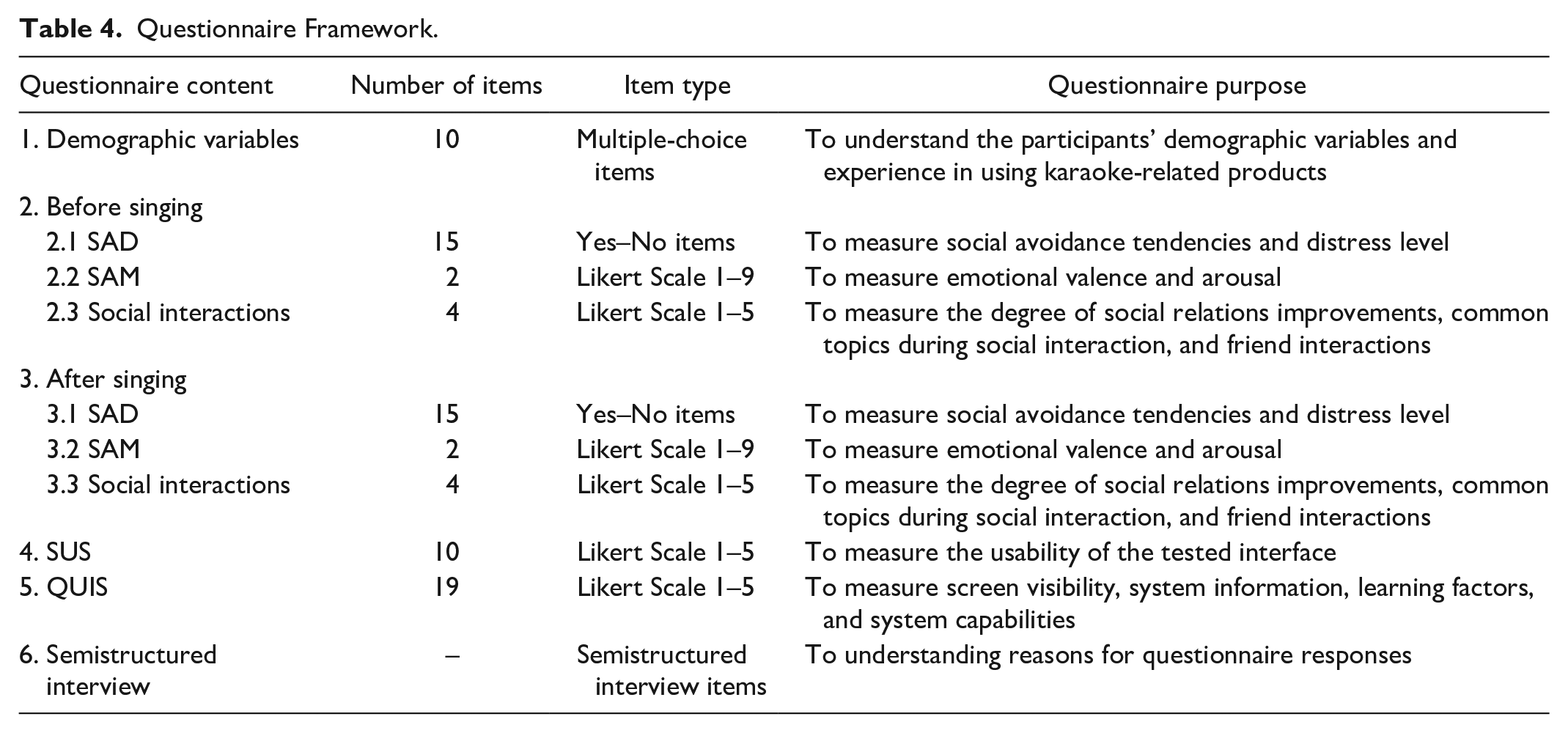
After singing, participants completed the third part, which assessed the participants’ psychological status before and after singing. Similar to the second part, the third part comprised a combined 21 items from the SAD Scale, SAM, and items on social interactions; 21 questions were related to social interactions. Participants continued to the fourth and the fifth parts, which comprising 10 SUS and 19 QUIS questions on the interface usability, respectively. Finally, semistructured interviews were conducted in the sixth part to understand the participants’ reasons for their questionnaire responses.
Results and Discussion
The study results are discussed in three parts: a comparison of the participants’ psychological status before and after singing, a comparison among the three groups, and a comparison between group and individual singing and also physical and digital karaoke forms.
Comparison of SAD Scale, Emotion, and Social Intteractions Before and After Singing
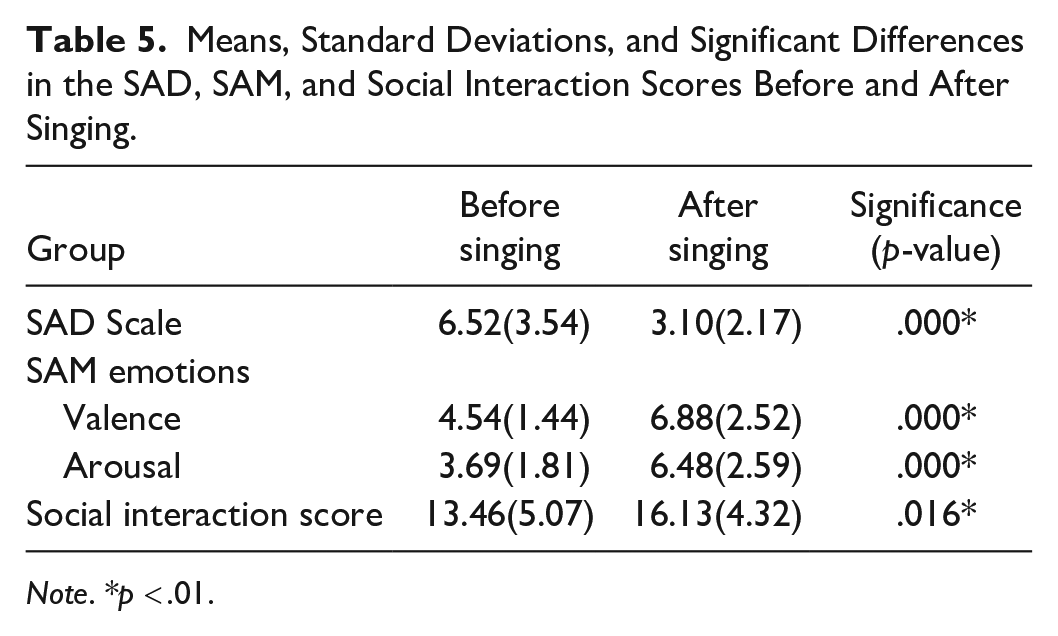
Figure 3 illustrates the variation in the means of the SAD Scale, SAM, and social interaction scores before and after singing. Table 5 displays the means, standard deviations, and statistical analysis results of the paired-sample t test.

Variation in means of the SAD, SAM, and social interaction scores before and after singing.
Means, Standard Deviations, and Significant Differences in the SAD, SAM, and Social Interaction Scores Before and After Singing.
Note. *p < .01.
The means and standard deviations of social avoidance and distress assessed using the SAD Scale were higher before singing (
The means and standard deviations for SAM valence were greater after singing (
The means and standard deviations for SAM arousal were higher after singing (
The means and standard deviations of social interaction scores were higher after singing (
Comparison of Emotion, Social Interaction Scores, and Usability Among the Three Groups
The SAM emotional valence and arousal, social interaction, SUS, and QUIS scores of the three groups were compared. Table 6 presents the mean values and standard deviations of the three groups. A preliminary ANOVA of the pretest indicated nonsignificant differences in SAD measurements. Therefore, they are not displayed in the table.
Means and Standard Deviations of the SAM, Social Interaction, SUS, and QUIS Scores of the Three Groups.

SAM measurement results were as follows:
Higher emotional valence scores indicate that the participant experienced greater degrees of joy after singing. Table 6 indicates that Group 3 demonstrated the highest mean emotional valence, followed by Group 2 and Group 1. The ANOVA indicated significance. Scheffe’s post hoc test indicated that the emotional valence score of Group 1 was significantly less than that of Group 2 and Group 3 (p = .048, p = .001; see Table 7). Therefore, new software apps did not as much positive emotions as conventional group karaoke singing did.
Scheffe’s Post hoc Test for Emotional Valence and Arousal: Significance (p-values) Among the Three Groups.

Note. *p < .01, indicating significance.
Regarding the participants’ emotional intensity (emotional arousal) after singing, the higher the score, the stronger the emotion was. The mean emotional arousal was highest in the Group 3, followed by Group 2 and Group 1. The ANOVA indicated significance. Scheffe’s post hoc test results are presented in Table 7. Emotional arousal in Group 1 was significantly less than that in Group 3 (p = .001). Therefore, the emotion arousal generated by new software apps was not as intense as that of conventional group karaoke singing.
The results of improving social relations, common topics during social interaction, and interactivity among friends were as follows:
Higher social interactions scores indicate greater interactivity experienced among friends. The mean social interaction score (Table 6) was highest for Group 3, followed by Group 2 and Group 1. The ANOVA indicated significance. Scheffe’s post hoc test results are displayed in Table 8, in which only the social interaction score of Group 1 was significantly less than that of Group 3 (p = .001). Therefore, the amount of social interactions provided by new software applications was less than that of conventional group karaoke.
Scheffe’s Post hoc Test for Social Interactions: Significance (p-values) Among the Three Groups.

Note. *p < .01, indicating significance.
The usability results are discussed as follows:
The mean SUS score was highest in Group 3, followed by Group 2 and Group 1. The ANOVA indicated significance. Scheffe’s post hoc test results are presented in Table 9; thus indicating that the mean SUS score of Group 3 was significantly greater than that of the other two groups (p = .045, p = .000). Therefore, the perceived usability of conventional group karaoke measured by SUS was the highest.
Scheffe’s Post hoc Test for Usability: Significance (p-values) Among the Three Groups.

Table 6 indicates that the mean QUIS score results are similar to that of SUS results. The ANOVA indicated significance, and Scheffe’s post hoc test results are displayed in Table 9. Only Group 3 had significantly greater scores than Group 1 (p = .045, p = .000). Therefore, according to QUIS measurement, the perceived usability of conventional group karaoke is higher than that of the new application.
Comparison of Emotion, Social Interaction, and Usability by Community and Form
For comparison purposes, Group 1 and Group 2 were combined into an individual singing group, whereas Group 3 was renamed to group singing group). Table 10 presents means and standard deviations of the SAM emotional valence and arousal, social interaction, SUS, and QUIS scores. Because a preliminary independent-samples t test of the pretest indicated that the SAD scores were not significantly different, the results are not presented.
Means and Standard Deviations of the SAM, Social Interaction, SUS, and QUIS Scores Between the group Singing and Individual Singing Groups.

Note. *p < .01, indicating significance.
The mean SAM, social interaction, SUS, and QUIS scores of the group singing group were collectively higher than those of the individual singing group. An independent-samples t test indicated that the differences were significant (p-value [two-tailed] = .000 < .05), as shown in Table 10. Therefore, the amount of social interaction provided in group singing was significantly greater than that provided in individual singing. In the semistructured interviews, participants believed that despite attempts were made to integrate online social functions into new karaoke applications to address the lack of social interactions in individual recreational activities, such applications remained insufficient. For middle-aged and senior citizens, the amount of emotional and interpersonal interactions provided by in-person interactions was greater than that provided by individual singing.
Finally, Group 2 and 3 were combined into the conventional physical karaoke group and Group 3 was renamed to the digital karaoke group for comparison purposes. Table 11 presents the means and standard deviations of SAM emotional valence and arousal, social interactions, SUS, and QUIS scores. Because an independent-samples t test of the pretest indicated no significant differences in the SAD measurements, the results are not presented.
Mean and Standard Deviation of SAM, Social Interaction, SUS, and QUIS Scores Between the Conventional Physical Karaoke and Digital Karaoke Groups.

Note. *p < .01, indicating significance.
The results revealed that the mean SAM, social interactions, SUS, and QUIS scores of the conventional physical karaoke group were collectively greater than that of the digital group. Independent-samples t tests invariantly demonstrated significant differences (0.007, 0.009, 0.006, 0.000, 0.006), as presented in Table 11, thus indicated that the emotional valance and arousal, social interactions, and perceived usability provided by conventional physical karaoke was significantly greater than that provided by digital karaoke applications. In semistructured interviews, participants explained that conventional physical karaoke equipment has undergone extensive development and fierce market competition. In addition, the human–machine interface design of conventional physical karaoke equipment has matured. Despite the launch of new digital karaoke applications, such applications fail to arouse sufficient emotions or interactions. Furthermore, in terms of usability, the design of apps remained more complex and difficult to learn.
Conclusions
This study successfully validated the positive effects of recreational activities on middle-aged and senior citizens. The results revealed significant differences between group and individual singing and also between new digital karaoke applications and conventional physical karaoke equipment. In conclusion, developing recreational activities could help improve middle-aged and senior citizens’ lives. Nevertheless, the design of current digital apps is still beyond satisfaction. The findings of this study can serve as a reference for the design of new software apps. The conclusions are summarized as follows:
Comparison before and after singing: After conducting recreational abilities, the amount of social avoidance and distress experienced by middle-aged and senior citizens decreased. In addition, they experienced positive and stronger emotions and demonstrated increased social interaction behavior.
Comparison between group and individual singing: Group singing was more beneficial than individual singing. Middle-aged and senior citizens who participated in group singing experienced more positive and stronger emotional arousal, demonstrated greater degrees of social interactions, and had higher perceived usability. This finding indicates that middle-aged and senior citizens preferred to interact with real people rather than to sing alone.
Comparison between physical and digital karaoke: Conventional karaoke outperformed digital apps. Participants who used conventional physical karaoke equipment demonstrated more positive and stronger emotions, higher degrees of social interactions, and higher perceived usability. Despite digital karaoke applications have attempted to integrate online social functions and constantly renew themselves to enhance perceived usability and to fulfill the shortage of social interactions, middle-aged, and senior citizens remained unsatisfied with such applications.
This study involved other limitations. For example, new digital karaoke applications are constantly renewed; therefore, their new functions may eventually fill in their shortages. In addition, technology acceptance among middle-aged and senior citizens also affects their acceptance of digital applications. Furthermore, in Group 2, YouTube was used to simulate karaoke equipment. The simulation effects can be further improved. These shortages may serve as a reference for future studies and inspire new interdisciplinary directions for research.
This study verified that group socialization could promote independence for senior health care. After singing, the middle-aged and senior citizens’ social avoidance and distress decreased, social interaction behavior increased, the emotional intensity was more vigorous, and social participation’s attitude tended to be positive. However, when designing digital apps, interface designers can focus on the following principles: enhancing users’ emotions, improving app usability, creating more social interaction functions. Finally, we hope that these results can provide interface suggestions for app designers and serve as a reference for the senior-related recreation industry’s future product planning.
Footnotes
Acknowledgements
The authors would like to thank the Ministry of Science and Technology of the Republic of China for its financial support under grant number MOST 107-2410-H-239 -012 -MY2.
Submission Statement
I confirm that neither the manuscript nor any parts of its content are currently under consideration or published in another journal.
Declaration of Conflicting Interests
The author(s) declared no potential conflicts of interest with respect to the research, authorship, and/or publication of this article.
Funding
The author(s) disclosed receipt of the following financial support for the research, authorship, and/or publication of this article: The work is supported by the Ministry of Science and Technology of the Republic of China (Grant No. MOST 107-2410-H-239 -012 -MY2).
