




Abstract
Senior citizens’ communities of practice (CoPs) in Taiwan focus on the sharing of experiences and expertise, and engagement with issues of mutual concern. Because most of their members have a wealth of social experiences, as well as the time and strong motivation to learn new skills, these CoPs have strong potential to become learning environments aimed at the sharpening of expertise. To better understand the senior citizens’ interactions in such an environment, the research team conducted a qualitative study of six CoPs in Taiwan, guided by the following research question: What are the key factors to construct the learning environment of senior citizens’ CoPs? The researchers visited selected CoPs, including two self-sponsored groups, two interest groups, and two volunteer groups. In total, 24 interviewees were recruited, and the semi-structured interview method was employed to explore how a learning environment is created for a senior citizen CoP. The findings highlight that a free-yet-practical communicative environment with a culture of respect for the individual fosters practice-oriented mutual engagement and joint enterprise. A facilitation-based method of building up senior-citizen learning environments is recommended. Collaborative tasks trigger comparisons and self-reflection. When sense-making activities work well, ample time will be needed to cement these activities into organizational routines, so that shared repertoires can be formed. The study also explained how the keys work as a whole.
Keywords
Introduction and Literature Review
In Taiwan, many retirees continue to actively participate in leisure and social activities, and retain considerable professional knowledge alongside their rich social experiences (Gau, 2011). According to Wenger (1998), people with time, professional knowledge, and active participation in specific knowledge domain are very suitable for the formation of professional communities of practice (CoPS). The term CoP, coined by Lave and Wenger (1991) and further elaborated by Wenger (1998), has been applied in multiple fields, mainly to describe knowledge-sharing between formal and informal systems. In healthcare, CoPs have been utilized to build nurse educators’ professional identity (Woods et al., 2015) and as a mechanism through which individuals can reflect on established knowledge and engage in professional development through boundary spanning (Barry et al., 2017). CoPs have also been created for patients, with the aim of improving their understanding of the medicines they are taking and their feelings about symptoms and treatments (Watson-Gegeo, 2005). In the field of professional development, universities have created CoPs to sharpen the participants’ understanding of how to conduct qualitative research (Green, 2005), to enhance students’ e-learning (Moule, 2006), and to improve secretaries’ understanding of their tasks, workplace, careers, and intrinsic value, while facilitating their growth, confidence, and self-esteem (Cho & Choi, 2015). Conceptually, a CoP can be seen as a container that gathers the professional experience and knowledge of experts with similar professional backgrounds, for their mutual benefit. In theory, through embarking on a “journey of thinking” with peers who are interested in their specific expertise, each individual will gain not only professional knowledge, but knowledge of him- or herself, and thus a clearer professional identity (Pyrko et al., 2017, pp. 391, 392).
At the group level, CoPs can also encourage varied learning among their members via social support. For instance, some CoPs, aimed at fostering learning among school children with social, emotional, and behavioral difficulties, are modeled as inclusive partnerships that build the members’ social capital (Botha & Kourkoutas, 2016). Similarly, acknowledging the interplay between network evolutions and changing learning needs can benefit entrepreneurial learning and networking activities, and integrate social networks into a CoP (Lefebvre et al., 2015). At the individual level, CoPs have been shown to facilitate virtuous circles between professional-development activities and professional identities, both among e-learners (Golden, 2016) and senior citizens with strong self-esteem (Gau, 2013). In the private sector, some companies have used CoPs to discuss database information collected from interactions with customers (Probst & Borzillo, 2008), while others have created professional CoPs to network different resources (Amin & Roberts, 2008). Long (2017) argued that, beyond their status as mere containers, CoPs are living pools in which supportive interactions may create new opportunities for networking and innovation, and thus revivify knowledge-creation possibilities in their wider institutional environment.
Few researchers have studied existing CoPs for the elderly, although some of these CoPs operate independently and some are instructed by particular persons or sponsoring bodies. In Finland, Nobre et al. (2015) conducted a qualitative study for elderly HIV patients and found that these patients rely heavily on the CoP providing supports from social networks, including family, friends, and support groups. In Canada, the Montreal Stroke Network, a CoP, integrates internal and external networks, provides referral information, and accelerates referral efficiency, etc., so that elderly care providers can have better control over the complex cases (Poissant et al., 2010). In South Korea, Kim and Merriam (2010) explored the CoPs in a senior citizens’ computer class and conducted research from the perspective of situated learning and identity development. They found that CoPs provide senior citizens with a positive learning atmosphere. Some believed that the success of a CoP for the elderly is mainly due to the enthusiasm, interactive ethics, diversity, and a free communication environment (Shaheen et al., 2021). Others explored the process of legitimating peripheral participation in senior citizens’ CoPs from the perspective of marketing, through which co-creation and co-construction with senior citizens were discussed (Gau, 2019). Although the concept of learning has been implied within the above studies, none explored how to establish an appropriate learning environment for senior citizens’ CoPs.
Early work by Lave and Wenger (1991) covered interactions between novices and old-timers, albeit with a focus on the formation of the latter’s professional identity, but this soon shifted to trajectories of personal growth during the process of legitimating peripheral participation (Wenger, 1998). Both these studies highlighted the importance of learning environments and shared an assumption that learning cannot be separated from the context in which it occurs; but neither explained in any detail how learning environments were created. Wenger et al. (2002) then further advanced the conceptualization of CoPs as tools for improving organizational competitiveness: demonstrating how they could be used to drive high-level corporate strategies, create new business opportunities, and connect personal development with business goals in the formulation of best practices. This was followed up by Wenger et al.’s (2011) proposal that learning creates different value cycles of participation, and that within networks, such cycles serve as catalysts for information flow and communication. In other words, while the focus of this body of work had somewhat shifted back to the concept of learning, important questions regarding how to build a CoP-based learning environment remained unanswered.
In general, senior citizens’ CoPs in Taiwan focus on the sharing of experiences and expertise, and engagement with issues of mutual concern (Gau, 2011). Because most of their members have a wealth of social experiences, as well as the time and strong motivation to learn new skills, these CoPs have strong potential to become learning environments aimed at the sharpening of expertise. To better understand the learning processes within such environments, the researchers conducted a qualitative study of six CoPs in Taiwan based on the key elements referring to the practice of CoPs proposed by Wenger (1998), including mutual engagement, joint enterprise, and shared repertoire. The elderly CoPs in this study were defined as a group of elderly people who voluntarily engaged in shared practices of common interests (mutual engagement) and developed shared vision (joint enterprise), in order to gradually have will to share resources derived from the collaborative interactions (shared repertoire). This study was guided by the following research question: What are the key factors to construct the learning environment of senior citizens’ CoPs?
Research Methods
This study used a qualitative method to collect and analyze the interactions amongst leaders, senior participants, and junior members of six different senior citizens’ CoPs to explain the key factors of creating a learning environment. According to Baxter and Jack (2008), a case study is to explore phenomena in specific contexts through various data sources. This method provides researchers with lenses and approaches to explore multiple aspects of individuals, groups, institutions, and communities, and to reveal specific phenomena, including some little-known insights, certain basic factors, processes, and relationships (Rashid et al., 2019).The case study strategy enables the research team to understand the interactions amongst people, things, and the environment from varied aspects, so as to explore the construction of the learning environment. To understand the keys to shaping a learning environment for senior citizens, the researcher selected six quality CoPs from a name list provided by the researcher’s previous study, a study on senior citizens’ CoPs from the perspective of internal and external marketing. The six senior-citizen CoPs were selected according to the following criteria: (1) having been established for more than 5 years and having attracted no negative publicity; (2) having at least 20 members who regularly participate in its activities; and (3) members with opinions on how to develop the community and willingness to participate in the present research. Varied experiences derived from different roles in a CoP was employed to explore the learning environment underpinned by members’ interactions. In each CoP, three or four interviewees were selected via the snowball sampling method, in each case the leader, one or two senior members, and one or two junior members were included. The purpose of interviewing leaders is to understand the leadership and management levels referring to the construction of the learning environment. Interviewing senior members enables the researchers to understand members’ deep learning experience in the CoP, while interviewing junior members enables understanding of a newcomer’s learning and adjustment process.
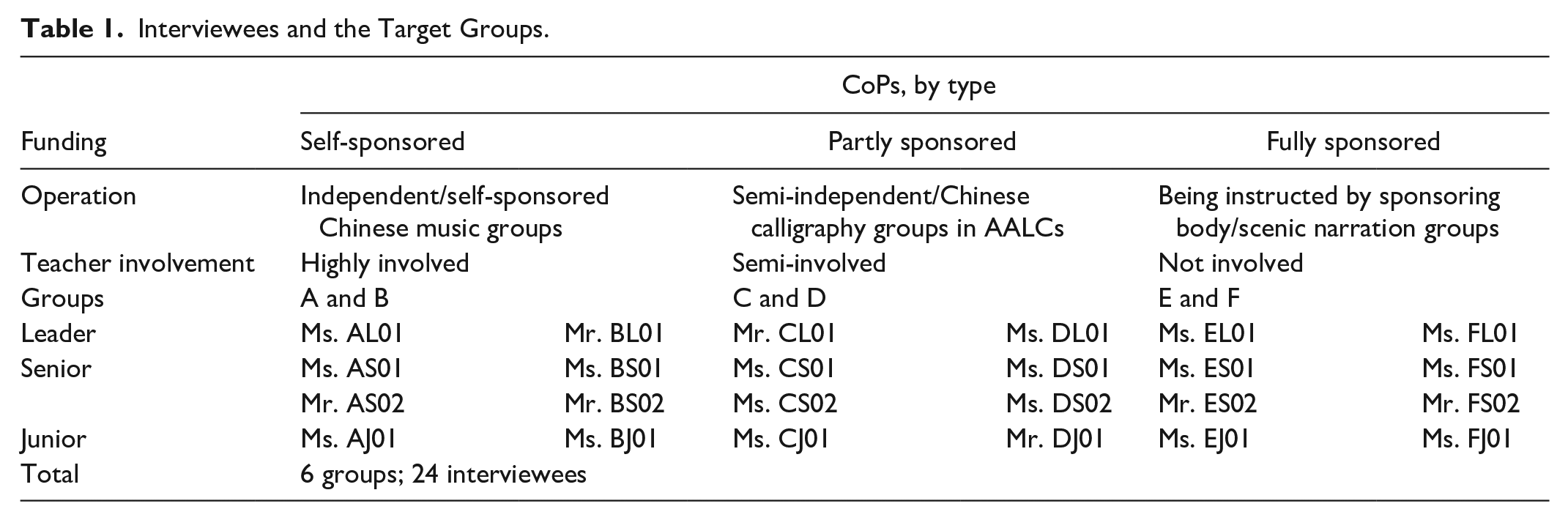
To ensure that the present study’s findings reflected the interactions that took place in a range of different types of Taiwanese senior citizens’ CoPs, the research team conducted semi-structured interviews with members of two self-sponsored groups; two interest-based groups that were partly sponsored by Active Ageing Learning Centers (AALCs); and two volunteer groups that were fully sponsored by specific organizations. The leaders of all six CoPs interviewed were known by the researcher from the researcher’s previous studies. To fully understand the quality of learning interaction in the CoP, the researcher asked the leaders to recommend their senior and junior members who had the best performance in the organization. The increase or decrease of interviewees was determined by data saturation.
In total, 24 interviewees—all aged 65 or over—were recruited from across the six CoPs. Table 1 presents additional details of the target groups and interviewees. The fieldwork was conducted by the research team which includes the researcher and two research assistants. The researcher has done qualitative research referring to senior citizens’ CoPs for years and has published many related papers. Both research assistants had worked as interns at AALCs and so are familiar with the operation of CoPs. They also have completed methodology courses in universities. Interviews, data analysis, and writing up were mainly carried out by the researcher, while interview recording, and data processing (coding) were done together by the research team.
Interviewees and the Target Groups.
All the interviewees signed consent forms regarding their participation in this research, which was approved by the researchers’ university following an ethics review process. The research performed in this study gained Institutional Review Board (IRB) approval at National Chung Cheng University. The IRB Protocol Number is CCUREC105051204. The interview guide of this research emerged through multi-level adjustments and was derived from the researcher’s previous research—a study on the internal and external marketing of the senior citizens’ CoPs. The researcher discovered the topic during the discussions with the interviewees and so planned this research and asked three interviewees (3 AALC members, including a leader, a senior member, and a junior member) to pre-test the interview guide. In other words, the interview questions in the interview guide were associated with the research question and pre-tested by key practitioners.
The research team interviewed six CoPs and conducted face-to-face interviews at the location of the CoP. The interviewees were required to be interviewed one-on-one, but if the interviewee wished to be interviewed with other members, that was also acceptable. In order to explore the learning environment suitable for the elderly to carry out social practice, the researcher used the semi-structured interview method to interact with the interviewees. All the questions in the interview guides revolved around the construction of a learning environment. In an unstructured interview, the researchers always maintained an interactive atmosphere centered on research questions to avoid being overwhelmed by unstructured observations or information.
To explore the factors forming the learning environment of CoPs for senior citizens in Taiwan, the researcher allowed the participants to describe, reflect on, and explain the learning environment they sensed through empirical discussions, so that the essence of the cases can be revealed to enable the research team to approach the world presented at the level of consciousness (Zahavi, 2015). According to Høffding and Martiny (2016), through continuous questioning, reflection, focusing, and explanation, researchers can gradually obtain abstract ideas from concrete descriptions and visualize the essence in phenomena. In other words, the interviews always focused on the “problems” and experiences the interviewees faced. Through the process of discussing the problem together, participants had the opportunity to reflect on some of the preconceptions inevitably brought into the interactions, and thus merged different perspectives (Witzel & Reiter, 2012). During the interview, the researcher made field notes, and the research assistants assisted in the observation and recording. After the interview, the researcher discussed details with his assistants to clarify key findings and supplement the field notes.
Each interview was tape-recorded and lasted between 1 and 2 hours. After the tapes were transcribed, the verbatim transcripts were returned to the participants for comment and correction to get authorization to use. The verbatim transcripts were then discussed, classified, and labeled by the research team according to their interpretation about the interviewees’ insights.
During the process of data analysis, the research team collected and summarized relevant sentences or paragraphs and labeled them manually as reflecting similar meanings. There were eventually about 28 categories embracing 132 labels associated with the theme of this study. Table 2 presents an example of the labeling process.
Samples of the Labeling Process.

A total of 12 themes related to constructing a learning environment were selected, including the culture of respect, shared interests, communicate through the shared knowledge, participation motivation, practice-oriented interactions, shaping shared feelings, mutual understanding, individual learning, organizational learning, daily sense-making activities, regular interactions and meetings, and continuous interactions. About 5 major themes shaping the key argument of this research were then summarized from the 12 sub-themes above: embracing shaping a community, domain of knowledge, collaborative practice, making comparisons, and daily routines. Figure 1 shows the formation of the key themes and the sub-themes. Sub-themes are followed by some related labels, while some of the labels are associated with each other, with specific themes, or with particular labels, as shown by the dotted line. The description and explanation of the themes and the dotted lines are mainly presented in the section of discussion and implication.

Forming of the key themes and the sub-themes.
In order to form the argument, the researcher discussed the findings with both assistants and continued reviewing the literature related to CoPs, older adults’ learning, and related topics to ensure the labels were appropriately organized. The research findings were in part derived from the frequencies of each of the final labels.
The three targeted types of CoP represented three distinct types of learning environment. Groups A and B, both of which were dedicated to Chinese music, regularly invited professional teachers to give courses aimed at improving the members’ instrument-playing skills. The role of these teachers was to deliver professional knowledge which was highly influential on the CoP. Groups C and D focused on Chinese calligraphy. In Group C, teachers gave regular classes, but were not closely involved in the CoP’s development. Group D was a supplementary learning group to a formal calligraphy class in AALCs; the group occasionally invited that class’s teacher to give a lecture, but again, there was little teacher influence on the group’s development. Lastly, Groups E and F were volunteer groups, neither of which was focused on the learning of new skills, apart from what was required to fulfil their core function of providing tour-guiding services to the public. Thus, again, the lecturers these groups occasionally invited had little influence on their development as CoPs.
Results
The Domain of Knowledge
In most learning-oriented senior-citizen CoPs, including the present study’s Groups A, B, C, and D, the members come together to learn specific knowledge, the improvement of which becomes a common purpose and motivation. In Groups E and F, on the other hand, the main aim of the members’ participation is not in pursuit of certain knowledge, but the provision of services to the public. Methods of improving the group members’ service skills become a shared knowledge domain that directs their learning and related efforts.
Although senior citizens’ CoPs tend not to exercise power over their members intentionally, they nevertheless do so, insofar as some power derives from various knowledge domains. For instance, in Group C, although Ms. CJ01 was a junior member, her ideas were highly respected and usually adopted due to her prior experience of organizing calligraphy exhibitions. In Group F, a similar dynamic arose around the ideas proposed by Ms. FJ01—for instance, about how to train members in telling stories—because she was a geography teacher and a good storyteller herself.
[Ms. FJ01] was a geography teacher in a secondary school, so she knew how to guide her groups by telling them some geography stories. . .. It was very good to have colleagues like her to provide us with wonderful information to make us learn together. (Ms. FS01)
As these examples indicate, knowledgeable members of a CoP can usually win their fellow members’ respect, thus strengthening personal connections and placing them closer to the core of the group. However, most interviewees in this study did not use their power to dominate others, but to help those who knew less to complete the shared tasks.
A Culture of Respect
In some of the senior-citizen CoPs sampled in the present study, the leaders adopted an attitude of respect for the other members, who in turn exhibited a respectful attitude toward the leaders and toward one another (Mr. CL01), thus allowing the creation of an open communicative environment. Rather than using a “top-down” method to rule the members, the leaders negotiated with them in a spirit of respect: The secret to leading them is respect. I respect you, and you will respect me in return. Our members are generally okay. . .Everyone has a temper, but if everyone can respect each other, it’s easier to get things done. (Mr. CL01) They can decide freely to be in or out. Normally they will join us because we have worked together for a long time. . .. (Mr. BL01)
Ms. EL01 suggested that her group’s members were well-educated people with rich social experiences, and thus deserved to be treated respectfully. Each member in group A, meanwhile, had a personal vision for his/her participation in the community that had to be respected (Ms. AL01).
Collaborative Practices
Mutual engagement triggered varied opportunities for learning. Firstly, the unspoken understanding derived, and sense of trust described by Mr. BS02 was a by-product of the process of completing his group’s collaborative tasks.
We learn and work together over time, so know each other very well. . .. Because I know you and you know me, we have an unspoken understanding with each other. (Mr. BS02)
Secondly, because the process of collaboration enabled the participants to re-examine their own performance and that of their partners which made them reflect on their performance and current situation.
Because you need to work with your classmates, you cannot fall behind, and this will discipline you to make you think why you cannot perform as well as others. (Ms. AJ01)
Ms. FL01 suggested that her group’s collaborative tasks enabled each individual member to put him- or herself in others’ positions, and to reflect on his/her own value from these fresh perspectives. And thirdly, the making of such comparisons within an atmosphere of collaboration helped the participants feel free to overcome their shortcomings and to strive for excellence by learning from others’ strengths.
In Group A, for example, because the older adults who were good at playing instruments understood that a good performance depended on teamwork rather than on the efforts of just one or two distinguished individuals (Ms. AL01), they were pleased to help those who were less proficient since doing so enhanced the group’s performance (Ms. AS01 and Mr. AS02). Members of Group B reported similar collaborative practices: We have a training team that is organised by senior members. When we find that some have difficulties in playing their instruments, we go to their homes to give them special training. (Ms. BL01)
In sum, the data collected as part of the present study confirms the ideas that collaborative tasks drive CoP members’ sense of responsibility for managing their learning; provide them with opportunities to know more about each other; and connect them with varied learning resources.
Practice-Oriented Interactions
In contrast to collaborative tasks, conceived of as opportunities for the pooling of resources, practice-oriented interaction can be seen as a mechanism to digest one’s learning/understanding by putting it to use. In the present study’s four learning-oriented CoPs (Groups A, B, C, and D), the members learned skills from classes and practiced what they had learnt in weekly meetings aimed at mastering those skills. In the service-oriented CoPs, Groups E and F, senior citizens gained professional knowledge through learning by doing. In other words, both learning-oriented and service-oriented CoPs had developed practice-oriented interactions as a means of helping individual members thoroughly understand and manage their focal bodies of knowledge.
In the learning-oriented CoPs, interviewees including Ms. AS01, Mr. AS02, Mr. BS02, Mr. CL01, Ms. DS01, and Mr. DJ01 agreed that practice was the key to enabling the individual to master their desired skills.
You can learn a lot through formal instruction, especially when the teacher is correcting your mistakes and pointing out other classmates’ mistakes. However, the true progress depends on your putting your understanding into practice. (Ms. DS01) Sometimes you may not be able to understand the teacher’s advice, because you did not practice enough. For learning Chinese calligraphy, it is not easy to grasp the essential tips, because not everyone has the ‘sense’ of calligraphy. And this sense comes from ongoing practice. (Mr. CL01)
As the above examples imply, the key to mastering the domains of knowledge in the sampled learning-oriented CoPs was widely seen to be practicing what had been learnt. Indeed, most of the participants stated that they paid attention to the processes as well as the outcomes of their learning.
Though learning was not designated as their main task, the participants in the two service-oriented CoPs nevertheless sharpened their skills through formal and informal learning activities. Some, including Ms. FS01 and Ms. EJ01, felt that the content they were learning became clearer when reinforced via practical scenic-narration and tour-guiding tasks.
Making Comparisons
Although practice-oriented interactions provided the present study’s participants with practical experiences that reinforced and enriched their theoretical knowledge, such interactions were not inherently capable of initiating processes of self-reflection. Rather, such processes must be triggered by the making of comparisons: in this case, the senior citizens’ identification and juxtaposition of differences between their own performances and those of others (Mr. CL01) as well as differing ideas, experiences, visions, and performances.
Individual learning can be stimulated by group dynamics. Ms. AJ01, for instance, disciplined herself to sharpen her music skills so as not to fall behind. Because she made comparisons between herself and other team members, she could then identify gaps in her skills that served as starting points for her learning journey. Likewise, an organization can learn via making comparisons with other organizations, as Ms. AS01’s team members reflected based on their own performances relative to those of other teams: When we see them work so hard and collaborate so well, we will wonder if our team is also good enough. . . This is a kind of benchmarking effect. (Ms. AS01)
Daily Routines
Creating an appropriate environment for learning is not a one-off job. It requires daily routines to embed positive interactions into an organized system. In the studied senior-citizen CoPs, the regular meeting—implying repetition—was an important mechanism for shaping the group members’ daily routines. Ms. FL01 argued that, even if the members of her CoP had nothing to discuss, they should still meet: You have to meet them regularly, even if you have nothing to discuss with them. . .. You can give some lectures, organise training programmes, or talk to them about visions or the future. . . to make them always keep the group’s affairs in mind. (Ms. EL01)
Likewise, according to Mr. BL01, the members’ ability to play their instruments was improved if they met to practice regularly—and even if they did nothing but chat with each other, their interpersonal networks were also enhanced.
In terms of communication, Ms. FL01 reported that regular meetings allowed her CoP members to keep abreast of what other members, and the group, were doing or planning to do. Other participants stated that such meetings allowed members to quickly grasp their group’s vision (Ms. EL01), organizational culture (Mr. ES02), and current situation (Ms. AL01, Ms. DL01, and Ms. FL01).
There are some unspoken rules that discipline us. When I was a newcomer, I tried to explore the rules. Because you meet your teammates regularly, you can gradually feel the atmosphere and know where the resources are, as long as you are willing to devote yourself. (Mr. ES02)
Group-level routines served the same functions discussed above but may also link lonely older people together in networks of interdependent caring. Thus, if a group member was absent, the others tended to check-up on them.
We come here every week, and we get used to it. If one day you don’t come, you will feel strange and uncomfortable. (Ms. DS02) She did not come over that morning. They then asked what happened to her and were a little worried about her, because we are now old people. . .. They tried to telephone her to see if something was wrong. (Ms. DL01)
Discussion
As can be seen from the cases of group A, B, C, and E, learning seems to be closely related to how the older adults feel in the process of interaction. In other words, the older adults are particularly concerned about whether they are respected in the community or during the learning process. In view of this, a facilitation-based method of building up senior-citizen learning environments is recommended. Because the senior-citizen CoPs studied in this qualitative research respected both the domain of knowledge and individuals’ value, their members felt free to express their ideas, attitudes, and personal goals to enable an autonomous and self-organized CoP to be formed. Such a culture with respect has many effects on learning as follows.
Bottom-Up Leadership Approaches Help Support the Development of Multiple Perspectives
The leadership in these circumstances seems to echo Spillane’s (2006, pp. 143–145) concept of “distributed leadership,” which takes account of the interactions between the leader, his/her followers, and the situation. Similarly, Lester and Kezar (2017) suggested that in a CoP, leadership does not describe a set of individual behaviors, but a range of interactions between and among the group’s members, its tasks, and its environment. Therefore, CoPs of this type merge their members’ personal visions through valuing diversity. Such groups can be viewed as having a bottom-up design, through which the individual members also achieve self-consciousness. According to Shaheen et al. (2021), the leader or organizer needs to focus on providing resources and support, rather than give orders or force the CoP to perform specific tasks. Being older adults themselves, the leaders of such groups—rather than enacting top-down strategies of domination—tend to treat the other members with care; to seek to understand and respect their individual goals and values; and to collaboratively help them broaden their horizons.
The Cooperation Among Members Triggers Individuals’ Learning Responsibilities
To advance the common interest or expertise, CoP members with different backgrounds innovate through collaboration (Lu et al., 2011). Because collaborative tasks require the participants to share responsibility for completing them (Herbers et al., 2011), they must work together to cope with difficulties and to establish interpersonal relationships and unspoken understandings. The above-noted dynamics exemplify what Wenger (1998, pp. 219, 220) referred to as “learning responsibility”: that is, that when it comes to learning in these circumstances, knowledge is constructed by the CoP participants’ mutual responsibility for completing the task, thus, they discipline themselves to learn what they need to know in pursuit of that goal. Moreover, this sense of responsibility encourages those who know less to learn actively from those who know more, while at the same time rendering the latter is willing to provide help to those who need it. Such interactions, in turn, enable the individual to reflect on his/her established knowledge by making comparisons between theory and practice. This echoes Wenger’s (2015) description of learning and practice, bringing each other about. However, in the absence of respect for the individual, practice-oriented interactions may fail to build group members’ knowledge.
A Free-Yet-Practical Environment for Communication Fosters Collaborative Learning and Knowledge Sharing
The culture of respect for the individual enables group members to appreciate members from different backgrounds, further enhancing opportunities for communication and cooperation. This facilitates the emergence of a communicative environment that is free-flowing yet practical, in which mutual engagement and social learning may also occur, as suggested by Wenger (1998). However, a free-yet-practical environment for communication cannot, by itself, guarantee that the members of a senior-citizen CoP will engage in shared practices. Rather, this requires collaborative practices that discipline them to work together and develop unspoken understandings. The process enables members to understand how to apply each other’s resources to sort out problems, create knowledge and learn together, which echoes what Pyrko et al. (2017) referred to as “thinking together.” In other words, a culture of respecting the individual imbues the communicative environment with diverse values, while collaborative practices enable older adults to take advantage of that environment by engaging in mutual knowledge exchange.
Practice-Oriented Interactions Enable Members to Construct New Knowledge
Learning by members of the service-oriented CoPs also strongly relied on their formal and informal interactions with particular knowledge resources. They seemed to care much less about what they had learnt than about whether or not their tasks had been completed smoothly. While such a stance might be seen as de-valuing learning, dealing with real problems nevertheless allowed the members of these two groups to integrate their various learning results and to connect with different learning resources (Mr. FS02). This in turn provided opportunities for them to reflect on their established knowledge, and triggered continuous learning, in keeping with Wenger’s (1998) theory—though Wenger did not focus on how to design learning programs within such contexts. According to Ms. ES02, the best way to plan a practice-oriented learning program for senior citizens is not to design for the older adults, but with them. Ideally, knowledge is not delivered by classroom-based courses but constructed through a process of coping with the difficulties arising from variation in knowledge resources.
Making Comparisons Result in Individual and Organizational Learning
However, the above practices cannot result in deep learning in the absence of self-reflection. Deep learning in this context results from group members making comparisons between and reflecting upon the differences between his/her established knowledge and resources and those of others. Senior-citizen CoPs provide their members with opportunities to compare different attitudes to life, to reflect on their own value systems, and to discipline themselves to avoid falling behind. An observed difference that emerges as important may become the focus of individual efforts to close the gap, thus triggering a learning process. The above finding echoes some scholars’ arguments, such as Pyrko et al. (2017), Herber et al. (2011), and Long (2017). On the one hand, self-reflection can enable group members to form a common vision that directs their individual efforts, despite differences in their personal goals; and, on the other hand, it can discipline individuals to avoid falling behind, thus prompting them to persevere in their individual learning efforts. Wenger (1998) also identified social learning as one of the learning theories applied to CoPs but did not deal with questions of how to trigger or develop social-learning processes. The results of the current study suggest that making comparisons is crucial to shaping a social-learning process that will stimulate individual CoP members to strive for excellence. Moreover, as cycles of comparison and reflection continue, other group members may also be touched by this positive behavior, to the point that individual learning can positively influence the group to trigger organizational learning.
In short, building a culture of respect for individuals’ value can be seen as key to running a senior-citizen CoP effectively, since such a culture is foundational to the three key influences (i.e., practice-oriented interactions, collaborative tasks, and making comparisons) on both individual and organizational learning. This finding seems to echo what Wenger (1998) referred to as the six basic elements of CoPs: the domain of knowledge, community, practice, mutual engagement, joint enterprise, and shared repertoire. It is hoped that, by integrating those elements into a continuous development process, CoP’s target domain of knowledge can be enhanced, its interpersonal networks improved, and its reflections on the relationship between human beings and particular knowledge domains invigorated. However, the weak link in such a process could be the concept of shared repertoire, which implies repetition and consequently can take a considerable amount of time to emerge. The authors of the present study therefore propose that organizational routines should be used to shape and strengthen CoPs’ shared repertoire. Neither individual learning nor organizational learning should be seen as a one-off event. If a group wants to foster an accountable system of ongoing learning, it must continuously facilitate collaborative-learning and self-reflection activities. Through these regular meaningful interactions, learning can be embedded into daily practices, so that sense-making activities become a part of its culture.
Conclusion
Members in senior-citizen CoPs are treated with a respectful attitude. The environment values members’ ideas, voice, and practical experience, and allows them to be freely expressed. This free-yet-practical communicative environment ensures that the members’ different voices are heard and respected, which in turn fosters practice-oriented mutual engagement and joint enterprise.
Collaborative tasks, meanwhile, enable the varied insights revealed by this communicative environment to be juxtaposed in ways that trigger comparisons and self-reflection. Such task serves as a catalyst for mutual engagement, insofar as it cannot be completed without other people’s help. To add, dedication to the task on the part of one person is generally responded to positively, that is, with the dedication of others. This collaborative atmosphere prompts CoP members to make comparisons between themselves and their colleagues that trigger self-reflection. When sense-making activities work well, however, ample time will be needed to cement these activities into routines and embed them systematically into group members’ daily lives, in a manner that forms shared repertoires of tacit and explicit group knowledge.
Because a study with N of 24 is difficult to generalize from, some suggestions for further studies include: (1) Doing cross-culture studies to identify particular keys to culture issues. (2) A comparative study of diverse types of senior citizen CoPs may help clarify the keys to building learning culture in other CoPs. (3) An open-ended survey for the older adults who do not belong to any CoPs may yield interesting cross-sectional data. (4) Doing random sampling from a larger population to enhance the generalizability. In addition, if some studies referring to virtual CoPs are conducted, some variation of virtual CoPs can be identified. It would be interesting to survey/interview other stakeholders (e.g., family members, caregivers, geriatric specialists, etc.) to see how their views differ from the findings of this study.
Footnotes
Declaration of Conflicting Interests
The author declared the following potential conflicts of interest with respect to the research, authorship, and/or publication of this article: I declare that I have no financial and personal relationships with other people or organizations that can inappropriately influence my work, there is no professional or other personal interest of any nature or kind in any product, service and/or company that could be construed as influencing the position presented in, or the review of, the manuscript entitled. Informed consent has been obtained from all interviewees included in this study
Funding
The author(s) disclosed receipt of the following financial support for the research, authorship, and/or publication of this article: This study was funded by Ministry of Science and Technology in Taiwan (grant number: MOST 105-2410-H-194-069-MY2).
