




Abstract
Older individuals often rely on informal methods, predominantly familial assistance, to acquire digital technology skills. However, as the number of universities for older adults in China has increased, there has been a notable shift toward formal digital education. This study examines participants in smartphone training courses at Shanghai University for Older Adults to uncover their learning approaches within formal settings. Using qualitative methods, we identify a phenomenon termed “collaborative domestication” among older learners. Collaborative domestication shifts the perspective of promoting digital inclusion toward a public-oriented approach, showing a mechanism driven from the top down, where multiple actors—individuals, society, and the state—collaborate to help older adults domesticate digital technology and thereby achieve digital inclusion. Following intensive collaborative domestication, most older adults achieve independent digital mastery. In introducing the concept of collaborative domestication, this article outlines the process and impact of this concept, offering insights to enhance digital literacy among older adults. We recommend mobilizing the enthusiasm of various actors, including the state, society, and technical experts, from a public perspective, to promote digital inclusion among older adults.
Plain language summary
This study examines participants in smartphone training courses at University for The Senior to uncover their learning approaches within formal settings. Using qualitative methods, we introduce the concept of collaborative domestication and illustrate its process, which includes the following key components:1 Government is the driver of collaborative domestication. The government plays a pivotal role in initiating collaborative domestication by encouraging or enacting policies that prompt institutions to provide formal platforms for the elderly to learn smartphone technology 2 University for the Senior is the platform establisher. The University for the Senior, as an educational institution, constructs the platform for collaborative domestication. It offers structured courses and support systems that facilitate the elderlys engagement with smartphones; 3 The technical expert is the teacher in collaborative domestication. Participants learn through direct guidance from the technical expert who provides systematic instruction and practical demonstrations, ensuring that the elderly can effectively acquire and apply smartphone skills 4 Peers are mutual supporters in collaborative domestication. Peers studying together at the University for the Elderly actively collaborate and support each other, facilitating flexible and reciprocal knowledge exchange. This embodies the proactive involvement of older adults in digital learning. Collaborative domestication promotes digital inclusion among the elderly by establishing a facilitative mechanism that generally enables them to domesticate digital technology. However, some elderly individuals may fall into the trap of over-reliance on collaboration during the process, thereby failing to achieve digital inclusion.
Introduction
In recent years, China has undergone rapid and expansive development in its information infrastructure driven by technologies such as the Internet, big data, cloud computing, artificial intelligence, blockchain, and 5G, significantly contributing to the nation’s economic growth. Mobile payments, primarily reliant on QR codes, have nearly supplanted physical currency, enabling individuals to venture out without the need for wallets. Access to daily necessities and routine activities is increasingly facilitated by mobile applications such as Taobao Mall, Baidu Maps, WeChat, and Didi Taxi, which are accessed through smartphones.
However, this swift advancement in digital technology poses significant challenges, particularly for older adults in China. According to data from the National Health Commission, the population of individuals aged 65 and older reached 200 million in 2021, accounting for 14.2% of the total population (Guangming Daily, 2022). Today’s older adults in China have witnessed a rapid technological evolution from traditional media to the Internet and, more recently, to the mobile internet era. Different from the younger people born in the Internet era, older adults often confront a heightened array of challenges when engaging with the Internet and utilizing smartphones. During the COVID-19 pandemic, the ubiquitous use of health codes and the increasing reliance on online shopping highlighted to older adults the necessity of mastering smartphone use to cope with the digital demands of daily life. To keep pace with digital development and ensure their basic survival, an increasing number of older adults are learning smartphone skills, leading to the emergence of a distinctive phenomenon in contemporary China.
Older adults engage in smartphone learning through both formal and informal methods. Formal learning takes place in universities for older adults and community-based training programs (Manheimer & Moskow-McKenzie, 1995), while informal learning primarily stems from digital support within families. Existing research has predominantly emphasized informal learning, highlighting the positive impact of intergenerational digital support from children on older adults’ smartphone acquisitions (Bailey & Ngwenyama, 2010; Tsai et al., 2015; Wang et al., 2011). These studies often depict older adults as facing systemic barriers, passively receiving assistance from younger generations, who are seen as tech-savvy benefactors. However, they overlook the potential learning agency of older adults and the mutual support that can occur among peers.
Formal learning environments, especially universities for older adults, provide opportunities and spaces for older adults to learn collectively, thereby creating entirely different learning contexts and experiences. In a survey of 189 members of a Learning in Retirement institute, cognitive interest and social contact were identified as the primary motivators for learning (Kim & Merriam, 2004). Eaton and Salari (2005) noted that restrictive classroom environments can frustrate older adults by limiting their ability to talk or move. Xie’s (2011) experimental study with 172 older Chinese participants revealed significant gains in general computer and web knowledge from pre- to post-intervention. While researchers who have studied formal environments tend to explore older adults’ learning motivations, difficulties, and effects, they often overlook the distinctive learning approaches in universities for older adults compared to everyday life settings.
In this study, we draw on domestication from communication studies (Silverstone et al., 1992; Silverstone & Haddon, 1996). Originally, domestication referred to the process of taming wild animals to become house-trained pets. As a metaphor, it has been widely applied by communication scholars to describe how individuals adopt new technologies (Berker et al., 2005; de Reuver et al., 2016; Haddon, 2005). We conceptualize domestication as a technology learning process where learners transition from complete unfamiliarity to proficiency, similar to taming wild animals. However, while this concept emphasizes individual adaptation to technology, it overlooks the impact of social interaction on individual technology adoption. By observing Shanghai University for Older Adults, we introduce the concept of “collaborative domestication” to describe a top-down, public digital practice involving multiple actors during the process of learning to use smartphones. This mode of digital practice facilitates the digital integration of older adults by providing an enabling mechanism.
Literature Review
University for Older Adults: A New Setting for Digital Learning Among Older Adults
The traditional “household” has long been regarded as the primary domain for older adults to acquire digital technology. Younger family members, especially children and grandchildren, play a crucial role in encouraging and explaining the use of information and communication technologies (ICTs) to their older counterparts at home (Eynon & Helsper, 2015; Hong & Li, 2019; Neves & Amaro, 2012). Close family bonds and the convenience of obtaining assistance anytime and anywhere make it an appealing choice for many older individuals seeking technical support. However, conflicting views exist. Some studies suggest that the presence of younger family members may impede the learning process and strain the relationship between older individuals and technology. Impatience from younger members and self-blame from older adults for needing help can hinder effective learning (Hong & Li, 2019).
Beyond familial ties, older adults also seek assistance from various sources, including peers, friends, colleagues, and neighbors, to form alliances to address technical challenges (Gatto & Tak, 2008; Hunsaker et al., 2019, 2020; Marler & Hargittai, 2024; Tyler et al., 2018). Since these mutual support relationships typically occur in informal settings (e.g., homes, parks, markets, and restaurants), and the helpers are grassroots individuals rather than authoritative experts (Hänninen et al., 2021; Hunsaker et al., 2019; Quan-Haase et al., 2018), we categorize intergenerational learning, peer learning, neighborly assistance, spousal support, and other relational dynamics as informal means of digital learning for older adults. Informal learning falls short in terms of the stability of supportive relationships, the comprehensiveness of learning content, and the cultivation of independent usage capabilities.
Compared to the extensive research surrounding informal learning, studies on formal learning are characterized by a paucity in quantity and a relative uniformity in perspectives. Researchers often assume that retirees receive less institutional support than those in the workforce or traditional schools (Selwyn, 2003). However, as aging becomes a global issue, countries worldwide are accelerating the development of educational and training institutions for older adults. In China, the “14th Five-Year Plan for the Development of the National Aging Career and the Construction of the Pension System” mandates that by 2025, every county will establish at least one university for older adults (State Council of China, 2022). These institutions have all offered digital technology training courses for older adults. This method of learning digital technology through formal channels may become another representative approach to digital learning for older adults, distinct from intergenerational feedback. Researchers should focus on the growing prevalence of formal education and the distinctive learning approaches to smartphones among older adults in this setting.
Building upon the preceding discussions, this study’s research questions are refined into three specific inquiries:
What learning approach do older adults adopt in universities for older adults, and what are the characteristics of this learning approach?
How does this learning approach work?
How does this learning approach impact the future digital learning trajectory of older adults?
Domestication: A Controversial Theory for Analyzing Digital Learning Among Older Adults
The theory of media domestication began in the 1990s with British television studies (Haddon, 2005). Influenced by the sociological life-course perspective, it gradually expanded to examine the adoption and use of various media technologies within micro-social contexts (Bakardjieva, 2011; Berker et al., 2005; de Reuver et al., 2016; Watulak & Whitfield, 2016). Domestication emphasizes how individuals transition from complete unfamiliarity with a technology to becoming familiar with it, mastering it, and integrating it into their daily lives. Similarly, learning a technology involves users progressing from ignorance to skill mastery. Therefore, the process of learning or acquiring a skill can be considered a form of technology domestication. However, domestication is generally seen as an extension and deepening of learning. While learning provides the foundation, domestication involves further internalizing and applying the technology, often incorporating the individual’s social and cultural background to integrate it into daily life. In this study, we use the term domestication specifically to refer to the process of learning to use technology, without addressing its broader socio-cultural implications.
In the framework of domestication, media technologies, much like pets and potted plants, transition from being “wild” to “house-trained” to integrate into the routines of individual and family life. This domestication process involves individuals exercising control over media and adapting it to suit their needs, emphasizing the role of personal agency in owning, controlling, and modifying media. However, as older adults experience a decline in physical abilities, their capacity to manage media diminishes. They often miss opportunities to engage with new media or forget how to use it after initial learning. This indicates that the domestication process for older adults is beset with difficulties and heavily dependent on external support. Thus, using the term domestication to describe how older adults master media technologies tend to overstate their agency and fail to accurately capture the realities of their technological learning experiences.
Furthermore, domestication theory often frames technology adoption as involving individuals or homogenized collectives, such as households, interacting with a single technology in isolation. This one-to-one approach is evident in studies by Silverstone (1994) and Haddon (2005), which focus on individual technology consumers or households as the primary agents of domestication. Examples like “teenager,” “housewife,” “working-class family,” and “Brazilian family” are used to illustrate these relationships. However, this perspective tends to overlook the dynamic interactions between individuals within a household during technological adaptation. This oversight is particularly pronounced when considering older adults, who often depend on their social networks for assistance with new technologies. Their reliance on others makes it difficult for them to navigate technology independently. By concentrating solely on individual or household-level interactions, traditional domestication frameworks risk neglecting the critical role of collaborative relationships and support networks, essential for understanding older adults’ experiences with technology.
Given these considerations, this study argues that domestication does not fully capture the learning process of new technologies among older adults. Traditional notions of domestication place too much emphasis on individual agency, overlooking the critical role of social interactions in technological practices. Unlike Silverstone’s focus on the interaction between individuals and technology within the private sphere during domestication, our research has identified that some older adults choose to move beyond their domestic spaces and seek assistance within public domains to facilitate their integration with smartphones. In domesticating smartphones, they find it necessary to engage in a wider range of social interactions, rather than relying exclusively on individual effort. Thus, building upon domestication theory, this article explores the approach of older adults to smartphone learning and broadens the scope of this theory.
To more clearly position the concept of collaborative domestication in relation to existing frameworks, we provide a conceptual comparison in Table 1. This comparison highlights how our concept builds upon and diverges from prior models, including traditional domestication theory, intergenerational learning, and peer-based informal support. While existing literature has emphasized individual adaptation, familial support, or informal peer assistance, collaborative domestication refers to a structured and institutionally supported process in which older adults, instructors, and peers co-construct digital skills through sustained interaction in public learning environments such as universities for older adults.
Conceptual Comparison of Collaborative Domestication with Related Frameworks.

Data and Methods
Data Collection and Analysis
To investigate the specific process through which older adults acquire smartphone technology via formal learning, this study employs qualitative research methods. The study is based on the case of Shanghai University for Older Adults, and through the analysis of this case, it explores a new way to promote digital inclusion for older adults.
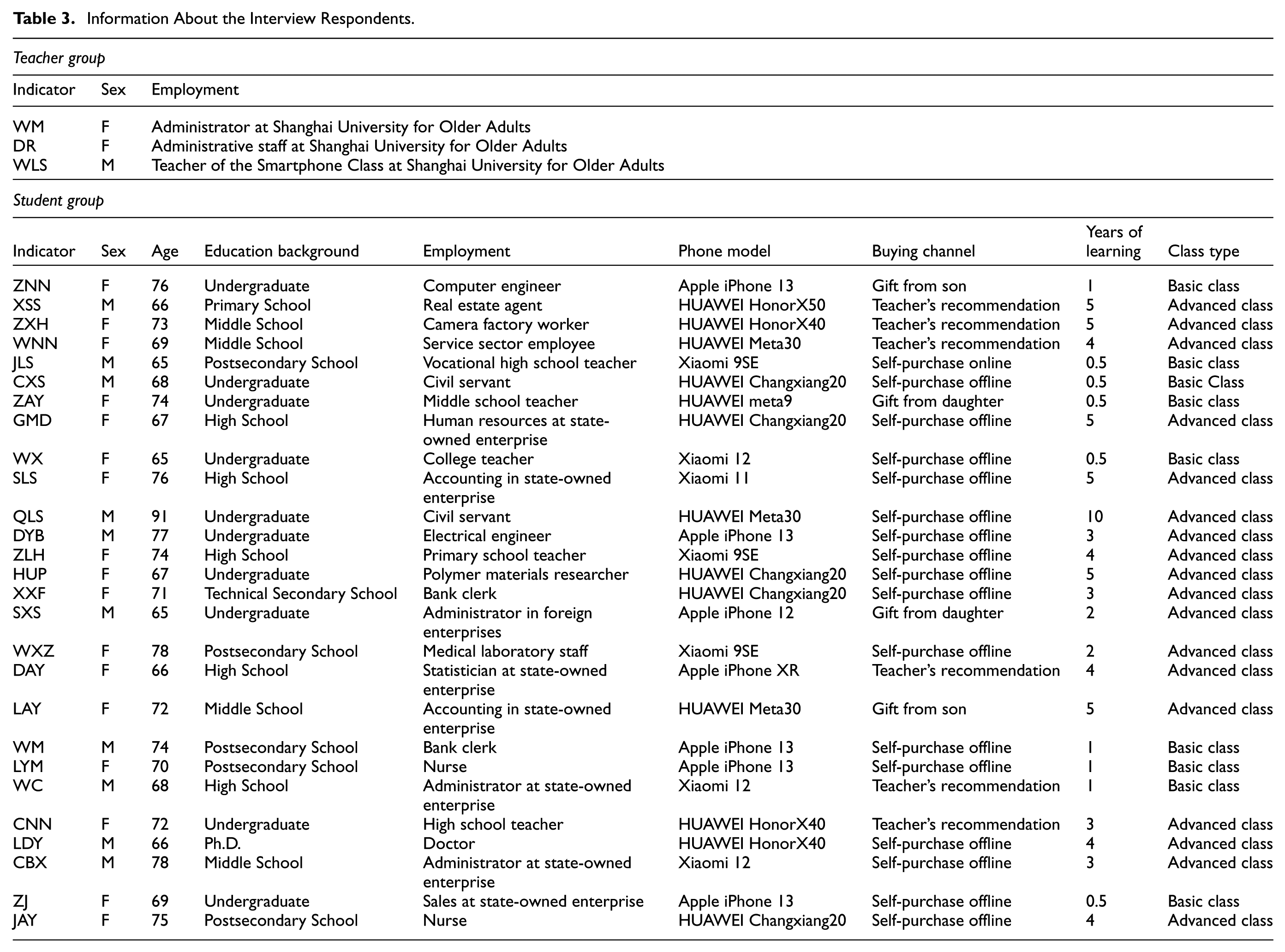
Two methods were used to collect data: participant observation and in-depth interviews. The study was conducted from March 2022 to January 2024 and participant observation was conducted online and offline. The subjects of observation included a Smartphone Basic Class and two Smartphone Advanced Classes at Shanghai University for Older Adults. During the study, a total of 30 lessons were observed. Each lesson lasted 2 hr. After each lesson, the researchers documented the key findings. In the online observation part, two researchers joined the WeChat Groups of three smartphone classes to observe discussions before, during, and after class. In-depth interviews were conducted with 27 participants aged 65 to 91 years, lasting between 30 and 150 min, to explore diverse experiences in smartphone learning. Additionally, three teachers from Shanghai University for Older Adults were interviewed to gain insights into their teaching experiences. The interviews were conducted in standard Mandarin.
The empirical materials obtained through the above research methods mainly include the following three aspects: (1) instructors’ perspectives on older adults’ smartphone learning and their conceptualizations for teaching content and forms; (2) students’ motivations for enrolling in smartphone courses at universities for older adults, their learning processes, methodologies, and views on smartphone use among older adults; (3) the interactions between instructors and students, and among students themselves, during smartphone learning sessions.
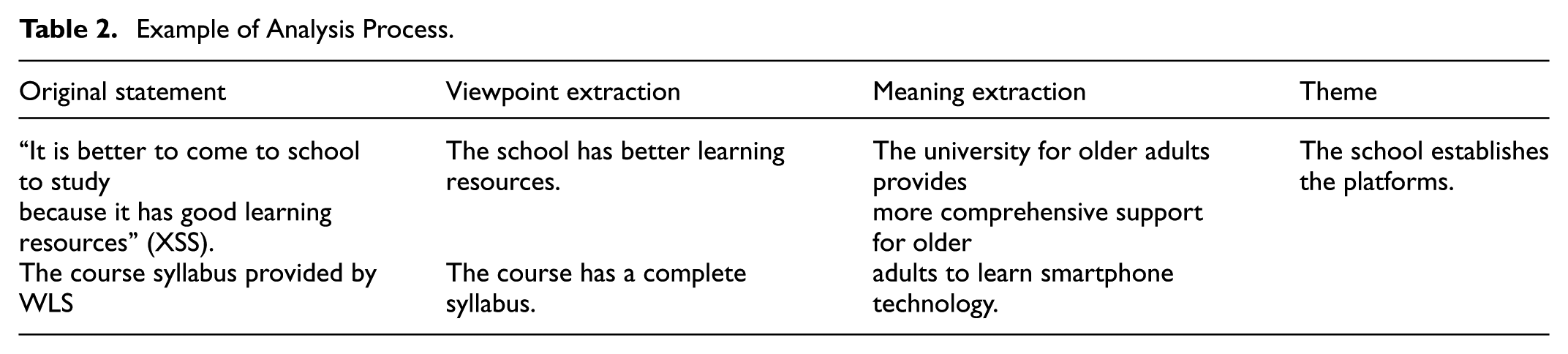
The researchers transcribed the experiential materials into textual information and analyzed the text from the perspective of domestication theory through a line-by-line reading approach. The researcher extracted recurring viewpoints, subsequently distilled the meanings behind these viewpoints, and after organizing and comparing these meanings, derived corresponding themes (see Table 2).
Example of Analysis Process.
To ensure research ethics, the researchers informed all participants of the study’s purpose, scope, and procedures prior to commencing participant observation and in-depth interviews. Upon entering the WeChat groups, the researcher introduced the research objectives and explained the voluntary nature of participation. Participants were assured that they could withdraw at any time without any negative consequences. The study design minimized risks by anonymizing personal information, blurring or removing identifiable features in images, and avoiding the collection of sensitive personal data. The potential benefits of the research, including contributing to digital inclusion and supporting older adults’ acquisition of smartphone skills, were considered to outweigh the minimal risks involved. Informed consent was obtained from all participants before data collection. The researchers ensured that participants’ privacy and confidentiality were protected throughout the study.
Description of Sample Characteristics
The participants in this study were predominantly residents of Shanghai, accounting for 96.3% of the sample, with only one participant from another province. In terms of education, the sample was distributed as follows: 5 individuals had a junior high school education or lower (18.5%), 6 had a high school or secondary education (22.2%), 15 had undergraduate or specialized education (55.6%), and 1 had a master’s degree or higher (3.7%). Before retirement, 85.2% of the participants were affiliated with party, government, or military organizations; scientific research institutions; or state-owned enterprises. Collectively, the 27 participants owned 45 properties, averaging 1.7 housing units per person.
Based on their education, occupation, and housing status, participants from Shanghai University for Older Adults can be classified as part of the urban middle class, which mainly consists of urban residents with moderate incomes. Many have benefited from China’s reform and opening-up policies, leveraging substantial careers and educational backgrounds to achieve economic stability and develop broad perspectives. Compared to their peers, they have higher expectations for their quality of life in post-retirement years, often aspiring to financial security, leisure, and personal fulfillment.
Traditional Chinese family values emphasize the joy of being surrounded by children and grandchildren (Gao et al., 2019). Consequently, it is common for older adults to live with their children after retirement. However, all interviewees in this study lived independently from their children, allowing them more time for learning without the responsibility of caring for grandchildren. In contrast to the prevalent cultural norm of “yielding” in Eastern families, where individuals prioritize their children’s needs over their own (Gao et al., 2019, p. 212), participants in universities for older adults are more focused on their personal needs, pursuit of knowledge, and social connections in their later years.
Regarding smartphone purchases, unlike many older adults who rely on smartphones provided or discarded by their children (Gatto & Tak, 2008), over 62% of the interviewees in this study chose to purchase their smartphones offline. They selected their devices after hands-on experience with various models, underscoring a strong emphasis on performance, suitability, and user experience with digital products. The detailed information about the respondents, including their smartphone models and purchase channels, is presented in Table 3.
Information About the Interview Respondents.
Process of Collaborative Domestication
Domestication theory primarily views human-technology interactions from an individualized perspective, which is more applicable to explaining digital inclusion among older adults through intergenerational support and peer assistance that relies on private relationships. However, digital inclusion for older adults is not merely an issue faced by individuals but also a universal challenge for society. Through case studies, researchers have identified a mechanism where individuals, society, and the state collaborate to help older adults domesticate digital technology and achieve digital inclusion. Specifically, the university for older adults, as a formal channel for learning smartphone technology, is essentially a collaborative domestication approach composed of multiple actors, including the government, the school, the technical expert, and peers, each with distinct roles. Based on this understanding, this study proposes the concept of collaborative domestication to explore the digital inclusion of older adults from a more public perspective. Collaborative domestication is divided into four components: a government-driven approach, the school establishing platforms, the teaching of a technical expert, and peer support (see Figure 1).

The process of collaborative domestication.
A Government-Driven Approach
The government’s role in driving digital inclusion for older adults is crucial in China. With the rapid development of population aging and the widespread use of smartphones, the Chinese government has increasingly recognized the importance of enabling older adults to master smartphone technology and has been exploring feasible solutions. For example, the establishment of smartphone training classes at Shanghai University for Older Adults was initiated by government impetus. Ms. WM, an administrator at Shanghai University for Older Adults, informed the researchers that the initial launch of the smartphone courses was mainly in response to the requirements of the local municipal education commission. The city where Shanghai University for Older Adults is located is at the forefront of information development nationwide. Therefore, around 2017, a strong demand for learning smart technology had already emerged among older adults in this city. “The leaders of the local education commission keenly perceived this and thus required us to open these classes.” Said the administrator.
The attempts of Shanghai University for Older Adults in smartphone technology training have played a pilot role in promoting smart technology education for older adults nationwide, thereby influencing government policymaking in return. “Our positioning is to be ahead of the curve. Shanghai University for Older Adults should also be at the forefront nationwide. We take the lead in trying out new approaches, and once we succeed, we provide a model for other regions across the country to learn from.” Said the administrator.
In November 2020, the General Office of the State Council officially released the “Implementation Plan for Effectively Solving the Difficulties of Older Adults in Using Smart Technologies.” The plan states that to address the difficulties that older adults face in using smart technologies in daily life, industry training institutions and experts should be organized to conduct specialized training to enhance older adults’ ability to operate intelligent applications. The university for older adults is specifically mentioned as an important institution for this type of training. The approach of conducting smart technology training through the university for older adults and community-based classes has begun to be promoted nationwide. By this time, 3 years had passed since Shanghai University for Older Adults launched its smartphone courses. One month before the release of this plan, Shanghai University for Older Adults organized a group of teachers to compile a report on their measures and experiences in smart technology training and submit it to the General Office of the State Council. “We later found that some of the expressions in the plan were very similar to the report we submitted,” said the administrator.
The case demonstrates the characteristics of the government as a driving force in the process of collaborative domestication. In this case, the establishment of the smartphone training classes at Shanghai University for Older Adults was driven by the local government, highlighting the key role of government in collaborative domestication. At the same time, the experiences gained by Shanghai University for Older Adults in practice have, in turn, influenced government policies, showing that pioneering institutions can have influence on the government policy in collaborative domestication.
The School’s Establishment of Platforms
In the process of collaborative domestication, Shanghai University for Older Adults, as the platform establisher, has transformed the learning of smartphone technology for older adults from informal, fragmented learning in daily life to systematic formal learning. This transformation is achieved by providing institutional guarantees, stable cooperative relationships, and comprehensive content support.
First, Shanghai University for Older Adults operates within highly organized and institutionalized structures. It enforces strict measures such as the semester system, attendance requirements, participation in Q&A sessions, and teaching evaluations. Such measures delineate clear responsibilities for teachers and regulate student behavior. This encourages the perpetuation of collaborative domestication.
Second, Shanghai University for Older Adults offers smartphone training courses in the form of classes, which provide stable and long-term relational support for the participants who join the class. In the past, learning how to use smartphones through intergenerational and peer assistance has often been characterized by its temporarily and loose. People typically come together temporary to address a specific issue, and once the problem is resolved, the “technological alliance” disbands. Shanghai University for Older Adults ensures continuity by assigning the same teacher to specific courses, whether basic or advanced, fostering lasting bonds between participants and the teacher. The smartphone class spans 1 year, with weekly 120-min sessions. Participants eagerly anticipate each class. Regular attendance nurtures a strong connection between learners and the technical expert, building trust and rapport over time. Older adults highly value ongoing technical support and actively cultivate these collaborative relationships. Many students enroll in the class repeatedly for continuous assistance. Participants not only maintain a stable collaborative relationship with teachers but also with each other. During the class, they cultivate deep mutual friendships, extending this connection through virtual communities. Throughout winter and summer vacations, participants maintain this synergy by posing questions or sharing useful smartphone tips on WeChat. WeChat groups, akin to Chayko’s (2008) notion of “portable communities,” connect individuals across different time zones, both inside and outside the classroom, forming a stable “classmate network” that reinforces bonds among participants and addresses the challenges of aiding at a physical distance.
Third, Shanghai University for Older Adults offers a comprehensive curriculum covering various aspects of smartphone use. WLS, the teacher of the smartphone technology training course at Shanghai University for Older Adults, provided the course syllabus to the researchers. The researchers found that the course content was highly comprehensive, encompassing both the foundational and advanced levels. Specifically, the foundational course included 32 distinct teaching themes, while the advanced course featured 33. These themes collectively addressed a wide range of daily life applications, including transportation, healthcare, photography, WeChat, online shopping, and more. One participant stated, “It is better to come to school to study because it has good learning resources” (XSS).
The Teaching of a Technical Expert
WLS, the teacher of the three smartphone training classes observed in this study, is over 70 years old. He is a technical expert. This is due to his profound interest in electronic devices and new technology. Currently, he devotes 2 hr daily to studying smartphone technology and acquiring cutting-edge information.
Within the classroom setting, WLS collaborated closely with participants in utilizing technology. Every step of their operations was intricately guided by the technical expert. The learning process unfolded in two stages: “learning by following,” where WLS dissected smartphone operation steps on both projection screen and participants’ computers (see Figure 2), and “one-on-one coaching,” wherein WLS provided personalized assistance to each participant in executing various smartphone functions (see Figure 3). Following the class, participants directly inquired to dedicated WeChat groups, and these were promptly addressed by WLS. In managing the hundreds of WeChat technology Q&A groups, WLS remains vigilant in responding to participants’ inquiries around the clock. Technical experts, exemplified by WLS, actively assist older adults with their smartphones, adopting a highly accessible approach through both in-person guidance and virtual support online.

Participants follow the teacher’s instructions step by step to navigate their smartphones.

WLS (the person on the far right) approaches participants at their seats, offering one-on-one guidance on smartphone usage.
The learning approach guided by technical experts significantly enhances the smartphone skills of older adults. In the case study, nearly all participants assert that WLS’s instruction has led to substantial advancements in their smartphone proficiency. Furthermore, they express a high level of trust in WLS. The researchers found that older adults willingly cede their agency, allowing technical experts to take the lead in knowledge dissemination. Each semester, WLS revised the syllabus, integrating cutting-edge smartphone applications to meet current demands. For instance, during the winter semester of 2022, WLS introduced applications such as “Sui Shen Ban Citizen Cloud” and “Community Group Buying” in response to the challenges posed by the COVID-19 pandemic. Drawing on subjective experience, WLS shapes the content and methodology of smartphone education for older adults, thereby defining the parameters of learning. Despite encountering content that may not fully cater to their needs, participants rarely share their perspectives. In the final class, WLS introduced ChatGPT, which, despite initial doubts about its practicality in older adults’ daily lives, was ultimately accepted by most participants. Older adults often attribute digital knowledge that seems inapplicable to lives to their limitations, such as having “a lack of broad vision” (ZJ) or “a slower pace in accepting new knowledge” (LYM), thereby legitimizing the authority of the teacher. Participants stated, for example, “As long as WLS’s answer is okay, I think it’s okay” (SLS) and “I agree with whatever WLS says. He’s right about everything” (DYB). Those Statements highlight a tendency to view technical experts as all-knowing, potentially hindering independent thought and perpetuating a knowledge transfer mode driven solely by technological expertise.
Peer Support
Students at the university for older adults bring a diverse array of preretirement work experiences, interests, and levels of proficiency in digital skills. The heterogeneous class structure enables effective knowledge exchange among both newcomers and seasoned learners, as well as between central and peripheral participants. These collaborative relationships foster the integration of individual knowledge, information, skills, and resources, resembling what Jenkins (2006) terms a voluntary and strategic “knowledge community.” Therefore, peer assistance is also an essential component in collaborative domestication.
Peer assistance is a common practice within the class, with individuals perceived as “authorities” or “superusers” generously supporting those with less experience (Tyler et al., 2018; see Figure 4). LDY, a 66-year-old who holds a PhD from Fudan University, is considered the class’s top student. Upon her arrival, fellow participants urged the researchers to interview her, stating, “Here is the learning expert; go and interview her. She is very adept at using smartphones. I often seek her guidance, and she understands everything” (CNN). In each session, LDY meticulously documented course content, using screenshots and text descriptions to compile detailed notes. Following her initiative, three participants with advanced skills joined the note-writing team, resulting in a comprehensive shared resource spanning over 200 pages of learning materials. Expressing gratitude for their work, one participant stated, “If I forget something, I just flip through it, and I’ll be able to operate my smartphone again. We must thank LDY for helping us” (WXZ). Participants share similar knowledge structures and discourse systems, enabling effective communication and translation of specialized knowledge into a common language for better comprehension. Moreover, considering the psychological aspects of older adults’“face culture,” mutual assistance from familiar classmates is preferred overexposing digital knowledge gaps to strangers, thus strategically benefiting all participants.

Older adults proactively establish support networks for smartphone learning by collaborating with their desk mates, classmates, and proficient students during class.
Post-class interactions extend the temporal and spatial dimensions of peer assistance. In the “Smartphone Advanced Class II” group on WeChat, a member shared a creatively synthesized photo using smartphone retouching software, replacing the background with a scenic image from an archive. This sparked a chain of responses, with other members sharing their artistically enhanced photos. Some participants contributed images from their travels to destinations such as West Lake, Sanya, Dunhuang, and Europe, accompanied by playful remarks directed at the original poster: “Feel free to take whatever you want! People might think you’re exploring the world again.” The class group serves as a central hub for knowledge exchange and skill enhancement, which is especially valuable since physical separation restricts day-to-day interactions. Across all three observed class groups, members consistently supported each other with smartphone-related queries.
Expanding on the class groups, participants formed smaller smartphone study groups based on shared interests. For example, QLS and eight like-minded individuals established the “Friends of Learning” group, focusing on smartphone photography. This subgroup hosts salon activities after each class, offering a platform to share and refine their photography skills. Unlike the class groups, this group operates without a fixed knowledge disseminator, with responsibilities distributed based on members’ expertise and interests. ZXH, a retired camera factory employee with a profound knowledge of photography principles and parameter setting, delves into theoretical aspects of smartphone photography, while QLS, a photography enthusiast since youth, shares practical insights gained from amateur competitions. Enthusiastic experts (Bakardjieva, 2005, p. 99), ZHX and QLS guide others on focusing, composition, and software utilization. Through this collaborative approach, members take turns sharing knowledge, leveraging each other’s strengths and special skills to compensate for individual deficiencies, and fostering a mutually beneficial exchange of knowledge.
The Impact of Collaborative Domestication on Digital Inclusion
This section explores how collaborative domestication influences digital inclusion among older adults. Our findings indicate that after experiencing intensive collaborative domestication, many older adults transition from relying on collaborative support to engaging in independent learning and smartphone use. This shift underscores the positive impact of collaborative domestication in promoting digital inclusion among older adults.
Collaborative Domestication as a Facilitative Mechanism
After learning at the university for older adults, most participants (21 out of 27) gradually gained the ability to independently navigate various smartphone functions, confirming the effectiveness of collaborative domestication in fostering digital inclusion among older adults.
One participant noted “At the beginning, I was too overwhelmed to operate anything. But through the class, I built a solid foundation, and then gradually, I got less scared. When a new feature comes out on my smartphone, I try it out right away, and I’m always able to use it” (GMD).
Another said, “When I first started learning, I was a little bit afraid, thinking that it was too complicated to use so many functions on my smartphone, and what if I pressed the wrong button? Now I’m not afraid anymore. This step is quite important. When I face difficulties in the future, I will feel that I can handle them, and I have a feeling of confidence, which is quite crucial for me” (WNN).
A “technological threshold” emerged in the participants’ learning process—a turning point in collaborative domestication after which older individuals achieve independent mastery of digital technologies. In the initial stages, users often felt intimidated and displayed a high level of insecurity about using their smartphones, earning them the label of “technophobe” (Neves & Amaro, 2012). Approaching this turning point, the users’ self-efficacy steadily increased, transitioning from fear to acceptance of the technology. After surpassing the technology threshold, some participants even assumed the role of “collaborator,” actively assisting others who were less proficient with technology. This means the realization of incorporation and conversion within the domestication process.
“We have a neighborhood WeChat group, and when someone asks questions in, I often respond. Later, some neighbors specifically came to knock on my door to ask me about smartphone issues. They said, ‘There’s an older person in this building who is even better than us [the younger people]’” (SLS), one participant noted.
The greatest advantage of collaborative domestication lies in its provision of a facilitative mechanism that encourages older adults to continuously engage with learning smartphone technology through various factors such as attendance, courses, classrooms, and teacher and peer support. This ultimately enhances the likelihood of older adults mastering smartphone technology. Such a facilitative mechanism was not present in the previous intergenerational and peer assistance models.
Over-Reliance on Collaboration
Collaborative domestication enables most participants to gradually acquire confidence in using smartphones, thereby truly integrating it into their daily lives and actively sharing their experiences of smartphone use with others. However, the study also found that a very small number of participants developed an over-reliance on collaboration after a period of learning, thus failing to truly domesticate smartphone technology.
Some participants develop an over-reliance on technical experts, believing that they cannot use smartphones independently outside the classroom. According to the JLS, “If you do it by yourself, you must read books and ask people, spend a lot of time, and the results won’t be very effective. But with WLS’s mentoring, it would be much better.” Another participant regarded the class as a motivator for studying, as noted by DYB: “I don’t usually use my smartphone when I’m alone. I usually wait until class to deal with it. If I don’t come to this class, I won’t even know the basic operations.”
This finding alerts researchers to the potential negative consequences of over-reliance on collaboration within the collaborative domestication model.
Conclusion: Advancing From Domestication to Collaborative Domestication
This study introduces the concept of collaborative domestication, which emphasizes the importance of promoting digital inclusion among older adults from a public perspective, highlighting the collaborative efforts of multiple stakeholders. Given the challenges older individuals face in independently adopting digital learning, collaborative domestication offers a valuable extension of traditional domestication theory.
Based on the investigation of Shanghai University for Older Adults, we introduce the concept of collaborative domestication and illustrate its process, which includes the following key components: (1) Government is the driver of collaborative domestication. The government plays a pivotal role in initiating collaborative domestication by encouraging or enacting policies that prompt institutions to provide formal platforms for older adults to learn smartphone technology; (2) Shanghai University for Older Adults is the platform establisher. As an educational institution, it constructs the platform for collaborative domestication. It offers structured courses and support systems that facilitate older adults’ engagement with smartphones; (3) The technical expert is the teacher in collaborative domestication. Participants learn through direct guidance from the technical expert who provides systematic instruction and practical demonstrations, ensuring that older adults can effectively acquire and apply smartphone skills; (4) Peers are mutual supporters in collaborative domestication. Peers studying together at the university for older adults actively collaborate and support each other, facilitating flexible and reciprocal knowledge exchange. This embodies the proactive involvement of older adults in digital learning.
Collaborative domestication promotes digital inclusion among older adults by establishing a facilitative mechanism that generally enables them to domesticate digital technology. However, some older adults may fall into the trap of over-reliance on collaboration during the process, thereby failing to achieve digital inclusion.
Collaborative domestication is essentially a top-down strategy for digital inclusion, characterized by its strong public nature. This is the most significant distinction from the intergenerational and peer support that have traditionally relied on private relationships. This finding offers the following insights for practice: First, collaborative domestication implies that the government should be an important factor in promoting the digital inclusion of older adults. Second, selecting appropriate platforms to drive formal digital technology teaching is of great significance for achieving digital inclusion. Beyond universities for older adults, community-based resources offer valuable support networks to explore, including neighborhoods, village committees, community centers, local workers, and building leaders, all of which can serve as potential technology collaborators. Third, fully leveraging the resources of technical experts and encouraging more of them to participate in promoting digital inclusion among older adults is also of great significance. Fourth, mutual assistance among peers can be leveraged by pairing individuals to maximize the enthusiasm and interests of older adults.
There are several limitations to this study. First, participants were exclusively learners at universities for older adults with relatively higher socioeconomic status. Those with limited digital access or financial constraints (e.g., unable to afford smartphones) were not represented. Future research should examine collaborative domestication in rural/community settings where the government is expanding digital literacy programs. Second, most participants were from advanced classes (18 out of 27), who had already demonstrated strong motivation and prior experience in smartphone use. This skewed representation may have led to an overly optimistic assessment of the transition from collaborative support to independent learning. Participants in basic classes or those who have just started formal learning may require more prolonged support and may not reach the same level of autonomy. Therefore, caution should be exercised when generalizing the effectiveness of collaborative domestication to less experienced learners or to settings outside formal institutions. Third, collaborative domestication, as a top-down digital inclusion model, emphasizes the government’s driving role in the digital inclusion process. Its feasibility is closely related to China’s unique national conditions. Therefore, this model may be difficult to implement in some small government countries. Finally, future research should incorporate quantitative methods to assess whether formal learning approaches, such as education at universities for older adults, or informal learning methods, such as intergenerational interactions or support from partners and peers, have a more significant impact on enhancing older adults’ skills.
Footnotes
Acknowledgements
The authors are thankful to Shanghai University for Older Adults for their substantial support of this research. The authors also extend immense thanks to Mr. Weng Leisheng, the instructor of the smartphone class, for his generous assistance. Deep appreciation is given to every participant in the smartphone class for their willingness to share their digital learning experiences with us.

Ethical Considerations
This study involved participant observation in smartphone classes and voluntary in-depth interviews, constituting non-interventional research under Shanghai University guidelines. Formal ethics approval was waived as no behavioral or environmental manipulation occurred. All identifiable data were anonymized, pseudonyms were used in reporting, and participants’ privacy/confidentiality were strictly maintained.
Consent to Participate
Informed consent was obtained from all interview participants, and classroom observations were conducted with the consent of the institution and participants.
Author Contributions
Yijun Chen: Conceptualized the research framework, designed the methodology, drafted the manuscript, conducted interviews, and led substantive revisions. Yi Zhong (Corresponding Author): Contributed to manuscript drafting, refined language and structure, participated in interview design/execution, and supervised final revisions. Min Wang: Served as institutional liaison, coordinated participant recruitment, contributed to manuscript editing, provided field research resources, and monitored research quality.
Funding
The authors disclosed receipt of the following financial support for the research, authorship, and/or publication of this article: This work was supported by the MOE (Ministry of Education in China) Project of Humanities and Social Science (grant number 23YJC860005).
Declaration of Conflicting Interests
The authors declared no potential conflicts of interest with respect to the research, authorship, and/or publication of this article.
Data Availability Statement
Data sharing not applicable to this article as no datasets were generated or analyzed during the current study.