




Abstract
Leadership style has often been considered as one of the vital factors that can enhance employees’ commitment and it is seen as the live wire for the attainment of organizational goals. Although research has focused on the nexus between leadership styles and employees’ commitment, little consideration has been paid to identify the influence of demographic variables on the nexus between leadership styles and employees’ commitment in Nigeria, thereby leaving a gap. It is based on the foregoing that this article examines the relationship between leadership styles (transformational, transactional, and laissez-faire leadership) and employees’ commitment and also identify the influence of demographic variables on the relationship between leadership styles and employees’ commitment in Lagos State Civil Service Commission of Nigeria. The survey data were collected from the employees of the organization, and the Statistical Package for Social Sciences (SPSS) version 22.0 was used for the statistical analysis. The results show that there is a significant medium positive relationship between transformational leadership style and employees’ commitment, whereas transactional leadership style shows an insignificant small negative relationship with employees’ commitment. In addition, laissez-faire leadership style has an insignificant small positive relationship with employees’ commitment in the study context. The study, therefore, recommends that employees’ commitment is more likely to be achieved when the appropriate leadership style is adopted and specific demographic variables like gender, age, marital status, academic qualification, and employment status are taken into account regarding the role they play in the relationship between leadership styles and employees’ commitment of Lagos State Civil Service Commission of Nigeria.
Introduction
Organizations all over the world, in both the public and the private sectors, are established primarily to accomplish predetermined set goals and objectives. In achieving these goals and objectives, the role of the human elements (employees) cannot be overemphasized (Gberevbie, 2017; Mokgolo, Mokgolo, & Modiba, 2012; Mottoh, 2015). This is simply because organizations, irrespective of other resources (financial, land, technological) at their disposal, cannot achieve anything meaningful in terms of attaining its set goals, without the human resources galvanizing all other resources (Gberevbie, Joshua, Excellence-Oluye, & Oyeyemi, 2017; Jain & Duggal, 2015).
However, several factors such as innovative remuneration structures, access to employee benefits, comfortable work environment, core values of an organization, career advancement opportunity, recognition, and employees’ engagement, among others, have been adduced to be responsible for enhanced employee and organizational performance (Armstrong & Murlis, 2004; Armstrong & Taylor, 2014; Popli & Rizvi, 2016). Moreover, studies have shown that top on the list responsible for employees’ commitment has been leadership, which pertains to the style adopted by the leader and the impact it has on the commitment level of organizational workforce for performance (Avolio, Walumbwa, & Weber, 2009; Trottier, Van Wart, & Wang, 2008; Yasir, Imran, Irshad, Mohamad, & Khan, 2016).
Today, organizational leaders in some part of the world have been accused of adopting leadership styles that favor the top-down, command and control technique in leading their subordinates, which most often than not causes negative reactions from their subordinates (employees) and hampers cordiality between both parties (Akinbode & Fagbohunde, 2012). The results of these styles of leadership would include the demotivation of staff and erosion of employees’ commitment, among others. This is usually obvious when such employees have no immediate opportunity for whatever reason to leave the organization and they become emotionally detached from the organization (Lok & Crawford, 2004; Nasurdin, Ahmad, & Razalli, 2014).
From the above, the importance of leadership (especially the style adopted by the leader) and employee commitment to the achievement of either job or organizational goals becomes apparent and critical. Leadership has always been considered as a critical element and function of management, which helps manage the dedication level of employees within the organization and the attainment of organizational goals (Abasilim, Gberevbie, & Osibanjo, 2018a; Keskes, 2014; Ojokuku, Odetayo, & Sajuiybe, 2012).
It has also been noted that the nexus between leadership styles and employees’ commitment has received considerable scholarly attention. Most studies on leadership have recognized numerous sorts of leadership styles that leaders adopt in managing organizations (Kelly & MacDonald, 2019; Sudha, Shahnawaz, & Farhat, 2016; Yukl, 2013). Transformational leadership, transactional leadership, and laissez-faire leadership styles have been classified as the most usually embraced styles utilized in organizational leadership studies (Abasilim, 2014; Rehman, Shareef, Mahmood, & Ishaque, 2012; Rukmani, Ramesh, & Jayakrishnan, 2010). Likewise, three major kinds of commitment (affective, normative, and continuance commitment) are exhibited by employees in organizations (Othman, Mohammed, & D’Silva, 2013). Also, most of the studies about the nexus between leadership styles (transformational, transactional, and laissez-faire) and employees’ commitment have shown that there is a positive relationship between transformational leadership style, transactional leadership style, and employees’ commitment, whereas laissez-faire leadership style has yielded a negative connection with employees’ commitment, irrespective of the work settings (Abasilim et al., 2018a; Abasilim, Gberevbie, & Osibanjo, 2018b; Dariush, Choobdar, Valadkhani, & Mehrali, 2016; Fasola, Adeyemi, & Olowe, 2013; Garg & Ramjee, 2013; Othman et al., 2013; Wiza & Hlanganipai, 2014; Yahchouchi, 2009).
From the above, what is not clear about these findings is the fact that these studies were performed outside Nigeria and causes one to wonder if the findings are also the case of Nigeria’s work context and also the influence of the demographic variables on the relationship between leadership styles and employees’ commitment is not known; hence, this study was conducted. This article is significant because it provides valuable insights into the current relationship between leadership styles and employees’ commitment in Lagos State Civil Service Commission of Nigeria. By so doing, it will confirm, reject, or modify the existing findings by previous scholars. It will also bridge the gap in the literature with respect to Nigeria’s work context and contributes to knowledge in Public Administration, Human Resource Management, Organizational Behavior, and Organizational Leadership studies, thereby extending the academic debate on the subject matter.
For the organization under study, this article offers empirical insights to the leaders, Human Resource Managers, and other stakeholders interested in understanding the extent of relationship that exists between leadership styles and employees’ commitment. It will help them to be aware of the specific leadership style that relates more with employees’ commitment. Ultimately, based on the recommendations proffered in this article, organizational policies and strategies will be recalibrated for optimal employees’ commitment that will enhance organizational performance. The findings in this study open up a new research vista for further studies, especially the need to take into consideration the influence of demographic variables on the relationship between leadership styles and employees’ commitment in Nigeria. In addition, this article is organized into six sections: Introduction, Literature Review, Method, Results and Analysis, Limitations of the Study, and Conclusion, respectively.
Literature Review
The Concept of Leadership Styles
Leadership literature is proliferated with numerous definitions, styles, and theories. For the purpose of this article, emphasis is on transformational, transactional, and laissez-faire leadership styles as the basis for employees’ commitment in an organization.
The concept of transformational leadership style
This leadership style encourages subordinates to rise above their self-interest to achieve organizational goals beyond the stated expectations. This is done through the alteration of their perception, behavior, morals, ideas, interests, and values (Bass, 1985). It is imperative to note that this concept was first presented by Burns (1978) and later expanded by different researchers like Bass and Avolio (1990); Bass, Avolio, Jung, and Berson (2003); and Antonakis, Avolio, and Sivasubramaniam (2003). In a similar manner, Bass and Riggio (2006) described transformational leaders as those individuals who are fond of stimulating and inspiring their followers to accomplish unprecedented results and, in the process, build up their own leadership competencies. This infers that transformational leadership is change driven, especially as it pertains to the way manner goals are achieved. These leaders are concerned not only about the attainment of organizational goals that go beyond the stated expectations, but also about the development of their employees/subordinate capacity.
Transformational leadership style has five distinctive components: idealized attributes, idealized influence, inspirational motivation, individualized consideration, and intellectual stimulation (Bass & Avolio, 1997). Idealized attribute is defined from the point of the leader’s characteristics (charismatic, confident, ethical, idealistic, and trustworthy) that is considered important. Idealized influence goes beyond the subordinate identifying the characteristics of the leader that are deemed important to the actual behavior or actions taken by them, especially in their ability to articulate the vision of the organization clearly to the followers and motivate them to accept and internalize the vision (Bass, 1999). These characteristics of transformational leadership style make the leader charismatic and a role model to their followers (Avolio & Bass, 2004). Inspirational motivation has to do with the extent to which the leader challenges his or her subordinates through instilling confidence and a sense of purpose in them, thereby achieving organizational aspirations (Yukl, 2013). This implies that the leader exhibits a high level of enthusiasm and optimism and communicate with the proper use of words with the aim of upgrading his or her commitment pledge to the objectives and the common vision of the organization. Individualized consideration is evident in the leader’s disposition as a mentor and coach. The leader shows respect and interest, takes care of the necessities of every individual need in the organization, and also expresses happiness when the followers achieve the shared goals of the organization (Winkler, 2010). Intellectual stimulation is portrayed as to how much a leader challenges the stereotypes or business as usual, takes risks, and is responsive to new thoughts from the followers without criticism (Bass et al., 2003).
The concept of transactional leadership style
Transactional leadership is described by the contractual relationship that exists between the leader and subordinates, which depends on their individual advantages (Winkler, 2010). This type of leadership is noted for its deployment of the carrot and stick method to accomplish organizational goals (Bass, 1997). This indicates that employees are remunerated based on the accomplishment of their tasks and, to avoid punishment, make sure that the leader’s requirements are also accomplished (Aarons, 2006). As indicated by Avolio and Bass (2004), transactional leadership comprises three elements: contingent reward, active management by exception, and passive management by exception.
The contingent reward has to do with the leader establishing the objectives and performance expectations to his or her followers, along with the use of rewards and promotions as an inducement to get them to achieve desired results (Akram, Lei, Hussain, Haider, & Akram, 2016). Active management by exception refers to continuous monitoring by the leader to ensure that tasks are executed, problems are found and solved, and procedures are reinforced (Gill, 2012). This implies that the leader is vigilant in the activities engaged in by their followers. Passive management by exception is evidenced when leaders are receptive, and they respond to problems only when they arise. These leaders react to issues just when they emerge (Yahaya & Ebrahim, 2016).
The concept of laissez-faire leadership style
This style of leadership is characterized by its physical presence but absent in leadership (Lewin, Lippitt, & White, 1939). It is defined as “the inability or a mark of general failure to take responsibility for managing and coordinating activities thereby showing leaders who avoid making decisions, hesitate in taking action, and are absent when needed in critical situations” (Eagly, Johannesen-Schmidt, & Van Engen, 2003, p. 571). In the same vein, Piccolo, Bono, Heinitz, Rowold, Duehr, and Judge (2012) described this style of leadership style as “leaders who avoid making decisions, hesitate in taking action, and are absent when needed” (p. 569). In addition, it is characterized by the leader’s non-interference with the activities of the employees in respect of decision-making processes and the way and manner in which employees intend to attain organizational goals that are left to them (Goodnight, 2011). In a similar manner, Bhatti, Maitlo, Shaikh, Hashmi, and Shaikh (2012) noted that laissez-faire style of leadership comprises “non-interference policy, allows complete freedom to all workers and has no particular way of attaining goals” (p. 193).
The Concept of Employees’ Commitment
Employees’ commitment has a wide range of meanings, making the concept elastic. For Vance (2006), employee commitment is “both the willingness to persist in a course of action and reluctance to change plans, often owing to a sense of obligation to stay on course” (p. 4). Furthermore, Akanbi and Itiola (2013) see employee commitment as the degree to which employees identify with their organization and are given to adding value to accomplishing the set goals and objectives of their organization. It could likewise be alluded as how much a person identifies himself or herself as an employee of an organization and the amount of enthusiasm displayed in meeting up his or her job roles (Mensah, Akuoko, & Ellis, 2016).
For Allen and Meyer (1996), employees’ commitment resides in their psychological attachment to their organizations and this helps reduce the rate of turnover that would have occurred if they were not committed. That is to say, employee commitment is the mental state that ties both individual and manager, occupation and organization (Meyer & Allen, 1997). They further identified three types of employees’ commitment (affective, continuance, and normative commitment). In clarifying what this type of commitment is, Ibrahim and Perez (2014) explained that affective commitment relates to emotional attachment of an employee to his organisation. Continuance commitment relates to an employee’s intrinsic obligation as a result of organisational socialisation and the pressure to stay with the organisation. On the other hand, normative commitment refers to the employee’s choice to stay with the organisation or change his job with the chance to incur a loss (p. 48).
From the various definitions of employee commitment stated above, the following can be deduced: Employees’ commitment has to do with an individual’s affection to an organization and the conviction in its goals and making the effort to reach those goals by remaining part of that organization.
Leadership Styles and Employees’ Commitment: A Review of Previous Empirical Studies
The relationship between leadership style and employees’ commitment has no doubt attracted considerable research interests. Most research reveals diverse findings; for instance, Yahchouchi (2009) in his study observed that Lebanese leadership style was assumed to be more transformational than transactional and that both leadership styles (transformational and transactional leadership) had positive relationships and affected employees’ commitment. The study observes that there were no significant differences between male and female respondents on transformational and transactional leadership styles. However, a significant difference exists between Muslim and Christian societies. For Christian employees, they perceived their leaders as more transformational than transactional because of their “collectivistic culture and family connections.” This means that there are factors such as religion, culture, and environmental setting that may account for the adoption and application of a particular leadership style to elicit employees’ commitment. The knowledge of these factors will enhance the understanding of managerial practices and leadership styles that will affect employees’ organizational commitment within a particular context. Mert, Keskin, and Bas (2010) conducted a study in Turkey and found that leadership effect on organizational commitment was substantial and that transformational leadership enhances the employees’ commitment in the banking sector.
Raja and Palanichamy (2011) in their study revealed that transformational leadership style was more preferred and more related to employees’ commitment than transactional leadership. It is observed that whereas the positional identity of the respondents had some significant impact on leadership style perception and employees’ commitment, salary did not seem to make a difference from among the sampled respondents. The study concluded that employees’ perception relative to others plays a role in the preference of leadership style and that salary which can be seen as a form of financial motivation seems not to account for leadership style preference and commitment to the organization. The outcome of this study supports the notion that it is not in all cases that extrinsic motivation accounts for employee commitment in an organization. In the same vein, the study by Cemaloglu, Sezgin, and Kilinc (2012) found that school principals adopted transformational leadership style preferably to transactional leadership style and that “teachers’ continuance commitment levels are higher than affective and normative commitment but on the contrary teachers give more importance to economic earnings than personal satisfaction” (p. 60).
The study further revealed that the low affective and normative commitment for teachers was attributable to the criticisms faced by teachers in their community. Also, their study revealed that the school principals’ behaviors that were characterized by the components of both transformational and transactional leadership (idealized attribute, idealized influence, motivation by inspiration, intellectual stimulation, individualized consideration, conditional reward, and management by exceptions—active) were negatively related to teachers’ affective commitment. On the contrary, teachers’ affective commitment was positively correlated with principals using management by exceptions (passive) and laissez-faire leadership styles. They also noted that the affective commitment of the teachers was not the function of extrinsic motivation. This implies that it is not in all cases that employees’ commitment is a function of the leadership style adopted in an organization.
A study by Garg and Ramjee (2013) in public agencies in South Africa found out that there is a weak positive significant relationship between transformational leadership and affective, normative, and continuance commitment. Whereas transactional leadership had a weak but significant positive correlation with normative commitment, laissez-faire leadership had a weak negative significant correlation to affective and normative commitment. The study concluded that the more the employees display the following characteristics (inducing trust, inspiring a mutual vision, producing excitement, empowering inventiveness, providing coaching, and acknowledging achievements) which are components of transformational leadership style, the more they may want to feel obligated to stay in the organization.
Whereas transactional leadership style with the following components (elucidation of objectives and targets and giving of acknowledgment once goals are accomplished, determining the benchmarks for compliance, and in addition what constitutes ineffective performance and punishing followers for being out of compliance with those standards as well as closely checking for deviances, mistakes, and blunders for remedial action as quickly as possible) appear to influence the way employees feel about the need to remain with the organization, laissez-faire leadership style, which is characterized by abstaining from taking action when issues emerge, negatively affects affective commitment. This likewise clarifies the diverse perspectives by employees concerning how they feel about whether they want to stay or not with the organization. The study reiterated that leadership styles (transformational, transactional, and laissez-faire) do account for the different levels of employees’ commitment (affective commitment, continuance commitment, and normative commitment).
In the same vein, Wiza and Hlanganipai’s (2014) analyses showed that leadership styles are drivers of employees’ commitment and noting this by the leaders of the organization will ensure desired outcomes. The study buttressed that employees’ perception of the leadership style to be good would help them identify with the organization. Their study also revealed that transformational leadership style had a significant positive relationship with affective and continuance employee commitment, whereas transactional leadership style had a significant positive relationship with only normative commitment. Ahmad, Majid, and Zin (2015) in their study indicated that an effective leadership system needs to be cultivated by the management of Public Tertiary Institutions among their academic staff. According to the findings, when this is in place, it would bring about an enhanced employee commitment level and reduce employee turnover in the organization.
A research investigation by Dariush et al. (2016) found that transformational and transactional leadership styles of managers have a significant positive effect on employees’ commitment, but laissez-faire leadership has a negative effect on employees’ commitment. The finding implies that not all leadership styles would have a similar kind of relationship with employees’ commitment. The relationship could be either positive or negative. Also, Dahie, Mohamed, and Mohamed’s (2017) study indicated that employees’ commitment is positively related with transformational and transactional leadership styles.
Recent studies also found a similar result. Mulugeta and Hailemariam (2018) revealed that the leadership style applied in their organization was more inclined to transformational leadership style, followed by transactional and laissez-faire leadership styles as adjudged by the employees. The study also concluded that there are certain factors that also affect the employees’ commitment in the organization, apart from leadership styles. Gcaza, Garande, and Echezona (2018) conducted a study which assessed the effect of leadership style and organizational culture on employees’ commitment. Their study found that there are significant positive effects of leadership styles and organizational culture on employees’ commitment. The study also revealed that employees’ commitment was influenced the most by transformational leadership style when compared with transactional leadership style.
In the Nigerian context, studies on examining the relationship between leadership styles and employees’ commitment seem to be under-researched. However, some studies reveal the increasing interest in leadership styles and employees’ commitment (Abasilim et al., 2018a, 2018b; Fasola et al., 2013; Okonkwo, Ikegbuna, Chigbo, & Nwandu, 2015; Othman et al., 2013). A study by Othman et al. (2013) revealed that both transformational and transactional leadership styles have a positive relationship with employees’ commitment among Nigerian public university lecturers. The study disclosed the enthusiasm, recognizing accomplishments, providing direction, and encouraging creativity offered by the leadership among Nigerian public universities to account for the variation of Nigerian public university lecturers in their commitment to stay and continue to work in Nigerian public universities.
In a related study conducted in Ibadan, Fasola et al. (2013) revealed that, despite the fact that transformational and transactional leadership have a positive relationship with the commitment of banking employees in Nigeria, transactional leadership styles show more impact on the commitment of banking employees in Nigeria, which was seen to be more effective than transformational leadership style. Although a positive relationship exists between transformational leadership and employees’ commitment, it was insignificant. This finding implies that the banking employees’ commitment was not a function of the transformational leadership style and that the relationship between leadership styles and employees’ commitment to one organization may differ from another organization. As a result, there is a need for leaders and managers to take note of their organization’s peculiarities.
In the same vein, Okonkwo et al. (2015) study perceived leadership styles as predictors of employees’ commitment showing that perceived leadership styles would jointly and independently predict employees’ commitment with democratic leadership having the strongest positive prediction. However, other leadership styles (authoritarian and laissez-faire) did not predict the employees’ commitment significantly. Abasilim et al. (2018a) in a study on the canonical analysis between the perceived leadership styles and employees’ commitment in Nigeria found out that there is a positive relationship between transformational leadership style and employees’ commitment and on the contrary a negative relationship between transactional and laissez-faire leadership styles and employees’ commitment in the study context. Furthermore, the results revealed that the most prominent indicators among the leadership styles that relate more to employees’ commitment are inspirational motivation, intellectual stimulation, contingent reward, and idealized behavior, respectively. The study concluded that organizational performance can be said to have been achieved, when the appropriate leadership style that engenders employees’ commitment has been identified and likewise that specific components of the leadership styles that relate more to employees’ commitment are known and applied.
In the same vein, Abasilim et al. (2018b) also noted that transformational leadership style is mostly related to personnel commitment in Nigeria and asserted that the private organizations under study should pay attention to transformational leadership style in achieving personnel commitment in Nigeria for higher performance. The study concluded that the role of leadership styles in ensuring the extent to which personnel are committed cannot be downplayed and in this case is transformational leadership style. From the review of related studies, one can deduce that there seem to be limited studies done in the Nigerian context and, in the other contexts where studies have been done, they have only concentrated on examining only the relationship between leadership styles and employees’ commitment without recourse to the influence of the demographic variables of the respondents on the relationship that exists between leadership styles and employees’ commitment. This article, therefore, will add to the body of knowledge in this regard both within and outside the Nigerian context.
Gaps in the Literature
From the relevant literature reviewed, most of the research findings on the relationship between leadership styles and employees’ commitment showed a concession to the connection between them. However, there were some variances in their findings and this causes one to ponder the universality of the findings and also the influence of the demographic variables on the relationship between leadership styles and employees’ commitment is not known with respect to the Nigerian work context. This observation indicates that there is a need to reconsider the relationship between leadership styles and employees’ commitment in Nigeria to confirm, reject, or modify existing claims by scholars. Along these lines, this study is an attempt to bridge this gap in the literature that affects the Nigerian work environment.
Research Problem
Studies carried out by scholars so far have reported only on the relationship between leadership styles and employees’ commitment in other sectors and countries (Dahie et al., 2017; Dariush et al., 2016; Garg & Ramjee, 2013; Gcaza et al., 2018; Mulugeta & Hailemariam, 2018; Wiza & Hlanganipai, 2014; Yahchouchi, 2009) with limited studies done within the Nigerian work context and in specific terms the Civil Service Commission in Nigeria (Abasilim et al., 2018a, 2018b; Fasola et al., 2013; Okonkwo et al., 2015; Othman et al., 2013). Although these studies have contributed to the understanding of the relationship that exists between leadership styles and employees’ commitment, there is a gap as to whether the outcomes of previous studies hold sway in Nigeria and also the influence of demographic variables on the relationship between leadership styles and employees’ commitment. It is on these premises that this article determines the relationship between leadership styles and employees’ commitment and also the influence of demographic variables on the relationship between leadership styles and employees’ commitment in the Lagos State Civil Service Commission of Nigeria.
Hypotheses
The main objective of this article is to examine the relationship between leadership styles and employees’ commitment in Lagos State Civil Service Commission. In line with the reviewed literature, the following hypotheses stated in an alternative form were tested in this study:
Method
The goal of this article is to examine the relationship between leadership styles and employees’ commitment and also identify the specific leadership style subvariables that relate more to the employees’ commitment in Lagos State Civil Service Commission of Nigeria. To achieve these objectives, the cross-sectional survey research design was employed. This is justified by the fact that the measurements of the independent (leadership styles) and dependent (employees’ commitment) variables were taken at approximately the same time without any intention of controlling or manipulating the variables under study (McNabb, 2012).
The target population for this study is the 140 current employees in Lagos State Civil Service Commission of Nigeria, located in Alausa, Ikeja, Lagos State, whereas 97 employees were sampled through the use of the systematic sampling technique. This is because this kind of sampling technique allows the researcher to randomly pick the first item or object from the population and then select each nth subject from the list (Johnson & Reynolds, 2012). As the instruments for data collection, two sets of standardized questionnaire were self-administered to the employees of the organization under study to fill at their convenience and returned on a later date to collect the completed copies of the questionnaire not collected as at the day of visit to the organization.
The questionnaires administered are Multifactor Leadership Style Questionnaire (MLQ) by Bass and Avolio (2004) and Organizational Commitment Questionnaire (OCQ) developed by Meyer and Allen (1997) were adapted and modified to suit the study’s environment in eliciting responses from the population of the study. The MLQ was abridged and has a five-point Likert-type scale (ranging from 0 to 4) where 0 = not at all, 1 = once in a while, 2 = sometimes, 3 = fairly often, and 4 = frequently, if not always that describes the employees’ superior’s leadership style. Examples of some of the items were The person I report to instills pride in me for being associated with him or her, The person I report to goes beyond self-interest for the good of the group, The person I report to talks about their most important values and beliefs, and so on. The leadership style examined in this article is based on the perception of the employees as regards the person they report to. The OCQ also has a five-point Likert-type scale (ranging from 1 to 5) where 1 = strongly disagree, 2 = disagree, 3 = undecided, 4 = agree, and 5 = strongly agree. Examples of some of the items to ascertain the commitment level of the employees were Spending the rest of my time with this organization would make me very happy because the leadership encourages cooperation, Discussing my organization with people outside makes me feel good because of the leadership, Jumping from organization to another is not for me now because of the encouragement and motivation I enjoy from the leadership, and so on.
The two questionnaires were divided into three sections: Section A focuses on the demographic data of the respondents, which include gender, age, marital status, highest qualifications, employment status, and years of service; Section B assesses the leadership style(s) of the employees in the study area; and Section C evaluates the type of commitment exhibited by the employees in the study area. For the data collected through the questionnaire administration, correlation analyses were used to test the null hypotheses at the .05 level of significance. The reliability of the instrument was established using Cronbach’s alpha method and the reliability coefficients of .73 and .78 were obtained for MLQ and OCQ, respectively. These reliability coefficients are high enough to justify the reliability of the instruments. The Pearson moment correlation and regression analyses were used in determining the relationship between leadership styles and employees’ commitment with the aid of Statistical Package for Social Sciences (SPSS; version 20.0).
Demographic Data of Respondents
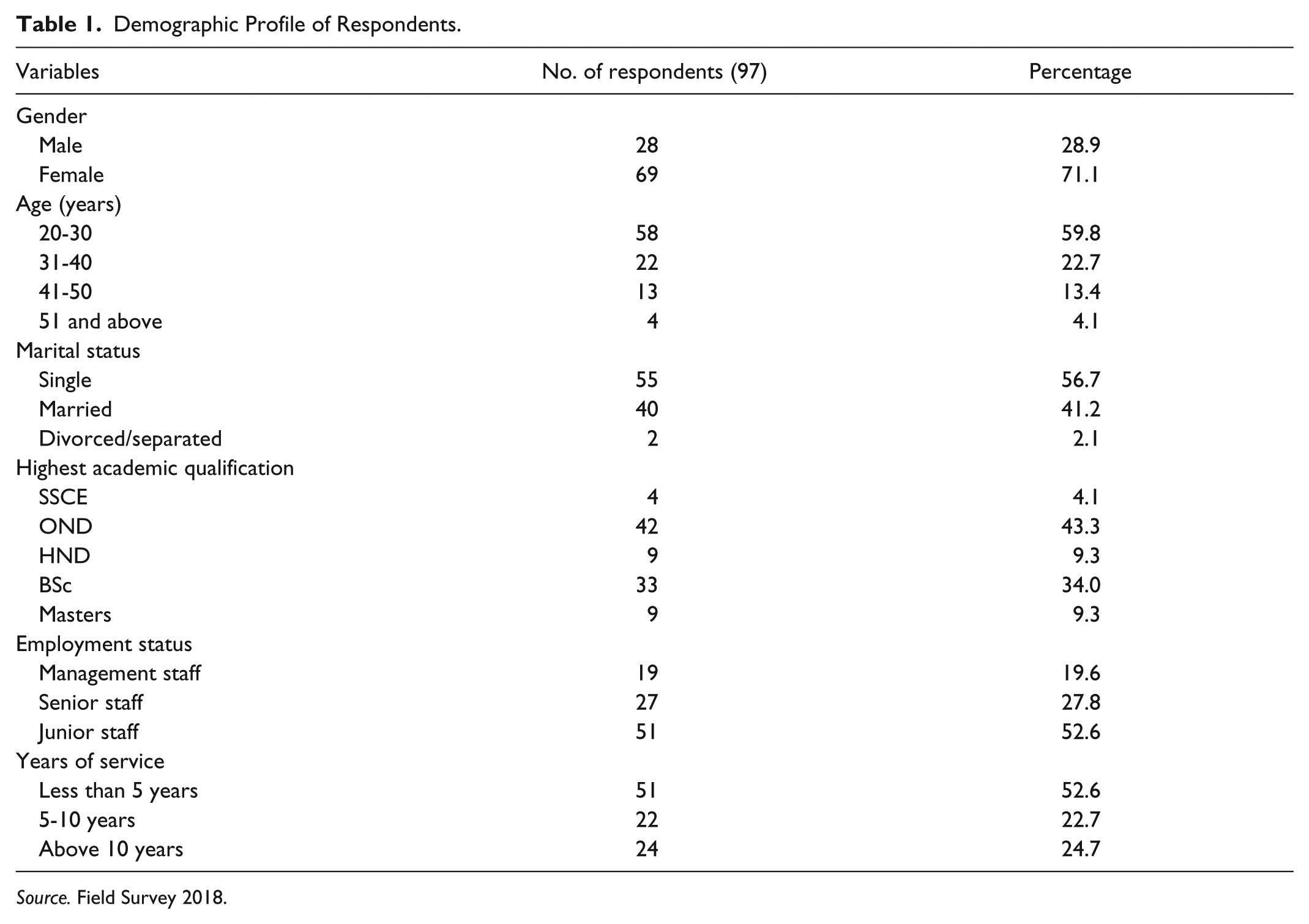
This section presents the demographics of respondents as detailed in Table 1 with respect to their gender, age, marital status, highest educational qualification, employment status, and years of service.
Demographic Profile of Respondents.
Source. Field Survey 2018.
The results in Table 1 show that 28 (28.9%) respondents were male and 69 (71.1%) were female. Of the respondents, 58 (59.8%) were within the age bracket 20 to 30 years, whereas 22 (22.7%), 13 (13.4%), and 4 (4.1%) respondents were within the age brackets, 31 to 40 years, 41 to 50 years, and 51 years and above, respectively. The table also reveals that most of the respondents were single (56.7%) and, based on their highest academic qualifications, most of the respondents were OND holders (43.3%). And 19 (19.6%) respondents were management staff, 27 (27.8%) were senior staff, and 51 (52.6%) were junior staff. From this result, it can be deduced that more than half of the respondents were junior staff. The distribution of their year in service reveals that 51 respondents (52.6%) had less than 5 years, 22 respondents (22.7%) have spent 5 to 10 years in service, whereas 24 respondents have spent above 10 years (24.7%).
Results and Analysis
To determine the relationship between leadership styles and employees’ commitment, correlation and regression were used. Also, differences in leadership styles and employees’ commitment scores based on gender were compared using t test, whereas differences in these variables based on other demographics variables (age, marital status, academic qualification, employment status, and years in service) were compared using analysis of variance. The direction of significant difference in leadership styles and employees’ commitment was determined using Duncan’s test.
The correlation coefficients for both variables in Table 2 are interpreted using Cohen’s (1988) suggested interpretations, where coefficients ranging from .10 to .28 are considered small effects, those from .28 to .49 are classified as medium effects, and those greater than .49 are large effects.
Correlation Coefficients for Leadership Styles and Employees’ Commitment.

Source. Authors’ calculations.
Significant at 5% (p < .05).
The results of the correlation presented in Table 2 reveal a significant medium positive relationship between transformational leadership style and employees’ commitment (r = .362, p = .0000, p < .05), which implies that the hypothesis is accepted. And transactional leadership style shows an insignificant weak negative relationship with employees’ commitment (r = −.032, p = .758, p > .05), which implies that the hypothesis is rejected. Results also reveal an insignificant small positive relationship between laissez-faire leadership style and employees’ commitment (r = .099, p = .336, p > .05), which implies that the hypothesis is accepted.
To determine the amount of variance in employees’ commitment accounted for by the leadership styles, multiple regression was used. The variance inflation factors (VIFs) were used to check for multicollinearity between the independent variables and the VIFs of 1.047, 1.044, and 1.007 were obtained for the transformational, transactional, and laissez-faire leadership styles, respectively. The VIFs were less than 10 meaning that there is no evidence of multicollinearity among the predictor variables. The adjusted R2 of .147 was obtained which implies that 14.9% of the variation in employees’ commitment was accounted for by the three leadership styles. The value of 5.336 with a p-value of .002 (p < .05) was obtained, meaning that the model is a good fit. Results show that, among the three leadership styles, only transformational leadership style has a significant positive relationship with employees’ commitment (β = .227, t = 3.86, p = .000, p < .05). Therefore, there is a significant relationship between transformational leadership style and employee commitment. Other leadership styles (transactional and laissez-faire leadership styles) show an insignificant relationship with employees’ commitment (p > .05). This can be seen in Table 3.
Regression.

Source. Authors’ calculations.
Dependent variable: employees’ commitment.
Predictors: (constant), transformational score, transactional score, and laissez-faire score.
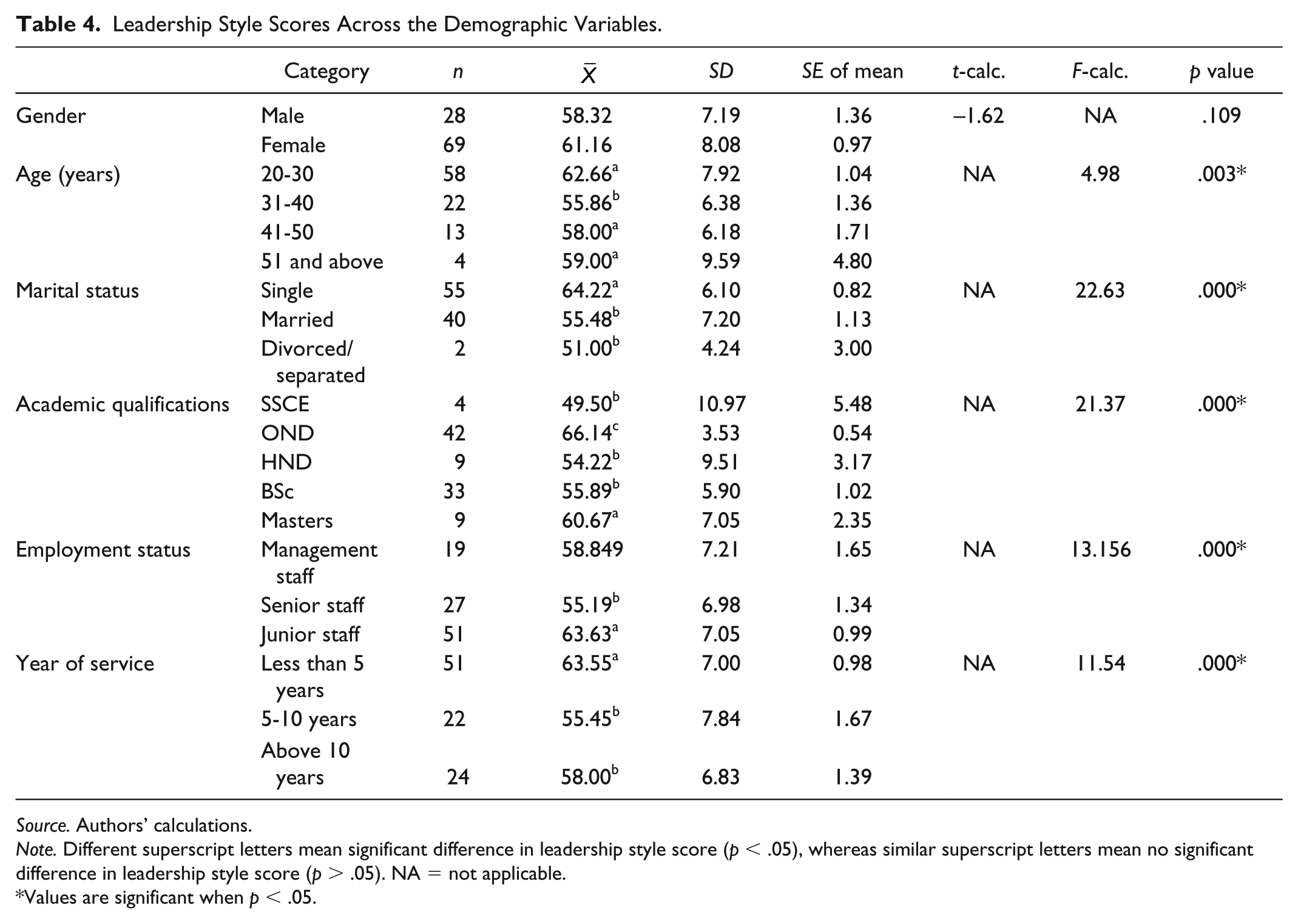
Table 4 shows how leadership style scores differ on demographic variables. The results reveal a significant difference in leadership style scores based on the age of the respondents (F-calc. = 4.98, p = .003, p < .05), marital status (F-calc. = 22.63, p = .000, p < .05), academic qualification (F-calc. = 21. 37, p = .000, p < .05), employment status (F-calc. = 13.156, p = .000, p < .05), and years in service (F-calc. = 11.54, p = .000, p < .05). Results show the highest of leadership style scores among respondents within the age group 20 to 30 years, single, OND, junior staff, and among respondents who had less than 5 years of experience compared with the other categories.
Leadership Style Scores Across the Demographic Variables.
Source. Authors’ calculations.
Note. Different superscript letters mean significant difference in leadership style score (p < .05), whereas similar superscript letters mean no significant difference in leadership style score (p > .05). NA = not applicable.
Values are significant when p < .05.
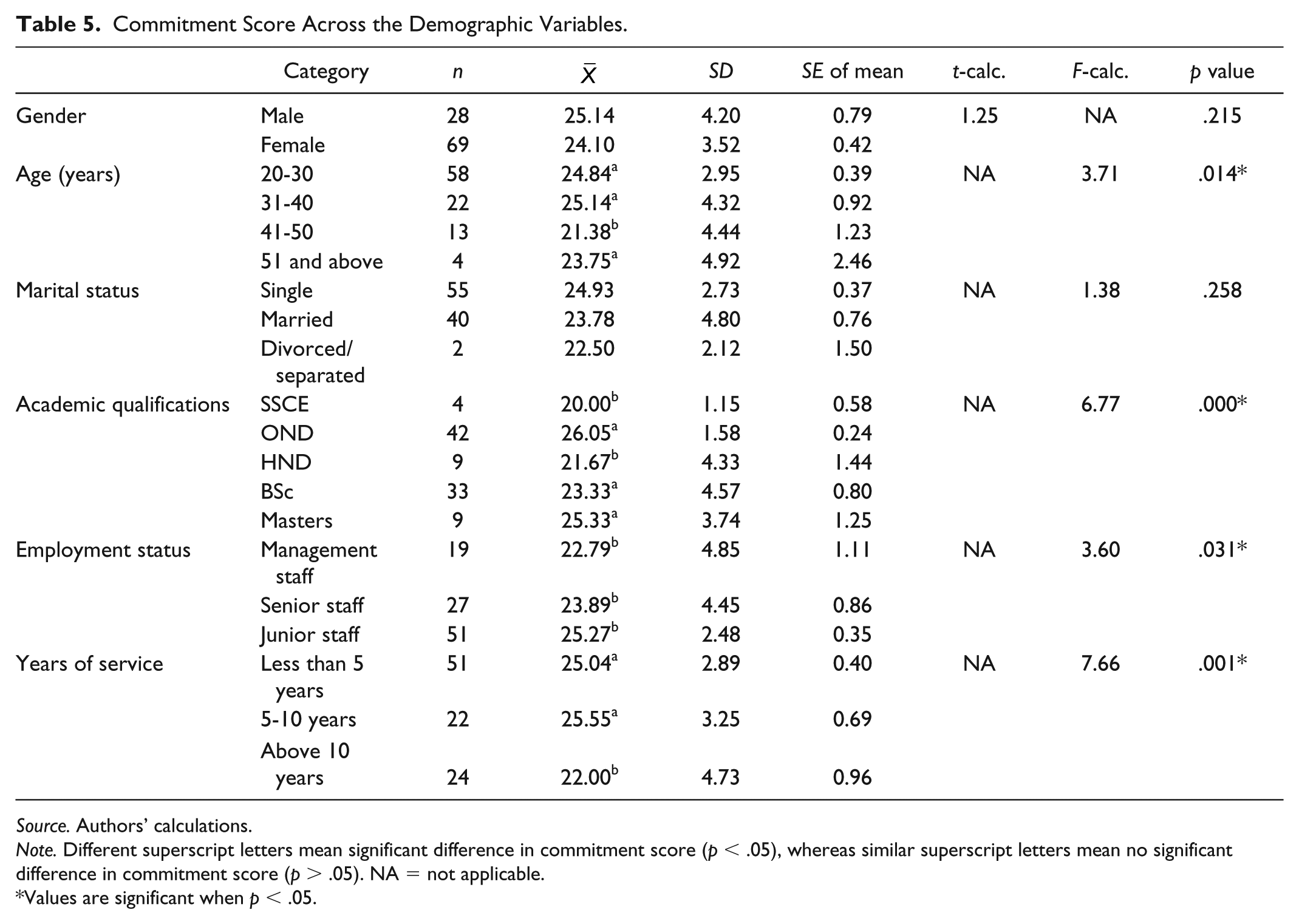
Table 5 presents the differences in employees’ commitment based on the demographic variables. The results reveal a significant difference in employees’ commitment based on age (F = 3.71, p = .014, p < .05), academic qualification (F = 6.74, p = .000, p < .05), employment status (F = 3.60, p = .031, p < .05), and years of service (F = 7.66, p = .001, p < .05). There was no significant difference in employees’ commitment based on gender (F = 1.25, p = .215, p > .05) and marital status (F = 1.38, p = .258, p > .05). Employees who were between the ages 31 and 40 years, had OND, were junior staff, and had 5 to 10 years of experience reported the highest score on employees’ commitment (see Table 4).
Commitment Score Across the Demographic Variables.
Source. Authors’ calculations.
Note. Different superscript letters mean significant difference in commitment score (p < .05), whereas similar superscript letters mean no significant difference in commitment score (p > .05). NA = not applicable.
Values are significant when p < .05.
Table 6 shows the analyses of the relationship between leadership styles and employees’ commitment scores across the demographic variables. The results reveal a significant positive relationship between leadership style and employees’ commitment among females (r = .485, p = .000, p < .05), age group 20 to 30 years (r = .473, p = .000, p < .05), single (r = .532, p = .000, p < .05), management staff (r = .524, p = .021, p < .05), junior staff (r = .367, p = .008, p < .05), respondents who had less than 5 years of experience (r = .362, p = .000, p < .05), and those with above 10 years of experience (r = .532, p = .007, p < .05).
Relationship Between Leadership Style and Commitment across Demographic Variables.

Source. Authors’ calculations.
Values are significant when p < .05.
Limitations of the Study
In this study, four limitations have been identified:
This article is limited by the scope of the study, which determined how leadership styles relate with employees’ commitment and also identified the influence of demographic variables on the relationship between leadership styles and employees’ commitment in Lagos State Civil Service Commission of Nigeria. However, the study was able to increase the awareness among researchers and managers of organizations about the relationship between leadership styles and employees’ commitment and the specific demographic variables that influenced the relationship that exists between leadership styles and employees’ commitment in Nigeria. In specific terms, this study has provided a platform for future research in this area.
Another limitation of this study is based on the sample size which is considered to be small, but the researchers ensured that most of the employees in the organization under study participated, thereby capturing their views on the subject matter.
The instruments (MLQ and OCQ) used in eliciting responses from the employees can also be considered as the limitation because in this study the persons the employees report to were considered as leaders. Nonetheless, the study was able to identify the dominant leadership style that relates with the employees’ commitment in Lagos State Civil Service Commission of Nigeria.
The cross-sectional research design utilized in this study also served as a limitation. However, the study was able to measure both the independent and the dependent variables at approximately the same time without the manipulation of variables.
Conclusion
The study focuses on determining the relationship between leadership styles and employees’ commitment and also identifying the influence of demographic variables on the relationship between leadership styles and employees’ commitment in Lagos State Civil Service Commission of Nigeria. In line with the analyses done, the study reveals that there is a positive relationship between leadership styles and employees’ commitment in Lagos State Civil Service Commission of Nigeria. Specifically, among the relationship between leadership styles and employees’ commitment, transformational leadership style has a medium positive relationship with employees’ commitment. This style pays attention to his or her employees, thereby stimulating and inspiring them to accomplish unprecedented results, which goes beyond the stated expectations, and the leaders are able to develop their capacity.
These findings are in line with previous studies done in this regard by Abasilim et al. (2018a), Dariush et al. (2016), Garg and Ramjee (2013), Mert et al. (2010), Othman et al. (2013), Wiza and Hlanganipai (2014), Yahchouchi (2009), and Abasilim et al. (2018b) who stated that transformational leadership style relates more with employees’ commitment and recommended that this style of leadership should be developed by leaders of organizations. This implies that attention should be paid to training leaders on transformational leadership skills to achieve desirable employees’ commitment.
Nevertheless, transactional leadership style had a small negative relationship with employees’ commitment and the application of this style entails a contractual relationship with the employees which depends on the deployment of the carrot and stick method to accomplish organizational goals. The carrots are in the form of rewards for desired outcomes, whereas the stick connotes punishment for undesired outcomes. On the contrary, the finding about transactional leadership style having a negative relationship with employees’ commitment contradicts Fasola et al.’s (2013) study that revealed that transactional leadership style affected more the employees’ commitment in the banking sector of Nigeria when compared with transformational leadership style. However, they recommended that managers/leaders as the case maybe should either praise or recognize employees when they achieve tasks that are beyond expectation. From the findings of this study, one thing is clear that each organization has its own peculiarities, and therefore leaders of organizations should take note of their unique peculiarities and the situation of their organization before applying a particular leadership style. Regular surveys within the organization can be done routinely to help establish the most appropriate leadership style that will engender employees’ commitment.
Laissez-faire leadership style had a small positive insignificant relationship with employees’ commitment. This style is characterized by the non-interference of leaders in the activities of the employees not only in decision-making processes but also not interested in the way and manner in which employees intend to accomplish organizational goals. These findings are alien to the reviewed literature and what this implies is that this style of leadership does not drive employees’ commitment so it should not be encouraged.
With respect to the influence of the demographic variables on the relationship between leadership styles and employees’ commitment, it is revealed that employees who were female, between the ages of 20 and 30 years, single, divorced/separated, SSCE holders, management staff with above 10 years of experience, and junior staff with 5 to 10 years of experience influenced the relationship between leadership styles and employees’ commitment in Lagos State Civil Service Commission, Nigeria.
The contributions of this study lie in the fact that the findings of this study have filled the gaps identified in the literature that necessitated the study and boosted the growing literature in Public Administration, Human Resource Management, Organizational Behavior, and Organizational Leadership studies on the relationship between leadership styles and employees’ commitment in the Nigerian work environment. The most important is the exposure of the influence of the demographic variables on the relationship between leadership styles and employees’ commitment apart from the relationship that exists between the variables under study. The findings of this study also provide an empirical insight to the leaders and Human Resource Managers of Lagos State Civil Service Commission, Nigeria. This means that although there is a relationship between leadership styles and employees’ commitment, it is expedient to know the role of demographic variables in ensuring employees’ commitment.
Furthermore, by this study, the leaders and Human Resource Managers will be aware of the type of leadership style that is significant and is positively related with employees’ commitment in the organizations. Ultimately, based on the recommendations proffered, organizational policies and strategies will be recalibrated for optimal employees’ commitment that will enhance organizational performance. The implication of the findings is that this study has provided a valuable extension to leadership theory in the organizational leadership literature and has also opened up a new research vista that explains the imperatives of the role of demographic variables in achieving employees’ commitment in Nigeria. In addition, employees’ commitment is more likely to be achieved when the appropriate leadership style is adopted and specific demographic variables like female gender, age (20-30 years), marital status (single and divorced/separated), academic qualification (SSCE), employment status (management and junior staff), and years of service (less than 5 years and above 10 years) are taken into account regarding the role they play in the relationship between leadership styles and employees’ commitment of Lagos State Civil Service Commission of Nigeria.
Footnotes
Acknowledgements
I appreciate my coauthors who are my supervisors—Professor D. E. Gberevbie. and Dr. O. A. Osibanjo., Associate Professor—for their immeasurable guidance all through this work. I also appreciate Covenant University for paying the publication fee of this article.
Authors’ Note
The article is a subset derived from the PhD thesis of U. D. Abasilim (2019) on Leadership Styles and Employees’ Commitment in Selected Public and Private Organisations in Nigeria (Doctoral thesis, Covenant University, Ota, Ogun State, Nigeria).
Declaration of Conflicting Interests
The author(s) declared no potential conflicts of interest with respect to the research, authorship, and/or publication of this article.
Funding
The author(s) received no financial support for the research, authorship, and/or publication of this article.
