




Abstract
Over the past 10 years, there has been a dramatic increase in the costs of building materials in Nigeria, and this development threatens the performance of the construction industry. The objective of the study was to assess the implications of the rising cost of building materials in Lagos State Nigeria. The data pertaining to factors affecting and the implication of rising cost of building materials were sourced from the main contractors, builders’ merchants and consultants who are registered with government bodies through questionnaire survey. The data on the prices of building materials were obtained from the archives of the The Nation Newspaper, Lagos QS News Letter, and field survey of builders’ merchants in 2012. The averages of the prices were used in the calculations of price indices and rates of inflation on building materials. The three most rated factors responsible for the rising cost of building materials are the exchange rate of the Nigeria Naira with a Mean Rated Average (MRA) = 4.4; cost of fuel and power supply, MRA = 4.3; and changes in government policies and legislation, MRA = 4.2, while fluctuations in the construction cost with MRA = 2.8; reduced volume of construction output, MRA = 2.52; and risk of project abandonment, MRA = 2.51, were the three most rated implications. The study concluded that the implications could result in a downward effect on the gross domestic product (GDP) in the nation’s economy.
Introduction
The construction industry in Nigeria is upcoming industry; the sector is regarded as a catalyst for growth while its performance serves as an indicator of the nation’s economy (Akanni, Oke, & Akpomiemie, 2014). It is supported by the association of construction players, which encompass developers, contractors, building material and equipment suppliers, manufacturers, financiers, regulators, and others in the value chain.
Building materials have been playing an important role in the construction industry—they are those materials put together in erecting or constructing structures, no field of engineering is conceivable without their use (Akanni, 2006; Udosen & Akanni, 2010). Building materials contribute immensely to the quality and cost of housing, from what is used in the foundation to the materials for roofing and finishes, while the building materials industry is an important contributor to the national economy of any nation as its output governs both the rate and the quality of construction work.
The cost of building materials poses a significant threat to both the construction industry and people aspiring to own houses (Anosike, 2009; Mekson, 2008; Mohammed, 2008; Njoku, 2007); for example, a bag of cement, which is valued at N1,350.00 in 2006, goes as high as N1,850.00 in 2009 (Anosike, 2009) depicting about 37% increment; the bag goes as high as N2,000.00 in 2012 during peak season (field survey 2012). Supporting this view, Jagboro and Owoeye (2004) earlier established that increase in the prices of building materials has multiplier effects on the industry while Idoro and Jolaiya (2010) affirmed that many projects were not completed on time due to the cost of materials, which have been on the increase. Besides timely completion, high prices of building materials form a crucial constraint to improving housing conditions in the low-income earning countries, Nigeria inclusive (United Nations Centre for Human Settlement [UNCHS], 1993).
In spite of the past studies on the cost of building materials in Nigeria, little is publicized about the implications of the rise in cost on the construction industry; most literature (Jagboro & Owoeye, 2004; Mekson, 2008; Njoku, 2007; Oladipo & Oni, 2012) has concentrated on identifying the causes with little emphasis on the implications; hence, the research seeks to provide information on implication of the rising cost of building materials by examining its influence on the construction industry and the nation’s economy.
Literature Review
Factors Affecting the Cost of Building Materials
Building materials had been playing an important role in the construction industry. They were all naturally occurring in the ancient times, for example, stone, wood, straws, clay, lime, and brick (Akanni, 2006; Taylor, 2013). As the building techniques were improving, simple composite materials, combined by means of mixing and/or heat treatment, were developed. A typical example is concrete, which was developed by the Roman Empire (Everett & Barritt, 1994). Due to advances in science and technology at the beginning of the 20th century, materials with better performance and durability were introduced, for example, reinforced concrete, steel, plastics, and metal (Taylor, 2013).
Ibn-Homaid (2002) and the report of UNCHS (1993) found that building materials remain the most significant input in project development and play a very important role in the delivery of construction projects. Buttressing this view, Jagboro and Owoeye (2004) and Idoro and Jolaiya (2010) find that building materials alone account for 50% to 60% of project cost and control about 80% of its schedule.
One of the major constraints in the Nigerian construction industry today has been the rapid inflation in the cost of the building materials. Windapo, Ogunsanmi, and Iyagba (2004) observed that the situations arising from the rapid increase in the cost of building materials may degenerate to acute shortages of housing with the millions of middle- and low-income families being priced out of the market for home ownership all across Nigeria.
According to Mansfield, Ugwu, and Doran (1994) and Obadan (2001), government policies set the economic environment in which all sectors operate including the building materials sector. Dlakwa and Culpin (1990) and Adekoya (2003) identified government fiscal policies as one of the factors affecting the cost of building materials in the Nigerian construction industry. However, findings of other researchers, Jagboro and Owoeye (2004); Mojekwu, Idowu, and Sode (2013); and Idoro and Jolaiya (2010), concluded that factors such as the change in government policies and legislations, scarcity of building raw materials, fluctuation in the cost of fuel and power supply, inadequate infrastructural facilities, corruption, fluctuation in the cost of plant and labor, seasonal changes, fluctuation in the cost of transportation and distribution, political interference, local taxes and charges, fluctuation on cost of raw materials, fluctuation in the interest rates and the cost of finance, the inflation, and fluctuation in the exchange rate of Naira were many of the recipes for the rising cost of building materials in Nigeria.
Implications of Rising in the Cost of Building Materials
The general direction at which prices of building materials are increasing in Nigeria was as the result of the combined effects of high interest rates, devaluation of the Naira, inflation, and non-effective distribution network of the materials (Ogu & Ogbuozobe, 2001; Oladipo & Oni, 2012). According to Mojekwu et al. (2013), the Nigerian Government curtailed activities in cement business when it banned the importation of Portland cement in the country between 2003 and 2007. The study also found that although the restraining of the importations was done to protect local manufacturer but then the local manufacturer were not able to produce enough cement that could measure to the demand and as such, the action contributed to the rising cost of the product.
However, Jagboro and Owoeye (2004) and Aibinu and Jagboro (2002) noticed that increase in the prices of building materials has multiplier effects on the industry as it leads to fluctuation in construction costs and the eventual abandonment of projects. Other implications such as completion at the expense of other projects, delay in progress of project works, other valuable projects not being commissioned, rate of employment of construction workers, poor workmanship as a result of the use of low-quality local materials, and inhibited innovations in construction methods were identified by Elinwa and Buba (1993); Idoro and Jolaiya (2010); Okpala and Aniekwu (1988); Oladipo and Oni (2012); and Windapo et al. (2004) as the possible implications of the rising cost.
Inhibited innovations in construction methods and material research
Egan’s (1998) report found that the very low and unreliable rate of profitability within construction is an obstacle to sustainable healthy development. The report was of the opinion that increasing financial pressure are bound to be on contractors when initial budget figures become completely unrealistic and concluded that the situation will damage the industry and jeopardize its existence
Xiao and Proverbs (2003) also argued that construction companies have a social responsibility to provide staff training, maintain a high level of health and safety of its workers, and invest in research and development to facilitate continuous improvement in technology and management. However, inflation in the cost of building materials had resulted in low and unreliable rate of profitability, and this has affected the performance of the industry in the area of innovations in construction methods and material research.
Fluctuation in construction costs
Maintaining steady cost projection on construction projects had been an issue of serious concern both to the client and project contractors. Azhar, Farooqui, and Ahmed (2008) noticed that the basic reason of cost overruns is that most contractors quote prices based on their projected estimates; unfortunately, the prices change so quickly that the initial budget figures become completely unrealistic. On the Nigerian scene, Jagboro and Owoeye (2004) found that one of the most serious problems in the Nigeria construction industry is the project cost overrun, with attendant consequences of completing projects at sums higher than the initial sum and concluded that project abandonment ensues in most cases.
Quality of workmanship is affected
According to Lam, Chan, Wong, and Wong (2007), one of the hallmarks of a developed construction industry is in the output of quality buildings and structures. The quality of workmanship in construction work is assessed according to the requirement of the relevant standard, and marks are awarded if the workmanship complies with the standard (Construction Industry Development Board, 2011).
The study of Oladipo and Oni (2012), which reported the trend in the cost of building materials, has envisaged great danger for the construction industry and the nation’s economy in that there were instances of conflicts between building contractors and their clients over upward review in contract sums, and in an attempt to avert such conflicts and remain in the business, some contractors resorted to the use of substandard or insufficient materials for construction projects, which had contributed to cases of building collapse in the nation.
Risk of project abandonment
Abandonment of projects has become a national menace in Nigeria’s infrastructural development as most clients are not adequately advised about the financial implications of the project to be embarked on (Ayodele & Alabi, 2011; Idoro & Jolaiya, 2010). According to these authors, the predominance of many uncompleted and substandard buildings was connected to the inflation and high cost of building materials. Their studies also affirmed that the situation may have a multiplier effect on the industry and may lead to fluctuation in the construction cost.
Volume of construction output is affected
According to Fagbenle, Adeyemi, and Adesanya (2004), the output of the construction industry in Nigeria is quite low when compared with construction industry of many developed countries. Congruent to this assertion, Windapo et al. (2004) observed that situations arising from the rapid increase in the cost of building materials may degenerate to acute shortages of housing with millions of middle- and low-income families being priced out of the market for home ownership all across Nigeria. The observations from these studies were due to the high cost of building materials according to Anosike (2009) who found that Nigeria has more than 17 million housing deficit as of 2004.
Rate of employment is affected
The construction industry’s workforce is extremely diverse and includes different types of individuals working within construction such as unskilled workers, skilled workers, craft, managerial roles, and administrative workers. According to research, maintaining and attracting the right people within the construction industry is a priority due to the scarcity of both skilled people and experienced managers. Ayodele and Alabi (2011) found that inflation in the costs of building material is killing the construction industry as many contractors are unable to forecast accurately the expected profit on the project, and the situation had contributed to laying-off of the workers and closure of firms in some extreme cases.
Research Method
To identify factors and the implications of the rising cost of building materials, a systematic literature review was conducted through which the questionnaire instrument was developed and used in the collection of the primary data. The secondary data on building material prices between 2003 and 2011 were obtained majorly from The Nation Newspaper, Lagos QS News Letter, and field survey of builders’ merchants in 2012. The exchange rates of the Nigerian Naira to the U.S. dollar were obtained from the Central Bank of Nigeria–Rates, Nigeria Naira Exchange Rate (2003-2012), while the inflation rates were obtained from the Central Bank of Nigeria–Data and Statistics, Inflation Rates (2003-2012).
Sample Size
The statistical sample size “η” of the respondent was calculated from the population of main contractors (68), building material suppliers (176), and consultants (109) who registered with various government bodies in the study area. The formula used by Al-Sedairy (1994) was adopted in the calculation of the sample size as follows:

where,

The V = standard error of the sampling distribution = 0.05,
S = maximum standard deviation in population at a confidence level of 95%,

where P is the proportion of population elements that belong to a defined class.
Hence, the sample size of main contractors,

The builders’ merchants,

The consultants,

Price Indexes and Inflation Rates
The study of Theil (1965) affirmed that price index is an index number expressing the measure of change in the average retail prices of group of commodity relative to the level of the prices of the same commodities commonly purchased by a particular group of people in a particular area during an arbitrarily chosen base period. To this extent, price data pertaining to 10 selected building materials for the period between 2003 and 2011 were obtained as secondary data while the current prices for the 10th year (2012) were obtained from the field survey of builders’ merchants. The building materials selected were assumed to be the basic and common materials for building construction in Nigeria and their average prices were used for the calculation of price indices. Theil’s study, which used the Laspeyres index formula and computed price indexes by taking the ratio of the cost of purchasing a specified group of commodities at current prices to the cost of that same group of base-period price and multiplied by 100, was used as follows:

Also, the rates of inflation of the selected materials were computed using the compound interest method as follows:

where P o = First value of the index, P n = the last value of the index, n = numbers of years, and r = rate of inflation.
Ranking of Factors and Implications of the Rising Cost of Building Materials
The ranking of the factors and implications of the rising cost of building materials were estimated from the Mean Response Analysis (MRA) statistics of the respondents. The mean score for each criterion based on the Likert-type scale of 1 to 5 as used by various construction management researchers such as Kothari (2004) and Fellows, and Liu (2009) was determined as follows:

where
n1, n2, n3, n4, and n5 = number of respondents who answered from “very low” to “strongly agree.”
Result Presentation
Demographic Statistics of the Respondents
The demographic aspect of the questionnaire was used to collect background data such as the areas of specialization, educational qualifications, and years of experience of respondents. The result in Table 1 showed that the majority of the main contractors, consultants, and builders’ merchants surveyed had an appreciable level of education with a number of years of working experience, the average being 12 years. The specialization of the consultants revealed that 15 of the respondents, representing about 12%, were quantity surveyors, 11 (9%) were architects, 13 (11%) were specialists in building production management, while 7 (6%) were engineers. Also, main contractors were 29 representing about 24%, while the builders’ merchants were 47 (38%). The spread of the respondents among various professions and businesses, their qualifications, and their average 12 years of working experiences imply that the data obtained were qualitative enough to provide a basis for analysis.
Demographic Information of the Respondents.

Price Indexes and Inflation Rates
The computed results in Table 2 show that the annual average index of the selected building materials rose from N98 in 2004 to N321 in 2012 while the results in Table 3 show the average inflation rate on the cost ranging from 5% for a bundle of galvanized iron roofing sheet as the lowest to 21.3% for sharp sand as the highest within the same period.
Building Material Price Index (N).

Note. Calculated price index using prices obtained from the Nation Newspaper, Lagos QS News Letter and Field Survey. Values in bold indicate the minimum and maximum annual averages.
Building Material Average Inflation Rate.

Note. Calculated rates of inflation on the price index of selected building materials. Values in bold indicate the minimum and maximum average inflation rates.
Factors and Implications of Rising in the Cost of Building Materials
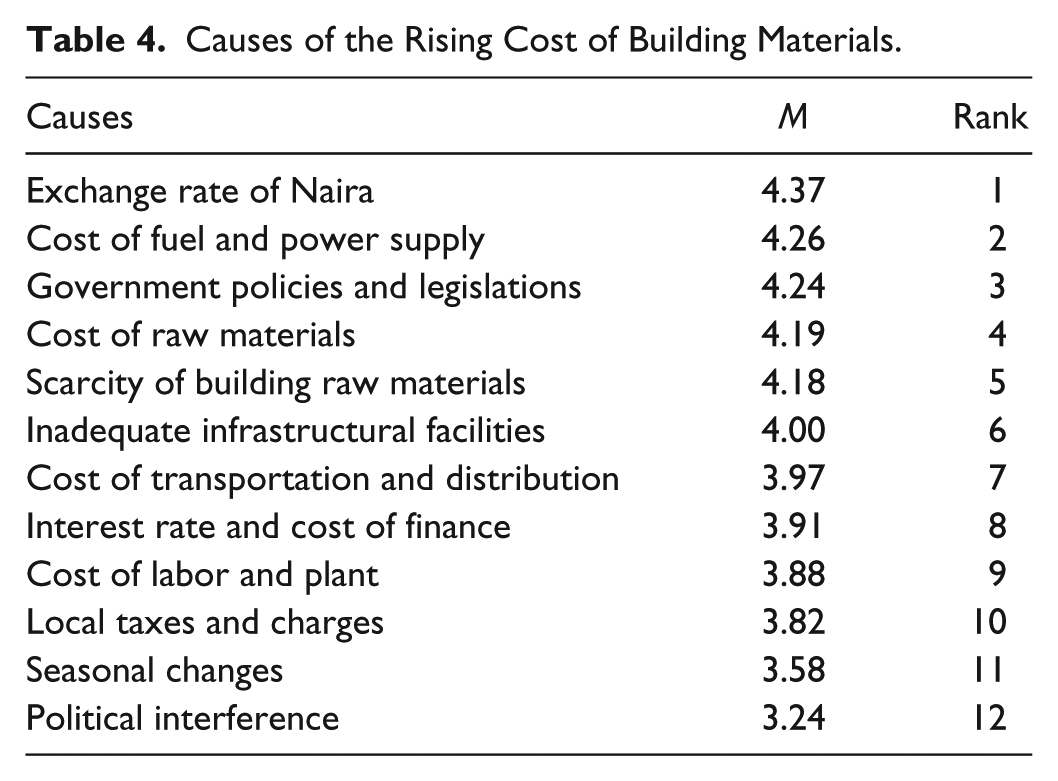
The results shown in Table 4 represent the respondents’ rating of the factors of the rising cost of building materials. The exchange rate of the Naira, cost of fuel and power supply, and government policies and legislations with average means of 4.37, 4.26, and 4.24, respectively, were the three topmost causes of the trend in the cost of building materials. Table 5 presents the respondents’ view of the implications of the rising in the cost of building materials, and the result indicated that fluctuation in construction costs, volume of construction output being affected, and risk of project abandonment are the three most likely implications.
Causes of the Rising Cost of Building Materials.
Implications of the Rising Cost of Building Materials.

Discussion of Findings
This study produces results that corroborate the findings of a great deal of the previous work in this field as the mean scores of the opinions of our respondents in Tables 4 and 5 further reinforce the findings of Jagboro and Owoeye (2004), Idoro and Jolaiya (2010), and Oladipo and Oni (2012). A close observation of the factors responsible for the rising cost of building materials in Table 4 reveals that the exchange rate of Naira is the most significant factor in the trend. The factor is perceived to have produced a chain effect and is responsible for the ranks of the cost of fuel and power supply as Nigerian dependency on imports of petroleum products, which are widely used to generate energy for both production and transportation of the building materials across the nation, is very high.
The exchange rate factor, which by implication affects the cost of fuel and the cost of transportation, is also perceived to have been responsible for the trend in the rising cost of locally sourced materials such as sharp sand, granite, plaster sand, and timber as depicted in the price index of Table 2.
It was also observed in Table 5 that the rising cost of building materials has high implications on construction cost, volume of construction output, and risk of project abandonment. This explained the findings of Dlakwa and Culpin (1990), Jagboro and Owoeye (2004), and Mojekwu et al. (2013) that increase in the prices of building materials has multiplier effects on the industry.
The implication of the fluctuation in the cost of construction is such that projects are not delivered within the budget and time, the level of quality required is difficult to achieve, conflicts between contractors and clients are ensue as a result of an upward review of contract sum and most likely leads to cases of abandonment where investments are tied-down since such project will not be put to use at the time expected. Another implication of the rising cost of building materials is such that the volume of construction outputs is reduced. The reduction in construction output is likely to jeopardize the government housing policy and invariably leads to shortage in the supply of housing demand of the citizenry and reduction in the employment, especially of labor workers in the construction sector, which by extension, is capable of bringing down the contributions of the construction industry to the nation’s gross domestic product (GDP).
The results of Table 5 also revealed low quality of workmanship and inhibited innovations in construction methods as further implications of the rising cost of building materials. It could be inferred that the rising cost of building material contributes to low and unreliable rate of profitability of contractors and an attempt to balance up could have resulted in the use of low-quality workmanship, which hinders new innovations in the construction methods. A concern about this implication is that poor quality workmanship had been identified as one of the recipes for building collapse by researchers in Nigeria.
Conclusion
The identified variables of the factors and implications of the rise in the cost of building materials had been quantitatively analyzed and evaluated. The nature of the cost of material and time was also established to follow a trend, which was explained by the varying degree of coefficients of relationship of cost and time, respectively, and it could be concluded that there is an inflationary trend in the cost of building materials between 2003 and 2012 with an average inflation rate between 5% and 21% during the 10-year period.
The study also concludes that the exchange rate of the Naira, cost of fuel and power supply, and changes in government policies and legislations were the three topmost factors responsible for the rising while fluctuations in the construction cost, reduced volume of construction output, and risk of project abandonment were the three topmost implications.
Inferences drawn from the conclusions on the implications of the rising costs of the building materials are that there is likelihood of a downward effect on the GDP in the nation’s economy and that the expectations of the government policy toward the realization of the program on “housing for all by the year 20/20” are no longer certain.
Recommendations
It is suggested that government should formulate policy that will play down the agitations on the use of imported building materials by encouraging research in the production of local building materials. Government should also take drastic steps to reduce the cost of production and transportation of goods by ensuring an adequate supply from the power sector and production of petroleum products through the local refineries as against dependency on importation.
Footnotes
Declaration of Conflicting Interests
The author(s) declared no potential conflicts of interest with respect to the research, authorship, and/or publication of this article.
Funding
The author(s) received no financial support for the research and/or authorship of this article.