




Abstract
Previous studies considered entrepreneurial orientation as a determinant of firms’ growth and performance. In this research, we are interested in spin-offs. Indeed, we aim to study the relationship between their entrepreneurial orientation and their performance. Therefore, we carried out a cross-cultural study in three different countries; Tunisia, Canada, and Morocco. We opted for a personal survey. We addressed our questionnaire to 180 managers of spin-offs and we analyzed the research variables using SPSS 20.00 (Statistical Packages for Social Sciences) and Smart PLS 3 (Partial Least Squares). Our findings highlight a positive correlation between entrepreneurial orientation and performance of spin-offs within the three samples.
Introduction
According to Venturini and Verbano (2017), spin-off companies have significant social and economic implications such as the creation of new jobs and the increase of revenue streams. Indeed, spin-offs are based on the transfer of their technology, founders, or other resources from a parent organization (Criaco, Minola, Migliorini, & Serarols-Tarrés, 2014). Spin-off companies may be considered as new ventures that are founded by individuals or groups who were a part of parent organizations that exploit universities or research institutions (Pratiwi, Sutopo, Zakaria, & Rasli, 2017, p. 8646).
In this research, we are interested in university spin-offs. Although the creation of university spin-offs is enhanced in the last decades, there are concerns that the absolute majority of these ventures have limited growth and performance (Fini, Fu, Mathisen, Rasmussen, & Wright, 2017). Several authors assessed the determinants of spin-off performance. For instance, Semadeni and Cannella (2011) examine the impact of parent organization on spin-off performance. Their findings indicate that spin-offs benefit from moderated links with parent organizations. Moreover, Visintin and Pittino (2014) analyze the relationship between demographic characteristics of founding teams and new venture performance. Their results indicate that a balanced demographic structure in spin-offs’ entrepreneurial team is critical to achieve good levels of performance. Furlan and Grandinetti (2014) emphasize other determinants of spin-off performance such as the entrepreneurial innovativeness and the intensity and variety of interactions between the entrepreneur and other individual actors.
In this research, we utilized the works of Walter, Auer, and Ritter (2006) and Jiménez-Jiménez and Sanz-Valle (2011) to assess the impact of entrepreneurial orientation on performance. Our objective was to examine the impact of spin-offs’ entrepreneurial orientation on their performance in three different countries, Tunisia, Canada, and Morocco.
Literature Review
Several authors such as Visintin and Pittino (2014) and Clarysse, Tartari, and Salter (2011) studied the determinants of spin-offs’ performance. They consider sales growth as the most appropriate dimension of performance.
Smith and Ho (2006), also, assessed the indicators of spin-off performance. They distinguished between financial measures such as turnover, position in finance cycle, and equity owned by external organizations and nonfinancial measures including number of people employed, number of offices/subsidiaries, patent, and licensing activity.
Lumpkin and Dess (1996) noted that measures of financial performance are not the only important indicators of firm performance. Therefore, several authors such as Poon, Ainuddin, and Junit (2006) used alternative measures of performance including nonfinancial ones (e.g., firm survival, innovation, reputation, and stakeholder satisfaction). Indeed, Venkatraman and Ramanujam (1986) considered a conceptualization of business performance that emphasizes indicators of operational performance (i.e., nonfinancial) as well as indicators of financial performance. According to Engelen, Gupta, Strenger, and Brettel (2015), this broad conceptualization “reflects the organization’s overall effectiveness in meeting multiple goals” (Engelen et al., 2015, p. 11).
Other studies consider only perceived performance. For example, Yang and Guy (2011) consider perceived performance as an appropriate measure because “managers’ perceptions of performance are grounds for performance ratings” (Yang & Guy, 2011, p. 533). Indeed, perceived performance may be defined as “an indicator including growth, firm profitability and market share in which firm growth and profitability are the essential parts of a firm’s performance and those are measured to evaluate the competitiveness of the firm” (Veliu & Manxhari, 2017, p. 61). Furthermore, Spreng, MacKenzie, and Olshavsky (1996, p. 20) define perceived performance as “beliefs regarding the product attributes, levels of attributes, or outcomes”….; “perceived performance generally has been included in the disconfirmation of expectations model as only the referent against which expectations are compared”.
In this research, we follow Yang and Guy (2011) and consider perceived performance. We will assess the perception of managers to measure the spin-offs’ performance. Indeed, performance is commonly considered in the literature as a multidimensional construct. For instance, Engelen, Kube, Schmidt, and Flatten (2014) consider three dimensions of performance: customer satisfaction, market effectiveness, and current profitability.
Following Stam and Elfring (2008), Walter et al. (2006), and Rauch, Wiklund, Lumpkin, and Frese (2009), we believe that entrepreneurial orientation may be a key success factor of spin-off performance.
Indeed, entrepreneurial orientation reflects “the organizational processes, methods, and styles that firms use to act entrepreneurially” (Lumpkin & Dess, 1996, p. 139). It may be defined as the processes, behaviors, and structures of ventures that are characterized by innovativeness, proactiveness, and risk-taking (Stam & Elfring, 2008). Similarly, Dada and Fogg (2016) note that entrepreneurial orientation “captures the extent to which a firm’s posture may be characterized as entrepreneurial versus conservative, with the former defined as those emphasizing innovativeness, proactiveness, and risk-taking” (Dada & Fogg, 2016, p. 89).
According to Dada and Fogg (2016), entrepreneurial orientation reflects the firm’s involvement in entrepreneurial behaviors such as undertaking risky business, developing proactiveness, and engaging in market innovation.
Indeed, the dimensions of entrepreneurial orientation are discussed in previous literature (e.g., Richard, Barnett, Dwyer, & Chadwick, 2004). Miller (1983) identifies only three dimensions of entrepreneurial orientation, namely innovativeness, risk-taking, and proactiveness. Dada and Fogg (2016) define these dimensions as follows: innovativeness is a tendency to search for novel, unusual, or creative solutions to challenges; risk-taking is entering into a costly commitment that has an uncertain future outcome; and proactiveness is a forward-looking perspective where companies actively try to anticipate future market opportunities ahead of competition. (Dada & Fogg, 2016, p. 93)
Later, the original components of entrepreneurial orientation (innovativeness, proactiveness, and risk-taking) have been extended to include autonomy and competitive aggressiveness (Miller & Le Breton-Miller, 2011). Indeed, Lumpkin and Dess (2001) consider competitive aggressiveness as a critical dimension of entrepreneurial orientation and they distinguish it from proactiveness. They note that proactiveness is “a response to opportunities whereas competitive aggressiveness is a response to threats” (Lumpkin & Dess, 2001, p. 434). The same authors consider autonomy as another important aspect of entrepreneurial orientation because it allows for individuals and teams to develop their creativity and exercise their promising ideas that is needed to occur entrepreneurship.
Furthermore, Harms, Reschke, Kraus, and Fink (2010) investigate the implementation of entrepreneurial orientation. They define it as “the creation of intervening elements that translate the entrepreneurial propensities inherent in entrepreneurial orientation into real actions that will finally lead to performance” (Harms et al., 2010, p. 137). This link between entrepreneurial orientation and firm performance was assessed by several researchers (e.g., Alegre & Chiva, 2013; Engelen et al., 2015; Van Doorn, Jansen, Van den Bosch, & Volberda, 2013).
According to Wiklund and Shepherd (2005), “the strategy and entrepreneurship literatures suggest that an entrepreneurial orientation improves firm performance, but the empirical results are mixed” (Wiklund & Shepherd, 2005, p. 71).
Indeed, Engelen et al. (2015) assessed the entrepreneurial orientation–performance link within small and medium-sized firms. Their results indicate a positive correlation between entrepreneurial orientation and firm performance. Their empirical findings reveal different contingencies that influence the strength of this relationship. They explain that entrepreneurial orientation–performance relationship may be moderated by top management’s transformational leadership behaviors, which are considered in the past two decades as the preferred leadership approach.
Likewise, Van Doorn et al. (2013) assess the entrepreneurial orientation–performance relationship. They confirm the positive impact of entrepreneurial orientation on firm performance. They suggest two moderator variables of this relationship, namely “senior team shared vision” and “senior team heterogeneity.” Their empirical findings approve that entrepreneurial orientation–performance relationship is positively moderated by senior team heterogeneity.
Lechner and Gudmundsson (2014) investigate the impact of entrepreneurial orientation dimensions on firm performance and they suggest “competitive strategy” as a mediating variable of this relationship. Their results reveal a positive correlation between entrepreneurial orientation and performance as well as a significant moderator effect of competitive strategies on entrepreneurial orientation–performance link.
Furthermore, Lee, Lee, and Pennings (2001) consider entrepreneurial orientation as a critical predictor of firm sales growth within a sample of young high-technology start-ups in South Korea. Moreover, Runyan, Droge, and Swinney (2008) perceive entrepreneurial orientation as positively related to firm performance in younger firms. Escribá-Esteve, Sánchez-Peinado, and Sánchez-Peinado (2008), also, argue a positive relationship between strategic orientation (measured by many elements of the entrepreneurial orientation) and firm performance. Likewise, Messersmith and Wales (2011) assess the positive correlation between the entrepreneurial orientation of young high-technology firms and their performance level. They note that entrepreneurial orientation implies the exploration of entrepreneurial initiatives within organizations. Thus, entrepreneurial orientation enables young firms to seize opportunities for growth. In particular, entrepreneurial orientation facilitates the exploration of new market entry opportunities within high-technology firms (Messersmith & Wales, 2011).
On the contrary, other studies failed to find a positive correlation between entrepreneurial orientation and performance. For instance, Wiklund and Shepherd (2005) argue that “entrepreneurial orientation may sometimes, but not always, contribute to improved performance” (p. 73). They indicate that entrepreneurial orientation is more likely to have a strong effect on performance in stable environments with less access to capital. They note that this result “reinforces the notion of entrepreneurial orientation being a differentiator” (Wiklund & Shepherd, 2005, p. 87).
Furthermore, Slater and Narver (2000) argue that there is no association between entrepreneurial orientation and business profitability. Furthermore, Matsuno, Mentzer, and Özsomer (2002) reveal a negative relationship between entrepreneurial orientation and firm performance. Moreover, Lumpkin and Dess (2001) report on two facets of entrepreneurial orientation, namely proactiveness and competitive aggressiveness. They examine the relationship of these two dimensions with performance in various contexts. Their empirical findings indicate that “proactiveness was positively related to performance but competitive aggressiveness tended to be poorly associated with performance” (Lumpkin & Dess, 2001, p. 430).
Moreover, Rauch et al. (2009) identify the internal and environmental determinants of entrepreneurial orientation–performance relationship. They suggest that this association depends on national culture, business size and technological intensity of the industry.
In this research, we will try to assess the impact of entrepreneurial orientation on spin-offs’ performance in three different countries. We hypothesize the following:
We present our research model in Figure 1.

Research model.
Method
Indeed, there are few researches that compare the spin-offs’ entrepreneurial orientation–performance link in different socioeconomic contexts (e.g., Riviezzo, Santos, Liñán, Napolitano, & Fusco, 2019; Semrau, Ambos, & Kraus, 2016). Therefore, we carried out a cross-cultural study in three different countries (Tunisia, Canada, and Morocco) to assess the relationship between entrepreneurial orientation and performance of spin-offs. We focus on this particular type of firms because of their innovative activities and technological assets.
We opt for a personal survey to collect primary data and we resort to previous literature to develop our questionnaire. We follow Rauch et al. (2009) and Walter et al. (2006) and consider entrepreneurial orientation as a unidimensional construct. We adopt the entrepreneurial orientation construct of Walter et al. (2006). We use their six items that capture the different dimensions of entrepreneurial orientation. However, we consider performance, following different authors such as Silva et al. (2017), Jackson et al. (2016), and Nguyen et al. (2016), as a multidimensional construct. We refer to the performance multidimensional construct of Engelen et al. (2014) that consists of three dimensions: customer satisfaction, market effectiveness, and current profitability. We adopt their scale of measures that uses four items for each dimension.
Indeed, customer satisfaction is widely considered as a crucial indicator of firm performance in previous literature (e.g. Wiklund & Shepherd, 2005). Customer satisfaction is measured by four items that deal with the different aspects of customer satisfaction and reflect the extent to which a firm responds to the clients’ needs and desires. Moreover, the four items measuring market effectiveness represent the market growth in terms of market share, sales revenue, customers, and turnover. Likewise, we measure financial performance with the four items of Vorhies and Morgan (2005) that assess firms’ profitability, return on investment, return on sales, and the amount of reached financial goals.
We generated primary data by conducting a personal survey of spin-offs from higher education institutions. We opted for three convenience samples from Tunisia, Canada, and Morocco. We chose the face-to-face survey method and we personally visited the three countries to gather valid, usable, and completed responses to our questionnaire.
To avoid misunderstanding and ambiguity, we tested the questionnaire before its development. Indeed, a copy of the questionnaire was presented to a limited number of Tunisian spin-offs’ managers. We took into consideration the different remarks to formulate the final version of the questionnaire.
Then, we administrated our questionnaire to 60 managers of spin-offs from each sample. Indeed, the Tunisian sample consists of 60 spin-offs specialized in computer sciences, web development, robotic, electronic, information and communications technology (ICT), marketing, software development, communication, and logistic. All of them are located in incubators and spin-offs. The Canadian sample also consists of 60 spin-offs specialized in life science, ICT, clean technology, and aerospace that are members of the techno-park of Montreal. Similarly, Moroccan sample consists of 60 spin-offs specialized in ICT sector, green technology, and cultural industry that are members of the techno-parks of Rabat and Casablanca.
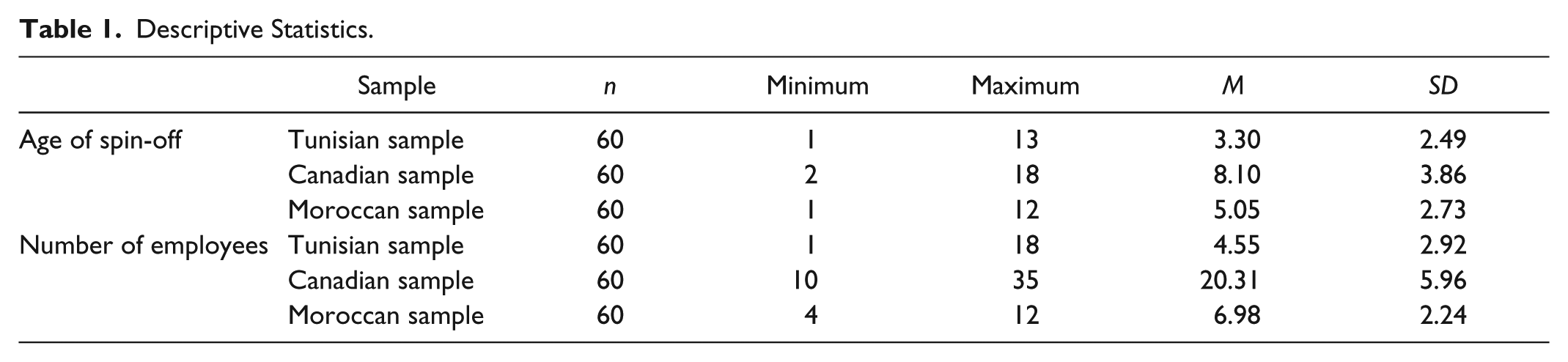
In total, we received 180 copies of valid questionnaires. We represent some descriptive statistics of our samples in Table 1.
Descriptive Statistics.
We assessed the validity of our variables according to Fornell and Larcker (1981) and we examined their reliability using the Cronbach’s alpha coefficient according to Evrard et al. (2009). We relied on the path coefficients provided by Smart PLS (Partial Least Squares) to test our hypothesis. We developed structural equation models and we calculated the correlation indexes.
Results
According to Evrard et al. (2009), our empirical findings reveal acceptable levels of validity (Extracted Average Value [EAV] are greater than 0.5). The results also highlight a satisfactory level of reliability according to Fornell and Larcker (1981) (Cronbach’s alpha coefficients exceed 0.70; see Table 2).
Reliability and Validity of Constructs.

To test our hypothesis, we used the Path coefficients provided by PLS software. Indeed, for the three samples, our empirical results outline a p value that is inferior to 0.05 (0.00) and high T-values (greater than 1.96) (see Table 3). Our findings reveal a positive impact of entrepreneurial orientation on performance within Tunisian, Canadian, and Moroccan spin-offs. This finding supports our hypothesis.
Path Coefficients.

Thus, we may retain that spin-offs’ entrepreneurial orientation enhances their performance independent of the countries’ different economic conditions.
Furthermore, we calculated the correlation index of spin-offs’ entrepreneurial orientation–performance link for the Tunisian, Canadian, and Moroccan samples (respectively, 0.891; 0.675; 0.944; see Table 4).
Correlation Coefficients.

We note that the correlation between entrepreneurial orientation and spin-offs’ performance is higher within Tunisian and Moroccan samples than within Canadian one. This finding suggests that the entrepreneurial orientation–performance link may be stronger in developing countries than in developed ones.
Furthermore, our findings indicate a high correlation index between entrepreneurial orientation and performance within the Tunisian sample (0.891).
Discussion of the Results
Our findings indicate that spin-offs’ entrepreneurial orientation enhances their performance independent of the countries’ different economic conditions. Therefore, spin-offs should develop their entrepreneurial orientation to boost the three dimensions of performance, namely, “Customer satisfaction,” “Market effectiveness,” and “Current profitability” (see Supplemental Appendix).
Furthermore, our results indicate that entrepreneurial orientation may be more beneficial for spin-offs’ performance in Tunisia and Morocco than in Canada. This finding needs explanation in future researches to compare the impact of entrepreneurial orientation on performance in developed and developing countries.
Moreover, our empirical findings suggest that entrepreneurial orientation–performance link is stronger in Tunisia than in Canada and Morocco. This finding may be explained by the environment hostility that characterizes the Tunisian sample. Indeed, the hostile economic environment that is engendered by the Tunisian revolution of 2011 seems to boost the entrepreneurial orientation–performance link. This empirical finding confirms the research of Lumpkin and Dess (1996). They emphasize that the effect of entrepreneurial orientation on performance depends on external factors such as the environmental stability. Furthermore, Covin and Slevin (1989) note that the positive impact of entrepreneurial orientation on performance seems to be stronger in hostile than in benign environments. To explain this effect, Lumpkin and Dess (1996) note that hostile environment is generally characterized by constrained resources that require more control, greater coordination, and implementation of new strategies. Thus, future researches should assess the moderating effect of environmental factors on spin-offs’ entrepreneurial orientation–performance link.
Conclusion
The objective of this study was to assess the impact of entrepreneurial orientation on the spin-offs’ performance in three different countries: Tunisia, Canada, and Morocco. We opted for a survey to measure the relationship between the dependent and independent variables. We developed a questionnaire according to previous literature and we addressed it to 180 managers of spin-offs.
We verified the validity and the reliability of our variables according to Fornell and Larcker (1981) and Evrard et al. (2009). Then, we performed a confirmatory analysis using Smart PLS and we developed structural equation models to test our hypothesis.
Our findings indicate that entrepreneurial orientation positively affects spin-off performance independent of countries’ economic circumstances. Also, our results suggest that environment hostility may enhance entrepreneurial orientation–performance link.
Hence, to develop their performance, Tunisian, Canadian, and Moroccan spin-offs should enhance their entrepreneurial orientation by developing its five dimensions, namely, innovativeness, proactiveness, autonomy, risk-taking, and competitive aggressiveness.
We approve that our research has some limits such as the differences between the three samples such as spin-offs’ ages and number of employees. We also note the restricted cultural contexts (only, Tunisia, Canada and Morocco) and the limited number of respondents (180).
Moreover, this research does not consider contextual factors of entrepreneurial orientation–performance link. Therefore, we suggest that future research should assess environmental factors that may affect the relationship between entrepreneurial orientation and performance of spin-offs.
Finally, our empirical research involves companies in different sectors across different countries which may weaken the comparability factor between our three samples. Thus, future researchers should assess same specializations of business across different country cases.
Supplemental Material
Appendix – Supplemental material for The Impact of Entrepreneurial Orientation on Spin-Offs’ Performance: A Cross-Cultural Study
Supplemental material, Appendix for The Impact of Entrepreneurial Orientation on Spin-Offs’ Performance: A Cross-Cultural Study by Mariem Khadhraoui, Michel Plaisent, Lassaad Lakhal and Bernard Prosper in SAGE Open
Footnotes
Declaration of Conflicting Interests
The author(s) declared no potential conflicts of interest with respect to the research, authorship, and/or publication of this article.
Funding
The author(s) received no financial support for the research, authorship, and/or publication of this article.

Supplemental Material
Supplemental material for this article is available online.