




Abstract
The aim of the study is to map patterns of teaching quality through interactions in Mathematics lessons in lower secondary school classrooms. The sample is 10 ninth-grade classrooms in Norway (pupils’ age, 14-15 years). Reciprocal linkages between teaching through interactions in Mathematic lessons and pupils’ results on a standardized National Curriculum Mathematic Test, before and after observed lessons (N = 115) over 7 months, are studied. To map quality of teacher–pupil interactions in classrooms, observations are video recorded and analyzed using Classroom Assessment Scoring System. Video analyses elicit that there is a variety in teacher–pupil interaction quality in the 10 classrooms concerning “emotional support,” “classroom organization,” and “instructional support.” The lowest quality is found for the dimensions “analysis and inquiry,” “instructional dialogue,” and “regard for adolescent perspectives,” which might preclude facilitation of cognitive and metacognitive strategies to enhance pupils’ learning and engagement in work with instructional content. Highest quality in teaching through interactions is found for the dimensions “behaviour management” and “productivity.” Analyses show that “positive climate” and “student engagement” both have strong effect sizes and are significant concerning pupils’ learning on class level when comparing classrooms with the highest and lowest improvement score on the standardized National Curriculum Math test over 7 months.
Keywords
Introduction
A review of effective learning programs in elementary and lower secondary school Mathematics provides support for an approach to emphasize teacher–pupil interactions for enhanced pupil learning (Slavin, Lake, & Groff, 2009). Slavin et al. (2009) found that “in terms of outcomes on traditional measures, such as standardized tests and state accountability assessments, curriculum differences appear to be less consequential than instructional differences” (p. 886). Their meta-analysis determined that interventions in Mathematics focusing on daily interactions between teachers and pupils had stronger effects than programs that focused solely on curricula and/or technology.
This is not to say that curriculum is unimportant but rather that we need to focus on what teachers do with the materials they have and on teacher–pupil interactions that enhance learning (Allen et al., 2013; Pianta, Hamre, & Allen, 2012). Several studies indicate that teachers’ use of whole-class teaching is more concerned with talk for teaching, than talk for learning, and that pupils’ prior knowledge is minimally emphasized in classroom talk (Black & Wiliam, 1998; Gamlem & Munthe, 2014; Mehan, 1979). The role of talk in shaping and developing pupil learning and understanding requires interaction patterns which reduce the teacher’s role as orchestrator or controller of classroom talk and instead repositions the teacher as an enabler of talk for thinking (Black & Wiliam, 2009; Lampert & Cobb, 2003; Perrenoud, 1998).
The aim of this study is to map patterns of teaching quality through teacher–pupil interactions in Mathematics lessons in lower secondary classrooms and what reciprocal linkages there are between pupil improvement in mathematics over 7 months and quality in teacher–pupil interactions. Quality teaching are a key to pupil success, and knowledge about dimensions for improvement in teacher–pupils interactions can inform what to improve in professional development to strengthen pupils learning. Identifying “the best teachers” is complex and might be controversial, still the process of identifying what they are doing promises to be even more so (Stewart, 2006, p. 14). One common question still begs to be answered: what exactly are the most effective teachers doing that is working so well? An aim for this study is to build more knowledge about the quality in teacher–pupil interactions to enhance pupil learning and achievement.
Teaching is defined as “classroom interactions among teachers and pupils around content directed toward facilitating pupils’ achievement of learning goals” (Hiebert & Grouws, 2007, p. 372). The study builds on a social cognitive perspective of learning (Bandura, 1997; Bransford, Brown, & Cocking, 2000; Zimmerman, 2000a). Furthermore, a future perspective on education is taken by adopting a comprehensive definition of the concept “responsive pedagogy” as explained by Smith, Gamlem, Sandal, and Engelsen (2016). Responsive pedagogy is a pedagogical approach aiming at developing pupils’ self-regulation and the experience of self-efficacy to enhance learning in the present, as well as preparing pupils for learning for the future. In the definition of responsive pedagogy, assessment and feedback interactions are central, as the teacher engages in a learning dialogue with the pupils. A dialogue is by definition “responsive,” and pedagogy is, as Smith et al. (2016) see it, not merely defined by its actions, but also by the knowledge, beliefs, and values based on which actions evolve.
In this study, reciprocal linkages between teaching through interactions quality in lessons and pupils’ achievement score on a National Curriculum Mathematic Test, before and after the observation period are studied. The study is in ninth-grade classrooms (pupils’ age, 14-15 years) in lower secondary school in Norway. The research questions are: What are the qualities of teacher–pupil interactions in Mathematics lessons over a period on seven months? What relationships can be found in patterns of teaching through interactions for the classrooms with the highest improvement on a National Curriculum Mathematic Test, and classrooms with the lowest improvement, over a period on seven months?
Teacher–Pupil Interactions in Classrooms
Pianta, Hamre, and Allen (2012) claimed that effective interactions between teachers and pupils are essential for promoting long-term school success. “If pupils are to engage in Mathematical argumentation and produce Mathematical evidence, they will need to talk or write in ways that expose their reasoning to one another and to their teacher” (Lampert & Cobb, 2003, p. 237). Teaching through interactions focus on the patterns of interactions between teachers and pupils as central drivers for pupil learning (Hafen et al., 2015; Hamre et al., 2013).
Studies find that teachers who investigate and build on pupils’ experiences, understanding and thinking can better support pupils’ development of understanding and engagement, by functioning as scaffolds for pupils (Black & Wiliam, 2009; Bransford et al., 2000; Lampert & Cobb, 2003). Furthermore, researchers express the need for clear learning intentions that can direct pupils toward enhanced learning, facilitating higher-order thinking, providing feedback that expands learning, and emphasizing depth of pupils’ understanding (Black & Wiliam, 2009; Hiebert & Grouws, 2007).
Pupils’ social and emotional functioning in the classroom is also increasingly recognized as an indicator of quality teacher–pupil interactions and school success (Hamre, Pianta, Mashburn, & Dower, 2007; Pianta, Hamre, & Allen, 2012; Wang, Brinkworth, & Eccles, 2013). Perceived classroom environment influences pupils’ beliefs about themselves and their schoolwork, which in turn relates to the nature and extent of their engagement in academic tasks (Patrick, Ryan, & Kaplan, 2007). Studies find that pupils are more willing to invest their effort and time in Mathematics if learning activities are enjoyable and interesting, rather than anxiety laden (Frenzel, Pekrun, & Goetz, 2007). Furthermore, academic emotions influence pupils’ learning and achievement in relation to pupils’ motivation (Villavicencio & Bernardo, 2013; Wang & Eccles, 2013).
There is evidence that cognitive strategies, particularly memory and monitoring processes, influence mathematical learning from primary school (Swanson & Jerman, 2006). Methods underlying cognitive strategy instruction is explicit instruction, which incorporates research-based practices and procedures such as modeling, verbal rehearsal, cueing, and feedback (Montague, 2003). Pupils learn to think and behave like proficient learners, as they apply various cognitive processes and build self-regulated learning strategies (Bransford et al., 2000; Montague, 2003; Zimmerman, 2000b). To illustrate, for mathematical problem solving, pupils learn to read, analyze, evaluate, and verify math problems using comprehension processes such as paraphrasing, visualization, and planning as well as self-regulation strategies (Mevarech, Tabuk, & Sinai, 2006; Weinstein, Goetz, & Alexander, 1988). Furthermore, self-regulation enhances learning by helping pupils to take control of their actions, seeking feedback and move toward independence as they learn. Importantly, as emphasized by Pintrich (2000), the development and expression of regulatory skills is highly dependent on the classroom environment. Lampert and Cobb (2003) argued for a participation structure for doing and learning Mathematics in lessons, where pupils become active participants into a conceptual discourse and mathematics ideas that process information to greater depth.
A Framework to Describe Quality in Teaching Through Interactions
To analyze quality of teaching through teacher–pupil interactions, a framework is needed. There are several observation tools that can be used in mathematics education (Perry, Seago, Burr, Broek, & Finkelstein, 2015). While most classroom observation systems developed as part of the teacher effectiveness research previously focused on evaluation of and investments in improvement for teachers, much of the current research shifts the emphasis of classroom observations away from teacher evaluation and more toward teacher feedback and support—that is, using observation systems for improvement of teaching (Hill & Grossman, 2013; Perry et al., 2015). The observation focus can be wide ranging depending on tools selected for research, thus it is “critically important to clarify observation goals at the outset of a project. The goals will determine how, when, and who you observe, and those decisions will influence how you can use the data collected” (Vitiello & Hadden, 2014, p. 13). Furthermore, a validated observation protocol can be used to strengthen reliability and reduce observer bias (Hiebert & Grouws, 2007; Perry et al., 2015). To use a validated observation protocol was a criterion for this study, in addition the tool should be grounded in models of effective teaching.
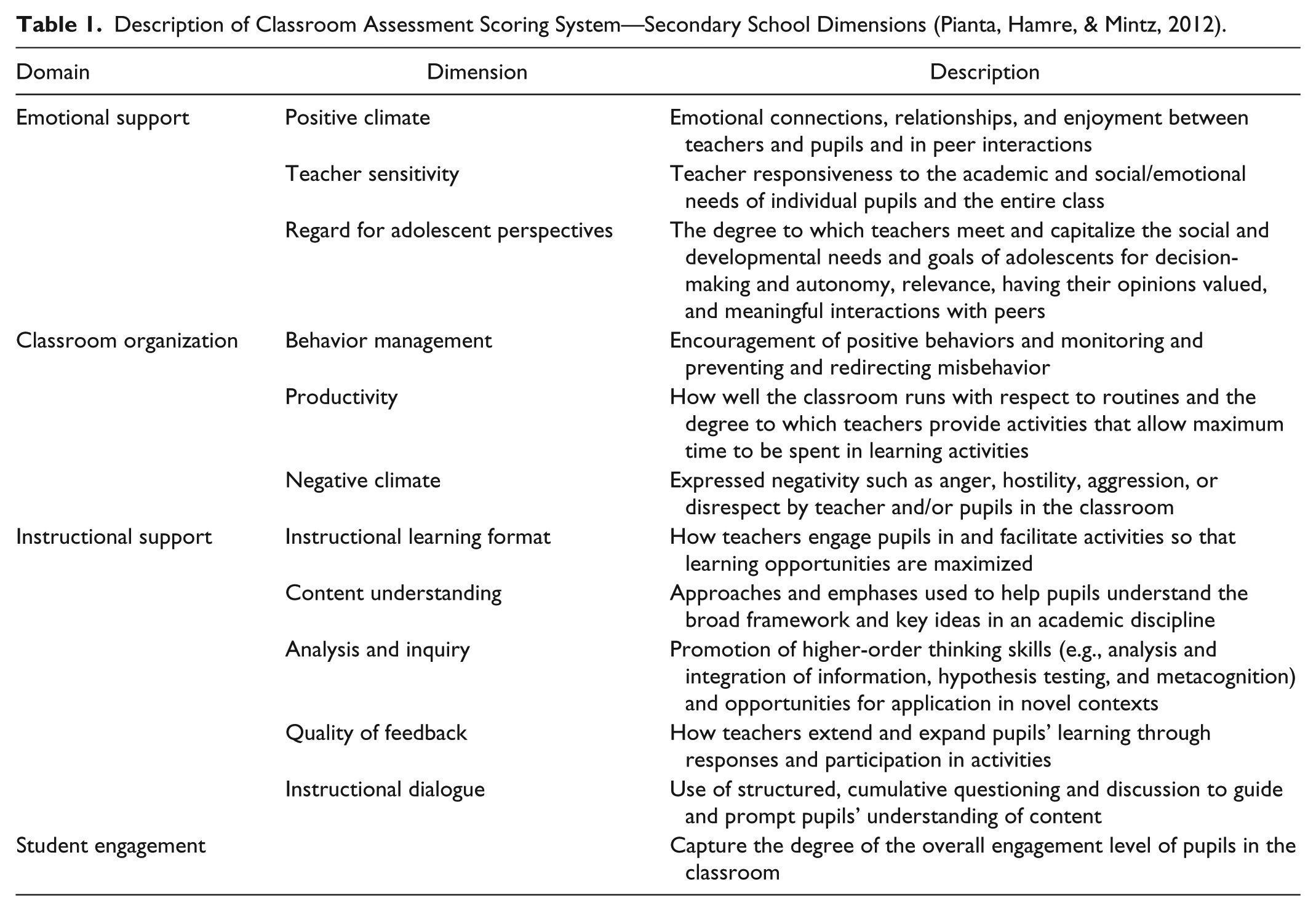
Classroom Assessment Scoring System (CLASS) is a framework that describes levels of quality in classroom interactions to enhance pupils learning across subjects and in classrooms from early childhood to secondary school (Hamre et al., 2007). Since this study is conducted in lower secondary school, the Classroom Assessment Scoring System—Secondary school (CLASS-S) observation tool is chosen. CLASS is grounded in models of effective teaching and sets of teacher performance standards (Perry et al., 2015). CLASS has been developed and tested over many years and through many studies (e.g., Hafen et al., 2015; Hamre et al., 2013; Hamre et al., 2007; Pianta & Hamre, 2009). This framework organizes teacher–pupil interactions based on a three-factor structure; each factor as a domain, capturing emotional, organizational, and instructional features (Pianta, Hamre, & Mintz, 2012). These domains are found to be essential when studying interactions that support pupil achievement. Studies in Finland (Virtanen et al., 2017) and Norway (Westergård, Ertesvåg, & Rafaelsen, 2018) have tested and validated the factor structure in CLASS-S. Both studies provide support for the a priori assumption of three interrelated factors (domains); “emotional support,” “classroom organization,” and “instructional support” (Pianta, Hamre, & Mintz, 2012). These three domains are composed of 11 dimensions in addition to one global measure; “student engagement” (See Table 1). The theoretical underpinnings for these three domains and the dimensions will further be explained.
Description of Classroom Assessment Scoring System—Secondary School Dimensions (Pianta, Hamre, & Mintz, 2012).
Domain “emotional support.”
The domain “emotional support” emphasizes pupils’ social and emotional function in the classroom as an indicator for school success (e.g., Bandura, 1997; Frenzel et al., 2007). This domain draws from attachment (Allen et al., 2013) and self-determination theories (Deci & Ryan, 2000; Ryan & Deci, 2000), highlighting individual’s need for relatedness. The dimensions assessed within the “emotional support” domain is grounded on decades of research demonstrating that relational supports and connections, autonomy, and competence, and relevance are critical to school success (Deci & Ryan, 2000; Eccles et al., 1993; Pianta, Hamre, & Allen, 2012). “Emotional support” contains three dimensions: “positive climate,” “teacher sensitivity,” and “regard for adolescent perspectives.”
Positive climate
A strong teacher–pupil relationship has shown a clear link with positive academic and social learning outcomes, enhancing motivation, and positive behavior (Allen et al., 2013). Indicators such as enjoyment and relationships are included in “positive climate” (Pianta, Hamre, & Allen, 2012). Supporting teacher–pupil interactions relate to preventive anxiety and depression among pupils and problem behaviors (Wang et al., 2013). Researchers claim that pupils perform better in learning environments that are challenging but immediately supportive and to which pupils perceive they belong (Hafen et al., 2015; Wang & Eccles, 2013).
Teacher sensitivity
“Teacher sensitivity” has proven to be a key element in the quality of teacher(s)–pupil(s) interactions (Verschueren & Koomen, 2012). It includes pupils’ needs and teachers’ ability to promote emotionally supportive classroom environments with warm and caring relationships (Pianta, Hamre, & Allen, 2012). Sensitive teachers respond to the social, emotional, and professional needs of single pupils, and the class as a group (Hafen et al., 2015).
Regard for adolescent perspectives
Teachers at secondary school that support pupils’ need for autonomy and codetermination are crucial for developing learning environments that engage young people (Eccles et al., 1993). Bandura (1993) underpins pupils’ beliefs in their own capacity to exercise control over their lives. These efficacy beliefs influence pupils’ thoughts, feelings, motivation, and actions. To give pupils meaningful choices within the framework of the lesson increases pupil engagement (Allen, Kuperminc, Philliber, & Herre, 1994). Decision-making and autonomy, relevance, having pupils’ opinions valued, and meaningful interactions with peers is crucial for learning environment that enhance learning and pupils’ engagement (Bru, Stornes, Munthe, & Thuen, 2010; Eccles et al., 1993; Pianta, Hamre, & Allen, 2012). For example, providing pupils with meaningful choices increases their engagement (Allen et al., 2013). Furthermore, a mismatch between the pupils’ need for autonomy and the teacher’s exercise of control might result in decreased pupil learning (Bru et al., 2010; Eccles, Wigfield, & Schiefele, 1998).
Domain classroom organization
“Classroom organization” measures classroom processes related to the organization and management of pupils’ behavior, time, and attention in the classroom (Pianta, Hamre, & Mintz, 2012). The theoretical underpinnings of this domain include work by developmental psychologists interested in pupils’ self-regulatory skills (e.g., Pintrich & De Groot, 1990; Schunk, 2005). Importantly, as emphasized by Pintrich (2000), the development and expression of regulatory skills is highly dependent on the classroom environment. “Classroom organization” contains three dimensions: “behavior management,” “productivity,” and “negative climate.”
Behavior management
This dimension refers to efficient, predictable, and goal-oriented activities and disciplinary practices in the classroom with the aim of engaging pupils in learning activities by encourage desirable behavior and prevent and redirect misbehavior, thereby maximizing learning time (Hamre et al., 2007; Pianta, Hamre, & Mintz, 2012).
Productivity
Classroom sessions where pupils are continuously exposed to the ability to learn and where inoperative time is reduced to a minimum are characterized as productive (Allen et al., 2013; Woolfolk Hoy & Weinstein, 2006). Work by “process-product researchers also focused attention on the importance of time management, providing consistent evidence that pupils are most engaged in productive classrooms and that this engagement, in turn, is directly associated with pupil learning” (e.g., Brophy & Evertson, 1976, cited by Pianta, Hamre, & Mintz, 2012, p. 4).
Negative climate
Awareness of negative emotions is important for pupils’ learning (Pianta, Hamre, & Allen, 2012). When adults provide emotional support in a preemptive, consistent, and safe environment, pupils are more assisted and able to take greater risks when they participate in classroom activities (Bowlby, 1969).
Domain instructional support
This domain highlights the “distinction between simply learning facts and gaining ‘usable knowledge’ which is built upon learning how facts are interconnected, organized, and conditioned upon one another” (Pianta, Hamre, & Mintz, 2012, p. 4). Classrooms with high levels of instructional support seems to have teachers who actively facilitate pupils’ high-level thinking (Allen et al., 2013), for example, by providing feedback that expands pupils’ learning and understanding, explaining learning intentions and promote dialogues to guide and prompt pupils’ understanding of content (Gamlem & Munthe, 2014; Pianta, Hamre, & Mintz, 2012). “Instructional support” contains five dimensions: “instructional learning formats,” “content understanding,” “analysis and inquiry,” “quality of feedback,” and “instructional dialogue.”
Instructional learning formats
How the teacher enhances pupil involvement and engagement through clear and current presentations of material, active promotion of learning, and interesting and engaging instruction is addressed in “instructional learning formats” (Good & Brophy, 2008; Pianta, Hamre, & Mintz, 2012). When teachers introduce and explain learning goals, research finds that learning outcomes are higher than when the teacher does not provide this (Black & Wiliam, 1998; Brophy, 1996; Hiebert & Grouws, 2007). Furthermore, effective teachers guide pupil performance through numerous examples, modeling, and opportunities for both supervised and independent practice (Bransford et al., 2000; Hafen et al., 2015).
Content understanding
This dimension can be understood from how the subject is taught in depth by providing multiple and varied examples, using contrasting nonexamples of concepts and procedures and helping pupils comprehend the framework, key ideas, and procedures in an academic discipline enhance pupils’ learning (Allen et al., 2013; Hafen et al., 2015). Pupils’ content understanding seems to develop when new concepts or broad ideas are linked to pupils’ prior knowledge in ways that advance understanding and clear misconceptions (Bransford et al., 2000).
Analysis and inquiry
Metacognitive approaches to instruction have shown to increase the degree to which pupils will transfer to situations without the need for explicit prompting as they become more self-regulated (Andrade, 2010; Butler & Winne, 1995).
The cognitive and metacognitive strategies teachers use to enhance pupils’ understanding and engagement in work with instructional content are important for pupil learning (Hafen et al., 2015; Wiliam & Leahy, 2007; Zimmerman, 2000b). Effective teaching engages pupils in high-level thinking skills through the application of knowledge and skills to novel and/or open-ended problems, tasks, and questions (Allen et al., 2013; Bransford et al., 2000).
Quality of feedback
High-quality feedback serves to enhance pupil learning either by bridging the gap between a pupil’s current level and the target goal and/or by pushing the pupil to think or process information in greater depth (Hattie & Timperley, 2007; Sadler, 1989; Wiliam, 2011). Effective feedback is tied to natural settings, is immediate, contingent, and corrective and/or specific (Black & Wiliam, 2009; Hattie & Timperley, 2007). Effective and quality feedback serves to increase interest, motivation, effort, and promote learning and higher-order thinking (Good & Brophy, 2008; Hattie & Timperley, 2007).
Instructional dialogue
Instructional dialogue is characterized as “purposeful questioning and chaining of ideas into ‘coherent lines of thinking and inquiry’” (Wolfe & Alexander, 2008, p. 8). Pupils seem to learn more when they are engaged in deep and meaningful conversation about content (Wolfe & Alexander, 2008). Literature has highlighted the importance of building shared dialogue, in contrast to the more typically seen classroom conversation patterns in which teachers ask question, pupils respond, and teachers ask follow-up questions (Mehan, 1979; Sinclair & Coulthard, 1975). Small-group discussions and whole-class dialogue are considered in “instructional dialogue” (Hiebert & Grouws, 2007).
Student engagement: A global measure
“Student engagement” functions as a global measure, focusing on the overall engagement level of pupils and pupil functioning in the classroom (Pianta, Hamre, & Mintz, 2012). In classrooms with high level of pupil engagement, pupils are full participants in the learning process and take full advantage of the opportunities provided for them. Pupils are, for example, responding to questions, asking their own questions, sharing ideas, or manipulating materials when showing engagement. High engagement is sustained throughout different activities, and pupils appear to be on-task and focused on their class-related goals (Allen et al., 2013; Pianta, Hamre, & Allen, 2012).
Student engagement is not included in the three-factor model of teacher–pupil interactions in CLASS-S but functions as a global measure analyzing the overall engagement level of pupils and pupil functioning in the classroom (Pianta, Hamre, & Mintz, 2012; Westergård et al., 2018).
Method
Participants
This study is part of a larger research project; (blinded), which has followed ninth-grade classes (age, 14-15 years) in 10 lower secondary schools in Norway over a school year (2016-2017). The participating classes were involved in an intervention over 7 months, emphasizing a value to strengthen pupils’ self-regulated learning (Zimmerman, 2000a), pupils’ use and seeking of feedback to enhance learning (Hattie & Timperley, 2007), and to empower pupils’ self-efficacy beliefs (Bandura, 1997) while working with Mathematics. The participating teachers and pupils gave written consent for their own participation in the study, and parents gave written consent to allow their children to participate.
In this study, video recordings were collected from 10 classes (N = 115 lessons), all in Mathematics. All the classrooms were Norwegian speaking. Class size varied from 21 to 25 pupils, (M = 23).
Measures
In this study, pupils’ achievement score on the National Curriculum Mathematics Test (ninth grade) is used as a measure for pupil learning Mathematics (on class level). The test was conducted in all classes as a premeasure before the observation period and then used as a postmeasure after 7 months of teaching Mathematics (see Figure 1).

Research design of data collection.
Time limit for the National Curriculum Mathematics test was set to 90 minutes, and it was answered individually on a computer. Pupils’ achievement on the test is scored by giving 1 point for each right answer, and 0 if the answers were wrong or not answered. A sum score in percent on class level based on number of right answers were made. Pupils’ improvement in Mathematics is measured by the difference in the pretest and posttest results, (see Table 2).
Prescore and Postscore on “National test in Mathematics,” Class Level.
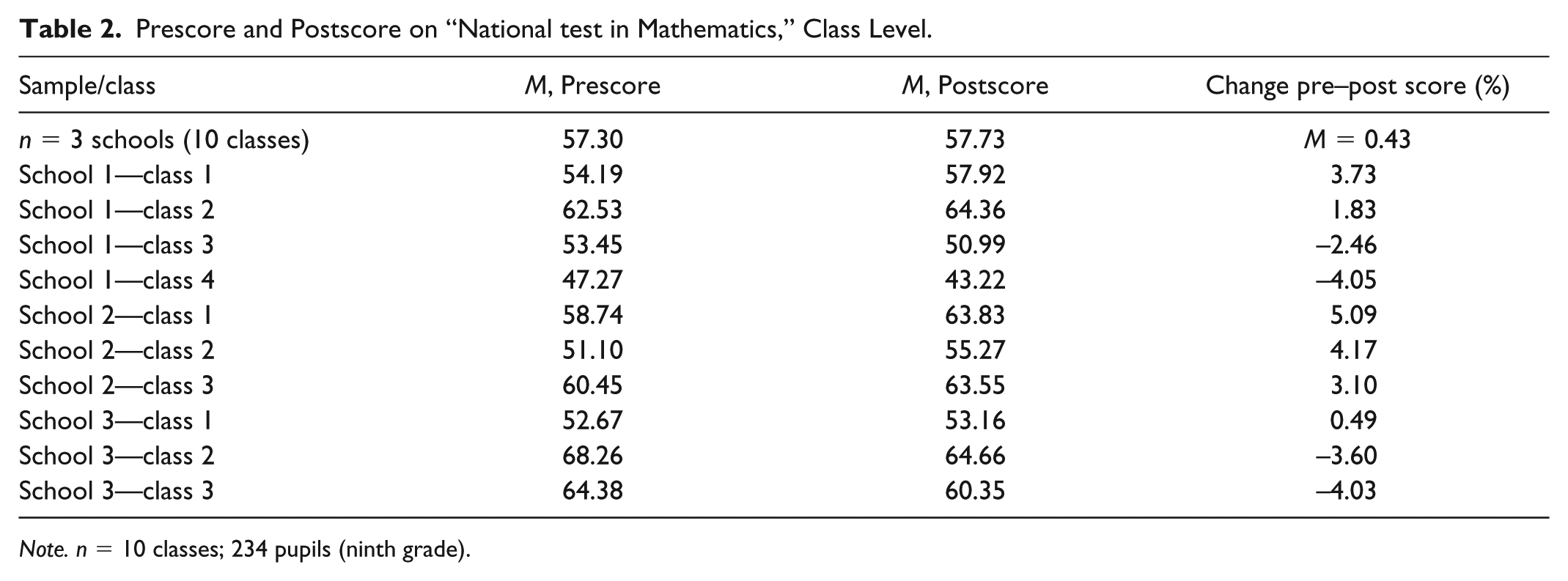
Note. n = 10 classes; 234 pupils (ninth grade).
Classroom interactions
Teaching can be understood as a system; “a pattern of teaching” (Stigler & Hiebert, 1999) and using CLASS-S (Pianta, Hamre, & Mintz, 2012), a pattern of teaching through interactions and quality of these interactions can be mapped. Still, although videotapes are a rich source of information, they provide only glimpses of the full activity of teaching and pupil learning. The position taken in this article is that teaching is best viewed as a system of interacting features, broader units that preserve the potentially important interactions in teaching is used. The typical daily lesson is one such unit (Stigler & Hiebert, 1999) and “has the advantage of being large enough to include key interactions among teaching features and small enough to be thoroughly analysable” (Hiebert & Grouws, 2007, p. 377).
The CLASS-S assesses classroom interactions for 7th to 12th graders in the United States (Pianta, Hamre, & Mintz, 2012), which will be the same in the Norwegian school context. The pupils’ age in this study is used as the criterion for choosing the appropriate version of the CLASS measure to study teaching Mathematics.
Procedure
Video recordings were taped between late October 2016 and the middle of May 2017. The teachers recorded all the videos using a camera on a tripod. To elicit all verbal communication with the pupils, the teachers used a collar clip microphone. Camera placement and how this might affect the individuals and their activity were taken into consideration (Erickson, 2006), also the best angle to capture teacher–pupil interactions. The camera was positioned in front of the classroom so that it captured the teacher as well as the whole class.
Analysis
Video recordings are all from the common core subject of Mathematic. Lessons (N = 115) last 45 minutes, resulting in a total of 5,175 minutes or 86.25 hours of film. Table 1 gives an overview of the 12 variables coded to score for quality in teacher–pupil interactions.
Scoring is determined by the quality of teachers’ social and instructional interactions with pupils as well as the intentionality and productivity evident in classroom settings. Quality of teacher–pupil interactions to support learning is the focus in this study, not only that interactions are presented. This means that it is not enough to study that feedback is observed in a lesson, it is the quality of the feedback that is studied. Still, when actions that reflect quality are absent in learning activities this also becomes a focus.
To code quality of the interaction, a scale with a 7-point Likert-type format is used. The variables (see Table 1) are anchored in dimensions and behavior markers provided in the CLASS-S manual (Pianta, Hamre, & Mintz, 2012), which are scored along a continuous rating scale between 1 and 7 (1-2 = low range, 3-5 = middle range, 6-7 = high range). A score 1 is given if a variable is not present or if it is of very low quality.
Each video is viewed in 15-minute cycles, notes are taken, and scores are given for each dimension for each cycle. This resulted in 345 cycles of video recordings for all 12 variables. Each coding is recorded on a separate scoring sheet before beginning the next observation cycle. Furthermore, a total score was computed for each variable in a lesson based on the average scoring rate for the three 15-minute cycles in the 45-minute lesson; for example, (instructional dialogue 1 + instructional dialogue 2 + instructional dialogue 3)/3 = total score of “instructional dialogue” in a lesson.
Reliability
One CLASS-S–certified coder performed all the coding. To ensure reliability of the CLASS-S ratings, an interrater reliability check was conducted with two independent researchers. This was done by asking two certified coders to each code three randomly chosen videos, six videos all together. The coding was done individually, before a comparison between the coders was conducted. An agreement on 86% was met for the peer coding of the six videos. In addition, the researcher did take a recertification test on the CLASS-S manual during the coding process to check for calibration and make sure she was stable in scoring and reliable—an agreement on 95% was met.
Furthermore, Cronbach’s alpha estimates for the three-factor structure scales in CLASS-S indicate rather good consistency for the domains “emotional support” (α = .76), “classroom organization” (α = .65), and “instructional support” (α = .82).
Results
Descriptive Statistics
Mean value for each dimension across the lessons in Mathematics (N = 115), with minimum and maximum scores, standard deviation, standard error of the mean, skewness and kurtosis are presented in Table 3. The full range of the scale (low, middle, and high) was used for only one dimension; “instructional learning formats,” with a minimum score of 1.33 and a maximum score of 6. The dimension “analysis and inquiry” has the lowest maximum score of all dimensions with the score 3.67 (middle range), while “positive climate,” “teacher sensitivity,” “behavior management,” and “productivity” have the highest maximum score, 7. All dimensions, except “negative climate,” have acceptable skewness values (±1.96). All kurtosis values, except “regard for adolescent perspectives” and “negative climate” are acceptable.
Descriptive Statistics for CLASS Dimensions.

Note. N = 115 lessons. Min = minimum scores, Max = maximum scores, SE = standard error of the mean, Skew = skewness, and kurtosis. Likert-type scale: 1-2 = low range; 3-5 = mid range; 6-7 high range.
The mean score for the dimensions in the domain “emotional support” (positive climate, teacher sensitivity, and regard for adolescent perspective) are in the middle range (score between M = 2.35 and 4.72), indicating generally middle quality in the observed classrooms (see Table 2). Furthermore, the mean scores for the dimensions in the domain “classroom organization” (behavior management, productivity, and negative climate) vary from the low range (M = 1.13) to the high range (M = 6.02). “Behaviour management” is the dimension with the highest mean score overall for the 11 dimensions (M = 6.02), indicating generally high quality, while “negative climate” with a mean score of 1.13 indicates generally no or rare episodes of negativity by the teacher and/or pupils. “Productivity” with a mean score in the high middle range (M = 5.58) indicates the degree to which teachers provide activities that allow maximum time to be spent in learning activities for the pupils. Finally, the mean score for the dimensions in the domain “instructional support” (instructional learning formats, content understanding, analysis and inquiry, quality of feedback, and instructional dialogue) are in the low to middle range (score between M = 1.63 and 3.25) in the observed classrooms.
The global measure “student engagement” has the mean score 4.49, indicating general quality in the middle range. This mean score reports the degree to which all pupils in the classroom are focused and participating in the learning activity presented or facilitated by the teacher. “Student engagement” has a minimum score of 3.0, and a maximum score of 6.33.
Based on the descriptive statistics (Table 3), we see that there are indications that the lessons in Mathematics (N = 115) in this study are characterized by a positive and supportive emotional climate and that the teachers generally use effective methods to encourage desirable behavior and prevent and redirect misbehavior. The high mean score for “behaviour management” also indicate that pupils are compliant and that there are few instances of pupil misbehavior. The analysis also elicits that dimensions from the domain “instructional support” is of far lower quality than the dimensions from the domain “emotional support.” The global measure “student engagement” is scored in the middle range. This indicates that there is a mix of pupil engagement with most pupils actively engaged for part of the time and disengaged for rest of the time—or a mix of pupil engagement with some of the pupils actively engaged and some disengaged.
Correlation Matrix of the Dimensions of the CLASS-S
Relationships (Pearson’s r product–moment correlations) among the 12 variables of teaching through interactions for the lessons in Mathematics (N = 115) are reported in Table 4. Results show a range in significant correlations from r = .77 to r = −.20. “Negative climate” correlates negatively with several of the dimensions and the highest with “behaviour management” (r = −.36, p < .01), “positive climate” (r = −.33, p < .01), and “student engagement” (r = −.27, p < .01).
Correlation Matrix of the Raw Scores of the Teaching Through Interactions in Mathematics—Dimensions of the CLASS-S.

Note. N = 115 lessons in Mathematics (45 min). PC = positive climate; TS = teacher sensitivity; RfAP = regard for adolescent perspectives; BM = behavior management; p = productivity; NC = negative climate; ILF = instructional learning formats; CU = content understanding; AI = analysis and inquiry; QF = quality of feedback; ID = instructional dialogue; SE = student engagement.
Correlation is significant at p < .05 (two-tailed).
Correlation is significant at p < .01 (two-tailed).
The highest significant correlation among the 12 variables are between “instructional learning formats” and “content understanding” (r = .77, p < .01). Furthermore, strong correlations are also found between “positive climate” and “teacher sensitivity” (r = .75, p < .01), “teacher sensitivity” and “instructional learning formats” (r = .75, p < .01), and “positive climate” and the global measure “student engagement” (r = .70, p < .01).
The dimensions “positive climate,” “teacher sensitivity,” and the global measure “student engagement” correlate with all variables (see Table 4). The dimension “negative climate” has the least number of significant correlations.
Patterns of Teaching: Extreme Cases
A selection of extreme cases for analysis are conducted to map if there are differences in quality for teacher–pupil interactions in classes with the highest and the lowest improvement score in Mathematics over a teaching period of 7 months. The sum scores on the National Curriculum Mathematics Test (ninth grade) for each class is used to select extreme cases.
Using the results from the pretest and posttest, the classes were ranged based on the “improvement mean score” on class level for a comparative extreme-case analysis (Yin, 2003). The two classes with the highest improvement scores (highest improvement in mathematics) in the sample (N = 10) and the two classes with lowest improvement scores (lowest improvement in mathematics) were selected to analyze if there were statistical significant differences in patterns of teacher–pupil interactions between these cases.
Analyses show differences in range of score on between the cases (classrooms) concerning the 12 variables (see Table 5). Cases 1 and 2 (highest improvement score in mathematics on class level) have overall a higher mean score, than Cases 3 and 4 (lowest improvement score) for the 12 variables. The dimensions “behaviour management” and “productivity” has the highest mean score values for these four cases, while “analysis and inquiry” has the lowest mean score for quality in the classrooms.
Patterns of Teaching Through Interactions in Mathematics (N = 4 extreme cases; 55 lessons).


Note. Four extreme cases (change in achievement score over 7 months in brackets). CLASS-S Score = 1-2 (low range), 3-5 (middle range), 6-7 (high range). CLASS-S Scores in mean values. PC = positive climate; TS = teacher sensitivity; RfAP = regard for adolescent perspectives; BM = behavior management; P = productivity; NC = negative climate; ILF = instructional learning formats; CU = content understanding; AI = analysis and inquiry; QF = quality of feedback; ID = instructional dialogue; SE = student engagement.
To test the hypothesis that the classrooms with the highest improvement score and the classrooms with the lowest improvement score were associated with statistically significantly different means for the CLASS-S dimensions, an independent samples t-test was performed. The dimension “negative climate” did not have acceptable skewness values (±1.96) and was taken out of data set. The four cases (see Table 5) were grouped into a high improvement group (Cases 1 and 2 = dummy code 1) and a low improvement group (Cases 3 and 4 = dummy code 2). A samples t-test (Levene’s test for equality of variance) was conducted to analyze if there were any significant differences in teacher–pupil interactions between the two groups based on the variables derived from the CLASS-S manual (Pianta, Hamre, & Mintz, 2012).
The assumption of homogeneity of variance was tested and satisfied via Levene’s F test (p < .05). A statistically significant difference was found when equal variance was assumed between the two groups for the dimensions “positive climate” and for the global measure “student engagement” (See Table 6). For the dimension “behaviour management,” a statistically significant difference was found when equal variance between the groups was not assumed.
Independent Samples t-Test (Levene’s Test for Equality of Variance).

Note. N = lessons (45 min). M = Mean score 1-2 (low range), 3-5 (middle range), 6-7 (high range), SD = standard deviation, SEM = standard error mean, t = t-ratio, df = degrees of freedom, p = correlation is significant at p < .05 (2-tailed), d = Cohen’s d.
Discussion
The aim of this study is to map patterns of quality teaching through interactions in Mathematics lessons in lower secondary classrooms and how teaching through interactions might differ for classrooms with a high and low improvement score in Mathematics on class level.
The samples t-test show that the dimension “positive climate” and the global measure “student engagement” both have strong effect sizes and are significant concerning pupil learning over 7 months (see Table 6). These results align with former studies emphasizing that pupils perform better in learning environments that are challenging but immediately supportive and to which pupils perceive they belong (Hafen et al., 2015; Wang & Eccles, 2013). Pupils’ social and emotional functioning in the classroom is by several researchers recognized as an indicator of school success (Hamre et al., 2007; Wang et al., 2013). Former studies have also found that pupils are more willing to invest their effort and time in Mathematics if lessons are enjoyable and interesting, rather than anxiety laden (e.g., Frenzel et al., 2007). This is something to be aware of in teacher–pupil interactions as the video analyses of the extreme cases (Table 5) show that the classrooms with the lowest improvement score in Mathematics on class level has the highest mean score of “negative climate,” while classrooms with the highest score on the achievement test have highest score on positive climate. Over all, this results emphasis the value of quality teaching belonging to the dimension “positive climate” when teaching Mathematics.
Looking at the video analysis of the 10 classrooms, the dimensions in “emotional support” (positive climate, teacher sensitivity, and regard for adolescent perspective) are generally scored in the low to mid range of quality. These results might be interpreted as low- to medium-quality opportunities to learn grounded on decades of research demonstrating that relational supports and connections, autonomy and competence, and relevance are critical to school success (Deci & Ryan, 2000; Eccles et al., 1993; Pianta, Hamre, & Allen, 2012). Former research has stated that a mismatch between the pupils’ need for autonomy and the teacher’s exercise of control might result in decreased pupil learning (Bru et al., 2010; Eccles et al., 1998). Analyses elicit that there is a variety in quality in the 10 classrooms concerning teachers’ sensitivity to pupils’ emotional and academic needs, the teachers’ regard for adolescents’ perspectives, and facilitation of a positive climate. These results are of concern, as Hafen et al. (2015) claimed that pupils in classes of sensitive teachers seems to be more committed and self-employed, have fewer internalized problems, and show greater professional progress than pupils do in classes with less sensitive teachers.
Furthermore, the sample t-test show that if equal variance is not assumed between the classrooms with a high or a low improvement score in Mathematics, the dimension “behavior management” is significant for pupil learning on class level in Mathematics. Patrick et al. (2007) claimed that classroom environment influences pupils’ beliefs about themselves and their schoolwork, which in turn relates to their engagement. The dimensions in “classroom organization” (behaviour management, productivity, and negative climate) are generally scored in the high range of quality in the 10 classrooms (“negative climate” is reversed; low score is no or rare episodes of negative climate). These results show medium- to high-quality interactions for these dimensions and can be understood as positive for pupils’ opportunities to learn. These results also align with the findings by Frenzel et al. (2007) that pupils are more willing to invest their effort and time in Mathematics if lessons are enjoyable and interesting, rather than anxiety laden. This indicates that the lessons generally are efficiently managed, predictable, and consists of goal-oriented activities and disciplinary practices with the aim of engaging pupils in learning activities and prevent and redirect misbehavior.
The dimensions in “instructional support” (instructional learning formats, content understanding, analysis and inquiry, quality of feedback, and instructional dialogue) are found to be in the low to mid range in the 10 classrooms. This indicates that pupils’ opportunities to learn are ranging from low to medium quality concerning teacher–pupil interactions. The lowest quality is found for the dimension “analysis and inquiry,” which represents cognitive and metacognitive strategies to enhance pupils’ engagement in work with instructional content. Pupils’ approach to work with analysis and inquiry is an important feature for self-regulated learning (Hafen et al., 2015; Wiliam & Leahy, 2007; Zimmerman, 2000b). Teachers emphasizing these interactions engage pupils in higher-level thinking skills through the application of knowledge and skills to novel and/or open-ended problems, tasks, and questions (Allen et al., 2013; Bransford et al., 2000). An approach of low quality in teacher–pupil interactions with these features might preclude pupils’ development of self-regulation skills, as metacognitive approaches to instruction have shown to increase the degree to which pupils are able to transfer to new situations and become more self-regulated (Andrade, 2010; Butler & Winne, 1995). To develop pupils’ skill for analysis and inquiry, teaching requires teachers to possess both a deep knowledge of content as well as flexibility in their presentation and utilization of this knowledge (Bransford et al., 2000).
The use of responsive pedagogy as an approach aiming at developing pupils’ feedback for strengthen self-regulated learning and the experience of self-efficacy to enhance learning (Smith et al., 2016) seems to be an opportunity of generally low quality in the observed lessons (N = 115). This is due to scores in low range for dimensions as regard to adolescent perspectives, quality of feedback, instructional dialogue, and content understanding. The mean score for “quality of feedback” are scored in the low range (M = 2.75), this is also found for the dimensions “instructional dialogue” (M = 2.15) and “content understanding” (M = 2.57). Aligning these results with a former study by Wolfe and Alexander (2008) strengthens the argumentation for a dilemma regarding pupils’ learning in the observed classrooms. Wolfe and Alexander find that pupils seem to learn more when they are engaged in deep and meaningful conversation about content, a practice that seems to be rarely represented in these observed lessons. Furthermore, several studies report the importance of building shared dialogue, in contrast to the more typically seen classroom conversation patterns in which teachers ask question, pupils respond, and teachers evaluate (Lampert & Cobb, 2003; Mehan, 1979; Sinclair & Coulthard, 1975). Studies have also emphasized that pupils seem to learn more when they are engaged in deep and meaningful conversation about content and are exposed to follow-up questions that expands and extends thinking, learning, and understanding (Lampert & Cobb, 2003; Perrenoud, 1998; Wiliam, 2011; Wolfe and Alexander, 2008).
Conclusion and Limitations
Quality feedback interactions serve to enhance pupil learning and serves to increase interest, motivation, effort, and promote learning and higher-order thinking, but this study reveals that a positive climate seems to be essential to generate pupils’ willingness to learn. The samples t-test show that “positive climate” and “student engagement” are dimensions in teacher–pupil interactions that make a difference for pupil learning in Mathematics when comparing classrooms with a high and low improvement score over a teaching period of 7 months.
Theories of teaching provide a framework within which to understand the teacher–pupil interactions for learning. Observations based on videos can be biased, as all videos are selections of practice; we can assume an observer and camera effect (Erickson, 2006; Lomax & Casey, 1998). In this study, the researcher did not enter the classrooms because the teachers did all the recordings, but a question can be asked how comfortable the teachers and pupils were by the presence of the video camera on the tripod.
The results from this study should not be generalized, due to sample size. Still, the results give indications for quality in teacher–pupil interactions in Mathematics lessons, and further how quality vary across classes and dimensions. More large-scale research is needed to get a deeper understanding of how certain types of teacher–pupil interactions promote or preclude pupils’ learning.
It is of importance to communicate that it is the quality of the teacher–pupil interaction that has been important to analyze in this study, and not simply that dimensions of interaction occur in the observed lessons of Mathematics. In all the classes studied, there were indications of, for example, “instructional dialogue,” but analyses elicit that the mean score were at the low range of the 7-point scale. Low quality or absence of, for example, instructional dialogue might be a dilemma when looking for quality of teacher–pupil interactions.
Quality of teacher–pupil interactions have been studied using CLASS-S (Pianta, Hamre, & Mintz, 2012), and there should be a remark that using a different observation tool could give different results. No observation system can accomplish all goals and by focusing on any one activity or aspect of instruction, others are likely to be lost (Harvey, 2006). Prioritizing the critical features of the observation tool is important, and the narrowness or breadth of the observations should be dictated by the overall purpose (Hill & Grossman, 2013). Since the focus in this study was quality of teacher–pupil interactions to enhance pupil learning in lower secondary school, CLASS-S was chosen.
As a final remark, I must add that there are other factors, such as out of school context that can impact pupils’ performance and learning.
Footnotes
Acknowledgements
The authors are grateful to Prof. John Gardner (University of Stirling), Prof. Louise Hayward (University of Glasgow), Prof. Reinhard Pekrun (Ludwig-Maximilians-Universität München), Prof. Mien Siegers (Maastricht University), and the RespMath research team (Responsive Teaching and Student Learning in Mathematics) for comments on an earlier draft.
Declaration of Conflicting Interests
The author(s) declared no potential conflicts of interest with respect to the research, authorship, and/or publication of this article.
Funding
The author(s) disclosed receipt of the following financial support for the research, authorship, and/or publication of this article: This study was supported by the Norwegian Research Council (grant no. 237442 for 2015-2018).
