




Abstract
This study discusses the cooperation model between the small and major scenic spots in peak seasons of tourism. First, we create a tourism supply chain that contains only one major and one small scenic spots to divert some tourists to a nearby scenic spot, reduce large scenic spot pressure, increase the benefits of small scenic spots, and promote the healthy development of the tourism supply chain. Second, we build two cooperation models between the major and the small scenic spots: the revenue-sharing model and the cost-sharing model. Based on a numerical analysis, we give a more clear comparison about the revenue changes and the overall efficiency changes of the tourism supply chain in these two models. Our results confirm that the cost-sharing model is an ideal cooperation model. In the cost-sharing model, the two parties’ revenues in the tourism supply chain are better than those in the revenue-sharing model, and the entire supply chain efficiency could be improved.
Introduction
Tourists are seasonally distributed in tourism destinations (Hastings, 2019). The major scenic spots with a significantly mature business model have rich tourism resources. Therefore, their attraction for tourists is strong. Most of the major scenic spots are crowded during the tourist season, especially in the annual statutory holidays. Crowding substantially reduces the viewing experience of visitors and is not conducive to the improvement of the service quality of major scenic spots. Consequently, in some popular scenic spots, tourists are not allowed to enter. For example, many passengers have been denied admittance to Hong Kong Disneyland in the Spring Festival of 2006 (Wang, 2006). The major scenic spots have increasing environmental protection pressure because of the excessive influx of tourists. This problem must be solved by major scenic areas in South Africa. The development of the scenic area itself will be affected, and the economic growth of the region near the scenic area will be reduced.
Many small scenic spots close to the major scenic spots do not easily gain the attention of tourists. These small scenic spots also have a few tourists even during the holidays, unlike the major scenic spots. These small scenic spots commonly have rich cultural and natural connotation. For example, the Simons Town and the George Town located in Cape Town are two typical scenic spots with time-honored history and typically represents the architecture of South Africa (Wikipedia, 2019a, 2019b). However, only a few people know about and travel to these towns. Accordingly, the small scenic spots have not been fully explored, and power and value to the local economic development are insufficient. This situation is not conducive to the development and protection of small scenic spots.
We use game theory methods to establish cooperation and coordination mechanisms between major and small scenic spots in the tourism supply chain to solve this dilemma. Large and small scenic spots are integrated to form a tourism supply chain. Major scenic spots have a limited carrying capacity. The largest revenue will be achieved when the number of visitors reaches its maximum carrying capacity. Given the increasing costs of environmental protection and the decreasing visitor views, the largest revenue of major scenic spots decreased when the number of visitors exceeds its maximum carrying capacity.
To ensure income stability and consumption satisfaction, major scenic spots would like to provide visitors with the following options when the maximum carrying capacity is exceeded.
The first choice is to purchase the tickets of the nearest small scenic spots and major scenic spots, or third-party transport companies provide transportation to these spots. Therefore, visitors do not shoulder additional costs.
The second choice is to purchase the tickets of small scenic spots. The major scenic spots are not responsible for providing transport and other supporting services for tourists.
The major scenic spots deny the visit and have no responsibility to compensate for any loss of tourists if tourists are not interested in the two programs and are not willing to go to small scenic spots.
In the first choice, major scenic spots can divert some of the visitors to small scenic spots to reduce their own pressure; improve service levels as well as the travel experience and satisfaction of visitors; and protect the environment of the major scenic spots. Small scenic spots can also improve their visibility through the large scenic diversion behavior, and the increased number of passengers can increase revenue. The cooperation and coordination mechanism to share information between the major scenic spots and small scenic spots has positive significance and promotes the healthy development of the tourism supply chain.
In the second choice, the revenue of small scenic spots increased, but major scenic spots do not gain benefit and the cost of visitors increases. Consequently, regardless of what point of view is taken into account, the second choice is not the optimal solution.
Small scenic spots must provide incentives to encourage large scenic spots to provide positive information to encourage tourists to choose the first option. Therefore, this study focuses on the following questions.
How can small scenic spots strategize the promotion of major scenic spots to join the tourism supply chain? How does the tourism supply chain increase its revenue and reduce the excessive imbalance of visitor distribution conditions through cooperation?
When major scenic spots cooperate with small scenic spots, which cooperation model is highly efficient to ensure that their revenues increased?
The rest of this article is organized as follows. Section “Literature Review” provides the literature review. Section “Problem Description and Models” describes the problem and the models in detail. Section “Numerical Illustration” provides a numerical illustration. Finally, Section “Conclusions and Future Research Directions” concludes the study.
Literature Review
The concept of tourism supply chain has been used widely in existing studies (X. Guo & He, 2012; Ling, Guo, & Yang, 2014). Tourism management has received widespread research interest because of the rapid development of the tourism industry. Such management enhances the competitiveness of enterprises generated from the background of economic globalization, increasing market competition, and diverse demand. Moreover, this management starts from the information sharing between upstream and downstream enterprises and coordinates the operation concerning the flow of goods and cash to realize a stable and effective supply–demand relationship (Yang, Huang, Song, & Liang, 2009).
Similar to the traditional manufacturing supply chain, the tourism industry consists of a series of enterprises that pursue their own interests but interact with one another. A substantial understanding of the interaction of enterprises plays a critical role in the operation of enterprises. Therefore, supply chain management is also applied to the analysis of the tourism industry. However, the tourism supply chain has gained little research attention (Song, Yang, & Huang, 2009). The study on the comprehensive framework for the tourism supply chain model, strategy, and revenues of supply chain management still needs improvement.
Tourism Supply Chain Management (TSCM)
Most existing literature (for example, Alford, 2005; Annibal, Leonardo, & Luiz, 2001; Antunes, 2000; X. Guo, Zheng, Ling, & Yang, 2014; Schwartz, Tapper, & Font, 2008; Trunfio, Petruzzellis, & Nigro, 2006; Welford, Ytterhus, & Eligh, 1999) used the tourism supply chain directly without presenting its definition. Following the purpose of these papers, the tourism supply chain can be described as the assembly of a series of entities (individuals, organizations, or commercial enterprises) that participated in the production and delivery of tourism service, information, finance, and tangible products for tourists directly or indirectly. Smith and Xiao (2008) studied three common tourism supply chain structures: agricultural market supply chain, holiday supply chain, and food and beverage supply chain. They confirmed that the macroeconomic situation and policy changes have a profound impact on the tourism industry. Accordingly, they suggested that the tourism supply chain participants must conform to the macroeconomic situation and improve the ability to respond to emergencies to minimize the loss of the supply chain system. Véronneau and Roy (2009) studied the operation model of the Yacht Company from the perspective of supply chain and raised some problems and the countermeasure of strategic, management, and other aspects of the Yacht Company. X. Guo et al. (2014) analyzed the coopetition relationship between hotels and online travel agencies from the perspective of cash back after stay. In their model, the online travel agencies distributes the hotels’ rooms at a given retail price determined by the hotels and provides their consumers a cashback after they finish their stay in the hotels.
In light of these studies, follow-up publications have paid attention to the practical applications of the tourism supply chain. Q. Guo (2008) studied the game that native tour operators and tour operators in the tourism supply chain presented low- and high-level tourism products and analyzed the mechanism and existing conditions for the birth of zero or negative fare. Yang, Huang, Song, and Liang (2008) established the game model of supply chain comprising theme parks, hotels, and tour operators by discussing the best choice of sales maximization strategy and profit maximization for tour operators and hotels under the conditions of department coordination and free choice. Yang et al. (2009) constructed the game model of the competition of two supply chains in the Hong Kong tourism industry and analyzed the number of the members in the tourism supply chain and their preferences, which include the influence of integration on the tourism supply chain. Song et al. (2009) conducted a theoretical investigation into pricing competition and coordination between Hong Kong Disneyland and a tour operator. X. Guo and He (2012) studied the tourism supply chain cooperation contracts between a tour operator and a tourism hotel. They affirmed that a revenue-sharing contract fully coordinates the tourism supply chain.
Sustainable Cooperation Research in TSCM
Game theory has gradually become one of the most common methods in TSCM in investigating the cooperation between service suppliers and retailers. Caccomo and Solonandrasana (2001) used game theory methods to study the problem of competition among the travel agencies from different regions. They believed that asymmetric information is widespread in the tourism supply chain, especially in transactions between tourists and travel agencies. Travel agencies are active. Therefore, visitors generally cannot obtain the most reliable price information. If geographical differences exist, then price differences would be easy to exist, and achieving the game equilibrium would be difficult. Wie (2004) used a dynamic noncooperative game model to study the luxury travel market in the Aegean region. The research confirmed that major travel companies in the formative years of this industry commonly expand the scale to improve their market size and share quickly. However, in the market’s mature stage, the major travel companies have to adjust their strategy to gradually and timely strengthen and improve their operational capacity and prevent risks. The expansion of the scale is no longer the first choice of the supply chain competition. The result further verified that the mature tourism market in the Aegean region is a typical oligopolistic competition.
Accinelli, Brida, Punzo, and Sanchez Carrera (2009) analyzed the environmental protection strategy from the perspective of policy makers; they assumed that decision-makers first decide whether to make environmental policy or fund for the establishment of environmental protection projects. Tourists determine the length of travel time according to the quality of the environment. They stay for a long time if the environment is good. The study confirms that the nearby residents of scenic spots are also agreeable to a party game. As long as the nearby residents are willing to participate in environmental actions, the game can achieve balance, and the income of the tourism supply chain increases. Morgan and Trivedi (2007) established a Nash game model to analyze the game among the residential services for enterprises, travel agencies, and tourists. The assumption under normal circumstances is that accommodation service companies can provide different quality levels of service. The second assumption is that travel agents understand the quality levels of service of accommodation service enterprises, and travel agents can disclose to the tourists the true level of service of the hotel. They can also choose to exaggerate the hotel level of service. Visitors then decide whether to stay at the accommodation service enterprise because of the information provided by travel agencies. They also decide whether to settle in the accommodation service enterprise according to their own experiences. The study confirmed that the travel agencies evaluate the quality of residential business services according to different price levels.
X. Guo, Ling, Dong, and Liang (2013) studied the cooperation contracts between hotels and online travel agencies using a mixed game model, which includes a Stackelberg game between service providers and retailers and a Nash game among the service providers. They verified that the cooperation contract becomes sustainable, given that its performance is close to that of the integrated model. Ling et al. (2014) investigated the strategy of hotels to open online marketplaces by cooperating with online travel agencies using a game model, and X. Guo et al. (2014) gave the optimal terms of cooperation contracts for hotels to maximize revenue when cashback promotion is adopted by online travel agencies.
The research in the tourism supply chain has been given considerable attention, but the literature that focuses on the sustainable cooperation contracts between small and major scenic spots, especially during the peak tourism seasons, is limited. To fill this gap and generate insightful implications for the sustainable cooperation relationship between scenic spots, this study investigates three types of cooperation contracts, including the centralized model as a benchmark, using the game theory model.
Problem Description and Models
We first present the research problem in this section. Then the three models, namely, the centralized decision-making model, the revenue-sharing model and the cost-sharing model are analyzed.
Problem and Model Setup
We use the following notation throughout the article. Only one small scenic spot (such as Simons Town located in the famous Cape Town) and one major scenic spot (such as Cape Town) are employed. The fact that the definition of a major scenic spot is not in terms of scale is worthy of note. The major scenic spot in this study has many tourists and mature supporting facilities. The small scenic spot refers to less famous and small-scale spots with few tourists.
Due to the lack of tourism demand, we assume that small scenic spots invite the large scenic spot to join the tourism supply chain. A major scenic spot that agrees to join the tourism supply chain will provide certain ancillary services, such as consignment tickets for the small scenic spot. Meanwhile, to encourage the majors to provide additional services, the small scenic spot would like to provide certain incentives or cost sharing to the major scenic spot. As a result, the small scenic spot can increase revenue, and the major scenic spot can also reduce the pressure from visitors and protect the environment.
We assume the x units of the tourist flow to the small scenic spot from the major scenic spot, and the eventual benefits that the small scenic spot will gain from each unit of visitors are represented by s. The total revenue function the small scenic spot can gain from all of these visitors is
Some tourists choose to leave major scenic spots to divert to small scenic spots, which implies the considerably high promotional costs of the major scenic spots, and the revenue of major scenic spots shows some loss. Consequently, the cost function of the major scenic spot is
Centralized Decision-Making Model
The entire supply chain in the centralized decision-making model can be viewed as a whole. Cooperation is the optimal choice to obtain win–win cooperation. The major and small scenic spots maximize the overall revenue of the entire tourism supply chain. Therefore, this study focuses on how to choose a reasonable and acceptable contract x using both sides of the cooperation model. The major and small scenic spots are undifferentiated units in the tourism supply chain. These two units can achieve unified decision making. Accordingly, the revenue of the entire supply chain is

The major and small scenic spots in the tourism supply chain choose to select a single decision-making context to achieve revenue maximization. The Leibniz principle states that equation (1) is the concave function. Consequently, we may obtain the partial derivative to b easily, and the optimal amount of tourists’ change of the major scenic spot should satisfy the following:

Therefore, the total revenue of the tourism supply chain can be expressed as follows:

Revenue-Sharing Model
In the revenue-sharing model, the small scenic spot launches a tourism supply chain and then the major scenic spot decides whether to join the tourism supply chain. The game is over if the major scenic spot chooses to not join the tourism supply chain. The revenue of the small scenic spot does not grow. Given the environmental carrying capacity constraints, the major scenic spot can only deny tourists; thus, the revenue of major scenic spots also stops to increase.
If the major scenic spot decides to participate in the tourism supply chain, some tourists can divert from the major to small scenic spot. Therefore, the revenue of the small scenic spot grows quickly, and new revenue is divided into a certain proportion to the major scenic spots; the distribution coefficient is b.
In the revenue-sharing model, the model is superior to noncooperation as long as the revenue of small scenic is greater than 0. Accordingly, the major and small scenic spots choose to cooperate with each other.
In the revenue-sharing model, the revenue of the major scenic spot is the following:

Some tourists who divert from the major to small scenic spots increase the cost of the small scenic spot. The increased cost of the small scenic spot is rx, and r expresses the average cost of every tourist.
Therefore, the revenue of the small scenic spot can be expressed as follows:

We can obtain the optimal total quantity of tourist diversion in the tourism supply chain by backward induction. The revenue of the major scenic spot is maximized. The Leibniz principle stated that equation (4) is the concave function, the partial derivative to x exists, and the optimal amount of the tourist change of the major scenic spot should satisfy the following:

Equation (6) represents the optimal total quantity change of tourists in the revenue-sharing mode. The profits of the major scenic spot can achieve maximum.
The total quantity of tourist change is inversely proportional to the cost coefficient of the major scenic spot. The greater the cost coefficient is, the less the maximum number of tourists is diverted from the major scenic spot to the small scenic spot. The less the cost coefficient is, the greater the maximum number of tourists who divert from the major to the small scenic spot.
The optimal quantity of tourist change is proportional to the sharing ratio of the small scenic spot. The greater the sharing ratio is, the greater the optimal quantity of tourist change becomes. The smaller the sharing ratio is, the less the optimal quantity of tourist change becomes. When the small scenic spot relays the strategies of the major scenic spot, its decisions are in favor of revenue maximization under their own conditions. Accordingly, after the decision of the major scenic spot, the payoff function of the small scenic spot is as follows:

We can obtain the optimal decision of the small scenic spot by the first-order conditions with respect to b of equation (7); we then have the following:

Substituting equation (8) into equation (6), we can obtain the following:

Therefore, the benefits of the major scenic spot in the revenue-sharing model are as follows:

The benefits of the small scenic spot in the revenue-sharing model are as follows:

Therefore, the total revenue of the tourism supply chain in the revenue-sharing model is as follows:

Cost-Sharing Model
In the cost-sharing model, the small scenic spot launches a tourism supply chain, and the major scenic spot decides whether to participate in the tourism supply chain. The game is over if the major scenic spot chooses not to join the tourism supply chain. The small scenic spot continues to launch other major scenic spots to form a supply chain until a major scenic spot decides to participate in the tourism supply chain.
If tourists divert from the major scenic spot to the small scenic spot, then the small scenic spot should share the revenue with the major scenic spot, and the major scenic spot should gain some cost sharing in a certain proportion. The cost-sharing ratio is
Therefore, the benefits of the major scenic spot are the following:

The revenue of the small scenic spot is as follows:

We can obtain the optimal total quantity of tourist change in the tourism supply chain by backward induction. The revenue of the major scenic spot is maximized. The Leibniz principle states that equation (14) is the concave function, that the partial derivative to x exists, and that the optimal amount of tourist change of the major scenic spot should satisfy the following:

Therefore, the revenue of the small scenic spot is as follows:

We can obtain the optimal decision of the small scenic spot by the first-order conditions with respect to

Substituting equation (17) into equation (15), we can obtain the following:

In the cost-sharing model, the revenue of the major scenic spot is as follows:

The revenue of the small scenic spot is the following:

Accordingly, the total revenue of the tourism supply chain in the cost-sharing model is as follows:

Proof
This result is easily proven in equations (9) and (18).
Proposition 2 shows that
The optimal quantity of tourist change is inversely proportional to the cost coefficient of the major scenic spot. The greater the cost coefficient is, the less the optimal quantity of tourist change becomes. The less the cost coefficient is, the greater the optimal quantity of tourist change becomes.
Moreover, the optimal quantity of tourist change is proportional to the sharing ratio of the small scenic spot. The greater the sharing ratio is, the greater the optimal quantity of tourist change becomes. The smaller the sharing ratio is, the less the optimal quantity of tourist change becomes.
Proof
(1) Initially, we compare the revenue of the major scenic spot in these two cooperation models; assuming

We assume that

Function y is a concave function on w, which means that y has a minimum. The original function
Assuming

we can obtain the following:


The revenue of the major scenic spot can achieve growth in the cost-sharing model, and the revenue is more than that obtained in the revenue-sharing model. Therefore, to achieve further growth of income, the major scenic spot tends to choose the cost-sharing model to cooperate with the small scenic spot.
(2) Subsequently, we compare the revenue of the small scenic spot in these two cooperate models. If π2 is chosen rather than π1, then the small scenic spot can obtain substantial benefits in the cost-sharing model. If π1 is chosen rather than π2, then the small scenic spot can obtain considerable benefits in the revenue-sharing model.

Assuming

If

then we seek the solution of this one quadratic equation. We have the following:

Equation (30) expresses that, if

If

Equation (32) expresses that the small scenic spot can obtain more revenue in the cost-sharing model than in the revenue-sharing model. Therefore, the latter is chosen to cooperate with the major scenic spot. Therefore, the cost-sharing model is better than the revenue-sharing model.
The major and small scenic spots can achieve revenue growth in the first model, and the overall efficiency of the major and small scenic spots has been improved. Therefore, this cooperation model of cost sharing is possible and operative to all participants in the tourism supply chain.
Proof
(1) As we compare the optimal amount of tourist change in these three cooperation models, we can obtain the following:

Given that
(2) We take the optimal amount of tourist change in the centralized decision-making model compared with the number of people who divert in the cost-sharing model; we have the following:

Numerical Illustration
The previous section presents the theoretical results of strategy choices in the revenue-sharing and cost-sharing models. Numerical examples are presented in this section to give a more clear understanding of the theoretical findings.
The parameters in this example are: the unit revenue of the tourism supply chain
Table 1 shows that the number of tourists who divert from the major scenic spot to the small scenic spot is increasing with the decrease of cost coefficient t of the major scenic spot. The revenue of the major and small scenic spots grow with the increase of revenue-sharing ratio b. Therefore, these data verified the previous research results.
Revenue Changes of Every Participant in the Revenue-Sharing Model.

In the revenue-sharing model, the benefits of the overall tourism supply chain are growing with the increase in the number of people who divert from the major to the small scenic spot. However, the growth of benefits in this model is limited compared with that in the centralized decision-making model. Therefore, the revenue-sharing model is not the most ideal cooperation model.
Table 2 shows that the benefit distribution in the cost-sharing model is similar to that in the revenue-sharing model. When k is stable, the tourists divert from the major scenic spot to the small scenic spot, which increases with the decrease of cost coefficient t of the major scenic spot. The revenue of the major and small scenic spots will increase.
Revenue Changes of Every Participant in the Cost-Sharing Model.

Compared with the revenue-sharing model, the major and small scenic spots can obtain substantial benefits in the cost-sharing model. The revenue changes of spots in these two cooperation models can be seen in Figures 1, 2, and 3, which shows the overall benefits of the tourism supply chain in these two cooperation models and the centralized decision-making model.
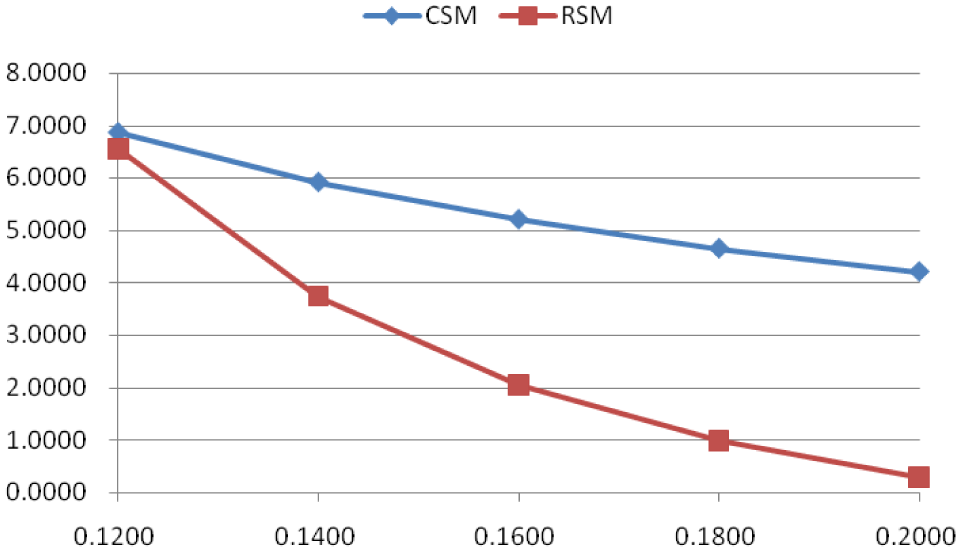
Revenue changes of the major scenic spot in the two cooperation models.

Revenue changes of the small scenic spot in the two cooperation models.
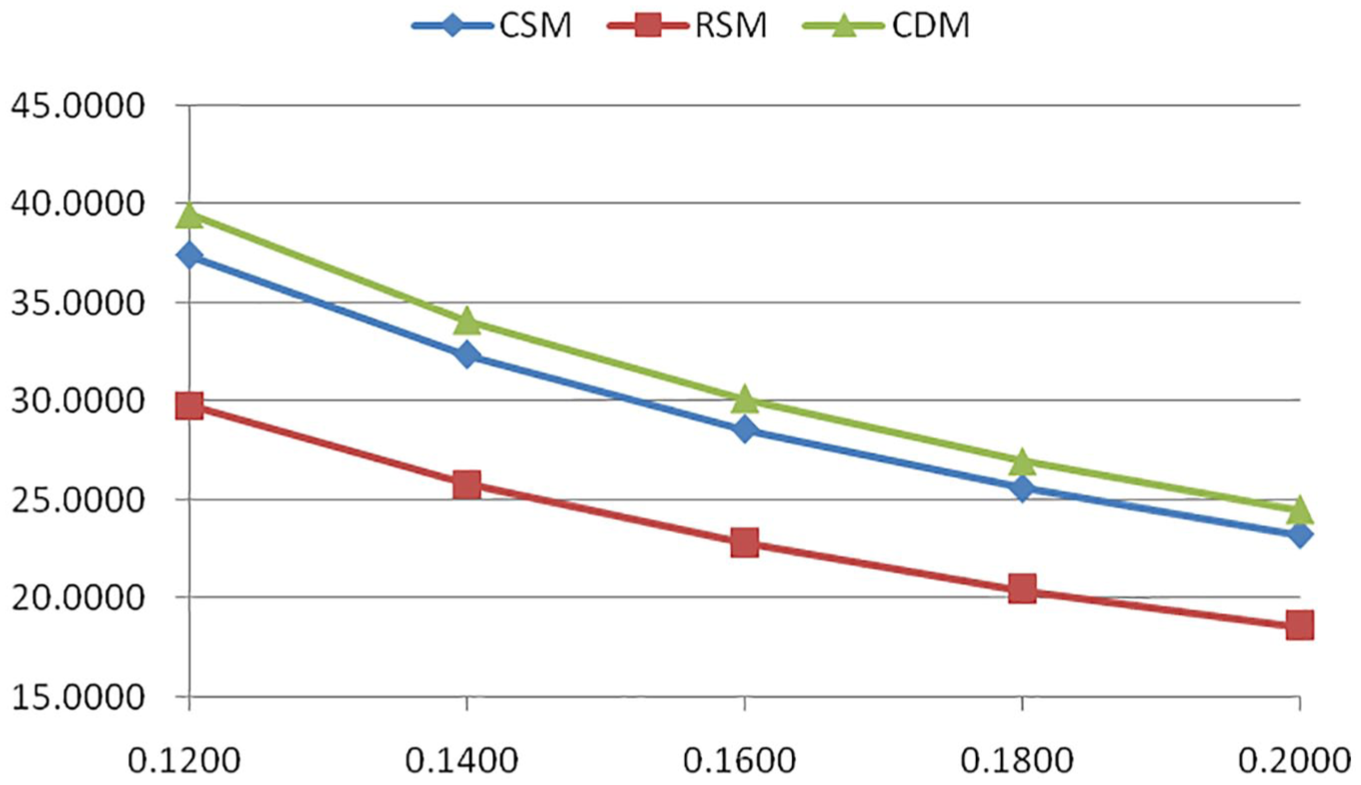
Revenue changes of the tourism supply chain in these three cooperation models.
The data in Figures 1 and 2 show that the cost-sharing model is superior to the revenue-sharing model. Both of the major and small scenic spots tend to cooperate in the cost-sharing model. The revenue of the tourism supply chain in the cost-sharing model is close to that of the centralized decision-making model.
Conclusions and Future Research Directions
Through a game theoretical model, this article studies the cooperation models between small and major scenic spots in peak seasons of tourism. During these peak seasons, major spots facing reception pressures due to limited carrying capacity, while small ones still facing insufficient tourism demands. As a result, both of them have incentive to cooperate to transfer tourism demand from major spots to small one to reduce the reception pressures of major ones and increase the demand of small ones. Specifically, two cooperation models between them, the revenue-sharing and the cost-sharing model, are analyzed. These results tell that (1) in the revenue-sharing and cost-sharing models, if the marginal cost of transfer tourists is low enough, then the major scenic spots encourage tourists to divert to the small scenic spot, and several tourists go to the small scenic spot through the publicity work of the major scenic spot. Few tourists tend to go to the small scenic spot if the marginal cost of transfer tourists is high. (2) In the revenue-sharing and cost-sharing models, the greater the sharing ratio of the small scenic spot is, the more intense the enthusiasm of the major scenic spot becomes and the more visitors will possibly visit the small scenic spot. Few tourists tend to visit the small scenic spot if the sharing ratio of the small scenic spot is less. (3) The major and small scenic spots tend to cooperate with each other to ensure revenue growth in the peak seasons of tourism. Moreover, the cost-sharing model is superior to the revenue-sharing model. The overall effectiveness of the tourism supply chain can be improved in the cost-sharing model.
Inevitably, this study has limitations. First, the cost function of the small scenic spot is linear, without considering the situation of the economies of scale. Second, this article considered that environmental protection is a crucial contribution to the size of the scenic spots but did not specifically introduce the environmental factors. The aforementioned limitations are also deemed as future research directions concerning the tourism supply chain.
Footnotes
Declaration of Conflicting Interests
The author(s) declared no potential conflicts of interest with respect to the research, authorship, and/or publication of this article.
Funding
The author(s) disclosed receipt of the following financial support for the research, authorship, and/or publication of this article: This work was supported by the National Natural Science Foundation of China (grant no. 71771072).
