




Abstract
The study proposed an optimal cooperative learning grouping technique to facilitate medical university students’ English learning process, considering their complementary competencies. A quasi-experimental design was adopted to evaluate the feasibility of using the grouping technique. TOEIC (Test of English for International Communication) pretest and posttest were given to both the experimental group (32 students) and the control group (31 students) before and after a 16-week intervention. After the intervention, the posttest results showed that the experimental group had significantly higher mean scores than the control group. As for effect sizes, there were moderate effects on listening, reading, and writing competencies and a large effect on speaking competency. The results confirm that the proposed optimal cooperative learning grouping technique is effective for improving students’ English learning. In other words, the grouping method considering students’ complementary competencies is worth recommending for cooperative learning.
Keywords
Background
Because English is the international language, the Ministry of Education in Taiwan has promoted the concept of “never too old to learn,” encouraging the general public to learn English (Wang & Liao, 2012). Moreover, Taiwanese enterprises prefer to hire people highly proficient in English (McLean, Murdoch-Eaton, & Shaban, 2013). Therefore, people in Taiwan believe that improving their English competencies will also increase their competitiveness in the workforce, thereby giving them more opportunities for promotion. Medical university students also use English to acquire their professional knowledge (Barrie, 2006). Poor English-language competencies hinder not only these students’ acquisition of medical knowledge but also their development of professional communication, presentation, and information-processing skills. Students with vocabulary or reading deficiencies may have difficulty with English-language reading, writing, listening, and speaking exercises in the medical field, which hinders their improvement of medical professional skills and practices. Hence, medical university students must improve their English proficiency to learn the science of medical care. The higher their levels of English proficiencies, the higher the learning goals they may reach (Bagheri & Andi, 2015).
Nonetheless, in Taiwan, although the environment for learning English has improved, students still learn the language in a passive way (Guo, 2012). There is not much interaction among students in class. Students usually passively copy down what they hear in class and regurgitate the lecture material back to their teachers. To help medical university students become as competent as possible in their English language, thereby helping them master their professions, teachers in medical education should create a learning environment that facilitates students’ English-language acquisition process.
Cooperative Learning
Cooperative learning has been a useful tool for students to facilitate their English-language learning processes (Bolukbas, Keskin, & Polat, 2011; Chenga & Linb, 2010; Dang, 2007; Fen, 2011). Cooperative learning involves participants working together in small learning groups according to carefully planned principles to increase their learning performances (Johnson & Johnson, 1996; Kagan, 2010; Meng, 2010; Smith, Sheppard, Johnson, & Johnson, 2005). Compared to individual or traditional lectures or teacher-directed learning, when students cooperatively work together to achieve shared learning goals, they obtain better academic results and personal achievements (Johnson & Johnson, 2009). Unlike the traditional competitive learning atmosphere, which reduces students’ motivation to learn, a cooperative learning environment fosters students’ motivation and interest because they work together to achieve shared goals through mutual encouragement and assistance (Chen & Wang, 2013).
Based on Johnson, Johnson, and Smith (2006), there are five essential elements of cooperative learning that make students learn more and feel more successful in their study: positive interdependence, individual accountability, face-to-face communication, interpersonal social skills, and group processing. Slavin (1996, 2000) demonstrated that cooperative learning can stimulate students to help one another and to maximize their abilities to learn.
Cooperative learning is superior to the dominant grammar-and-translation method used in Asia (Ghorbani & Nezamoshari’e, 2012), in which students are always passive and not given opportunities to use their knowledge in practical or creative ways. The research results demonstrated that students in cooperative learning scored better on their achievements posttest than the students in traditional lecture or teacher-directed classes. Pan and Wu’s (2013) study revealed that the students in cooperative learning groups had significantly better English reading comprehension than those not in cooperative learning, especially students with medium and low proficiency in the language.
Liao and Wang (2016) also showed that cooperative learning can enhance the motivation to learn, which is crucial for determining the probability of a student’s learning outcome. The more motivation that students have to learn, the more actively they will participate in their own language-learning processes. Students in heterogeneous cooperative learning clusters, or grouped based on their mixed abilities, tend to be more productively engaged in and responsible for their learning processes than those in homogeneous cooperative learning clusters (Liao & Wang, 2016). However, when tasks must be accomplished soon, stronger students may get impatient with weaker students, take more responsibility for the task, and embarrass the weaker students (Marcus, 2009). Therefore, to allow each cluster member to contribute to a learning cluster, when organizing students into heterogeneous clusters, teachers should consider students’ complementary competencies.
Based on the literature review, it is obvious that cooperative learning can improve students’ academic performances and that students grouped based on their mixed abilities tend to be more involved in their learning processes. Therefore, to allow each student to contribute and feel mutually beneficial to their learning clusters, the study used an evolutionary computational intelligence technique, genetic algorithm (GA), to cluster and obtain optimal cooperative learning groups to facilitate medical university students’ English-language acquisition, considering their complementary competencies. Accordingly, the study tended to examine whether the grouping technique could enhance medical university students’ English learning competencies.
Method
Participants
To evaluate the optimal cooperative learning grouping, two classes of medical university students were randomly chosen as the experimental group (32 students) and as the control group (31 students). The experimental group adopted the optimal cooperative learning grouping considering students’ complementary competencies, while the control group could form their cooperative learning clusters. All students were informed before participating in the study, and the research was conducted following the rules of the Declaration of Helsinki (World Medical Association, 2017).
Experimental Design
The study used a quasi-experimental design to examine whether medical university students’ English competencies would be improved by the use of optimal cooperative learning grouping considering students’ complementary competencies. TOEIC (Test of English for International Communication) pretest and posttest were used to obtain quantitative results. In addition, qualitative interviews were used to explore students’ responses to the optimal cooperative learning grouping. The intervention was implemented for 16 weeks, with 2-hr class learning and no less than 2 hr of self-study per week.
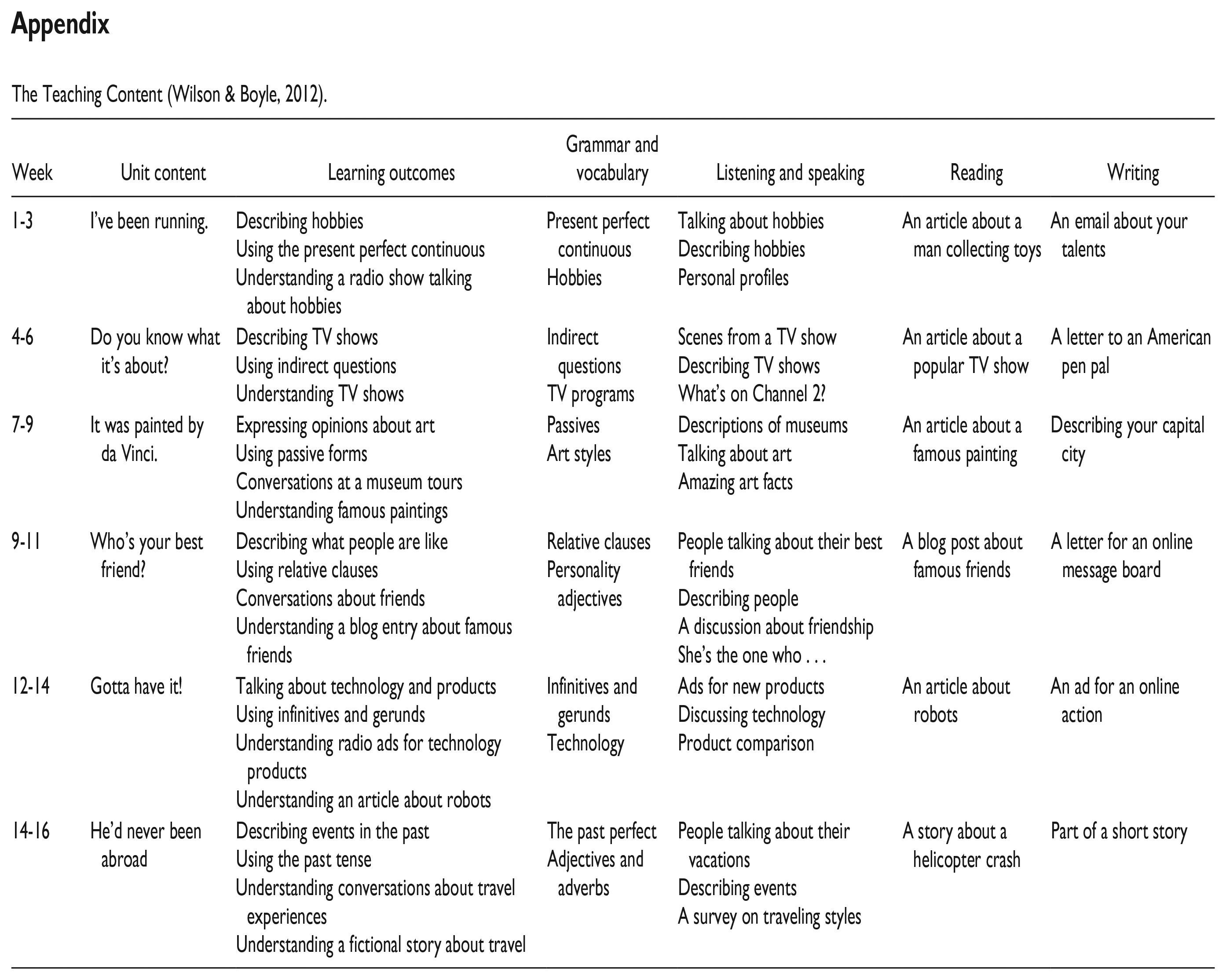
The teaching material was taken mainly from an intermediate-level English learning material, Smart Choice Level 3 Student Book with Online Practice, published by Oxford University Press, which was developed for college students to learn four-skill American English with personalized e-learning activities in listening, speaking, reading, and writing (Wilson & Boyle, 2012, see Appendix). The teaching material was in a mixed media format, in which more online practice was provided to allow students to master their English skills. Therefore, students could get lecture notes, learning activities, and online practices to facilitate their learning inside and outside class. Moreover, the online practice provided additional practices in instant scoring and hence after finishing the practices, students could quickly spot their weakness in certain competencies and find peer assistance in class or outside of class with a discussion board.
To avoid confounding effects on the intervention, the teaching materials, assignment, and evaluation criterial were same to both experimental and control groups though they were situated in different grouping arrangements. The only difference was that the experimental group adopted the optimal cooperative learning grouping considering students’ complementary competencies, while the control group could form their cooperative learning clusters. Both group students could stream all course video and audio content—anytime and anywhere, as they like. However, while confronting difficulties in class or outside class, experimental group students who were weak in certain competencies could seek help from their cluster mates who were stronger in those competencies; however, they might also give assistance to their cluster mates, using their stronger competencies.
Optimal Cooperative Learning Grouping
Research has shown that computational intelligence techniques can be used for the optimal learning group formation (Cruz & Isotani, 2014). However, Hosny, Hinti, and Al-Malak (2018) pointed out the limitation of many classical clustering algorithms in that they derive different outputs for the same database (Hosny et al., 2018). Therefore, to overcome the limitation of deriving different outputs and solutions, some studies (Goldberg, 1989; Sheikh & Raghuwanshi, 2008) have used evolutionary-based algorithms for the intelligent and robust techniques, among which the GA is one of the most popular evolutionary methods. Hence, to enhance the effectiveness of cooperative learning, this study used an evolutionary computational intelligence technique, GA, to cluster and obtain optimal cooperative learning groups. The GA is a good algorithm which can be used to solve NP-complete because using GA for cluster analysis is generally heuristic in nature and can be obtained in polynomial time. Research in social sciences (Hwang, Yin, Hwang, & Tsai, 2008; Meslec & Curşeu, 2015; Wang, Li, & Liao, 2011; Yannibelli & Amandi, 2012) has also used the GA for group formation to investigate human and social interactions.
The study took the reference of Wang’s et al. (2011) GA clustering and adapted the algorithm for optimal cooperative learning grouping considering students’ complementary competencies, the experimental group students’ TOEIC pretest scores were collected and computed to form the optimal cooperative learning clusters. First, to avoid variation of scoring system to measure students’ distinctive English competencies, each student’s English competency scores were normalized as Zij = the ith student s English proficiency test j / the maximal score on English proficiency test j. Table 1 shows the experimental group students’ normalization scores.
Normalization of English Competency Scores.
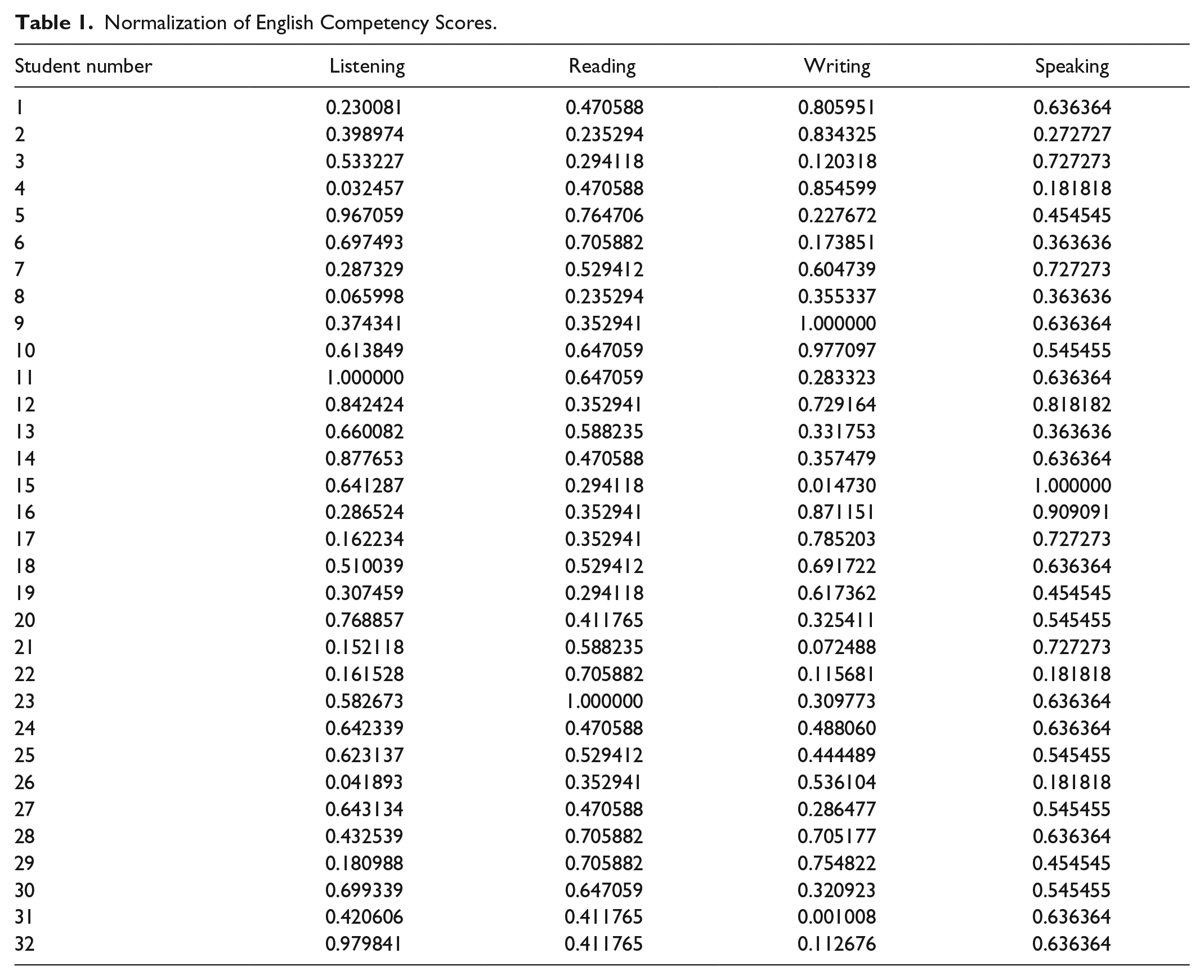
Second, the order-based GA was adopted to obtain the optimal cooperative learning grouping. Here, the software, Evolver 4.0, was used to obtain the optimal solution of order-based GA. The parameter setting is shown in Table 2.
Parameter Setting for the Order-Based Genetic Algorithm.

In addition, a GA fitness function was set up to obtain the optimal cooperative learning grouping with a minimal total variance. However, in each cluster, there was maximal complementarity. The GA fitness function was as Max
Optimal Cooperative Learning Grouping.

Instrumentation
TOEIC listening, speaking, reading, and writing competency tests
To prove that the students in the two groups were homogeneous in their English competencies, the researchers used the TOEIC database to assess the students’ English competencies. In the test, the listening and reading sections each contained 100 multiple-choice questions and each counted for 495 points (Educational Testing Service, 2012a). The speaking section contained 11 questions and counted for 200 points. The writing section contained eight questions and counted for 200 points (Educational Testing Service, 2012b).
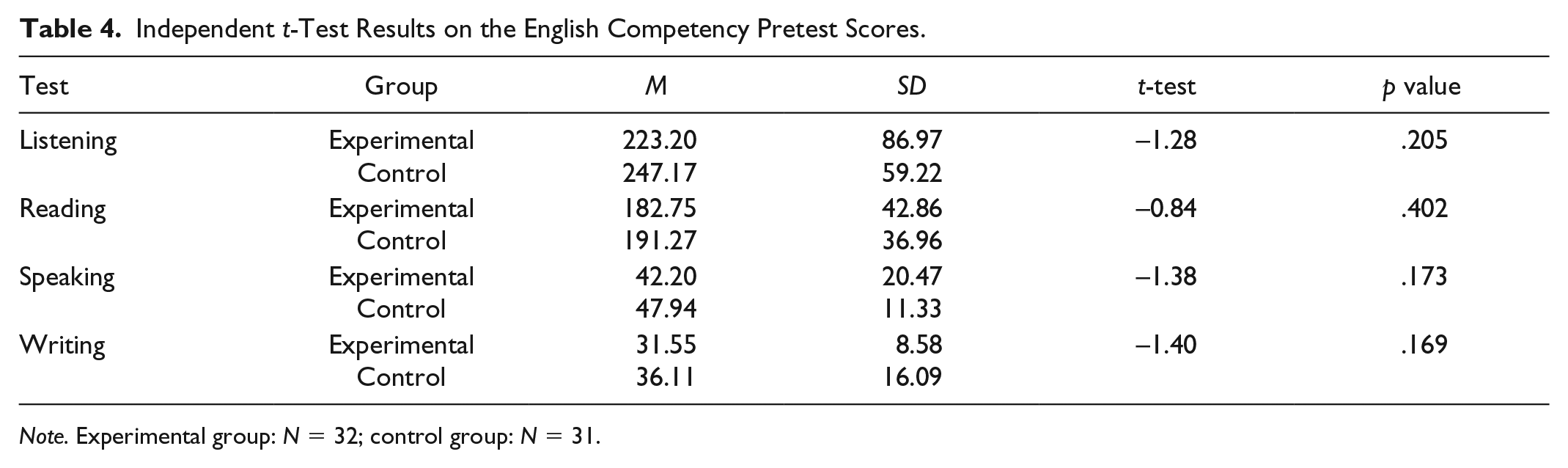
The English competency pretest scores (see Table 4) showed no significant differences between the means of the experimental group (means = 223.20, 182.75, 42.20, and 31.55) and the means of the control group (means = 247.17, 191.27, 47.94, and 36.11; p > .05) in the initial listening, reading, speaking, and writing competencies.
Independent t-Test Results on the English Competency Pretest Scores.
Note. Experimental group: N = 32; control group: N = 31.
In-Depth Student Interviews
To acquire more in-depth feedback about the use of optimal cooperative learning grouping, the researchers used in-depth student interviews to verify the quantitative results and to be aware of students’ perspectives of being situated in the optimal cooperative learning clusters. To protect students’ privacy, pseudonyms were used.
Data Analysis
SPSS 14.0 was used for data processing. Effect sizes were calculated and a one-tailed t-test was used to examine whether there were any significant differences between the experimental and the control groups in English competency scores.
Results
Quantitative Results
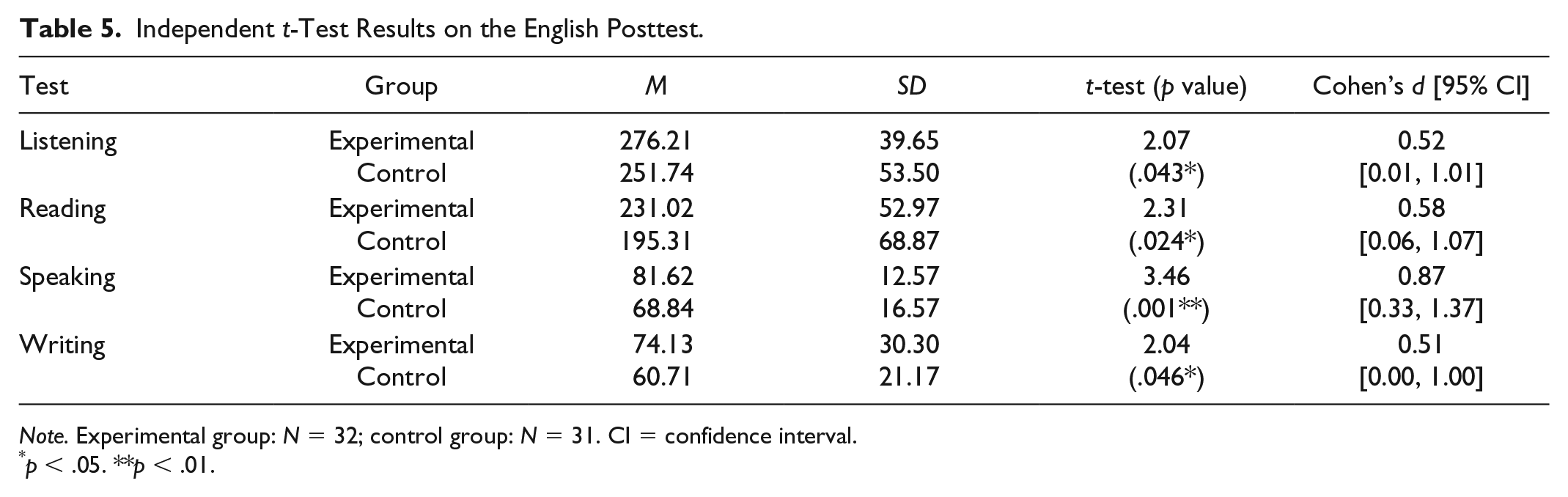
The study investigated whether medical university students in optimal cooperative learning grouping, considering students’ complementary competencies, would become more proficient in English listening, speaking, reading, and writing competencies than those in traditional cooperative learning clusters. As mentioned, there were no significant differences between the two groups in the four sections (p > .05; see Table 4). However, after a 16-week intervention, the posttest mean scores showed that the experimental group improved more than the counterpart in the four skills. In the listening, reading, and writing competencies, the means of the experimental group (M = 276.21, 231.02, and 74.13) were all significantly higher than the means of the control group (M = 251.74, 195.31, and 60.71; p < .05). Notably, in the speaking competency, the experimental group had a significantly higher score (M = 81.62) than the control group (M = 68.84; p < .01; see Table 5).
Independent t-Test Results on the English Posttest.
Note. Experimental group: N = 32; control group: N = 31. CI = confidence interval.
p < .05. **p < .01.
The effect size (Cohen’s d) is one of the important outcomes to interpret empirical research findings (Ellis, 2010; Nakagawa & Cuthill, 2007). That is, Cohen’s d formula allows to quantify the magnitude of the experimental treatment and compare the treatment effect between the experimental and control groups (Lipsey & Wilson, 1993). Hence, this study used Cohen’s d formula to calculate the effect sizes to quantify the differences between the two groups in the posttest results (see Table 5). Cohen (1988) suggested that a d value between 0.2 and 0.5 as a “small” effect size, a d value between 0.5 and 0.8 as a “moderate” effect size, and a d value greater than 0.8 as “large.” The d values on listening, reading, and writing were 0.52, 0.58, and 0.51, signifying moderate effect sizes. The d value on speaking was 0.87, signifying a large effect size.
Because the posttest results reflected that the experimental group had significantly higher means scores in the listening, speaking, reading, and writing competencies, it can be inferred that optimal cooperative learning grouping, considering students’ complementary competencies, is effective to facilitate students’ English-language acquisition.
The study further investigated whether weaker or stronger peers within the experimental group made bigger improvements. The students whose pretest scores were higher than the mean scores were regarded as stronger students, while those with pretest scores lower than the mean scores were regarded as weaker students. In the listening section, the score improvements for those stronger students and weaker students were 5.34 and 3.61; in the speaking section, 25.52 and 57.27; in the reading section, 13.85 and 82.68; and in the writing section, 32.48 and 52.69. The improvement results showed that stronger students in the optimal cooperative grouping had a bigger improvement in listening, while the weaker students had much bigger improvements in speaking, reading, and writing.
Qualitative Results
Because the proposed manipulation (the use of optimal cooperative learning grouping) is new and unexplored, based on the educational research (Merriam, 1998), there is a need to acquire more in-depth feedback for the experimental group to confirm the quantitative results and to find out why the new and unexplored manipulation can lead to better learning outcomes. Therefore, the qualitative interview was used for the experimental group students. Some of these interview results are summarized as follows.
Eight students revealed that optimal cooperative learning grouping helped them develop their problem-solving, communication, interpersonal, and cooperative abilities. The students mentioned that when they were situated in the optimal clusters for cooperative learning, they could participate equally and interact in the learning process because they felt they were needed by their learning partners. They also learned to share and exchange ideas better when it came to solving the proposed problems (M2, M9, M11, F1, F5, F9, F18, F20).
Eleven students said that the optimal cooperative learning grouping could increase their motivation to learn English. They were glad that they could contribute in certain ways to the learning clusters and help their group members overcome their English listening, speaking, reading, or writing weaknesses. Students were proud of their unique contributions to the learning clusters. Also, they developed a stronger motivation to learn and a positive attitude toward English learning (M3, M6, M7, M12, F2, F5, F8, F11, F16, F19, F20).
Twelve students revealed that when they were situated in the optimal learning clusters, they could eliminate their psychological barriers and reduce their English learning anxiety. By receiving help from the clusters, they contributed their unique input to the cluster, and therefore, felt like they made a positive and active contribution toward the study of English. Therefore, their confidence in English knowledge had been strengthened (M1, M2, M8, M10, M11, F3, F9, F10, F13, F15, F16, F17).
Moreover, 10 students mentioned that their cluster mates were always available to help them in or after class. As a result, by receiving an adequate amount of academic assistance from their cluster mates, their English comprehension and communication skills were sharpened significantly (M2, M4, M8, M9, F3, F4, F9, F12, F14, F19).
Discussion
The quantitative and qualitative data confirmed that the optimal cooperative learning grouping was worth recommending for improving students’ English competencies. Figure 1 shows the improvement of English listening, reading, speaking, and writing competencies in experimental-group and control-group students.

The improvements of English competencies in experimental and control groups.
The improvement results also showed that both weaker and stronger peers within the experimental group made improvements, though some having bigger improvement in listening and some in speaking, reading, and writing. Therefore, it can be implied that the optimal cooperative grouping could benefit both stronger students and weaker students. In other words, the students within the experimental group would not only improve those skills they were already good at but also improve their weaker skills. Besides, the study used a GA fitness function to arrange the optimal cooperative learning grouping with a minimal total variance to let all learning clusters to be homogeneous (Yannibelli & Amandi, 2012). Because all learning clusters in the experimental group were homogeneous, it can be concluded that all learning clusters could make progress and be benefited by the optimal cooperative grouping. In addition, the qualitative results also revealed that those in the optimal clusters enjoyed participating and interacting in the teaching-and-learning process because they felt they were needed by their cluster mates. Moreover, they reflected that they were more motivated and willing to contribute to the English learning community, using their stronger competencies.
The results corresponded to Marcus’s (2009) study: when grouped based on students’ mixed abilities, students in cooperative learning situations were more productive, because each group had at least one student stronger in certain competencies who could contribute to the English teaching-and-learning process. The results also supported Jalilifar’s (2010) research, which suggested that the success of cooperative learning lies in each cluster member feeling needed and being involved in the knowledge construction. Students stronger in certain competencies can help students weaker in those competencies; this mutual contribution facilitates English acquisition for all students in the cluster (Liao & Wang, 2016). Consequently, students arranged in the optimal cooperative learning grouping can have significantly better English achievement in the areas of listening, reading, speaking, and writing.
Conclusion
In the study, the researchers used an optimal cooperative learning grouping technique, considering students’ complementary competencies, to facilitate medical university students’ English-language acquisition. Two steps were proposed to generate these optimal learning clusters. Step 1 involved collecting students’ TOEIC pretest scores and normalizing those data. Step 2 involved using the order-based GA to obtain the optimal cooperative learning clusters. Finally, to verify the feasibility of using the optimal cooperative learning grouping technique, after a 16-week intervention, comparisons were made between the two groups. The quantitative and qualitative results demonstrated that the proposed grouping technique could lead to significantly better English achievements in the areas of listening, speaking, reading, and writing. Also, students in the optimal cooperative learning grouping were more motivated to learn English because they could participate equally and interact in the learning process. Moreover, while their cluster mates were always available to help them, they could also contribute in certain ways to the learning clusters. Feeling needed, they could have less anxiety and more confidence in mastering English-language skills.
The proposed optimal cooperative learning grouping technique can also be applied to medical education and on-the-job or in-house medical training programs. First, the optimal cooperative learning grouping can be derived with the proposed algorithm. Medical-care teachers and administrators do not need to invest in developing new algorithms for cooperative learning. Second, the research results confirm that the proposed optimal grouping technique is effective at increasing students’ English-learning performances, considering their complementary competencies. Therefore, instructors and administrators can use the optimal cooperative learning grouping technique in other medical-care training programs, such as patient-doctor communication, anatomy, and medical humanities programs.
In addition, medical-care students or professionals grounded in different departments, disciplines, or backgrounds may not be familiar with one another’s training and responsibilities, which can cause communication difficulties. However, the proposed optimal cooperative learning, considering students’ complementary competencies, may provide the opportunity for interdisciplinary cooperation, helping medical-care students and professionals with different backgrounds work together, understand each other, and develop better communication skills. Future studies may use this study as a basis for deriving optimal learning clusters to facilitate the learning process in different courses and programs. Future studies may also try to recruit larger samples to see whether the intervention will bring any difference between students with different genders, cultural, and economic backgrounds.
Footnotes
Appendix
The Teaching Content (Wilson & Boyle, 2012).
| Week | Unit content | Learning outcomes | Grammar and vocabulary | Listening and speaking | Reading | Writing |
|---|---|---|---|---|---|---|
| 1-3 | I’ve been running. | Describing hobbies Using the present perfect continuous Understanding a radio show talking about hobbies |
Present perfect continuous Hobbies |
Talking about hobbies Describing hobbies Personal profiles |
An article about a man collecting toys | An email about your talents |
| 4-6 | Do you know what it’s about? | Describing TV shows Using indirect questions Understanding TV shows |
Indirect questions TV programs |
Scenes from a TV show Describing TV shows What’s on Channel 2? |
An article about a popular TV show | A letter to an American pen pal |
| 7-9 | It was painted by da Vinci. | Expressing opinions about art Using passive forms Conversations at a museum tours Understanding famous paintings |
Passives Art styles |
Descriptions of museums Talking about art Amazing art facts |
An article about a famous painting | Describing your capital city |
| 9-11 | Who’s your best friend? | Describing what people are like Using relative clauses Conversations about friends Understanding a blog entry about famous friends |
Relative clauses Personality adjectives |
People talking about their best friends Describing people A discussion about friendship She’s the one who . . . |
A blog post about famous friends | A letter for an online message board |
| 12-14 | Gotta have it! | Talking about technology and products Using infinitives and gerunds Understanding radio ads for technology products Understanding an article about robots |
Infinitives and gerunds Technology |
Ads for new products Discussing technology Product comparison |
An article about robots | An ad for an online action |
| 14-16 | He’d never been abroad | Describing events in the past Using the past tense Understanding conversations about travel experiences Understanding a fictional story about travel |
The past perfect Adjectives and adverbs |
People talking about their vacations Describing events A survey on traveling styles |
A story about a helicopter crash | Part of a short story |
Declaration of Conflicting Interests
The author(s) declared no potential conflicts of interest with respect to the research, authorship, and/or publication of this article.
Funding
The author(s) received no financial support for the research, authorship, and/or publication of this article.
