




Abstract
This study investigates the claim that the strategies used by second/foreign language learners are, more or less, the same as those used by speakers of pidgin/creole languages. To this end, the speech of two speakers of the well-known Broad Jamaican Creole is compared with the performance of Saudi learners of English, with respect to the pronunciation of the closing diphthongs /əʊ/ and /eɪ/. The results show that the above claim is valid. Also, the behavior of the two groups corroborates that of child language, which will be taken as external evidence that adds to the existent literature of the logical problem of language learning. The behavior of the speakers in the three domains (i.e., L1, L2, and pidgin/creole languages) goes hand in hand with norms of historical change. That is, the two diphthongs have historically developed from the monophthongs used as substitutes. In addition, the centrality component in these diphthongs is a marked parameter, which is yet to be set before they could be mastered. The substitutes made by the speakers of Jamaican Creole and by Arab learners are the same chosen by the child.
Introduction
One goal of linguists is to decipher the mystery of the logical problem of language learning, one example being how a normal 5-year-old human child acquires his or her mother tongue (cf. Brown, 1973). Another important aim of modern linguistic theory is to come up with language universals—the principles according to which all human beings speak a language (see Greenberg, 1966). Although it is important in the linguistic behavior, the domain of phonology in second/foreign language learning and pidgin and creole languages has received little attention compared with the other aspects of language. Years of investigation have revealed that child language, second/foreign language learning, and pidgin and creole languages are, more or less, related in terms of processing. Many phenomena in these fields have been shown to be similar (Bickerton, 1995; Cook, 1993; Holm, 2000; Schumann, 1978; Washabaugh, 1977). Moreover, research on processes of pidginization and creolization has led to important advances in a number of areas of applied linguistics and theoretical linguistics (cf. Holm, 2000). In this study, the strategies used by Saudi learners of English, particularly with regard to the acquisition of the closing diphthongs /əʊ/ and /eɪ/ as in home and lane, respectively, are compared with the process of creolization of two speakers of Broad Jamaican Creole (JC; Bailey, 1966). The similarities between the two creole speakers and Saudi learners of English will be highlighted drawing on the assumption that “the dynamics by which pidgins and creoles come into being and the development of the L2 learner’s interlanguage might be governed by the same factors” (Cook, 1993, p. 69). In other words, in both situations, the behavior of those concerned is constrained by the principles of Universal Grammar, a genetically determined pre-disposition for language. Furthermore, it is also assumed that foreign/second language learning and historical change are significantly linked, in such a way that accounting for these learning situations without historical explanations may lack credibility. Thus, another aim of this study is to see to what extent the behavior of the speakers of the Broad JC and Saudi learners of English exhibits facts of historical change.
Literature Review
As an interesting and promising domain of linguistic research, the comparison of non-native language acquisition with pidginization/creolization has attracted a significant number of linguists. This is so because researchers have come to realize that to understand the behavior of early and late second/foreign language learning, an appreciation of the processes involved in pidginization/depidginization, creolization/decreolization is a key issue (McLaughlin, 1987). For instance, Baxter, Lucchesi, and Guimaraes (1997), in their investigation of the Brazilian spoken dialect of Helvecia, observed a series of parallels with structures in early stages of L1 Portuguese acquisition.
In a comparison between the decreolization of the Guyanese Creole negation system and the acquisition of English negation by Spanish speakers, Schumann (1978) found that the overall movement along the linguistic continuum in the two operations involved a rule change from a basilect/basilang pre-verbal negation to the target English post-copula auxiliary negation. Furthermore, it was observed that the above rule change in the situations was accomplished by identical linguistic processes—the replacement of surface forms and the restructuring of underlying units. Likewise, in the depidginization of Hawaiian Pidgin English, as reported by Bickerton and Odo (1976), a continuum of development occurs, which is similar to that witnessed in decreolization and second language acquisition.
Patrick-Andre (2006) has come to the conclusion that many of the features found in Haitian French-lexifier creoles do occur in L2 French and other interlanguages as a result of L1 transfer and other acquisition processes. The investigation includes word order within the noun phrase, pronominal clitics, absence of copula, grammatical gender, and verb movement. The major claim of the model of creole genesis advocated in the study, which he calls gradualist/second language acquisition, is that creole genesis does not involve any specific mental processes or strategies other than those attested in ordinary second language acquisition. In Lefebvre, White, and Jourdan (2003), a number of second language researchers and creolists engage in dialogues that focus on the processes characterizing various stages of L2 acquisition and creole genesis, such as relexification and transfer from L1 and their role in the initial state. The dialogues also cover morphological, phonological, semantic, and syntactic properties of interlanguage grammar and creole grammars. Their findings lend support to the view that the same processes are found to shape the initial stages of the two situations.
The reader is reminded that we are conducting a research on the acquisition of two closing diphthongs, namely, /əʊ/ and /eɪ/. Hence, it will be seen whether our findings corroborate those of the aforementioned researchers. However, a brief account of diphthongs is necessary. Diphthongs are described as combinations of two vowel sounds within a single syllable. The production of a diphthong involves the gliding of the speech organs from a first vocalic element (i.e., starting point) to a second differently articulated element, which constitutes the target to which the transition is made (see Gimson, 1980; Ladefoged, 1982; Roach, 2000). Thus, for the production of the word load, which contains the closing diphthong /əʊ/, as illustrated in Figure 1, for instance, the vowel position for the beginning of this is the one for schwa /ə/; the lips may be slightly rounded anticipating the glide toward the second element /ʊ/, for which there is quite noticeable lip-rounding. Likewise, in the production of the closing diphthong /eɪ/ as in pain, the glide begins from slightly below the half-close front position, with the mid vowel /e/ and with spread lips as illustrated in Figure 1.

Illustration of the glides involved in /əʊ/ and /eɪ/.
This gymnastics has proven to be problematic in L1 (Hua & Dodd, 2000; Santos, 2007), L2 (Hung, 2004; Randell, 2004), African American Vernacular English (AAVE; Bailey & Thomas, 1998; Rickford, 1999), and pidgin and creole languages (Cassidy & Le Page, 1967; Holm, 2000). We are mainly concerned with the acquisition of the above closing diphthongs by Arab L1 learners of English and speakers of JC.
The abovementioned continuum of development is also reflected on in this study as will be shown in the discussion. In addition, an attempt will be made to explain why errors take place in the acquisition of the two diphthongs under study, with reference to historical sound change. An effort will be made to illustrate the learners’ deviation from native speakers’ norms with respect to the pronunciation of these diphthongs, using the framework of Dependency Phonology (Anderson & Ewen, 1987). However, before we go further, an account of diphthongs in Arabic and in JC is worth outlining.
Generally speaking, Hejazi Arabic (like standard Arabic and almost most varieties of Arabic) does not have diphthongs, and the diphthong-like combinations [aw] and [aj] are realized as [o:] and [e:], respectively, as in (1):
1. [yo:m] day, [ʕo:m] swimming, [be:t] house and [de:n] debt (cf. Mousa, 1994).
We can argue that [aw] and [aj] in Arabic are not diphthongs, based on the fact that [w] and [j] have consonantal status, as in (2):
2. [ʕajn] eye versus [ʕajjana] “he allocated,” [qaws] baw versus [qawwasa] “he bent,” [bard], cold versus [barrada] “he cooled,” and [mılћ] salt versus [mallaћa] “he salted” (cf. Mousa, 1994).
Notice that the glides [w] and [j] behave exactly like other consonants in that they germinate in the causative case. Contineau (in Alaoui, 1987) considers [w] and [j] in the previous examples as positional variants of [u] and [i], respectively. A consequence of this view is to disregard the consonantal function of [w] and [j]. That is, if we follow Contineau, we should ignore the function of glides as fully fledged elements of root morphemes as in such words as [ʔabjađ] white and [waqu:d] fuel. Equally, we will have to ignore their function as constituents in the canonical structure of Standard Arabic, according to McCarthy (1981). Another counter-argument is that /i/, j and /u/, w cannot be variants of the same segment because they can occur side by side (Trubetzkoy, 1949). Furthermore, there are minimal pairs that indicate that /i/, j and /u/, w are different pairs. Consider the examples in (3):
3. [wafij] loyal [waafi:] exhausted
[ʔabij] “he who does not” [ʔabi:] “my father”
“tolerate humiliation”
The articulation of diphthongs, then, is clearly alien to Arab learners. Although [aw] in [jawm] day and [aj] in [bajt] house may sound similar to house and fine in English, the articulation of these diphthongs in the two languages is different, as Mitchell and El-Hassan (1989) have shown. They argue that the second elements in these two diphthongs are articulated as if they were the consonantal [j] and [w], which are stronger and fuller in Arabic. In English, the second elements are, however, very short.
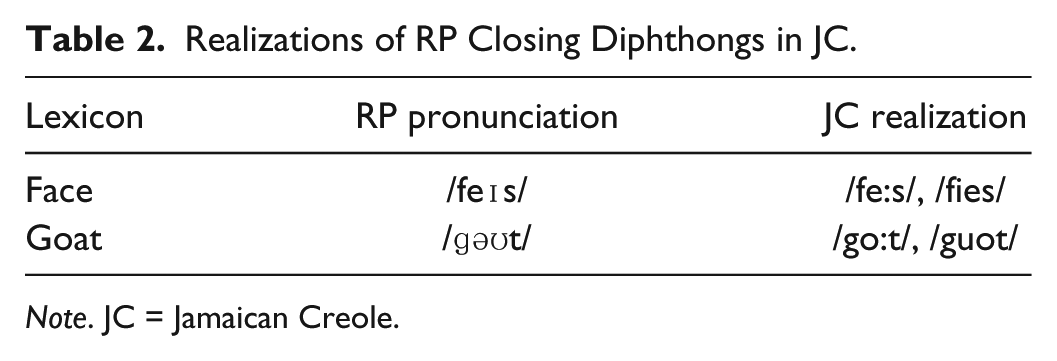
As for JC, it has four diphthongs: /ai/, /ou/, /ie/, and /uo/. The first two, according to Cassidy and Le Page (1980) and Devonish and Harry (2004) (cf. table 2), would approximate the vowels in the pronunciation of such English words as “mice” and “cow,” respectively. The second two (/uo/ and /ie/), according to Cassidy and Le Page (1980) and Devonish and Harry (2004), involve a combination of the high vowel /i/ or /u/ with the mid vowel corresponding to its backness or frontness (i.e., /e/ and /o/). This is displayed in the pronunciation of /kien/ “cane” and /guot/ “goat,” respectively.
According to Devonish (2006), the reversal witnessed in the Received Pronunciation (RP) closing diphthong /əʊ/ “is systematic and is a generalization of a very limited variation in normal Jamaican speech between /uo/ and /ou/ in a small number of words all of which end in /l/” (p. 78). Specifically, /uol/ “old,” /buol/ “bowl,” and /kuol/ “cold” have /oul/, /boul/, and /koul/, respectively, as alternative forms.
JC has been affected by the tendency of the phonemic reduction that languages with Pidgin origins had gone through (cf. Hall, 1966). The above creole diphthongs emanated from several steps of this creole development that affected the vowel inventory of the language. Lalla (1983) reports that JC had gone through three stages of change, which are instigated by the processes of the creolization of the former Pidgin language. The first two stages had culminated in the reduction of the whole vocalic system. Thus, during the first stage of development, the language lost vowel length distinction. The second stage witnessed the merging of vowels, which led to the reduction of quality distinction. This is clearly noticed in that “the distinction in quality between, say close and mid-close front vowel /i, ɪ/ or close and mid-close back /u, ʊ/ are not usually preserved” (Nývlt, 2012, p. 29). In fact, the first element in each of the Jamaican diphthongs is indicative of this lack of distinction.
Universalists argue that vowels that are less common in the world languages, including centralized /ɪ/, /ʊ/, and /ʌ/, are generally absent in creoles (Beckford-Wassink, 1999). Hall (1966) also suggests that less common front and back rounded vowels, such as /y/ and /œ/, tend to lose their frontness or roundness in French-based creoles. Thus, /y/ is replaced by the more common/i/ or /u/ and /œ/ by the more common /e/ or /o/ in words of French origin. We take that as indication of the adoption of more universal vowels. One can see that the above Jamaican diphthongs are clearly an illustration of this fact.
The third and last stage of development resulted in lengthening and diphthongization of certain vowel phonemes of creole. By way of illustration, the mid-close front /e/ and the mid-close back/o/ were prolonged to become /e:/ and /o:/, respectively, and eventually developed the on-glides /ie/ and /uo/ (cf. Alleyne, 1980) as shown in table 1. Nývlt (2012) presents a list of lexical items from JC, together with the way they are pronounced in RP, in which one can notice that Jamaican speakers do not really abide by vowel quality distinction. Table 2 illustrates two examples, one for the RP /eɪ/ and the other for /əʊ/, and how they are realized in JC.
The Vocalic System of JC.

Note. JC = Jamaican Creole.
Realizations of RP Closing Diphthongs in JC.
Note. JC = Jamaican Creole.
Although some linguists argue that the diphthongs concerned are in fact monophthongs, which may have diphthongal realization (Veatch, 1991; Wells, 1973 1 ), most researchers classify them with diphthongs (Alleyne, 1980; Cassidy & Le Page, 1980; Devonish & Harry, 2004; Holm, 2000; Rosenfelder, 2009, among others).
Finally, the diphthongal status of the JC diphthongs in question has been acoustically confirmed by Beckford-Wassink (1999) who observes that there is a difference between monophthongals /e:/ and /o:/ and diphthongals /ie/ and /uo/. According to the researcher, “the downgliding diphthong [i.e., /ie/] displays rather slight movement down the peripheral track of the left system boundary combined with movement toward the centre of acoustic space. Monophthongal [e:] shows little movement in either F1 or F2” (pp. 134-135).
As for /uo/, Beckford-Wassink takes it to be typically a centring or downgliding diphthong which shows a rise in F2 on the order of 100 Hz or more lowering in vowel height accompanied by a rise in F2. The monophthongal variant /o:/ typically exhibits very little change in F1. (p. 157)
Informants
This section details the informants who formed the sources of the data of this study.
Jamaican Informants
The informants are two speakers of what is called the Broad JC (Bailey, 1966) of nearly the same age. The first one, Mr. Mike (the barber henceforth), is from Hanover in the west of Jamaica. He migrated to Britain when he was 18 years old. Today, he is 61 years old. He is a barber in Moss Side, Manchester, England. Most of his customers are West Indian, old and young. He uses the same language (Broad JC) at work, home, and everywhere. He is always in touch with the West Indian people. He has little education. He left school before the age of 18, and his reading and writing are not perfect.
The second informant, Mr. Norman (the driver henceforth), is from St. Mary in the north of Jamaica. He migrated to Britain when he was 17. Today, he is 59 years old. He worked in two factories in Manchester, as a dry cleaner, and as a carpet fitter before he became a taxi driver, which is his present job. He also studied for a while in Jamaica and took a course in reading and writing in Manchester. This means that he dealt, and is still dealing with, different people. Accordingly, his language is expected to be influenced more than that of the first informant.
Saudi Learners of English
The second category of participants in this study includes 60 native speakers of Hejazi Urban Dialect (HUD), a variety of Arabic spoken in the urban areas of the Western Province of Saudi Arabia, mainly Makkah, Madinah, and Jeddah. They were divided into three groups, 20 in each. None of them had lived in an English-speaking country before the time of study. The first group consisted of pupils at the third year of intermediate school. Their age ranged from 14 to 16 years. They had been studying English for 3 years, 4 hr a week. The second group was pupils of the third year at secondary school. They were between 17 and 18 years of age. They had been exposed to English for 6 years at a frequency of 4 hr a week. The third group was university undergraduate students (third-year level). They studied different subjects. They had been studying English for 9 academic years.
Data Collection
Regarding Jamaican English, data were gathered in three ways. The author once lived with his Jamaican informants for 1 year and therefore was able to observe a great deal of the properties of their speech. Second, he recorded their casual speech with their permission. Third, in the process, he gave them separately a list of words and sentences carrying the diphthongs under study to read. However, one fact is worth mentioning. Actually, it was not the intention of the author to use the Jamaican data for research. Rather, it was the author’s first time to hear this mode of speech as he was used to hearing American and British English only until he accidentally came across this variety. After he had left them back home and started teaching English, he discovered that his Arab learners pronounced the above two diphthongs in the same way as the two Jamaican informants. It was this similarity of behavior that instigated the present study. This is why we do not have a unified methodology, as the purposes of data collection in the two groups are different. Thus, when the author decided to collect data for the purpose of research, the task was more organized, and the data were enormous compared with the data from the Jamaican speakers who were no longer in contact with the author. It is hoped that the bulk of research on creole languages, the least of which are cited in this investigation, will consolidate our arguments and make up for the paucity of data with regard to the Jamaican informants. It should be mentioned that the JC transcriptions in this study are based on Cassidy (1961) and Cassidy and Le Page (1967), and the RP counterparts on Gimson (1980) and Roach (2000).
As for the Arab learners of English, data elicitation involved an experiment with three phases: recognition task, production task, and description of pictures. In the production task, a list containing 1,012 words (containing monophthongs and diphthongs) in isolation and in carrier sentences was prepared and given to the learners to read. They were instructed to read silently the words and sentences in question twice before actually reading them out. Their utterances were recorded in a sound-treated room in the language laboratory at the English Language Center, King Abdulaziz University, Jeddah. Recordings of individual participants were done on separate tapes. Recognition task involved two phases. In the first phase, a list of 172 word pairs containing minimal pairs and pairs of similar words were recorded by a native speaker of English who worked as a professional language instructor. Learners had to listen to the pairs and judge whether the relevant pairs consisted of similar or different words. In the second phase, a list of 100 word sets, each of which contained 3 phonetically similar words, was prepared and recorded on a tape by a professional native speaker. The list was handed out to the learners to read silently. They were then instructed to listen to each set and identify the word read out from each group after a short interval between the sets and the word to identify. The learners were then presented with 104 pictures and instructed to name objects and describe entities or sequences (events). Their utterances were recorded in a sound-treated room.
Transcribing and codifying data were done by the researcher himself, then checked by trained transcribers and a phonologist at the University of Bangor, North Wales. Data were coded manually to identify the diphthongs involved. For reference regarding Jamaican talk of the participants, Cassidy (1961), Cassidy and Le Page (1967), Bailey (1966), and Holm (2000) were consulted. As for the Arabic speakers, the author referred to Basalamah (1990) and to his intuition as a native speaker of the dialect spoken by the Arab participants. Data were analyzed with reference to the dependency framework (Anderson & Ewen, 1987).
Results
Almost all participants (when speaking casually, in their attempt to pronounce the test words and when describing the pictures in the case of Saudi learners) have persistently produced /o:/ for /əʊ/ and /e:/ for /eɪ/, as indicated in Tables 3 and 4, respectively. For instance, the Saudi learners fail to come up with the closing diphthong /əʊ/ necessary for the production of such words as home, hope, coat, rope, and so on. Instead, they opt for the monophthong /o:/, thus behaving in accordance with their tendency in the production of diphthong-like combination [aw] in Arabic, as mentioned earlier.
Sample of Arab Learners’ Pronunciation of English Closing Diphthongs.

Referred to in due course.
Sample of Jamaican Informants’ Pronunciation of English Closing Diphthongs.

Note. JC = Jamaican Creole.
Referred to in due course.
The learners also treat words such as rain, lane, train, and so on, which are pronounced with the diphthong /eɪ/, in the same way Arabic-speaking people treat the diphthong-like combination in [aj]. That is, they produce the monophthong /e:/. Table 3 displays a sample of Saudi learners’ pronunciation of these English diphthongs. Thus, one would have the impression of initially ascribing our learners’ error in the pronunciation of these two diphthongs to transfer from L1. Table 4, which contains examples of the Jamaican informants’ pronunciation of the same diphthongs, suggests that despite the fact that /uo/ and /ie/ are expected to be used by the two speakers as potential substitutes for the diphthongs in question (thus complying with the norm of the Broad JC), the speakers opt for the same substitutes witnessed in the speech of Saudi learners, /o:/ and /e:/. The use of these two vowels by the informants may indicate that /uo/ and /ie/ are marked, as they require on-glides in their combination. The reader will remember that these Broad JC’s diphthongs are reported to have emerged from /o:/ and /e:/, respectively. Thus, it will be significant if speakers from different linguistic backgrounds and learning situations opt for the same sound substitution. In what follows, an attempt will be made to find out whether this is a uniform practice in the acquisition of the above closing diphthongs.
Discussion
The speech of our Jamaican informants as well as that of the Saudi learners manifests deviations from RP norms in the production of English diphthongs, especially the above two closing diphthongs. In what follows, an account of their behavior is outlined.
Although the Broad JC does have the back, mid-rounded opening diphthong /uo/ as a recent on-glide development of the stereotype /o:/ (Alleyne, 1980), which is pronounced in such words as show, nose, boat, and so on, our informants pronounced coat, road, woe, going, and open with the latter, that is, with the monophthong /o:/. An instant interpretation one can give here is that our informants do not show any sign of moving toward the RP norm. 2 However, the use of a long vowel does, at least, reflect the informants’ awareness that the vowel in question is not simple; that is, they seem to have realized that they are dealing with a complex vowel. However, instead of coming up with the glide associated with the production of a diphthong, they chose to lengthen the equivalent of the second element of the diphthong concerned. In other words, this diphthong consists of two centralized vowels, a schwa /ə/ and a mid high centralized /ʊ/, and both seem to be lacking from the vocalic system of JC, as the predominating vowel pattern in West African languages (which is expected to have constituted the original vowel systems of the Atlantic Creoles [Holm, 2000]) does not contain them. As we will explain later, the first element does not have any locational information. The second element, /ʊ/, contains a centrality component dependent on a high-rounded articulatory configuration. An explanation of why our informants chose to produce the cardinal vowel /o:/ as a realization of this diphthong will be given, using the principles of Dependency Phonology outlined in Anderson and Ewen (1987).
According to Chomsky and Halle (1968) in the standard model, a feature can either be present or absent in a feature matrix describing a particular segment. That is, for each feature used, either (+) or (−) is assigned to it. Chomsky and Halle (1968) claim that the use of binary features is “the natural way of indicating whether or not an item belongs to a particular category” (p. 297). At least two deficiencies could be detected in this approach (i.e., mode of notation). On one hand, these features, which describe a vowel, are unordered. This indicates that there is no structural relationship among them. Therefore, by using this mode of representation, we cannot express hierarchical intrasegmental relationships that we have isolated to account for our learners’ and informants’ behavior. On the other hand, if the feature matrix contains only the minus values, then one would have the impression that either there is no phonetic content or calculate the symmetries that result from the use of the plus value for the same features. Take, for example, the representation of [e] and [ɔ] in the standard model:
high
low
This representation makes use of the height and lowness parameters, but these articulations cannot be read off directly from the representation itself. And it does not matter whether you start with low or high, because no structural (hierarchical) relationship between the features is assumed. The dependency notations, however, make use of the unary features with structural relations rendering the phonetic content of the segment in question, as will be seen later.
The same failure in the production of the relevant glide in the pronunciation of the front, mid, unrounded closing diphthong /eɪ/ persists. Thus, the words lay, face, razor, and so on are pronounced with the monophthong /e:/ by our informants. In fact, with the exception of /aʊ/, /aɪ/, and /ɔɪ/, diphthongs in RP are realized as long vowels both in the speech of our Jamaican informants and Saudi learners. In the latter’s speech, words such as home, hope, both, coat, and so on were all produced with the monophthong /o:/, whereas words such as rain, stain, state, train, safe, and so on were articulated with the monophthong /e:/. Perhaps it is helpful to mention that the elements of the diphthongs /eɪ/, /əʊ/, /ʊə/, /ɪə/, and /eə/ are marked for these two groups. Our Arab learners do not have centralized vowels or the mid high vowel in their vocalic system; therefore, almost all English words bearing these vowels were pronounced with the nearest vowels in their phonemic inventory (cf. Mousa, 1994). Likewise, JC does not have centralized vowels, and although /e/ is part of its phonological system, its existence in the diphthongs /eɪ/ and /eə/ does not seem to be helpful (cf. Table 4). In what follows, the errors in the pronunciation of /əʊ/ and /eɪ/ are illustrated using Dependency Phonology as a mode of representation (Anderson & Ewen, 1987).
RP /əʊ/ is characterized by the fact that there is little—if any—tongue gesture during the production of this complex segment (cf. Alaoui, 1987). This is because the schwa, the first element, is a central (neutral) configuration. The second element involves the same process with little increase of lip-rounding as the diphthong is articulated. That is, there seems to be no difference of tongue position between the elements /ə/ and /ʊ/. Because centrality as a component is not available in the vowel space of Hejazi Arabic (cf. Basalamah, 1990; Ingham, 1971; Mousa, 1994), we would expect that this diphthong would pose a problem to our learners and that its learning would take place late. Indeed, this diphthong was pronounced as [o:] at a high error percentage (cf. Mousa, 1994). By the same token, we can argue that this diphthong will not be an easy target for speakers of JC whose vocalic system lacks the two elements that constitute it. Let us again consider the phonetic content of the segment produced (i.e., [o:]), to be able to compare it with /əʊ/, the target. By so doing, we would like to hypothesize about the strategy that our informants as well as our Arab learners seem to have resorted to, being informed by their phonological system and interphonological grammar, respectively. Consider the representation in Figure 2.

Representation of element dependency.
Notice that the element to the left of /v/ does not have any locational information. The second element contains a centrality component dependent on a high-rounded articulatory configuration. As mentioned earlier, both gestures do not occupy a point in the vowel space of the two groups (i.e., the Jamaican informants and Arab learners).
Following Eckman (1977), we expect our Jamaican informants and Arab learners to replace this vowel and complex segment with the closest less marked segment in their vocalic systems. Thus, because the first element (i.e., the schwa) is a weak vowel, the substitution would be based on the second element, which is a mid-high centralized rounded vowel (i.e., /ʊ/). To keep the mid position of this diphthong, the centrality component has been removed and replaced by a lowness component /a/, which is dependent on /u/ to yield /ɔ/, and once this is done, we assume that the phonetic articulatory content of this vowel is mapped onto the articulatory content of the schwa. This operation would yield the vowel /o:/. The dependency notations in Figure 3 illustrate these substitutions.
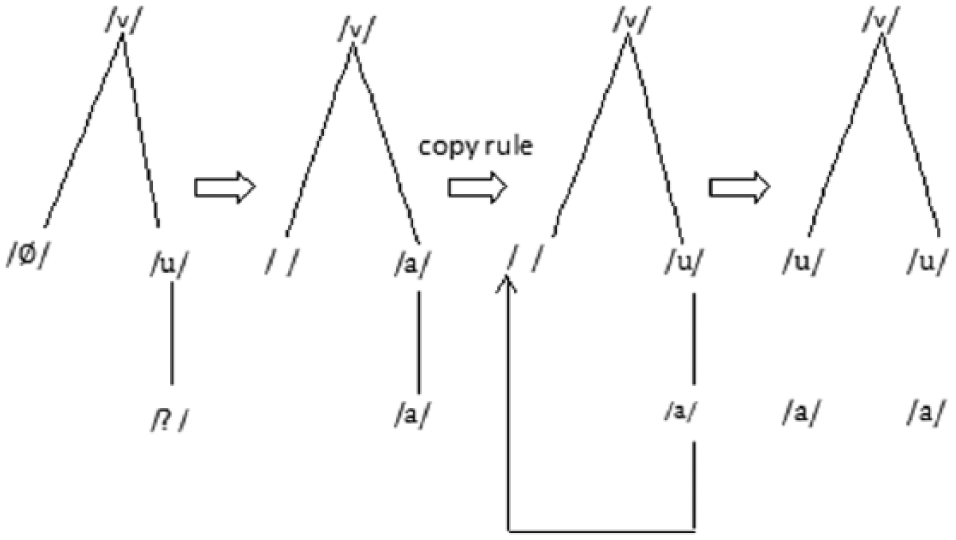
Display of substitutions based on dependency.
It is noteworthy that a model of phonological description such as the one with the dependency notations in Figure 3, which allows componentiality, would allow the second language researcher or the creolist in the area of phonology to relate the speaker’s pronunciation in these two situations to general principles that constitute the principles of the model used. For instance, the descriptions and explanations available through standard handbooks such as Mitchell and El-Hassan (1989) handle the well-known phonological phenomena in the pronunciation of Arab learners of English. They outline the phonetic features of language in the native language, comparing them with the characteristics of those of the target language, and then hypothesizing about predictions in the behavior of speakers. One consequence of this practice is that one would have the impression that the mispronunciations of vowels are unrelated phenomena, in spite of the fact that obvious similarities in alternations in the structural change of the target vowels follow from the same principle. In other words, if we go about enumerating mispronunciations and assigning different descriptive labels to them, we would give the impression that we are dealing with unrelated instantiations of behavior in pronunciation. When we give a different name to a process, we tend to talk of this process as a phenomenon different from the others. We wish to argue that if we set off analyzing our learners’ interlanguage and our Jamaicans’ speech in terms of the acquisition of parameters (in the descriptive sense), then we can easily relate what would seem unrelated processes, and we would thereby capture the phonologically significant generalizations about our learners’ interphonological grammar and the phonology of the JC. To the extent that this line of argument is valid, we consider the lack of the centrality parameter in our learners’ vowel space and perhaps that of the JC as the variable from which the mispronunciation of the above diphthongs emanates. The second principle that seems to explain the mispronunciation of diphthongs is the process whereby the schwa, which lacks locational information, is filled with the articulatory content of the neighboring vowel together with which it constitutes a diphthong. This insight is expressed with a copy rule, which has been postulated above and which will be repeated in Figure 4.
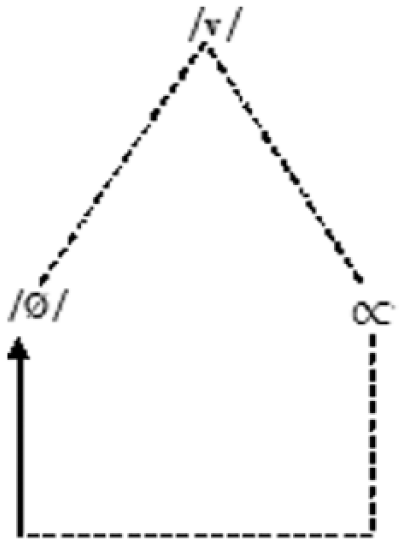
Copy rule.
This rule reads as follows: Fill the articulatory gesture of a vowel that lacks it with the locational information of the vowel immediately preceding and following it, where ∝ is a variable ranging over loci. From this discussion of the behavior of our Arab learners and our Jamaican informants as far as the vowel space is concerned, it emerges that only two principles can explain the fact that the above diphthongs and central vowels have not been acquired fully yet. These two principles are the centrality parameter and the copy rule.
Concerning the alternations /eɪ/
On universal grounds, Wode (1980) notes that the open rising diphthongs (/aʊ/, /aɪ/) and the falling (/ɔɪ/) would very unlikely be replaced by L1 forms in an L2 learning situation. Furthermore, Wode (1980) has found that L2 English diphthongs /eɪ/ and /əʊ/ are regularly replaced by the monophthongs /e/ and /o/, respectively, by speakers with different L1 backgrounds. Wode’s observation is based on investigation of data provided by native speakers of Hindi, French, Arabic, and Twi (cf. Wode, 1980, p. 133). James (1989) takes this fact to be due to universal typological constraints to the effect that if a language contains closing diphthongs, the least marked and possibly the easiest to pronounce forms will be those that are maximally open to close in their articulation.
Our Arab learners’ and Jamaican informants’ performance with respect to the diphthongs /aɪ/, /aʊ/, and /ɔɪ/ lends support to James’ assumption in that these three diphthongs have not been found to pose learning problems for them. Support for universal tendency of the monophthongization of these two diphthongs comes from Hyman (1975). According to Hyman, Phonological rules can coalesce segments. In many languages /aɪ/ and /aʊ/ are realized respectively as /e/ (or[ɛ]) and [o] or [ɔ]. In such cases the phonetic output is in a sense a “blend” of the two segments in the phonological input: the lowness of /a/ combined with the close tongue position of /i/ and /u/ results in the mid vowels [e] and [o]. (p. 14)
Our learners and Jamaican informants have produced the long vowels (i.e., /e:/ and /o:/) because of the following considerations. The test words we used in the experiments are almost all monosyllabic, and the lengthening they produced can be due either to the fact that a short vowel cannot stand as a nucleus of a monosyllabic word with simple coda, or that this behavior has been instigated by the postulation that these diphthongs are universally more marked or less easy to pronounce. Another obstacle for the learning of /eɪ/ (especially in the case of our Arab learners) is that the first element in the diphthong /e/ has not yet been acquired fully by our learners (cf. Mousa, 1994). This implies that the acquisition of diphthongs would have as a prerequisite the acquisition of elements constituting those diphthongs. We can hypothesize that at this stage, the only feature that has been acquired by the two groups (i.e., Arab learners and Jamaican informants) concerning the diphthongs /əʊ/ and /eɪ/ is duration. And the only diphthongs produced relatively correctly do not involve the centrality component.
We also take it that the centrality component is a marked parameter in the vowel space, compared with the lowness and height parameters. To the extent that this stipulation is correct, one would expect the centrality parameter to be set at a stage succeeding the setting of the lowness and height parameters. Indeed, English centering diphthongs are acquired by Arabs at the final stage (Stage VII) in Mousa’s (1994) study, due to their difficulty. Following Eckman (1977), we take it that typological markedness is a valid technique for measuring the degree of difficulty in acquiring a second language, L1, and perhaps in the explanation of behavior of pidgin and creole speakers because of the following considerations. Language universals are a reflection of the structure of the human mind (Lenneberg, 1967). Furthermore, it is assumed that human beings normally learn to do things that are less complex before they learn to do things that are more complex, but never the other way around (Sanders, 1977).
Monophthongization of English diphthongs seems to be resorted to for two different purposes. That is, speakers of AAVE and the more general dialect of the Southern United States (Burling, 1973; Labov, 2002), and perhaps speakers of Atlantic creoles, as indicated by Schneider (1989), seem to pronounce such words as pride, proud, and oil without or with a reduced glide as a sign of identity preserving. “It is possible that there is a kind of historical connection between this and the parallel reduction of diphthongs in some Atlantic creoles” (Holm, 2000, p. 148). In fact, Frank Gooding, the phonetician in the Department of Language and Linguistics, University College of North Wales at Bangor, noticed that our Jamaican informants produced the words name and way without any glide (i.e., with the monophthong [e:]), and the word house with a diphthong that was not fully rounded (i.e., with [ɑ‘ʊ]). However, off-gliding in the pronunciation of English diphthongs by L2 learners is mainly resorted to due to their markedness. For instance, in the pronunciation of /əʊ/, L2 learners seem to be unaware of the fact that the difference between the two elements of the diphthongs is insignificant, although the second element is produced with little increase of lip protrusion. What they seem to be doing is start the glide with a truly back vowel (Gimson, 1980), as mentioned earlier. Once the schwa is absent from the vocalic system of our learners, its position is filled with articulatory function of the back vowel, which has been substituted for the second element of /əʊ/, hence conveying [o:]. In other words, the use of [o:] “shows the horizontal feature specification [back], as opposed to the TL specification of the initial element of /əʊ/ as [central]” (James, 1987, p. 242). Hung (2004) reports the following Diphthong Reduction Rule in the interlanguage phonology of the speakers of Hong Kong English:

According to this rule, a diphthong is reduced to a monophthong when followed by a velar stop or a nasal, as displayed in the following Hong Kong English examples:
lake → [lɪk]
take → [tɪk]
joke → [ʤʊk]
soak → [sʊk]
pain → [pɪŋ]
rain → [rɪŋ]
loan → [lʊŋ]
bone → [bʊŋ].
Other examples of monophthongization are also manifested by Randell (2004), regarding Finglish 3 speakers. The words stove, grocery, and birthday are pronounced as touvi, rosseri, and pörtteri, respectively. Notice that there is no indication of a glide, whatsoever. Thus, so far, creole speakers, speakers of AAVE, and English L2 learners are all consistent with the above monophthongization of English diphthongs. In what follows, an account of the child’s behavior in this connection is given, thus echoing Ervin-Tripp (1974) and others’ inquiry whether second language learning is like L1.
The same phenomenon of monophthongization of diphthongs has been found to shape child language in general. Children from different linguistic backgrounds tend to simplify diphthongs by reducing them into a simple vowel. According to Hua and Dodd (2000), who investigated the acquisition of Modern Standard Chinese, the vowel retained was normally the louder and more sonorant vowel of the diphthong. Thus, the children tended to produce the second element of on-gliding diphthongs, for example, /ua/ as /ɑ/, but the first element of off-gliding diphthongs, for example, /ao/ was produced as [a]. They also came to the conclusion that whereas simple vowels emerged early in development, triphthongs and diphthongs were prone to systematic errors. In acquiring Brazilian Portuguese, according to Santos (2007), children apply elision where adults apply diphthongization. Consider table 5 which illustrates examples from Santos (2007).
Child’s Monophthongization of Adult’s Diphthongs.

Notice that the child’s productions do not contain glides (cf. table 5). In other words, what is pronounced as a diphthong by adults is realized as a monophthong by children. Santos refers this to the fact that children use elision instead of diphthongization before they acquire the syllable structure CCV, which allows parsing of raising diphthongs such as those in the examples above. Moreover, the examples above point to the fact that these children have not yet mastered the acquisition of Sandhi processing, which Santos thinks needs to be learnt (see Lass, 1984).
Monophthongization of diphthongs appears to shape the early stages of child phonology in many investigations, and the diphthongs /əʊ/and /eɪ/ have been reported to be among the most problematic diphthongs in both L1 and L2 learning. Table 5 provides a brief illustration of child’s substitutions for diphthongs is given.
Notice that all the child’s renditions of the English diphthongs displayed in Table 6—except the last three—are monophthongs. This monophthongization seems to be a popular strategy in dealing with diphthongs, especially those that contain problematic elements. For instance, in the acquisition of Finnish vowel harmony (FVH), Leiwo, Kulju, and Moyama (2006) report that all the productions of children of 2.6 years, when confronting front vowels especially the diphthongs /yö:/ and /öy/ as in “pyöra,” bike, and “pöyta,” table, include substitutions of long vowels for the diphthongs in question. The reason is that these diphthongs contain front rounded vowels, which are yet to be acquired. Consequently, these diphthongs have always been replaced by back monophthongs. Likewise, some vowels appear later than others in English L1 learning. According to Bernhardt and Stemberger (1998), among English vowels, the basic triangle (/i/, /a/, and /u/) is mastered first, followed by back and central vowels. They add that the front non-low vowels (i.e., /e/, /ε/, /ɪ/) and r-colored vowels (/ɝ/, /ɚ/) are reported to be the last vowels to be acquired by an English-speaking child. Thus, the child’s renditions of English diphthongs as monophthongs (cf. Table 6) can be explained in terms of the markedness of their elements. In other words, the English diphthongs /eɪ/ and /əʊ/ consist of sounds that are acquired late in child language. The Finnish children’s behavior with respect to the pronunciation of these two diphthongs lends support to Zajdo’s (2002) findings that Hungarian speaking children have problems with front rounded vowels at ages 2.0 and 2.6.
Child’s Renditions of English Diphthongs.

Further struggle with diphthongs containing the centrality parameter is reported by Kehoe and Lleo (2003). With reference to Kehoe and Lleo (2003), at Stage I, when he was 1:6.16 (1 year, 6 months, and 16 days old) and 1:7.1 (1 year, 7 months, and 1 day old), Thomas—who was learning German—produced heijβ /haɪs/ as [has] (meaning hot) and moin /mɔɪn/ as [mɔn] (meaning good morning). The analysis of diphthongs produced by Thomas at Time Periods II and III indicated that diphthongs were produced more accurately than even long vowels. This may be taken as a corroboration of Olmsted’s (1971) survey. The survey suggests that full mastery of vowels—including diphthongs—will not be achieved until the age of 4.
However, the above substitutions of diphthongs with long vowels do not downplay the fact that children are capable of producing complex vowels that are sometimes taken to approximate the adult targets. For instance, in addition to target-like productions ([pφtæ] and [pyφræ]), children’s productions with FVH only in Leiwo et al.’s (2006) total data included forms such as [pæijæ], [pφipæ], [pætæ], and [pφ:tæ] for [pöytä], and [pø:py], [py:py], [pφijæ], and [pφ:ræ] for pyörä (Leiwo et al., 2006). Notice that all these productions contain diphthongs, though not the targets. This would give the impression that diphthongs are acquired gradually. Further evidence for the gradual acquisition of diphthongs comes from Garo and the English-speaking child in Burling (1978) who has been reported to make the last three substitutions in Table 6. That is, the two elements of the diphthong are pronounced but without the fusing of the English nucleus whose second element is a centralized vowel. We take the child’s response with two vowels instead of a monophthong as a sign of progress toward the target diphthongs. We also suggest that diphthongs—including /eɪ/ and /əʊ/—will not be acquired authentically until their elements have been fully mastered. Bond, Petrosino, and Dean (1982) traced child vowel development after the period of 17 to 29 months. They noticed a clear overlap between the vowels and imprecisely defined vowel space, which suggested inaccurate articulatory gestures during Linguistic Stages I and II. In other words, the vowels of these early stages showed less definition in the F2 dimension than later productions of the same vowel tokens. Their observation revealed that the F1 range of early vowels was extensive and that later productions had considerably less variability in the F1 plane. Consider Figure 5.

Vowel formants for Linguistic Stage 1.
Notice the clear overlap of the vowels displayed. Perhaps this explains Fletcher’s (1973) claim that the lips, tongue, and palate of the new born allow only gross phonation; 6 to 8 more years of development are necessary for the development of coordinated articulatory pattern. This is a clear indication of physiological limitations in the child.
Adults’ failure to produce English diphthongs, which involve centrality parameter, can also be ascribed to the fact that members of such diphthongs are yet to be produced authentically. For instance, according to Bohn and Flege (1992) and Major (1987), Germans and speakers of Brazilian Portuguese produced an accented /ε/ in a word such as “bet,” that was relatively higher in the acoustic vowel space and short in duration. Germans also produced English /i/ and /ɪ/ higher in the acoustic vowel space than speakers of English (Bohn & Flege, 1992).
In Busà (1992), native speakers of Italian have been reported to produce an undistinguished vowel for both /u/ and /ʊ/ in food and foot, which is about as high as an American /u/ as indicated by similar first formant frequency values, though less centralized. It is more back and more rounded, as displayed by the low F2 values. Even in terms of perception, it is thought that acoustic vowel space indicators of tongue height and advancement during vowel articulation are crucial for the identification of vowel (Fox, 1982). To explain how such a link might manifest itself, Repp (in Fox, 1982) and Oden and Massaro (in Fox, 1982) refer to a prototype model of speech perception. In other words, the ideal internalized perceptual prototype of a particular vowel, which is defined in terms of features pertaining to important acoustic cues of the vowel in question, may be identical to the idealized acoustic/articulatory target at which a speaker aims during the manipulation of that vowel. This might explain the behavior of Saudi learners of English in Mousa (1994). The learners produced the vowels /e/ as [i], /ɪ/ as [i], and /ʊ/ as [u]. The results of perception and production tests showed that this was more or less exactly how they perceived these vowels. This reminds us of the phonological processes of the tensing of lax vowel and the merger of /ɪ/ε/ before nasals in AAVE. According to Bailey and Thomas (1998) and Labov (1972), among others, speakers of this variety of English pronounce still, pig, pen, and again, as [stiəl], [piəg], [pɪn], and [əgın], respectively. One should not be surprised to come across this development. According to Hall (1966), In the earlier stages of English-based pidgins, the distinction between tense and lax vowels often disappeared, and there was no longer a contrast between the /i/ vowel of English beat and the /ɪ/ vowel of bit; between /u/ in fluke and /ʊ/ in book; between /eɪ/ in bait and /ε / in bet; or between /əʊ/ as in coat and /ɔ/ as in caught. (p. 29)
The above behavior on the part of adults is expected to have been instigated by the influence of an earlier linguistic system (L1 in the case of Italian, German, and Arabic speakers, and substrate systems in the case of African American speakers).
This being the case, one would like to argue that once non-native speakers of English find difficulty producing single vowels, especially centralized ones, then it would be more difficult for them to produce diphthongs containing them. Indeed, diphthongs involving centrality parameters are reported to be most problematic for learners from different linguistic backgrounds (Wode, 1980). Moreover, the learning of these diphthongs is expected to take place in stages. Consider table 7 which illustrates the gradual acquisition of the diphthong /eɪ/ in against reported in Mousa (1994) and which is written in the form of phonological rules. All these stages were observed in the speech of Arab learners of English.
Illustration of the Gradual Acquisition of the Diphthong /eɪ/.

Notice that Rules 3, 4, and 5 as is the case in table 7 are intrinsically ordered: 3. eɪ → e:, 4. e: → e, and 5. e → i.
Thus, before our learners manage to produce the target diphthong, their productions manifest variation, which may indicate the developmental aspect of their learning. This would make one conclude that in both L1 and L2, the acquisition of diphthongs, especially ones that involve centrality parameter, is accomplished gradually. As for our Jamaican informants, we can also find evidence in favor of the gradual production of diphthongs. According to phonetician Frank Gooding, one of our informants pronounced the words name and way with the vowel /e/, short of /e:/, which has been used abundantly by both informants for the diphthong /eɪ/. Gooding also suggests that in their pronunciation of the words house and out, the first vowel of the diphthong is not fully rounded. He suggests that their pronunciation would best be transcribed as [hɒ‘ʊs] and [ɒ‘ʊt] rather than RP /haʊs/ and /aʊt/. Also, in the pronunciation of weir and wear, our informants manifested the following variation. Although they both pronounced both diphthongs as [e:] most of the time, they also pronounced both words with a vowel such as that found in the French words “sœur,” sister, “fleur,” flower, and so on, that is, [œ]. In addition, the barber also pronounced wear as [wi:r] and prepare as [pripi:r]. Regarding the internal structure of the diphthongs in question, we mentioned earlier that centralized vowels are not part of Jamaican vocalic inventory. However, one might argue that the mid vowel /e/, which constitutes the first element in /eɪ/ and /eə/, is a legitimate vowel in JC; therefore, these diphthongs should be easier to pronounce by our informants. The answer is that their pronunciation of “correct,” “television,” “seven,” and so on as [korik], [tiliviʒən], [sivin], respectively, suggests that /e/ and /i/ are merged, perhaps indicating that their behavior resembles that of speakers of AAVE.
In a similar vein, one can also assume that our Jamaicans’ pronunciation of the diphthongs /eɪ/ and /əʊ/ is influenced by the AAVE. In this variety of English, the second element of the diphthong /aɪ/ is deleted, and the first element is typically lengthened. Thus, words such as pie, ride, and time are pronounced as [pɑ:], [rɑ:d] and [tɑ:m], respectively (Bailey & Thomas, 1998; Rickford, 1999; Wolfram, 1994). The same applies to words such as toybox [tɔbaks] instead of /tɔɪbaks/, oil [ɔɫ] instead of [ɔɪl], and cowboy [kaboɪ] instead of [kaʊbɔɪ] (Rickford, 1999; Wolfram, 1994). Moreover, words such as cake and coats are pronounced with monophthongs, for example, [kek] and [kot], respectively (Bailey & Thomas, 1998). They report that this last behavior is witnessed in Gullah and Carribean creoles, and that in the 1800s, it occurred in AAVE.
The history of English has revealed that with the exception of /ɔɪ/, the RP diphthongs often derive from earlier pure vowels (Gimson, 1980). The most significant sound change of the Middle English was the Great Vowel Shift. What happened was that non-low long vowels raised one height and high vowels diphthongized, as illustrated by Figure 6.
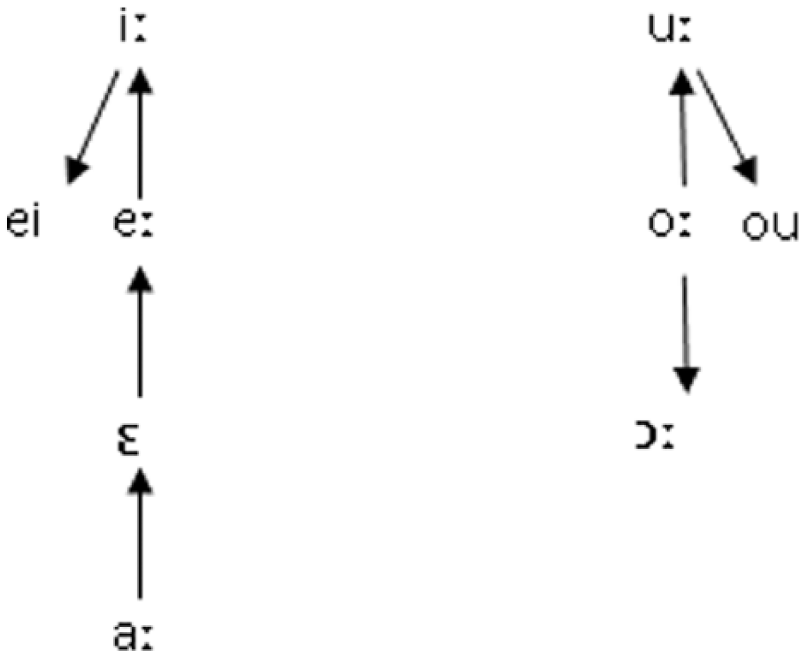
The Great Vowel Shift of Middle English.
Notice that the diphthongs /əʊ/ and /eɪ/ were once pronounced as [o:] and [e:], respectively. Another fact regarding the development of diphthongs from single vowels comes from the Romance languages. It is common for stressed and unstressed syllables to behave differently with the evolvement of language. For instance, in the Romance languages, the Latin vowels /e/ and /o/ have generally diphthongized in a stressed syllable. Because stress figures in verb conjugation, this has resulted in verbs with vowel alternation in these languages. By way of illustration, the Spanish verb “volver” (to turn) has the form “volvi” in the past but “vuelvo” in the present. In Italian, the same phenomenon is observed, but with the vowel /o/ alternating with /uo/, instead. Nouns also do bear this fact. For example, Spanish “ventilación” (ventilation) becomes “viento” (wind) from Latin “ventum” (Wikipedia). In fact, today, many varieties from RP in the London area and many other regions use pure long vowels varying between cardinal [o:] and cardinal [ɔ] for /əʊ/, and cardinal [e:] and cardinal [ε:] for /eɪ/ (Gimson, 1980). One form of the development of these two diphthongs is that the pure vowels [ɔ:] and [ε:] had probably reached a quality near cardinal [o:] and cardinal [e:] in the 16th and 17th centuries (cf. Gimson, 1980, for a fuller account). The above historical facts about the diphthongs in question are crucial for explaining the behavior of our Jamaican informants regarding the production of these sounds. That is, Holm (2000) was quite right to suggest that in any discussion of the development of European vowels into their corresponding forms in the creoles, it should be recalled that the starting point was not necessarily the same as the modern vowel of the standard European language, but rather the corresponding vowel of the speech of the 15th to 17th centuries (for Portuguese and Spanish) or 17th to 18th centuries (for French, Dutch, and English). (p. 146)
Thus, one can safely assume that Jamaican informants might have retained the old pronunciation (or archaic usage) of these diphthongs, as this is a common practice among creole speakers, regarding different aspects of language. For instance, speakers of English-based Atlantic creoles use from as a conjunction with the temporal meaning of since, for example, “From I was a child I do that,” which is part of both archaic and regional English (Holm, 2000, p. 109). In Haitian creolized French, chat /šat/ (earlier pronunciation) of cat is used instead of today’s /ša/. A third example comes from Annobonese creolized Portuguese. In this creole, the word for doctor is “babélu” from Portuguese “barbeiro” (barber). This is because, in the past, barbers bled their clients (patients) for treatment (cf. Holm, 2000).
Monophthongization of European diphthongs seems to have always been the trend in the early creoles. Holm (2000) cites the following examples from Sáo Tomé creolized Portuguese. In this creole, the Portuguese diphthongs /ai/ and /oi/ are pronounced as /a/ and /o/, as in “basu,” under, from Portuguese “debaixo” and “dodo,” crazy, from (doido), respectively. Hall (1966) refers this monophthongization to the influence of substratum languages on the phonetics of these creoles. According to Hall, many languages—including those of Africa, China, and Melenesia—do not diphthongize the vowels /i’, e’, ǒ, ʋ̆,/ in such words as fear, go, bait, and so on. Thus, neo-Melanesian, neo-Solomonic, and other English-based pidgins and creoles normally have non-diphthongized vowels.
After this detailed account on the production of diphthongs, especially /eɪ/ and /əʊ/, in the contexts of L1, L2, AAVE, historical linguistics, and creole languages, one clear pattern is observed. That is, speakers in all these contexts (including native speakers of English) indicate preference for monophthongization. This is the case not only for those whose languages do not have the diphthongs concerned but also for adult native speakers. One explanation for this tendency of monophthongization is that monophthongs require less gymnastics to produce than diphthongs. In other words, although the vowel substitution patterns of diphthongs are more or less similar to those of long monophthongs, and although both contain two timing units, diphthongs are more complex than long vowels. Put differently, diphthongs contain two separate root nodes, whereas long vowels contain only one (Fikkert, 1994), as illustrated in Figure 7.

Representation of long vowel and diphthong.
Notice that the second node of the diphthong is a glide that is necessary for the speech organ to combine the vocalic elements of the diphthong, and whose absence causes hindrance in the production of the diphthong. The glide will also pave for the existence of the copy rule in Figures 3 and 4. It seems that this gymnastics, which involves the joining of two vocalic elements, is not part of the vocalic system of the speakers, so far. Thus, the natural consequence of this marked gymnastics is to simplify the task by eliminating the problematic gesture in the manipulation—the glide. Our view on the complexity of diphthongs has been supported by Stokes, Lau, and Ciocca (2000) regarding the production of diphthongs by Cantonese-speaking children with phonological disorders. They propose that diphthong errors arise as a function of both ambient frequency and feature complexity.
Conclusion
The output of this investigation is that to explain why L2 learners behave in a certain way, it is wise to look at other modes of language contact, such as creole languages. However, once the two fields (i.e., L2 and creole) involve language in the making, in that they are linguistic systems comprising finite numbers of grammatical rules (like any natural language) capable of being internalized and used productively by their speakers, it is inevitable to bring in the domain of child language in which an attempt is made to discover the logical problem of language learning. Our investigation has shown that the learning of the diphthongs under study is more or less accomplished in the same way in the three domains. For instance, speakers in the three situations are found to simplify the two diphthongs by reducing them into a simple vowel, thus eliminating the glide that seems to be a problematic gesture in the manipulation of a diphthong. In particular, the behaviour of the two groups (i.e., Arab learners of English and speakers of JC) with regard to the acquisition of the two diphthongs in question corroborates that of child language, which is taken to be “external evidence” in the sense of Singh (1988). The centrality parameter is found to be a marked feature in these diphthongs, which need to be mastered before their production is handled. Moreover, insights from historical linguistics suggest that the strategies deployed by the child acquiring mother tongue, L2 learners, and creole speakers are not incompatible with the norms displayed in the development of natural languages. More specifically, Baron (1973) and Traugott (1977) found a number of similarities between the historical change and the line of change in language acquisition. Dickenson (1976) also draws this parallel. Nemser (1981) postulates that “the diachronic mechanism underlying historical change and those active in . . . language acquisition are not only closely related but also organically united” (p. 74). In a word, it seems that the same factors govern the acquisition of these two diphthongs in pidgin and creole languages, as well as in second language learning.
Footnotes
Declaration of Conflicting Interests
The author(s) declared no potential conflicts of interest with respect to the research, authorship, and/or publication of this article.
Funding
The author(s) received no financial support for the research and/or authorship of this article.