




Abstract
This empirical study was aimed at deepening the knowledge of the direct and indirect effects of entrepreneurial orientation (EO) on business performance and how industrial organization (IO) influences EO of micro and small firms from a city in a developing country, using the partial least squares structural equation modeling (PLS-SEM). In this study, the satisfaction of the customers was considered as a mediator variable and the IO as a formative construct. The results show enough evidence that IO positively affects EO; EO positively influences business performance and customer satisfaction (CS); likewise, EO impacts business performance in a positive manner both directly and indirectly through CS. Regarding managerial implications, the study provides knowledge to managers over the processes of shaping strategy and decision making, stressing the importance of both encouraging the development of EO capabilities and focusing efforts on CS to improve business performance.
Keywords
Introduction
Previous studies have examined the relationship between entrepreneurial orientation (EO) and firm performance and generate no definitive results probably due to the omission of the moderating role of different unidentified variables (Covin & Slevin, 1991; Lee & Chu, 2017; Lumpkin & Dess, 2001). To explicitly address this gap, this study investigates how EO influences firm performance, considering the mediating effect of customer satisfaction (CS) and the impact of industrial organization (IO) on EO of micro and small firms.
Before to get started about EO and CS, it is important to precise that this research approaches the IO from the perspective of Michael Porter’s five forces, namely, threat of new entrants, intensity of competition, bargaining power of buyers and suppliers, and the threat of substitutes (Porter, 2013). This model has been used since the late 70s as an understanding of the competitive forces and their underlying causes, to reveal “the roots of an industry’s current profitability while providing a framework for anticipating and influencing competition (and profitability) over time” (Porter, 2008, p. 26).
On the contrary, EO is relevant as a strategic capability to develop opportunities in the environment, with the strategy-making processes allowing the creation of competitive advantage based on innovativeness, proactiveness, and risk-taking (Covin & Slevin, 1989, 1991). Frequently, EO is related to external forces where industrial competition has a strong effect on firm behavior (Covin & Miller, 2014; Guggenheim, 2016; Lechner & Gudmundsson, 2014). The strategic perspective of a business then provokes the advent of strategic competition that incites different behavior and action preferences (Dälken, 2014). In this sense, entrepreneurs have been affected by the context. For instance, they are not commonly informed or do not have the skills to respond in the same manner to competition in an economic rational way (Kovaleva & de Vries, 2016).
Likewise, numerous authors considered this orientation as a managerial attitude that provides an important capability to improve the way firms make decisions (e.g., Alegre & Chiva, 2013; Real, Roldán, & Leal, 2014; Van Doorn, Jansen, Van den Bosch, & Volberda, 2013). Currently, this posture mitigates the financial performance when it starts to decline (Wales, Parida, & Patel, 2013). According to the revised literature, we could emphasize that EO has a clear relationship with external and internal variables in many ways—environmental, organizational, strategic, and managerial views (Covin & Wales, 2011; Dälken, 2014).
In this tone, we must identify innovation, risk-taking, and proactivity as an evolutionary routine, which permits the necessary-driven value-creation from taking advantage of opportunities that the market offers to become a chance in something reachable (Acar, Zehir, Özgenel, & Özşahin, 2013). In a global demand, where the particularities of selling are necessary to have a defined strategy based on the needs of customers, thus, an entrepreneur must be able to recognize characteristics of the market—i.e., physical, emotional, and psychological characteristics—which are to be expanded (Wang & Juan, 2016). The skills to determine the needs of the market arise when an entrepreneur knows how to point out customer orientation; if he or she is informed about changing customer needs in turn to pursue new opportunities of business, he or she will reach CS, applying limited resources that could be focused on leading company performance (Tajeddini, Elg, & Trueman, 2013).
Several studies have indicated that many firm resources are spent on determining CS (e.g., Saeidi, Sofian, Saeidi, Saeidi, & Saaeidi, 2015; Sun & Kim, 2013; Swaminathan, Groening, Mittal, & Thomaz, 2014); at the same time, multiple opportunities are created by attending to the preferences of a customer (Chokesikarin, 2014), which in the end positively impacts business performance.
Authors such as Chokesikarin (2014), Lee and Chu (2017), and Sun and Kim (2013) have explored the direct relationship between either EO or CS with business performance. Zehir, Gurol, Karaboga, and Kole (2016) look at EO as a mediator variable between strategic human resources management and business performance, meanwhile Xie, Jia, Meng, and Li (2017) and Eren, Eren, Ayas, and Hacioglu (2013) found evidence of the mediating effect of CS between firm performance and other variables different from EO. Cui, Fan, Guo, and Fan (2018) found that the positive effect of EO in business performance is mediated by variables such as dynamic capabilities of absorptive capacity (ACAP) and boundary-spanning. In a similar way, Zehir, Can, and Karaboga (2015) studied the mediating effect of both differentiation strategy and innovation performance in the relationship between EO and firm performance. But it is Kurtulmuş and Warner (2015) who opened the gap that this research is seeking to contribute toward their research, which explores the relationship between EO and the performance of subject–matter experts (SMEs) in a developing country, finding that this relationship is not effective. Therefore, the study raises a question about the nature of the relationship between EO and performance and the moderating role of environment. On the contrary, how CS maximizes the relationship between EO and business performance.
Previous research has shown that the performance of SMEs is influenced by their ability to create superior customer value and pursue entrepreneurial opportunities (Buli, 2017), but to do so, SMEs must use an integrative approach of EO and market orientation. Choi and Williams (2016) found that market action mediates the relationship between EO and firm performance on SMEs. In a similar way, Baker and Sinkula (2009) showed that EO and market orientation complement one another in small businesses, improving financial performance. In all those studies, the constructs of market orientation and market action took into account different elements of CS.
Through this study, we want to determine the direct and indirect effects of EO on firm performance and how CS works as a mediator variable in this relationship, providing empirical evidence in the context of micro and small businesses in a developing country; such as is the case of Mexico. This being a contribution by itself, the second one is the application of a different methodology from previous researches; we address the entrepreneurship study using PLS-SEM (partial least squares structural equation modeling) with a formative-reflective model, assessing the direct and indirect effects with a mediation variable, to this end, the Cohen test was also used (Cohen, 1988), best known as the effect size
Theoretical Background and Hypotheses
There are potential boundaries, which represent a harsh route to get better business performance, to link a walking through from the industry factors to support business performance variations. Our research proposes an integrated model in which any firm is involved, where different factors are affecting business performance. We give empirical evidence in two angles: external, industrial factors; internal, EO and CS. With this complex perspective, we want to show the stretch of EO as the main variable, in view of contemporary studies where it was related in one way (e.g., Boso, Story, & Cadogan, 2013; de la Garza Carranza, Soria, & Estrada, 2016; Dickson & Weaver, 2008; Dwairi & Akour, 2014; Lechner & Gudmundsson, 2014; Maldonado-Guzmán, López-Torres, & Castro, 2016; Martin & Javalgi, 2016; Roxas & Chadee, 2013; Ruiz-Ortega & Parra-Requena, 2014; Tang & Hull, 2012).
If we consider that Porter’s five forces represent the IO approach, this implies that the firm should anticipate market structure and competency, then recognizing the attractiveness to operate there and establishing a strategy based upon threat of new entrants, intensity of competition, bargaining power of buyers and suppliers, and threat of substitutes (Porter, 2013). Despite this, IO has been relevant to entrepreneurship over the years (Leff, 1978). The notable connection suggests that where an asymmetric environment is settled, imperfections produce high risk and uncertainty to participants of the market, which cause unprotection, low confidence, and nonshared knowledge between stakeholders (Ali, 2015; Parga-Montoya, 2016; Sambharya & Musteen, 2014).
Research in IO has shown low entrepreneurship when it is difficult to pursue opportunities. The efforts of an entrepreneur are deficient when there are no incentives to take risk and to be proactive (Aparicio, Urbano, & Audretsch, 2016; Dwairi & Akour, 2014; Roxas & Chadee, 2013). Shane and Venkataraman (2000) assumed that entrepreneurs are more likely to recognize opportunities where to competitive is advantageous; the information market is there to be exploited and to motivate good forecasts for the future. The industry is changing to a more articulated world looking for nonbarrier patterns to lead entrepreneurship to rapid development based on evolving industrial forces that make the environment understandable to economic actors (Agarwal & Braguinsky, 2015). In developing countries, it is well known that industrial profile is less diversified and more fragmented, as well, the incomplete economic structure does not allow new entrants, and entrepreneurial skills are constrained by specific constraints of industry (Calá, Arauzo-Carod, & Manjón-Antolín, 2015). The first hypothesis of the study is framed as follows:
As we said before, EO is a process, which gives a response to the market by taking financial, physical, and social risk. The level of EO determines how the firm will dare the entry into new markets or to develop new goods or services (Acar et al., 2013). This perspective is often engaged with beating competitors, undertaking risky ventures and having success with new products in response to customer needs. That notion shows a possible relationship with the clients because the proactive firm is trying to be better than its opponents due to the knowledge of consumer experiences with its products (Chokesikarin, 2014), alluding to CS. Thus, it is necessary to engage a dominant logical posture based on entrepreneurship, because preceding studies have focused on CS on organizational level (e.g., Ažman & Gomišček, 2015; Jones, Taylor, & Reynolds, 2014; Mittal, Ross, & Baldasare, 1998).
To define the relationship of how EO could affect CS, several authors have considered that new product development must go beyond to incorporate an innovative perspective with scarce resources, which allow the knowledge of how to deal with the market by taking risks and being competitive (Martin & Javalgi, 2016). Although prior research has established a previous step to get CS, considering service performance a direct relationship between EO and CS (Neck, Houghton, Sardeshmukh, Goldsby, & Godwin, 2013; Wang & Juan, 2016), it means that EO has been related in an indirect way with CS. Hence, this study aims to mainly define the direct effect for being oriented to entrepreneurship, which enables the remarking of the differentiation of the competitors by the consumers especially when the firm is sufficiently creative to offer new products, which depend on customer needs (Kollmann & Stöckmann, 2014). The second hypothesis to be tested in this study is as follows:
With regard to the effects that EO have on the firm, Covin and Miller (2014) has established business performance as a dominant theme, therefore, in agreement with extensive EO literature, which has researched the effects of EO on firm performance (Boso et al., 2013; Lechner & Gudmundsson, 2014; Martin & Javalgi, 2016; Real et al., 2014; Sok, O’Cass, & Miles, 2015; Su, Xie, & Wang, 2013; Van Doorn et al., 2013); this study intends to compare the indirect effects on business performance being affected by EO through CS, as a panoramic view of the behavior where a firm has to develop its strategic orientation to satisfy its clients and to get successful results.
The first perception of CS is defined as the behavioral intentions of a customer to repurchase in consistency with his or her experiences with the product (Mittal, Han, Lee, Im, & Sridhar, 2017). The satisfaction of a client is a reflection of the economic value of a product, where the business can attempt to fulfill the need of the specific client on different levels. Therefore, businesses should construct activities that allow them to learn about the need of the client (Eisenbeiss, Cornelißen, Backhaus, & Hoyer, 2014). Consequently, to put this in concordance with the purposes, CS has been related to business performance by many previous authors (Eisingerich, Auh, & Merlo, 2014; Jones et al., 2014; Mittal et al., 1998; Saeidi et al., 2015; Sun & Kim, 2013; Swaminathan et al., 2014).
On the contrary, it has been found in the scientific literature that CS has been studied as a mediating construct, but evidence has not been found where CS mediates the relationship between EO and business performance. For instance, Xie et al. (2017) and Eren et al. (2013) found evidence of the mediating effect of CS between firm performance and other variables different from EO. Likewise, Cui et al. (2018) found a positive effect of EO in business performance mediated by variables such as dynamic capabilities of absorptive capacity (ACAP) and boundary-spanning; in a similar way, Zehir et al. (2015) studied the relationship between EO and business performance mediated by differentiation strategy and innovation performance. With these two relationships, we shape our model on five hypotheses where EO is an essential variable to provide a holistic view of the firm:
Figure 1 shows the theoretical model, which gave rise to the formulation of the hypotheses of this study.

Theoretical model.
Method
The present empirical study has a quantitative, nonexperimental, transversal, descriptive, and explanatory research design using the statistical technique of PLS-SEM, through the statistical software Smart PLS 3.2.6 (Ringle, Wende, & Becker, 2015), in which the estimation of the measurement model was first considered and then the structural model was assessed as a model of hierarchical components (Lohmöller, 1989, cited in Cuevas-Vargas, 2016). In this sense, the model was measured using the indicator repetition approach (Ringle, Sarstedt, & Straub, 2012; Wetzels, Odekerken-Schröder, & van Oppen, 2009), which is necessary to run higher order models in PLS-SEM (Cuevas-Vargas, 2016; Hair, Hult, Ringle, & Sarstedt, 2017). It should be noted that this statistical technique was also used because it works with nonparametric tests solving the possible problems of nonnormality of the data (Hair et al., 2017). This will be shown in the section on descriptive statistics.
Sample Design and Data Collection
For the development of this study, the database of the National Statistical Directory of Economic Units (INEGI, 2017) was taken as a reference, considering as objective population economic units with less than 50 employees in the city of Valle de Santiago, Guanajuato, in which there were a total of 4,677 registered micro and small enterprises. When determining the sample with a confidence level of 95% and a 5% margin of error, a sample of 355 companies was obtained. In this sense, when using the technique of simple random sampling, the survey was applied from February to April 2017 to the owners or managers of the chosen companies of the sample, obtaining at the end, 338 valid surveys, which represent the sample of the present study.
According to the distribution of the sample, it has a predominant bias to the microbusiness sector comprising 97.9% of the sample, given the insufficiency of knowledge that there is about this segment as it is the one that dominates the economy. Likewise, the sectors with the highest representation are commerce, with 46.8%, and services, with 33.2%, followed by manufacturing, with 18.5%, and agribusiness, with just 1.5%. About 30% of these businesses are run by women.
Variables
IO variable
The lower order construct (LOC) industry organization was adapted from Porter’s five forces analysis (Porter, 2013) modeled as a formative construct, measured through five indicators that measure firms’ perspective on the threat of new entrants, the threat of substitute products or services, the threat of established rivals, the bargaining power of suppliers and the bargaining power of buyers. All of them were measured with a Likert-type scale from 1 to 5 points; where possible answers range from totally disagree to totally agree.
EO variable
To measure EO, the higher order scale (HOC) created by Covin and Slevin (1991) was used, which measures strategic orientation to entrepreneurship in three specific dimensions of reflective type: Innovation, an adapted construct, which is measured by four indicators; proactivity, measured through three indicators; and risk taking, measured with three indicators. All of them measured with a 5-point Likert-type scale, where answers range from totally disagree to totally agree.
CS variable
To measure the CS variable, a LOC of a reflective type was used, adapted from Zhang, Vonderembse, and Cao (2009), which measures the level of satisfaction of clients in micro and small business, through a six-indicator scale. This was measured with a 5-point Likert-type scale, where answers range from totally disagree to totally agree.
Business performance variable
To measure this construct of lower order (LOC) of reflective type, we used the scale of AECA (2005), which measures the evolution that micro and small companies have had regarding the return of their investment, increase in sales, CS, employee satisfaction, and overall results through a six-indicator scale. This was measured with a 5-point Likert-type scale, where answers range from low to high.
Reliability and Validity
To assess reliability and validity, the measurement model was estimated using the PLS-SEM statistical technique with the Smart PLS 3.2.6 statistical software (Ringle et al., 2015). In this sense, based on the results obtained and shown in Table 1, we highlight the high internal consistency of all reflective lower and higher order constructs of the measurement model, as the composite reliability that represents the part of the variance between the group of observed variables and the underlying constructs (Fornell & Larcker, 1981), exceeds the value of 0.708 recommended by Hair et al. (2017).
Formative and Reflective Measurement Model Assessment.

Source. Own contribution from results obtained with Smart PLS 3 Ringle, Wende, and Becker (2015).
Note. VIF = variance inflation factor; FLOC = formative lower order construct; RLOC = reflective lower order constructs; AVE = average variance extracted; PLS = partial least squares.
In addition, the Cronbach’s alpha for each of the constructs is higher than 0.7 as suggested by Hair, Anderson, Tatham, and Black (1998) and Nunnally and Bernstein (1994), and finally, exceeds the AVE (average variance extracted) value of 0.5 (Fornell & Larcker, 1981; Hair, Sarstedt, Ringle, & Mena, 2012). Likewise, it has been found that the reliability of the indicator is higher than 0.5, as its corresponding standardized factor loading is higher than 0.708 (Hair et al., 2017), and are statistically significant (p < .001). This guarantees the communality of each indicator; and having obtained AVE values higher than 0.5, it is guaranteed that each of the scales used has convergent validity (Hair et al., 2017).
As for the construct of formative type, it is shown that the formative construct of IO has convergent validity as the redundancy analysis was above 0.7 (Hair et al., 2017); similarly, the indicators did not present problems of collinearity because the VIF value of every single indicator was under 5 (Hair et al., 2017). Finally, with respect to the significance of the outer weights (relative importance), as some of them were not significant, their absolute contribution represented through the outer loadings had to be analyzed, and all of them were higher than 0.5 and statistically significant (Hair et al., 2017).
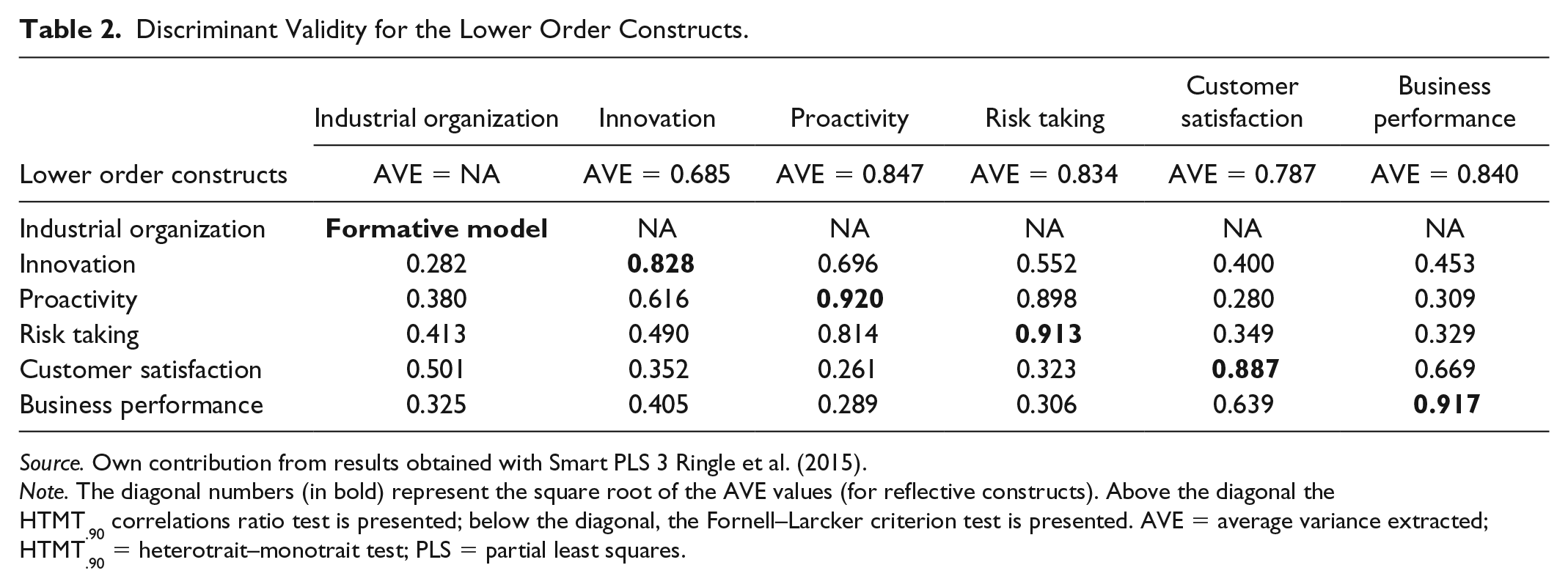
With respect to the evidence of discriminant validity, this was calculated through two tests, which are shown in Table 2. First, above the diagonal, the heterotrait–monotrait test (HTMT90; Henseler, Ringle, & Sarstedt, 2015) is shown, being considered as a criterion of better performance to determine the discriminant validity of the constructs. It was obtained with PLS-SEM when requesting the complete bootstrapping, finding that the values of the correlations between the reflective constructs are below 0.90 (Gold, Malhotra, & Segars, 2001; Henseler et al., 2015; Teo, Srivastava, & Jiang, 2008). In addition, to corroborate the discriminant validity, the Fornell–Larcker criterion was calculated using the square root of each construct AVE whose values represent the diagonal, and according to Fornell and Larcker (1981), these values are higher than their corresponding correlations with any other construct.
Discriminant Validity for the Lower Order Constructs.
Source. Own contribution from results obtained with Smart PLS 3 Ringle et al. (2015).
Note. The diagonal numbers (in bold) represent the square root of the AVE values (for reflective constructs). Above the diagonal the HTMT.90 correlations ratio test is presented; below the diagonal, the Fornell–Larcker criterion test is presented. AVE = average variance extracted; HTMT.90 = heterotrait–monotrait test; PLS = partial least squares.
Based on these analyses, it can be concluded that these studies’ data are clearly reliable and valid to prove the hypotheses with PLS-SEM.
Results
As for the descriptive statistics, which are shown in Table 3, we highlight the manifest variables that had a greater relevance for the owners of micro and small enterprises. First, with respect to the five forces with which the IO was measured, it was found that 64.4% of the respondents agree that there is a high rivalry among the companies in the sector and 58.3% agree that it is easy for new companies to enter, indicating that there are no entry barriers by the industry for those starting a new business.
Descriptive Statistics and Evaluation of Data Normality.

Source. Own contribution from results obtained with Smart PLS 3, Ringle et al. (2015).
Note. Excess kurtosis and skewness values > ±1 are not normally distributed (Hair, Hult, Ringle, & Sarstedt, 2017). PLS = partial least squares.
Regarding EO, as to the variables with which the innovation was measured, 30.3% of the owners agree that there have been changes or improvements to the products or services by their companies. However, 49.7% consider that no changes or improvements have been made to their production processes and 47.9% stated that they have not acquired new equipment to improve their production processes, which has affected the few improvements they have made to their products. Regarding proactivity, only 20.6% agree that in general their company has a strong tendency to confront others by introducing novel ideas or products, whereas 52.6% disagree that when they compete with the competition, their company is the first to introduce new products and/or services, processes, technologies, and administrative techniques. In terms of risk taking, 30.1% agree that due to the nature of the environment, it is necessary to act in a bold and direct way to achieve the objectives of the company; however, 56% do not have a strong preference for high-risk projects.
Regarding CS, it was found that there is an 87% consensus that their company has a good reputation for their products or services, 85.9% agree that their customers are loyal to their products, and only 13.2% consider that their clients do not perceive that they receive the value of their money when they consume products or services of the firm, which demonstrates a high satisfaction from their customers. Finally, in terms of performance, it was found that 57.4% of the managers or owners consider that according to their objectives the satisfaction of their clients was high, 51.4% consider that the satisfaction of their employees was high, and 50.2% consider that the increase of their sales was high. However, 29.4% consider that in relation to their objectives the level of return on investment was low.
To obtain the statistical results and the verification of the research hypotheses, the structural model was analyzed using bootstrapping, through Smart PLS 3.2.6 (Ringle et al., 2015), finding evidence to get confidence intervals for evaluating the precision of the parameters. The results show that the structural model has predictive relevance, as shown in Table 4, where it can be seen that the EO is explained in 17% by IO (R2 = .170); CS is explained in 12.8% by EO (R2 = .128); and business performance is explained in 43.6% by EO and CS (R2 = .436). Therefore, these results indicate that the model has quality and its results are useful for making business decisions (Hair et al., 2017).
PLS-SEM Results of the Structural Model.

Source. Own contribution from results obtained with Smart PLS 3, Ringle et al. (2015).
Note.
With regard to the first hypothesis, the results shown in Table 4 (β = .412, p < .001) indicate that the IO has positive and significant effects on the EO of micro and small enterprises. Therefore, H1 is accepted, as it has been found that the five forces with which the IO was measured impact in 41.2% on EO, and according to Cohen’s (1988) test is of medium size, having obtained a value of
Concerning the second hypothesis, the results indicate that EO has positive and significant effects on CS (β = .358, p < .001). Hence, H2 is accepted, as the EO has a 35.8% impact on CS, and that this effect according to the test of Cohen (1988) is small in size, having obtained a value of
Regarding H3, the results show the effects that EO has on business performance (β = .176, p < .001), therefore, H3 is accepted, as it has been found that EO has a direct impact of 17.6% on business performance, and that this effect according to the test of Cohen (1988) is small in size. Having obtained a value of
In relation to the H4, the results (β = .576, p <.001) show that CS has positive and significant effects on the performance of micro and small enterprises in Valle de Santiago, Guanajuato. Therefore, H4 is accepted, as the empirical evidence shows that CS has an impact of 57.6% in the performance of these firms. In line with Cohen’s test, there is a large effect size considering the
To assess the direct and indirect effects of the EO and CS on business performance, Table 5 shows the total effects of the different variables on the target construct business performance. It can be seen that the IO has an indirect and total effect of 0.158 on business performance and EO has a direct effect of 0.176 and an indirect effect 0.206 on business performance. Therefore, the EO has a total effect of 0.382 on business performance; and with regard to CS, this variable has a direct and total effect of 0.576 on business performance.
Path Model and Total Effects.

Source. Own contribution from results obtained with Smart PLS 3, Ringle et al. (2015).
Note. PLS = partial least squares; IO = industrial organization; EO = entrepreneurial orientation; CS = customer satisfaction.
Obtained from the effects of IO on EO (0.412) multiplied by the effects of EO on CS (0.358) multiplied by the effects of CS on business performance (0.576) plus the effects of IO on EO (0.412) multiplied by the effects of EO on business performance (0.176).
Obtained from the direct effects of EO on CS (0.358) multiplied by the effects of CS on business performance (0.576).
Finally, with regard to the H5, the mediating effect of CS on the relationship between EO and business performance was tested using bootstrapping, finding a significant indirect effect (β = .206, p < .001), demonstrating the mediating effect of CS. Therefore, H5 is accepted. To establish the mediating effect, the indirect effect a × b must be significant. To test for significance, the z statistic (Sobel, 1982) was applied in the following way:
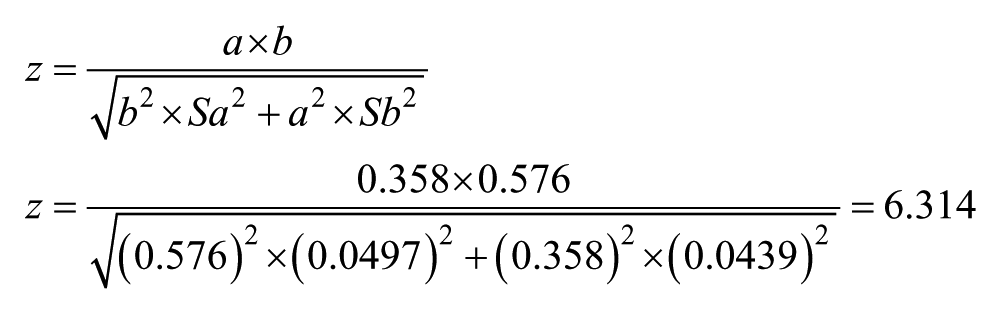
According to this result, the mediating effect is confirmed by the z statistic (Sobel, 1982). Therefore, the result shows that EO has a direct effect on business performance as well as an indirect effect via the CS construct.
It is important to note that to determine the magnitude of the indirect effect, the variance accounted for (VAF) formula was used as suggested by Hair et al. (2017). This formula helps to determine to what extent the variation of the dependent variable is directly explained by independent variables and how much of that variance is explained by the indirect relation through the mediator variable. The following formula depicts how the VAF was calculated:

Based on the results obtained through the VAF, it can be concluded that the CS variable within the present research model played the role of mediating variable in the EO, as 54% of the effect of the EO on business performance is explained through the mediation of the CS. Because the VAF is greater than 20%, but lower than 80%, suggested by Hair et al. (2017), therefore, this situation can be ranked as a partial mediation (Hair et al., 2017).
Discussion
In present times, finding a source of a sustainable competitive advantage is the main job for CEOs, managers, and entrepreneurs. The reason is that a sustainable competitive advantage will guarantee any organization a better performance, which is, in the end, the very reason for the existence of any business. Unfortunately, the existence of a competitive advantage relies on a series of capabilities of the organization, as well over a series of external factors that shape the strategy of any business. Due to this, there has been a lot of research aimed to find the most relevant variables that affect business performance. In an age where the technology, information, and markets are closer and more accessible to everyone, EO is taking relevance as a strategic capability (Covin & Slevin, 1989, 1991). That having been said, EO has been the subject of a lot of research, to demonstrate that it is a core strategic capability in any organization, affecting both business performance and consumer satisfaction, as Chokesikarin (2014) did.
This study, focused on micro and small firms, not only obtained empirical evidence of the relationship between EO and business performance, but also assessed how the IO, as a group of external forces, influences EO. Going even further, the research also evaluated the impact of EO over CS, which permitted the assessment of the indirect effect of EO over business performance through CS. Considering Porter’s five forces as a representation of the IO approach, the research shows that the external, industrial environment has positive and significant effects on the EO of micro and small enterprises. On the contrary, understanding Porter’s five forces as external variables that influence the process of strategy making and define the level of attractiveness of a particular industry (Porter, 2013), the research makes clear the relevance of developing EO, understood as the grade of innovativeness, proactiveness, and risk-taking approach of the organization (Covin & Slevin, 1989, 1991). This is supported by the research done by Jabeen and Mahmood (2014) that demonstrate a significant moderating effect of external environment (EE) on EO and business performance relationship.
Due to globalization, shorter life cycles of products and continuous improvements in technology, the current business environment has become very dynamic, competitive, and complex, a lot of managers and CEOs have turned their attention to internal capabilities, especially to EO (Jabeen & Mahmood, 2014). Researchers have been studying EO as an internal capability and as source of business performance and competitive advantage (Acar et al., 2013; Chokesikarin, 2014; Jabeen & Mahmood, 2014; Khadhraoui, Lakhal, Plaisent, & Bernard, 2016; Lumpkin & Dess, 2001; Wang & Juan, 2016). However, this research went further, not only looking for the direct effect of EO over business performance, but also the indirect effect that EO has over business performance passing through CS.
The evidence shows that EO has positive and significant effects on CS, supporting the evidence obtained by Jabeen and Mahmood (2014) and Khadhraoui et al. (2016), as other researchers have shown the relationship between CS and business performance (Eisingerich et al., 2014; Jones et al., 2014; Mittal et al., 1998; Saeidi et al., 2015; Sun & Kim, 2013; Swaminathan et al., 2014). This particular research gives to the decision makers a new and supported reason to develop the EO capabilities inside their organizations. Besides, this research also supports the direct, positive, and significant effect of CS over the business performance. According to the analysis, the development of EO in micro and small firms must become a priority to managers and CEOs, because this approach is perfectly compatible with a customer focused strategy (Acar et al., 2013), affecting positively the CS and drive, which must be the top priority of any decision maker in a company: a better performance of the business.
An interesting finding was the relative disagreement of the firms in EO, mainly in the variable, which measures the proclivity of the firm to introduce new products/services before acquiring the necessary competence; this is compared with our results of the direct, positive, and significant effect on CS. We could assume a strong position: The direct effects on CS are influenced by the proclivity to introduce new products albeit the values are low. To support this interpretation, we propose a new approach based on EO taxonomy of firms: low EO and High EO. Whether the risk-taking actions and competitive schemes with a previous understanding of the market’s behavior, the proactive behavior of the firm will be focused on the perception of good reputation and quality for the company’s products as a consequence of positive customer response, making constructive suggestions (Eisingerich et al., 2014).
We suggest that the results are negatively perceived for the strategy position of the firms toward being more cautious with the market proposals, prioritizing the retainment of customers, expressed in the high levels of worth/money ratio perception. In these results, Morgan, Anokhin, Kretinin, and Frishammar (2015) determined that product newness could affect the relevant performance of the product, being radical and potentially risky. The fact is if a firm combines EO and CS, it will understand what consumers need both economically and functionally. Reijonen, Hirvonen, Nagy, Laukkanen, and Gabrielsson (2015) have found that customer’s decisions are based on price rather than brand, which both dimensions give managerial skills to cope in competition and retain CS.
Regarding the mediating effect of CS on the EO-BP relationship, we argue on the extent to which the benefits of the firm, increasing sales, and overall satisfaction—customers and employees—are directly explained by innovative skills, taking risk attitudes and mainly, proactive positions and how much of the business performance is explained by the quality of the products, good reputation, and loyalty of the customers via mediator variables. Our results are suggesting that overall results are being influenced by taking initiatives against competitors, introducing new products, and bearing an aggressive posture at the market, provided that the knowledge of customer needs, which allows high confidence among stakeholders.
When specific actions are taken by the firm to enhance the efficiency in a merger market, the firms will facilitate the value creation, and will explain how important EO is for the business performance, this means, what strategic position is establishing in the market. Due to this aggressive posture, the firms in the same industry will define the standard CS in agreement with the higher proactive firm. Thus, as we emphasize money’s worth results, when the market establishes products’ satisfaction schemes, other firms must adjust their features according to the most entrepreneurially oriented.
Conclusion
This research found empirical evidence on micro and small firms of the direct, positive, and significant relationship between IO and EO, EO and CS, CS and business performance, as well as a relevant, positive, and significant relationship between EO and business performance, both directly and indirectly. The methodology was built over a subjective approach of business performance, in virtue of which the financial information implies certain problems to be obtained from micro and small companies.
The relevance of this study is based on the knowledge it provides to managers and CEOs in SMEs over the processes of shaping strategy and decision-making, stressing the importance of both encouraging the development of EO capabilities and focusing efforts on CS. On the other side, it makes clear how an IO shaped by the perspective of Porter’s five forces influences EO in the organization. Due to the fact that this study was made using a sample whose scope included four different economic sectors; the results are relevant to a wide spectrum of businesses. Further research will be necessary to assess the impact of specific dimensions of EO over CS and business performance, as well as to assess the impact of EO over specific economic sectors.
Footnotes
Declaration of Conflicting Interests
The author(s) declared no potential conflicts of interest with respect to the research, authorship, and/or publication of this article.
Funding
The author(s) received no financial support for the research, authorship, and/or publication of this article.
