




Abstract
This article investigates vulnerabilities related to commercial pressure and asks whether the ability to resist commercial temptations is class related. Four hypotheses are developed and tested in a nationally representative web survey among 1,707 respondents living in Norway. We found no differences in the ability to resist temptations between working-class and middle-class people, but the analysis gave some support to the conspicuous consumption hypothesis: Consumers from the upper middle class, with high purchasing power, reported to be the least able—or willing—to resist commercial temptations. Lacking ability to resist commercial temptations is an important vulnerability driver. Members of the upper middle class can normally afford their conspicuous consumption and can hardly be characterized as vulnerable. Members of the working class, however, are more vulnerable as measured by the tendency to buy things one cannot afford, even though they are better prepared to resist commercial temptations. The reason working class people are more likely to buy things they cannot afford is best explained by unequal class related distributions of financial opportunities, rather than by class in itself. Overall, the analysis demonstrates that self-reported class affiliation is a relevant approach for the study of social inequalities.
Keywords
Introduction
In today’s consumer society—with endless shelves of consumer goods combined with smart marketing and easily available credit possibilities—the ability to resist commercial temptations is important. Rich people can afford more commercial frivolity, without severe consequences, than poor people can. Accordingly, vulnerabilities related to commercial temptations can have socially unfair consequences. Poppe, Lavik, and Borgeraas (2016) document that poor people more often than others face payment problems and indebtedness. The European Commission has documented that consumers with poor financial opportunities are generally more likely than others to be vulnerable in the consumer role (European Commission, 2016). Furthermore, several studies indicate that economic orientations and financial practices are socially inherited and class related (Brusdal & Berg, 2011; Webley & Nyhus, 2013, 2006). Still, there have been few recent studies in Norway investigating how class might affect the consumer role. More generally, Skarpenes (2017) calls for renewed interest and studies investigating the working class and probable class differences in Norway.
According to Zukin and Maguire (2004), studying consumption represents an ideal bridge between economy and culture, and provides new sites for examining social classes. The intention of this article is precisely to study class-related consumption. The article does not intend, however, to contribute to the theoretical discussion about the class concept or how class should be defined (Flemmen, Toft, Andersen, Hansen, & Ljunggren, 2017; Hjort, 2016; Skarpenes, 2017). Class is understood and operationalized, straightforwardly, by people’s subjective perception of what class they belong to. This article intends to contribute to the field of social inequalities, examining whether social class is a relevant variable in studying consumption in today’s Norway. In a two-step analysis, the following research questions are investigated:
To explain probable class differences, four hypotheses related to social class and the ability to resist temptations are developed, and thereafter, tested in a quantitative material consisting of 1,707 nationally representative consumers, aged 16 to 60 years, living in Norway.
The Vulnerability Project
The analysis presented here is part of a larger project alternating between qualitative and quantitative approaches, aiming at understanding consumer vulnerabilities and detriment. In a first nationally representative telephone survey, two important vulnerability drivers were distinguished: (a) high digital activity and (b) self-declared bad economic awareness, both predominant in younger age groups (Berg, 2015). In searching for possible mechanisms behind these drivers, we continued with a pilot project, interviewing young adults about their digital activity and economic awareness (Berg, 2016). From these interviews, new hypotheses were elaborated and then tested in a second quantitative study. First, vulnerabilities related to young people’s digital activity were further explored, and the selfie-effect contributing to commercial pressure among young adults was distinguished (Berg, 2018). The main research question investigated in this article—Is the ability to resist commercial temptations class related?—was first inspired by the following statements from the pilot-project interviews (Berg, 2016):
“It can be scary to buy things. I’m afraid to regret. Sometimes I see a sweater that I like, thinking: ‘oh—this one was nice.’ But, I do not want to use that much money because I’m afraid I’ll find an even nicer sweater the next week. Then, perhaps, one week later, I might think: I just have to get that sweater, and then I buy it. This is kind of a rule of thumb that we follow.”
“I like nice clothes, and I want high quality. Others might just walk into a shop and buy a jacket. I like to look around, and it might end up as a little project—to find a jacket” (embarrassed laugh).
“I usually have a picture of the jacket I want in my head. It’s nice and normally quite expensive, I shall use it for several years. I’m not very good at comparing prices, though. It happens like: Oooooh, this one was nice! I want it! I buy it. Things goes very quickly!”
“If I’m in a shop and find a jacket, let’s say at a price of 3,000 (NOK), then I go online and check the price of that jacket in other online stores. If the jacket costs 300–400 (NOK) less online, but I am in the shop and can have the jacket right away, I think there is no need to wait, and that’s it!”
As illustrated by these statements, people have different economic orientations. While Mathilde’s and Martin’s narratives signal willingness and strategies to resist immediate temptations, Wanda and Willy want to buy their jackets right away when they first find something they desire in the store. These statements reminded me of an age-old study among American high school students: “Social stratification and the deferred gratification pattern” (Schneider & Lysgaard, 1953). The intention of Schneider and Lysgaard (1953) was to explain low social mobility through class-specific family socialization. They claimed that to maintain their families’ social status, middle class children, as opposed to working-class children, were socialized to defer immediate gratification in numerous ways, especially by investing in higher education instead of establishing a family early. If true, middle class people are probably also better trained and prepared to resist commercial temptations.
In the mentioned pilot project, I did not ask about the class position of informants, but both Mathilde and Martin were planning for university degrees, whereas Wanda and Willy had vocational high school exams. Accordingly, these statements give some support to Schneider and Lysgaard’s deferred gratification hypothesis. The statements from two other informants, however, signal the opposite class pattern:
with a vocational high school degree said: “When I went to high school, I worked in a grocery store. I didn’t get money at home. If I wanted something, I had to earn my own money. Those who have worked in a shop understand more about how the markets work.”
who works to save money for a trip around the world before he enrols at university, said: “My Dad wants to enable me to focus one hundred per cent on school and not having to work in a shop after school. Although I have been active in sports and worked as a coach, almost all the money I spend comes from my parents. I realise many would say that I am spoiled, and probably, objectively spoken, I think I am.”
These last two statements signal instead that it is children from the working class, as opposed to children from upper middle class, who learn to be economically reflective consumers, hence better prepared to resist commercial temptations. Wincent, who had to finance his own consumption when he went to high school, learned the value of money, whereas Michael, it seems, could concentrate on school without having to defer commercial gratifications.
Inspired by the above quotations, I intend in this article to examine whether self-declared social class can predict how vulnerable a person confronted with commercial temptations is.
Theoretical Background
Drawing on quite different—often competing—theoretical contributions, the following discussion intends to illuminate how social class background might affect the ability to resist commercial temptations. Eventually, hypotheses to be tested in the following analysis are constructed.
Socialization
Socialization to more or less favorable consumption patterns is expected to contribute to the reproduction of lifestyles and social inequalities. Following small children with a GoPro camera on their heads when visiting the grocery store together with their parents, Rosenberg (2016) documents how middle class parents educate their children to distinguish between what is healthy and what is unhealthy, and not least, how to resist temptations. Furthermore, Bugge (2010), with reference to Bourdieu’s (1984) work on how food practices are part of the production and reproduction of different class identities, documents that people with low education consume more sweets, salty snacks, and sugary soft drinks than others do.
Nyhus and Webley (2013) document that only a very few parents discuss financial matters with their children, and their analyses reveal educative differences according to adolescents’ social background. They conclude that variations in economic socialization highlight the importance of financial education in schools (Webley & Nyhus, 2013). Brusdal and Berg (2011) point at differences in young adults’ attitudes toward the use of credit cards and consumer loans. While some young adults with middle class backgrounds, almost regardless of situation, avoid all kinds of credit, others follow their parents’ unwise credit card use and finance old-credit debt by expensive new-credit loans.
The Deferred Gratification Pattern
In accordance with the studies presented above, Schneider and Lysgaard (1953) claimed that different classes socialize their children into different economic orientations, and that this difference could explain the lack of social mobility. While working-class children wished to become financially independent and leave home as early as possible, children from the middle class were socialized to defer gratification in numerous ways. To defer gratification was associated with the ability to resist the temptation for a smaller reward to collect a larger and more enduring reward later. Their most exotic example—this was before the times of safe contraceptive methods and legal abortion—is the Kinsey Report, which showed that females from the working class, more often than females from the middle class, became pregnant before marriage (Ginzberg, 1948 referred to in Schneider & Lysgaard, 1953). Another area expected to require deferred gratification, the main road to a prosperous future career, is to invest in higher education. It has been widely documented over the years that children from the working class, more seldom than children from the middle class, enroll and graduate with higher university degrees (Andersen & Hansen, 2011; Hansen, 2008, 2014; Jackson, Erikson, Godthorpe, & Yaish, 2007). There is no common agreement, though, that the reason for this social pattern originates from a difference in the ability to defer gratification.
Frugality
According to Mullainathan and Shafir (2013), it is not the rich middle class, but rather the people from families with scarce financial resources, who are socialized to a modest consumption pattern. They describe how poor people are forced to learn the value of a dollar, and must behave more economically rationally in the consumer role than others to prevent subsequent pecuniary troubles. This point is illustrated by suitcases of different sizes. While rich people have plenty of room in their suitcases, poor people have smaller suitcases and must economize; one item in, means another item out. While poor people must prioritize, rich people can have it all (Mullainathan & Shafir, 2013).
Conspicuous Consumption
Some decades after Marx’s (1867) “Capital,” Veblen (1899) connected class directly to consumption. In the Theory of the Leisure Class, Veblen claimed that high-status people, that is, the leisure class, signal their high social status through conspicuous consumption: such as admiring and acquiring artworks worthy of possession only for their monetary value, or by continually buying expensive new clothes when the fashion changes. The function of clothes was not to protect the wearer from weather or the environment. Rather, the symbolic function of expensive clothes and conspicuous consumption was to signal status and class. High social status was also displayed by conspicuous leisure and even conspicuous waste.
The successful businessman was described as one who managed to increase profits by making people of different classes buy the same products at different prices. Expensive products, however, tended to be perceived to be of better quality. And, one strategy to gain higher status within a social class was to imitate high-status members by consuming over-priced brands, even when more affordable products were available (Veblen, 1899).
Cultural Capital and Taste
In accordance with Veblen, Bourdieu (1984) describes how the cultural tastes of the ruling class dominate the tastes of lower classes. Through socialization and early internalization, children are taught to favor certain kinds of food, music and art, tastes, and lifestyles appropriate for their social positions. In practice, when people of different classes or cultures encounter one another, they might find the taste of the other as “disgusting,” and people from lower positions risk societal disapproval and being accused of appearing to be vulgar. Bourdieu operationalizes class by levels of capital, distinguishing between cultural and economic capital. The possession of cultural capital (education and taste) is the main ingredient in the mechanism that ensures the reproduction of social classes, and hence impedes social mobility. Cultural and economic capital are independent capacities, meaning that becoming rich is not sufficient to be accepted by the ruling class, and meaning that people with high cultural capital might lack financial capital.
Inconsistent Time Preferences
While Bourdieu (Bourdieu & Wacquant, 1993) rejects methodological individualism and theories building on rational actors, Elster has been concerned about shortcomings and paradoxes related to rational choice theory. One is myopia, or the tendency to prefer the present to the future even when the gain in the future is much larger than the immediate gain, or, as it might happen in commercial environments, the reduction in price consumers will pay if they wait until the product is on sale, seems smaller and less important at the moment they are in the shop and the product is available there and then. To illustrate how preferences for temptations might change over time, Elster (1979) uses Ulysses and how he binds himself to the mast before his ship shall pass the island with the Sirens and their irresistible songs. Ulysses is aware that if he first hears the Sirens’ song, he will be hit by weakness of will, and blindly follow their alluring tones—but he also knows that he will regret that later. This phenomenon is conceptualized as inconsistent time preferences or the tendency to discount delayed rewards (Ainslie, 1985).
It is the tendency to discount the future that makes people use their credit cards to buy things they cannot afford at the moment, at a much higher price than if they had waited till they had saved enough money to pay the whole bill. One reason people with scarce financial resources more often fall into debt can be explained by the fact that they more often than others are confronted by inconsistent time-preference challenges, as they lack the money to choose the financially smarter options. In other words, according to people’s financial opportunities, people who lack money face commercial temptations they cannot afford more often than people who can afford to buy whatever they wish whenever they want to.
Social Class
Today there is consensus that consumption plays a central role in the expression of self, as well as in the signaling of collective identities, including class affiliation (Zukin & Maguire, 2004). Marx’s class concept, developed in the early Industrial Age, was defined by citizens’ relationship to the means of production, emphasizing how the proletariat was exploited by the capitalists (Marx, 1867). Today the social division of labor and power is much less prominent, and in Norway skilled (male) workers might have higher salaries than (female) higher educated employees. Still, according to Piketty (2014), the deep structures of capital and social inequalities persist. During and after the Second World War, inequalities decreased, but—as explained by Piketty—today the returns on capital tend to exceed the rate of economic growth; thus, capital accumulations and class inequalities are increasing.
Interestingly, more than 150 years after Marx’s (1867) “Capital,” people still relate to his class concept. In several Norwegian election surveys, respondents’ self-declared class positions were registered, from 1965 to 2001, and finally again in 2017. As expected, the number of people who say they belong to the working class has decreased during this period, and class and political views are now less intertwined (Bjørklund referred to in Klassekampen, 2017).
Leaning on Bourdieu and correspondence analysis, Prieur, Rosenlund, and Skjott-Larsen (2008) investigate the role of cultural capital in the formation of social division in Denmark today. They did distinguish social structuring of lifestyles, but concluded that cultural capital in a contemporary Danish context appears to be less related to traditional highbrow cultural consumption than in Bourdieu’s France. Presumably, class inequalities and distinctions are smaller in today’s Scandinavian welfare states than in Veblen’s late 19th-century America and Bourdieu’s late 20th-century France.
Hypotheses
The above theoretical discussion suggests probable class-related mechanisms that might explain consumer vulnerabilities, driven by differences in the ability to resist commercial temptations. There is no clear coherence between the different theoretical contributions presented above; rather, they point at mechanisms pulling in opposite directions. The following analysis distinguishes between hypotheses reflecting probable class-related socialization patterns on one hand (Hypotheses 1 and 2), and the respondents’ class-related present financial opportunities on the other (Hypotheses 3 and 4).
Method
The analytical model and variables presented here build on the already cited qualitative interview study of 14 young adults, 19 to 24 years old, living in Norway (Berg, 2016).
Data Collection
As our informants insisted that it is pupils in high school who are the most vulnerable consumer group, we decided to include respondents as young as 16 years old and instead excluded the oldest consumers in the quantitative survey. During the spring of 2016, 1,707 respondents between 16 and 60 years old, living in Norway, responded to our questions. As most people between 16 and 60 years in Norway have access to computers and smartphones, we decided to collect the material through an online survey (CAWI). The data collection was organized by Norstat Norge AS.
Research Design
Based on the hypotheses presented above, the analytical model distinguishes between socialization during childhood and the respondents’ present financial situation. The two main research questions are approached in a two-step analysis (Figure 1):
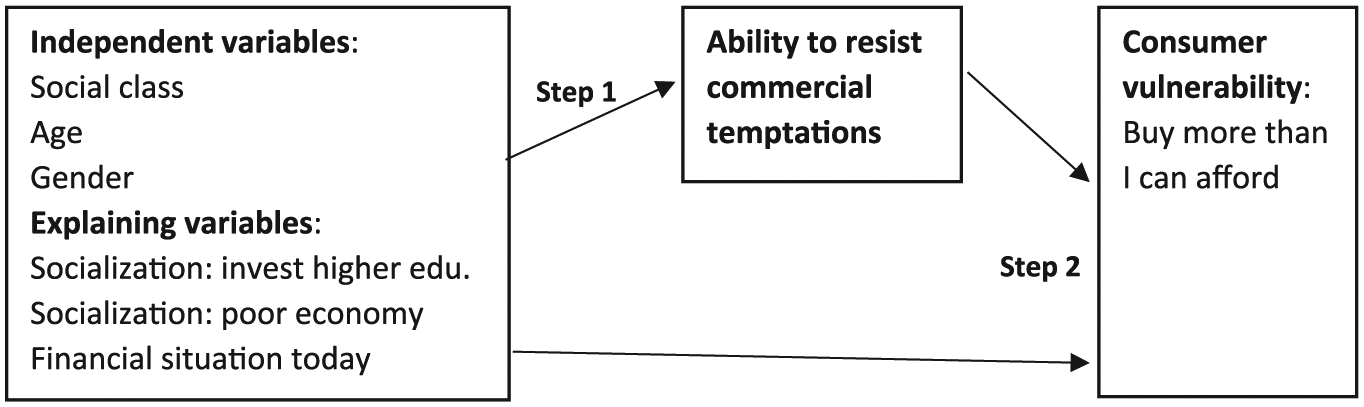
Factors affecting the ability to resist commercial temptations (Step 1). And, factors—including the ability to resist commercial temptations—affecting consumer vulnerability (Step 2).
After a bivariate mapping of relevant variables according to respondents’ class background, the following analysis will investigate, by stepwise regression, whether possible class differences in the ability to resist temptations disappear when the explaining variables are introduced in the regression equation.
Resist Temptation Index
One apparent advantage of surveys compared with register data is that questions can be designed precisely to meet analytical purposes. Hence, the four variables behind the “ability-to-resist-temptation index” are inspired directly by the above-mentioned interviews. On the statements below, the respondent could choose “Totally agree” (2), “Partly agree” (1), or “Don’t agree” (0). The index (0-8) is constructed by adding the values of these four variables.
Because I am afraid to regret, I do not buy expensive things on impulse.
If I see something I desire, I buy it—quickly! (for the index reversed values)
If I shall buy expensive clothes, I wait for sales.
If I shall buy expensive electronics expected to be reduced in price, I’ll wait.
All indicators constructing the theoretically based index are positively correlated and significant at the .01 level (Cronbach’s α = .60).
Independent Variables
Gender and age are expected to influence consumption patterns (Berg & Gornitzka, 2012; Berg & Teigen, 2009) and are included in the multivariate model as independent variables.
Educational level is a frequently utilized socioeconomic background variable expected to reflect cultural capital, status, and class (Andersen & Hansen, 2011; Bourdieu, 1984; Hansen, 2008). However, in our sample—aged 16 to 60 years, the educational level for the younger respondents—still under education—will not be representative of their cultural capital, status, and class. Therefore, the chosen operationalization of social class relies on Marx’s class concept. I do not intend, however, to contradict Bourdieu’s distinction between cultural and economic capital. Socialization to higher education in respondents’ family backgrounds, as well as their financial situations, is considered, and included, among the explaining variables.
Class affiliation is our main independent variable to study. In Lysgaard’s (1952) categorization of 15,000 high school pupils, he used both pupils’ self-declared class as well as a class variable based on their fathers’ occupation. He finds that it is self-declared class that gives the most distinctive results. A pragmatic argument for a self-declared class variable is that it is much easier, simpler, and cheaper to measure. According to Bjørklund (2017), it is more difficult—in particular over time—to define a worker than to ask respondents about what class they associate with.
Respondents were asked, Sometimes one separates between different social classes. To which class do you think that you belong: The working class, middle class, or upper class? Because the middle class is large, and almost no one in Norway says they belong to the upper class, we asked those who answered middle class an extra question to distinguish between upper and lower middle class, as well as “don’t know.” Based on the responses, three classes were constructed: the working class, the middle class (lower and “don’t know” on the follow-up question) and the upper middle class (including upper middle class and the few who marked upper class).
Class affiliation is included in the multivariate analyses as a dummy variable, where the upper middle class, as well as the working class, are compared with the middle class. In order not to infect the middle class with missing answers, these are excluded from the multivariate analysis. As many as 87% responded to the class affiliation question, nicely distributed between “working class” (31%), “middle class,” (36%) and “upper middle class” (34%). The “totals” include the whole responding sample (i.e., including 13% missing answers on class affiliation).
It was foremost young people who did not register class. However, young people were initially oversampled, so young people are considered to be quite well represented anyway. To be nationally representative, the totals in Table 1 have been weighted according to age, gender, and geography.
What Characterizes Respondents With Different Self-Declared Class Affiliations: Average Age/Percent.

Pearson chi-square: *p < .05. **p < .01.
Explaining Variables
To measure a possible impact from a deferred gratification socialization pattern within the middle class, we included a proxy based on Lysgaard’s own argumentation: My parents urged me to take a long and solid higher education. The analyses distinguish between only those who “totally agree” and the rest (“disagree” and “partly agree”). The proxy intending to distinguish those who might have learned frugality from growing up in families with scarce financial resources relies on the question: How was the financial situation in your family when you grew up? The analyses distinguish between “very poor” and “poor” childhood families and the rest (“very rich,” “rich,” and “neither rich nor poor”).
The two variables reflecting respondents’ present financial situation are measured by the same 5-point scale, in the analysis distinguishing between “very poor” and “poor” on one hand, and “rich” and “very rich” on the other hand.
Dependent Variable
The purpose of the dependent variable is to capture consumer vulnerability, measured by the simple question: Do you buy things you cannot afford? The answer to this question depends on respondents’ pecuniary situation. In other words, what we measure is respondents’ subjective financial vulnerability. The answers were “Yes, often,” ‘Yes, occasionally,” “Yes, but rarely,” and “No, never.” “Don’t know” was interpreted and recoded to “Yes, but rarely.” On the other questions, the few ‘Don’t know’ answers were given the mid value.
Results
In presenting the results, I shall first map how respondents’ average age and gender, as well as their educational and financial situations, are distributed according to their self-declared class affiliation. Also, the variables constructing the resist-temptation index, and a few variables reflecting respondents’ consumption patterns are presented in Table 1. The variables written in bold are the variables selected for the final multivariate analyses.
Table 1 reveals an expected and reasonable class pattern, supporting the use of self-declared class in the multivariate analysis to come. The first line shows that average age varies little between classes, and the totals (including those who did not provide a class affiliation) signal that the youngest group—logically—is overrepresented among those who did not answer the class affiliation question. The second line shows that women are slightly overrepresented among those who say they belong to the middle class, while men are slightly overrepresented in the working class and especially in the upper middle class. As expected, those who identify themselves with the middle class and upper middle class more often than respondents from the working class report having a higher educational degree. The differences are even larger for the middle-class socialization proxy variable: Although only 14% among those who say they now belong to the working class come from families socializing their children to defer gratification by urging them to take long and solid higher educations, as many as 43% from the upper middle class said so. Still, we do not know if these are middle class parents, only that their adult children now identify themselves as middle class. The proxy variable reflecting financial opportunities during childhood also gives an expected result: As many as 40% from the working-class report growing up in families with poor financials compared with only 18% of the respondents now associating themselves with the upper middle class. Similarly, upper middle class people more often said their present financial situation was good (60%), compared with those associating themselves with the working class (20%). This first mapping indicates that self-declared class captures differences in both educational level and financial capabilities. The socialization variables also reflect that there is a reproduction of class position from generation to generation.
The four variables constructing the resist-temptation index do not show the expected pattern according to the deferred gratification hypothesis. The differences are small, but it is instead people from the working class who report having a better ability to resist commercial temptations, hence supporting the frugality hypothesis and/or the conspicuous consumption hypothesis. Will this pattern persist in the multivariate analyses?
The dependent variable shows that 40% in the working class compared with 25% in the upper middle class reported buying things they could not afford (“often,” “occasionally,” or “yes, but rarely”). A large majority, however, regardless of class, admitted to buying things they did not need.
The last six lines support the view that variations in the preferences for consumer goods might signal class affiliation (Zukin & Maguire, 2004). Even though tattoos have been adopted by middle class people and are now considered a mainstream fashion (Halnon & Cohen, 2006; Kosnut, 2006), the results indicate that tattoos are still more popular as identifiers among people from the working class as opposed to middle class people, who instead use expensive-brand clothes and designer bags as social identifiers. There are no significant class differences related to the acquisition of expensive digital products or cosmetic surgery.
Is the Ability to Resist Commercial Temptations Class Related?
We shall now test the four class-related hypotheses, that is, how class effects on the ability to resist temptations might change when the proxy variables reflecting socialization patterns during respondents’ childhood, and respondents’ present financial situation, are excluded/included in the analysis (stepwise regressions). Table 2 distinguishes between Step 1 and Step 2, as presented in the analytical model (Figure 1).
Factors Affecting the Ability to Resist Commercial Temptations (Index) and Consumer Vulnerability (Buy More Than I Can Afford to; n = 1,491).

Note. Two stepwise linear regressions. Standardized regression coefficients (beta).
p < .05. **p < .01. ***p < .001.
The last line of the last column in Table 2 shows that lacking the ability to resist commercial temptations is an important consumer vulnerability driver, hence interesting to study. The main result is shown in the first two lines of Step 1a: People who say they belong to the working class do not report less willingness or less ability to resist commercial temptations than middle class people do, age and gender kept constant. Compared to the middle class, it is people who say they belong to the upper middle class who are overrepresented among those who have problems resisting commercial temptations. This pattern persists even when parents’ educational attitudes and financial opportunities, as well as respondents’ present financial situation, are included in the regression equation. The two socialization variables do not show significant results, and hence do not support either the deferred gratification hypothesis or the frugality hypothesis. A present good financial situation, however, promotes lower ability—or willingness—to resist commercial temptations, but it has only a minor reducing effect on the genuine upper-middle class effect. One interpretation of this result is that many rich people, regardless of class, do not care to resist commercial temptations, because they can afford it. People from the upper middle class—all other variables kept constant—are even less willing to resist temptations. The fact that women, according to themselves, are less influenced by commercial temptations than men might reflect that we are surveying practices in markets where female consumers are better informed and prepared to visit than male consumers are (Berg & Teigen, 2009). Age has no significant effect on the ability to resist temptations. Step 1 gives some support to the conspicuous consumption hypothesis: It is, in particular, rich men from the upper middle class who are the least able—or willing—to resist commercial temptations.
Step 2 in the analysis shows the stepwise results for respondents’ tendency to buy more than they can afford—an indicator of consumer vulnerability. Again, the last line, showing the effect from the “resist-temptation index,” supports the idea that the ability to resist temptation is important to prevent imprudent consumer choices, independent of how many variables are included in the regression equation. Our main concern, the possible impact from class, shows an interesting—and changing—pattern: First, even though it is upper middle class people who are the least able to resist commercial temptations (according to Step 1), they are less vulnerable than others, measured by their tendency to buy more than they can afford (Step 2a). The apparent reason for that is that rich people can afford to indulge in instant commercial gratification. It is people from the working class who appear to be the most vulnerable, measured by their tendency to buy more than they can afford, age and gender kept constant. When the two socialization variables are included in the regression equation, nothing changes, meaning that neither socialization to a deferred gratification pattern nor a poor financial situation during childhood can explain this class-related pattern (Step 2b). But rather interesting, in the last column, when respondents present financial situation is included, this pattern changes dramatically; the class-variables lose significance, meaning it is not class in itself, but the financial situation characterizing many people in the working class that explain why working class people somewhat more often than others buy things they cannot afford.
Conclusion and Discussion
The simple aim of this study has been to draw attention to what impact, if any, social class might have on the consumer role. More precisely, whether or not self-declared social class can predict how vulnerable a person confronted with commercial temptations is.
As expected, lacking ability to resist commercial temptations is an important vulnerability driver. Even though it is people from the upper middle class who shows the least ability—or willingness—to resist such temptations, it was people from the working class who appeared to be more at risk of buying things they could not afford. The apparent reason for this is that upper middle class people can normally afford to follow their commercial desires, and hence need not resist commercial temptations. Seen from a working class perspective, the analyses indicate that the reason working class people are more vulnerable than others confronted by commercial temptations, measured by their tendency to buy more than they can afford to, is not because they are less able to resist temptations. Rather, the reason is fewer financial opportunities, meaning that the reason working class people more often than others buy things they cannot afford cannot be explained by class in itself, but instead by class-related distribution of financial opportunities.
Based on the analyses presented in this article, we can reject the deferred gratification hypothesis inspired by Schneider and Lysgaard (1953), as well as the frugality hypothesis inspired by Mullainathan and Shafir (2013). In other words, in today’s Norwegian society, such class-related socialization during childhood and adolescence has minor, if any, effects on working class and middle class people’s ability to resist commercial temptations as adults. We do find, however, some support for Veblen’s (1899) old conspicuous consumption thesis, describing how rich upper class people signal their wealth and high social status through the overconsumption of commodities and expensive brands.
Overconsumption
The way upper middle class people follow their commercial desires, not wishing to resist temptations, might be part of an intentionally conspicuous-consumption pattern, demonstrating their superior social status. The material shows a higher tendency among upper middle class people to purchase designer bags and expensive branded cloths. If we included more categories representative of conspicuous consumption, such as expensive cars, diamonds, art, or furniture icons, this pattern would probably have been strengthened.
Nevertheless, if we employ a wider definition of conspicuous consumption, we find that 87% say they happen to buy things they do not need, and the majority (72%), regardless of class, report to have bought at least one expensive digital product during the last year. So, in commercialized societies such as Norway’s and those of many other Western countries, one might suspect that almost “everybody” engages in some kind of conspicuous consumption.
In affluent consumer societies, offering endless series of desirable goods and services in shops and online, everywhere and anytime, it might be hard to keep calm and to always act as a prudent consumer. On the one side, suppliers are offering desirable products in seductive contexts, nudging consumers by smart marketing to increase their sales. On the other side, banks are pushing expensive credit cards to people who do not have money available currently. In between stand consumers—who are not rational actors, but human beings with all their vulnerabilities, easy to exploit by commercial actors (Berg, 2014).
Today many people have high purchasing power, and live in highly commercialized societal environments, where the main message is not to save for the future, but rather to borrow money for whatever people might desire. “Because you deserve it,” is a slogan used in commercials so many times that consumers, worldwide, seem to believe it.
Socially Unfair
The results presented in this article also give reason to worry about how a commercialized environment has socially unfair consequences. The analyses indicate that rich people are the least able to resist commercial temptations, but that commercial temptations are more harmful to poor people. One interpretation is that poor people are more often than rich people confronted, and therefore affected, by inconsistent time preferences (the hypothesis inspired by Elster). Taking advantage of this mechanism, suppliers offer expensive credit loans; “enjoy today, pay tomorrow.” Hence, this practice makes poor people pay more than others for their status products. Logically, people with scarce resources—overrepresented among working class people—are more often than others tempted to finance their consumption by credit and expensive consumer loans, and are hence more vulnerable in consumer markets than people with better financial opportunities are.
The Environment
According to the analysis presented in this article, it is rich, upper middle class people and upper class wannabes who are exploited the most by commercialism. If people can afford their conspicuous overconsumption, it might not be a big problem at the individual level. But from a global perspective, seen from the world’s environmental and climate situation, overconsumption is a big problem. Buying less is one strategy to reduce our carbon footprint. Large groups in non-Western countries who expect to achieve improved standards of living cannot be expected to reduce their footprint. One large question of today is how to reduce overconsumption in the rich parts of the world and make it sustainable, without losing jobs and destabilizing the labor markets.
Class Analysis
Class affiliation as a distinguishing social characteristic has the advantage of pointing at the past, present, and future; hence, it is a more stable status variable than education and income alone are. Self-reported class, as it is registered in this survey, shows the expected social pattern. In many cases, class might be a more distinct variable than education and income level are. In particular, this is the case when young people are included in surveys, as in the study presented here, because neither young adults’ present level of education nor their levels of income will signal their social status.
Even though class-related socialization appeared to have no importance for people’s ability to resist commercial temptations, the analysis still reveals a class-related consumption pattern in Norway. In particular, the study highlights upper middle class people’s tendencies for conspicuous consumption. The study supports the view that class is a relevant variable to include in consumer studies, as well as in studies of inequalities.
Footnotes
Declaration of Conflicting Interests
The author(s) declared no potential conflicts of interest with respect to the research, authorship, and/or publication of this article.
Funding
The author(s) received no financial support for the research, authorship, and/or publication of this article.
