




Abstract
This article conducts a systematic literature review (SLR) on the relationship between innovation and performance in private companies. The research corpus was based on research protocol systematization. Dissemination of knowledge was examined in two stages: the summary of general corpus characteristics, and the content analysis performed according to the categories that emerged via the study’s themes. Relationships among authors, co-citations, keywords, and centrality statistics were identified through algorithms for optimizing standard graph layout. This study discusses the results of this relationship for improving the competitiveness of enterprises. The relationships among the authors of the corpus constitute relationships between isolated groups with little connectivity, low density, and a formation of distinct communities. The categories of analysis emerged in the study themes, as well as the techniques adopted to measure the relationships between innovation and private company performance. In the analyzed studies, innovation initiatives converge. Overall, they contribute to improvements in company performance. In the scientific field, initiatives for developing innovations have enhanced the performance of private companies. A key theoretical contribution of this article is in identifying the research corpus on the relationship between innovation and performance in private companies. The practical contribution of this study lies in offering evidence produced by studies that can help decision making regarding the creation of strategies and policies focused on competitiveness. The differences in the evidence found in the literature highlight the importance of the outcome of this study and indicate the need for future research in an effort to better understand the phenomenon.
Introduction
Many studies on innovation and performance have been carried out due to their relevance for both private and public organizations (Archibugi & Filippetti, 2018; Laursen & Foss, 2003; Laursen & Salter, 2006; Powell & Snellman, 2004; Stek & van Geenhuizen, 2016). The empirical evidence has shown that innovative companies tend to achieve higher performance in the same way that countries that invest public resources to develop innovation also improve conditions for economic development (Powell & Snellman, 2004; Taalbi, 2017).
The effect of the interaction between markets has also contributed to the development of national innovative potential because it fosters knowledge sharing (Etzkowitz & Leydesdorff, 1995, 2000; Ivanova & Leydesdorff, 2014). The reasons why a nation improves productivity when a rapprochement occurs between new technologies and management practices need to be investigated (Powell & Snellman, 2004). Some authors argue that there are gaps in theoretical studies on innovation and performance that should be examined by the scientific community. The effect of the interactions in international research on national innovative performance is one of the issues that could be investigated (Ivanova & Leydesdorff, 2014; Rosenbusch, Brinckmann, & Bausch, 2011; Stek & van Geenhuizen, 2016). The complexity of coordinating public policies on economic development innovation and efficiency in managing a territorial innovation system for economic development (Fixari & Pallez, 2016) present other research possibilities. Research on the impact of innovation and performance has produced mixed results. In some studies, the outcome was unsatisfactory despite investments in innovation (Adegbesan & Ricart, 2007).
Several policies carried out by the Brazilian government to improve research and development (R&D) did not produce results that contributed to innovation (Rocha, 2015; Veiga, Veiga, Del Corso, & Silva, 2012). The effects of innovation may differ across sectors and countries, and some are more intense in the technology sector. These effects contribute to the dissemination of innovations and economic growth (Powell & Snellman, 2004), suggesting that it is necessary to better understand the effect of innovation (Roach, Ryman, & Makani, 2016). In addition, Greco, Grimaldi, and Cricelli (2017) point out that in Europe, local, national and European public subsidies for company R & D activities contribute to promoting open innovation, increasing the efficiency of innovation. A peculiar aspect emphasized by the authors indicates that the excess of collaboration diminished the positive effect in the generation of the innovation, being necessary to have a balance in the forms of collaboration.
This article presents a systematic literature review (SLR) investigating the relationship between innovation and performance in private companies. It answers three research questions defined ex-ante:
A research protocol with the methodological rigor required for SLR was established, resulting in the research corpus. The dissemination of knowledge was examined in two stages. The first stage featured a detailed summary of general corpus characteristics, and the second stage featured content analysis performed according to the categories (clusters) that emerged via the study’s themes. The relationships found in the research corpus were obtained using ForceAtlas2 and a Fruchterman–Reingold standard layout of graph algorithms. This study is important because it is the first to perform an SLR on the relationship between innovation and performance in private companies. Rousseau, Mathias, Madden, and Crook (2016) has a similar focus, but it is a meta-analysis, so he used a quantitative metric to establish some relationships, so the results were superficial because he did not deepen the analysis qualitatively. This article is different from the other articles because it combined the use of the quantitative and qualitative approach by aggregating different estimates and analyzes to obtain a more accurate result using (a) a validated compost research protocol for three stages of analysis sedimented by the classic study of Tranfield, Denyer, and Smart (2003), which was applied in the engineering area; (b) use of the quantitative approach when using network statistics and two social network algorithms, ForceAtlas2 and Fruchterman–Reingold, which determines the relationships between the research corpus considering attraction and repulsion between actors and optimization of the arrangement; (c) use of the qualitative approach, presenting a content analysis associated to clustered themes to explain the relationships found in detail; (d) identification and analysis of all the variables used that measured the innovation, performance, and control variables used in the estimations; and (e) identification and analysis of all the analysis techniques used in these studies.
A key theoretical contribution of this article is in identifying the research corpus on the relationship between innovation and performance in private companies. This article analyzes studies based on field mapping and responds to specific research questions. The practical contribution of this study lies in offering evidence produced by studies that can help decision making regarding the creation of strategies and policies focused on competitiveness. The differences in the evidence found in the literature highlight the importance of the outcome of this study and indicate the need for future research in an effort to better understand the phenomenon.
Innovation and Performance
The literature on innovation focuses on the sources that allow companies access to the generation of ideas and enable them to develop the innovative potential of products and/or services. These sources also provide contact with external actors as a means of fostering innovation (Blommerde & Lynch, 2014; den Hertog, van der Aa, & de Jong, 2010; Denicolai, Ramirez, & Tidd, 2016; Etzkowitz & Leydesdorff, 1995). These studies tend to argue that the nature of innovation is the generation of ideas (Laursen & Salter, 2006).
The Oslo Manual created by the Organisation for Economic Co-Operation and Development (OECD; 2005) defines “innovation” as the implementation of new products and processes involving technological improvement. Product innovation is implemented via market placement, whereas process innovation is developed through its use in a process. Both product and process innovation involve “scientific, technological, organizational, financial and commercial activities” (OECD, 2005, p. 31). Its development presupposes close contact with research universities, technology development, financial incentives, and companies interested in introducing innovation in the market. The innovation of a new product or process launched in the market may be radical. Radical innovation may also happen when a brand new or incremental production process is introduced or through an adaptation that does not change the original form of the process (Freeman, 1998).
Some scholars argue that the innovative potential of a company, region, or country can be driven when partnerships are established among companies, educational institutions, and government entities (Bischof et al., 2017; Etzkowitz & Leydesdorff, 1995, 2000; Ivanova & Leydesdorff, 2014). Roach et al. (2016) point out that companies must be willing to act collaboratively in a network of partners. Such interactions seem to influence innovation in products, services, and performance. This consensus converges on the triple helix model proposed by Etzkowitz and Leydesdorff (1995). According to this model, innovation occurs in a context of interactions among three drivers of national development: universities, government, and business. This model states that each sphere drives innovation when acting in accordance with its role, which is accomplished over time. Companies act as recipients of innovation when they establish links with universities in search of solutions to organizational problems. They act as intermediaries when they launch products and/or services into the market. Universities and research centers have human resources, such as researchers, teachers, and students, who are fundamental to developing ideas and knowledge and devising equipment for their research. The government oversees incentives and/or financial resources such as research grants and the purchase of materials and equipment. Innovation is accomplished through the joint action among companies, universities, and government (Etzkowitz & Leydesdorff, 2000; Ivanova & Leydesdorff, 2014; Veiga, Veiga, Corso, & Silva, 2016), which create an environment that reduces uncertainty and thus fosters innovation (Ivanova & Leydesdorff, 2014).
Due to the importance the literature accords to the development of innovation, several studies have investigated it in detail. Several studies investigate its impact on the performance of companies, regions, and countries. Laursen and Salter (2006) examined 2,707 factories in the United Kingdom, finding that developing strategies focused on the external environment fostered innovation. This observation indicates that the search for external sources, combined with internal resources, is a valuable tool in the development of innovation. This incentive to innovate in enterprises fosters better business performance (Löfsten, 2014). Suppliers, customers, and universities are also important sources of innovative ideas for companies (Laursen & Salter, 2006). Examining 1,900 Danish companies, Laursen and Foss (2003) found that human resources management influenced firms’ financial performance, and thus had an impact on their innovation.
Rocha (2015) evaluated the effects of government incentives on innovation for 243 Brazilian companies, finding that government support did not contribute to innovation in private firms. The study argues that the R&D policies carried out by the Brazilian government were not effective in fostering innovation. Stek and van Geenhuizen (2016) evaluated the effects of different types of international research collaboration on innovative performance in 32 countries across various sectors between 2003 and 2008. Based on the number of patents, they noticed that the effects on collaboration differed across countries and economic sectors. Although the results indicated that patents propelled knowledge production, no effect of international research collaboration on innovation performance was found when the unit of analysis was sectors, in general. The main influence—positive, negative, or null—occurred on specific sectors (Stek & van Geenhuizen, 2016). They also found that innovation in the chemical and pharmaceutical sectors was positively influenced when international collaboration was conducted by multinational corporations, but this influence was not found in other sectors. In the computing and software industry, the influence of institutional collaboration depended on the economic situation of each country (Stek & van Geenhuizen, 2016). The innovation effect differed among sectors and countries. The most active sectors in the information technology industry contribute to the dissemination of innovation; they are responsible for the economic growth of the areas to which they are linked (Powell & Snellman, 2004). A country’s technological progress depends more heavily on intellectual ability than upon inputs or natural resources. Powell and Snellman (2004) argued that a nation’s productivity improves when there is a rapprochement between new technologies and the organizational practices that complement the integration of these technologies. Löfsten (2014) found that only a few dimensions of innovation influenced performance among Swedish businesses, indicating that innovative companies do not necessarily yield higher profits. For firms in Germany, Italy, and Spain, Fassio (2015) identified differences among R&D activities in terms of economic impact. These three countries were similar in the sources of knowledge used in innovation, which improved their performance.
The effect of eco-innovation on the performance of 223 Slovenian companies was investigated by Hojnik and Ruzzier (2016). This study showed that, among the determining factors for promoting eco-innovation such as customer demand, environmental awareness, and economic incentives, the search for greater competitiveness was the key element. The results indicated eco-innovative companies displayed greater profitability, growth, and competitive benefits. Consequently, the authors suggested that managers should develop public policy instruments that are sector-specific, such as tax cuts and subsidies (Hojnik & Ruzzier, 2016). In a study on small, medium-sized, and large companies in South Korea, Ali, Kan, and Sarstedt (2016) found that absorption capacity and innovation in products, processes, and management helped companies improve their organizational performance. Environmental regulation may be a contributing factor in product differentiation because there is a market for eco-innovative products (Rennings & Rammer, 2011).
In a study of cultural organizations, Carmen and José (2008) suggest that museum managers should have a market view concerning management and should incorporate innovation as a way to improve their economic and social performance. Park (2016) evaluated the behavior of private companies and nonprofit organizations in response to incentives through national R&D programs offered by the government of Korea between 2008 and 2012. The nonprofit organizations showed a lower performance than private ones. Park (2016) states that, for private companies, there were no standards for government investment in innovation in terms of greater returns on performance and that their number of patents was not statistically significant. Conversely, collaboration produced a positive effect: Private companies performed better in terms of number of registered patents and job generation when partnerships with universities and research centers were established. The study of C. Lee, Park, Marhold, and Kang (2017) found that the educational background of the top managers in specific areas, as science or engineering, with their experience in R&D area, has a positive impact on innovative activities.
The way public policies for innovation and economic development are coordinated has become complex (Fixari & Pallez, 2016). Studying France, Fixari and Pallez (2016) found that efficient territorial innovation systems and their effect on economic development still produced unsatisfactory outcomes. The systems need management mechanisms with a strategic outlook on public policies focused on developing approaches on a collective level (Fixari & Pallez, 2016). Oura, Zilber, and Lopes (2016) found that the performance of small- and medium-sized Brazilian enterprises was more strongly influenced by international experience than by capacity for innovation. In Chinese provinces, foreign direct investment has been found to have a positive effect on innovation performance when it is modulated by the following variables: absorption capacity, presence abroad, and intensity of competition in the market (Li, Strange, Ning, & Sutherland, 2016). In Europe, Greco et al. (2017) point out that public incentives from government to business contribute to increasing innovation as well as promoting innovation. The authors emphasize the creation of public policies that identify the best way to allocate public resources, so that innovation in companies is promoted, and that the collaborations made are functional for innovation projects.
The information presented so far indicates the gaps that remain in the literature. Generalizations about the relationship between innovation and performance, which motivates this study, cannot be made.
Research Method
As mentioned, this study seeks evidence in the literature that answers the following questions: How has the relationship between innovation and performance been studied? What are its results? and How has it been measured? The SLR technique was used to map the studies conducted on this subject. The research questions were defined ex-ante based on the literature, which established a relationship between innovation and performance (Denmark; Ali et al., 2016; Fixari & Pallez, 2016; Hojnik & Ruzzier, 2016; Laursen & Foss, 2003; Li et al., 2016; Oura et al., 2016; Park, 2016; Powell & Snellman, 2004; Rocha, 2015; Stek & van Geenhuizen, 2016). An SLR analysis was conducted along with the systematization of a research protocol (see Figure 1), serving as an instrument with the methodological rigor required to validate and propose a structured knowledge base for decision makers and research analysts (Tranfield, Denyer, & Smart, 2003). The SLR analysis was conducted in three stages, as proposed by Tranfield et al. (2003). These three stages are described in Figure 1.

Systematization of the research protocol.
Stage 1: SLR Planning Review
The first stage, planning, was carried out through expert consultation on the main theme and research corpus development. To help create the corpus, the method in Aarts (1991) was employed, which prescribes a set of selected and organized texts and expresses a certain sense of language. At this stage, the research corpus aims to extract the attributes that have already been developed quantitatively and draw qualitative representations from the contents analyzed (Bauer & Aarts, 2000). In this stage, the research protocol was defined as a means of attributing objectivity to various stages and their descriptions (Tranfield et al., 2003). The protocol elements consisted of research questions, a population, and a sample. This was the strategy adopted to decide on the inclusion and exclusion of studies in the SLR.
Stage 2: Conducting SLR
The second stage consisted of a careful, comprehensive study of the literature (Tranfield et al., 2003). Searches were conducted in the Web of Science and Scopus database for keywords and terms referring to innovation, performance, and companies. The syntax used in the Web of Science search was for Title TI (i.e., innovation AND performance AND firm). The syntax employed in the Scopus database search was for Title (i.e., innovation AND performance AND firm).
The Web of Science and Scopus databases were chosen because they cover a larger body than other databases do, such as the Science Citation Index Expanded, Social Sciences Citation, Arts and Humanities Citation Index, Conference Proceedings Citation Index (Science), Conference Proceedings Citation Index (Social Science & Humanities), Emerging Sources Citation Index, Current Contents Connect, Derwent Innovations IndexSM, KCI-Korean Journal Database, Russian Science Citation Index, SciELO Citation Index, Cambridge University Press, Elsevier, Springer, Wiley-Blackwell, and the Nature Publishing Group.
Due to the breadth of the subject and the volume of articles in the databases searched, the presence of “innovation,” “performance,” and “firm” in the title of the article was defined as the main search criterion, and the search was confined to articles written in English. The performance of the search required the presence of the three words “innovation,” “performance,” and “firm” in the title, as the search strategy of this article was focused on the relationship between Innovation and Performance in Private Companies. This criterion was adopted so that the systematic review did not lose the sense of approaching innovation and private companies, which could be lost with the use of synonyms for these words. This form of search was based on the literature recommended in the study by Tranfield et al. (2003). The authors recommend that systematic review research becomes structured using predetermined keywords and search strings identified in the literature and discussed among researchers.
This strategy enabled the extraction of articles that examined the relations under study. The title was a criterion support, and the articles searched were in the administration (e.g., economics, business) field. We found 347 articles in the Web of Science and 450 articles in Scopus, totaling 797 articles. It was afterward found that some of these did not fit the main theme of “management.” To retain only the articles linked to international innovation and performance and due to their high volume, new filters for specific magazines linked to innovation and management were created. Relevant sources included the Journal of Product Innovation Management; International Journal of Innovation and Technology Management; RISUS Journal on Innovation and Sustainability; Creativity and Innovation Management; Asian Journal of Technology Innovation; European Journal of Innovation Management; Innovation: Management, Policy & Practice; Industry and Innovation; International Journal of Innovation Management; Economics of Innovation and New Technology; International Journal of Entrepreneurship and Innovation Management; and the International Journal of Business Innovation and Research.
No time limit for article selection was set, which gave all studies published on the theme being investigated the same chance of being identified, composing a probabilistic stratum defined by filter composition. After the inclusion of the filter criteria, the final sample comprised 25 articles from the Web of Science and 41 articles from Scopus. The abstracts and introductions of each article were read individually. Studies on innovation performance evaluation, which is not the focus of our study, were excluded. Among the articles excluded, 15 were obtained from the Web of Science database and 30 from the Scopus database.
Through this procedure, 21 articles were left to constitute the corpus of research. Ten articles were obtained from the Web of Science and 11 from Scopus. These studies conformed to the criteria set out in this SLR, and they were reviewed for face validity.
The research corpus was compiled in an electronic spreadsheet, with the essential elements of each article highlighted individually. Article data relating to citation and content indicators were extracted. The citation indicators were coded for seven items: (a) the year when the article was published, (b) related journal, (c) title of the article, (d) number of citations in the article, (e) name of the authors of the article, (f) number of authors, and (g) country of origin of the authors of the study. The content indicators comprised 12 elements analyzed in studies: (a) keywords mentioned in the article; (b) goal of the article; (c) contribution of the article; (d) theme related to innovation and performance; (e) quantitative, qualitative, or mixed approach; (f) type of classification of methodological study; (g) data collection procedure adopted; (h) use of primary and/or secondary data; (i) variables or categories of analysis used; (j) main results of the study; (k) limitations of the research; and (l) suggestions for future research.
Stage 3: Dissemination of Knowledge
The third stage is the dissemination of the SLR results, produced by synthesizing of the articles, emphasizing generation of knowledge (Tranfield et al., 2003). Consistent with the rigor proposed in the SLR, the dissemination of knowledge was conducted in two stages. The first was a detailed analysis and the second an in-depth analysis.
First step of Stage 3: Detailed analysis
The first step of Stage 3 was a detailed analysis of the characteristics of the articles in the corpus of research produced by the electronic spreadsheet software Gephi and wordClouds.com. The detailed analysis of the general characteristics of the 21 corpus articles examined the following: (a) the relationships between the authors of the indexed articles in the corpus; (b) statistics on the centrality of mediation generated from the relationships between the authors; (c) general statistics on the relationships between the authors; (d) relationships between the most-cited authors (co-citation) by degree of relationship (>500) in the 21 articles of the corpus; (e) statistics on the centrality of mediation in the co-citation network; (f) general network statistics; (g) the most relevant words found in the titles, abstracts, and keywords of the corpus articles; and (h) the relationships between keywords in the corpus.
Two standard layouts for graph algorithms, ForceAtlas2 and Fruchterman–Reingold, were employed to determine the corpus relationships. The ForceAltas2 algorithm is a linear algorithm of attraction and repulsion, in which the approximation force is calculated automatically. It optimizes Gephi software networks, which comprise measures ranging from 10 to 10,000 nodes (Jacomy, Venturini, Heymann, & Bastian, 2014). The Fruchterman–Reingold algorithm is a classic disposition algorithm that has been used since 1984. It features heuristics for optimizing the length of uniform edges (Fruchterman & Reignold, 1991). In this step, a detailed description of the corpus field is provided.
Second step of Stage 3: In-depth analysis
In the second step, an in-depth thematic analysis of the corpus was conducted through the identification of clusters or categories of analysis representing research themes like those found in the 21 articles. The emerging categories of analysis were grouped into six different groups or clusters: (a) innovation and performance, coupled with the social network approach (this had a positive effect on business performance); (b) innovation and performance allied to organizational culture; (c) environmental innovation and performance; (d) dimensions of innovation and performance; (e) investment in R&D, allied to innovation and performance; and (f) other relationships with innovation and performance. An analysis of the variables employed to measure the relationship between innovation and performance in private companies was then carried out.
The most frequent variables employed in studies estimating the relationship indicated in the research questions were also analyzed. This step was conducted by examining the concentrations of consensus states shared among different themes found in the corpus (Tranfield et al., 2003). The creation of clusters and categories allowed a detailed description of their contributions, highlighting the relevant parts of the corpus, following Tranfield et al. (2003).
Discussion and Data Analysis
Figure 2 shows the relationships among the authors found in the corpus. The Fruchterman–Reingold algorithm was employed to examine the researcher network.

Relationships among authors in the corpus.
A display of the relationships among the authors of the research corpus (see Figure 2) shows the characteristics of the relationships between groups, with little connectivity between them. Total articles per Journal and H-Index Factor are presented in Table 1. Statistics supplementary to Figure 2 are presented in Table 2, showing the centrality, degree, and Eigenvector centrality.
Total Articles per Journal and H-Index Factor.

Statistics of Centrality of Mediation Generated From Relationships Among Authors.

The statistics presented in Table 2 confirm the centrality of integrating the red nodes (see Figure 2). A greater degree centrality was confirmed for A. C. Bullinger, F. Danzinger, M. Dumbach, K. M. Moeslein, and M. Rass. These authors have an eigenvector centrality of 1.0, which measures the node’s influence within the network. The authors of the corpus represented had the second-highest eigenvector centrality value (0.278). These authors were W. Arzt Kendall, B. Cardinal Laura, Donald E. Hatfield, Patricia M. Norman, and Crook T. Russell. Table 3 presents the general statistics on the relationships among the authors in the corpus.
General Statistics on Relationships Among Authors in Corpus.

The network represented by the relationships among the authors of the corpus has low density (0.038) because the indexed studies total 21 articles, and there are few interactions among them. The modularity of the statistics indicated a value of 0.911, indicating the existence of 21 distinct communities. To identify the most-cited authors of studies on the relationship between innovation and performance in private companies, all authors cited in the corpus’ references were extracted. Then, the relationships between them were established. Figure 3 presents the networks between the most-cited authors (co-citation) according to the degree of their relationship with the 21 articles of the corpus. For a better visualization of the network, only relationships with a degree greater than 500 are displayed.
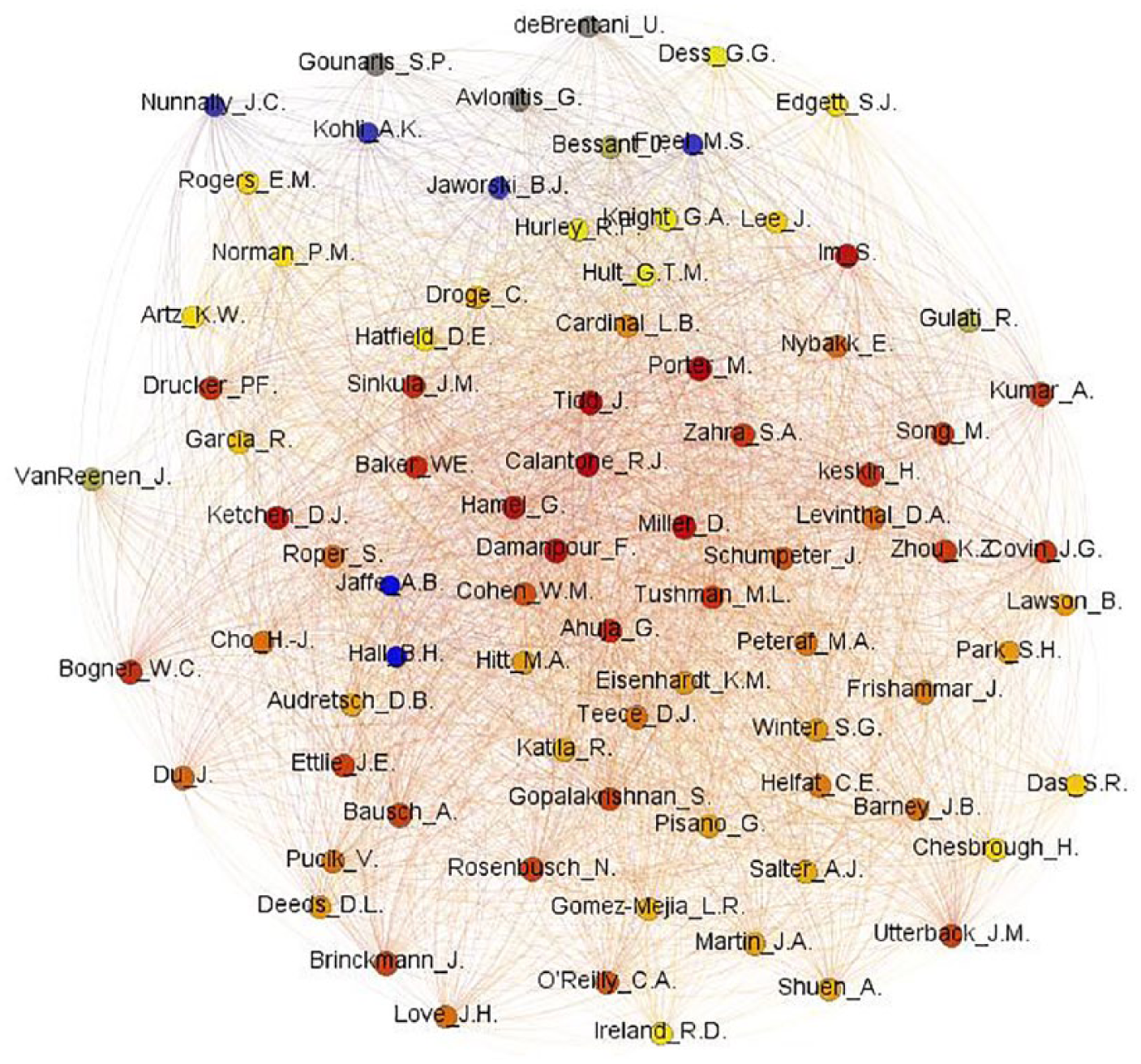
Relationship between most-cited authors (co-citation) by relationship of degree (>500) of the 21 corpus articles.
The ForceAtlas2 algorithm was employed to create the graphs. This algorithm approximated nodes according to the strength of their interactions and created groups (clusters) in the same graph. The ForceAtlas2 algorithm is a driving-force type that analyses each node continuously. It also repositions it within the network, finding the best possible optimization for its analysis (Jacomy & Venturini, 2011). The results in Figure 3 indicate a frequency of 3.170 authors in total. The most-cited authors in the corpus are in red: Porter, Calantone, and J. Tidd. This result is consistent with the study’s focus on the relationship between innovation and performance in private companies. These works are specific to those topics, indicating that they have very close theoretical relationships. Moreover, the citations of classical authors on the issues under examination are also consistent with the study’s focus, highlighted by the relationships between them. Table 4 shows the statistics for co-citation network, represented by the statistics of centrality of mediation.
Statistics for Centrality of Mediation From the Co-Citation Network.
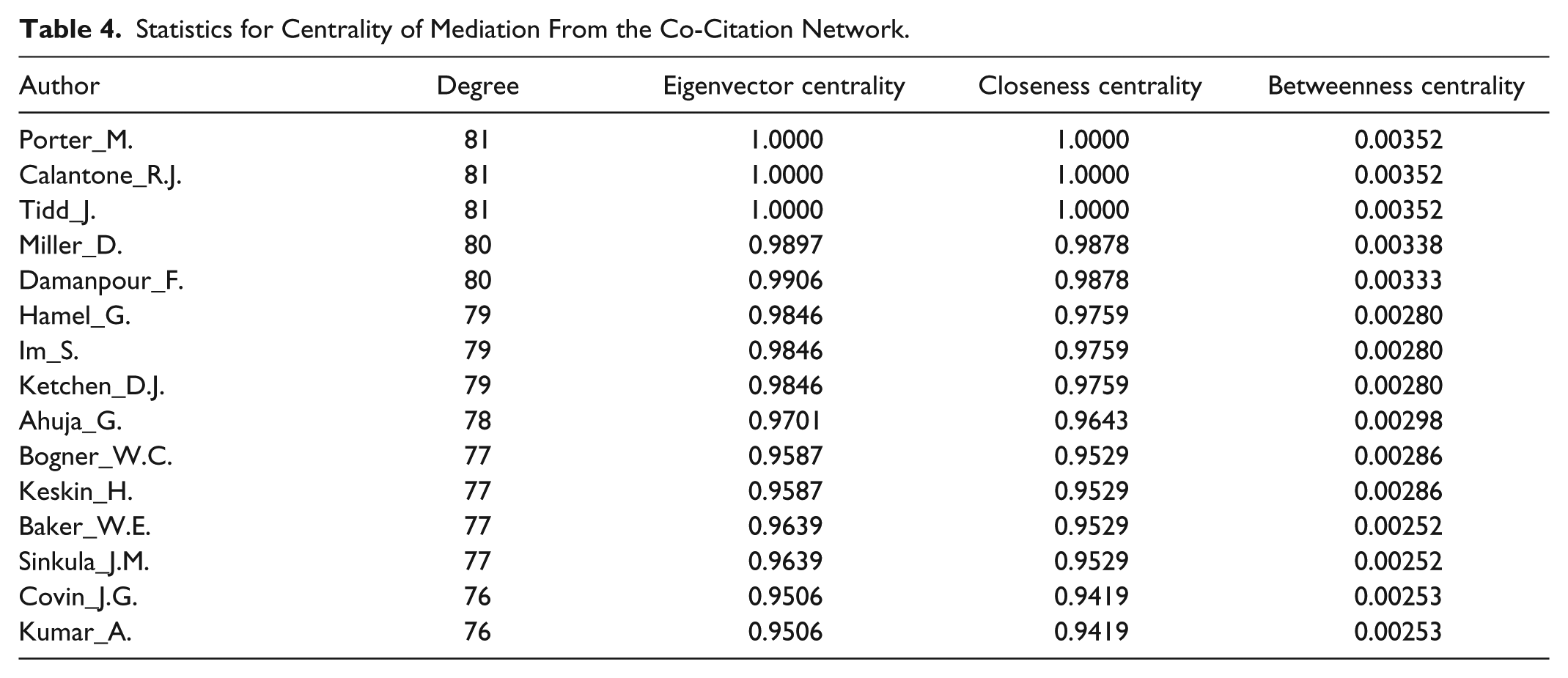
The results shown in Table 4 are consistent with those shown in Figure 3, indicating that the central authors, with the highest statistics for degree of centrality, eigenvector centrality, closeness centrality, and betweenness centrality, are Porter, Calantone, and Tidd. Table 5 shows the general statistics for the co-citation network.
General Co-Citation Network Statistics.

Table 5 shows that the network displayed only three distinct communities, as detected by the modularity of the statistics. The density had a value of 0.846, indicating a well-connected network. The density statistics are inversely proportional to the modularity statistics. Figure 4 illustrates the main words in the titles, abstracts, and keywords used in studies on innovation and performance in private companies. As expected, the most prominent words are innovation, performance, and firm.
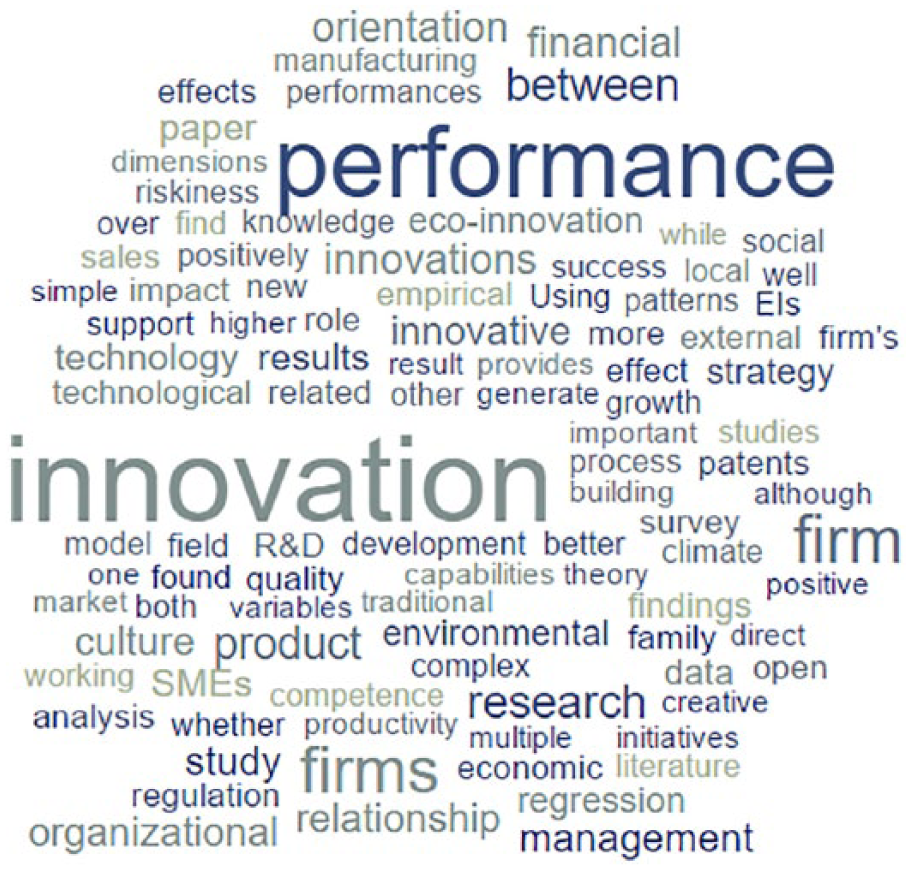
Most relevant words found in titles, abstracts, and keywords in the corpus.
Figure 5 illustrates the relationships among the keywords employed in the 21 articles of the corpus.
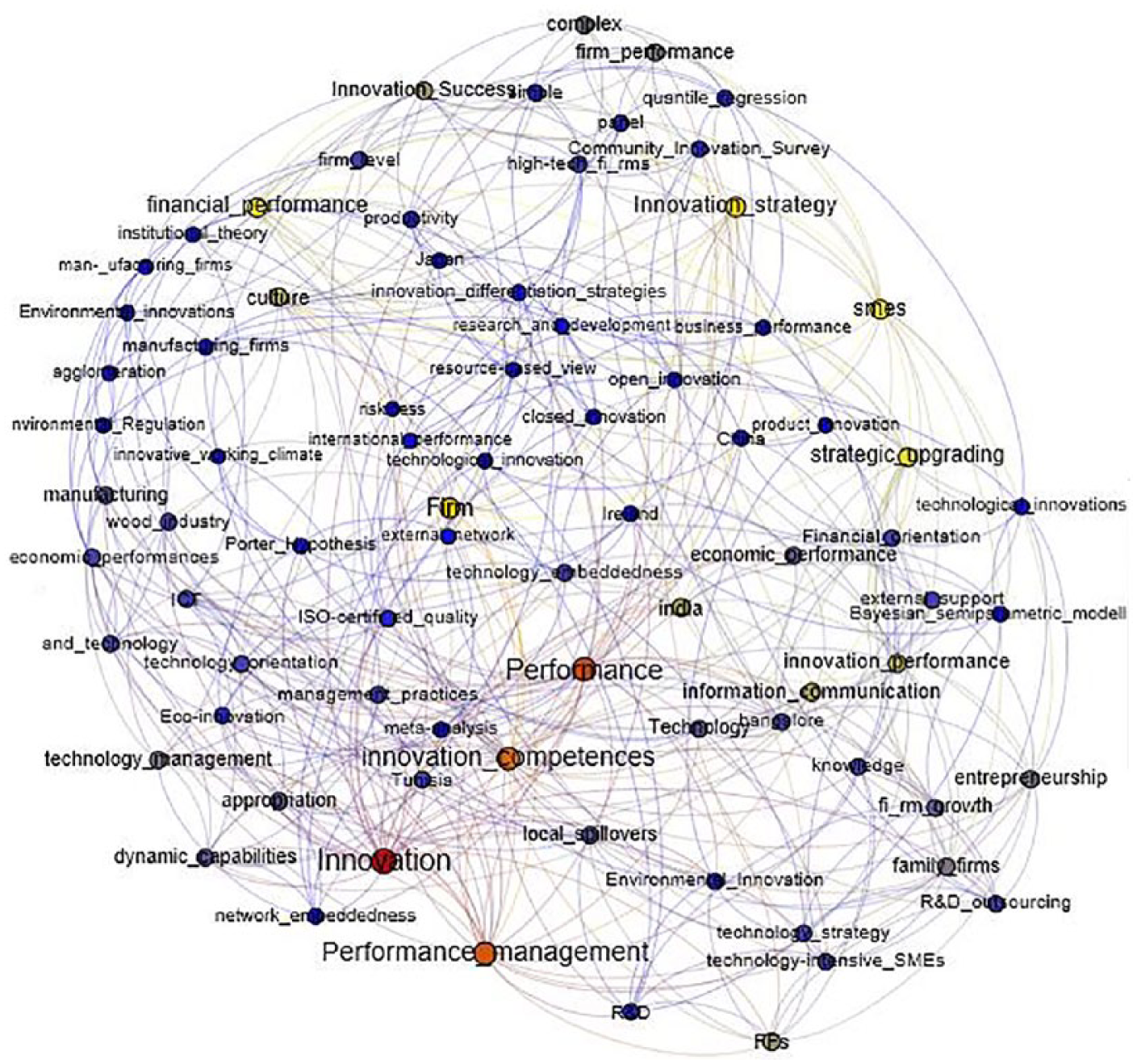
Relationships among the keywords in the studies of the corpus.
The most frequent keywords in studies used together (through relationships) are innovation, performance, performance management, innovation competences, firm, and innovation strategy. As expected, the innovation and performance keywords were more frequent because they are related to the central theme, highlighting its relationship with the firm keyword.
Following the steps proposed in the SLR (see Figure 6) and the results of the analyses of general characteristics, patterns of analysis in the corpus articles were identified. The patterns were grouped into five clusters or categories of analysis: (a) Cluster 1: networks, innovation, and performance; (b) Cluster 2: culture, innovation, and performance; (c) Cluster 3: environmental innovation and performance; (d) Cluster 4: dimensions of innovation and performance; and (e) Cluster 5: investment in R&D, innovation, and performance. In addition to the articles that formed each cited cluster, a general cluster (f) was created to group other relations that converge on the general themes.

Clusters by category of analysis identified in corpus.
A convergence among studies was found in the literature on the relationship between innovation and performance. These studies were allied to the social network approach, with a positive effect on business performance (Cluster 1). Performance was evaluated in both financial and general performance terms among European and North American companies (Salomo, Talke, & Strecker, 2008) as well as Chinese (Liu & Wu, 2011) and South Korean companies (D. H. Lee, Dedahanov, & Rhee, 2015). Rass, Dumbach, Danzinger, Bullinger, and Moeslein (2013) conducted theoretical research focusing on overall performance. The Cluster 1 article findings converge on the perception that coordination among social network relationships affects innovation positively. In turn, innovation shows a positive effect on business performance. Such studies also looked into the relationships among innovation, performance, and social networks using structural equation modeling (SEM), exploratory factor analysis (EFA), correlation, and multiple linear regression. When companies seek to integrate relational and structural technology embeddedness, their financial performance may be affected if mediation occurs via the differentiation of innovation strategies (Liu & Wu, 2011). Thus, the interaction between structural and relational support may directly influence the performance of the company. According to Salomo et al. (2008), strategic guidance in innovation prevails in practice and has directly and indirectly positive effects on performance among the companies analyzed in their research. Companies that innovate are more highly valued by investors, thus generating stock with higher market values (Salomo et al., 2008).
When a relationship with social capital is established, the presence of instruments of open innovation also has a positive effect on the financial performance of the company (Rass et al., 2013). Thus, social capital may also be a variable influenced by the interaction. This happens when open innovation approaches are adopted by companies, influencing business performance in both the medium and long terms (Rass et al., 2013). Social media influence innovation as well as overall firm performance. Thus, the generation of new patents, products, and services contributes to business performance in terms of sales and profitability (D. H. Lee et al., 2015). Innovation therefore also acts as a mediating variable in the relationship between technological orientation in networks and financial performance (D. H. Lee et al., 2015). The use of new technologies and equipment must be discussed by company managers. New technologies and equipment can be integrated into the organization by qualified staff as a way to help enhance performance (including production, share-of-market, financial, sales, and others outcomes), innovation, and financial performance (only financial outcomes; D. H. Lee et al., 2015).
Analysis of the second cluster (Cluster 2) showed a similarity among the studies addressing innovation and performance together with the organizational culture of companies in Norway (Nybakk & Jenssen, 2012), Tunisia (Nybakk & Jenssen, 2012), and banks in Turkey (Anderson, Harbi, & Amamou, 2012). The research found that culture impacts both innovation and financial outcome. Thus, companies achieve better performance when they create a climate of innovation and develop strategies for its development (Nybakk & Jenssen, 2012). One caveat is mentioned by Anderson et al. (2012), who argues that, although an innovative culture has a positive effect on performance, local and/or specific company conditions may also influence it either positively or negatively. Interestingly and counter-intuitively, it was found that a more controlling way of managing employees led to higher levels of performance than did encouraging creativity coupled with innovation. Innovation is essential for businesses to be competitive. Thus, spending time and effort to create an effective organizational culture is important for maintaining superior performance (Uzkurt, Kumar, Kimzan, & Eminoğlu, 2013). These studies used SEM, correlation, linear regression, and multiple linear regression to assess culture, innovation, and performance.
The third cluster (Cluster 3) revealed a similarity among studies on environmental innovation and company performance in Germany (Lichtenthaler, 2016; Rennings & Rammer, 2011), Ireland (Doran & Ryan, 2012), and Italy (Antonioli, Borghesi, & Mazzanti, 2016). When environmental innovations are promoted via regulatory pressure (i.e., laws), companies tend to reap higher profits. If environmental regulation and innovative activities converge, companies can set the sale prices they wish. Regulation drives demand and contributes to the differentiation among products (Rennings & Rammer, 2011).
Environmental regulation may also be a contributing factor in companies becoming eco-innovative. Doran and Ryan (2012) found that eco-innovative companies showed better performance than non-eco-innovative ones, a finding relevant to political decision makers. They could, for example, foster national economic growth by working toward a greener society. In addition, companies that operate in societies that embrace environmental innovation are more likely to pursue it and may thus attain greater economic performance (Antonioli et al., 2016). Environmental innovation may be a significant source of regional system growth if it is fostered by local spillovers. Environmental innovation may also contribute to survival in times of economic crisis (Li et al., 2016). In these studies, Tobin’s Q, multiple linear regression, the probit model, and panel data were adopted to assess environmental innovation and performance.
A relationship between innovation and performance (Cluster 4) was also found in studies performed in Korea (Y. Lee, Park, & Song, 2009), the United States, and Asia (Kumar & Sundarraj, 2016). The adoption of closed innovation strategies, featuring control in small- and medium-sized family enterprises, helped improve financial performance. This did not occur when these companies adopted open innovation strategies, which contradicts the hypothesis that open innovation is related to an increase in operating profit (Y. Lee et al., 2009).
Annavarjula, Nandialath, and Mohan (2012) found that the innovation that had the strongest positive impact on international performance was the generation of innovation by patents. This has a strong influence in large companies but not in small ones. Kumar and Sundarraj (2016) found that adopting creative-accumulation patterns led to better business performance, working as a moderator in the relationship between innovation and performance in periods of economic difficulties. Multiple linear regression, quantile regression, and panel data were employed in these studies to assess innovation and performance.
The fifth cluster (Cluster 5) was identified by studies analyzing investments in R&D and their impact on innovation and performance. Artz, Norman, Hatfield, and Cardinal (2010) evaluated companies in different sectors, and Tajeddini (2016) analyzed Japanese companies. Artz et al. (2010) found that investments in R&D helped increase patents and new products. However, a negative relationship between the number of patents and financial performance was found. Companies making investments in R&D tend to have more patents, but a company may not necessarily achieve higher returns relative to its performance. A positive influence on product innovation indicates that small- and medium-sized enterprises are more likely to adopt process innovation, which also has a positive relationship with financial performance (Tajeddini, 2016). These studies employed technical analyses such as correlation, multiple linear regression, confirmatory factor analysis (CFA), and hierarchical regression.
The other studies examined the relationship between innovation and performance. They also included many other variables, which did not enable a specific grouping (Cluster 6), such as technology strategy in Italy (Alberti & Pizzurno, 2013), external support in India (Subrahmanya, 2013), quality management in China (Wang, 2014), productivity at work in Swedish companies (Tavassoli & Karlsson, 2016), risk in the 100 most innovative companies according to Forbes (Syed, Riaz, & Waheed, 2016), and contingencies in a meta-analysis study (Rousseau et al., 2016). In contrast with other studies, Alberti and Pizzurno (2013) found that family businesses with superior performance displayed innovative behavior when developing new products considering market knowledge; this did not occur with technological knowledge. The factors determining the external support companies are strongly linked to the existence of a specific sector for innovation and the frequency of innovation. Product and process innovation make a greater contribution toward economic performance (Subrahmanya, 2013). Wang (2014) found that relations between processes of innovation and quality management affected the performance of high-tech companies. Thus, quality management initiatives strengthen a firm’s capacity for innovation and performance. Tavassoli and Karlsson (2016) found that companies implementing complex innovation strategies had higher future productivity. Syed et al. (2016) found that companies embracing risk tolerance behaviors produced innovative results and increased their profitability. Rousseau et al. (2016) found that companies with innovative products and processes attained better performance than did companies innovating in products only. The techniques employed by these studies were correlation, content analysis (NVivo), logistic regression, panel data regression, generalized estimating equations (GEE), and meta-analysis.
Coding SLR enabled the extraction of the variables used in 21 studies measuring innovation and company performance, as well as control variables (see Figure 7). Variables were identified according to the analysis of article content clusters (see Figure 1). A varied trend appears when measuring innovation with different variables. The most representative variables included those measuring investments in R&D, number of patents, types of innovation in products or processes, technology sharing, regulation, and knowledge generation. The evaluation of firm performance occurred somewhat like the use of the variables in the comparison with innovation. Thus, more studies estimated performance by employing financial variables such as return on assets (ROA), profit, market growth, sales growth, EBITDA (earnings before interest, tax, depreciation and amortization), and region(s) of interest (ROI). Among the studies that also employed control variables to assess the relationship between innovation and performance, there was greater use of variables such as performance sector, age of firm, and location. When the variables were assessed, a consolidated trend between the use of techniques to estimate innovation and performance was found.

Innovation, performance, and control variables.
A detailed discussion of the results found in this systematic review of literature highlights some essential elements to be considered by the academic community, private companies, and policy makers. A first implication to be considered is the need to create an entrepreneurial culture oriented toward innovation; that is, it is important that private companies have behaviors and habits in their management oriented to innovative initiatives. This indicates that practices, strategies, and the organizational climate are present between directors and employees of these companies. The incentive practiced through an innovative business environment becomes a driver for thinking and creating innovations in companies. This effect was considered positive and significant to generate innovation and to improve the performance of the analyzed companies. Just as companies need to present an organizational culture oriented to innovation, it is important that the government fosters this culture in companies by creating policies to encourage innovation, because when the conditions of the environment in which the company operates are favorable—this includes the local, regional, and national contexts—it is possible to create a cultural identity in companies geared to innovative activities. All the analyzed studies emphasized that the investments of the government for this purpose, in their most varied contexts, contribute to promote innovation and, as a consequence, economic development. In this sense, it is important to emphasize that the innovative culture of private companies is oriented toward optimizing forms of collaboration, as Greco et al. (2017) warned when collaboration is very high, government subsidies may have a negative effect. This is an aspect that should be considered by public managers and formulators. All the estimations performed to evaluate this effect were statistically positive, suggesting that the different estimations made using the SEM, correlation, and simple and multiple linear regression estimation techniques presented the same positive result when evaluated the contribution of the organizational culture to promote innovation and performance.
A second implication to be considered is oriented to the forms of collaboration and the optimized coordination of these relationships, indicating that the social networks (relationships) established between companies and institutions have presented positive effects to generate innovation and superior performance. There is a need for a strategic look at how these relationships are realized, so that there is a balance, so innovation can be the result of the combination of efforts that add up to and generate better financial performance and overall performance. In this aspect, the valuation of the shares and the visibility that the companies present to the society are positive elements, originating from the relations established, presenting high economic and social value. As a result of the algorithms used, there was a convergence in the results estimated by SEM, EFA, correlation, and multiple linear regression.
A third implication is the relevance points to the generation of innovation as a result of legal pressures to which companies are also subject. Although environmental innovations are the result of sustainability-oriented management, this adoption benefits companies by generating innovations as well as higher financial results. There is a social aspect involved, since companies are constantly subject to the pressures of society to adopt environmentally correct practices, being the innovations generated a means to sediment the use of sustainable practices, differentiating these companies from the others that do not use sustainability-oriented innovation. The use of statistical techniques proved that the generation of sustainable innovation had a positive effect on financial performance, as it is highlighted in the different metrics used as Tobin Q, multiple linear regression, probit model, and panel data regression.
A fourth implication points out that the way in which innovation impacts the performance of private companies is different between large, medium, and small companies. Although internal aspects such as innovative culture, practices, strategies, and relationships associated with innovation can be part of both, the effects generated by the form of innovation practiced become different. It seems that closed innovation is more effective in small and medium enterprises; and, in contrast, in large companies, open innovation has shown more effective results in the performance of these companies. Large firms are more likely to benefit from open innovation when associated with patents, which may be the result of collaborative forms of collaboration in this type of innovation, being more consistent with the needs of the context. Different estimates such as multiple linear regression, quantum regression, and panel data regression contributed to differentiate the contributions of open innovation and closed innovation in the studies analyzed.
The main implications presented offer evidences found in the analyzed studies that contribute to the decision making. In private companies, innovation is a reflection of a set of elements that begins with the presence of a culture, practices, and actions oriented to innovation. It is important that the manager shares innovative practices and disseminates this culture among all organizational members. This culture is widespread when the government creates a favorable environment, allowing companies to develop to act in accordance with innovation and foster partnerships between stakeholders.
Final Remarks
This article conducts an SLR on the relationship between innovation and performance in private companies to contribute to scientific knowledge on innovation and performance. This article was founded on research questions defined ex-ante and derived from the literature. A research protocol was also created with the methodological rigor required for systematic literature review (Tranfield et al., 2003), which resulted in the composition of a research corpus.
Based on the dissemination of knowledge analysis, a detailed summary of the general characteristics of the corpus was conducted using ForceAtlas2 and Fruchterman–Reingold standard graph layout. The relationships among the authors of the corpus constitute relationships between isolated groups with little connectivity, low density, and a formation of 21 distinct communities. The Fruchterman–Reingold algorithm employed heuristics to optimize the length of uniform edges. The ForceAtlas2 algorithm approximated nodes according to the strength of their interactions, creating groups (clusters) within the same graph. This algorithm indicated a frequency of 3,170 authors cited in the studies of the corpus. This indicates that, in general, the studies have a very close theoretical relationship. The citations of classical authors on the theme of the study were convergent, which is highlighted by the relationships among them.
An in-depth analysis of content based on the categories of analysis (clusters) was also carried out. The categories of analysis emerged in the study themes, as well as the techniques adopted to measure the relationships between innovation and private company performance. In the analyzed studies, innovation initiatives converge. Overall, they contribute to improvements in company performance. The categories of analysis grouped articles into clusters, enabling an evaluation of the standards in the creation of scientific knowledge. This occurred via the identification, mapping, and analysis of six different clusters addressing the proposed relationship in this SLR: (a) innovation and performance coupled with social network approach, which has a positive effect on business performance; (b) innovation and performance allied to organizational culture; (c) environmental innovation and performance; (d) dimensions of innovation and performance; (e) investment in R&D, allied to innovation and performance; and (f) other relationships with innovation and performance. According to those studies, the relationship between innovation and performance in private companies has been producing positive results. Innovation initiatives have helped improve their performance.
The analysis of the research corpus on the relationship between innovation and performance of private companies shows a consensus: In these studies, this relationship is beneficial for the development of private companies. The performance of companies integrated with social networks, as well as with strategic guidance in the field of innovation, has a directly and indirectly positive effect on the performance of companies due to the sharing among those working in the networks. The evidence also suggests the importance of environmental regulation and being eco-innovative, which enables firms to devise sales price strategies, as well as stimulating economic growth by pursuing a greener society. Performance may also be influenced by the adoption of innovation strategies, specifically for small- and medium-sized enterprises. The analyzed studies show positive relationships between investments in R&D and higher returns in relation to performance. The positive influence on product innovation indicates that small- and medium-sized enterprises are more likely to adopt process innovations, which also have a positive relationship with financial performance (Tajeddini, 2016).
This study increases the corpus of research on the relationship between innovation and performance and conducts a mapping and analysis of this issue on the basis of specific research questions. This study presents evidence that may help public and private company managers formulate strategies and policies focused on competitiveness.
This study expands the corpus of research on the relationship between innovation and performance and performs a mapping and analysis of this question based on specific questions. This research presents evidence that can help managers of public and private companies in the formulation of strategies and policies aimed at competitiveness. The implications presented to the academic community, public managers and private companies, guide the need for private companies to adopt an organizational culture that adopts innovative practices and guides the internal environment in adopting innovative behavior. When companies recognize innovation as important and this is reflected in their actions, managers’ decisions are likely to contribute to better company performance. This need to generate innovation is also driven by governmental substitutes, by the accomplishment of collaboration between different institutions. Managers of private companies should consider company size as an element associated with open innovation or closed innovation because the results are different between large, medium, and small companies. In these respects, firms tend to be more competitive when innovation contributes to improved performance, which is also associated with better local, regional, and national development in public policy.
Footnotes
Acknowledgements
The authors would like to thank the anonymous reviewers of the SAGE Open for their significant contribution to the final version of this article.
Declaration of Conflicting Interests
The author(s) declared no potential conflicts of interest with respect to the research, authorship, and/or publication of this article.
Funding
The author(s) received no financial support for the research, authorship, and/or publication of this article.
