




Abstract
We examined how mushroom experts organize and process their knowledge, compared with novices, and which types of arguments they use to process information. Mushroom experts and novices carried out an identification/memorization task, a free recall task, and a matching task. Results showed that experts performed better than novices on all three tasks. In the identification task, they named items at the subordinate level, whereas novices named them at the basic level. In the free recall task, experts recalled more items than novices, by grouping them into categories, while in the matching task, they used both similarity and dissimilarity criteria and provided conceptual and perceptual arguments. In conclusion, experts seem capable of carrying out two types of processing: relational processing, reflecting the ability to form categories at the basic level by considering the similarities of items belonging to the same category, and more analytical processing at the subordinate level, reflecting the ability to process difference in a context of similarity, indicating that experts are also able to use specific (distinctive) attributes, relying simultaneously on perceptual and conceptual information.
Effective information retrieval is now widely acknowledged to rely on the organization of that information. This is why expertise is an area of considerable interest, as it enables us to study the organization of knowledge and, more precisely, of categories in semantic memory and its underlying mechanisms.
Early work on chess-based expertise gave important insights into the processes and mechanisms underlying expertise (Chase & Simon, 1973; de Groot, 1966, 1978; Gobet, 1998; Gobet & Simon, 1998; Simon & Chase, 1973). The better performances of experts compared with novices have been attributed either to the organization of knowledge in long-term memory in the form of chunks corresponding to structured sets of information in memory (Simon & Chase, 1973) or templates (Gobet, 2005; Gobet & Simon, 1996), or to the construction of organized structures in long-term working memory (LTWM; Ericsson & Kintsch, 1995, 2000). The items of information included in these chunks, templates, or LTWM structures are assumed to share a number of common/similar criteria. However, these theoretical views of category organization do not fully explain experts’ performances in real-world domains. In fact, in the domains of the real world, we place some items in the same category despite their differences (Ericsson, 2005; Tanaka, Curran, & Sheinberg, 2005; Vicente & Wang, 1998). The question we can ask is how our cognitive system builds categories by using both similar and different criteria? The research by Einstein and Hunt (1980) and Hunt and Einstein (1981) indicates that memory involves a combination of processing based on the analysis of similarity (relational processing) and processing based on the analysis of differences (specific processing).
Research on expertise has highlighted the importance of the principle of similarity (Jacoby, Wahlheim, & Coane, 2010; Lynch, Coley, & Medin, 2000; Proffitt, Coley, & Medin, 2000; Shipman & Boster, 2008; Tanaka et al., 2005). According to Jacoby et al. (2010), experts are able to identify new items and incorporate them into the categories of their area of expertise, owing to the common characteristics of the items already present in those categories. There has been a great deal of research on the principle of similarity, and more recently, the focus has shifted to the difference principle (which refers to the concept of distinctiveness). However, little research has yet been conducted on the joint use of these two principles (Hunt & Rawson, 2011; Rawson & Van Overschelde, 2008; Van Overschelde, Rawson, Dunlosky, & Hunt, 2005). Distinctiveness, as an explanatory concept, considers that optimum memorization involves taking into account both similarity and difference, thus allowing individuals to gain a precise description of a given item in a given context. The processing of similarity refers to the processing of the dimensions (semantic, spatial, temporal, etc.) common to all the items in a given situation, while the processing of difference refers to the processing of the properties of individual items that are not common to the other items. Thus, the combination of the two is supposed to improve memorization because it specifies both the context governing an event and the unique properties of a particular item (Hunt, 2006).
This is why our study aimed to identify the types of processing used by experts, compared with novices: similarity, difference, or both? We were also interested in the criteria they used to explain their choices: perceptual and/or conceptual?
There have been many studies involving the principle of similarity, as well as the criteria used by participants to make their choices. These studies have investigated real-world expertise in a variety of domains, such as living/nonliving domains (dogs, birds, fish, trees, antique furniture, cars, etc.), different professions (musicians, doctors, footballers, etc.), various games (bridge, go, etc.), and food and drink (beer or wine) (for reviews, see Ericsson, 2005; Vicente & Wang, 1998). In all these studies, the authors investigated the organization of the experts’ knowledge and the skills they implemented in their particular area of expertise. Findings revealed that one of the most notable differences concerned the nature of the representations elaborated by the experts compared with novices. Experts appear to organize their knowledge according to abstract and conceptual principles, whereas novices focus more on concrete, surface aspects, and links to their daily experience. Another difference is the ability of experts to categorize exemplars belonging to their area of expertise at different levels of abstraction (i.e., superordinate, basic, and subordinate) compared with novices, who tend to categorize at the basic level (Ericsson, 2005; Vicente & Wang, 1998).
Research on the effect of expertise on categorization has shown that experts tend to form more hierarchical categories on the basis of more conceptual and precise criteria, while novices tend to construct categories that are more often based on perceptual criteria and are related to their daily experiences (e.g., Augustin & Leder, 2006; Chatard-Pannetier, Brauer, Chambres, & Niedenthal, 2002; Shipman & Boster, 2008). Concerning the structuring of these categories in the living domain, when Shafto and Coley (2003) compared novice and expert fishermen using a marine animal picture sorting task, they noticed that the novices relied on perceptual criteria based on appearance to categorize these pictures, whereas the experts grouped them on the basis of more conceptual criteria, such as ecological niches. Lynch et al. (2000) found similar results when they looked at the typicality and structuring of the tree category among novices and three types of experts (taxonomists, landscapers, and park maintenance workers). Participants were asked to note the typicality and familiarity of 48 different species of trees. The authors observed that the structuring of the category was based on familiarity for the novices, whereas the experts relied mainly on conceptual criteria, such as the fragility of the trees or the height they could reach. They also found that the determinants for structuring the category varied across the groups of experts, probably owing to differences in jobs and experiences. For their part, Tanaka and Taylor (1991) investigated the level of categorization undertaken by bird and dog experts. In the first of three experiments, they asked participants to associate characteristics with target items. In the second, participants had to name images presented to them one after the other as quickly as possible, while in the third, they had to validate (by indicating “true” or “false”) the link between an image (e.g., animal, bird, sparrow) and a level of abstraction (superordinate, basic, or subordinate). Results showed that the experts named items at both the subordinate and basic levels. Moreover, they tended to name items in their field of expertise at the subordinate level, and seemed to be just as quick at categorizing items at the subordinate level as at the basic level (Lynch et al., 2000; Tanaka & Taylor, 1991).
Shipman and Boster (2008) also interviewed tree experts and looked at differences in knowledge use between experts and novices, as well as between three subgroups of experts (horticulturists, tree surgeons, and landscape designers). In the first free recall task, participants were asked to name as many trees as possible. The authors expected the experts to produce lists structured into categories. Participants then had to make similarity judgments with the purpose of grouping the trees, and justify their choices in terms of similarity criteria. The third and last tasks were to identify and name trees. The authors observed differences between all the groups and subgroups. The experts named more items than the novices, and their lists were much more structured, while the tree surgeons named significantly more items than the landscape designers or horticulturists. With respect to similarity judgments, the tree surgeons used more ecological criteria and far fewer taxonomic ones (as expected by the authors). The opposite was observed for the horticulturists, while the landscape designers provided as many ecological criteria as taxonomic ones. For the identification task, the experts gave the highest number of correct answers, while the novices gave very few correct answers. The authors attributed these different results to the fact that all the experts had different knowledge and approaches, as they all had different jobs. With respect to the novices’ poor results, the authors suggested that they simply had a lack of interest in trees (Shipman & Boster, 2008).
Similar results have been reported in studies investigating the structuring of nonliving categories. For example, Augustin and Leder (2006) administered a hierarchical sorting task in which experts and novices had to separate contemporary art paintings into two piles. Participants then had to divide these piles again, and continue doing so until they deemed they could subdivide them no further. Results showed that experts subdivided the paintings more than novices did, pointing to the existence of more precise and hierarchized representations. In addition, the categories constructed by the experts were based more on conceptual criteria, such as the style of the paintings, whereas those of the novices were based more on their personal experience (feelings). In the same way, when Chatard-Pannetier et al. (2002) asked experts and novices to evaluate antique armchairs, they observed that the experts relied on more—and more conceptual—criteria than novices (e.g., period of the chair or similarity to recent chairs).
As for research on distinctiveness, Van Overschelde et al. (2005) carried out a study to show the importance of taking account of the difference between experts’ memorization and that of novices in the field of football teams. They used isolated lists (nine national football teams and a university football team) and homogeneous lists (nine university football teams and one target team: the same university team as in the isolated list). These lists allowed the authors to see whether it was easier for the experts in the field of football teams to find the target football team, that is, to perceive the difference (university football team) in a context of similarity (national football teams). Results showed that being an expert in a field makes it easier to identify difference, which is an asset for good memorization (Van Overschelde et al., 2005). In another study, Rawson and Van Overschelde (2008) went even further, speculating that the efficient organization of information in an expert’s memory does not depend solely on the processing of similarity or difference. Rather, it is the joint involvement of these two types of processing that explains the memory advantage of experts compared with novices. They recruited 189 participants, whose level of expertise in football was determined by a post-experiment questionnaire. They used 40 items divided into eight categories (five items per category): four categories representing football and four representing cookery. They administered two tasks: a categorization task that allowed them to observe similarity processing, and a pleasurable task that allowed them to observe difference processing. The participants were divided into three groups: one group performed the first task, one performed the second task, and one performed both tasks. The authors hypothesized that the group that performed both tasks would perform better, in accordance with distinctiveness theory. Results were in line with their hypothesis, confirming the importance of these two types of processing in the organization of knowledge in expert memory (Rawson & Van Overschelde, 2008).
In summary, the studies described above showed that experts are able to form categories not only at the basic level, on the basis of common, abstract criteria including similarities between exemplars of the same category (relational processing), but also at the subordinate level, which indicates that they are also able to pick up specific and distinctive attributes (analytical processing) that are ignored by novices. By contrast, novices tend to use more easily accessible criteria to group objects and form categories, such as perceptual similarities or personal experience. Experts are therefore able to simultaneously engage in two types of processing: relational processing (basic level) and more analytical processing, corresponding to the ability to process difference in a context of similarity (subordinate level) (Hunt & Rawson, 2011).
To improve the current understanding of the organization of categories in semantic memory and the nature of the processing used by experts (similarity vs. difference), as well as the criteria they used to explain their choices (perceptual and/or conceptual), we conducted a study in the little-studied field of mycology (Melcher & Schooler, 2004), focusing on the fungus category. There were several reasons for this: a surprisingly large number of people are experts in mushrooms, there are associations of mycologists, and also mycology courses. In some countries, pharmacists are trained to recognize edible or toxic fungi, and then, there are all the amateur mushroom pickers. Moreover, a large number of poisonings are recorded each year in France and across the world. In France, according to the mycological society (Mycological Society of France [SMF]), there are 16,000 species of mushrooms, but only 1,384 species are edible! The Institute of Public Health Surveillance (InVS) has been monitoring poisoning cases in France every year since 2010, based on records kept by the Antipoison and Toxicovigilance Centres (CAPTV). As an example in France, in 2014, from June to September, there were 460 recorded cases of mushroom poisoning, including 16 serious cases and one death.
Scope and Hypotheses
The aim of the present study was to capture the essence of expertise in the mushroom domain and its underlying mechanisms. Through this domain, we explored the organization of categories in semantic memory and the strategies used for retrieval. We were also interested in the nature of the processing used by experts (similarity, difference), as well as the criteria they used to explain their choices (perceptual and/or conceptual).
Thus, the main aim of the present study was to investigate how mushroom experts organize and process information in their field of expertise, compared with novices. To this end, we administered an identification/memorisation task and a free recall task to pinpoint the level (basic and/or subordinate) at which experts process information, compared with novices, and gauge their memory capacities. We hypothesized that degree of expertise will play an important role in the identification of items and expected experts in this field to name and recall more mushrooms than novice participants. We also assumed that experts would use different strategies from novices. More specifically, we expected them to label the exemplars more at the subordinate level and recall the items more by category than the novices.
In most previous research, authors studied the processing of similarity and difference separately, making it difficult to ascertain which of the two participants preferred. For this reason, in the present study, we constructed a matching task, manipulating both perceptual and conceptual similarity and/or difference criteria, to find out whether experts and novices preferentially use similarity processing, difference processing, or both simultaneously. We asked participants to match two items, and to justify their choice with respect to similarity and difference criteria (for both the chosen and nonchosen items). We hypothesized that experts, to justify their choice, use both types of processing (similarity and difference) by using both types of information (perceptual and conceptual) more often than novices, who tend to engage in similarity processing based on perceptual rather than conceptual criteria.
Materials and Methods
Participants
A power analysis using G*Power 3 software indicated that a total sample of 20 people would be needed to detect medium effects (d = .30) with power (1 – β) set at 0.80 and α = .05 using an F test (repeated-measures analysis of variance [ANOVA], within factors) for main effect of category. Twelve mushroom experts (M age = 48.2 years, SD = 18.2, age range = 22-78) and 12 novices (M age = 46.8 years, SD = 19.5, age range = 21-76) were enrolled in this study. Participants assigned to the expert group possessed extensive knowledge of mushrooms and were active members of the SMF. Their expertise in this domain was confirmed with the aid of a questionnaire administered to all participants prior to the start of the experiment. For example, in response to a question about their number of years of experience, the experts said they had between 10 and 20 years of experience, while the majority also stated that they trusted their own judgment to recognize mushrooms. The novices claimed not to have any experience in the field. The two groups did not differ significantly on either the French version of the Mill Hill Vocabulary Test (Part B; Raven, 2005) (experts: M = 36.9, SD = 2.2; novices: M = 35.0, SD = 1.2) or education level: number of years in higher education (experts: M = 2.8, SD = 0.4; novices: M = 2.4, SD = 0.8). Neither the experts nor the novices included in this sample reported any history of neurological disorders, brain injury, serious cardiovascular conditions, or mental illness. All participants led active lives, and the French version of the Mini Mental State Examination (Kalafat, Hugonot-Diener, & Poitrenaud, 2003), administered according to standard procedures, indicated normal cognitive functioning in all participants (experts: M = 28.7, SD = 0.5; novices: M = 28.6, SD = 0.8).
Material
We devised two tasks, run by PsychoPy software, for the purpose of this experiment: an identification/memorization task and a matching task. Images of mushrooms were first selected from the online databases of various mycological associations. These colored images depicted mushrooms in their natural environment and were all of the same size (5 × 5 cm).
For the identification/memorization task, we constructed two sets of 24 images each depicting six categories of mushrooms, with four exemplars per category (see the appendix for the set of items). To attenuate primacy and recency effects, we included six buffers (three images of mushrooms at the beginning and three others at the end). Overall, each participant therefore saw 30 items, including 24 target items and six buffers. The 24 target items appeared randomly on the screen.
For the purpose of the matching task, we constructed eight slides, each containing three images. Participants were requested to match a target item (located at the top of the slide) with one of the other two items (located at the bottom). The mushroom pictures were selected with regard to two criteria: category membership (same or different) and visual appearance (similar or dissimilar). The eight slides were constructed such that the target mushroom could be matched with either (a) a mushroom in the same category but visually dissimilar or (b) a mushroom in a different category but visually similar (see Figure 1 for an example).
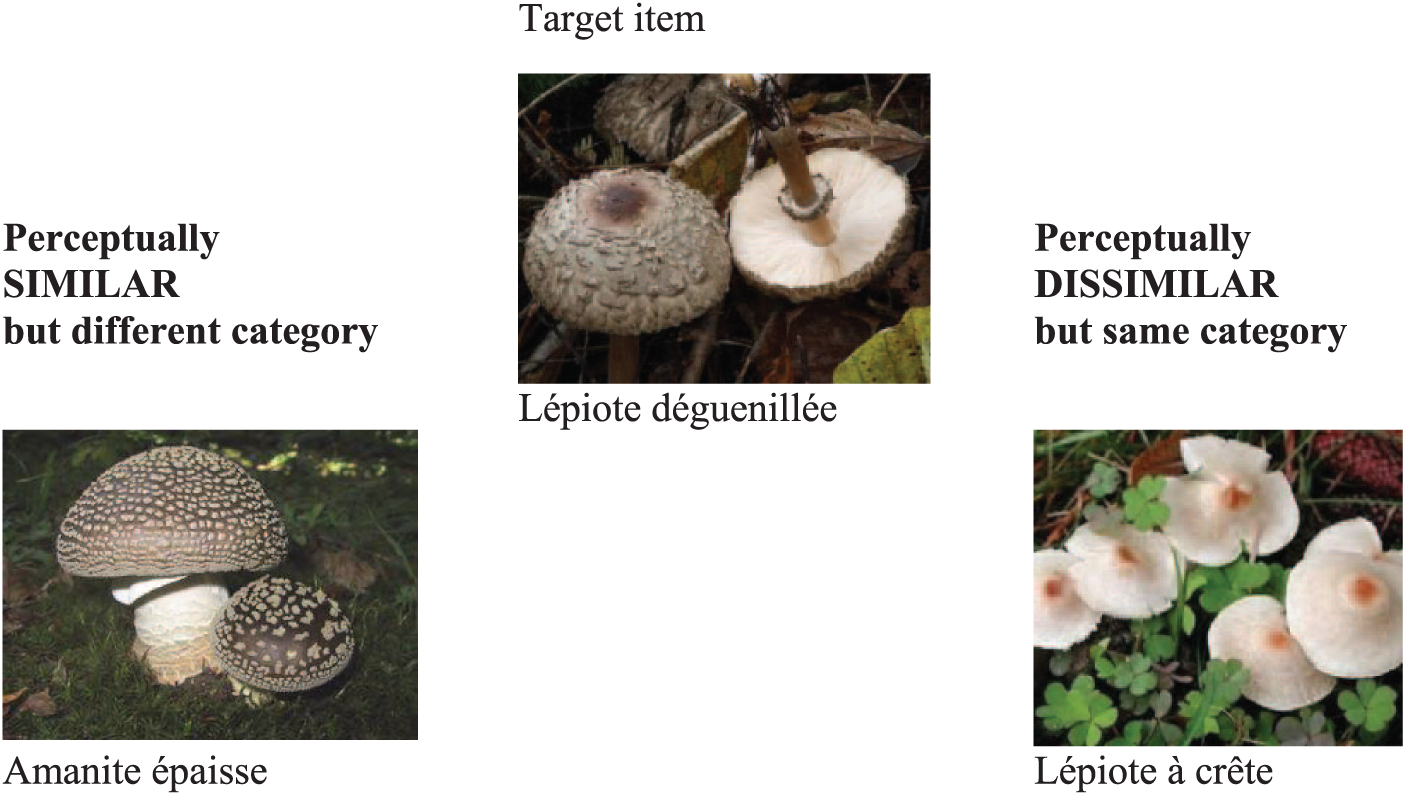
Example of a slide used in the matching task.
Procedure
Each participant was seated 45 cm from a computer screen and given the instructions. The experiment started with the identification/memorization task, where participants were requested to learn the list of 30 items (24 target items and six buffers). Each mushroom image was displayed on the screen for 8,000 ms, and participants were asked to give its name, which was recorded by the experimenter. The name of the mushroom was then displayed under the picture for 8,000 ms, giving participants an opportunity to learn the correct name if they had given a wrong answer or an answer that lacked precision (see Figure 2). We have to note that the first term of a mushroom name indicates the category (e.g., Amanita fly agaric) and the second term the specific name of the mushroom (e.g., Amanita

Procedure for the identification/memorization task.
After viewing and memorizing all the items, participants performed an intervening task for 2 min (saying the names of as many European countries as possible). They then proceeded with the free recall test, where they were given 3 min to recall as many of the mushrooms as possible.
The experiment ended with the matching task. Participants were shown each slide and asked to match the target item (located at the top of the slide) with one of the other two items located underneath. They were told that there were no right or wrong answers. Once their choice was made, participants were asked to make two types of judgment: a judgment about the similarities and a judgment about the differences (a) between the target item and the chosen item and (b) between the target item and the nonchosen item. The aim of this task was to identify the criteria (conceptual/perceptual similarities, conceptual/perceptual differences, or processing of both similarities and differences) on which the experts and nonexperts based their decision to match the target item with one of the two other items.
Scoring and Data Analysis
For the identification/memorization task, we took two levels of identification into consideration when analyzing responses: basic and subordinate.
For the free recall test, we considered the number of correctly recalled items and categorical grouping strategies (i.e., when participants consecutively recalled two or more items from a single category, we noted how many groups they recalled).
Finally, we analyzed the mean number of judgments of similarity and difference for both the chosen and nonchosen items in the matching task. Responses were classified according to whether they were perceptual (mushrooms of the same color or with the same shaped hat) or conceptual (mushrooms of the same variety or growing in the same environment or season). To this end, we calculated the mean number of units of perceptual or conceptual information provided by participants across all items. If participants gave several arguments, we looked at whether most of them were perceptual or conceptual. This classification was performed by two persons who were blind to the purpose of the study, and interrater agreement was satisfactory (Cohen’s kappa coefficient = 0.88).
Results
Data analysis was processed separately for each task as a function of the degree of expertise.
Identification Task
For the identification task, a 2 × 2 mixed factorial ANOVA was conducted with the level of identification as the repeated-measures factor and the degree of expertise (expert or novice) manipulated between groups. A significant effect of expertise was observed, F(1, 22) = 54.20, p < .001,

Mean percentage of items named at the basic or subordinate level by experts and novices in the identification task.
Free Recall Task
For the free recall task, data were analyzed using the nonparametric Mann–Whitney U test. In this test, experts (M = 32.78%, SD = 2.39) obtained better performances than novices (M = 12.78, SD = 10.03), Z = –4.07, p < .001.
Another analysis was conducted on the use of recalling strategies based on categorical grouping. We calculated the number of grouping categories recalled by the participants including at least two items of the same category recalled consecutively. For example, when the participant recalled as first item Amanite des césars (Amanita of Caesars) and as second item Amanite épaisse (Thick Amanita), in this case, we identified one grouping category. Then, if the same participant recalled other items of another category consecutively, for example, Entolome livide, Entolome en bouclier, and Entolome des haies (Entoloma livid, Entoloma Shield, and Entoloma hedgerows), we counted it as another grouping category. This analysis revealed that experts (M = 9.44%, SD = 5.47) were more likely to use categorical grouping strategies when recall than novices (M = 2.78%, SD = 1.92), Z = −2.65, p < .01.
Matching Task
For the matching task, we analyzed the first item chosen by the novices and experts (similar or dissimilar), then the item they did not choose.
Next, we conducted a 2 × 2 × 2 mixed-factorial ANOVA with type of judgment (similar or different) and type of justification (perceptual or conceptual) as the repeated-measures factors, and degree of expertise (expert or novice) as a between-groups factor. This analysis was run first for the chosen item, then for the nonchosen item.
Analysis for Chosen Items
It should be recalled that we asked participants to choose between the two items matched with the target mushroom: (a) a mushroom in the same category but visually dissimilar and (b) a mushroom in a different category but visually similar (see Figure 1 for an example). Analysis of the results showed that the perceptually similar item was more chosen by the novices (similar: M = 7.33, SD = 1.15; dissimilar: M = 0.67, SD = 1.15), whereas the dissimilar item was chosen more by the experts (similar: M = 5.17, SD = 2.66; dissimilar: M = 64.58%, SD = 2.66), F(1, 22) = 28.95, p < .001,
Once they had made their choice, participants were asked to make two types of judgment: a judgment about the similarities (between the chosen item and the target item) and a judgment about the differences. The ANOVA revealed significant main effects of all three factors. For all participants, the judgment of similarity was given more frequently (M = 5.75, SD = 4.49) than the judgment of difference (M = 1.17, SD = 1.81), F(1, 22) = 166.6, p < .001,

Mean number of judgment (similarity or difference) provided by experts and novices for the chosen items in the matching task.
Analysis for Unchosen Items
ANOVA revealed significant main effects of the type of judgment and the type of justification. These factors were also significantly involved in various interactions. Concerning the type of judgment effect, for all participants, the judgment of difference was given more often (M = 5.08, SD = 3.08) than the judgment of similarity (M = 1.40, SD = 3.08), F(1, 22) = 86.87, p < .001,
A significant effect of the type of justification was also obtained, suggesting that perceptual justifications (M = 4.31, SD = 4.36) were more common than conceptual ones (M = 2.17, SD = 2.68), F(1, 22) = 40.03, p < .001,
Finally, all three factors interacted significantly, F(1, 22) = 21.05, p < .001,

Mean number of judgment provided (similarity or difference) by experts and novices for the nonchosen items in the matching task.
Discussion
The aim of this research was to capture the essence of expertise in the mushroom domain, to better understand the organization of categories in semantic memory and the strategies used for its recovery. More precisely, we study how experts and novices take into account similarities and differences of the items for the construction of mushroom categories and what types of information they take into account to build these categories (perceptual and/or conceptual).
Results of the first identification/memorization task confirmed our first hypothesis, showing that degree of expertise played an important role in the identification of items. The experts were able to name the items at both the basic level and the subordinate level, whereas the novices only named them at the basic level. These findings confirm the results of previous studies indicating that experts are able to categorize at different levels of abstraction (i.e., superordinate, basic, and subordinate), whereas novices categorize more at the basic level (Ericsson, 2005; Vicente & Wang, 1998). This ability of experts to categorize at different levels of expertise suggests that they are able to simultaneously engage in two types of processing: relational processing (basic level) and more analytical processing, corresponding to the ability to process difference in a context of similarity (subordinate level) (Hunt & Rawson, 2011). These results can be explained within the framework of the organization of knowledge in long-term memory including both fixed information (core; corresponding to the ability to name items at the basic level) and variable information (slots; corresponding to the ability to name items at the subordinate level) (Ericsson & Kintsch, 1995, 2000; Gobet, 2005; Gobet & Simon, 1996).
This idea of knowledge being organized in structural sets was also reinforced by the results of the free recall task, which showed that experts not only performed better than novices but also used better recall strategies based on categorical grouping, as they often grouped the items they recalled by category. The fact that the experts were able to name items more often at the subordinate level, as well as to group items together at the basic level during the free recall task, suggests that expertise leads to a restructuring of classification systems and the acquisition of the ability to navigate between the basic and subordinate levels.
To explain the construction of these structured sets of knowledge in the form of chunks (Simon & Chase, 1973), templates (Gobet, 2005; Gobet & Simon, 1996), or organized structures in LTWM (Ericsson & Kintsch, 1995, 2000), authors have suggested that the items making up these sets share a number of common/similar criteria. The results of our matching task supported this suggestion of common/similar criteria, and showed that experts (like novices) preferentially use similarity judgments to justify their choices, in agreement with the findings in the literature (Ericsson & Kintsch, 1995, 2000; Gobet, 2005; Gobet & Simon, 1996; Simon & Chase, 1973). However, when we asked for judgments of difference in the matching task, we found that the experts could explain what differentiated the items far better than the novices could. These results validated our second hypothesis that experts use both types of processing (similarity and difference), whereas novices tend to use similarity processing more. These results suggest that experts, to retrieve knowledge from memory, simultaneously engage two types of processing: relational processing (on the basis of common, abstract criteria including similarities and differences) and more analytical processing, corresponding to the ability to process difference/distinctive attributes in a context of similarity (Hunt & Rawson, 2011). This way of considering expertise brings together theories emphasizing the role of organizational processing (Ericsson & Kintsch, 1995, 2000; Gobet & Simon, 1996; Simon & Chase, 1973) and theories emphasizing distinctive processing (Hunt & Rawson, 2011; Rawson & Van Overschelde, 2008).
The results of our matching task clarified the nature of the information that underlies judgments of similarity and difference, which are both conceptual and perceptual in the case of experts. Matching results showed that the experts, who predominantly chose dissimilar items first, justified their choices by providing information based on conceptual similarity. However, when asked for judgments of difference, they provide both conceptual and perceptual arguments. This ability of experts to use both conceptual and perceptual information was confirmed by the arguments they provided for the nonchosen items, which included more conceptual information, whereas for judgments of difference, they cited both perceptual and conceptual information. By contrast, results showed that novices justified both chosen items (mostly similar items) and nonchosen ones using essentially perceptual information, for both judgments of similarity and judgments of difference. Experts therefore seem able to use both types of similarity and difference processing, providing both conceptual and perceptual arguments to process information in their area of expertise. These results are in agreement with the assumption of chunking-based models that “perceptual skills play a central role in the development of expertise, and that conceptual knowledge is later built on such perceptual skills” (Gobet, 2005, p. 193).
In conclusion, experts seem capable of carrying out two types of processing: relational processing, reflecting the ability to form categories at the basic level by considering the similarities of items belonging to the same category, and more analytical processing at the subordinate level, reflecting the ability to process difference in a context of similarity, indicating that experts are also able to use specific (distinctive) attributes, relying simultaneously on perceptual and conceptual information. By contrast, it was likely that novices relied on visual appearance versus category membership to make their decisions. Our results suggest that novices tend to use more easily accessible criteria to group objects and form categories, such as perceptual similarities or personal experience. Finally, understanding how people become experts could have applications in learning. For example, our results could be used to implement learning sequences based on both similarity and difference criteria, and including both perceptual and conceptual information. Concerning the limitations of our study, we did not take into account the type of expertise and the multimodal nature (e.g., olfactory) of fungi recognition. This is why future research should focus on different types of expertise in the field of fungi, to highlight how knowledge is constructed according to the expert’s purpose (mycologist or gatherer). It would also be interesting to carry out studies on multimodality and expertise, to highlight the role of other modalities (olfactory, tactile, etc.) in the acquisition of knowledge and the construction of expertise.
Footnotes
Appendix
The table below provides an English translation and the scientific name of the mushrooms. Note that unlike the original French list, the common English names of the mushrooms are less likely to indicate information on category.
Acknowledgements
The authors thank the mycology associations in Paris and Amiens that allowed them to interview the experts and test all the participants in this study.
Declaration of Conflicting Interests
The author(s) declared no potential conflicts of interest with respect to the research, authorship, and/or publication of this article.
Funding
The author(s) received no financial support for the research, authorship, and/or publication of this article.
