




Abstract
As school leaders, novice principals faced some challenges within the first years of their leadership journey. This mixed-methods study explores the initial challenges faced by novice principals while leading their schools. At the same time, their countering strategies in handling the initial challenges are also being explored. A total of 168 novice principals responded to all items within a questionnaire on their initial challenges and their useful strategies to overcome the challenges. In addition, 11 novice principals were interviewed for in-depth information on their challenges and possible strategies in overcoming them. Findings revealed that dealing with a previous principal’s legacy and heavy workloads were major challenges faced by novice principals. In terms of their countering strategies, novice principals employed various approaches such as organizing an initial meeting with teachers, getting parents involved in school activities, and sharing leadership practice.
Introduction
Research indicates that school leadership positions are considered to be challenging with a high possibility of affecting principals’ well-being (Bagi, 2015; Burkhauser et al., 2015, Klocko & Wells, 2015). In this context, novice principals will face strenuous situations and struggle to fulfill their tasks, to understand their own school culture, and to adjust their leadership preferences within the school context (Sackney & Walker, 2006; Slater et al., 2008).
Novice school leaders enter the transition period into principalship after completing their leadership preparatory programs. Thus, novice principals are “tossed into the trenches” unprepared, isolated, and left to survive on their own (Lovely, 2004). Faced with contradictory issues, novice principals describe their initial experiences with mixed feelings. To some, the challenges are described as intriguing and exciting (Bagi, 2015), while to others, they can be daunting (Edwards, 2016) and lead to self-doubt (Earley & Bubb, 2013) and conflict-laden environments (Davis, 1998). The situation becomes worse when novice principals receive little support, such as induction courses and practical guidance (Bagi, 2015; Yeatts, 2005), and yet are burdened with a considerable workload (Bagi, 2015; Liljenberg & Andersson, 2019; Oplatka, 2017a, 2017b; Turkoglu & Cansoy, 2020). Even though novice principals are less experienced, they are expected to be skillful in fulfilling their duties from their first day as a school principal (Daresh, 2007), which can potentially lead to increasing workloads and stress (Bugbee, 2006; Hansford & Ehrich, 2006; Mahfouz, 2020; Oplatka, 2017a; Turkoglu & Cansoy, 2020).
Although, current studies of novice principals’ challenges from an Asian perspective are considered limited, they were initially studied as early as the 1980s by Weindling and Earley (1987) and later by Parkay and Hall (1992) who offer some suggestions for improvement. Previous researchers also point out those novice principals face challenges from school cultures, and the previous principal’s legacy (Bagi, 2015; Earley & Bubb, 2013; Theodosiou, 2015). In this context, Beam et al. (2016) and Northfield (2013) argue that understanding the challenges of novice principals’ experiences is critical as they may inform more appropriate content for the structure and curriculum of leadership preparatory programs. Recently, there is a growing body of literature on the novice principals’ challenges within their inception years of principalship. For instance, Hobson et al. (2003) reveal that novice principals experience feelings of isolation and loneliness and have to deal with the legacy of previous principals besides issues such as workload, time management, school budgeting, facilities, new curricula, and school improvement projects. Lately, researchers have drawn attention to novice principals experiencing challenges such as isolation, lack of knowledge of leadership, a low level of confidence (Male, 2006; Miklos, 2009), socialization issues (Daresh & Arrowsmith, 2003), and problems in adopting their new school’s culture (Cowie & Crawford, 2008).
Critically, there is little information on neophytes in terms of their challenges and the strategies or support that may lead to their professional growth (Parkay & Hall, 1992; Turkoglu & Cansoy, 2020; Walker & Carr-Stewart, 2006). In fact, studies of novice principals’ approaches in managing their challenges are considered to be limited (Brauckmann et al., 2015; Demirkasımoğu, 2015; Liljenberg & Andersson, 2019; Oplatka, 2017a). Novice principals’ challenges within their first year experience have been widely explored within western schools (Mukhtarova, 2013). Regrettably, local studies dealing with novice principals’ challenges are considered limited and the area remains understudied. From the local perspective, Saidun et al. (2015) found that secondary novice principals in Malaysian secondary schools face challenges such as isolation, logistics, the previous principal’s legacy, and financial issues. Furthermore, Ismail et al. (2009) also assert that novice principals face problems in adjusting themselves within their school’s culture. In addition, there is also a lack of studies attempting to explore novice principals’ initial challenges and their possible countering strategies within Malaysian primary or secondary schools. Despite the increased numbers of local studies that tried to explore the initial challenges faced by novice principals, there is a wide gap when most previous studies did not further explore the coping strategies employed by principals to overcome their notable challenges. Thus, these findings warrant a strong call for more studies on the challenges faced and the possible countering strategies used by novice principals that can serve as guidelines for future leadership development programs for Malaysian principals. This study critically examines the challenges encountered by novice principals and possible countering strategies through two essential research questions:
What are challenges faced by novice principals within their inception years of principalship?
What are the possible useful strategies perceived by novice principals to counter their challenges and problems?
Literature Review
Novice Principals’ Initial Challenges
Admittedly, there is a growing body of literature from innumerable educational systems reporting on novice principals’ challenging situations related to their substantial workload, such as longer working hours, unending supervision, enormous loads of paperwork, and excessive work pressure (Bagi, 2015) all of which form part of the initial challenges of being a novice principal. While handling these initial challenges, a novice principal also needs to understand their new school’s culture, performance, and how to cope with the previous principal’s legacy (Edwards, 2016; Walker & Qian, 2006; Weindling & Dimmock, 2006). Based on the literature review, it is argued that challenges faced by novice principals are considered a global issue since most previous studies reported on similar patterns of challenges within different educational systems. In this sense, Garcia-Garduño et al. (2011) affirmed that the initial challenges faced by novice principals are generally quite similar, but cultural and contextual perspectives cause some variations.
Bagi (2015) stressed that one relevant factor contributing to novice principals’ initial challenges was their current schools’ situation in which the problems appear to be more complex, demanding, strenuous, and stressful compared to 10 years ago. Thus, their current school situation is considered as demanding to a novice or beginning principal. As such, Liljenberg and Andersson (2019) stressed that novice principals have limited competence and yet they are facing intense work situations, which comes as a shock after holding a post as a deputy school principal, resulting in high levels of stress (Spillane & Lee, 2014).
Empirically, a number of previous studies have explored the challenges faced by principals within their initial phase of leadership. Challenges such as dealing with teachers who have negative attitudes, dealing with a previous principals’ legacy, issues of feeling isolated and lonely, and high demands from school stakeholders are examples of the notable challenges for novice principals (Edwards, 2016; Klocko & Wells, 2015; Saidun et al., 2015). Undeniably, these challenges have influenced novice principals’ feelings of being unprepared to hold the post of principal, despite most of them having attended their leadership preparation programs (Ng, 2015). According to Edwards (2016), aspiring principals initially felt prepared to perform their new roles as principals; however, they felt unprepared once they were given the post which required immediate decision making from their first day as a school leader. Thus, novice principals felt unprepared to adapt to a situation that required an instant decision making process; a challenging issue which could definitely lead to them experiencing stressful situations (Walker & Qian, 2006).
In studying the novice principals’ challenges, many studies (Cowie & Crawford, 2008; Crow, 2006; Earley & Bubb, 2013; Edwards, 2016; Flessa, 2012; Ng, 2015) pointed out the issue of dealing with a previous principal’s legacy as an essential challenge for novice principals, especially if the previous principal had succeeded in improving the school’s performance. This happened because the school community was accustomed to and felt comfortable with the leadership style and preferences of the previous principal. Thus, it is not easy for the staff and teachers to accept a new leadership style and the preferences of a novice principal (Briggs et al., 2006). Teachers and staff can also resist change, new routines, and culture because they have been familiar with the previous preferences and practices (Spillane & Lee, 2014).
Furthermore, novice or beginning school leaders are facing difficulties with the multi-faceted administrative tasks that they are expected to achieve (Barnett et al., 2012). Thus, Spillane and Lee (2014) concluded that having to fulfill too many administrative tasks and duties will result in novice principals experiencing heavy workload problems. As a school leader, Edwards (2016) cited that novice principals will have to “wear lots of hats” and continuously try to adjust their needs to fulfill the demands and requirements of others. Hence, novice principals will be facing heavy workloads and huge responsibilities such as staffing, teamwork, and school finance among their other responsibilities. A similar situation was reported by Bagi (2015) who studied the heavy workloads and responsibilities faced by rural Australian school principals which can affect their well-being. These novice principals spent most of their time on leadership activities and could well overlook their management activities.
The issue of strenuous demands from stakeholders was also considered as one of the major challenges for novice principals. For instance, in Kazakhstan, Mukhtarova (2013) summarizes novice principals’ initial challenges related to stakeholder pressure and demands, such as working with inspectors, which contribute to their experiencing stress. Another study conducted by Theodosiou (2015) summarized the challenges faced by Cypriot primary principals when they have to cope with a wide range of tasks and responsibilities but with limited resources, they included the school’s financial issues, feelings of isolation, and interpersonal issues. As such, Flessa (2012) also concludes that novice principals in Ontario, Canada, have limited capacity to influence the implementation of policy within their school context. The inability to achieve a work–life balance also becomes a challenge for novice principals in rural schools; who spend almost 60 hours per week in the office. From the perspective of Israeli schools (Oplatka, 2017a, 2017b), it was revealed that novice principals faced difficulties in managing their time effectively which stemmed from their inability to balance their time appropriately. Thus, they were seen struggling to balance completing their tasks and their leisure time; indeed, most of them felt that they lacked time for leisure and their family. In addition, they also felt unmotivated, fatigued, and with negative attitudes toward their schools.
Other challenges faced by novice principals are linked with the complications in adjusting their preferences to cope with the new school environment and culture. Ng (2015) studied novice principals in Singapore and reported that they faced some difficulties in adjusting to their new role as school principal and also to the culture of their new schools. In addition, novice or beginning principals were notably lacking in prioritizing tasks (Crawford & Cowie, 2012; Edwards, 2016) due to their lack of experience. In addition, their heavy workload had affected their roles as effective instructional and curriculum leaders in schools. While leading, novice principals are expected to have a good relationship with teachers. While dealing with teachers, novice principals have to face other challenges which include the tasks of handling teachers who are uncommitted and engender “principal-ache” symptoms, as reported by novice principals in Kazakhstan (Mukhtarova, 2013) and in Western Australian schools (Clarke et al., 2011).
In terms of managing administrative issues, novice principals were also reported to have some challenges such as problems with school finances and poor maintenance of school facilities (Mukhtarova, 2013). In addition, novice principals also faced many challenges in school financial management which were not given priority when they were deputy or assistant principals (Nelson et al., 2008; Spillane & Lee, 2014). At the same time, challenges such as managing their school’s facilities, implementing recent government policies and initiatives, lack of resources, and lack of in-service training (Sincar, 2013) have to be overcome by novice principals. All the above-mentioned elements required novice principals to acquire new and additional knowledge or access to external information and experience (Cheung & Walker, 2006; Weindling & Dimmock, 2006).
The professional deficiencies and isolation experienced by novice principals may affect their initial performance (Daresh, 2001; Edwards, 2016; Sackney & Walker, 2006) and lead to stressful situations (Stephenson & Bauer, 2010). Novice principals usually feel isolated as it takes some time for them to be accepted by the teachers and staff (Earley & Bubb, 2013). Later, using the naturalistic approach, Edwards (2016) found that 11 novice rural principals from Ontario felt isolated and faced some difficulties in handling problematic teachers. In addition, unhealthy relationships with teachers and staff can also exacerbate isolation problems (Barth, 1990; Dussault & Barnett, 1996), especially when teachers have difficulty in accepting the novice principal as a member within the school community. Therefore, novice principals are left alone to learn and master their roles through trial and error since they have limited guidance to rely on (Nelson et al., 2008).
Strategies to Counter the Challenges
Ng (2015) called for more time and efforts in understanding how novice principals countered their challenges and the strategies they employed. Shoho and Barnett (2010) added that novice principals need considerable backing to embark on their leadership journey since they have to become the teachers’ resource person once they are appointed as a school principal. In meeting the challenges confronted by novice principals, researchers suggested a number of strategies. Empirically, most researchers believe that coaching and mentoring programmes can be employed as a strategy in handling these challenges (Bush & Middlewood, 2013; Hernandez & Menchaca, 2011; Ng, 2015; Saidun et al., 2015; Stephenson & Bauer, 2010). Through mentoring, novice principals may have stronger networking with experienced principals to support their experience-exchange activities. According to Ng and Szeto (2016), positive networking with other principals might provide a platform for both principals to share and exchange their knowledge and practical ideas on effective school management. In general, positive networking, induction, and mentoring provide novice principals with guidance and support that can promote a smooth transition into their principalship (Bush, 2018; Hernandez & Menchaca, 2011; Ng, 2015; Shoho and Barnett, 2010; Simieou et al., 2010).
In Israeli schools, Oplatka (2017b) found that principals were seen to use shared leadership practice and delegate authority to their middle managers and senior teachers. With the delegation approach, principals are able to empower their teachers by involving them in the school’s decision making process. In turn, this positive strategy was able to enhance teachers’ sense of belonging and become part of the initial training provided by principals to teachers who later become aspiring school leaders. However, it is cautioned that principals must know how to appraise their middle managers and teachers’ work quality and allocate time and resources to upgrade teachers’ performance.
Similarly, Turkoglu and Cansoy (2020) disclosed that coping strategies and methods used by novice principals in Turkish schools are leaning toward planning and re-scheduling the given tasks that they have to complete. In this sense, Turkish principals had the ability to prioritize the tasks that they have to complete based on their stakeholders’ requirements and time scheduling. In addition, delegating the authority and responsibilities to teachers is another effective method employed to overcome feelings of overwork and stress. Admittedly, this significant approach has been mentioned by previous studies as an option to overcome principals’ heavy workload issues (Leithwood & Azah, 2014; Oplatka, 2017a). However, Turkoglu and Cansoy (2020) critically cautioned that principals remain responsible and accountable even though the tasks have been shared with teachers and middle managers, especially when some unintended consequences occur.
Another pertinent coping strategy employed by U.S. principals reported by Mahfouz (2020) is balancing their busy routines with family and friends in handling their stress issues. As principals, it is wise to understand how to manage the tasks and work requested by building a positive network with stakeholders and knowing how to manage their own well-being. To overcome their professional isolation, researchers (Kelchtermans et al., 2011; Mahfouz, 2020; Walker & Qian, 2006) suggest the importance of building a collegial relationship with other school leaders to obtain their support and at the same time share the issues with which they are struggling as a new principal. In addition, Parkay and Hall (1992), Daresh (2007), and Simieou et al. (2010) recommend an effective professional development for novice principals, such as induction courses, that may combat issues within their inception years. Through these effective courses, novice principals may be able to understand their roles and challenges and provide a platform to share their common problems and difficulties (Shantal et al., 2014) with colleagues, which in turn promotes positive peer interaction and collegiality. Another suitable approach is the establishment of networking with other principals (Mentz et al., 2010; Ng & Szeto, 2016; Weindling & Earley, 1987). Through effective networking, novice principals may be able to receive support and assistance in performing their duties and responsibilities while at the same time reducing feelings of isolation. Through sharing sessions, both parties can exchange their experiences and effective practices in leadership that will certainly benefit novice principals’ leadership journeys (Eileen Piggot-Irvine, 2004; Patuawa, 2006). In this sense, Riley (2007) also recommends a professional development program for first-year principals, which would promote peer interaction and collegiality among beginning principals through their coming together periodically to share common problems and gain additional mutual insights.
Method
Participants
In this study, a total of 131 primary and 37 secondary novice principals were asked to provide their responses related to the challenges faced within their inception years. In addition, we also ask about the possible countering strategies that they used to resolve their initial challenges. All of them had been participants in a short course on school improvement conducted by the Institut Aminuddin Baki and had been in-post at various schools in Malaysia for between 3 months and 2 years. The content of the short course was related to school improvement and administration and meant only for novice principals. Initially, 200 questionnaires were distributed to all novice principals who attended the school improvement course. In total, 168 questionnaires were returned by novice principals, all of whom volunteered to participate and provide their feedback on all items.
Furthermore, 15 purposely selected novice principals from the total of 168 were interviewed (5 females and 10 males). Five of them were secondary principals and 10 came from primary schools. All of them were attached to public government schools. However, four primary principals decided to withdraw, which left only 11 novice principals—five secondary and six primary—to be interviewed. Several essential criteria were used for selecting principals to be interviewed: first, all principals selected as participants for the qualitative interviews must have had wide experience as deputies; second, they were willing to participate; third, participants must have spent at least 3 months as school principals and so were currently facing their initial challenges. Table 1 indicates the selected secondary and primary principals interviewed.
Interviewed Novice Principals.

To protect their identities, pseudonyms are employed in this study; their identities are replaced with PP “A” to PP “F” (for primary principals) and SP “A” to SP “E” (for secondary principals) (Johnson & Christensen, 2014). They were selected to obtain more insights, reflections, in-depth explanations, and suggestions with regard to their experiences and challenges as novice principals.
Instrumentation
Two instruments were used to collect data in this study: a survey questionnaire and an interview protocol. The questionnaire asked all novice principals to provide their feedback on three elements: their challenges, possible useful strategies, and their demographics.
The questionnaire
The questionnaire was divided into three sections: Section A requested demographic variables (two items using nominal scales); Section B focused on the challenges faced by novice principals (nine items); and Section C asked about the useful strategies that novice principals can employ to address some of their initial challenges (seven items). All items in this questionnaire required dichotomous “yes” and “no” responses to enable a fast response from novice principals who are busy school leaders and have limited time to give their feedback. Items are self-developed and adopted based on the thorough review of the past literature and findings on novice principals’ challenges (e.g., Bagi, 2015; Beam et al., 2016; Earley & Bubb, 2013; Mukhtarova, 2013; Saidun et al., 2015). All items were written in the Malay language to ensure clear understanding by novice principals.
Validity checking and the pilot study
To enhance the content validity of the study, two retired principals were approached and later provided with the questionnaire. Both retired principals provided comments to improve the quality and confirm the items and content of the questionnaire (Cohen et al., 2013). Since most principals are busy individuals, some comments obtained were related to the adjustment of the items to provide simple language and to aid understanding. At the same time, two novice principals were also approached and asked to provide their comments on the questionnaire. Later, based on the comments obtained, items were improved before proceeding with the pilot study.
The pilot study was to ensure the reliability and understandability of the items and scales. Items were later piloted to 10 novice principals who were excluded from the actual study. All 10 novice principals were asked to give their feedback about the items. All comments and suggestions were taken into consideration and the items were revised based on the suggestions and recommendations. After the pilot test, changes were made based on the recommendations and suggestions provided by the 10 participating principals (Morgan et al., 2013). Furthermore, items were checked by a Malay language expert to ensure the correctness of the sentence structure before the grammar and the meaning of the items were finalized. Similarly, a pilot study of the interview protocol was conducted with the aim of identifying problems, updating the interview protocol, and providing training for the researcher before the actual interviews (Merriam, 2001).
Reliability analysis
From the pilot study, suitable reliability checking was later conducted. Since data were in the form of a dichotomous scale, the suitable statistical analysis involved using the Krippendorff alpha coefficient (Hayes & Krippendorff, 2007; Zapf et al., 2016) and the Rasch measurement analysis. First, the Krippendorff alpha was calculated and a result of 0.743 obtained, which is considered an acceptable value for social-science-based research. Furthermore, the items’ reliability was also checked using Rasch measurement analysis. Based on the Rasch analysis, the internal item reliability value was 0.96 and the separation value was 1.76. Also, participant reliability was 0.76 with a separation value of 4.75. Both values exceeded 0.70 and were therefore acceptable (Bond & Fox, 2007). In addition, a principal component analysis was also performed which reported a value of 74.9% which is above the 40% minimum value suggested by Fisher (2007) and Conrad et al. (2011).
The interview protocol
The second instrument was an interview protocol in which the principals were asked general questions in the initial part of the interview followed by more focused questions (Kvale, 2006). The questions asked during the interview were related to the novice principals’ challenges and the possible strategies employed to meet them. Some of the questions were as follows: (a) Did you face any challenges during your early years as a school leader? (b) What strategies did you employ to counter your challenges? All interview sessions were conducted in Malay to provide comfortable situations to all novice principals. The purpose of conducting interview sessions with 11 novice principals was to acquire in-depth explanations and information (Johnson & Christensen, 2014) regarding their initial challenges and the useful coping strategies employed. The interview sessions were conducted and treated as a follow-on process from the quantitative data analysis to provide further in-depth explanations and additional insights (Creswell, 2014; Creswell & Creswell, 2018) on the challenges faced by the novice principals and the possible useful strategies they employed to meet them. This approach aimed to enrich the data (Collins et al., 2006) related to the initial challenges and useful strategies based on novice principals’ experiences. Thus, it is hoped that it is hoped that the integration of the interview and questionnaire data will provide a more holistic overview than the use of quantitative data alone (Creswell, 2014).
Data Collection and Analysis
The data collection and analyses involved three major phases. In the first phase, the data collection started with the distribution of all questionnaires to all novice principals who attended the school management and leadership course. In the second phase, all quantitative data were counted and totaled based on the participants “yes” response and presented in the descriptive statistics—percentage and frequencies—for each item. After totaling all the principals’ challenges and useful strategies, it was decided to select the novice principals to participate in the interview sessions. Selection was based on a principal’s tenure, wide experiences as a deputy, and willingness to participate. Initially, a total of 15 novice principals were purposely selected, they were contacted to obtain their permission and willingness to participate in the study. Thus, researchers initially arranged and divided the 15 novice principals into three clusters of five novice principals each. Novice principals were contacted by telephone regarding their interview appointments and the locations where the interview sessions could be conducted. However, four principals had to withdraw due to their busy schedules and task pressures.
Following the findings from the descriptive statistics, three series of interviews were organized with 11 novice principals. Each session lasted approximately 2 hours and covered topics related to their challenges and the useful strategies employed during the early phase of principalship. To provide comfortable sessions, interviews were organized in an informal manner. Before the interview, the novice principals were informed about their anonymity since all interview sessions were tape-recorded. Initially, all principals gave permission to record the discussion. In the interview sessions, three major questions were asked: the general questions, the challenges, and the useful strategies that they employed to counter them.
Analysis started with the process of transcribing the interview data after each session ended. The process of producing these transcripts was conducted manually by researchers. Following Braun and Clarke (2006), the data analysis process had four phases. In the first phase, all the sketch notes and recordings obtained from the interview sessions were compared to check for any errors or omissions. Also at this stage, the data were checked and read repeatedly to provide understanding based on the purpose of the study (Miles & Huberman, 1994). In the second stage, the process of selecting the data took place in order to distribute and classify the data based on similarities and differences in the meanings conveyed by the principals. Next, the data were coded. At this point, comparisons between codes were made to combine some codes into several main themes. Theme comparisons were made based on the similarity of meanings inherent in the interview data. At the final stage, conclusions were constructed based on meaning and interpretation. The final process is that of writing and preparing the interview report.
In securing the trustworthiness of this qualitative data, two important procedures were used in securing the reliability and validity of the interview data (Miles & Huberman, 1994). First, inter-reliability tests were conducted with two evaluators who assessed all transcripts (Johnson & Christensen, 2014). The inter-reliability value was reported at 0.77, which indicated substantial strength of agreement based on kappa statistics (Landis & Koch, 1977). In examining the validity, all novice principals’ verbatim quotes were returned to principals to secure their comments and ensure the accuracy of the interview data.
Findings
Demographic Variables
The descriptive statistics for the 168 novice principals who completed the questionnaires are presented in Table 2. Demographically, 72 (42.8%) were male principals and 96 (57.1%) female principals. In terms of courses, a total of 161 novice principals (95.8%) had attended the National Professional Qualification for Educational Leaders (NPQEL). There were only two novice principals (0.01%) who had attended courses organized by their State Departments of Education. Finally, only five novice principals (0.02%) had only attended the school leadership and management courses organized by the Ministry of Education (MOE).
Novice Principals’ Demographics.

Note. MOE = Ministry of Education; SED = State Departments of Education; NPQEL = National Professional Qualification for Educational Leaders.
Novice Principals’ Challenges
Quantitative findings
Table 3 indicates novice principals’ responses based on their perceptions of the challenges faced during their early years of principalship. Their perceptions were analyzed descriptively.
Descriptive Statistics for Novice Principals’ Challenges.

Note. Novice principals (N = 168).
Table 3 illustrates the challenges faced by novice principals within their initial years of school leadership. From the feedback, 106 novice principals (63%) indicated that dealing with the previous principal’s legacy was a challenge during their initial years. In addition, 85 novice principals (50.5%) reported that they were facing heavy workloads, followed by 76 (45.2%) who mentioned the challenge of having to travel a long distance to their school. In addition, 55 novice principals (32.7%) believed that the challenges were related to lack of knowledge about leading their schools. Another 53 (31.5%) novice principals mentioned that they lacked experience in solving their school’s problems and another 40 (23.8%) mentioned the lack of parental support received. Furthermore, 31 novice principals (18.4%) also stressed that they are facing problems in integrating theory into practice followed by 25 novice principals (14.9%) who mentioned that they faced some difficulties in adapting to the culture of their new schools. Surprisingly, only 16 (9.5%) novice principals reported that they experienced isolation at school.
In addition, we also examined the significant differences based on novice principals’ gender and the leadership preparation courses that they had attended. Thus, chi-square statistics were used to investigate whether gender and their leadership preparation courses led to significant differences in their perceptions; the results are presented in Tables 4 and 5. In Table 4, in terms of principals’ gender, female primary principals indicated that they encountered five major challenges compared to their male counterparts who only encountered only four major challenges. In terms of significance difference measurement, all chi-square results indicate that there is no significant difference based on novice principals’ gender. In terms of novice principals’ leadership courses that they have attended, the chi-square results also indicate that the principals’ course is not a significant factor, as presented in Table 5. Nevertheless, significant differences were found for “previous principal’s legacy” (χ2 = 20.182, p = .001) and “isolation” (χ2 = 13.029, p = .023).
Chi-Square Analysis of Novice Principals’ Challenges Based on Gender.

Note. Novice principals (N = 168).
Chi-Square Analysis of Novice Principals’ Challenges Based on Leadership Preparation Courses.

Note. Novice principals (N = 168). NPQEL = National Professional Qualification for Educational Leaders; MOE = Ministry of Education; SDE = State Departments of Education.
Significance level at *p < .05.
Qualitative findings
The interview sessions with novice principals listed several challenges they faced within their initial years of principalship. Themes such as dealing with the previous principal’s legacy, a feeling of isolation, lack of parental support, heavy workload, traveling long distances to school, and lack of knowledge about school leadership emerged during the interview sessions.
Dealing with the previous principal’s legacy
Through interviews, a novice secondary principal admitted that his teachers were frequently comparing his style of leadership with the previous principal. To overcome this issue, he always mentioned to his teachers and staff that they have to accept his style of leadership: There was a comparison issue. Teachers like to compare my style of leadership with the previous principal. To my understanding, they have to accept me as their recent [sic] school leader. To overcome this issue, we have to use our own influence so they can accept me as their new school leader. (SPE)
Feeling of isolation
Emotionally, most of the novice principals felt anxious when they were deprived of the support, warm relationships, and companionship with teachers. They also mentioned that they were treated as a new member of the school, left alone, and felt unable to rely on others for assistance. A primary principal revealed her painful experience of being isolated: Yes, I felt isolated within my first year as a school principal when I was left alone without any friends to rely [on] since I was new here and left alone. (PPB)
Lack of parental support
Another issue faced by novice principals was the lack of parental support. In a primary principal’s case, she was trying her best to get optimal parental participation. To this principal, parental issues were definitely a crucial challenge since a majority of the school’s students were from the low income families. In addition, most parents were working far from their homes: My students come from low income families. Most of them have to travel far since they are working in “C,” district. Thus, it will be very difficult for us to contact them whenever [there] were issues. (SPE)
Heavy workload
During the interviews, novice principals highlighted their heavy workloads which include the financial, human capital, administrative, and physical resources of the school. For instance, a primary principal revealed the deficiency of her school’s filing system. Thus, she had to improve the systematic procedures of a filing system: The school was problematic with its filing system. It took me years to learn the systematic ways of doing it. Now, I am quite relieved since we have achieved some improvements for the filing system. (PPF)
During the interview with another primary principal, she also mentioned the heavy workload which sometimes caused her stress. In addition, she emphasized that the heavy workload referred to the many administrative tasks that she had to complete within a short period of time: When talking about heavy workload, we as principals have many administrative tasks to monitor such as improving the school’s operational system and completing the administrative requirements. In addition, we also have to finish administrative work by the timeline given. In fact, we have to bring those unfinished tasks back home. Even at home, we have to check for any messages in case there are urgent administrative tasks we have to complete
Travel long distances to school
From the interviews, a few primary principals admitted that they had to travel a long distance to their school every day. Thus, they started to travel very early in the morning and had a lengthy drive to reach their schools. The long hours of traveling resulted in tiredness and fatigue. This problem was shared by a primary principal when he had to drive for more than an hour for him to reach his school. PP “D” shared his experience: I was appointed to a school located [at a] distance from my previous district. Later, I felt exhausted which decreased my performance. (PPD)
Lack of knowledge on school leadership
As a novice, principals felt that they were lacking some practical knowledge about school leadership. Some novice principals believed that there was a wide distinction between the theoretical and practical aspects of principalship which required them to obtain more practical knowledge, although some of them had experience as deputies and had attended courses in school leadership. During interview, a novice secondary principal also commented on the feeling of lack of knowledge about school leadership which sometimes decreased her level of confidence to lead: . . . My biggest hurdle is lack of knowledge about school leadership. I requested more knowledge on how to manage our staff, especially teachers. In addition, I also need some knowledge on financial management. As for me, I will learn to improve myself. (SPD)
Useful Strategies to Counter Challenges
In this study, novice principals employed various strategies in countering their challenges within their initial years. In exploring their strategies, novice principals were asked about their challenges and useful countering strategies to overcome them. To obtain their perceptions, seven possible useful strategies were listed and they were asked to choose the workable strategies for overcoming their initial challenges. Table 6 shows the possible strategies to overcome challenges faced by novice principals.
Descriptive Statistics for Possible Useful Countering Strategies.

From the feedback of novice principals, 63 (37.5%) highlighted that they believed a mentoring strategy is the effective approach in countering the challenges that they faced. However, 52 (30.9%) novice principals believed that initial practical experience and internship before their official appointment was an effective strategy for principals. Based on their feedback, 51 novice principals (30.3%) reported that they believe that more courses about school leadership should be conducted to minimize the initial challenges they faced. Fourth, 48 principals (28.6%) highlighted the importance of shared leadership and that the practice of distributed leadership can also be used as a useful strategy in minimizing their initial challenges as novice principals. In addition, 46 (27.3%) novice principals also believe that attending conferences and seminars was another strategy which should be undertaken by novice principals while facing challenges. At the same time, another 46 (27.3%) novice principals also highlighted that the strategy of building a rapport with teachers would help novice principals. Finally, 31 (18.4%) novice principals stressed induction courses to assist novice principals in remedying their lack of knowledge on school leadership and any difficulties in adapting to a new school culture.
Qualitative findings
After analyzing novice principals’ responses on their useful and possible strategies, this study advanced using a series of three-session interviews with novice principals. Interview data were transcribed, coded and segregated into seven major themes related to novice principals’ useful strategies. These themes are presented as follows.
Building rapport with teachers
To overcome their isolation and teachers’ acceptance challenges, novice principals used socialization strategies to build a good relationship with their teachers such as having lunch and coffee together in the school canteen. A novice principal shared her experience: During my initial years, I frequently interacted with my teachers [since] I have to explain to them to provide better understanding. I frequently used the informal sessions with my teachers to get to know them better. (PPA)
Parents’ involvement
From the interview, a novice principal highlighted that parents’ involvement is considered positive for his school’s improvement process: In my school, parents are supportive and we frequently met four times in a month to discuss issues related to our students. (SPC)
Initial meeting with teachers
During the interviews, a novice principal revealed that he tried to be open to any suggestion forwarded by his teachers: In my initial stage of leadership, I tried to emphasise the concept of sharing ideas and certainly [being] open to any effective ideas. At the same time, it decreases some initial challenges that I faced as a new principal. (SPC)
Sharing leadership with deputies
In solving the challenge related to heavy workload, a majority of novice principals revealed that they received their initial leadership assistance from their deputies. A novice principal shared his experience: Initially, I had to ask my deputies to provide me with the information related to the school. After obtaining all the information, I had to make my own decision. Using this approach, I think that we have things to improve and at least some of my heavy workload was shared. All decisions are made collectively together with my deputies. (SPB)
Continuous professional development (CPD) course
During the interviews, novice principals talked about the benefits of having their initial training as exposure to such as the NPQEL program. However, novice principals suggested that the NPQEL should add new subjects such as financial management, human resources, and school procedures. A principal proposed her ideas: To my concern, there should be support courses and some topics should be re-examined. For instance, financial management and other elements should be added. As principals, we should update our knowledge and always check online for some new information that we might miss. (SPD)
Mentoring
Some novice principals acknowledged that they also had to learn the skills of school leadership from senior principals. A secondary principal shared his compelling story: To be an effective principal, I also have to learn from senior principals who teach me how to lead the school effectively. When I have problems, I also refer to them to eliminate critical mistakes. (SPA)
Moving to a new district
In the interviews, novice principals revealed that they were willing to travel long distances because they knew that they will be re-appointed at a new school within their own districts after spending years in their first schools. A primary principal shared his experience: I knew that some of my friends drive to their new schools. In my case, I decided to stay near to my school to avoid the long hours of driving. In my case, moving means that I’m able to understand my students’ parents and also the community. Sometimes, we have informal discussions and PTA meetings until late at night. (PPD)
To summarize, the challenges faced and the useful strategies employed by novice principals within their initial years of principalship are presented in Table 7. These suggestions emerged in the interview transcripts of the 11 novice principals.
Novice Principals’ Challenges and Useful Suggestions as Countering Strategies.
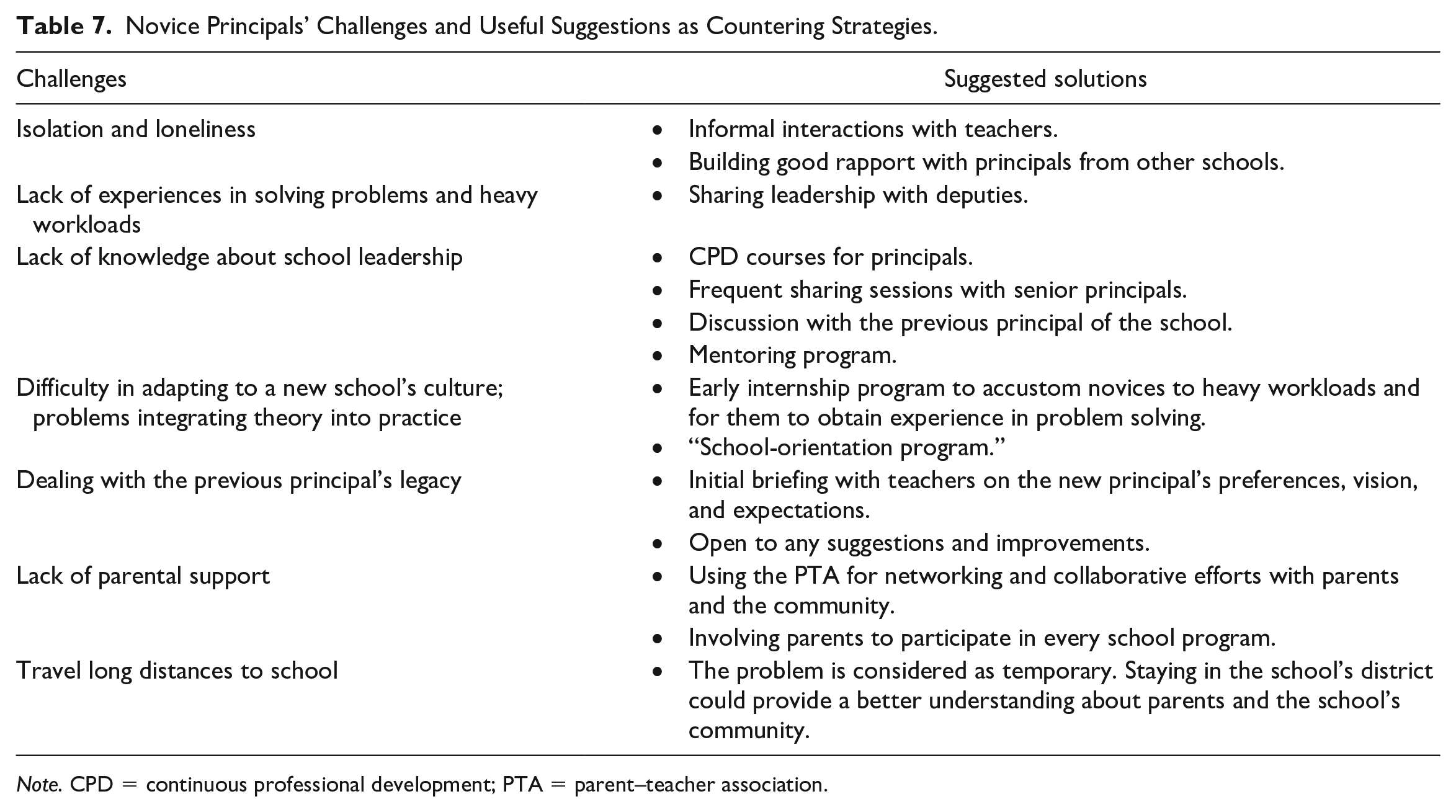
Note. CPD = continuous professional development; PTA = parent–teacher association.
Discussion
From the findings, novice principals identified communalities related to their initial challenges and selected four major challenges they faced as novice school leaders: dealing with the previous principal’s legacy, heavy workload, traveling long distances to school, and lack of knowledge. Data obtained from the survey disclosed that dealing with the previous principal’s legacy was often selected as a challenge faced by novice principals. From interviews, principals raised the issue that teachers always tried to compare their preferences and leadership style with those of the former principal. Thus, novice principals felt that they were being rejected and felt unhappy when their leadership styles were being compared with the previous incumbent. The novice principals admitted feelings of rejection because teachers and staff had been accustomed to the previous principal’s leadership style, preferences, and attitudes. This finding is aligned and highlighted by previous studies conducted at English schools (Earley & Bubb, 2013), Greek schools (Theodosiou, 2015), Australian schools (Bagi, 2015), and also Malaysian secondary schools (Saidun et al., 2015). This challenge is considered as an on-going issue widely faced by novice principals.
Second, both secondary and primary principals highlighted the heavy workloads that lead to stress and pressure. As school leaders, they have multi-faceted roles in encountering the complexities and challenging demands of leading a school (Normore, 2004; Simmons, 2012). Some novice principals felt pressured when they had to fulfill various administrative and leadership tasks. The problem of heavy workloads was reported by previous studies (Bagi, 2015; Bugbee, 2006; Hansford & Ehrich, 2006; Mahfouz, 2020; Turkoglu & Cansoy, 2020). The issue of being overwhelmed by the heavy workload is not a recent issue since most previous studies reported on the experience of stress due to the heavy workload resulting from principals’ numerous responsibilities. In fact, Oplatka (2017a) critically emphasized that novice principals’ heavy workload is to the detriment of their well-being and their leisure time with their families.
Another problem faced by novice principals was that their first posting was to schools located at a distance which required them to drive long hours to their schools. Later, this resulted in fatigue and arriving late to school which negatively affected their performance. Admittedly, there is still a lack of previous studies that point out the challenge of traveling long distances to schools. In expanding this issue, Tahir et al. (2019) explored the reasons why novice principals were posted to a school located far from their districts. First, there may be a lack of vacancies within their districts. Second, they were posted for just a short and temporary period of time. Thus, after a few years assisting and leading their first schools, principals will be transferred back to their districts after they have completed their initial phase as novice school principals.
Surprisingly, the issue of professional isolation that has been highlighted by previous scholars was not chosen by novice principals as their main initial challenge even though, during the interview, they highlighted that they felt rejected and lonely within their initial years of being school leaders. Thus, this finding contradicts those of previous studies which claimed that novice principals felt isolated during their inception years, as reported by Hobson et al. (2003), Miklos (2009), and Saidun et al. (2015). Another challenge faced by principals is related to a lack of knowledge about school leadership. Due to lack of knowledge and experience, novice principals felt lacking in confidence to lead their schools, especially when making significant and immediate decisions. In fact, novice principals did mention the lack of relevant knowledge such as human resource management and financial management which are essential for school leaders to understand and obtain. In this sense, Mahfouz (2020) raised the issue of the lack of preparation provided to novice principals in handling the challenges within their initial years as a school principal. In this sense, Farkas et al. (2003) disclosed that 67% of principals in their study claimed that their preparation program did not prepare them for the reality of being a principal.
Descriptively, based on principals’ gender, it is acknowledged that female novice principals have encountered five initial challenges compared to their male counterparts who encountered only four challenges. This finding is consistent with Izgar (2009) who found that challenges among female principals, including the professional isolation issue, were higher than for their male colleagues. Based on the chi-square analysis, the data showed that gender was not a significant factor in the challenges faced by novice principals. Therefore, it is argued that all principals, regardless of their gender, will experience challenges within their initial years of being school leaders.
In terms of the leadership preparation courses attended by novice principals, there were high numbers of principals that participated in this study who were NPQEL graduates; yet, they too pointed out that they experienced challenges within their initial years of leadership. In Malaysia, to be appointed as a school principal in public schools, it is a mandatory requirement to have the NPQEL qualification. Critically, although they are the leadership preparation program graduates, previous researchers (Farkas et al. 2003; Mahfouz, 2020) believe that there are deficiencies in the syllabus of the preparation program which did not emphasize how to overcome their initial challenges and gave less focus on the real situations which later lead to pressures for novice principals. Thus, these challenges will arise only after reporting to their new schools and having then to find useful strategies to overcome the challenges. A failure to deploy effective coping strategies will have implications for a principal’s psychological and emotional well-being (Holloway, 2004; Riley, 2007; Wells, 2013).
Based on the possible strategies suggested in the questionnaire, novice principals preferred the mentoring strategy which to them is the essential platform for the novice principals to learn the skills and knowledge from senior principals. In addition, they were also favorable toward having an initial practical internship with their potential schools before receiving their official appointments. Such a significant approach could provide them with some initial knowledge of their potential school’s values, norms, and culture. Later, this exposure will provide them with much easier understanding when facing the challenges within their new schools. In addition, novice principals also believe in the practice of shared leadership which is able to decrease their heavy workloads and they requested more courses about school leadership to provide them with recent knowledge on how to lead their schools effectively. This finding was not surprising since most previous studies indicated the importance of mentoring as a significant approach in assisting novice principals to obtain knowledge and skills on how to lead their school effectively (Bush & Middlewood, 2013; Hernandez & Menchaca, 2011; Saidun et al., 2015; Sciarappa & Mason, 2014).
From interviews, most of the novice principals employed various strategies to overcome their challenges. As such, they indicated the importance of building a good relationship with teachers that can eliminate their feelings of isolation. While socializing, they also tried to spend their spare time with teachers to be accepted as a new member of the school. Benefits obtained from this approach include: novice principals being able to work with their teachers in eliminating the feeling of loneliness and to develop the spirit of teamwork throughout the early days of their appointment so that they may share the responsibility of decision-making with other teachers (Ackerman & Maslin-Ostrowski, 2002). This finding is aligned with previous studies that also pointed out the importance of building a good rapport with teachers (Barth, 1990; Howard & Mallory, 2008; Mahfouz, 2020; Stephenson & Bauer, 2010). Furthermore, novice principals also emphasized that it was crucial for them to share some of their workload with their deputies by practicing teamwork and, thereby, sharing the responsibility of decision-making with their deputies.
Novice principals highlighted that most of them had practiced shared leadership and delegated some duties to their deputies and senior teachers as their coping strategy to overcome their heavy workload. Through sharing leadership, empowering, and delegating practices, some tasks were shared with their deputies and middle managers as part of collaborative leadership practice. Through this approach, senior teachers, especially the school deputies, sense of belonging will be improved and they will also receive some exposure to, and initial training in, the responsibilities of school leadership. Nevertheless, the practice of sharing or distributed leadership requires full commitment from novice principals since Spillane et al. (2015) argued that their considerable responsibilities sometimes prevent them from practicing a distributed approach. This finding is congruent with previous studies that reported on the shared leadership and delegation approaches employed by principals in “sharing” their workloads (Mahfouz, 2020; Oplatka, 2017a, 2017b; Turkoglu & Cansoy, 2020).
In addition, both novice principals also talked about high levels of parental participation in the school’s activities that nurture a healthy interaction between the school and the community. In the end, it helps reduce the gap and gets parents closer to the school in realizing the school’s vision and mission. Another strategy mentioned is for new principals to organize meetings with teachers to introduce their likes, preferences, and leadership styles which are sometimes significantly different from those of the previous principal.
Critically, both novice principals also pointed out the role of continuous professional development courses that can help increase their professional growth and confidence as school leaders. In this sense, researchers (Clarke et al., 2011; Levine, 2005) point out the lack of exposure given to aspiring principals within their preparation program on how to handle and overcome their challenges as novice principals. Through some continuous courses, such as mentoring and peer-networking, novice principals will obtain more practical knowledge and skills related to school leadership practices. In addition, they also supported the idea of mentoring which provides novice principals with a strong link with other senior principals. Mentoring activities may include critical discussions, reflection, questioning, and assistance from others who hold similar responsibilities (Colgan, 2003; Stephenson & Bauer, 2010). Apart from that, novice principals also apprehended that they had to stay within their school’s district to avoid the tiredness of traveling long distances to school and to increase the opportunities to understand and build their networks with parents and communities through informal discussions and official meetings.
Practical Implications and Limitations
As school leaders, it is suggested that novice principals have positive interactions and meetings with teachers. This strategy highlights the importance of collective work between teachers and principals. With the application of distributed and shared leadership practices, all teachers have the opportunity to lead and contribute to their schools at various levels. Furthermore, this approach may lead to senior teachers making professional preparations as aspiring principals in the future. It can also decrease the principal’s stress due to heavy workload and provide initial experiences for capable teachers to participate in solving the school’s problems. In handling the previous principal’s legacy, the principals suggested holding an initial meeting to address their preferences. In fact, this situation will provide more trust and create a bonding culture between teachers.
As principals, they also suggested encouraging parents to become highly involved in the parent–teacher association (PTA). This is encouraged to obtain parental support. In fact, every school program has to involve parents in realizing their roles as pertinent supporters of the school’s development process. As for the induction course, all aspiring principals will spend 2 to 3 months in the school before they are allowed to take the responsibility as a principal in the same school. At the same time, out-going principals are also able to mentor their novice successors before passing on the responsibilities as part of an internship program. This is critical as it is an initial process of familiarization and socialization in understanding the school’s culture. Externally, some suggestions are made to improve the quality of the professional development of school principals, as listed below: (a) a CPD course for principals, (b) a mentoring, internship or school orientation program, and (c) informal sharing sessions with senior principals.
In assisting novice principals who are coping with their challenges, the role of the local education authorities is considered to be essential. First, it is essential to have more support and continuous professional development programs to enhance novice principals’ level of confidence and promote positive communication and collegiality. Through mentoring by senior principals who are willing to share his or her experience, novice principals will gain skills, knowledge, and confidence, which may decrease their feelings of stress and loneliness at the beginning of their appointment.
During the leadership preparation program, notable effective strategies showing how principals would be able to build a strong relationship with teachers, especially pertaining to flexible leadership in a school, should be emphasized. Thus, novice principals should be exposed to the concept of teacher and collaborative leadership as a way of securing the concerted efforts of principals and teachers. In this sense, Bush (2003) critically points out that the notion of a heroic leader in schools is no longer applicable as it is impossible to run the school single-handedly. By developing teacher leadership, teachers are given opportunities to lead their teams and contribute to their school’s improvement at various levels (Harris & Lambert, 2003). Furthermore, this approach may support teachers’ professional growth.
In addition, previous researchers (Martinez, 2007; Steyn, 2013) also pointed out the importance of a new strategy—the residential program. Through this program, aspiring principals will be coached and mentored by the SIPartner+ who will share their knowledge and experiences in understanding the culture, norms, and potential of their schools and teachers. Finally, it is suggested that the local education authorities should include topics such as socialization strategies, managing stress and well-being, handling teachers’ conflicts and attitudes, problem-solving skills, effective decision making, and, finally, effective communication skills within novice principals’ leadership preparation programs. Within this context, the NPQEL training syllabus should equip potential principals with their own useful approaches for overcoming their challenges and pressures. As potential school leaders for 21st century schools, novice principals need to be exposed, empowered, and trained on how to encounter and confront their challenges through their leadership preparation programs. In fact, the training and exposure on how to counter their challenges should be continued as part of the training syllabus within principals’ on-going professional programs. In addition, Merseth (2015) suggested providing novice principals with a problem-solving guide book of case studies as a sufficient resource material for reference in solving their school problems.
We are aware of the limitations of a study which is based on the feedback provided by 168 novice principals who attended the course. Therefore, the feedback is limited to only 168 novice principals. The next limitation is related to the very simple analysis of the responses to yield descriptive statistics. In conclusion, the findings of this study shed some light on the challenges experienced by novice principals in the initial years of their leadership appointment. Thus, from this study, it is truly believed that collaborative efforts between principals’ personal solutions and formal approaches from the education authorities would be able to decrease the challenges and problems faced by novice principals and eventually improve their performance and achievements.
Footnotes
Declaration of Conflicting Interests
The author(s) declared no potential conflicts of interest with respect to the research, authorship, and/or publication of this article.
Funding
The author(s) disclosed receipt of the following financial support for the research, authorship, and/or publication of this article: The authors would like to express their gratitude to the Ministry of Higher Education Malaysia (MOHE) and Universiti Teknologi Malaysia (UTM) for supporting this research under the Fundamental Research Grant Scheme (FRGS) under the reference code of FRGS/1/2020/SSO/UTM/02/22; UTM Reference No: PY/2020/05256; UTM Cost Centre No: R.J130000.7853.5F289.
