




Abstract
Increasing attention has been paid to understanding expert design behavior to help novice students enhance their knowledge and abilities for their professional development. However, an integrative framework must still be created to identify expert-based design behavior. Using an international web-based survey, this study identifies major expert design behaviors, and reports on the development of a unique behavioral multiple scale that measures central behaviors in the design process for assessing design expertise. Considering theoretically grounded behaviors of experts in the design literature, a 29-item scale is formulated for capturing key expert design behaviors based on exploratory factor analysis. Evidence for construct validity and reliability is presented, suggesting seven primary expert diversified behaviors in the design process. Nevertheless, using a structural equation modeling, it is concluded that the behavioral multiple scale represents only six significant behaviors of design expertise. Moreover, a path analysis of this comprehensive framework shows that some behaviors are central, directly related to design expertise (i.e., strategic approach to design complexity and framing of design problems), and act as mediators for other behaviors (i.e., reflection on design problems and solutions, systematically breaking the design into sub-problems, application of conceptual thinking, and reuse of previous solutions). Findings can be implemented by intervention programs in the design studio aiming to support professional development in design education by training students to enhance their expertise.
Keywords
Introduction
A central goal of design and design education is to help students develop their knowledge and skills to become expert designers in their disciplines. A designer is an individual who plans how something will look and function. For example, an architect is a designer of buildings, and a civil engineer is a designer of structures such as bridges. Design is an activity with many domains of application that include architectural and urban design, systems design and computer science, product design, and engineering. Studies in different design disciplines centered on design expertise from the designer behavior perspective (Atman et al., 2005; Björklund, 2013; Oluwatayo et al., 2017). The focus has been on the type of design behavior that can be encouraged while training novices to tackle design problems. Gaining insight into the behavior of designers can provide intervention programs in the design domain with tools that can help enhance designers’ expertise, and contribute to their professional development.
According to the Oxford Learner’s Dictionary (2023), behavior can be defined as how somebody functions, reacts, or conducts oneself in response to a particular external situation or stimulus. Internally, a behavior can be understood as a response to cognitive issues, that is, thoughts, and affective issues, that is, feelings, attitudes, and values. In this study, however, we explore the behavior of designers from a cognitive perspective. This can be generally associated with the way designers act in problem-solving. For example, when dealing with an architectural or engineering design problem, some designers may sequentially identify and explore alternative solutions to a problem. In contrast, others may explore parallel solutions through the design process (Cross, 2004). Extensive studies have investigated the design process jointly with the designer’s behavior over the past five decades (Neroni & Crilly, 2019). Some of these works paid increasing attention to the nature and development of expert design behavior (Cash et al., 2017). One main reason is that design is an ill-defined and highly complex activity where design problems are ambiguous and non-routine (Goel & Pirolli, 1992; Rittel & Webber, 1984). An example of a design problem can be creating a product for new parents that will help them feel connected to a support group, as they spend too much time isolated with their babies, making them feel lonely. A characteristic of design problems is that they are poorly structured, the goals are not completely specified, and many unpredictable and potentially controversial solutions are possible. Hence solving design problems demands some level of expertise (Smith, 2015).
Literature shows an increasing number of works dealing with expertise in many different fields (Hoffman et al., 2018; Sekules et al., 1999), and it is also extensively studied in design (Cross, 2004; Lawson & Dorst, 2013). Expertise is generally defined as an outstanding performance of a person in a domain (Ericsson & Lehmann, 1996). Departing from existing studies on this topic (e.g., Chi et al., 1988; Ericsson et al., 1993), design expertise can be defined as self-perceived superior achievement in the design domain affected by individual knowledge, procedural skills, and experience (Casakin & Levy, 2020). An expert designer possesses a broad and well-integrated body of domain-specific knowledge (Ahn & Workman, 2012), which he or she can easily identify, access, transfer, and apply to particular tasks (Popovic, 2004). The above features are fundamental when looking for problem solutions (Mylopoulos et al., 2018). Based on the design thinking literature (e.g., Chen et al., 2022; Cross, 2004), a central characteristic of design expertise consists of the sequence of cognitive processes to deal with problems successfully. Therefore, expert design behavior can be defined as a set of activities that expert designers carry out to achieve good design performance based on her acquired competencies.
Understanding design expertise and the behavior of the expert designer is of crucial relevance for both design education and the development of professional practice. Many are the design behaviors of experts that differ from those of novices regarding their cognitive processes employed in design problem-solving (Kim et al., 2007). Studies that assessed such dissimilarities found that experts are more involved in their attempts to understand the initial ill-defined problem specifications (Cross, 2004; Goel & Pirolli, 1992; Kavakli & Gero, 2002). Experts treat design problems more critically than novices to gain awareness about contextual constraints (Ahmed et al., 2003). This is why they spend more time and effort gathering comprehensive and relevant information during the initial phases of the process before generating design alternatives (Atman et al., 2005; Cross et al., 1996). An example of a design behavior in the architectural domain can be an experienced architect trying to understand in-depth the needs, requirements, desires, and expectations of a client related to the design of the layout of a house, its spaces, and programmatic functions before thinking about potential solutions. Consequently, design experts produce fewer alternatives than novices but more qualitative ones (Chakrabarti et al., 2004). On the other hand, others assert that experts speculate about potential solutions without spending considerable effort examining the problem, but they continually modify goals and constraints (Cross, 2004).
Other features of expert designer behavior are the capability of gathering information into larger chunks efficiently encoded into memory. Such chunks of domain-specific information reduce the cognitive effort necessary to recognize key features of a design problem, and to approach the design solution efficiently (Yu et al., 2015). The experience accumulated over the years solving an assortment of problems in a variety of situations enables experts to identify and access a growing number of complex patterns, which they apply intuitively to deal with new design situations (Curry, 2014; Luck, 2012).
Some studies argued that expert designers employ a broad systemic approach when dealing with a design task, unlike novices who focus on a limited problem context (Nelson, 2019). They guide and actively control their design actions along the process (Cross, 2003; Kim et al., 2007). Other studies maintained that a structured and systemic working style does not imply that experts blindly adhere to prescribed guidelines (Atman et al., 2005). On the contrary, the cognitive flexibility of design experts enables them to employ a prescribed approach opportunistically, so that deviations from an initial plan while dealing ad hoc with the design situations are possible (Davies & Castell, 1992). Accordingly, while experts may employ a comprehensive plan guiding their behavior and actions at each stage of the process, eventually, these can be influenced by alternate episodes resulting from the ill-structured nature of the design problem-solving activity (Ball et al., 2010; Cross, 2004).
Experts also dedicate much attention to the completeness of the solution (Chai et al., 2015), which includes recursive explorations of esthetic and structural aspects aimed to integrate visual and technical elements of the design along the process (Seitamaa-Hakkarainen & Hakkarainen, 2001). Blending robust design knowledge with a refined visual imagination enables them to adapt a variety of concepts to new design situations (Atman et al., 1999; Casakin, 2004; Casakin & Goldschmidt, 2000). As a result, their well-established knowledge structures and spatial reasoning skills that enable them to organize and connect visual information into meaningful solution principles (Suwa & Tversky, 1997), enhance the quality of their design products (Casakin, 2010; Curry, 2014; Luck, 2012).
More extensive awareness of what characterizes expert design behavior can be beneficial for improving design performance and productivity (Ball & Ormerod, 2000), as well as for enhancing understanding of design thinking (Cross, 2004). Gaining insight into the assessment of design expert behavior is critically relevant for nurturing and developing design professionalization. Whereas design research centered on the effect of knowledge, abilities, and skills on expertise (Casakin & Levy, 2020; Oluwatayo et al., 2017) or on how knowledge is represented and used regarding the level of expertise of the designer (e.g., Popovic, 2004), the relationship between design expertise and expert behavior merits more investigation. Firstly, while the literature discusses different types of expert design behaviors, an integrative framework of such behaviors still needs to be developed to the best of our knowledge. Additionally, studies have yet to attempt to comprehensively investigate the relationships between expert design behaviors with design expertise.
To bridge these research gaps, this study aims at: firstly, based on the literature, to identify and classify major expert design behaviors; secondly, to propose a conceptual framework that integrates design expert behavior categorization with design expertise. Such an approach will allow us to understand better the role of designer behavior on design expertise, with important implications for design training, design education, and professional development in design. According to these goals, two research questions can be formulated:
RQ1: What are the major groups of behaviors that characterize expert behavior in design problem-solving?
RQ2: What are the relationships between categories of expert design behavior and design expertise?
In the remaining sections, we introduce the research methodology and a scale development followed by an empirical classification of expert design behavior. Then, the emerging factors are labeled according to their cognitive behavior meaning, and a theoretical framework is developed in relation to design expertise. The identified expert design behaviors are treated, and the main findings are discussed. Finally, the research contribution with implications for education in the design studio is presented.
Method
Sample and Data Collection
Data was collected via an international web survey. Participants were contacted and enrolled using community web groups of designers (e.g., PHD-DESIGN List, ENGINEERING-DESIGN List, DESIGN-RESEARCH List). Invitations to take part in the survey were delivered by email and via these forums of designers. Those who agreed to participate were instructed to use a website link to complete a questionnaire.
In total, 200 valid responses were collected. Since all the respondents belonged to a design field, nobody was excluded from the study. The sample consisted of international designers living in 35 countries. The majority resided in Europe (43%), while others were from Asia (25%), North America (18%), and the rest were from South America (6%), Australia (6%), and Africa (2%). Of these, 49% were males, and 51% were females. Their professional background belonged to a variety of design fields that included: Architecture (33%), Industrial design (16%), Graphic design (14%), Engineering (12%), Textile design (4%), Urbanism and Planning (4%), Interior design (3%), and others (14%). Their professional experience levels were 20% less than 3 years, 27% between 3 and 10 years, and 53% more than 10 years. Regarding their education level, the vast majority held a Master’s or Doctoral degree (79%).
Measurements
Since there are no existing scales measuring expert behaviors in the design process, items for the questionnaire were formulated based on elaborations of key concepts found in the literature describing expert design behaviors in design problem-solving (Ball et al., 2010; Schön, 1983). The selection and validation of the items are described in the next section - scale development. Design expertise items were taken from Casakin and Levy (2020), based on the self-perceived expertise scale devised by Mieg (2009), and adjusted to the design field. Participants were requested to specify their level of agreement regarding diverse statements based on a Likert scale ranging from 1 = strongly disagree to 5 = strongly agree.
Professional experience is a term acknowledged as a prolonged deliberate practice to enhance performance in a specific domain (Ericsson et al., 1993). Literature suggests that a decade of intense training is needed to acquire sufficient experience in a field to accomplish expertise (Ericsson, 2006). Following the “10-year rule” suggested by Simon and Chase (1973)—was also supported by studies in several domains (Lehmann et al., 2018; Wang, 2018), in the current study, the designer temporal experience was considered as a binary scale specifying more/less than 10 years’ experience.
Additionally, culture was added as a control variable to deal with a possible external effect of cultural differences in the international sample (Adair & Xiong, 2018; Fang et al., 2016; Zhang & Zhou, 2014). This factor was operationalized considering Hofstede’s (2001) approach to national culture. Four relevant dimensions were selected: long-term orientation, uncertainty avoidance, power distance, and individualism. The relative scores of these dimensions assigned for each country were adopted from Hofstede (Hofstede Center, 2018; Hofstede et al., 2010). Demographic data were also collected.
Data Analysis
Scale Development—Procedures
Expert behavior is characterized by several behaviors related to design problem-solving activities. These activities are interpreted via unique scales. The developed scales are the outcome of a comprehensive process, which is briefly outlined below:
Items were formulated based on key featural behaviors identified in the design literature. In this procedure, a pool of 70 items was produced. Some items were refined to remove possible superpositions or duplications, and others were eliminated. As a result, we arrived at an instrument of 48 items that composed the expert behavior scales. This criterion of preliminary screening of items was conducted to avoid presenting the respondent with an extensive questionnaire.
All items (n = 48) were submitted to an Exploratory Factor Analysis (EFA, using principal component analysis with Varimax rotation) to discriminate, determine different constructs, and evaluate pertaining items to latent constructs. Factors with eigenvalues greater than 1 were kept. Before exploring the underlying patterns of the reported factors, a correlation matrix for the factors, the Kaiser-Meyer-Olkin measure of sampling adequacy, and the Bartlett test of sphericity were used to determine the suitability of principal components analysis. A close examination of the correlation matrix indicated that items in each factor were significant in correlation. The Kaiser-Meyer-Olkin (KMO) value = 0.84, which indicates that the sampling is adequate (KMO values between 0.8 and 1 indicate adequacy). The Bartlett’s Test of Sphericity (Chi-Square (1128) = 4061.52, p < .001) indicates that the correlation matrix of the variables largely diverges from the identity matrix, and therefore a data reduction technique is suitable to use. The analysis produced eight factors explaining 53.23% of the cumulative variance. Considering that this is exploratory research, items with loadings above 0.4 were accepted (Hair et al., 2010). As a result of this procedure, six items were deleted. Accordingly, the remaining 42 items showed internal consistency (acceptable loading). These constructs were tagged via their design behavior profile.
Two independent judges with at least 10 years of expertise in the design field examined the items in each profiled construct for content validity. Items not consensually judged as acceptable were eliminated (e.g., demonstrated different meaning than the assigned label to each factor, or represented more of the designer’s features than the designer’s behavior). Consequently, 13 additional items were deleted, including those that were part of a factor with items characterized by inconsistency and obscurity in connotation. The resulting survey instrument consisted of 29 items organized into seven acceptable constructs.
The 29 remaining items of expert design behaviors, in addition to the seven items of design expertise, were subjected to a second EFA. The Kaiser-Meyer-Olkin (KMO) value = 0.83 confirms that sampling is adequate, and the Bartlett’s Test of Sphericity (Chi-Square (630) = 2470.98, p < .001) shows that the data reduction technique is suitable to use. The analysis produced eight factors (counting for seven factors of expert behaviors, and one factor of design expertise), explaining 56.50%of the cumulative variance. All items show internal consistency (acceptable loading; Hair et al., 2010). Common Method variance Bias (CMB) was checked using Harman’s one-factor test (Podsakoff et al., 2003). Results indicated that one factor accounted for 21.79% of the total variance, suggesting that CMB may not be a severe issue. Internal consistency was further analyzed and confirmed by Cronbach’s alpha (coefficients ranging between .61 and .81). Considering this exploratory research, measurements above 0.6 were accepted (Hair et al., 2010).
Finally, labels were given for each group of items according to the inner meaning of the associated behavioral pattern of the design expert. The proposed seven labels are: Strategic approach to design complexity (henceforth, strategic approach); Framing of the design problem (henceforth, problem framing); Reflection on design problems and solutions (henceforth, design reflection); Systematically breaking the design into sub-problems (henceforth, systematic break); Stick to initial design objectives and ideas (henceforth, stick to objectives); Apply conceptual thinking (henceforth, conceptual thinking); Reuse of previous example solutions (henceforth, reuse of examples). A treatment of the identified expert design behaviors is provided in the Discussion section. Study factors and items can be found in Appendix 1. Item loadings and the different variables’ Cronbach’s alphas can be found in Appendix 2.
Model Testing
Firstly, significant correlations (p < .01) between six behavioral variables (strategic approach, problem framing, design reflection, conceptual thinking, systematic break, and reuse of examples) and design expertise were observed (See Table 1). The correlation between sticking to objectives and design expertise was insignificant. Next, Structural Equation Modeling (SEM) was performed as the principal analytic technique, allowing simultaneous testing of the proposed structural model. Given the number of cases (N = 200), we needed to reduce the number of free parameters (Bagozzi & Yi, 1988). Therefore, each multi-item scale was aggregated by calculating the arithmetic mean as an index for the construct (Hoegl & Gemuenden, 2001). Optional models were compared, from which the one that indicated a better fit was kept as the ultimate model (Bagozzi & Edwards, 1998).
Correlation Among Study Variables.
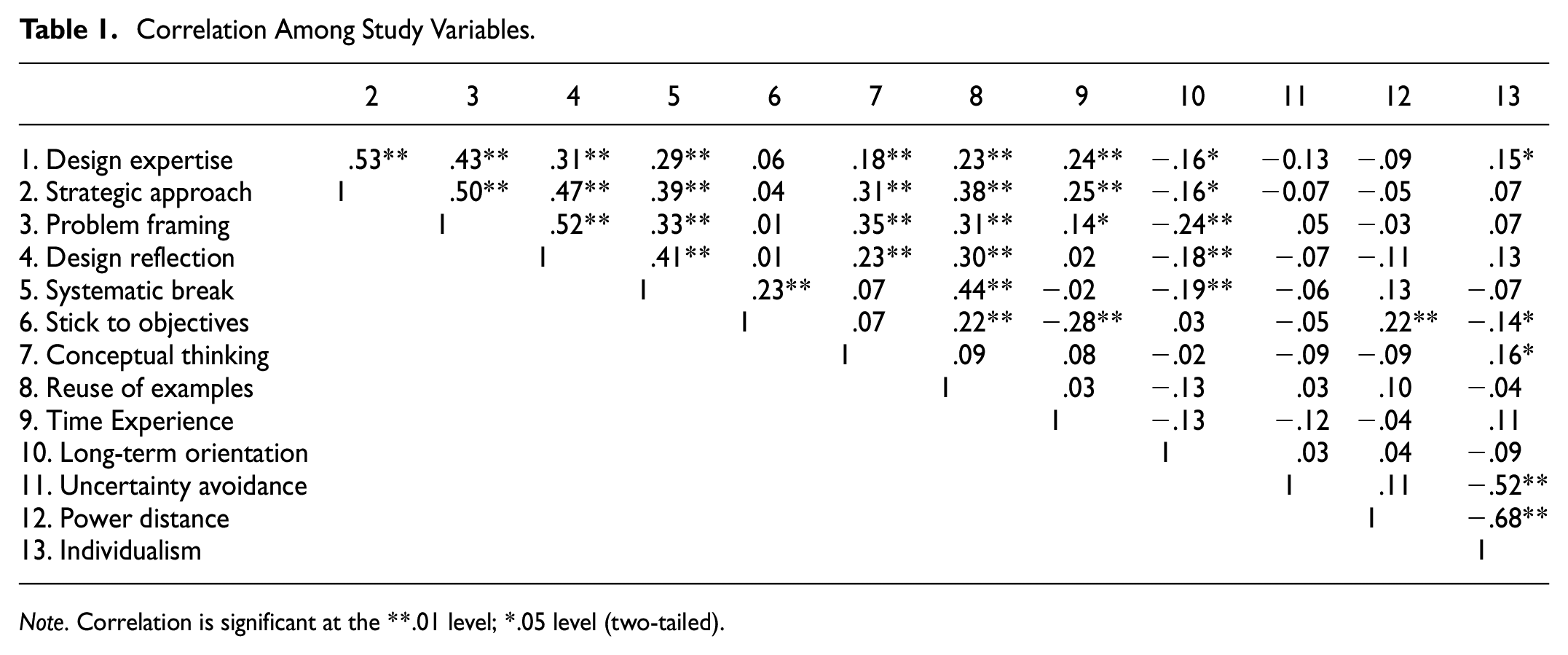
Note. Correlation is significant at the **.01 level; *.05 level (two-tailed).
The path analysis findings showed that the overall fit statistics (goodness of fit measures) display an acceptable level of fit (χ2 value (41) = 56.21, p > .05 (χ2/df < 2); CFI = 0.976; NFI = 0.920; RMSEA = 0.043). Figure 1 depicts the path model, regression standardized coefficients, and their significance, and Table 2 illustrates the direct and indirect relationships among the variables.

Effect of design behavior on design expertise: A path model.a
Relationships Among the Model’s Constructs: Direct and Indirect.
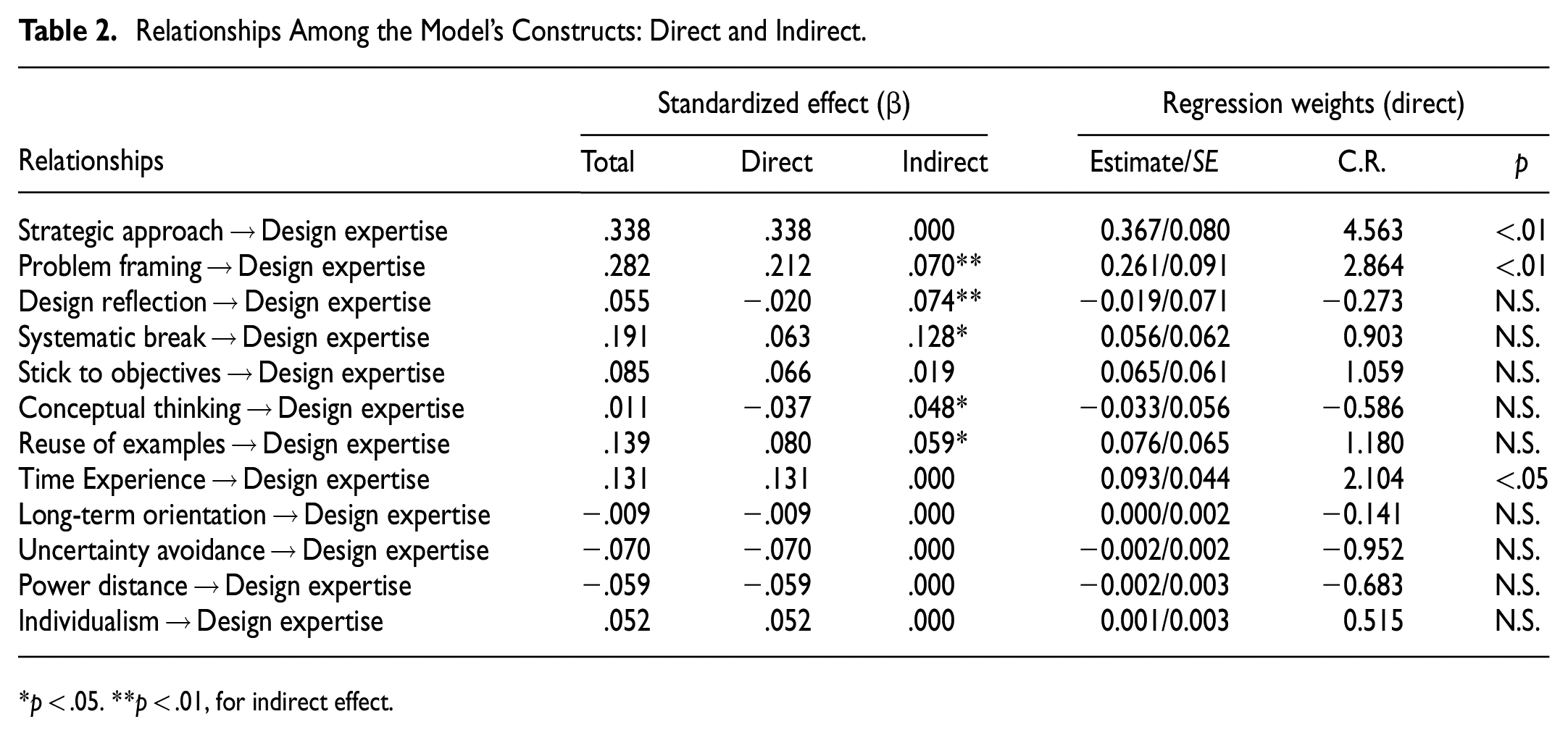
p < .05. **p < .01, for indirect effect.
Figure 1 shows that two behaviors have positive direct relationships with design expertise, strategic approach (β = .34, p < .01), and problem framing (β = .21, p < .01). The effect of five behaviors, conceptual thinking, design reflection, systematic break, reuse of examples, and stick to objectives have no significant direct relationships with design expertise (β = −.04, −.02, .06, .08, .07; p > .05, correspondingly).
Additionally, the model demonstrates the centrality of the strategic approach. Problem framing also has positive relationships with strategic approach (β = .21, p < .01). Conceptual thinking, design reflection, systematic break, and reuse of examples have positive relationships with strategic approach (β = .14, p < .05; β = .22, p < .01; β = .15, p < .05, and β = .17, p < .01; respectively). Systematic break has a positive relationship with design reflection (β = .39, p < .01) and reuse of examples (β = .40, p < .01). Finally, stick to objectives has a positive relationship with reuse of examples (β = .14, p < .01).
The path model further shows indirect relationships of the five behaviors, problem framing conceptual thinking, design reflection, systematic break and reuse of examples, toward design expertise (β = .07, 95% CI [0.02, 0.12]; β = .05, 95% CI [0.01, 0.10]; β = .07, 95% CI [0.04, 0.15; β = .13, 95% CI [0.03, 0.21], and β = .06, 95% CI [0.02, 0.12]; p < .05 respectively) through strategic approach. Stick to objectives has neither a direct nor indirect significant relationship with design expertise.
Discussion
This study aimed to investigate major design behaviors in design problem-solving and propose a conceptual framework that integrates design expert behavior with design expertise.
The research yields two significant innovative findings. First, in response to the RQ1, expert behavior in the design process can be captured through seven factors of behavior. These represent most important self-perceived behaviors of designers during the problem-solving activity. This conceptualization of expert behavior as a multivariable construct provides a comprehensive measure of design expertise, and complements the selective treatment in the literature (e.g., Adams et al., 2003; Ball et al., 2010; J. Kim & Ryu, 2014). Seven behaviors were empirically identified and include: Strategic approach to design complexity (strategic approach); Framing of the design problem (problem framing); Reflection on design problems and solutions (design reflection); Systematically breaking the design into sub-problems (systematic break); Sticking to initial design objectives and ideas (stick to objectives); Applying conceptual thinking (conceptual thinking); and Reuse of previous example solutions (reuse of examples).
The first behavior—strategic approach to design complexity—can be defined as how a designer approaches a design problem. A strategic approach is heavily based on the experience and knowledge accumulated in solving an assortment of different types of problems in different design situations (Curry, 2014). Experts are well known for using strategies opportunistically during the design process (Yilmaz & Seifert, 2011) while exploring the viability of solution ideas (Ball & Ormerod, 1995). Hence, they are good at deciding what strategies to apply best, under what circumstances, and their execution (Lemaire & Siegler, 1995). Whereas novice designers are known as problem-focused, experts are more solution-focused (Lawson, 2004). The strategies of the experts also involve top-down, working-forward, and breadth-first approaches, which are structured and hierarchical. A top-down strategy encompasses a design solution development starting from abstract levels through levels of growing detail (Ball et al., 2010; Cross, 2003). A working-forward strategy is characterized by applying rules from the early stages of the problem and solving the problem by data-driven search. The “Breadth-first approach” is about developing several sub-solutions at the same level of abstraction before moving to a lower level. This strategic approach depends mainly on procedural knowledge (Ho, 2001). In contrast, novice designers use the “depth-first” approach to problem-solving, characterized by expanding only one solution or a part of the solution at progressive levels of detail. This approach heavily hinges on declarative knowledge and demands many trial-and-error attempts and calculations before finding a solution (Lee et al., 2003). However, several studies found that experts mixing breadth-first and depth-first design strategies was a flexible and effective tactic, as demanded by the design situation (Luck, 2007).
The second behavior corresponds to the framing of the design problem. Frames are defined as a set of grounded, co-activated concepts based on the problem-solvers knowledge, experience, and values. As a design thinking method, it defines, comprehends, and prioritizes ill-defined problems (Schön, 1983). Formulating a design problem demands framing a problematic design situation. This includes defining its boundaries, focusing on particular objects and relationships, and establishing norms that might guide subsequent design moves following a certain logic (Schön, 1988). Framing and formulating the problem are considered essential features of design expertise (Akin, 1990; Cross, 2004; Lawson & Dorst, 2013), which help make better and faster decisions about the design situation. Designers need to comprehensively gain insight into the problem context, use their experiences and knowledge to interpret it, and adequately frame the design situation. Although framing a design situation is somewhat subjective, it is crucial to finding conflicts between goals, expectations, and needs (Yuan & Hsieh, 2015). Experienced and outstanding designers were found to be involved in problem-reframing activities not only in the early phases of the process, but regularly during the development of the task (Goel & Pirolli, 1992). Dorst and Cross (2001) argued that framing capability is critical to high-level performance in creative design. A primary challenge in reframing a design is to think out of the box to understand the problem from an innovative perspective (Paton & Dorst, 2011). However, the more time designers spend in structuring and understanding the problem at hand, the more creative the design result.
The third identified behavior concerns reflection on design problems and solutions, defined as the thoughtful conversations that the designer maintains with the components of a design situation. The reflective practitioner model proposed by Schön (1983) is considered a suitable framework for gaining insight into the designer’s behavior during problem-solving (Adams et al., 2003; Casakin, 2011). Accordingly, the design is seen as a dynamic and recurrent process in which ideas are generated, and solutions are developed when the practitioner attempts to structure the emerging design situation and reflect on the design outcomes. The interaction with the materials allows the designer to gain a deeper insight into the design problem, and this behavior is progressively enhanced as knowledge is increased and expertise develops (Luck, 2007). Schon and Wiggins (1992) suggested that design can be considered a reflective conversation with the materials by means of which a designer “sees, moves, and sees again.” In this cyclical interaction of creating and discovering, designers inspect what they have produced at that moment; then they continue sketching and scrutinizing again the produced visual representation to be informed of what the new design situation is about. As an expert behavior, the reflective practice is considered an ability of the designer to build a consistent argument in support and justification of her design decisions.
The fourth design behavior involves systematically breaking the design into sub-problems, which consists of dividing or decomposing a problem into smaller instances of the same problem. Decomposition is a critical problem-solving technique that was explored in different domains such as cognitive psychology (Newell & Simon, 1972), architecture (Alexander et al., 1977), mechanical engineering (Pahl & Beitz, 2013), and design (Ho, 2001; Simon, 1997). Ill-defined design problems are complex and challenging to solve at once. For this reason, the decomposition technique enables systematically dividing a design problem into smaller and better achievable subproblems so that design decisions can be taken more easily. The decomposition technique was found to aid in finding new ways to perceive and tackle a design problem and unveil its hidden structure (Liikkanen & Perttula, 2009). Akin (1986) investigated the knowledge needed to decompose a design problem into smaller chunks of information. He showed that splitting a problem demands some level of expertise, provided that it is concerned with transforming declarative into procedural knowledge. In this regard, Guindon (1990a) showed that experienced designers effectively used opportunistic decomposition to deal with ill-structured design problems. Ball and Ormerod (1995) also demonstrated that experts benefit from explicit decomposition to produce more effective and detailed problem structures than novices. In another study, Ho (2001) showed that expert designers rely on a two-fold explicit-implicit problem decomposition approach that novices lack.
The fifth behavior relates to applying conceptual thinking, which can be defined as the intangible aspects of the design considered while using holistic reasoning in problem-solving. Compared to novices, experts construct conceptual models of a design situation by including abstract information rather than concrete objects of the problem (Gentner & Stevens, 1983). A critical feature of experts is the cognitive ability to overlook the particularities of extensive examples collected over the years, identify underlying principles and construct conceptualizations of them (Petre, 2004). Experts represent and express what they see and think in terms of concepts rather than physical objects, which endows meaning to their designs (Bernal et al., 2015). Their large and cognitively well-integrated concepts and relationships among concepts allow them to easily recognize and categorize problems. Consequently, experts can accurately understand and interpret a design phenomenon (Yuan & Hsieh, 2015), make generalizations that go beyond the specific problem at hand, and change how likely problems will be tackled from there on (Akin, 1990). This process is supported by the production of sketches. While doodling and manipulating drawings in hopes of unexpectedly finding satisfying solutions, designers gain an understanding of the design using abstraction. Sketching at the early stages of the process allows them to discover schematized knowledge and new design concepts rather than concrete forms (Kokotovich & Purcell, 2000). Experts employ conceptual thinking at the outset of the process and successfully refine the design into a larger level of detail. Their ability to refine designs guide successive decisions at different levels of abstraction (Davies & Castell, 1992).
The sixth behavior refers to the reuse of previous example solutions, which consists of identifying, retrieving, and adapting earlier designed components or solutions to meet the requirements of a new problem. Experts collect, over the years, a vast collection of valuable design examples that are stored and organized in their minds. Experiencing and remembering large numbers of examples is a precondition to gaining expertise (e.g., Chi et al., 1988). Experts’ memories are full of solution examples, some of which are known as precedents, which are remarkable master designs that have an important lesson to teach. The experience gained from examples like these is fundamental to forming well-established knowledge structures to solve design problems efficiently (Kim et al., 2007). At some point in the design process, experts retrieve information from the previous solutions that they consider useful to solve the problem at hand (Björklund, 2013; Lawson, 2004). While abstracting the information from multiple examples stored in their memories, they are able to identify familiar kinds of problems and solutions (Casakin, 2010). Indeed, the experience and knowledge gained from the collection of examples enable them to quickly examine the feasibility of potential design solutions and apply a repertoire of guiding design principles to the problem at hand (Bernal et al., 2015).
The last behavior corresponds to sticking to initial design objectives and ideas, which is the propensity to adhere to main goals and solution concepts for as long as possible. Guindon (1990b) argued that reluctance to abandon initial ideas appears normal expert design behavior. Researchers suggested that rather than generating an array of alternative solutions, it is quite frequent that experienced designers prefer to apply their stored ordering principles to deal with the problem at hand (Björklund, 2013). Although employing familiar concepts can eventually be found to be less satisfactory, designers often try to hold on to them due to the obstacles and problems that could appear while moving back in the process. Hence, an important problem-solving activity consists of dealing with such difficulties without starting a main idea anew (Cross, 2004). However, a disadvantage is that being bound to early objectives and ideas may cause experts to exhibit fixation on existing design solutions (Vasconcelos & Crilly, 2016). In this regard, Kim and Ryu (2014) argued that expert designers are predisposed to fixation since they believe that instead of taking risks to create uncertain and potentially unsuccessful solutions, staying attached to their initial goals and familiar ideas can lead to good designs. Whether fixation on initial ideas can affect the creativity of the design is still a matter of debate (Sio et al., 2015).
Second, in response to RQ2, empirical findings further support the suggested conceptual framework that integrates different design expert behaviors with design expertise. It shows that most behaviors (excluding sticking to objectives) positively relate to design expertise (see Table 1); however, differences are observed in the magnitude of the relationships. In this regard, a strategic approach and problem framing directly relate to design expertise. Nevertheless, design behaviors concerning problem framing, design reflection, systematic break, conceptual thinking, and reuse of examples were not directly connected to design expertise. Solving design problems is a complex activity demanding some level of expertise (Curry, 2014). Therefore, to acquire and develop expertise, an integrative approach is needed based on the co-activation of several design behaviors through time. Our study found a connection between each behavior to design expertise, but this was somewhat indirect. This can be explained by the integration of the different identified design behaviors reflected in the strategic approach. Consequently, strategic approach was observed to be an integrative central factor in the process that mediates the relationships of the other five behaviors (i.e., problem framing, design reflection, systematic break, conceptual thinking, and reuse of examples) with design expertise.
This study further emphasizes the centrality of strategic approach behavior in design expertise. Specifically, this behavior reflects how a design expert compared to a novice, approaches a design problem (Curry, 2014; Luck, 2012). The positive direct relationships with other behaviors indicate that the strategic approach combines several essential expert behaviors. Its importance rests on the fact that the other expert behaviors (i.e., design reflection, systematic break, conceptual thinking, and reuse of examples) cannot independently predict design expertise. Hence, they make their path through strategic approach behavior.
Additionally, the current study shows that problem-framing behavior has two possible paths toward design expertise: (i) a direct path that confirms its essential role in predicting design expertise and hence relies less on a strategic approach (Akin, 1990; Cross, 2004; Lawson & Dorst, 2013), and (ii) an indirect path, implying that problem framing behavior can affect design expertise through strategic approach behavior. Our study is aligned with previous works arguing that framing ability reflects expert high performance (Dorst & Cross, 2001; Paton & Dorst, 2011). It suggests that a well-trained designer in design framing can reduce the need to employ a strategic approach, which can serve as a shortcut to attaining expertise.
Regarding sticking to objectives, our findings are aligned with works empirically showing that this behavior has neither direct nor indirect relation with design expertise (e.g., Sio et al., 2015). Indeed, to reduce potential risks in problem-solving (Kim & Ryu, 2014), it is not unusual that experienced designers prefer fixation to initial ideas, rather than searching for alternative and possibly less familiar solutions (Björklund, 2013). However, our results indicate that this behavior has no relationship with strategic approach and does not lead to design expertise. It can be concluded that although not exclusive to experts, design fixation is an uncommon behavior for them.
Conclusions and Implications for Design Training and Professional Development in Design Education
This study proposed a scale measuring key behavioral facets in problem-solving that differentiate experts from novices to predict design expertise. The suggested scale was validated and confirmed as a reliable evaluation tool. Additionally, the proposed behaviors were successfully integrated into a comprehensive framework that allowed us to unveil the magnitude of the behaviors, the dynamics among them, and their capability for predicting design expertise.
The study has several theoretical implications for design training and professional development in the design studio. First, it contributes to understanding the diverse behaviors of design expertise. Corresponding with previous research, the present study supports the notion that there are behaviors that differentiate experts from novices, such as design students. Extending previous research primarily focused on singular or limited behaviors, this work suggests a more comprehensive perspective and provides a new theoretical framework for understanding and predicting design expertise. Second, the study contributes further by offering empirical evidence that the analyzed behaviors represent reliable predictors of design expertise. Additionally, the conceptual framework reflects the magnitude and dynamic of the behaviors associated with design expertise.
The study also has pedagogical and practical implications for professional development in the design education domain. Intervention programs can consider findings related to the different aspects of expert design behavior as guidelines for training and assessment in the design studio, which is the core of the design studies. These should be seen as a convenient integrative learning approach encompassing the design behaviors needed to nurture and develop expertise in the discipline. In this regard, novices must be encouraged to implement the strategic approach behavior in problem-solving at the progressive stages of the design. They should also be challenged to frame and reframe problems, which can enhance their “thinking out of the box” and the generation of creative design idea solutions while developing their expertise. The design studio learning is based on the experimental trial-and-error methodology primarily based on intuition, which can reduce performance mainly in the early stages of the process (Emam et al., 2019). To deal with this, the strategic approach behavior can offer a robust scaffolding to guide intuition, enhance performance, and help develop design expertise. Awareness of the main behaviors identified in this study can contribute to improving the quality of teaching and learning, as well as teacher-student communication through the design process.
Finally, design practitioners can benefit from the proposed scale as an instrument to assess design expertise during recruiting procedures and for training or measuring employees’ ability to tackle design problems.
Study Limitations and Future Research
While this study enhances understanding of how particular behaviors influence design expertise, some limitations must be considered. First, this study focused on design expertise without distinguishing between design fields. Future research should check the proposed conceptual model in different design fields, such as industrial design, architecture, and engineering. Studies like these can strengthen the generalization of current findings and adjust the model to the different disciplines.
Second, the design creativity literature indicates that cultural aspects play a significant role in the individual’s creative achievements (Adair & Xiong, 2018; Fang et al., 2016; Zhang & Zhou, 2014). The current study treated cultural aspects as control variables to ensure that the relationships in the conceptual framework are neutralized from their influence on the diverse participants. Nevertheless, further research can benefit from studying the relationships between cultural aspects and the identified expert-based behaviors in design. While the present conceptual model used an international sample of designers, other research can center on specific cultures or countries.
Third, whereas this study focused on designers with different levels of experience, it can also be extended to gain further insight into the design behavior of novice and advanced students from other disciplines. This can be done using an empirical study in a design studio environment. Research of this kind can explore behavioral aspects throughout the different stages of the design process, and their effect on the quality of the produced design outcomes. Moreover, while the present study focused on the behavior of the individual designer, the influence of collaborative design activity on team members’ design behavior can also be investigated.
Fourth, while design behavior can be affected by cognitive and affective aspects, in this study we explored the behavior of designers only from a cognitive perspective. Future studies may consider including the affective domain to investigate feelings, attitudes, values, and their relation to design expertise.
Footnotes
Appendices
The Study Items’ Factor Loadings and Cronbach’s Alpha.

| Factor 1 | Factor 2 | Factor 3 | Factor 4 | Factor 5 | Factor 6 | Factor 7 | Factor 8 | |
|---|---|---|---|---|---|---|---|---|
| Design expertise 1 |
|
0.091 | 0.201 | 0.090 | −0.181 | −0.062 | 0.039 | 0.196 |
| Design expertise 2 |
|
0.020 | 0.212 | 0.081 | 0.111 | 0.094 | 0.076 | 0.140 |
| Design expertise 3 |
|
0.244 | 0.058 | 0.034 | 0.147 | 0.078 | 0.188 | 0.056 |
| Design expertise 4 |
|
0.277 | 0.325 | 0.080 | 0.142 | 0.130 | −0.114 | −0.114 |
| Design expertise 5 |
|
0.107 | −0.054 | 0.119 | 0.036 | −0.160 | −0.091 | 0.058 |
| Design expertise 6 |
|
0.026 | −0.044 | 0.124 | 0.401 | 0.108 | 0.141 | −0.060 |
| Design expertise 7 |
|
0.386 | 0.182 | −0.071 | −0.183 | −0.058 | 0.032 | 0.099 |
| Strategic approach 1 | 0.147 |
|
0.102 | 0.172 | 0.084 | 0.034 | 0.226 | 0.161 |
| Strategic approach 2 | 0.110 |
|
0.174 | 0.305 | −0.011 | 0.223 | 0.043 | 0.074 |
| Strategic approach 3 | 0.226 |
|
0.148 | 0.301 | 0.160 | −0.163 | 0.063 | 0.171 |
| Strategic approach 4 | 0.301 |
|
0.076 | −0.131 | 0.036 | 0.184 | 0.078 | −0.001 |
| Strategic approach 5 | 0.152 |
|
0.102 | 0.235 | 0.090 | −0.287 | 0.135 | 0.237 |
| Problem framing 1 | 0.151 | 0.230 |
|
0.214 | 0.070 | −0.112 | −0.045 | −0.155 |
| Problem framing 2 | 0.066 | −0.065 |
|
0.338 | −0.057 | 0.012 | 0.114 | 0.173 |
| Problem framing 3 | 0.163 | 0.098 |
|
0.114 | 0.187 | −0.057 | 0.162 | 0.089 |
| Problem framing 4 | 0.207 | 0.260 |
|
0.024 | 0.206 | 0.020 | 0.243 | 0.050 |
| Problem framing 5 | 0.126 | 0.288 |
|
0.232 | −0.008 | 0.125 | −0.114 | 0.225 |
| Design reflection 1 | 0.126 | 0.022 | 0.092 |
|
0.139 | −0.023 | −0.051 | 0.161 |
| Design reflection 2 | −0.036 | 0.091 | 0.228 |
|
0.198 | 0.042 | 0.083 | 0.032 |
| Design reflection 3 | 0.177 | 0.214 | 0.159 |
|
−0.008 | 0.017 | 0.250 | −0.023 |
| Design reflection 4 | 0.111 | 0.330 | 0.261 |
|
0.139 | −0.161 | 0.041 | −0.092 |
| Systematic break 1 | 0.017 | 0.090 | 0.198 | 0.009 |
|
0.151 | −0.056 | 0.093 |
| Systematic break 2 | 0.033 | −0.110 | 0.056 | 0.236 |
|
0.050 | −0.061 | 0.169 |
| Systematic break 3 | 0.248 | 0.412 | 0.020 | 0.084 |
|
0.054 | 0.088 | 0.196 |
| Systematic break 4 | 0.055 | 0.197 | 0.007 | 0.436 |
|
0.019 | −0.001 | 0.157 |
| Stick to objectives 1 | 0.090 | 0.089 | −0.087 | −0.098 | −0.086 |
|
−0.141 | 0.109 |
| Stick to objectives 2 | −0.092 | 0.222 | 0.051 | −0.043 | 0.192 |
|
0.073 | 0.034 |
| Stick to objectives 3 | −0.081 | −0.312 | −0.220 | 0.064 | 0.019 |
|
0.115 | 0.083 |
| Stick to objectives 4 | 0.142 | −0.004 | 0.220 | 0.098 | 0.317 |
|
0.159 | −0.090 |
| Conceptual thinking 1 | 0.127 | 0.174 | 0.012 | 0.047 | 0.013 | 0.035 |
|
−0.017 |
| Conceptual thinking 2 | 0.000 | 0.113 | 0.097 | 0.171 | −0.025 | 0.095 |
|
−0.096 |
| Conceptual thinking 3 | −0.010 | −0.017 | 0.442 | −0.096 | −0.077 | −0.098 |
|
0.278 |
| Reuse of examples 1 | 0.097 | 0.203 | 0.115 | −0.113 | 0.121 | −0.077 | −0.025 |
|
| Reuse of examples 2 | 0.143 | 0.238 | 0.179 | 0.222 | 0.200 | 0.107 | −0.008 |
|
| Reuse of examples 3 | 0.109 | −0.020 | −0.087 | 0.247 | 0.205 | 0.335 | 0.026 |
|
| Eigenvalue/variance | 7.90/22.56 | 2.73/7.80 | 2.32/6.62 | 1.93/5.51 | 1.47/4.19 | 1.36/3.88 | 1.26/3.59 | 1.19/3.41 |
| Cronbach’s alpha | .81 | .74 | .74 | .73 | .75 | .61 | .64 | .61 |
Note. Bold indicates a significant factor loading of the item in reference to its corresponding factor.
Declaration of Conflicting Interests
The author(s) declared no potential conflicts of interest with respect to the research, authorship, and/or publication of this article.
Funding
The author(s) received no financial support for the research, authorship, and/or publication of this article.
