



Abstract
In this study, we aim to understand the clients’ experiences with counselor candidates in Turkiye by examining the meanings that clients attribute to their counseling experiences. Using a qualitative survey, we asked 13 participating clients (2 males, 11 females) questions about meaning attributed to counseling before, during, and after the counseling and their thoughts about the counselor as a candidate and the effects of supervision. A thorough thematic analysis identified four key themes: “the counselor being a counselor candidate,”“before counseling,”“counseling process,” and “counseling outcomes.” The study showed that the clients were unaffected by the fact that their counselor was being supervised. In addition, we also observed that receiving service from a counselor candidate was seen as an advantage rather than a disadvantage, the counselor candidate was perceived as a competent expert, and the outcome of the counseling process was found satisfactory.
Keywords
Examining the client’s experiences in the counseling process will provide a better understanding of the counselors’ therapeutic skills and develop more effective interventions (Elliot, 2008). For this purpose, many researchers have focused on client-experiences in the counseling process (Israel et al., 2008; Mörtl & Von Weitersheim, 2008; Paulson et al., 1999).In addition to examining the clients’ assessments of services provided by specialist therapists, many researchers also examined the clients’-assessments of services provided by inexperienced counselors who are in training (Bachelor, 1991; De Stefano et al., 2010, Sackett et al., 2012; Stiles & Snow, 1984; Tuna, 2019).
The process of providing the first counseling service is an important process in counseling training. In this process, the counselor candidates use their theoretical knowledge, create therapeutic conditions, and put their counseling skills which they have already acquired in training into action. The counselor candidates also need the support of the supervisors, and often do not feel confident about providing counseling services, and experience anxiety (Rønnestad & Skovholt, 2003). Carried out in the presence of a supervisor, these first experiences on the challenging path to competency provide a unique learning environment for counselor candidates (De Stefano et al., 2010).
The Training Process of Novice Counselors in Turkiye
In countries such as the USA, Canada, and England, counselor training is characterized by accredited graduate education and an intensive practice process (British Association for Counselling & Psychotherapy [BACP], 2021; Canadian Counselling and Psychotherapy Association [CCPA], 2017; Council for Accreditation of Counseling and Related Educational Programs [CACREP], 2016; McCarthy, 2011). In Turkiye, counselor candidates are trained in the Department of Guidance and Psychological Counseling, a 4-year undergraduate program within the faculties of education. During this training, many theoretical courses such as Introduction to Psychology, Developmental Psychology, Personality Theories, and applied counseling skills courses such as Principles and Techniques are offered. In their senior year, counselor candidates provide counseling services within the scope of the Individual Counseling Practicum course (Council of Higher Education, 2018).
In her supervision experiences in the Individual Counseling Practicum study, Eren Gumus (2015) stated that Individual Counseling Practicum is important since it is the first time the counselor candidates practice counseling and perhaps the last time they get supervision. Counselor candidates’ (Aladag, 2014; Atik, 2017; Bakalım et al., 2018; Koçyiğit-Özyiğit & Erkan Atik, 2021) and supervisors’ (Aladag & Kemer, 2016) assessments regarding the supervision processes conducted within the scope of this course is an issue that has been frequently addressed in the critical literature on the topic. As reported by Kemer and Aladag (2013), counselor trainers’ practices regarding supervision models are limited in Turkiye, and therefore, many counselor trainers do not have the competence for this kind of work (Aladag, 2014). It is believed that this lack of competence would affect the client as well as the counselor candidate.
The Present Study
Assessing the counseling process from the client’s perspective is important for training more competent counselors. Understanding this process from the client’s perspective provides the most authentic information about the meaning and outcomes of the counseling for them. In addition, it provides information about the connections between the counselor candidate and client during the counseling process that is not noticed by the counselors or supervisors (Elliot & James, 1989). Clients’ experiences while receiving counseling from counselor candidates, who are referred to as novices in the literature, are not frequently encountered in Turkish literature (Tuna, 2019). It seems important to develop the course by conducting research on this course in which counselor candidates apply their own skills for the first time in psychological counselor education in Turkiye. Although the supervisors know about the counselor candidates’ skills in the process, it is also important to obtain information about the perception of counseling help. As a candidate counselor, it will be a valuable outcome of the course to ensure that the client leaves by benefiting from this service without harm. Therefore, it is necessary to determine the current situation in order to understand how the process could be made more beneficial to the clients. Furthermore, this process, which starts with graduate education elsewhere in the world, plays out differently in Turkiye. In this respect, this study is believed to add unique information to the literature since it focuses on the clients’ experiences in the Psychological Counseling Education process at the undergraduate level. Assessing these services carried out by novice counselors from the perspective of the client is also important for counselor trainers.
This study aims to understand clients’ experiences regarding the counseling services carried out by the counselor candidates within the scope of the Individual Counseling Practicum course. The study aims to answer the following question: What are the client’s experiences in the counseling process conducted by novice counselors?
Method
This section contains information on the study design, participant characteristics, data collection tool, data collection process, data analysis, and validity and reliability.
Study Design
The study employed phenomenology, one of the qualitative research methods. In phenomenology, the aim is to learn about the experiences of the individual as they experience them (Bevan, 2014). With this approach, which focuses on human experience, researchers gain new insight into the original experience. The conscious life experiences of the individual are examined (Van Manen, 1990). In this study, we examined the experiences of the first clients of the counselor candidates regarding the counseling service process they received.
Participants
In order to reach people who can describe the essence of the experience (Creswell, 2013), the counselor candidates at the university where the first author of this paper worked were asked to share the research announcement with the clients they had already counseled. Thus, the criterion sampling method (Patton, 2001) was employed in the study. The document containing the information on the study, the informed consent, and the contact information of the clients who agreed to participate in the study was sent to them via Google Forms. Accordingly, all the clients who filled out the informed consent form and shared their contact information were included in the study. When the data obtained from the interviews was analyzed, it was observed that data saturation was already achieved. Thus, it was not necessary to reach additional participants by making a research announcement again.
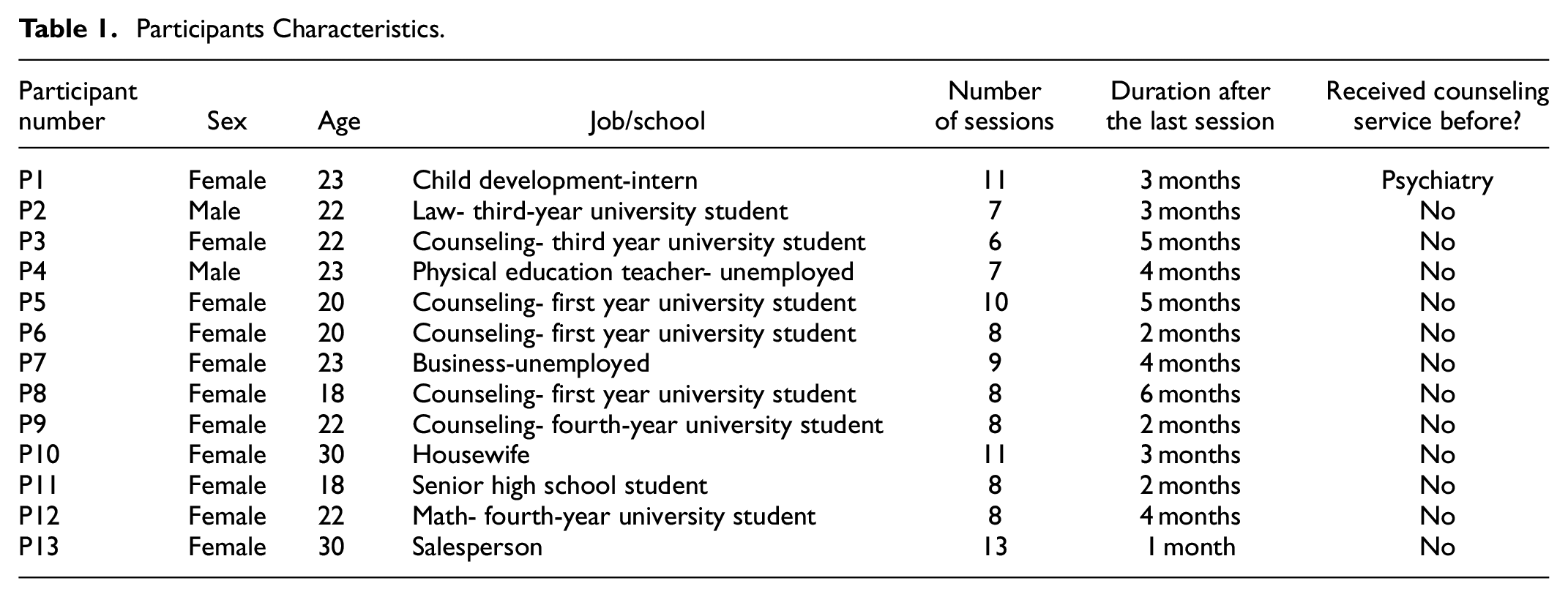
Information on the 13 clients who agreed to participate in the study is presented in Table 1. According to Table 1, 2 of the participants in the study were male (15%), and 11 of them were female (85%). The ages of the participants ranged from 18 to 30, with a mean age of 22.54. The participants received between 6 and 13 sessions of counseling. While two of the clients received face-to-face counseling services, 11 received online counseling. The clients were from different parts of Turkiye, and most of them lived in small cities or districts. Table 1 presents the participants’ gender, age, department/job, the number of sessions they have received, the time since the last session, and whether they have been diagnosed or not.
Participants Characteristics.
Themes, Sub-Themes, Categories, and Codes of Clients’ Views on the Counseling Service Received from the Counselor Candidates.

Data Collection Tools
While preparing the phenomenological interview form, questions focusing on the clients’ biography, the counseling experience’s details, and the meaning (Seidman, 2006) were developed based on the literature. To get an expert’s opinion on the interview form consisting of 10 questions, the form was sent to two field experts who have PhD in counseling and are experienced training counselor candidates and give the Individual Counseling Practicum course. The questions were revised in line with the experts’ opinions. Questions on whether the participants received any counseling service or psychiatric support before, the meaning of the counseling experience for the participants, and the change underwent during the counseling process were added to the already existing interview questions. The final version of the form has 12 questions.
Data Collection Process
The data was collected by semi-structured in-depth interview technique. This technique is based on the participants talking about their own experiences through open-ended questions asked by the interviewer (Merriam, 2009). It allows direct quotations in the interpretation of data by obtaining in-depth information about the participants’ experiences, knowledge, feelings, etc. (Patton, 2001).
The interviews were conducted through WhatsApp and Zoom. At the beginning of the interview, the participants were asked for their consent to be recorded. The participants were also informed that the interviews would only be used for scientific purposes and that their identities would not be shared with anyone other than the researchers. The data were collected in May 2021. Each interview lasted between 18 and 32 minutes, adding up to a total of 307 minutes. If the participant was a student of the first author, the second researcher conducted the interview. Six out of 13 interviews were conducted by the second researcher.
Data Analysis
The thematic analysis method was used in data analysis. In the thematic analysis method, the qualitative data obtained about a subject that has not been much researched are interpreted by determining patterns (Braun & Clarke, 2006). MAXQDA program was used in the analysis of the data. The audio recordings of the interviews were transcribed and turned into Microsoft Word documents. The researchers analyzed the data together by discussing each code, category, and theme, taking into account both explicit and implicit meanings (Braun & Clarke, 2006). First, the data content was examined, and then the codes were formed. From the codes, categories, and themes were formed later. Thus, it can be said that induction was used.
Validity and Reliability
Lincoln and Guba (1985) addressed the criteria and techniques for assessing the trustworthiness of qualitative research. These criteria include techniques such as long-term participation, expert verification, and participant checking for internal validity (credibility). In the present study, in-depth interviews were conducted to collect data, and the researchers analyzed the data after discussing it. In addition, if the participant did not understand a question or did not give in-depth information, the question was asked again, and some questions were asked to be explained a little more. Furthermore, expressions such as “instructor” and “lecturer” were used instead of “supervisor” so that the participant could understand the question correctly. An intensive description was used to establish the external validity (transferability). More specifically, the characteristics of the participants in the study were explained in detail.
Regarding dependability (reliability), detailed information about how data is collected and analyzed in this process is presented. In addition, the researchers’ background information that could affect the study is also provided. The first researcher is the supervisor of the counseling candidates. She also received supervision training. Both researchers have PhD degrees in psychological counseling and guidance. Both researchers supervised counselor candidates within the scope of the Individual Counseling Practicum course. The first author had been supervising for 7 years, while the second author had been doing it for 2 years. In addition, both researchers received supervision support through PhD or different training programs.
Results
As a result of the data analysis, four themes were drawn, namely “the counselor being a counselor candidate,”“before counseling,”“counseling process,” and “counseling outcomes.” The sub-themes, categories, and codes of these themes are presented in Table 2.
As we can see in Table 2, the themes of “the counselor being a counselor candidate,”“before counseling,”“counseling process,” and “counseling outcomes” were formed. According to the table, “the counselor being the counselor candidate” influenced the entire process, whereas “before counseling,”“counseling process,” and “counseling outcomes” mutually impacted each other. Themes about both the advantages and disadvantages of the counselor not having graduated yet were deduced. Based on the clients’ statements, themes about “before counseling,”“counseling process,” and “counseling outcomes” were formed. This result is visualized in Figure 1. Afterward, the findings are explained in detail.

Themes about the process of receiving counseling service from a candidate counselor.
Theme 1: The Counselor Being a Counselor Candidate
The theme of “the counselor being a counselor candidate” consists of sub-themes of advantages and disadvantages.
Subtheme: Advantages
The participants talked about flexibility, sincerity, the counselor candidate’s caring approach, and not being labeled and diagnosed as the advantages of the counselor being a counselor candidate. Flexibility was mainly about scheduling the sessions according to the client’s convenience. On this issue, P13 said, “We arranged the times according to my availability; it was adjusted for me; it was always this way.” Similarly, P10 said, “She was texting me first to see if I was available for our sessions.” P2 also cited sincerity and said, “Maybe it is sincerity because we are both students.” P1 talked about not being labeled or diagnosed and said, “For the first time, it wasn’t in an institution. It felt more sincere.”
Subtheme: Disadvantages
The participants talked about the lack of depth in engagement as well as the occasional anxiety of the counselor candidate as the disadvantages of the counselor being a counselor candidate. On the lack of depth, P3 said, “For example, if I had gone to a real professional psychologist somewhere today, maybe we’d have talked about much deeper and more lively things, or we’d have gone deeper.” P5 referred to the counselor’s anxiety, stating, “While the counselor candidate was talking, I think it was his first session, so he was a little anxious or something; sometimes he couldn’t complete the sentences, and he mixed up, but towards the end, he began to speak more fluently.”
Theme 2: Before Counseling
The theme of “before counseling” consists of the sub-themes of the counselor candidate’s ethical approach, thoughts before counseling, feelings before counseling, and reasons for contact.
Subtheme: Counselor Candidate’s Ethical Approach
The participants talked about being counseled by someone they didn’t know and being asked for consent under the sub-theme of the counselor candidate’s ethical approach. On being counseled by someone they did not know, P2 said, “I had a friend from high school in your class… She used to say that you can’t give help to your friends. So, she directed me to Y (counselor candidate), and we started that way.” P8 pointed to volunteering when speaking on the counselor candidate’s ethical approach and said that “I mean not quitting, for example, feeling compelled to talk about it for seven sessions, not ending it, it’d be a stressful situation for me when it comes to not being able to end it. I mean, I’d have said, do I really have to say this …” P3 emphasized the confidentiality principle and said, “I didn’t have concerns about being in the same university with the counselor candidate… I know this counseling process; after all, it’s confidential.”
Subtheme: Thoughts Before Counseling
The subtheme of thoughts before counseling is made up of inappropriate thoughts or expectations before counseling and positive thoughts before counseling.
Inappropriate thoughts or expectations consisted of waiting for the counselor to solve the problem, the thought of counseling coming to light one day, idealizing the counselor, belittling the problem, and not believing in oneself. P10 clearly talked about her expectation of the counselor finding a solution to her problem and said, “Well, I was looking to relax. I mean, I was looking for someone to say something, actually to give advice and direct my life.” Similarly, P4 clearly expressed his expectation of the counselor to find a solution and said, “Will she be able to solve my problem that I will tell her?” Also, P4 stated that he was afraid that getting counseling service might negatively affect his life in the future and said, “I was a little afraid of this, frankly, because we may apply to be a part of the police force, we may apply to higher institutions. I wondered if there would be any problem in the future about applying for these kinds of jobs.” Furthermore, another client mentioned that she did not believe in herself before counseling and said, “Yeah, because I was a person without belief; I mean, I didn’t believe in myself. I mean, I didn’t believe it at first; I said we wouldn’t work. I was thinking like I couldn’t do it and wouldn’t be happy.” In addition, one of the clients (P2) believed that the number of sessions would be proportional to the severity of the problem. He said, “I thought it would end earlier, like five weeks, and I didn’t think that there would be so many problems and that our relationship (with his girlfriend) was that problematic.” Another inappropriate thought/expectation was about idealizing the counselor candidate. On this subject, P4 said, “You solve everything because you got your training on this. This excited me because I’m looking for someone who can figure out the core problem, assess my capacity, intelligence, and even anger issues.”
Furthermore, there are also clients who had positive thoughts about the process before counseling. These included not judging the counseling process negatively and believing that counseling would be helpful and an integral part of everyone’s regular routines. P2 stated that he considered counseling to be helpful and said, “No, I’ve always found counseling right and productive, but I had never felt such a need, or I had never found myself in such an impasse before to go to counseling.” Similarly, P6 mentioned that she always had positive thoughts about counseling and explained, “I’ve always looked kindly on this, and I’m still looking kindly on this. I mean, I didn’t have any prejudices or negative thoughts before.” In addition, about counseling being among life’s regular routines, P8 said, “Counseling actually should have a place in a normal functioning life. This is what I know, and I think it should be like this. So, none of my views have changed.” Despite these statements, the proportion of positive thoughts was lower than that of inappropriate thoughts and expectations.
Subtheme: Feelings Before Counseling
Before the counseling process, the clients talked about their feelings as well as their thoughts. These feelings were anxiety, hope, and excitement.
Anxiety consisted of feelings of inadequacy, not knowing what to talk about, hesitation, lack of trust. P10 mentioned her concerns that she might be inadequate and said, “I wondered a lot if what I shared would be adequate. I thought a lot about if what I said would be enough.” Also, there were participants who got worried about what they would tell the counselors. In addition, one participant (P8) mentioned the feeling of hope and said, “I felt hope. I mean, I really thought something would happen, and my pain would lighten.” Furthermore, some participants emphasized the excitement they experienced since it was their first experience. On this issue, P2 explained, “I was excited, frankly, because I had never received such training and because I had never gotten any help before.” He attributed his excitement to the fact that he received counseling for the first time. Along the same lines, P2 said, “I was excited. I mean, I was also wondering how it would go; I didn’t know it would be useful. So, I was curious in that respect.”
Subtheme: Reasons for Contacting the Counselor Candidate
Under the subtheme of reasons for contacting the counselor candidate, the participants stated that they wanted to experience, needed, and were recommended counseling. P3, who is also a counselor candidate, said, “I thought it would be an experience for me, too.” Another counselor candidate, P8, talked about how she only wanted to experience the process as a client and said, “This idea was more appealing to me. Even if I didn’t trust her, I’d hurdle through it, and I’d experienced it.” In addition, P13 stated that she got counseling after a friend’s recommendation. Explaining this, she said, “H works at the same place as me. She is also majoring in counseling. I mean, they need to conduct sessions, whatever you’d call it, I guess assignment. We were just having a normal conversation, and I said that would be great.” Similarly, counseling was recommended to P11 by her teacher. She explained, “It started with a coincidence when I went to see my advisor. She recommended it. So, the counseling happened on my teacher’s advice, and I just said why not.” Also, some clients perceived getting service from a counselor candidate as an opportunity because they already had a need to talk. P2 said, “I wanted to solve this problem in a better and more professional way. So, I wanted to get counseling; that’s how it started.”
Theme 3: Counseling Process
The “counseling process” theme consists of the sub-themes of motivation to continue receiving counseling and the counselor candidate’s qualifications.
Subtheme: Motivation to Continue Receiving Counselling
The participants talked about willingness and desire for self-disclosure under the sub-theme of motivation to continue receiving counseling.
Willingness is getting excited and wondering about the next session, whereas desiring to open oneself is related to the feeling of relaxation, digging deep, and self-disclosure. P13 expressed her excited anticipation regarding the counseling process and said, “I’m meeting with her; I mean, I’m waiting for the day when I’ll get to talk to her every week.” P1 explained her sense of curiosity, making the statement, “From the first day I went there to the last day of the sessions, on the way, I wondered what I would tell about myself that day, what I would discover about myself that day.” P11 talked about the self-disclosure and relaxation that happened in the process. Explaining this, she said, “To be honest, I didn’t think that there’d be a change at first, but I didn’t think there’d be a change in the next couple of sessions, but as the sessions progressed, I realized that my thoughts changed. I mean, to be honest, I can say that I got better.” P9 talked about digging deep and said, “I mean, we tell everyone about our issues, and everybody listens to our problems, but this isn’t like that. I mean, we dig deep into events in the past. We tell stuff that we thought we’d never tell anybody.”
Subtheme: Counseling Candidate’s Qualifications
The factors that made the counseling sessions more effective are the counselor’s professional qualifications and the counselor’s individual characteristics. While a counselor’s professional qualifications are about the perception of competence and the application of counseling skills, individual characteristics influence relatability and candor because of similar age and experience. The perception of competence was mentioned by P2. He said, “Well, they’re being trained for this; even while they’re listening to me, they’re listening in a trained way because that posture, sitting, and eye contact… they have perfect listening skills; it really relaxes you.” Similarly, P13 said, “F (counselor candidate) had such a place in my eyes; even something she said was so valuable to me. I mean, she was trained for this, could understand what I said, and could explain well. Yeah, I mean, it was very nice.” Regarding the application of counseling skills, P9 emphasized active listening and said, “Well, we mostly talked. He listened to me; he understood me. That’s how the process was. I mean, he encouraged me to talk. That’s how we did it. So, it wasn’t very technical.” Furthermore, P2 mentioned the techniques taught by the counselor candidate and said, “I learned empathy, I learned I-language and You-language. We talked about this in the third or fourth session. This has brought many returns.” By saying, “Because if you are an ordinary person and you tell a friend or partner, they will criticize you; after all, as a society, we aren’t like, you know, trained for such a thing.” P10 pointed to the comfort given by the counselor candidate, not judging her. In addition, P1 emphasized the counselor candidate being unprejudiced and said, “She’s a stranger. She listens better and isn’t prejudiced. She doesn’t have any opinion of you whatsoever, negative or positive. You are describing yourself in your own words. I mean, she knows me from what I’m telling her.” Furthermore, the clients also talked about counselor candidates’ reliability, careful listening, reflection, making them feel understood, impartiality, and candidates not giving advice, using the appropriate tone of voice, and being prepared.
Under the counselor candidate’s individual characteristics, P8 talked about being able to relate to them and said, “I don’t know the reason; I found her very similar to me.” About being similar in age, P12 stated, “I mean, I felt comfortable because she was my age; maybe if it was someone older than me, I might not have felt so comfortable.”
Theme 4: Counseling Outcome
The theme of “counseling outcome” consists of the sub-themes of change and satisfaction.
Subtheme: Change
Change is about the change in the perception of counseling and the transformation that the client underwent. Change in the perception of counseling refers to the realization that the counselor does not exactly solve the problem, anyone can get counseling; not just those with mental health problems, and the counselor does not direct or give advice. On the other hand, the client’s own transformation refers to the change in cognitive, emotional, and behavioral areas.
One of the changes in counseling perception is to realize that the counselor will not solve the problem for the client. P4 stated, “Actually, Z didn’t do anything. She helped me a lot because she listened to me, and she was an excellent listener. That’s how I solved it.” In addition, P13 mentioned the fact that it is not only those who have problems that get counseling and said, “We were always watching it on TV, you know, or we thought that only people with problems would go to these counseling sessions because only those who were very stressed would resort to this method.” P5 explained how the counselor would not direct the client, stating, “When we started meeting with F (counselor candidate), I thought beforehand that I’d tell him about my problems; for example, he’d guide me and even advise what to do, I had such a counseling process in my mind. But during the counseling process, I learned and realized that F, for example, made me realize my feelings. When I became aware of my feelings and thoughts, I found my own way. I directed myself.”
P6 reflected on her own change in the cognitive area and said, “I can say that my perspective towards events has changed; I can say that I’ve started to look more positively.” In addition, P3 talked about the increase in her affective and behavioral awareness and said, “I realized that you should not be in pursuit of happiness or something, I can say that it increased my awareness a little more. This is the change from the first session to the last session.” On the same issue, P1 said, “Actually, for me to discover myself a little bit, I listened to the other person, and I actually found myself in what she told me. I mean, I found myself not in what she told me but in the way she paraphrased what I had just said.” The change in the affective area was described by P5, saying, “What kind of place it has in my life… I learned to be able to face and talk with my emotions, to take them into consideration rather than suppress them, to follow a path according to them, to manage and direct emotions.” Also, clients specifically mentioned the feeling of self-importance. P8 said, “I realized that I don’t care about myself. If I cared about myself or knew how to care about myself, everything would have eventually started to go towards a solution.” P3 talked about the affective outcome and stated, “The counseling calmed me down a bit more, so it was a positive process for me.” Explaining the behavioral change, P12 said, “When I start doing something at first, when I say I will take 5 minutes to do that, I encounter an obstacle because I tend to procrastinate so much. This got better, so it fell into place.” Similarly, P10 said, “Now when I start to explain something, I explain in a language that they can understand like they are children (behavioral change towards her children).”
Subtheme: Satisfaction
Satisfaction refers to the desire to experience the process again and satisfaction with the outcome. The desire to experience the process again is about being able to go to counseling again, wishing counseling sessions would continue, and regret about not applying earlier. P1 talked about her desire to go to counseling again and said, “Before going to those sessions, I was much worse, much more hopeless, much unhappier, but for example, as I discovered myself and felt better, it became much better for me, I wish I could go to counseling again.” Similarly, P12 said, “Actually, she said only two sessions before ending it that she would end it. She said that that session was the second last session. I got emotional, I mean, I felt different that it would end. I guess I got used to it.” Regarding her regret about not experiencing counseling before, P13 stated, “I wish I had gone to counseling before. I guess, I needed it, I was hungry for it.”
Satisfaction with the outcome is about seeing the benefit, realizing the counseling is good, finding the achieved outcome satisfactory, and recommending counseling to others. Talking about the process being helpful, P13 stated, “I changed with the counselor candidate, I came to life. It was very productive, I don’t know, I’m very satisfied.” Similarly, P1 said, “I feel that it was really good for me.” P6 stated that she found the outcome very satisfactory. She said, “For example, she asked how many points I give to my decisions out of ten and what point I want to achieve. We decided on a few issues. I can’t say I achieved everything, but it was very helpful. I can’t deny that.” P13 stated that she would recommend counseling to others and said, “I told Z (counselor candidate) that all people who experience this(problem) should get support. Not just because you have a problem, but if I had gone to counseling before all these problems happened, my life would have been different.”
Discussion
Within the scope of this study, the experiences of the counseling process were examined from the perspective of the clients who received counseling services as part of the Individual Counseling Practicum course, an important step in counselor training in Turkiye. In counseling training, Individual Counseling Practicum (Aladag & Kemer, 2016; Eren Gumus, 2015) is the first course in which the theoretical knowledge and counseling skills that are learned in important skill courses such as Principles and Techniques in Counseling (Aladag et al., 2014) are put into action (Aladag & Kemer, 2016).
The Counselor Being a Counselor Candidate
The first theme of the study was formed as “the counselor being a counselor candidate.” Under the theme of “the counselor being a counselor candidate,” there are two subthemes, namely advantages and disadvantages.
The examination of the sub-themes of this theme revealed that the majority of the clients perceived counseling as an advantage, but very few of them perceived it as a disadvantage. Focusing on the disadvantages of the counselor being a counselor candidate, certain clients stated that the counselor’s inexperience was reflected in the form of anxiety and not being able to dig deeper. Another study showed “anxiety about counselors’ roles in therapeutic relationships” of counselor candidates (Schwing et al., 2011).They could doubt themselves and fear making mistakes (Cigrand, 2020). They could feel anxiety about supervision (Kocyigit, 2023). On the other hand, counselor candidates want to gain the skills of managing their own emotions in their training (Wu, 2019). After taking certain courses (Aladag et al., 2014) that are taught using microteaching practices, counselor candidates are anxious about conducting one-to-one counseling with a client for the first time. Although this anxiety is a developmentally expected situation (Rønnestad & Skovholt, 2003), it is also a situation that is expected to change in the process. Participants also pointed to counselors’ anxiety in the first session. In addition, as expressed by Lilienfeld et al. (2010), one of the clients’ myths about psychological treatment is that “more experienced counselors tend to have much higher success rates than less experienced counselors.” However, the counselor’s competence is more important than the counselor’s experience. Accordingly, most of the participants in the present study found their counselor candidate competent and did not talk about the issue of inexperience.
Within the scope of this research, it was observed that the clients were generally satisfied with the helping relationship. In contrast, novice counselors can reflect on the helping relationship in daily life, such as giving advice and not setting boundaries in their professional relationships (Rønnestad & Skovholt, 2003). The clients, who perceived the counselor being a counselor candidate as an advantage, assessed this as a factor supporting help-seeking behaviors. These are listed as flexibility, sincerity, the caring approach of the counselor candidate, and not being labeled or diagnosed. Clients emphasized flexibility because the clients who received service from counselor candidates were able to set up their sessions during this process at any time they wanted and cancel their sessions when they were not available. Providing counseling services online is considered a sign of significant flexibility (Koçyiğit-Özyiğit & Erkan Atik, 2021). Accordingly, in the present study, most of the clients got their counseling through online platforms during the COVID-19 pandemic. Along the same lines, clients in face-to-face counseling stated that accessible scheduling was a beneficial factor in the counseling process (Paulson et al., 1999). In addition, the clients who received counseling from inexperienced counselors expressed that they perceived the relationship in the counseling process as sincere, attentive, and unprejudiced (De Stefano et al., 2010). In the effectiveness of the counseling process, variables such as the client’s readiness for counseling, the counselor’s age, sex, and experience, as well as the relationship between the counselor and the client are extremely important (Henkelman & Paulson, 2006).
Before Counseling
The examination of the clients’ statements about the time before counseling showed that the clients talked about the counselor candidate’s ethical behaviors and their thoughts and feelings about counseling before the process began. The counseling services given within the Individual Counseling Practicum course are supervised from beginning to end. In the informed consent, information on the free service provided to clients, registration processes, principles, and supervision is given beforehand (Atik, 2017). The counselors’ ethical behaviors regarding confidentiality, volunteerism, and multiple relationships are listed as the factors attracting client candidates to the process. Similarly, Kocaayan and Koçyiğit-Özyiğit (2018) reported that clients knowing that there is confidentiality in counseling helps them adapt to the process.
In the study, some clients had some “inappropriate thoughts” about the counseling process before the process began. The first two of these are waiting for the counselor to solve the problem and idealizing the counselor, both of which are about the client’s high expectations in the counseling process. Corey (2015) maintained that clients who are not familiar with the counseling process may often participate in the counseling process with the anticipation of a prescription. They believe that the counselor will make suggestions so that they will solve the problem quickly. Another point regarding their thoughts about counseling before the process began the clients emphasized was “the thought of counseling coming to light one day.” The idea that counseling will come to light one day is associated with labeling, which includes the diagnosis of clients after receiving psychological help and the hindrance of this to their work or social lives. Studies show that social labeling is an important factor in reducing the likelihood of seeking psychological help (Barney et al., 2006; Sever et al., 2021; Wrigley et al., 2005). Clients also emphasized the same among the advantages of having a counselor candidate as their counselor. Therefore, not being labeled or diagnosed may be an important reason for some of the participating clients preferring counseling services from a counselor candidate. Finally, regarding the theme of before counseling, “belittling the problem” was also an important point mentioned by the clients. Similar to social labeling, belittling the problem is one of the important obstacles in front of seeking psychological help (Bilican, 2013; Koydemir et al., 2010).
The feelings of anxiety, hope, and excitement were mentioned under the sub-theme of clients’ feelings before counseling. Under anxiety, important sources of anxiety were whether the counselor could be trusted and whether he/she could be able to express himself/herself appropriately. In the counseling process, trust emerges as a very basic emotion in the formation of the therapeutic relationship between the counselor and the client. The process of building trust can be time-consuming. However, with the formation of the client-counselor relationship at the beginning of the counseling process, unidentified needs are discussed, and the feeling of anxiety leaves its place to trust the counselor and oneself (Levitt et al., 2016). Before the counseling process, it was seen that some clients also referred to the feeling of hope in the solution to the problem. As expressed in empirical studies, clients who have positive expectations from the counseling process and who are highly motivated are associated with greater improvement (Constantino et al., 2021), and those who do not have this feeling are more reluctant to deal with the problem (Wrigley et al., 2005). Also, it is important to support the client’s hope for a solution (Larsen & Stege, 2012). The excitement of the clients before the counseling also has an important place among their experiences. The clients experienced feelings of excitement because they did not have any information about how the psychotherapy process would progress and what they would experience.
Counseling Process
The theme of the counseling process consists of the sub-themes of motivation to continue receiving counseling and the counselor candidate’s qualifications. Motivation to continue receiving counseling is very important to the counseling process. When clients volunteer to continue to receive counseling (Tuna, 2019) and when they feel cooperation with the counselor, they continue getting counseling (Johansson & Eklund, 2006). In the sub-theme of motivation to continue receiving counseling, clients talked about having positive feelings about the next session, realizing that they became relaxed in the process by disclosing themselves and digging deeper into the issues as factors increasing this motivation. Clients making progress regarding the problem in such a process, the belief that the problem will be solved, and the feeling of satisfaction with the process ensure the continuation of the counseling process (Bados et al., 2007; Johansson & Eklund, 2006; Yikilmaz et al., 2016). Another sub-theme affecting the client’s motivation to continue in this process was the counselor candidate’s qualifications. Both the professional and individual characteristics of counselor candidates are considered important in the counseling process. In the present study, most of the clients perceived their counselor candidates as competent and even reported that they did not realize that they were candidates. Especially under the counselor candidate’s qualifications sub-theme, the issue of trust came to the fore because clients felt they could trust their counselor candidate since they were trained in the profession. Clients generally expressed their positive thoughts about their counselor’s counseling skills and practices and emphasize points such as the use of basic skills, technique and skill teaching.
In the sub-theme related to the counselor’s individual characteristics, the clients gave importance to the fact that the counselors were relatable and similar to them in terms of both age and characteristics. While being similar in terms of age may be a reason for the client to prefer that specific counselor before the counseling process (Tuna, 2019), it can also sometimes lead to the perception that the process will not be beneficial due to inexperience (De Stefano et al., 2010).
Counseling Outcome
The theme of counseling outcome consists of the sub-themes of change and satisfaction. After the counseling process, the clients talked about their changing thoughts about the quality of the psychological counseling service. This sub-theme, which includes the clients’ thoughts about the counselor actually solving the problem and directing the client toward the solution, is actually a situation expected by clients who do not have a good grasp of the counseling process and who have difficulties in participating in the process (Corey, 2015). Due to the high pattern of external control in Turkish culture, it is possible for the clients to expect their counselors to provide solutions for their problems during the counseling process (Yorgun & Voltan-Acar, 2014). However, in the present study, the attitude and the ethical approach (autonomy of the client) of the counselor in the counseling process in this regard eliminated these expectations of the clients. In fact, clients’ perception of counseling transformed into “only those who have problems don’t get counseling.” Counseling is a professional process of solving minor or major psychological, interpersonal, educational, or career-related problems in addition to diagnosis and treatment (American Counseling Association [ACA], 2010; Sommers-Flanagan & Sommers-Flanagan, 2004). This change seems to have enabled individuals who receive counseling services to see counseling as a help that can be taken in different problems rather than a diagnosis-treatment relationship.
The counseling process causes affective, behavioral, and cognitive changes in the client, as participants expressed in the sub-theme of change. Similar to other studies, as a result of the counseling service conducted by the counselor candidates, the clients in the present study went through cognitive changes, such as gaining awareness and developing a different perspective on the current problem. They also reported affective changes such as gaining skills and a decrease in unwanted behaviors, feeling calmer, a decrease in anger, and relaxation (De Stefano et al., 2010; Israel et al., 2008).
The clients expressed their satisfaction with the process as one of the counseling outcomes. The clients expressed their satisfaction with the changes stemming from the counseling with their desire to receive counseling again, and the satisfaction they felt from the result achieved. Under the heading of desire to receive counseling again, regarding their changing perspectives on the process and the results they got, the clients stated that could get counseling again if they needed, and that they wished they had received counseling earlier. The clients were satisfied with the outcomes they got. A few clients expressed that they would recommend the counselor candidate to others.
Clients reported that they mostly went through positive changes regarding the reasons for seeking help. However, a few of the clients reported that they were involved in the counseling process with the need to experience a task that awaits them in the future, as they are also counselor candidates. Also, a few clients, both future counselor candidates and non-counselor candidates, reported their desire to seek counseling to help the counselor candidate with his/her homework. However, this changed in the process and ended with the client having the goal of receiving psychological support. As a result, counseling services conducted by counselor candidates were found to be effective, as in similar studies (De Stefano et al., 2010; Stiles & Snow, 1984). The fact that the counselor was a candidate and received supervision during this service was something that the clients did not realize during the counseling process, or it did not affect the process negatively. Before the counseling process, the counselor candidate’s ethical briefings about the process were perceived as an attractive factor, and inappropriate thoughts about counseling before the process transformed into “changes” after counseling. Furthermore, the feeling of anxiety, which was among the feelings related to counseling before the process began, was replaced by cognitive, affective, and behavioral changes and satisfaction with the result obtained. Finally, clients’ feelings of anxiety and hope before counseling shifted toward motivation to continue sessions in the counseling process.
Limitations and Recommendations
This study provided an understanding of clients’ perspectives on the counseling service offered by the counselor candidates. In Turkiye, counselor training is offered at the undergraduate level, and a program based on theoretical courses is followed. First of all, students should become competent in basic counseling skills through these courses. However, in order to prevent these skills from remaining at the theoretical level, it is believed that increasing the number of courses in which the micro-teaching method is used for counseling skills before courses such as Individual Counseling Practicum will contribute to the training of more qualified counselors. In addition, it is believed that it is necessary to support counselor candidates to be more competent in their training and to plan and implement a systematic supervision process. One of the study’s limitations is that the study participants received counseling services from the students of only one university. For this reason, studies can be designed in which participants from different universities are included, and maximum diversity sampling is employed. Furthermore, in this study, the questions were asked within the framework of basic counseling skills instead of a specific theory. Therefore, after determining the approach most used by the counseling candidates, another study can be conducted within the framework of this approach. Most of the participants were female. Studies with similar numbers of male and female participants can be planned in the future.
This research emphasizes the value of counseling practice in counseling education, benefiting both the client and the counselor. It appears advantageous for participants advantageous to keep them from worrying about fees and labeling while offering flexible planning. Therefore, it is vital to expand the course with more credits. A longer-term approach to providing counseling services to more clients. It contributes to the development of counselor candidates’ skills as mental health specialists under supervision. At this point, improving the competencies of the experts who will act as supervisors is necessary.
Footnotes
Declaration of Conflicting Interests
The author(s) declared no potential conflicts of interest with respect to the research, authorship, and/or publication of this article.
Funding
The author(s) received no financial support for the research, authorship, and/or publication of this article.
