



Abstract
The surge in digital platforms has revolutionized how consumers purchase, favoring online shopping. Despite its popularity, customer loyalty in this sphere requires enhancement. Companies are striving to augment loyalty and repurchase intention among consumers. However, the factors driving repurchase intention through shopping well-being in the online context, particularly in Vietnam, remain incompletely understood. This study examines shopping value components, including utilitarian and hedonic values, while exploring their relationships with customer trust and impulsive buying, influencing repurchase intention through customer’s shopping well-being on digital platforms. Employing a mixed-method approach, the study conducts qualitative interviews with online shoppers, marketers, and researchers to refine assessment scales for the Vietnamese context. A quantitative survey will gather data and use Covariance-based Structural Equation Modeling (CB-SEM) to test proposed hypotheses. In addition, the PRISMA model is applied in the systematic evaluation of literature reviews. This research offers a theoretical model for understanding consumer behavior in the Vietnamese online shopping landscape. Additionally, it furnishes valuable insights for digital platform sellers aiming to improve customers’ repurchase intention by refining the shopping experience and well-being.
Keywords
Introduction
The advent of digital platforms has fundamentally transformed consumer purchasing behaviors. Remarkably, people tend to switch from venturing into brick-and-mortar stores to the burgeoning realm of online shopping (Menaka & Seethal, 2018). As lifestyles shift from traditional to digital, online shopping’s global popularity is rising due to its convenience and efficiency (Huseynov & Yıldırım, 2016; Li et al., 2020; Martínez-Domínguez & Mora-Rivera, 2020). This transition, underscored by Eroglu (2014) and Chandio et al. (2021), highlights the growing preference for e-commerce. Taking advantage of this trend, retailers, marketers, and online retail channel makers have been developing an increasing number of online sales channels—where customers can shop and evaluate items freely without having to go directly to the store (Melacini et al., 2018). Concerning the Vietnam context, E-commerce has grown significantly, making Vietnam one of the world’s fastest-expanding markets (Pham et al., 2018). In Vietnam, E-commerce has grown considerably in recent years and is anticipated to reach US $39 billion by 2025 (E-commerce in Vietnam, 2023).
Some previous studies explored the connection between online shopping and aspects of consumer psychology, such as happiness, life satisfaction, and a show-off mentality. Concurrently, the concept of shopping well-being has gained attention from numerous studies in different aspects such as marketing, psychology, the retail industry, E-commerce, and the logistics industry (M. S. W. Lee & Ahn, 2016; Maggioni et al., 2019; Nghia et al., 2020; Yu et al., 2018). Shopping well-being is crucial in enhancing the enjoyable shopping experiences provided by online stores such as businesses selling licensed sports merchandise (Paek et al., 2021). According to research on shoppers’ motivations, life satisfaction and consumers’ well-being correlate with happiness in shopping experiences (Grzeskowiak et al., 2016; Wagner, 2007). In an individual’s shopping life, previous research discussed shopping well-being, which reflects the positive and negative impact of shopping on consumers’ overall well-being (Ekici et al., 2018; El Hedhli et al., 2013). Besides, an increasing number of retailers have focused on enhancing the online shopping experience for customers in recent decades (Zheng & Ma, 2021). Despite this interest, there remains a limited understanding of the potential benefits it offers consumers and retailers (Maggioni et al., 2019). Nghia et al. (2020) defined online shopping well-being as a positive contribution to the quality of life of online consumers. Therefore, research on happiness in online shopping is currently a focus of marketing professionals addressing issues related to customer loyalty toward online brands.
The rapid rise in online shops presents fresh challenges for businesses (Eyvazpour et al., 2020; Tabaeeian et al., 2023). Amidst the competitive landscape of e-commerce, with retailers facing severe rivalry and heightened customer expectations, understanding consumer behavior becomes paramount for attracting and retaining customers (Varadarajan, 2020; Vo, & Phan, 2023). Moreover, companies want to increase repurchase intention because securing a new customer costs considerably more than retaining an existing one (Gallo, 2014). Shafiee and Bazargan (2018) also emphasized that boosting online repurchase intentions contributes to the achievement of long-term profitability. Indeed, numerous studies discuss repurchase intention, such as Mehrabian–Russell (1974), Social Exchange Theory (Chou & Hsu, 2016), and Expectation-Confirmation Theory (Anderson & Sullivan, 1993; Oliver, 1980). However, customer loyalty in online shopping still needs improvement, and companies are striving to enhance customer loyalty and repurchase intention (Al-Adwan & Al-Horani, 2019). Besides, people are not just interested in price or quality in contemporary life. Consumers also consider intangible values, including social and emotional aspects, along with their overall experience during the purchasing process (Lou et al., 2022). Therefore, retailers should create emotional and rational customer values to increase their intention to repurchase (C. Kim et al., 2012).
Meanwhile, online shopping well-being has a positive impact on repurchase intention. The duality approach by Nghia et al. (2020) and Nghĩa (2021) has significantly enhanced our understanding of online shopping well-being in Vietnam, providing a detailed exploration of factors that contribute to well-being beyond what previous studies have offered. This approach addresses the complex nature of shopping well-being, filling a crucial gap in the existing literature. However, the connection between improved shopping well-being and repurchase intentions, particularly within Vietnam’s online shopping context, has not been fully elucidated (Nghia et al., 2020). On the other hand, the Mehrabian-Russell (M-R) model has highlighted the relationship between shopping well-being and repurchase intentions; it lacks the comprehensive insight provided by the duality approach. On another note, the fact remains that while the M-R model has identified the relationship between shopping well-being and repurchase intentions, it does not offer the in-depth analysis found in the duality approach. Therefore, integrating the impact of shopping well-being on repurchase intentions into this duality approach could provide a more complete picture of consumer behavior in Vietnam’s online marketplace.
Identifying the above issue, the research figured out that the research gap between our study and others is that the authors combined two theoretical models from previous studies to generate a new and more complete model. Specifically, the authors primarily based on two main models: the Value-Attitude-Behavior (VAB) framework and the Mehrabian-Russell environmental psychology (M-R) model. The VAB model is a theoretical framework commonly applied to study human behavior, particularly in researching customer behavior across various industries such as tourism, entertainment, and food & beverage (Erul et al., 2023; H. H. Lee et al., 2019; Teng et al., 2014). Meanwhile, the M-R model is also employed to investigate customer psychology in service-related industries, media, and more (Doan et al., 2022; Manthiou et al., 2017; Porat & Tractinsky, 2008). However, both models share the commonality of being extensively utilized in previous research to study customer online shopping. These two models have been primarily applied in many studies to research shopping well-being, customers’ repurchase intention, and general online shopping (Chung & Park, 2009; Mehrabian & Russell, 1974; Nghia et al., 2020).
Various models like CAB (cognition-affect-behavior), ACB (affect-cognition-behavior), and ABC (affect-behavior-cognition) have been utilized to study the online shopping market dynamics (C. L. Chiu et al., 2019; Edy et al., 2021; Hsieh & Liao, 2011; Liao & Hsieh, 2010; Martínez-López et al., 2005; Mathew, 2016). Nonetheless, this research focuses on the influence of shopping values on customer trust and its subsequent effect on online shopping well-being. Drawing from prior research (Al-Debei et al., 2015; S. H. Chen & Lee, 2008; Homer & Kahle, 1988), the Value–Attitude–Behavior (VAB) model is deemed apt for the online context to elucidate the interactions among shopping values, impulsive buying, customer trust, and online shopping well-being. The VAB model highlights the significant role of individual values in shaping perceptions, attitudes, and behaviors under specific conditions (Homer & Kahle, 1988; Maio & Olson, 1994). In online shopping, utilitarian and hedonic values are key to enhancing customer trust (Bilgihan, 2016), with different shopping objectives leading to varied purchasing behaviors (Huynh & Olsen, 2015; Voss et al., 2003). This suggests that customers’ targeted shopping values crucially influence their impulsive buying behaviors and trust attitudes.
The Mehrabian–Russell (M-R) environmental psychology model also suggests a strong relationship between online shopping well-being and repurchase intentions by highlighting how environmental emotions significantly influence decision-making (Mehrabian & Russell, 1974). So et al. (2020) indicate that environmental stimuli from the experiential climate affect individuals’ emotional states, often referred to as perceived enjoyment. As Hew et al. (2018) note, this enjoyment serves as an emotional reaction linking behavioral intentions to stimuli. Furthermore, El Hedhli et al. (2016) observe that shopping well-being arises from the pleasure found in the shopping experience, underscoring the substantial effect of the shopping environment on well-being and, subsequently, on customers’ future behavioral intentions. Although traditionally applied to physical environments, Huang (2003) recognizes the M-R model’s increasing relevance in virtual shopping contexts. Despite many studies employing these frameworks separately across different domains, a combined approach to illustrate the impact of shopping values on online consumer behavior and attitudes toward repurchase intention remains unexplored.
The research goes deeper into the VAB framework and analyzes the dimensions of shopping values (utilitarian and hedonic values) in more detail. It will explore how factors within utilitarian and hedonic values impact impulsive buying and trust. Because previous studies have yet to clarify each impact of small components. Especially, utilitarian values come with six dimensions including cost-saving (Chakraborty & Soodan, 2019; P. L. To et al., 2007), convenience (C. Chiu et al., 2014; Kesari & Atulkar, 2016), information availability (Akram et al., 2021; Kumar & Sadarangani, 2018), selection (E. J. Lee & Overby, 2004; Yu et al., 2018), lack of sociality (Akram et al., 2021; P. L. To et al., 2007), customize product of service (Kesari & Atulkar, 2016; P. L. To et al., 2007). Meanwhile, there are six dimensions of hedonic values: adventure/explore (Kesari & Atulkar, 2016; šÊš¿šù, 2019), social (C. Chiu et al., 2014; Redda, 2020), idea (Erdem & Yilmaz, 2021; Gültekin & Özer, 2012), value (Prawira & Sihombing, 2021), authority/status (Kumar & Sadarangani, 2018; P. To & Sung, 2014), entertainment (Kesari & Atulkar, 2016; Yu et al., 2018).
Besides, this study intentionally investigates the relationships between shopping value, trust, and impulsive buying, which impact repurchase intention due to customers’ shopping well-being on digital platforms. Consequently, the research will adopt a mixed-method approach, including qualitative, quantitative, and PRISMA methods. The qualitative method will involve in-depth interviews with two groups: customers and marketers to refine the scale for Vietnam’s context and researchers to evaluate and adjust the scale’s terminology. The quantitative method will involve a survey to collect data on customers’ perceptions of shopping value, trust, impulsive buying, shopping well-being, and repurchase intention. The data will be analyzed using AMOS and SPSS to test the proposed hypotheses.
Therefore, this study holds significant theoretical and practical ramifications. Notably, it introduces a novel theoretical framework concerning the interplay between shopping value, trust, impulsive buying, shopping well-being, and repurchase intention within the Vietnamese context. The authors contribute to actionable insights for digital platform vendors through the research. These insights can be leveraged to enhance customers’ overall shopping well-being, thereby increasing their repurchase intention during the shopping process. In other words, the objective is to determine the factors affecting the return of Vietnamese customers to online platforms through online shopping well-being by constructing an upgraded model from prior research papers. Businesses can use that to provide digital platform retailers with an approach to enhance repurchase intention through online shopping well-being and customers’ buying intention. Here are the specific objectives of this study.
RO1: Conducting a theoretical research model for enhancing customers’ repurchase intention through variables of shopping values, impulsive buying, customer trust, online shopping well-being, and repurchase intention when going shopping online in Vietnam.
RO2: Assessing impact level among shopping values, impulse buying, and customer trust toward online shopping well-being and repurchase intention.
RO3: Based on research findings, solutions are proposed to aid sellers in digital platforms in approaching and gaining customers’ well-being when shopping on the Internet.
Literature Review
Shopping Values
Shopping value plays a critical role as an extension that appraises the influential elements present in consumption environments, thereby molding and influencing consumers’ shopping encounters (Gallarza et al., 2011). One of the most prevalent shopping value scales to date is the measurement devised by Babin et al. (1994; Picot-Coupey et al., 2021). This Personal Shopping Value scale comprises 15 items designed to assess consumers’ shopping experiences based on both hedonic and utilitarian values (Babin et al., 1994). Regarding shopping malls, these stores tend to meet customers’ utilitarian and hedonic values (Arnold & Reynolds, 2003; Babin et al., 1994; Jones et al., 2006; Ng, 2003; Uzzell, 1995). Specifically, to enhance customer shopping values, malls utilize various image dimensions like assessment, selection, pricing, and promotions (Mohammad Shafiee & Es-Haghi, 2017). For hedonic-oriented online shopping sites, the main goal of website design is to provide enjoyable and pleasurable experiences. In contrast, the website design objective for a utilitarian-oriented site is to boost user loyalty by providing productive and efficient usage experiences and encouraging repeat visits (Van der Heijden, 2004). Moreover, according to Hsu et al. (2015), the availability of information can build the trust and satisfaction of members engaged in virtual communities. Tauber (1972) stated that people tend to pursue utilitarian motives and satisfaction when shopping. In nature, utilitarian value is commonly characterized as “task-related” and “rational” (Babin et al., 1994). Otherwise, according to Overby and Lee (2006), utilitarian value is elucidated as a comprehensive evaluation (i.e., judgment) of functional advantages and trade-offs. The utilitarian value of online shopping refers to the task-specific application of online shopping, which includes considering and contemplating purchases. It is the process that involves the assessment of product, service, and price attributes before making an actual purchase (Hoffman & Novak, 1996). In 1982, Holbrook and Hirschman assumed that hedonic shopping values, assessed through multisensory, fantasy, and emotive aspects, fulfill customers’ emotional and sensory satisfaction during shopping. Compared to utilitarian value, hedonic value is more subjective and personalized, arising from enjoyment and playfulness rather than task-oriented accomplishments. Bellenger et al. (1976) assumed that hedonic shopping value emphasized the buying process’s prospective entertainment and emotional worth. Following Babin and Attaway (2000), hedonic value denotes the intrinsic worth inherent in the shopping experience itself. While the research of Babin and Attaway (2000) and Darden and Reynolds (1971) mainly focused on offline shopping, Hoffman & Novak (1996) considered hedonic value as a vital component of online shopping.
In this study, the authors considered utilitarian value and hedonic value to be two primary parts that indirectly lead to online shopping well-being. Why did the authors use the word “indirectly”? While studying previous research linking utilitarian and hedonic values, the authors found that utilitarian and hedonic values directly affect impulsive buying and customer trust. To clarify, utilitarian values that impact impulsive buying and customer trust appeared in studies by Nghia et al. (2020) and Nghĩa (2021), while the influence of hedonic values on impulsive buying and customer trust is also published in much research by Nghia et al. (2020), Erdem and Yilmaz (2021), and Nghĩa (2021).
On a more detailed side, our study classified utilitarian value and hedonic value into various minor aspects. Regards utilitarian value, the authors reviewed other studies and listed the possible elements such as cost-saving (Chakraborty & Soodan, 2019; Majid, 2017; P. L. To et al., 2007), convenience (C. Chiu et al., 2014; Kesari & Atulkar, 2016), information availability (Akram et al., 2021; Kumar & Sadarangani, 2018), selection (E. J. Lee & Overby, 2004; Yu et al., 2018), lack of sociality (Akram et al., 2021; P. L. To et al., 2007), customize product of service (Kesari & Atulkar, 2016; P. L. To et al., 2007). Specifically, a study by Shafiee and Shahin (2021) found that price significantly impacts customer trust. Also, regarding cost saving, discount promotions positively influence impulsive purchasing behavior (Hosseini et al., 2020 ). In terms of hedonic value, it can be mentioned through some dimensions such as adventure/explore (Kesari & Atulkar, 2016; 오빙청, 2019), social (C. Chiu et al., 2014; Redda, 2020), idea (Erdem & Yilmaz, 2021; Gültekin & Özer, 2012), value (Prawira & Sihombing, 2021), authority/status (Kumar & Sadarangani, 2018; P. To & Sung, 2014), entertainment (Kesari & Atulkar, 2016; Yu et al., 2018). Because consumers purchase for both utilitarian and hedonic reasons, shopping values might explain a considerable portion of online shoppers’ trusting attitudes and impulse purchase behavior (Nghĩa, 2021).
Hypothesis 1a (H1a): Utilitarian value will positively affect impulsive buying
Hypothesis 1b (H1b): Utilitarian value will positively affect customer trust
Hypothesis 2a (H2a): Hedonic value will positively affect impulsive buying
Hypothesis 2b (H2b): Hedonic value will positively affect customer trust
Customer Trust
Several pieces of research have been used to investigate subjective customer trust. In marketing and behavioral science, customer trust is highlighted as a significant variable (Hoffman et al., 1999; Morgan & Hunt, 1994; Walsh & Mitchell, 2010). Trust also fosters the establishment of relationships between brands and customers (Beatty et al., 1996; Vivek et al., 2012). Accordingly, the consumer’s trust is one of the most crucial antecedents influencing customers’ willingness to acquire goods or services (Haque & Mazumder, 2020; Kushwaha, 2014). Therefore, the key to sustained success and competitive advantage lies in the trust established with customers (Shafiee et al., 2017). In the e-commerce business, trust is a decisive prerequisite since it enhances the ease with which internet retailers may seize opportunities (Reichheld & Schefter, 2000). According to several scholars (e.g., Marcella, 1999; Shankar et al., 2002), there are discrepancies between online and offline trust. Additionally, Corritore et al. (2003) described online trust as a confident expectancy frame of mind in an online environment of risk that one’s vulnerabilities will not be abused.
Furthermore, extant literature widely acknowledges two conceptual forms of trust: cognitive trust and affective trust (Beldad et al., 2010; S. J. Chen et al., 2021; Johnson & Grayson, 2005; McAllister, 1995). Regarding cognitive trust, Lewis and Weigert (1985), McAllister (1995), and Schaubroeck et al. (2011), it is the reasonable assessment of whether the other party in a transaction is trustworthy by considering knowledge and information about it. On the other hand, affective trust is formed via interactions with the partner based on emotions (Lewis & Weigert, 1985; Rempel et al., 1985), which makes it less transparent to economists’ impartial risk estimates (Johnson & Grayson, 2005). Not to mention, the positive impact of customer trust in online shopping well-being has been elaborated by Nghĩa (2021).
Hypothesis 3 (H3): Customer trust will positively affect online shopping well-being
Impulsive Buying
According to I. L. Wu et al. (2020) and Darmawan and Gatheru (2021), when exposed to exciting indications, customers intuitively make unplanned and unexpected purchases. Concerning shopping motives, impulsive buying is widely acknowledged (Akram et al., 2018; Y. H. Lin & Chen, 2013; Wahab et al., 2018). Accordingly, the term “impulse buying” refers to the circumstance in which customers make purchases based on an instantaneous, intense, and persistent need rather than a planned purchase (Rook, 1987). From the viewpoint of consumers, engaging in impulse buying, to a moderate extent, is seen as a socially permissible form of leisure and is generally benign (Redine et al., 2023). Hosseini et al. (2020) also mentioned that impulse buying is a quick and emotional decision driven more by feelings than rational thinking, with the consumer having little control over their actions. Consequently, Nguyen and Vu (2018) believe that consumer impulsive buying behavior is a distinct buying habit with a shorter purchase process and different stimulating feelings than typical buying behavior. High desire and a sense of pleasure have frequently been accompanied by these purchases (Chan et al., 2017; Rook & Fisher, 1995). Online buying on impulse primarily affects customers who exhibit impulsive behavior due to losing control when exposed to online stimuli from e-stores (Amos et al., 2014).
Additionally, impulse buying is a reactive activity that occurs when customers are exposed to multiple stimuli, both external and internal (Nghia et al., 2021). Although most impulse purchases are motivated by affect, customers’ cognition also plays a role. According to Xiao and Nicholson (2013), impulsive buying results from cognitive information processing. Similarly, Youn and Faber (2000), Coley and Burgess (2003), and I. L. Wu et al. (2020) defined impulsive purchase as a function of effect and cognition. Moreover, through several studies, impulse buying influences subjective online shopping well-being (B. P. George & Yaoyuneyong, 2010; Verplanken & Herabadi, 2001; Xiao & Nicholson, 2013).
Hypothesis 4 (H4): Impulsive buying will positively affect online shopping well-being
Online Shopping Well-Being
One of the equally vital elements of our research article is online shopping well-being. Fairly early on, shopping well-being was examined and characterized based on various aspects. Oishi et al., 2018 and L. K. George (2010) link shopping well-being to the broader concept of subjective well-being, characterized by a lasting cognitive outlook on life. According to El Hedhli et al. (2013), shopping well-being boosts satisfaction in one’s quality of life. From the standpoint of shopping malls, shopping well-being focuses on how shopping malls impact the overall quality of life, extending beyond the mere act of shopping itself (Mohammad Shafiee & Es-Haghi, 2017). Also, Ekici et al. (2018) associate shopping well-being with the belief that shopping enhances both individual and familial quality of life. Therefore, through shopping activities, people reach both hedonically pleasurable and self-expressive. Hedhli et al. (2021) found that both hedonic and utilitarian shopping values positively influence shopping well-being.
With the expanding Internet user base, researchers increasingly focus on both shopping and online shopping well-being. Particularly, online shopping well-being significantly boosts pleasure and life satisfaction among rural residents. By shopping through multichannel, including online shopping, certain characteristics of multichannel shopping improve one’s well-being (Harris, 2017). The more individuals engage in sustainable consumerism, the more satisfied they are with their lives (Guillen-Royo, 2019). According to “The Psychology of Happiness” (Argyle, 2013), Argyle claimed that satisfaction, contentment, a sense of accomplishment, joy, and delight are all components of well-being. Not merely referring to shopping well-being, previous research has revealed a link between shopping well-being and repurchase intention (S. Y. Lin & Chang, 2020; Miao et al., 2021; Su et al., 2016).
Hypothesis 5 (H5): Online shopping well-being will positively affect repurchase intention
Repurchase Intention
Numerous scholars have explored the concept of repurchasing, as highlighted in studies by Quick and Burton (2000), Seiders et al. (2005), Wänke and Friese (2005), and Hellier et al. (2003). These studies collectively define repurchase intention as the likelihood of an individual choosing to repurchase services from the same company, influenced by their current situation and context. Furthermore, repurchase intention is the likelihood that buyers will buy a product from the same supplier again (C. Chiu et al., 2009; Nguyen et al., 2021). One of the most critical variables in relationship marketing is perceived to be online trust and satisfaction (Fullerton, 2005; Morgan & Hunt, 1994). Related to online shopping, several scholars (e.g., L. Y. Wu et al., 2014) claim that repurchase intention is the consumer’s perceived likelihood of returning to an online business and is an essential indicator of purchasing activity. According to Shafiee and Bazargan (2018), loyalty impacts substantially on customers’ support and satisfaction, thereby fostering shopping motivation and repurchase intention. Additionally, repurchase intention is a good attitude of consumers toward e-retailers that will result in repeat purchases, also called repeat purchasing behavior (Suhaily & Soelasih, 2017).
After reading associated articles about online shopping well-being and repurchase intention, the authors see that most of the studies used methods that have become popular, such as VAB, MEC, SOR, M-R, and OCE. Thus, the authors decided to take a fresh approach to the study by combining the VAB model and the M-R model, along with factors such as shopping values (utilitarian value and hedonic value), impulsive buying, consumer trust, online shopping well-being, and repurchase intention. Then, the authors suggest research models through accessing repurchase intention based on online shopping well-being.
Methodology
Research Design
The authors meticulously planned and followed the research procedure. After topic selection, the authors launched a literature review and then released a draft model. In-depth interviews with two lecturers and two business people helped the authors tweak the scales and check the components and their interactions in the model, which is useful for questionnaires. Then, the authors continued combining CB-SEM with IBM SPSS Statistics 20, AMOS 4.0.9.3 to obtain a significant number of sample sizes, converted, analyzed, and evaluated data. The following section concludes with the results and brings out solutions for online businesses.
Data Collection
Regarding quantitative methods, the probability sampling method is used in the quantitative method. The authors chose a simple random sampling of Vietnam dwellers to gain objectively high-value data. An online survey was executed through Google Forms to gain data on customers’ perceptions of shopping value, trust, impulsive buying, shopping well-being, and repurchase intention. The survey was accessible to participants through web links shared on various social media platforms, thereby expanding the reach and facilitating responses from a broader audience. Hence, respondents could select predefined options or provide their own responses. Nevertheless, Ball (2019) discovered the disadvantages of online surveys; thus, an offline survey through distributing questionnaires was also carried out in parallel with the online survey to reduce unwanted cases such as survey fraud or sample bias. People in shopping malls used this offline approach, including Lotte Mart, Vincom Plaza, Go! Supermarket, MM Mega Market, and Co.op Mart. Paper surveys were distributed, and respondents marked their answers. Additionally, the authors also used phone surveys, where the questions were read out and responses were recorded. The participants in this questionnaire are people who are living in Vietnam. Specifically, the authors focused on conducting this research on Vietnamese dwellers, including students and workers, with diverse demographics, shopping frequency, and previous online shopping experience. In particular, the authors prioritized choosing regular online shoppers to ensure comprehensive data collection. In fact, the respondents were selected based on their likelihood to shop online at least 2 to 3 times a month and utilize a minimum of two e-commerce sites, ensuring the study’s validity.
Tabachnick et al. (2019) suggested that the best sample size for CB-SEM analysis is calculated using the formula N = 50 + 8*m, where m represents the number of independent variables. With this calculation, in this study, there are a total of 12 independent variables; thus, the minimum sample size of N should equal or exceed 148, and the actual sample size is 180.
Furthermore, in synthesizing previous research papers, the authors employed the Preferred Reporting Items for Systematic Reviews and Meta-Analyzes (PRISMA) for rigorous and systematic evaluation (Shamseer et al., 2015). The authors also implemented to discover secondary data with grounded theory, focusing on keywords such as online shopping well-being and purchase intention. With the PRISMA approach, 96 relevant research papers were identified, selected, and synthesized systematically from many different reputable sources, such as Science Direct and Research Gate. Additionally, the authors searched reputable database sources, including journals with ISI rates ranging from Q1 to Q4, to review research papers on theoretical models, scope, context, and research methods to build theoretical models and different types of research gaps.
Turning to qualitative methods, in-depth qualitative interviews were carried out with experts in the field of research and marketing executives to increase the relevance of the research model and the scales. The authors decided to approach the non-probability sampling method, specifically purposive sampling. The reason why purposive sampling is used in this study is that it can help researchers justify selections made based on logical, analytical, or theoretical grounds (Berndt, 2020). Two professional researchers and two marketing executives from Swinburne Vietnam Alliance Program, FPT University, Hilab Technology, and DNX Agency were involved. With an in-depth interview process, a question list was emailed to responders, who then typed their answers and sent them back to the authors. A set of both unstructured and structured questions were asked in a face-to-face setting, as shown in Supplemental Appendix 7. The qualitative interviews aim to adjust the scales and confirm the factors in the model, aiding questionnaire development. Indeed, although relationships among factors are based on previous studies from reputable sources, people who go to work still need to confirm whether the relationships are reasonable. The interview process involves six phases, including approaching participants, introducing research, commencing the interview, during the interview, ending the interview, and after the interview (Legard et al., 2003). Therefore, this research applied such stages in interviewing participants.
Survey Structure
A questionnaire, implemented both online and offline, targeted residents experiencing online shopping in Vietnam. The survey comprises seven parts and 63 questions, encompassing demographic details and various variables (Table 1). Previous studies conducted surveys using a Likert scale to have a clear view and impartial assessment of shopping well-being and customer’s repurchase intention. Based on L. Y. Wu et al. (2014) and Yu et al. (2018) research, surveys are about the influence of factors on shopping well-being and repurchase intention of customers using a 5-point Likert scale. Moreover, the Likert scale is also used in surveys by Nghia et al. (2020), I. L. Wu et al. (2020), and C. M. Chiu et al. (2009) to demonstrate the degree of satisfaction, preferences, and level of agreement when shopping online. Following this precedent, this research employed a 5-point Likert scale (ranging from 1 for “totally disagree” to 5 for “totally agree”) to measure utilitarian value, hedonic, impulsive buying, consumer trust, online shopping well-being, and repurchase intention.
Respondents’ Demographics.

Measurement
In this research, scales were initially collected and developed to create a draft scale, which was later refined through in-depth interviews with professional researchers to modify the scales and with marketing executives to gather diverse perspectives on customer insights or behaviors. Subsequently, the official scales were adjusted and finalized, including Utilitarian value scales (Supplemental Appendix 1), Hedonic value scales (Supplemental Appendix 2), Impulsive buying (Supplemental Appendix 3), Consumer trust scales (Supplemental Appendix 4), Online shopping well-being scales (Supplemental Appendix 5) and Repurchase intention scales (Supplemental Appendix 6). Scales and quantitative research were combined. Finally, there is a test to evaluate scales through the reliability assessment method of CB-SEM using the AMOS tool with version 20 and IBM SPSS Statistics 20.
Data Analysis
Analysis of Moments Structure (AMOS) is a popular software program for SEM (Hair et al., 2011). According to Lowry and Gaskin (2014), there are two main forms of SEM: Variance-based SEM, such as PLS, and Co-variance-based SEM, such as AMOS, EQS, Lisrel, and MPlus. Nevertheless, the authors opted for AMOS statistical software to test research hypotheses and examine the causal and effect relationship between independent and dependent variables in one theory. The study used Cronbach’s alpha to evaluate the reliability and validity of scales, leading to determining the level of correlation between the items as a basis for eliminating observed variables and unsatisfactory scales (Cronbach, 1951). This coefficient is expressed between 0 and 1, where 0.7 or above is acceptable (Cortina, 1993). After conducting Cronbach’s Alpha test, the authors performed exploratory factor analysis (EFA) to examine the relationships between variables across different groups, aiming to assess the validity of the observed variables (Stapleton, 1997). For items to be considered valid and dependable for execution in future observations, the factor loading value in the EFA must be at least .50. In addition, KMO (>0.5) and Bartlett’s Test (sig. < .05) tests have been performed, which gives an apparent understanding of sampling adequacy reached a significant level (Effendi et al., 2019; Mia et al., 2019).
In this research, Confirmatory Factor Analysis (CFA) is a statistical test assessing the overall fit of data based on model fit indices such as Chi-square, CMIN/df, CFI, TLI, GFI, RMSEA… (Mia et al., 2019). Chi-square is a measure evaluating the overall model fit, which evaluates the degree of difference between the sample and fitted covariances matrices (Hu & Bentler, 1999). At a 0.05 threshold, it would display an insignificant value (Barrett, 2007; Hooper et al., 2008; Kline, 2015). Its crucial issue is its dependence on the sample size and number of indicators, necessitating the consideration of other fit indices for decision-making (Hancock et al., 2018). CMIN/df, which stands for discrepancy divided by degree of freedom, reaching 3 or less than 3 is considered to be a good model fit measure; in some cases (Kline, 2015), CMIN/df value can reach 5 (Marsh & Hocevar, 1985). Next, there is a substitute for the chi-square test that calculates the percentage of variance called the goodness-of-fit statistic (GFI); it is between 0 and 1 (Joreskog & Sorbom, 1993). In general, a 0.90 threshold is advised; however, for small samples and lower factor loadings, a 0.95 threshold is advised (Hair et al., 2017; Miles & Shevlin, 2007). Nevertheless, Sharma et al. (2005) discourage the use of GFI; thus, this index will not be used in this study. Moreover, the root mean square error of approximation (RMSEA) indicates how well the model would fit the population’s covariance matrix if its parameter estimates were unknown but carefully selected (Byrne, 2013). The RMSEA value of a good model fit should be 0.07 or below (Browne & Cudeck, 1992; Shi & Maydeu-Olivares, 2019). Besides that, the comparative fit index (CFI) is a modified version of the NFI that considers sample size (Byrne, 2013) and has good performance even with small sample sizes. It ranges from 0 to 1, with values closer to 1 indicating a good fit. An indicator of an acceptable model fit is a threshold value of 0.9 and above (higher than 0.95 in small samples; Hair et al., 2020). Also, the non-normed fit index (NNFI or TLI) promotes simpler models over complicated ones. A threshold value of 0.90 and above indicates a satisfactory model fit, with TLI typically yielding results smaller than GFI (Bentler, 1990; Hair et al., 2020). Moreover, the bootstrapping calculation is employed in this study to evaluate reliability estimates in the research model as well as the effects of variables on online shopping well-being and repurchase intention (Byrne, 2013).
Result
Testing Scales for Concepts With Cronbach’s Alpha
Table 2 demonstrates the results of the Corrected Item-Total Correlation, Cronbach’s Alpha, and Cronbach’s Alpha if the Item Deleted from the constructs. The authors tested Corrected Item-Total Correlation and Cronbach’s Alpha coefficient for each structure to evaluate the internal consistency. Accordingly, the Corrected Item-Total Correlation of all observable variables reaches above .53, and no variables are rejected. Besides, these results show that the observed variable correlates more strongly with the remaining variables (J. Kim & Stoel, 2010). In terms of Cronbach’s Alpha, all values exceed .7 (>.6), so they are considered valid (Nunnally, 1978). In addition, Cronbach’s Alpha if Item Deleted is smaller than Cronbach’s Alpha and larger than .3, so no items are eliminated. In conclusion, all items are retained to enter EFA testing.
Cronbach’s Alpha of Scales.

Testing Scales for Concepts With EFA
The research included 60 conceptual scales using the Primary Axis Factoring extraction method with Promax rotation. The results showed that 17 factors were extracted at the lowest point Eigenvalue 1.051, with a total variance extracted at 77.141% (higher than 50%). The factor loading coefficients vary from 0.598 to 0.942 and are all greater than 0.5, and the distance in factor loading coefficients is no less than 0.3 (Table 3). The KMO = 0.748, and Barlett’s test with Sig. = .000 are statistically significant.
EFA Results in Official Research.

Testing Scales for Concepts With CFA
From the results of the EFA analysis, continue to analyze CFA for 17 concepts in the final measurement model. The results of the CFA analysis of the proposed model (Table 4) show that the model fits market data with truly different scale values in the model; specifically: Chi-square = 1,827.554, df = 1,574, Chi-square/df = 1.161, CFI = 0.958, TLI = 0.953, RMSEA = 0.030. According to Sharma et al. (2005), GFI is not recommended for evaluating model fit. Therefore, the authors did not consider GFI in this study.
Standardized Regression Weights.

Testing the Research Model With SEM Analysis
Investigating the research model through SEM with the concepts of research and hypotheses regarding relationships, the results of the linear structural analysis using SEM indicate that the measurement scales are all appropriate with the data, based on criteria such as convergence validity, discriminant validity, composite reliability, and variance extraction. The initial estimation results reveal Chi-square = 1,991.300, df = 1,604, Chi-square/df = 1.241, TLI = 0.930, CFI = 0.937, and RMSEA = 0.037. Based on these results, it can be concluded that the model is compatible with the market data.
Testing the Research Hypotheses
Table 5 shows the results of the relationship between research concepts in the model as follows:
Path Coefficients.
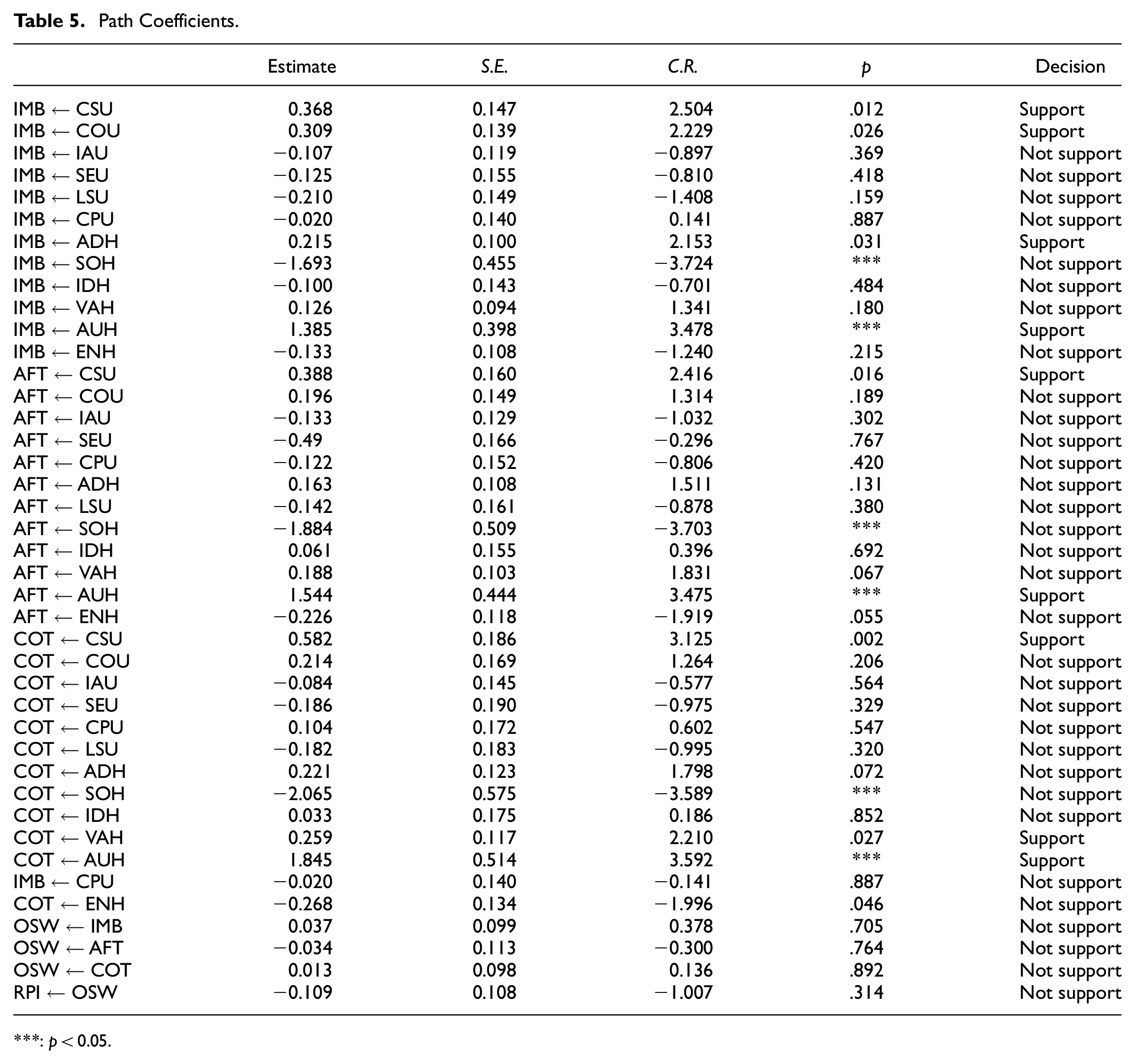
***: p < 0.05.
Hypothesis 1a shows the influence of Utilitarian values on IMB, including
○ The impact of CSU and COU on IMB is accepted because the p-values are .012 and .026 (<.05), respectively.
○ The impact of IAU, SEU, LSU, and CPU on IMB is rejected due to the p-value > .05
Hypothesis 1b shows the influence of Utilitarian values on Customer trust, including
○ For COT, only accept the influence of CSU due to the p-value = .002 (<.005). The remaining factors of Utilitarian values are rejected because the p-value > .05.
○ For AFT, only accept the influence of CSU due to the p-value = .016 (<.005). The remaining factors of Utilitarian values are rejected because the p-value > .05.
Hypothesis 2a shows the influence of Hedonic values on IMB, including
○ The impact of ADH and AUH on IMB is accepted because the p-value is .031 and *** (<.05), respectively.
○ The impact of SOH, IDH, VAH, and ENH on IMB is rejected because the p-value > .05
Hypothesis 2b shows the influence of Utilitarian values on Customer trust, including
○ For COT, only accept the influence of VAH and AUH because the p-value is .027 and *** (<.005), respectively. The remaining factors of Hedonic values are rejected due to the p-value > .05.
○ For AFT, only accept the influence of AUH due to the p-value = *** (<.005). The remaining factors of Hedonic values are rejected due to the p-value > .05.
Hypothesis 3 shows the influence of Customer Trust on OSW, including
○ The impact of COT on OSW is rejected because the p-value > .05
○ The impact of AFT on OSW is rejected because the p-value > .05
Hypothesis 4, showing the influence of IMB on OSW, is rejected because the p-value > .05
Hypothesis 5, showing the influence of OSW on RPI, is rejected because the p-value > .05
Discussion
The study uses the Value-Attitude-Behavior (VAB) framework and the Mehrabian-Russell environmental psychology (M-R) model to investigate the enhancement of repurchase intention on digital platforms, centering on the well-being of the shopping experience through shopping value, trust, and impulsive buying.
Five hypotheses are mentioned in the research and counted from 1 to 5: H1, H2, H3, H4, and H5 (shown in Figure 1). With the factors belonging to the VAB model, in terms of the impact of UV on IMB, the results signified that CSU and COU greatly impact IMB. According to Stern (1962), price significantly impacts impulsive buying. For instance, promotions or the perception of lower prices tend to evoke positive sentiments in consumers, driving them toward impulsive purchasing behavior (Hajipour et al., 2020). From the standpoint of e-commerce shoppers, online shopping offers savings on transportation costs and enables quick product acquisition. Most customers are willing to make a purchase when they believe the perceived value outweighs the costs involved (Nizar Hidayanto et al., 2017). Furthermore, consumers are also likely to stay loyal to the same online store when they perceive its value to be high (L. Y. Wu et al., 2014). Specifically, through food delivery platforms, customers can diminish the sense of waiting time and cut down on transaction expenses, as they no longer need to make expensive phone calls to inquire about their orders (Alalwan, 2020). Besides, the optimization of payment and delivery processes brings convenience to customers when engaging in online shopping, facilitating impulsive buying behavior (Bañares et al, 2020). Moreover, delivery services can also alleviate the challenges individuals face due to busy schedules and demanding environments to provide them convenient access to necessities like food, clothing, furniture, and more (Sharma, 2023). On the other hand, the convenience that delivery platforms bring significantly impacts consumers’ repurchase intentions. Particularly, providing quality delivery services, which include timely and accurate product delivery, highly customizable payment methods like cash on delivery, free return logistics, online tracking of items, and the ability to make changes or cancel orders, will directly influence customers’ repeat purchasing behavior (Ali & Bhasin, 2019 In Vietnam’s dynamic market, distributors and brands often offer enticing promotions when introducing products on e-commerce platforms or online. This strategic tactic appeals to consumers’ desire for savings while helping them manage their shopping budgets wisely. Consequently, this synergistic approach enhances product accessibility and procurement for online retail customers. Regarding the convenience factor, online customers tend to buy goods impulsively if the products sold on e-commerce platforms have significant discounts. Utility will be manifested through features such as easy price comparison, effortless delivery, easy returns, and product visibility. Also, online retail offers numerous smartphone applications, enabling consumers to shop conveniently anytime and anywhere (Sulemana, 2020 Vietnamese online customers can readily initiate product returns when making online purchases.

The general proposed model of the study.
Meanwhile, other UV components, including IAU, SEU, LSU, and CPU, do not support IMB. Due to ingrained shopping habits, Vietnamese consumers meticulously examine product details like origin, expiration date, and usage instructions before purchasing. This behavior stems from a belief that product images and information on online retail platforms lack authenticity and can be misleading. According to a survey by Mesiranta (2009), insufficient product information may lead consumers to abandon purchases. Therefore, they usually think that they have to directly observe and evaluate products to ensure reliability before purchasing. Customers frequently engage in a rational examination of product details before concluding a purchase, emphasizing rational shopping over impulsive buying. During online shopping, as consumers encounter an excessive array of choices, they exhibit a proclivity for comprehensive evaluations (Chan et al., 2017). A diverse range of selections, including various colors, designs, and prices, fosters utilitarian web browsing but dissuades impulsive buying (Johansson, 2019). Hence, the availability of options prompts customers to make more deliberate and informed purchasing choices. Unplanned purchases have become a trend thanks to digital transformation and convenience. From searching for products and evaluating them to purchasing, customers can operate everything through electronic devices like phones and laptops without creating social relationships. Thus, the effect of social connection on impulsive e-commerce buying is insignificant. Even without guidance from salespeople or recommendations from friends or family, impulsive buyers often make emotional purchases. In the Vietnamese e-commerce market, customers who prefer products tailored to their needs invest time studying product information and assessing suitability before buying, making them planned rather than impulsive shoppers. In some instances, customized products may result in “mass customization confusion,” where customers face information overload due to many choices, leading to confusion (Matzler et al., 2011).
Another association relating to UV is the relationship between UV and Consumer trust. The findings show that when CSU affects both AFT and COT belonging to Consumer trust, other components comprising COU, IAU, SEU, CPU, and LSU do not manifest any effect on the two elements of Consumer trust. Within the domain of electronic commerce, trust emerges as a paramount factor, as consumers are compelled to make purchase decisions amid intricate uncertainties (Hong, 2015; Suleman, 2019). According to Punyatoya (2019), both COT and AFT play pivotal roles in fostering customer satisfaction and engendering unwavering loyalty in the context of online retailing. Within the online shopping environment, individuals build cognitive trust by evaluating the reputation of companies, brands, or retailers based on their commitment to promises, authenticity, and consistent reliability (Lim et al., 2006). In the Vietnamese market, customers build cognitive trust by realizing that online shopping can save them money, including transportation and incidental expenses. In essence, when they find online shopping financially more beneficial than offline methods, their trust solidifies. Moreover, affective trust can manifest itself through affective responses. It constitutes an emotional, instinctual, and intuitive experience rooted in an individual’s conviction that a person or entity is indeed reliable (Hansen & Morrow, n.d.). According to Lewis and Weigert (1985), trust is built on both cognitive and emotional foundations, with the emotional aspect complementing the cognitive. Additionally, affective trust hinges on the consideration of whether an individual has derived any personal advantages or benefits from the welfare of another person (McAllister, 1995). Henceforth, purchasing goods and services online at lower costs than offline shopping enhances customers’ emotional trust, and is seen as a profitable and cost-saving experience. This positively influences both the affective and cognitive aspects of online shopping. Internationally, customers strongly favor online shopping for its unmatched convenience.
However, in Vietnam, conveniences such as not having to queue or not spending hours walking around each store looking for the right item are insufficient to make customers fully trust online shopping over their habitual offline shopping. In online shopping, consumers cannot test products or services before purchasing, which may lead to concerns about whether they will meet expectations (Tran & Nguyen, 2022). This lack of opportunity to physically interact with items can cause apprehension and anti-trust among buyers. Among Vietnamese consumers, receiving personalized advice and support while physically engaging with a product in-store fosters emotional and rational trust. Obtaining product or service-related information is an essential step in any shopping process. Research sponsored by Google also discovered that, on average, consumers consult approximately 10.4 information sources prior to making a purchase (Riasanow et al., 2015). Notwithstanding, not every customer possesses the acumen to sift through the myriad types of available product information and identify the most accurate details, especially when shopping online. E-commerce platforms feature abundant information, images, and product reviews, yet discrepancies between descriptions and actual product quality or customer service levels can occur. Providing inaccurate information on these platforms risks eroding not only individual customer trust but also that of the broader customer base. Furthermore, Thanh Nien newspaper reported on the prevalence of issues within the digital space, particularly concerning the sale of counterfeit, substandard products, a lack of transparency regarding pricing and product origins, and other related concerns on various social network platforms (Quân, 2022). Before proceeding with an online purchase, customers usually face numerous choices and evaluations, such as the accuracy of available information, cost comparison, and seller’s credibility. Besides, regarding online transactions, buyers are placed in remote, impersonal environments devoid of face-to-face seller interactions and the opportunity for physical product inspection, thereby elevating the inherent risk associated with such transactions to a considerable degree (Garbarino & Strahilevitz, 2004). Addressing the challenges of overwhelming options and risks is critical for building customer trust. Personalized shopping experiences hinge on collecting sensitive personal data, a concern for customers in the e-marketplace. In Vietnam, people often rely on reviews or real experiences shared by others when making purchasing decisions, leading to a small demand for customized products and services in the online market. Despite the development of online shopping channels, in-store promotions are favored over online channels as they allow consumers to physically interact with products before buying. Also, word-of-mouth recommendations from relatives, friends, and colleagues, along with in-store promotions and holiday discounts, play an important role in purchasing decisions (The Vietnam Consumer Survey An accelerating momentum, 2020). Hence, direct interaction between salespeople and customers is crucial in establishing trust with each customer when they contemplate purchasing a product.
In all the factors within HV, only two factors, AUH and ADH, support IMB, while the remaining factors, SOH, IDH, ENH, and VAH, do not demonstrate an impact on IMB. When it comes to customers’ authority in Internet shopping, it relates to their dominance over technology (P. L. To et al., 2007). With shopping authority in hand, customers have the freedom to shop at any store, at any time, and for any type of product or service. Most notably, when individuals choose online shopping platforms, they’re less influenced by external factors like salespeople or companions present in physical stores. In Vietnam, brick-and-mortar store visits often lead to purchases driven by sales persuasion or discomfort avoidance of lingering in a store without making a purchase. This challenge is significantly alleviated in online shopping environments. Adventure shopping can be viewed as a distinctive form of motivation distinct from routine shopping and is indicative of impulsive buying tendencies (Arnold & Reynolds, 2003). In other words, adventure shopping can be viewed as a distinctive form of motivation distinct from routine shopping and is indicative of impulsive buying tendencies (M. Lee et al., 2013). The adventure dimension implies that consumers discover new and captivating aspects, enjoying the thrill of exploration during their shopping process (Ozen & Engizek, 2014). According to “How Customers Think: Essential Insights into the Mind of the Market” by Gerald Zaltman, the subconscious, primarily driven by emotions, accounts for 95% of our buying motivation (Chierotti, 2018). Particularly in the Vietnamese market, characterized by a constant search for novelty and a penchant for the latest trends, fostering the concept of adventure shopping will catalyze unleashing customers’ latent impulsive buying potential.
While offline shopping necessitates direct interaction between sellers and buyers, the online shopping experience unfolds in a highly personalized manner. Devoid of the physical presence of sellers, friends, relatives, and other factors, customers can fully immerse themselves in the shopping environment, free from external influences or hindrances. In Vietnam, consumers tend to engage in online shopping during specific hours, typically around 12 a.m. and 9 p.m., when they find themselves in solitude within a tranquil setting (News, n.d.). As a result, social interaction during online shopping at these times is relatively minimal, elucidating the absence of an impact of SOH on impulsive buying. There is no relationship between IDH and IB, which shows that Vietnamese people do not buy impulsively because they want to keep up with trends in general and fashion trends in particular. Although emotional factors predominantly drive impulsive shopping, their application to the Vietnamese market does not promote unplanned shopping behaviors. While providing products online with enticing discounts and promotions fosters consumer demand, Vietnamese consumers show limited enthusiasm for these advertising and discount efforts.
Based on the findings, HV also influences Consumer trust through two components, VAH and AUH. Otherwise, ADH, SOH, IDH, and ENH do not show an impact on Consumer trust. Between COT and AFT, VAH just manifests a notable influence solely on COT. In addition to the apparent advantages offered by online shopping, such as time and energy savings, cost efficiency represents one of its hallmark values. Individuals often seek out discount codes, promotions, vouchers, and more while browsing online retailers. As evaluating the credibility and reputation of advertisements on online shopping platforms gradually fosters trust in the seller, supplier, or brand. This trust is cultivated through awareness and an evaluation of the trustworthiness and authenticity of online store users. In terms of AUH, it remarkably affects both AFT and COT. Online shopping activities are inherently conducted on digital platforms, devoid of physical seller presence. Consequently, when customers can effortlessly navigate and oversee their shopping journey, they perceive online shopping websites as exceptionally supportive and accommodating, underscoring a genuine commitment to customer satisfaction. This forms the fundamental basis for cultivating both emotional and cognitive trust among customers.
Trust among Vietnamese online shoppers is primarily vested in VAH and AUH. In contrast, factors such as ADH, SOH, IDH, and ENH do not exert a significant influence on Consumer trust. When it comes to making purchasing decisions, Vietnamese online shoppers tend to place their emphasis on factors like COU, VAH, or AUH. While the notion of adventurousness holds appeal toward online shopping, more is needed to foster customer trust. The essence of adventurous shopping leans toward customers’ excitement for new emotions during purchases. However, to trust a product or service, customers need to spend time researching, evaluating, and using it rationally rather than solely relying on immediate emotions. Besides, Gozukara et al. (2014) also suggested that the value of adventure shopping is primarily influenced by the negative image perceived due to potential risks, which may undermine or even ruin the enjoyable online shopping experience. Similarly, the factor of ENH does not significantly contribute to engendering trust among Vietnamese customers, as trust in online shopping hinges on more pragmatic considerations beyond mere entertainment and relaxation. The limited influence of social shopping value on online customer trust can be attributed to the multifaceted nature of trust-building in the e-commerce landscape. While social shopping aims to harness the power of peer influence and recommendations, online customers often prioritize the authenticity and impartiality of information when assessing trustworthiness. Typically, aligning shopping behavior with fleeting trends tends to be a short-term objective, whereas trust-building is a pursuit that requires a longer-term perspective. Consequently, IDH, often associated with trend-following purchases, may not be a suitable factor for fostering enduring customer trust within the Vietnamese online shopping market.
For the remaining 3 hypotheses, including H3, H4, and H5, the factors do not have a significant influence on each other. The results indicated that IMB does not support OSW. Due to the inherently “unplanned, reflexive, and impulsive” characteristics of impulsive buying (Chan et al., 2017), it carries the potential to introduce unwarranted risks into the online shopping experience. In the circumstance of heedless shopping without due consideration of financial implications, customers may find themselves burdened with substantial financial consequences. For instance, Vietnamese youths frequently engage in unbridled shopping sprees upon receiving their salaries, only to find themselves left with meager funds in the aftermath, necessitating stringent frugality until the next paycheck arrives.
Toward the impact of Consumer trust on OSW, consumer trust in the context of Vietnam primarily centers on the reliability and credibility of online platforms and sellers, whereas online shopping well-being encompasses the broader realm of satisfaction, comfort, and emotional fulfillment during the shopping journey. These two facets, although interrelated, often operate independently, as the overall shopping experience influences well-being. In the diverse landscape of Vietnamese online shoppers, the subjective nature of well-being becomes apparent, varying from person to person based on their unique preferences and experiences. Concerning the influence of OSW on RPI, in this dynamic market, repurchase intention is influenced by a broad spectrum of considerations, extending well beyond the realm of immediate well-being. Vietnamese online shoppers, like consumers worldwide, assess factors such as product quality, pricing competitiveness, convenience, and trust in the e-commerce platform or seller when determining whether to make a repeat purchase. Online shopping well-being typically reflects immediate comfort and satisfaction, but it may not always carry substantial weight in these longer-term decisions. Moreover, well-being is inherently subjective, varying between individuals based on their unique preferences and expectations. Consequently, it is challenging to generalize its impact on repurchase intention. In essence, repurchase decisions in the Vietnamese online market are driven by a multifaceted mix of factors, highlighting the complexity of consumer behavior in this evolving landscape.
Conclusion
In summary, the model has demonstrated the relationship between elements of shopping value on impulsive buying and trust, online shopping well-being, and repurchase intention by conducting a mixed-method approach and surveying the Vietnamese market. The theoretical model significantly impacts gradually going deeper into understanding customer behaviors in terms of their repurchase intention. Particularly, the factors that have a decreasing impact on IMB are AUH, CSU, COU, and ADH. Regarding Customer Trust, the factors with the greatest impact on COT are AUH, followed by AUH on AFT, CSU on COT, CSU on AFT, and VAH on COT.
Recommendation
Grasping the interplay between consumer behavior and online shopping dynamics is fundamental for businesses aiming to thrive in the digital marketplace. The research underscores the pivotal role of enhancing customer experience and fostering repeat purchases through strategic alignment with online shopping values. This approach is imperative for businesses to bolster competitiveness, attract and retain customers, and propel sustained growth in online retail. The following are recommendations for businesses to actualize these goals.
The concept of IMB is intricately linked with UV, especially the aspects of CSU and COU, offering a fertile ground for businesses to cultivate strategies that tap into these consumer motivations. E-commerce platforms can harness the power of limited-time promotions to instigate a sense of urgency among consumers. Countdown timers and real-time notifications highlight the transient nature of cost-saving opportunities, compelling consumers to make swift purchasing decisions. Moreover, strategic product placement within online stores can significantly enhance the visibility and attractiveness of cost-saving deals to impulsive buyers, thereby boosting sales.
Simultaneously, enhancing COU element is equally vital. Simplifying the checkout process and optimizing mobile and website interfaces to facilitate an effortless journey from product selection to purchase completion can remarkably elevate the consumer experience. Incorporating features such as one-click purchasing options and leveraging advanced data analytics for personalized product recommendations can further streamline the purchasing process, directly catering to the impulsive buying tendencies of consumers.
Beyond CSU and COU, the values of ADH and AUH influence on impulsive purchasing behaviors. To engage consumers driven by ADH, online retailers can introduce exclusive and limited-edition products that promise unique and thrilling shopping experiences. Highlighting these items’ exclusivity and scarcity, engaging visual storytelling, and fostering user-generated content can magnify their appeal, enticing consumers to make impulsive purchases.
Similarly, tapping into AUH value requires businesses to create opportunities for consumers to feel part of an exclusive community or attain a sense of status through their purchases. Encouraging product experience sharing and creating platforms for user-generated content can enhance perceived product value, aligning with consumers’ desire for status and authority.
Building AFT in online retail involves transparent communication about promotions, discounts, and pricing strategies. Ensuring that consumers are well-informed about cost-saving opportunities without hidden fees or misleading practices is crucial for fostering trust and loyalty. Responsive customer support, coupled with showcasing positive customer testimonials and reviews, can further cement a foundation of trust, encouraging repeat purchases and long-term customer engagement.
Lastly, the interplay of COT with factors such as CSU, VAH, and AUH presents a multifaceted strategy for businesses to enhance consumer trust and confidence. By emphasizing product guarantees and quality assurance and providing clear and honest communication about product value and pricing, businesses can navigate the complexities of online retailing. Adopting these strategies not only fosters a conducive environment for impulsive buying but also builds a robust framework for customer retention and satisfaction, ultimately driving growth and competitiveness in the online shopping arena.
Limitation
The research evaluates factors’ influence on online shopping well-being and repurchase intention in Vietnam. However, the study encountered certain limitations that need acknowledgment for a comprehensive understanding of the results. With the repurchase intention factor, this study did not explore the influence of different product types on e-commerce. Therefore, recognizing this limitation, future research endeavors aim to address this gap.
Additionally, although there are already related questions and criteria, a crucial aspect, such as nationality, was not considered in the questionnaires. This vital dimension’s absence could impact the study’s applicability across diverse demographic groups. Thus, there will be research directions in the future that include nationality criterion.
Supplemental Material
sj-docx-1-sgo-10.1177_21582440241278454 – Supplemental material for Enhancing Repurchase Intention on Digital Platforms Based on Shopping Well-Being Through Shopping Value, Trust and Impulsive Buying
Supplemental material, sj-docx-1-sgo-10.1177_21582440241278454 for Enhancing Repurchase Intention on Digital Platforms Based on Shopping Well-Being Through Shopping Value, Trust and Impulsive Buying by Trinh Le Tan, Khanh Nguyen Chau Ngoc, Hien Le Thi Thanh, Hoai Nguyen Thi Thu and Uyen Vo Truong Hoang in SAGE Open
Footnotes
Declaration of Conflicting Interests
The author(s) declared no potential conflicts of interest with respect to the research, authorship, and/or publication of this article.
Funding
The author(s) received no financial support for the research, authorship, and/or publication of this article.

Data Availability Statement
Data sharing is not applicable to this article, as no datasets were generated or analyzed during the current study.
Supplemental Material
Supplemental material for this article is available online.
References
Supplementary Material
Please find the following supplemental material available below.
For Open Access articles published under a Creative Commons License, all supplemental material carries the same license as the article it is associated with.
For non-Open Access articles published, all supplemental material carries a non-exclusive license, and permission requests for re-use of supplemental material or any part of supplemental material shall be sent directly to the copyright owner as specified in the copyright notice associated with the article.
