




Abstract
This article explores the association between Internet use and community participation of older adults using data from the China Longitudinal Aging Social Survey (CLASS) in 2016. The empirical results indicate that there is a significant positive association between Internet use and the intention of community participation of older adults. Moreover, mediating effect investigation shows that Internet use promotes the intention of community engagement of the older adults by improving subjective health. The benchmark results are still consistent after addressing the potential endogeneity by employing propensity score matching method. Finally, subsample analysis suggests no significant difference in this positive effect between urban and rural older adults.
Introduction
According to The Seventh National Census in China, the percentage of people over 60 years old has reached 18.70% of the national population. The aging of Chinese society is deteriorating. With the rapid development of the Internet, the number of Chinese netizens had reached 989 million by December 2020. Moreover, Internet penetration has increased to 70.4% from 59.6% in December 2018. The proportion of older adults over 60 using the Internet rose from 6.6% to 11.20%. The Internet in the daily life of the elderly is becoming increasingly important. As a specific group, once people enter old age, it means that they begin to be out of touch with society and even lag the current social development. Now, the Internet has become an indispensable medium for them to keep connected to society, so how to meet the higher level of needs of the elderly is gradually becoming one of the goals of the general concern of society.
In the background of the rapid development of the Internet, how to make full use of information technology to mitigate the negatives effects of aging has been raised to the height of national development strategies. In 2019 China’s State Council issued the National Medium and Long-term Plan for Actively Coping with Population Aging, which proposes a service system based on family and community, combining medical treatment with the pension.
As people grow older, their physical functions begin to deteriorate, and the range of movement is limited. The community is the primary place for older adults to interact with each other and the outside world. Community participation of older adults is a way to achieve further self-worth through life and emotional satisfaction in community participation while being physically healthy. (Gao et al., 2019). With the continuous improvement of economic and material life, older people are no longer content with basic physiological and security needs. Participation in community activities can bring the elderly a higher sense of belonging and respect, even self-fulfillment (Ju & Li, 2020). Internet use can reconfigure the social life of older adults across spatial limitations and actively address the challenges of aging (Jin & Zhao, 2019). Extensive studied have investigated the impact of Internet use on the wellbeing of older adults (Cohall et al., 2011; Moult et al., 2018).
Promoting community participation of older adults is an active response to aging in China. This study will provide an important reference for understanding the relationship between Internet use and community participation of older adults in China. To this end, this article uses data from the 2016 China Longitudinal Aging Social Survey (CLASS) with the older adults as the observation subject. We empirically analyzed the effects and mechanisms of Internet use on community participation of older adults in China.
This study may contribute to relevant literature in several aspects. First, looking into the relationship between Internet use and community participation of older adults, it fills the gaps of previous studies. Second, mediating effect investigation allows us to understand the mechanisms how Internet use affects community participation of older adults. Finally, large sample adopted in this paper guarantees high representativeness of the data and reliability of the study findings.
Literature Review
Research on the impact of Internet use of older adults is increasing as the enhancement of Internet penetration and deepening of aging society, such as physical and mental health, life satisfaction, happiness, and loneliness. It was a well-established fact that Internet use can significantly improve the physical and mental health of older adults (L. J. Wang, 2018; Zhao & Liu, 2020), since older adults have access to more health knowledge and information through the Internet, which improves their physical health. Many older adults tend to view the Internet as a tool for health maintenance (Cohall et al., 2011; Moult et al., 2018). Internet use significantly increases the life satisfaction of older adults (Du & Wang, 2020; Szabo, 2019; Zhou & Wang, 2020), and older adults who use the Internet have a stronger sense of subjective well-being than those who do not (Peng et al., 2019). Loneliness, as an adverse psychological experience that older adults are prone to have a series of negative impacts on their physical and mental health. Some studies have shown that Internet use shows a significant negative correlation with the loneliness of older adults, which means that Internet use among older adults can bring about a significant reduction in individual loneliness (Song et al., 2019). Internet use can help older adults prevent social isolation (Chopik, 2016; Khosravi et al., 2016) and allow older adults to remain socially active (Choi et al., 2014; Hill et al., 2015; Leukel et al., 2017).
In response to the “active aging” policy, community participation of older adults is becoming a focus of aging research. Community participation in a broad sense refers to the intention and behavior of community residents to participate in community activities. Different studies have defined community participation of older adults in different ways, which mainly include three categories: first, according to different perspectives of participation content and social interaction, some scholars classify it into political and non-political community participation (Han, 2021); others directly classify it into political, economic, social, and cultural aspects according to participation content (Xie et al., 2021). Second, they are classified according to participants’ intentions, their own characteristics, and abilities, such as some scholars classify them into active participation and passive participation (Han, 2021); others classify them into collective participation, productive participation, and political participation according to older people’s own social networks and ability to access resources (Bukov et al., 2002; Song et al., 2020). Third, according to the motivation of participation and the sense of belonging to the community, it can be divided into “participation for others” and “participation with personal purpose” (Duan & Zhang, 2008). Community participation of the elderly should pay more attention to the subjective consciousness and objective ability of the elderly, and meet the material and spiritual cultural needs of the elderly when physical conditions allow.
Moreover, many factors affect the community participation of older adults. Some studies have shown that older adults who participate in intergenerational care are more likely to be active in the community (Ma & Lin, 2020; McNamara et al.,2011). It has also been found that intergenerational in dual-earner families significantly reduces the possibility of community participation of older adults (Ho, 2015; C. Wang et al., 2011). In addition, previous research has found that demographic characteristic variables are associated with community participation. These include age (Ponce et al., 2014; Szanton et al., 2015), gender (Shen, 2017; Szanton et al., 2015), education (King et al., 2017), marital status (Bastos et al., 2015), and physical condition (Szanton et al., 2015) had significant effects on the motivation to participate in community activities.
In addition, some studies have paid attention to the relationship between Internet use and community involvement of older adults. Most studies found that information technology leads to greater social engagement in older adults over 60 years old in the United States (Ihm & Hsieh, 2015; Kim et al., 2016). Which showed that IT use among older adults was positively associated with outdoor activity. Advances in information technology have broken the limits of people’s interaction space (Yuan et al., 2019). He and Yan (2022) found that Internet use significantly reduces the probability of both public- and private-benefit community participation among older adults. Moveover, the motivations and patterns of Internet use among older adults affect their community participation behaviors (Baker et al., 2018; Chiu, 2019).
By reviewing the literature on the relationship between Internet use and community participation, we find that scholars are particularly interested in the impact of the Internet on offline communities (Matei, 2001; Putnam, 1995). Early research took a purely technical approach, reflecting two widely divergent perspectives. Based on displacement theory, some scholars argue that Internet use competes with local community activities and that Internet use serves as a substitute for offline community activities, while researchers of the other view argue that the Internet serves as a strong link to fading community relationships (Dutta-Bergman, 2004). Previous studies have emphasized the role of technology and ignored the group differences and drivers of community engagement.
In the context of China’s rapid aging and the increasing popularity of information technology, this paper divides community participation into community participation intentions behavior and community participation behavior, and explores the impact of Internet use on older adults’ community participation from the perspective of their Internet use and further analyzes its impact path.
Data
The data of this study is from the China Longitudinal Aging Social Survey (CLASS) in 2016, which was collected by the China Survey and Data Center and the Institute of Gerontology, Renmin University of China. It is a national social survey that focuses on the health, family status, social background, and economic status of older adults over 60 years old. The questionnaire was designed according to the cognitive level of the elderly and used a stratified multi-stage sampling method. The survey was conducted in 462 residential areas from 134 counties. After deleting the samples with missing values of main variables, this study obtains 11,511 valid samples.
Measurements
Internet use
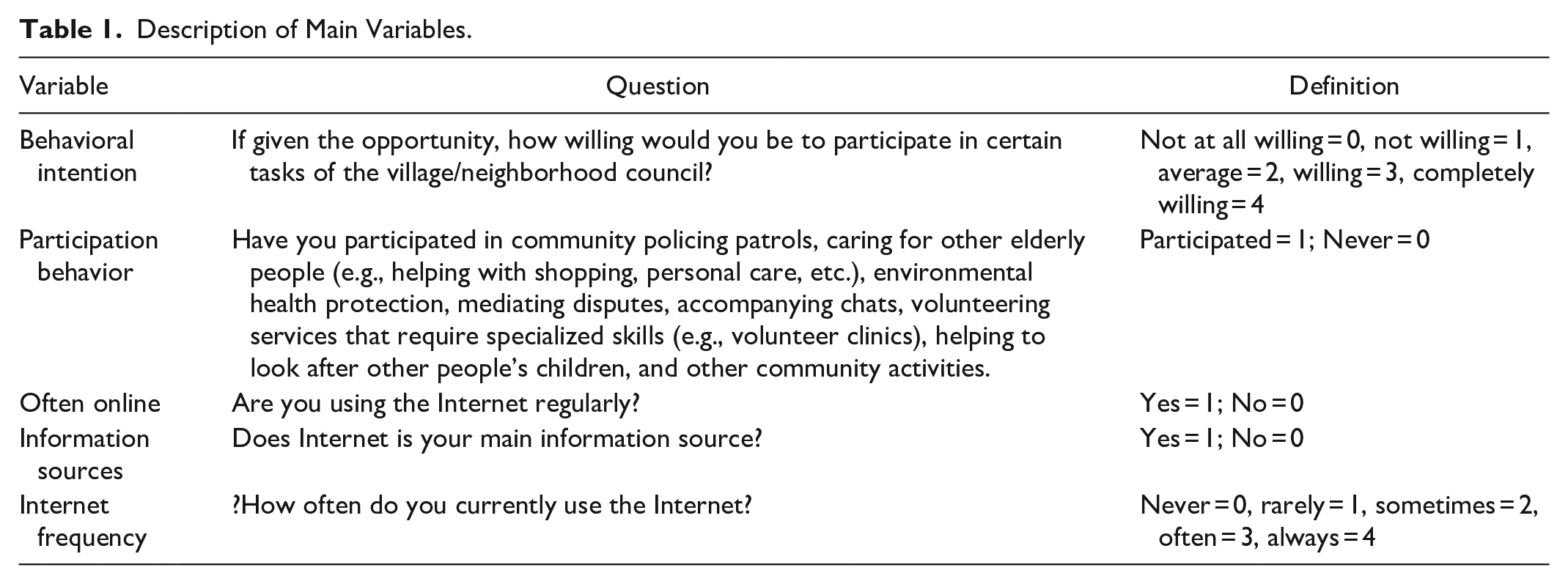
The Internet use of older adults are measure with three indices, whether they access the Internet frequently (Jin & Zhao, 2019), frequency of using the Internet (Leukel et al., 2017), and the Internet as a primary source of information (Schehl, 2020). The frequency of Internet use is to measure the extent to which the older adults use the Internet, which is divided into five categories: never, rarely, sometimes, often, and always, with values from 0 to 4 assigned in increasing order. The rest measures are dummy variables with the values of 1 if answer is “yes,” 0 otherwise.
Community participation
The dependent variable in this study is the community participation of the older adults. It is measured by the subjective intention and objective ability of the older adult. Therefore, community participation is defined as the intention to participate in the community and the actual participation in the community behavior, respectively.
The intention to participate in the community is selects based on the answers to the following question in the questionnaire: “If given the opportunity, how willing would you be to participate in certain tasks of the village/neighborhood council?” Which was divided into five categories: not at all willing, not willing, average, willing, and completely willing. In addition, the questionnaire defined the question on community participation behaviors as follows: “Have participated in community policing patrols, caring for other elderly people (e.g., helping with shopping, personal care, etc.), environmental health protection, mediating disputes, accompanying chats, volunteering services that require specialized skills (e.g., volunteer clinics), helping to look after other people’s children, and other community activities.” The researcher identified older adults who had participated in any one or more of these as community participation behaviors. Table 1 presents the specific descriptions of the core variables in this article.
Description of Main Variables.
Controls
There are known studies that have shown that the marital status, education, asset, and residence type of older adults can directly or indirectly affect the enthusiasm of community participation (Lin, 2016). Therefore, the above factors are controlled in this paper. Specifically, the age is calculated by the year of birth of the elderly. Gender was defined as female or male. Education was measured by asking older adults about their highest level of education. This question provided six specific options (illiterate, private school/literacy class, elementary school, middle school, high school/junior college, college, and above). The numerical value increases with the education level. Based on the answers received, researchers grouped the married respondents into one category and the others into one; the type of residence of the older adults into urban and rural; family size refers to the number of family members who live with the respondents regularly (eat to live together, including themselves).
Specification
To summarize, the community participation of the older adults studied in this paper is divided into community participation behavioral intention and community participation behavior, which are ordered variables and binary variables, respectively. So, the multiple ordered Probit regression model is selected as the benchmark regression model to analyze the community participation behavioral intention of the older adults; To test the influence of Internet use on community participation behavior, using a logit model for regression. The basic form of the ordered Probit model is as follows.


Where,
Binary selection model specification. This

Results
Descriptive Statistics
Respondents are all over 60 years old. Excluding the missing values of core variables and invalid data such as “don’t know” and “refused to answer” in the questionnaire, the final valid number of samples remained was 8,856. Among them, the older adults who used the Internet in the past 3 months accounted for 16.32% of the sample. In this survey, older adults who had participated in community activities account for 10.9% of the sample, which means that the older adults have a low community participation rate. However, the average value of the respondents’ intention to participate in the community is higher than the numerical mean value, indicating the phenomenon of “high willingness and low participation,” which is consistent with the existing research conclusions (Xie, 2017). About control variables, the average age was 70.20 (standard deviation (SD) = 7.557). The sample is balanced in terms of gender. About 62.74% of respondents living in urban and married respondents accounted for 71.6% of the sample. The specific data are shown in Table 2.
Summary Statistics(N = 8,856).

Benchmark Results
Intention for community participates of older adults
Table 3 reports the regression results using the intention of older adults to participate in the community as the dependent variable. The coefficients of the proxy variables for Internet use are all significantly positive at the 1% level, which means that Internet use can improve the intention of the older adult to participate in the community. Older adults using the Internet regularly are more willing to participate in the community than those who do not. A unit increase in the frequency of Internet use leads to the increase of the intention of the old adults to engage in the community by 17.7%. Older adults who use the Internet as the primary source of information are 50.5% more strongly motivated to participate in their communities than other older adults.
The Impact of Internet Use on Community Participates Intention (Oprobit).

Note. Standard errors in parentheses.
p < .1. **p < .05. ***p < .01.
Concerning control variables, education is one of the important factors affecting the community participation of older adults. The coefficients for education indicate a positive promotion of community participation of older adults at the 1% level, implying that the higher the level of education of the elderly, the stronger the willingness to participate in the community. Education can affect older adults’ understanding of community institutions and norms and change their intentions and behaviors to participate in the community (Cong et al., 2020).
community participates behaviors of older adults
Table 4 shows the influence of Internet use on the community participation behavior of older adults. Often online and Internet frequency significantly stimulated the older adults to participate in community activities at the 1% level. The Information source was significantly positive at the 5% level. Overall, the use of the Internet has significantly increased the probability of community participation of older adults. However, many factors need to be considered for older adults to participate in community activities, such as physical condition, family support, and schedule. Therefore, the phenomenon of “high willingness, low participation” has emerged in some areas of China (Xie, 2020).
The Impact of Internet Use on Community Participates Behaviors (Logit).

Note. Standard errors in parentheses.
p < .1. **p < .05. ***p < .01.
Regarding control variables, the coefficient of the Residence Types shows that older adults living in urban are significantly more likely to participate in community activities than those living in rural. According to the statistics of the survey data in this paper, only 38.76% of the rural older adults live in communities with places or facilities such as elderly activity rooms, fitness rooms, chess, and card (mahjong) rooms, libraries, or outdoor activity venues. However, 72.86% of older adults in urban life in communities with these places. In contrast, the coefficient for household size is significantly negative, which suggests that older adults in larger households are less likely to participate in community activities.
Robustness Tests
To avoid the effects of endogenous problems and ensuring the reliability of results on the impact of Internet use on community participation of older adults. The study employs propensity score matching (PSM) to test the robustness of the benchmark regression. The propensity score matching method is a reasonable comparison of the experimental and control groups through a counterfactual inference model that eliminates confounding factors between the groups.
The treatment variable for PSM is “whether to use the Internet.” We set the older adults who used the Internet as the treatment group, while those who do not use the Internet were the control group. Also, the outcome variable is “the community participation behavior.” When the treatment group matches one or more individuals with similar characteristics in the control group, the difference in community participation behavior between the two groups is the Average Treatment Effect on the Treated (ATT) as reflected by the treatment event. We obtain ATT by three methods: four-nearest-neighbor matching, caliper matching, and kernel matching.
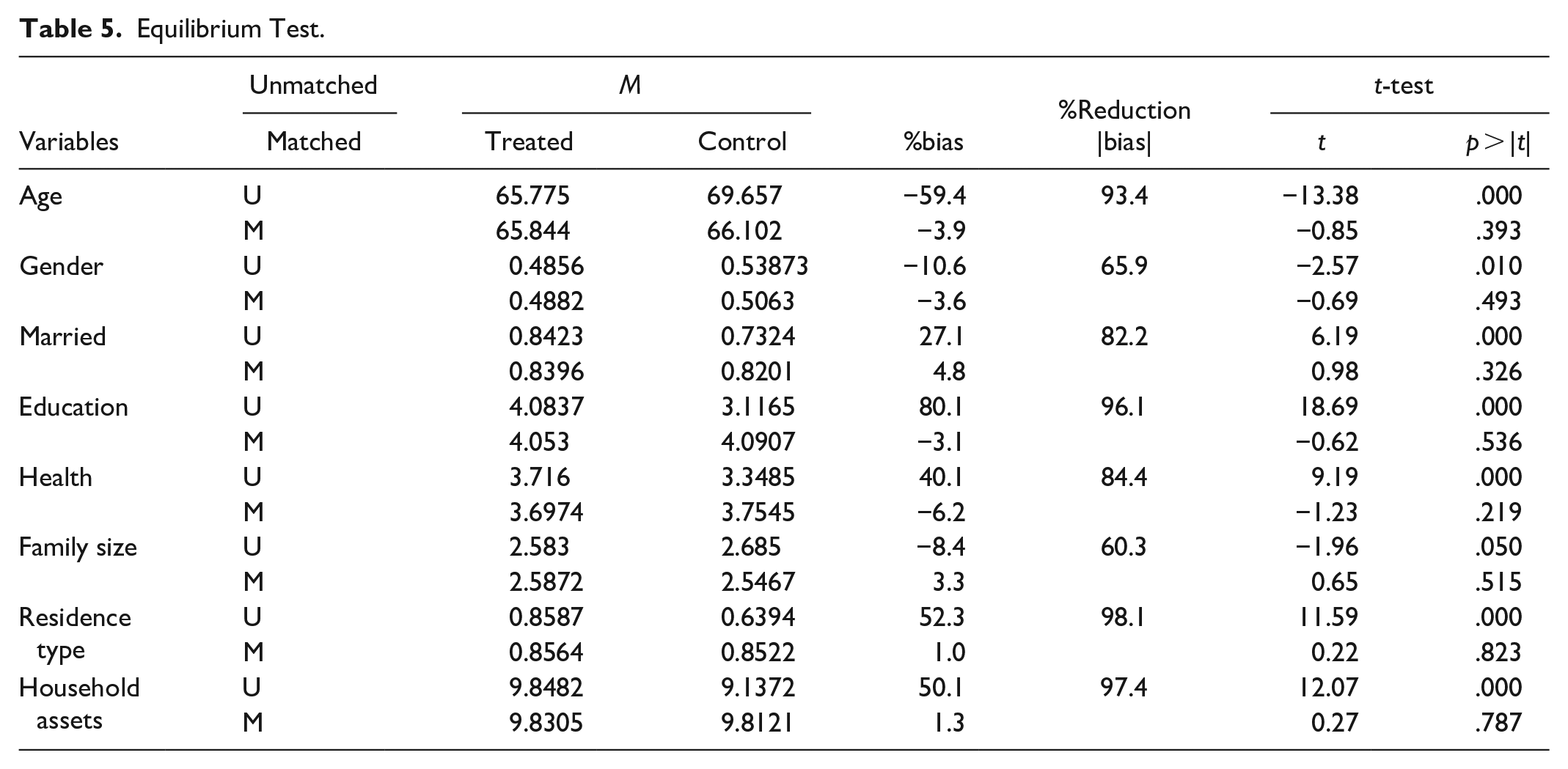
As shown in Table 5, the t-test results after matching are not significant. Moreover, the standardized %bias is less than 10% after matching. That implies that passing the balance test and meet the basic requirements of Propensity Score Matching. Figure 1 displays the change in standardized %bias of the variables before and after matching. Compared with the before matching, the standardized %bias of the variables after matching is significantly smaller.
Equilibrium Test.

Standardized deviation of each variable before and after matching.
Table 6 reflects the propensity score matching the results of the treatment effect. When sample selection bias is eliminated for the control and treatment groups, ATT derived from the three methods are 0.145, 0.141, and 0.143. The signs and significance of the regression coefficients obtained based on different matching methodology converge, indicating that the results are highly robust. That suggests a real and significant positive effect of Internet use on the community participation of older adults.
Regression Results of PSM.

Note. Standard errors in parentheses. Bootstrap has a sample number of 300.
p < .1. **p < .05. ***p < .01.
Mechanism analysis
We explored and validated the impact of Internet use on community participation of older adults. Next, this section will discuss how does Internet use contributes to community participation. Previous studies have shown that Internet use improves the health condition of older adults (Hunsaker & Hargittai, 2018; L. J. Wang, 2018). In addition, considering that community participation behavior is based on physical status, older adults who are healthier are more likely to participate in community activities (Szanton et al., 2015). Thus, we attempted to demonstrate that the health of older adults mediates the impact of Internet use on community participation.
To test whether subjective health is the medium of Internet use affecting the community participation of older adults. This study selects subjective health as the mediating variable, which is classified as “very unhealthy, relatively unhealthy, average, relatively healthy, and very healthy.” It is important to emphasize that path


Where,
Figure 2 presents the regression results of the mediating effects. We can find that path
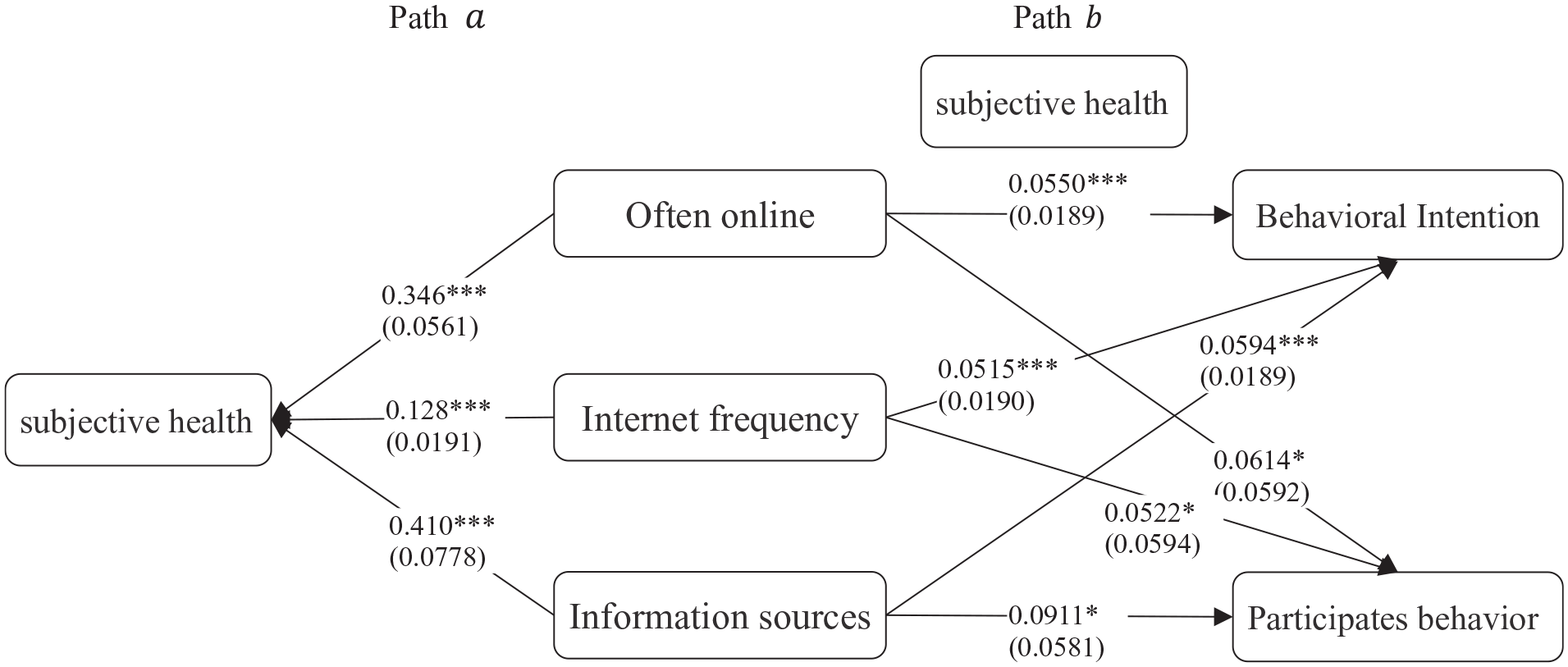
The results of mediation effect.
Impact of Internet Use on Community Participation of Older Adults in Urban and Rural
In China, urban neighborhoods and rural neighborhoods are usually identified from the perspective of geographical division. Given the differences of community identity between urban and rural elderly. We explored the impact of Internet use on community participation for urban and rural older adults using data from a nationwide sample of older adults, respectively.
As shown in Table 7, Internet use can significantly enhance the willingness of urban and rural elderly to participate in the community. Specifically, the regression coefficient of Information sources is significant in urban, but not in rural, which means that the Internet as the primary source of information has no impact on the rural elderly. This finding is consistent with the previous study. (Schehl, 2020). Older adults living in rural neighborhoods have a stronger sense of community (Kitchen et al., 2012). A smaller range of activities depends more on their traditional sources of information, such as neighborhood interaction and information networks of friends and family.
Impact Results on Intention to Participate in the Community by Residence Type (Oprobit).

Note. Standard errors in parentheses. Control variables are controlled.
p < .1. **p < .05. ***p < .01
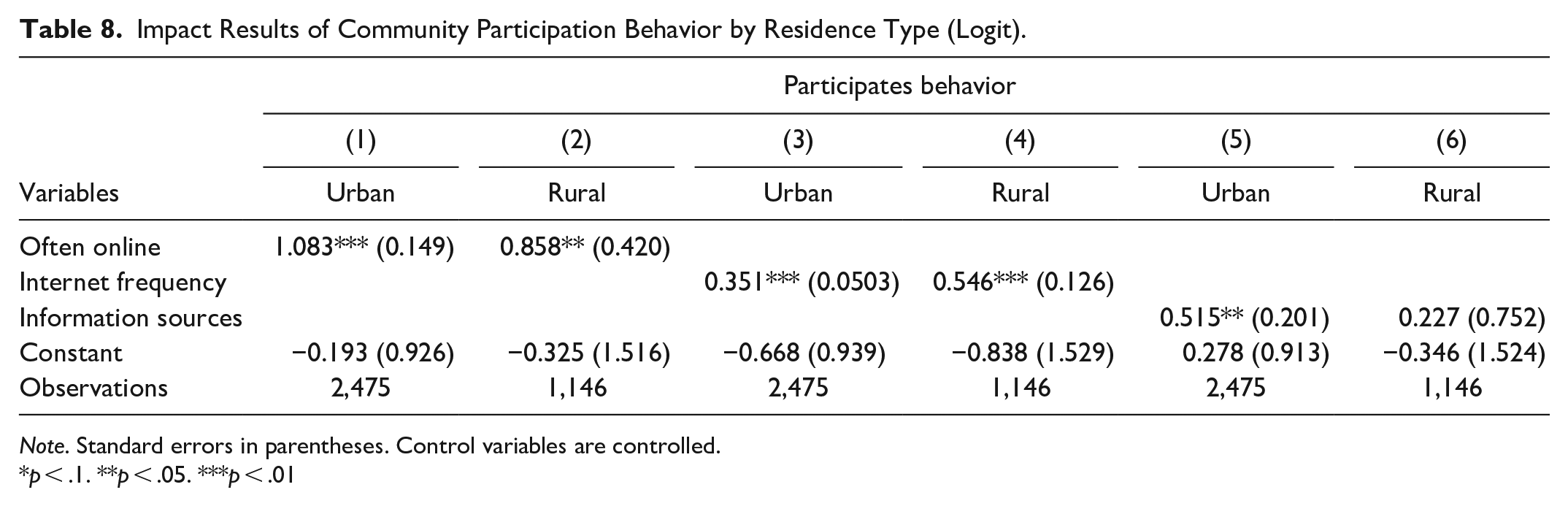
Table 8 presents the results of community participation behavior of older adults in urban and rural. There is less variation in the impact of Internet use on the community participation behavior of older adults. Taking a closer look at the influence of Internet use on the urban elderly community participation behavior is more significant. Compared with Internet information sources, the rural elderly is more dependent on traditional information sources (Xu & Huang, 2021). On the other hand, the rural people must farm and cultivate to take up the time for community participation. The form and platform of rural community activities lack some standardization compared to urban communities. However, rural neighborhoods’ close degree is high, more convenient to carry out community activities.
Impact Results of Community Participation Behavior by Residence Type (Logit).
Note. Standard errors in parentheses. Control variables are controlled.
p < .1. **p < .05. ***p < .01
Conclusion
This study explores the impact of Internet use on the community participation of older adults. We use the ordering model and the discrete choice model to verify this idea based on the 2016 China Longitudinal Aging Social Survey (CLASS). In addition, this paper further discussed the robustness test, mechanism analysis, and heterogeneity test. Which effectively enriches the understanding of the existing research on the Internet and community participation of older adults.
The empirical findings are summarized as follows. First, the association between Internet use and older adults’ intention to participate in the community and their actual participation in the community was positive and significant. After addressing the endogeneity problem, and the benchmark results are still consistent. Furthermore, Internet use can improve the subjective health of the elderly and further promote community participation, which verifies the mediating role of subjective health in the process of Internet use affecting the community participation of the old adults. Finally, there is no significant difference in the impact of Internet use on the community participation of older adults in urban and rural.
The findings of this paper are of some practical significance, the researcher makes several policy recommendations based on the empirical results. First, companies should design smart devices that are portable and easy to operate to meet the needs of the elderly to access the Internet and use it. Second, the government can subsidize seniors when they purchase smart devices. Third, the government should organize volunteers to help the elderly learn to use smart devices such as cell phones. Finally, government departments need to further improve community service systems and policies to provide opportunities and platforms for seniors to engage in community participation.
This study has some limitations and needs to be improved in the following aspects. First, since changes in older adults’ behavior are a long-term and continuous occurrence, panel data are beneficial to obtain results that would be more convincing. What’s more, because of the limitations of the questionnaire, the researcher was unable to explore the specific effects of Internet use on different motivations and domains of community participation of older adults.
Footnotes
Declaration of Conflicting Interests
The author(s) declared no potential conflicts of interest with respect to the research, authorship, and/or publication of this article.
Funding
The author(s) received no financial support for the research, authorship, and/or publication of this article.
