




Abstract
Skill shortages along with changes in employee demographics have required that employers reconsider hitherto undifferentiated retention strategies in favor of a more targeted approach that accounts for precisely which total reward factors induce retention among talented employees. One notable gap in corresponding research is insufficient empirical data regarding the impact of employees’ generation on the relation between total rewards and retention. This article addresses existed gab(s) in the literature by exploring how total rewards—categorized into extrinsic, intrinsic, and social rewards—influence retention among two distinct groups in today’s labor force, Generation X and Generation Y, via surveys conducted among schoolteachers in Jordan. A total of 250 copies of structured questionnaire were administered to the high school teachers in the eastern areas of Jordan, while partial least squares structural equation modeling (PLS-SEM) was employed for the model analysis, and multigroup analysis was conducted to determine the moderating effects of generations. Findings revealed that no statistically significant difference in terms of the total rewards–employee retention relationship exists between the two generations. For both generations, extrinsic rewards had a significant impact on retention, while social rewards had none. Intrinsic rewards proved effective among Generation Y though not Generation X employees although the difference was minimal. Ultimately, in recruiting and managing employees of both generations in Jordan’s education sector, the results of this study indicate that employers should channel their resources primarily into providing attractive extrinsic rewards.
Introduction
Essentially, this study aims to contribute to the ongoing discussion of how organizations can deploy employee retention as a strategic approach in retaining the best among its employees. Retention of talent—notably that of the most knowledgeable and highly qualified—is critical to organizations. Such employees are considered as an organization’s key resource; the caliber of a firm’s human capital is widely recognized as a key determining factor of organizational performance (Maamari & Alameh, 2016; Mandhanya, 2015; Taamneh et al., 2018). They, furthermore, represent the often significant time, money, and organizational knowledge that have been invested in their development within the organization. The recent trend in the technological changes that are happening in most workplaces has enabled the shifting of organization focus of attention to retaining the knowledgeable staff in their firm to meet the changing need of the society.
Within the literature, there is much evidence testifying to the importance of total rewards—that is to say, the totality of the various forms of compensation offered/provided by an employer—in securing an employee’s will to remain in his or her job (e.g., Akhtar et al., 2015; Alhmoud & Rjoub, 2019; Makhuzeni & Barkhuizen, 2015) and in motivating him or her to deliver optimal performance therein (e.g., Armstrong & Brown, 2006; Milkovich & Newman, 2008). Notably, however, there is no consensus as to which of the three types of reward (extrinsic, intrinsic, or social) is most effective in terms of retention (Akhtar et al., 2015; Newman & Sheikh, 2012). While Morgan et al. (2013) argue in favor of extrinsic rewards having the greatest impact, numerous others (e.g., Armstrong & Murlis, 2004; Chen & Hsieh, 2006; Gibson & Tesone, 2001; Milkovich & Newman, 2008; Muralidharan & Sundararaman, 2011; Zahra et al., 2013; Zingheim & Schuster, 2007) offer evidence of intrinsic rewards being the stronger determinant.
Various studies have further highlighted that research into the relationship between rewards and retention should not fail to consider how demographic factors among recipient employees might modify that relationship (Codrington, 2008; Schlechter et al., 2015; Snelgar et al., 2013). Indeed, scholars have explored gender (e.g., Ingersoll, 2001; Luekens et al., 2004), age (e.g., Borman & Dowling, 2008), level of professional experience (Kavanaugh et al., 2006), and marital status (Crawley, 2005), with interesting results. One such factor that has so far not been exhaustively investigated in terms of empirical research is generation. Whereas, for an organization to identify and implement a human resources strategy such as employee retention that will be successful, the managers need to understand the compensation value differences among the generations (old and young), most especially in this current ever-evolving workplace.
According to generational theories, the generation to which any given individual belongs has an influence on individual’s perception of his or her context (Ajzen, 1991). A recent study by Zaharee et al. (2018) posited that the differences between millennial (Generation Y) and earlier generations (Generation X) in terms of workplace preferences are exaggerated. But, Fryer et al. (2019) opined that for an employer to engage in employee retention as a strategy there is a need for the understanding of the attitudes, commitment, and motivations of these varying generations because they are not consistent with those attributes at the workplace. Thus, the impact of contextual factors such as extrinsic rewards on an individual’s behavior could be modified by that individual’s generational identity. The basis of this study is thus the claim that the effectiveness of total rewards depends in part on the generational characteristics of the employees in receipt of these rewards as well as the nature and objective value of the latter (Calk & Patrick, 2017; Twenge et al., 2010). Thus, one might consider that generational characteristics contribute to how an individual perceives and values these rewards.
Meanwhile, retention is not only a challenge for profit-oriented organizations but also nonprofit-oriented organizations like schools. This sector is also facing the challenge of retaining capable and competent staff. Akhtar et al. (2015) observed that the internationalization of education has made the educational sector to be competitive and as such schools are in a run for skilled staff with attractive reward package. In reference to Khalid et al. (2012), the significance of educational institutions as a source of knowledge and awareness production within a country cannot be overemphasized. Literature suggests that academic staffs are more interested in their intrinsic satisfaction than extrinsic (Akhtar et al., 2015), but Dvorak and Phillips (2001) emphasized that both extrinsic and intrinsic satisfaction determines the satisfaction of academic staff.
This study investigates the moderating effect of generations on the relationship between total rewards and employee retention in the high schools of Jordan. Jordan is an economically developing country that relies heavily on human capital prepared by educational institutions. Presently, educational institutions (private and public) are competing. In this situation, the enhancement of the prestige and ranking of the institution will depend on having competent, qualified, and skilled staff. The competition, however, among the educational institutions and other related sectors on attracting and retaining qualified staff has been a challenge. The study of Müller et al. (2009) suggests that achieving employee retention will require an understanding of the behavior and attitude of the employee. Unfortunately, studies concerning the education sector in developing countries is very scant especially in Jordan. Thus, this article is aimed to bridge the gap by investigating and discussing the total rewards and employee retention in educational institutions in Jordan considering the moderation effect of generation.
This study contributes to the literature by empirically developing the dimension of total reward strategies that are effective in attracting and retaining current and future intakes of talent. First, we shed light on generation as a moderating factor in the relationship between total rewards and employee retention. Second, we did so in the context of Jordan, an economically developing country located in the Middle East, and a context that is relatively unknown in the literature on employee retention and total rewards. Finally, this is the first systematic analysis of the effectiveness of total rewards on employees from Generation Y, the generation predicted to comprise three quarters of the global workforce by 2025 (Ernst & Young, 2015).
Literature Review
Employee retention is becoming a great challenge to most of the organization. The available jobs with high compensation and a conducive working environment that is suitable for career development are pushing organizations to have a review of their employee retaining strategies. Some previous research claimed that successful firms share a fundamental philosophy of appreciating and investing in their employees (Nwokocha & Iherirohanma, 2012). Among the few notable past efforts in describing retention was that of Frank et al. (2004) that defined retention as “an effort by an employer to keep desirable employees to meet organizational objectives” (p. 13). In a similar vein, the study of Chiboiwa et al. (2010) provides a more detailed definition and suggests that it is a strategy to prevent the leaving of proficient employees. As a result of the higher economic value of human capital to an organization, which is regarded as high worth productive assets (Ejiofor & Mbachu, 2001), it has been agreed in the literature that employee retention strategies are very significant to an organization because a well-trained and experienced workers are important to the achievement of organization objectives (Akhtar et al., 2015). Aside the cost required to train another employee as a result of employee turnover, and the vacuum of knowledge and skills that will be created (Kyndt et al., 2009), Gentry et al. (2007) posited that switching of the job by talented employees could lead to employees’ performance, morale, and productivity in an organization. Meanwhile, several factors have been highlighted in the literature as measures that an organization could adopt to ensure retention of its talented employees (Akhtar et al., 2015; Zingheim & Schuster, 2008), but Allen (2008) observed that employers are still searching for the easy way of establishing employee commitment and successfully achieve their retention.
Today’s business world is characterized by high competition for talent. In response, many organizations are investing significant resources in their efforts to attract and retain valuable human capital. As firms attempt to equal and outdo their competitors in the war for talent, generous rewards systems along with work environments that enable and encourage career development are becoming increasingly common (Milkovich & Newman, 2008). Social exchange theory claims that employee satisfaction, together with the various rewards or compensation received from their organization, will engender organizational commitment among those employees (Haar & Spell, 2004). Thus, a total rewards approach to retention has the potential to be particularly profitable.
Total rewards are a concept that covers all tangible and intangible forms of compensation received by employees as a result of their employment (Malhotra et al., 2007). The objective of establishing a total rewards system is ultimately to attract and retain talent; however, besides motivating employees to remain with the organization, there is also evidence that such a system also positively affects employee performance (Bergmann & Scarpello, 2002; Gross & Friedman, 2004). Research into total rewards identifies three main categories of reward: extrinsic, intrinsic, and social (Morgan et al., 2013; Twenge et al., 2010; Williamson et al., 2009). Extrinsic rewards refer to the tangible and mostly financial benefits of a job such as salary, bonuses, and pay rises (Malhotra et al., 2007; Morgan et al., 2013). Intrinsic rewards are intangible rewards such as satisfaction in achieving job tasks that depend, for example, on the meaningfulness of job tasks and the individual’s opportunity for input into those tasks (Morgan et al., 2013). Social rewards relate to those generated by positive relationships with colleagues, supervisors, and clients within the workplace (Twenge et al., 2010; Williamson et al., 2009). Besides, Cao et al. (2013) opined that for an organization to align the total rewards with the need of employees, the organization must adopt total rewards as a compensation strategy for retaining proficient employees.
While the concept of rewarding employees by diverse means to improve their commitment, performance, and retention has long been acknowledged in both theory and practice, the question of how to design and implement rewards systems that are effective in achieving these results remains one that generates a substantial quantity of research. Incorporating into the design process the identification of the workforce’s specific characteristics and needs has now become a more common idea. As mentioned above, many researchers have investigated the impact of various demographic characteristics among employees on the effectiveness of rewards. Throughout these studies, however, one element that remains somewhat not exhaustively investigated in terms of empirical evidence is the impact of generational differences among employees on the effectiveness of total rewards on employee retention.
Organizations across the world are currently facing the imminent retirement of a whole generation of older workers, and thus, their replacement with younger employees becomes imperative (Twenge et al., 2010). To survive this transition—to successfully attract, recruit, and retain the top talents in this younger workforce—organizations must develop an approach to determine which of the total rewards system is appealing to and satisfies this younger generation whose values may well diverge from those of their predecessors. Acknowledging the gap in the extant literature, this article thus intends to investigate the moderating effect of generational differences in the relationship between total rewards and employee retention in the particular context of educational institutions in Jordan.
According to Huh and Chang (2017), the current global workforce can be divided into four generational categories: the Silent Generation (born 1925–1945), baby boomers (born 1946–1964), Generation X (born 1965–1979), and Generation Y (also known as Millennials,; born 1980–2000). In terms of needs, habits, behavior, mind-set, expectations, skill sets, culture, and motivation, each generation is distinct (Calk & Patrick, 2017; Twenge et al., 2010). Generation Y, for example, has (certainly in Western contexts) grown up with far greater access to high-speed technology, the internet, social media, and higher education opportunities than their predecessors, all of which bears influence on the various characteristics mentioned above.
Today’s labor market predominantly consists of individuals from Generations X and Y, the latter taking up an increasingly large proportion. It has been estimated that by 2018 Generation Y employees will represent almost 39 million workers worldwide, which is to say 50% thereof (Meister & Willyerd, 2010; Toossi, 2009). In 2016, Deloitte recorded generational divisions in the U.S. workforce were calculated as follows: 32.0% Generation Y, 31.2% Generation X, 30.6% baby boomers, and 6.2% Silent Generation. Given that Generations X and Y constitute the two largest segments of the workforce, these are the two groups on which the present study is focused.
Organizations in general and human resource (HR) managers, in particular, have much to gain from developing their understanding of the different generational identity traits, most especially aspects such as work-related values and motivation as well as workplace preferences. Such awareness will enable firms to organize job tasks and responsibilities, establish the working environment, and design HR strategies such as total rewards systems in such a way that they effectively attract, manage, and retain individuals from the specific generation(s) targeted. It is important to state and restate that those values that the older generation, now in managerial positions, held in their youth are not necessarily the same as those espoused by the youth now joining today’s workforce. Organizations, specifically the people responsible for recruitment and retention, need to continuously and actively consider who their target employees are and what they want from a job. Successful total rewards systems will thus match the traits identified as defining the specific workforce demographic targeted.
The Table 1 was developed by Martin and Ottemann (2016) based on their literature review and presents the predominant work-related values exhibited by employees belonging to Generations X and Y.
Strongest Held Work-Related Values for Generation X and Generation Y.

Source. Martin and Ottemann (2016).
As it is evident from Table 1, there are distinctive work-related values identified as belonging to each generation, as well as values common to both generations. The extent to which these different values between generations might warrant differentiated reward practices is the question posed by Martin and Ottemann (2016). Twenge et al.’s (2010) study measured how Generations X and Y value different types of rewards. Their findings reveal slight differences between the generations. Extrinsic, intrinsic, and social rewards were all valued higher by Generation X than by Generation Y; yet, extrinsic and intrinsic rewards were nonetheless considered important by Generation Y, while social rewards were indicated as being of less significance. Other empirical studies that have compared the effectiveness of different types of rewards on employee behavior (including their intention to remain with their organization) between Generations X and Y have yielded interesting findings. Bussin and Van Rooy (2014), for example, present further evidence of differences in rewards preferences between generations.
However, despite the insights that such studies have given into different values and preferences for rewards between generations, there remains limited empirical data to support theoretical assumptions regarding the difference that generation makes as a factor influencing how total rewards can determine employee retention. More empirical data are still needed to contribute to a more complete picture that will respond to Martin and Ottemann’s (2016) question as to the extent to which generational differences in work-related values warrant differentiated reward schemes, specifically in terms of increased retention rates, hence, the primary motivation behind the current study. Furthermore, no research on this topic has yet been conducted in Jordan, an economically developing country wherein brain drain and high turnover in general risk long-term effects in the context of the education sector as regards the quality of education and educational foundations of the country’s future generations. This study thus contributes to the literature by extending the academic perspective on this subject to a relatively unknown context.
Hypotheses Development
There is a divergent view by the previous studies on the relationship between total rewards and employee retention (Akhtar et al., 2015). For instance, Stone et al. (2010) found that in most times, financial compensations are not welcomed by most of the employees and also the materials rewards do not generally tend to satisfy their basic psychological needs and discern the individual variability, and similarly, Hill and Tande established that larger percentage of high skilled employees leave the organization not as a result of financial compensation, but as a result of unhappiness with management, lack of recognition, and other reasons. However, the study of WorldatWork (2007) posited that a larger percentage of employees considered compensation and benefits as a significant factor in retaining them with the firm. Thus, the mixed results in the literature is an indication that different dimensions of total rewards need to be explored to understand the contribution of each of the dimension of total rewards to the employees’ retention.
Extrinsic rewards including payment, bonuses, and promotion have long been acknowledged as representing the principal motivators for human beings to work. Despite the tendency of organizational theory today to focus on other types of rewards (Brett & Stroh, 2003; Ryan & Deci, 2000), the importance of extrinsic rewards in recruitment remain undeniable. The appreciation for extrinsic rewards is likely to be affected by the particular circumstances through which each generation has lived. Generations that have experienced economic difficulties, for example, may well value financial compensation more highly than others. More generally, the value sets of different generations diverge. Today’s younger generations, for instance, have been identified as more materialistic and individualistic (e.g., Dey et al., 1992). There is a common assumption that Generation X held a particular concern for extrinsic rewards from work as a result of declining social security and high inflation in terms of the cost of living. Generation Y, however, has been cited as having a greater interest in work that is stimulating than work that pays highly (e.g., Center for Women and Business [CWB], 2011; Lancaster & Stillman, 2003). This may be consequential to a general perspective that life is about more than simply earning money, a viewpoint possibly derived from seeing parents spend more time and energy at work than at home. Nonetheless, today’s youth are seeking work in an economically challenging context wherein the greater demand for higher education (International Labor Organization, 2007), greater costs of higher education (The College Board, 2005) and subsequently greater student debt (Scherschel & Behmyer, 1997), and households’ need for a dual-income are likely to increase the importance of the extrinsic rewards of a job. Research has not so far addressed a direct comparison between the effects of extrinsic rewards on employee retention of different generations. Heeding the above, this study will test the following hypothesis:
Intrinsic rewards elicit a motivation to work for the sake of the work itself as opposed to material or other forms of compensation. Thus, a job that interests and challenges the employee, provides variety and responsibility in its tasks, allows the employee to see the outcome of his or her efforts, and wields a positive impact on other people can be defined as one that is intrinsically rewarding (Deci & Ryan, 2000). A number of studies indicate that both Generations X and Y value work that is meaningful (Arnett, 2004; Lancaster & Stillman, 2003; Tulgan, 2003, 2009) HR management trends suggest that organizations believe this to be the case given the emphasis placed on individual career development in recruitment and HR management processes. Many organizations make great efforts to offer their employees training opportunities designed not simply to develop the base-line skills required for the job, but rather to assist the individual employee in pursuing his or her ultimate potential. There has furthermore been a widespread increase in policies that focus on enhancing individual employee autonomy and developing mechanisms to enable inclusive participatory decision-making, both developments feeding into the intrinsic value of a job. To date, little of the extant literature directly addresses the impact of intrinsic rewards on employees of different generations in terms of retention. Twenge’s (2006) study, claiming that Generation Y demonstrates greater individualism and more positivity in their views of self, might support the argument that Generation Y is likely to value jobs that are interesting and meaningful. However, there is little in the research upon which to firmly base the following hypothesis, which will be tested precisely to unearth evidence of any impact generational differences have on the relationship between intrinsic rewards and retention:
In terms of social rewards, it essentially elicits a positive sense of belonging and connection with others. Such rewards ultimately fall into the broader category of intrinsic rewards; Baumeister and Leary (1995), for example, explicitly identify an individual’s need to belong or to feel connected as an element of intrinsic motivation. In terms of generational traits as regards social values, there is a limited amount of research currently available. Twenge (2001) claims that Generation X tends to be a more extraverted generation; Twenge and Im (2007) add that they are less inclined to seek social endorsement than baby boomers. Generation Y, despite growing up in the era of online social networking, has been reported as having less and weaker social relationships than their predecessors (e.g., McPherson et al., 2006). Accumulatively, the literature that exists does not offer a strong case for either Generation X or Y valuing social rewards more than the other, and no study has yet directly explored how social rewards affect retention comparatively among employees from the two generations. In the context of this gap, the following hypothesis is proposed:
Method
Measures
This study intends to investigate how generation impacts the relationship between total rewards and employee retention within the context of Jordan’s education sector. A survey instrument was devised comprising 56 items, all of which have proven reliable and valid as measurement tools in relevant research (see Appendix). Extrinsic rewards were assessed using six different variables (financial rewards, employer insurance, promotion opportunity, organizational support for education and training, supervisor support of career development, and having a reasonable workload), which, together, consisted of 22 items, all adopted from Morgan et al. (2013). Four variables measured intrinsic rewards (supervisor support in job tasks, opportunity to have input into defining job tasks, the meaningfulness of job tasks, and coworker support). In total, 26 items, again adopted from Morgan et al. (2013), were included in these four variables. Social rewards were accounted for using two items taken from Twenge et al. (2010). Employee retention was measured using four items applied in Kehoe and Wright’s (2013) study. For all items, responses were taken by way of a 5-point Likert-type scale (1 = strongly disagree; 5 = strongly agree).
Participants and Procedure
Data were collected from the high school teachers from educational institutions in the east of Jordan. They constituted the study’s population. The record of education authority in East Jordan shows the number of teachers within the region to be about 700. Therefore, following Gill et al. (2010), that recommends 248 samples with a 95% confidence level for such population size; thus, 250 samples were adopted for this study. Subsequently, 10 institutions were randomly selected and 25 questionnaires were administered in each of these institutions. The questionnaires were distributed to 25 individuals in each of the institutions using a convenience sampling method. Follow-up reminders were sent to those who did not respond within the requested period to maximize the rate of response. The final rate was 74.4%, with 186 questionnaires recovered.
Demographic details of the total number of respondents are presented in Table 2. Over half of the respondents (53%) were male. A significant majority was married with a percentage of 76.9%. Most respondents (over 82%) held a bachelor’s degree. In terms of professional experience, 20.4% had less than 5 years, 26.9% had over 15 years, and the remaining respondents had 5 to 15 years. Over half of respondents (52.2%) were from Generation X, while the remaining respondents (45.2%) were from Generation Y. Less than 3% of respondents were baby boomers and they were excluded from the final analysis. Therefore, Generations X and Y were taken into account.
Demographic Variables of Respondents.

Data Analysis
The hypotheses of this study were tested by way of variance-based structural equation modeling with partial least squares (PLS). Compared with alternative methodologies, PLS is a particularly effective tool for conducting multigroup analysis, especially in the case of violation of some multivariate assumptions (Hair et al., 2014; Sarstedt et al., 2011). It is not necessary to have a large sample to evaluate complex models, multigroup analyses, and interaction effects (Elrehail et al., 2018; Garson, 2016; Hair et al., 2014). PLS was thus considered the most appropriate approach for this study.
The three stages of data analysis were conducted. First, the measurement model was assessed for both samples (Generation X and Generation Y) to confirm its validity and reliability. Second, a measurement invariance analysis was performed to ensure that the measurement model was invariant across both Generations X and Y. This step is important to ascertain that any differences between group-specific model estimations derive in fact from the latent variables being measured rather than from other distinctive elements between Generations X and Y (Henseler et al., 2016); it ensures that results attained from this measurement model are valid. Third, a comparison was made of the various path coefficients for Generation X and Generation Y by way of PLS multigroup analysis (Sarstedt et al., 2011).
To achieve the first step, the reliability, convergent validity, and discriminate validity of all first-order constructs for both generation samples were estimated. Reliability was measured according to Cronbach’s alpha, values of which should equal or exceed .7 (Hair et al., 2011), and the composite reliability of the constructs. Convergent validity was evaluated based on an estimation of the average variance extracted (AVE) for each construct, which must be larger than .50 (Fornell & Larcker, 1981). Discriminant validity was assessed by estimating the square root of the AVE values, which must be greater than all inter-construct correlations. Tables 3 to 5 present the results of the measurement model’s quality assessment. As can be seen, comparable results emerged for the two samples. In both, composite reliability and Cronbach’s alpha were measured at .7 or above, which indicates that the constructs are reliable. Convergent validity was sufficiently demonstrated by AVE values higher than .50 in both samples, as was discriminant validity by the square root of each construct’s AVE being more than correlations with other constructs. Thus, the measurement model for both samples was proven to be adequately valid and reliable.
Reliability and Convergent Validity.

Note. CR = composite reliability; AVE = average variance extracted.
Discriminant Validity: The Square Root of AVE (Generation X and Generation Y Samples).

Note. AVE = average variance extracted.
Bold values indicate that the item loading in their corresponding columns are all higher than the loading of the items used to measure the other constructs.
Permutation Test for Compositional Invariance.

To achieve the second step, analyzing measurement invariance for both Generation X and Generation Y samples, we applied the measurement invariance of composite models (MICOM) procedure as recommended by Henseler et al. (2016). This involves the measurement of three distinct elements: configural invariance, compositional invariance, and equality between composite mean values and variances that are connected hierarchically. To ascertain configure invariance, latent constructs must be identically specified and parameterized across all groups. This was the case for the latent constructs in the models for both Generation X and Generation Y groups where structure, data treatment, and algorithm criteria were affirmed as being equal. To substantiate the compositional invariance according to Garson (2016), “scores created by the indicator weights for the observed groups should correlate perfectly with scores created by the indicator weights vectors for pooled data” (p. 186). Compositional invariance indicates similar results across all groups of reducing indicator variables into composites. In this study, a permutation procedure (Henseler et al., 2016) was employed. The results are displayed in Table 5. The results confirm compositional invariance for all first-order constructs, for which none of the original correlation values are significantly different from 1 (permutation p-values > .05 and <.95). Full measurement invariance, signifying equality between composite mean values and variances, was not assessed as this study aimed to examine any disparity between the two target generations, not to amalgamate the data (Sarstedt et al., 2011). Having proven the compositional measurement invariance for the measurement model, comparing the coefficients between the two groups (Generation X and Generation Y) is confirmed as meaningful.
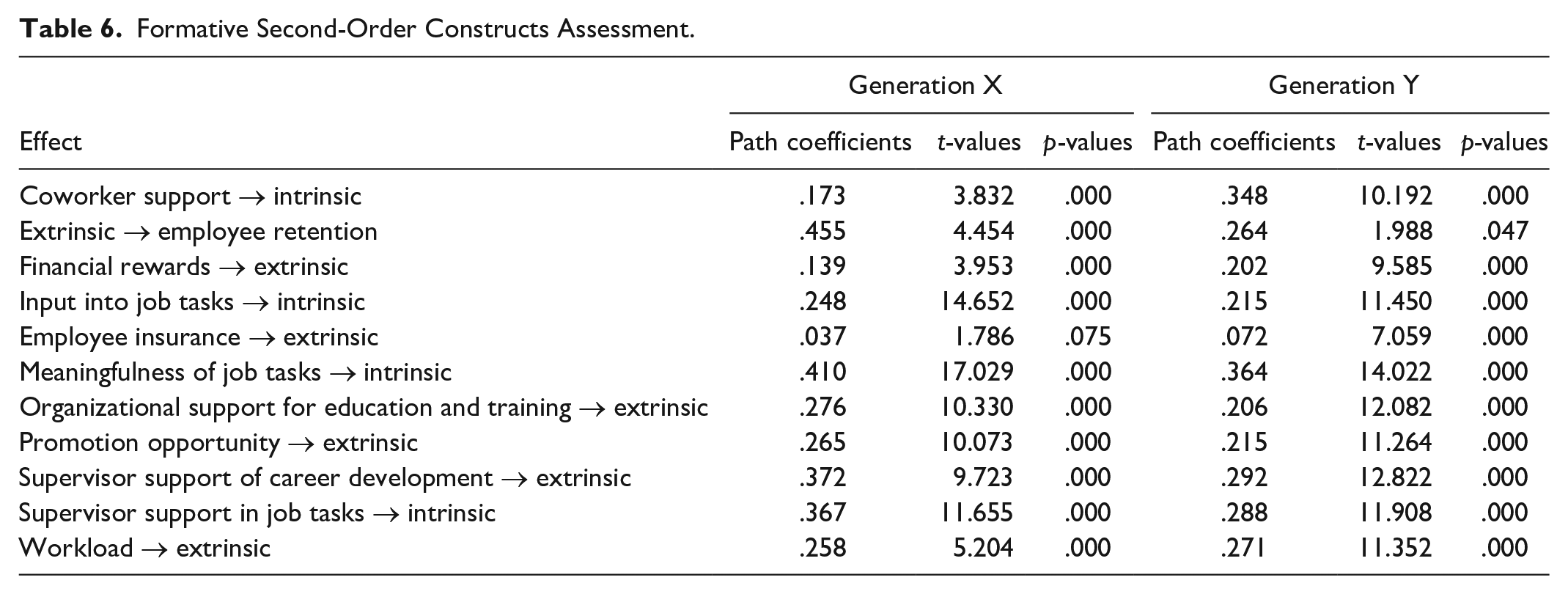
In line with Morgan et al. (2013), intrinsic and extrinsic rewards were constructed as reflective–formative second-order constructs. Therefore, before testing the hypotheses, we assessed the psychometric properties for these constructs to ensure that the first-order constructs weighed adequately as per their postulated second-order constructs (Alsaad et al., 2015; Becker et al., 2012; Garson, 2016). As is evident in Table 7, all first-order constructs demonstrated significant path coefficients and thus weighed sufficiently and significantly on their postulated second-order constructs, thereby affirming the conceptual value of extrinsic and intrinsic rewards as reflective–formative second-order constructs.
Formative Second-Order Constructs Assessment.
Path Coefficients Estimation and PLS Multigroup Analysis Comparison.

Note. PLS = partial least squares.
Subsequently, the path coefficients of extrinsic and social rewards were measured across both generation groups. PLS multigroup analysis was used to ascertain any significant difference in coefficient values between Generation X and Generation Y. Table 7 shows the results of both the path coefficient estimation and PLS multigroup analysis. According to these results, extrinsic rewards have a positive and significant effect on employee retention among individuals in both Generation X (path coefficient = .455, p < .001) and Generation Y (path coefficient = .264, p < .05). Based on the multigroup analysis, the difference between the path coefficients representing the effect of extrinsic rewards on retention for the two-generational groups was not significant (path coefficients difference = .91, p > .05 and <.95). Hypothesis 1 is thus rejected.
In terms of intrinsic rewards, their effect on employee retention was not found to be significant for Generation X (path coefficient = .24, p > .05) but was significant for Generation Y (path coefficient = .308, p < .05). However, this difference in the effect of intrinsic rewards on retention between the two generations was proven not statistically significant according to the multigroup analysis (path coefficients difference = .068, p > .05 and <.95). Hypothesis 2 is consequently rejected.
The effect of social rewards on employee retention was shown to be significant for neither Generation X (path coefficient = .028, p > .05) nor Generation Y (path coefficient = .203, p > .05). Once again, the path coefficient difference between Generations X and Y in terms of the effect social rewards have on employee retention is not significant (path coefficients difference = .174, p < .05 and <.95). Hypothesis 3 is therefore also rejected.
Meanwhile, to ensure the robustness of the study, other demographic variables such as gender, educational level, and years of experience were controlled for in the study. The results as presented in Table 8 reveal that only intrinsic rewards were found to statistically significant influence the retention of the employee (.412*), while social and extrinsic rewards’ influence on employee retention was found not to be significant. As for differencing the marital status, the result as shown in Table 8 reveals that either married or single do not significantly mediate the influence of the three dimensions of rewards on employee retention. Meanwhile, the level of education (those with Bachelor and below were categorized as low and those with Masters and above as high educational level), as shown from the result presented in Table 8, significantly mediates the perception of employees on the relationship between extrinsic (.721**) and intrinsic rewards (.60*) with employees retention. However, the years of experience was found to have significant influence on the relationship between all the three dimensions of rewards (extrinsic, intrinsic, and social) and employee retention.
Path Coefficients Estimation and PLS Multigroup Analysis Comparison (Gender, Marital Status, Educational Level, and Years of Experience).

Note. PLS = partial least squares.
and ** denote 5% and 1% confidence levels, respectively.
Discussion
Voices in both academia and social commentary have laid claims that specific sets of work values define different generations. This article intended to investigate how such generational differences might affect the respective relationships between various types of organizational rewards (extrinsic, intrinsic, and social) and employee retention. Contrary to the proposed hypothesis relating to extrinsic rewards, the study results demonstrate no difference between Generation X and Generation Y: For both, the effect of extrinsic rewards on employee retention emerged as positive and significant. Much prior research has offered evidence of the importance of extrinsic rewards in employee management in general and in retention in particular (e.g., Akhtar et al., 2015; Morgan et al., 2013), even as a primary factor in minimizing turnover (Morgan et al., 2013; Twenge et al., 2010). Specifically, in Jordan and in the teaching profession, institutions struggle very much to retain teachers who can often be tempted to seek more financially lucrative teaching positions in the Gulf countries. The extrinsic rewards of salary and financial benefits are of great significance in such a context. The lack of generational difference in terms of the impact of extrinsic rewards on retention diverges from several other studies based on empirical data (e.g., CWB, 2011; Twenge, 2010; Twenge et al., 2010), wherein Generation X was found to place greater value on extrinsic rewards. However, Muthu and Yee’s (2011) study of three-generational groups in Malaysia testifies to the common importance of salary across all groups in terms of values and expectations. The results of this study could be explained by Jordan’s economic and political context.
Concerning intrinsic rewards, results for Generation X indicate no significant effect on employee retention, while those for Generation Y suggest the opposite. However, statistically, the difference in the values ascribed to this effect in the two-generational groups is not considered significant. Some extant research has put forward the argument that younger generations are interested in seeking meaningful work (e.g., Arnett, 2004; Lancaster & Stillman, 2003). The CWB’s survey on work values and expectations supported the above, suggesting that Generation Y value intrinsic job satisfaction over financial compensation in that they favor useful work experience over rising ranks, making a positive difference over gaining professional acknowledgment, and enjoying a positive working environment over salary (Henderson, 2012). Thus, the greater impact among Generation Y as compared with Generation X of intrinsic rewards in terms of improving retention is in line with several other research conclusions.
In terms of social rewards, results showed no significant effect on employee retention for either Generation X or Generation Y. There was minimal discrepancy between results for the two groups. This latter result contrasts with the findings of studies such as Twenge et al.’s (2010), in which Generation Y considered social rewards less valuable than did Generation X. Twenge et al. (2010) suggest that their results may be an indication of Generation Y’s tendencies to rely on modern technology to maintain social connections that they do not look for in the workplace. Their study was however conducted in the United States, a country wherein social culture follows very different patterns to those in Jordan. In the latter, social connections are—and have traditionally always been—largely built on strong family networks that perhaps do not necessitate seeking social rewards from work.
Indeed, the particular context of this research may explain the insignificant relationship between social, even intrinsic rewards, and employee retention. Jordan is currently facing limited employment opportunities, a high presence of refugees, worsening economic circumstances, as well as regional political instability and lack of security. Such factors are likely to have reduced, for people of all generations, the importance of any compensation beyond financial rewards, which ultimately enable people to survive and feed their families. Hence, possibly, the weak connection between a comprehensive total rewards approach and retention. The lack of jobs and high rates of unemployment may also be an indirect cause for retention, rendering employees keen to keep their current job even if its intrinsic rewards are poor simply to maintain a source of income amid the dearth of alternative options.
Although the generational differences were not significant for the three dimensions of rewards relationship with employee retention and while extrinsic reward influence positively the employee retention for Generation X, intrinsic reward was found to be significantly influencing employee retention for Generation Y. Thus, adequate attention should be paid to intrinsic reward in the Jordanian educational institutions because the generation involved comprises the largest population of the workforce of any sector. Also, the significant mediating role of educational level as it affects the relationship between extrinsic and intrinsic reward relationship with employee retention is an indication that the management of the educational institutions in Jordan should try to address the needs of all employees in terms of providing them with continuous feedback, ensuring transparency and engaging them with motivation.
Conclusion
There is much literature arguing that recognizing how generational groups differ from each other enables organizations to develop strategies that successfully meet the various needs of a diverse workforce, thus engendering greater commitment among employees and increasing the chances of the organization retaining its valuable talent. However, the findings of this study show that in this particular context of the educational sector in Jordan, the differences between Generation X and Generation Y—the two largest cohorts in today’s global workforce—in terms of the total rewards–retention relationship are minimal. The extrinsic rewards are ultimately the most influential rewards in terms of determining employee retention across both generations, while social rewards have no substantial impact on either. Intrinsic rewards are valued marginally more among Generation Y than Generation X workers.
Implications
Educational institutions in Jordan would benefit from acknowledging the needs and values indicated in this study to be held by the men and women employed in this sector. Careful, targeted recruiting and management techniques that take these into account are likely useful in limiting disappointment and ultimately turnover among staff. Given that extrinsic rewards have a greater impact on retention than social and even intrinsic rewards, organizations’ resources are therefore best directed toward meeting employees’ needs for good financial and professional compensation and perhaps exploring intrinsic rewards for the younger generation of workers.
Limitations and Future Research
The fact that this research was conducted among employees within one particular sector (education) and in the specific country context of Jordan means that their generalizability is limited. Replications of this study in different sectors or even geographical areas within Jordan would undoubtedly be valuable to complement the results of this study and offer an opportunity to consider the implications of Jordan’s particular political, economic, and sociocultural status on the relationship between total rewards and retention. For this latter reason, it may also be interesting to compare the findings of this study with the findings drawn from other researches in other developing countries with similar political, economic, and sociocultural characteristics so as to explore the effect of these contextual factors on the total rewards–employee retention relationship concerning Generations X and Y and other demographic variables.
Footnotes
Appendix

| Type of rewards | Variables | Construct measurement | SD | D | N | A | SA |
|---|---|---|---|---|---|---|---|
| Extrinsic rewards | Financial rewards | – The pay is good. | |||||
| – The job security is good. | |||||||
| – Your fringe benefits are good. | |||||||
| Employer insurance | – Respondent has health insurance that is either partially or fully paid by the employer. | ||||||
| Promotion opportunity | – There are opportunities for promotion with my employer. | ||||||
| – This job is a stepping stone to other better-paying jobs with my employer. | |||||||
| – If I complete education programs or degrees, I will be promoted within this employer. | |||||||
| Organizational support for education and training | – I am encouraged to take formal training or classes relevant to my job. | ||||||
| – My employer helps me to acquire or improve my skills while at work. | |||||||
| – My employer provides opportunities for teachers to improve their math, reading or English as second language skills. | |||||||
| Supervisor support of career development | – My supervisor helps me identify career opportunities. | ||||||
| – My supervisor advocates for me for wage increases or promotions. | |||||||
| – My supervisor helps me identify educational opportunities. | |||||||
| – My supervisor teaches me new skills through examples at work. | |||||||
| – My supervisor creates a learning environment at work. | |||||||
| Workload | – There is not enough time to get the required work done. | ||||||
| – I never seem to have enough time to get everything done on my job. | |||||||
| – It is difficult to take off of work for personal or family matters. | |||||||
| – This job just wears me out. | |||||||
| – The client load is too high. | |||||||
| – You do your best and sometimes your best is not good enough. | |||||||
| – You have to be physically strong to do this job. | |||||||
| Intrinsic rewards | Supervisor support of job tasks | – My supervisor treats me as an equal member of the school team. | |||||
| – My supervisor listens carefully to my observations and opinions. | |||||||
| – My supervisor gives me credit for my contributions. | |||||||
| – My supervisor respects my ability to observe and report. | |||||||
| – My supervisor lets me know how helpful my observations are. | |||||||
| – My supervisor trusts me to do a good job. | |||||||
| – My supervisor helps me with job tasks when help is needed. | |||||||
| Input into job tasks | – You are given the chance to do the things you do best. | ||||||
| – You can see the results of your work. | |||||||
| – It is basically my own responsibility to decide how my job gets done. | |||||||
| – I have a lot of say about what happens in my job. | |||||||
| – I generally have opportunities for creative input and innovation in my work. | |||||||
| Meaning of job tasks | – We treat clients like family. | ||||||
| – My clients give me a reason to return to work each day. | |||||||
| – We care about the job we do. | |||||||
| – I spend time just listening to the clients I care for. | |||||||
| – I treat clients like I would like to be treated. | |||||||
| – I know what my clients want and need. | |||||||
| – It upsets me to return after being off to find my clients not well cared for. | |||||||
| – I try to keep the clients’ routines in place when caring for them. | |||||||
| Coworker support | – Some teachers act hostile toward clients. | ||||||
| – Sometimes our teachers take out their bad days on the clients. | |||||||
| – Some teachers here do not show up for work. | |||||||
| – Teachers from the previous shift often leave some of their work for me to do. | |||||||
| – Some teachers here don’t want to be around clients. | |||||||
| – Some of the teachers are clock-watchers. | |||||||
| – Some of the teachers I work with are troublemakers. | |||||||
| – Some teachers do the least work they can do. | |||||||
| Social rewards | – A job that gives you a chance to make friends. | ||||||
| – A job that permits contact with a lot of people. | |||||||
| Independent variable: Employee retention | Intend to stay | – I would turn down a job with more pay to stay with the school. | |||||
| – I plan to spend my career at school. | |||||||
| – I intend to stay at school for at least the next 12 months. | |||||||
| – I do not plan to look for a job outside of this school in the next 6 months. |
Declaration of Conflicting Interests
The author(s) declared no potential conflicts of interest with respect to the research, authorship, and/or publication of this article.
Funding
The author(s) received no financial support for the research, authorship, and/or publication of this article.
