




Abstract
Increasing trend of the burden of household water management is exemplified by recent literature as the effect of climate change on women. The current study explores a gender role in household water management in the context of climate change in the Melamchi watershed area of Nepal. The study shows that decreasing water volume compounded with the geographical proximity of water sources determines workload women have to bear regarding distance cover, time spent, and frequency for water collection. Search for new water sources is potential risk perceived by women, whereas scarcity of household water is the apparent perceived risk at the community level. Climate change effect is gradual and hence perceived as less important over other immediate problems by individual and community. Sensitization over awareness at individual, household, and community level is hence indispensable attitudinal and motivational capacity for climate change adaptation to increasing water stress borne by women.
Keywords
Introduction
Nepal is highly vulnerable to climate change and variability according to findings of Nepal National Adaptation Programme of Action, NAPA report (Ministry of Environment, 2010). The report showed a significant increase in mean annual rainfall based on 30 years rainfall trend. A recent study in Melamchi valley of the country shows that variability in temperature rose up to 10.5% over a 20-year period of 1978-1999 (Sujakhu et al., 2016). Climate change and variability observed in the mountains include irregular rainfall pattern, the early arrival of the monsoon, longer drying period, and droughts with negative impacts on agriculture, livelihood, and water security (Gentle & Maraseni, 2012). The temporal variability of monsoon rainfall has affected the daily life of people (Bartlett, Bharati, Pant, Hosterman, & McCornick, 2010). It is anticipated that climate change will most critically impact the hydrological system, water sources, and water-dependent human activities in coming years (International Water Management Institute [IWMI], 2012; National Research Council, 2012). Climate change will affect water sources, access to water, and quantity, escalating the vulnerability of rural people (Dhakal, Silwal, & Khanal, 2010). Natural spring water is the major source of household water use in the hill and mountain areas of Nepal. Exploration of household water use and management becomes an important research area in climate change context.
The discourse on gender roles, needs, and capabilities to manage, access, and control over water is becoming a nuanced understanding of water gender research interface in the context of developing countries. The dynamic relationship between women and nature is outlined through feminist environmentalism, eco-feminism, and feminist political ecology and issues regarding women and water have emerged at international forums over recent decades (Shah & Kulkarni, 2008). The different gender roles and activities affect the environment (including changing climate) differently and have a different impact on gender. The response of and coping to the environment also differ from short-term to long-term adaptation (Ongoro & Ogara, 2012). Water availability and access condition, perception, and experiences on climate change are imperative in addressing and minimizing the risk of climate change at the local level. In this context, the present study is designed to produce an understanding of gender roles and responsibilities in household water management in the context of climate change specifically in selected villages of Melamchi watershed of Nepal.
Methods and Materials
Climate change is the result of both climatic and nonclimatic drivers of change. Climatic drivers primarily include distribution pattern of temperature and rainfall, while nonclimatic drivers (influencing factors) include demographic, socioeconomic, technological changes, and human activities and lifestyle changes which have a strong impact on the water resource and water systems (Jiménez Cisneros et al., 2014). The present study has adopted an integrated approach pertaining to biophysical and sociocultural aspects from a gender perspective to explore both climatic and nonclimatic drivers of climate change in the Melamchi watershed area. Four villages of Melamchi watershed area of Nepal are selected for the study (Figure 1). The watershed is selected as a study area because it lies within one of the largest interbasin water transfer project area, Melamchi Water Supply Project (MWSP), which aims to bring water to Kathmandu Valley (KV) from water sources outside the valley to fulfill the water demand of the capital city region.

Location of Study area.
Study Area
The study area is comprised of four villages of Melamchi Watershed area namely, Baruwa, Bhotang, Helambu, and Kiwool located in Sindhupalchok district of Nepal. Melamchi, Yangri, and Larke are the three major rivers flowing from the north, which confluent to Indrawati River. The elevation of the study area ranges from 900 to 6,100 m resulting in varying temperature and rainfall regimes. The climate varies from subtropical to arctic type, within 40 km south–north range so as biophysical and socioeconomic characteristics. Barren land with rugged terrain and snow in the winter covers more than 40% of the study area. Natural forest covers 31% area and shrubs and bushes cover 18% of the total area. Agriculture is confined to 8% of the total area. More than 50%, of the northern part of the study area, falls in Langtang National Park. Most of the settlements are located on the southern, middle, and lower slopes. According to population census 2011, the total population of four villages is 9,927 among which male population (5,065) slightly outnumbers female population (4,862). Spatial distribution of the population is variable within the study area. Baruwa village at the higher elevation has the lowest population density with 13 people per km2 and Kiwool at the lower elevation has the highest density with 113 persons per km2 (Figure 2). The population density in the study area has decreased by seven persons between the decade of 2001 to 2011 (Central Bureau of Statistics [CBS], 2014). This decrease in population density is attributed to the increasing outflow of migrant workers from the country and is a prominent factor influencing the spatial distribution of the population.

Population density in Melamchi watershed area.
Methods
The study has adopted a mixed method of qualitative and quantitative approaches. Sociophysical research tools were used for required data and information collection. Global Positioning System (GPS) survey of water sources was carried out to collect information on the status and accessibility of household water sources. Field observation, household questionnaire survey, focus group discussions (FGDs), key informant interviews (KIIs), informal discussion, and literature review are key tools used for household information collection. Daily activity profile and capacity and vulnerability matrix were applied as standard gender analysis tools.
A GPS survey of natural springs was conducted during the dry season (April/May 2016) to locate and measure the water discharge. A checklist was prepared to collect information on location and types of spring, the physiographic condition, and water availability.
Household questionnaire survey using Quota sampling method was carried out for sociocultural context analysis on water use, access, and management. Total of 269 households was surveyed comprising 10% of the total respondents from four villages. Among the total respondents, 54% were male and 46% were female. FGDs were conducted in eight different communities (two in each village) with a mixed group of 12 to 15 people. The group consisted 55% female and 45% male, with a total of 120 participants. FGD was conducted on historical spring source condition and water volume, source management practices, water scarcity problem, and vulnerability. Likewise, six key informants from each village (total of 24 KII) were interviewed which included teachers, village secretaries, governmental officials, and elderly people to explore perceived and experienced climate change effect on water.
Results
Sociocultural Characteristics
The current section explores the nonclimatic drivers of climate change in the study area which are regarded as important indicators for context analysis. It includes culture-ethnicity, literacy, primary occupation, food sufficiency, and land holding.
The ethnicity of the study area demonstrates a distinct geographical and cultural pattern. Two distinct cultural-ethnic groups are found in the study area, namely, Tibetan-Mongolian ethnic group (Tamang, Hyolmo, Bhote, and Sherpa) in the higher elevation area and Indo-Aryan ethnic group (Brahmin/Chhetri including Dalit) in the lower elevation area (Dahal, 2014). The dominant ethnic group in the study area is Tibetan-Mongolian ethnic group which constitutes 85% of the total population. It is followed by Indo-Aryan ethnic group with 15 %. Spatial distribution exhibit that Hyolmo population is dominant in Helambu (85.6 %) and Tamang population is dominant in Bhotang (94 %) and Baruwa (81.9 %). Kiwool is the only village which comprises a mixed ethnic group. Cultural diversity is also found in household water use. Out of total household water use, water for drinking purpose (22%) is highest as compared with cooking, cleaning, washing, sanitation, and livestock feeding among Tibetan-Mongolian group, whereas it is lowest (9%) among Indo-Aryan group. This variation is due to the cultural practice of drinking of Tibetan tea and brewing Alcohol among Tibetan-Mongolian group, whereas Indo-Aryan group does not follow such culture.
An overall literacy rate of the study area (47.2 %) is far lower than the national average of 65.9% (CBS, 2014). The average female literacy rate is 41.2% as compared with a male literacy rate of 52.3%. Ethnically, Tamang has the lowest literacy rate of only 42%, while geographically, Bhotang and Baruwa has the lowest female literacy rate with 34.5%. The lowest literacy rate in these two villages may be attributed to the dominance of Tamang cultural-ethnic group.
Agriculture is the primary occupation of the people (79 %) in the study area which comprises highest in Kiwool (82 %) and lowest in Helambu (76 %). Overall, foreign employment has the second highest percentage share (9 %) after agriculture. Percentage of people engaged in the business (6%) and the service sector (6%) is the lowest. The lower percentage of the population in business and service can be attributed to the lower level of literacy rate. The percentage share of the population engaged in the nonagriculture sector in the study area is 19% which is higher than the national level of 14% (CBS, 2014). So far as food sufficiency is concerned, only 36% household has sufficient yearly food production. Similarly, only 6% of the population holds more 1-hectare land area. Majority of the population have less than 1-hectare land area and 6% of the population are landless. From the gender perspective, there is an inverse relationship between landholding size and female ownership. More than 70% female do not own land and there are less than 1% of women who own land larger than 1 hectare.
Household Division of Labor
Gender roles and responsibilities in terms of household labor were observed based on seasonal daily activities using household survey and FGDs. Farm work, fodder, and firewood collection, and water fetching are major outside activities, while cooking, child care, cleaning, washing, and livestock care are inside activities. Activities and time allocation for inside and outside activities vary with gender. There is a major disparity in time devoted by men and women for different activities. Time allocation also varied with Seasonal variation. As a common practice in many parts of the developing world, the traditional division of labor is manifested in household water fetching in the study area, irrespective of cultural-ethnic diversity. Variable labor hour is obvious in activities like rest/sleep, cooking, water fetching and community, and social involvement. Overall, men work up to 16 hr a day and rest for 9 hr, whereas women work for 18 hr and rest only for 6 hr. Men spend more time in fieldwork during the wet season. An equal amount of time is spent by both genders for caring livestock during both seasons. Women are not engaged in the community and social work outside the home, whereas men are not engaged in cooking and water fetching. Women spend up to 4 hr of a day for fetching water and 3 hr for cooking. Besides, they spend 2 to 3 hr in other household works like child care, washing, and cleaning. The differentiated division of labor and workload of men and women in the study area is exhibited in Table 1.
Daily Activity Profile of Men and Women in Melamchi Watershed (Hrs).

Source. Field survey and focus group discussions, October 2015 & March 2016.
Water Accessibility and Management
Major sources of household water in the study area are natural springs, community taps, and piped water supply. There are 412 natural springs in the study area and among them, 93% is perennial and only 7% is seasonal. Among total households, 40% uses natural spring as primary water source followed by piped water supply (32%). However, piped water is not sufficient for all household activities so people also use spring water sources for other than drinking purpose. Dependency on natural spring water source is highest (60%) in Baruwa.
Since last 10 years, local people have experienced decreasing water volume of natural springs. However, it is sufficient for household use during the wet season. Local people have experienced that water for irrigation was sufficient in the past, but rainfall pattern has changed since the last 10 years and supply is gradually decreasing and becoming insufficient even during the wet season. Majority of the locals experienced the decreasing volume of water during dry season. More than 60% have experienced decreasing water volume and water shortage during the dry season. The decreasing volume of water has mounted incidence of social conflicts in water distribution. However, in the higher elevation area of Helambu, the locals have reported constant water flow even during the dry season.
Melamchi Watershed area is no exception regarding the traditional role of women in household water fetching and use. It is found that 85% of the water fetching activity is carried out by women. Nine percent of men are also involved in water fetching, mostly where there is piped water supply within house premise. Men are not involved in water fetching activity in Kiwool, whereas a relatively higher percentage of men (15%) is involved in water fetching in Baruwa. Travel distance is variable based on the type of water sources accessed. A positive correlation is found between distance traveled for water fetching and traditional gender division of labor. Women tend to travel farther than men to fetch water from a natural spring source. It is found that 9% of men fetch water by traveling up to a kilometer as compared with 85% women, who fetch household water by traveling up to 4.5 km.
There is an inverse relationship between time spent on water fetching and gender role. More than 46% of women spend up to 3 hr to fetch water, whereas the majority of men who fetch water spend less than 15 min. Nine percent of women spend more than 3 hr fetching water. The variation is also found in the source of water used to fetch water by men and women. Piped water supply is mostly attributed to water fetching by men, whereas most of the women fetch water from natural spring water sources. The biased gendered division of labor regarding distance traveled and time spent to fetch water is obvious from Figures 3 and 4.

Distance traveled to fetch water.

Time spent to fetch water.
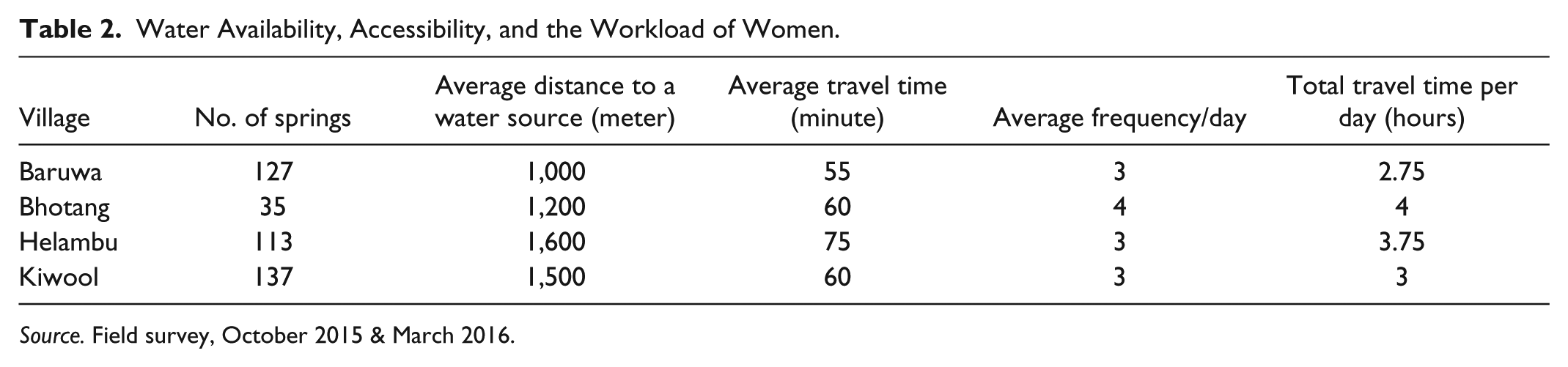
Geographical variation of water availability, accessibility, and the workload women have to bear regarding average distance traveled, time spent, and the frequency of water fetching in a day is evident from Table 2. The drudgery of fetching water in the study area is compounded with the long distance to travel on rugged topography and slopes because 50% springs are located at the slope between 30° and 60°. Forty-seven percent of springs are located in the forest area and 8% is located in the swampy area.
Water Availability, Accessibility, and the Workload of Women.
Source. Field survey, October 2015 & March 2016.
No distinct management practice is visible in the study area; neither any dominant geographical and cultural disparity is found in household water management practices. However, during the dry season, women adjust to limited water availability by restrictive use in cleaning and washing and sometimes increasing the frequency of water fetching. This, in turn, increases the workload of women. Regarding water supply and demand management of natural spring water, both traditional and modern practices are evident. Traditional practices include cleaning spring source during festivals and rituals, planting vegetation and putting fences around the source, and covering source mouth with plastic sheet and stone slab. Modern practices include constructing a concrete wall around the source, constructing collection chambers, storing water into storage tanks, and piped transportation from source to community water storage tanks.
Perception, Capacity, and Vulnerability to Climate change
Local people have experienced the major effect of climate change on seasonal springs. According to the locals, seasonal spring has decreased by 10% in the last 10 years. The water volume of 44% of perennial spring has decreased by up to 50%. Gender-based perception and adaptation to climate change at household and community level reveal that the most obvious effect experienced is a decrease in rainfall and increasing dry period (Table 3). The specific effect to women is longer travel distance for water fetching due to reduced water volume of springs. The scarcity of drinking water is the perceived future risk at community level, whereas at a household level, search for new water sources is a risk identified by women. Local adaptation practices to climate variability were found in the study area. People reported that due to water scarcity and longer dry period, they are shifting their major occupation (agriculture) to other alternatives, mostly out-migration (foreign employment) and business (hotel business in case of Helambu). Another alternative is reducing a large herd of livestock to a smaller size. However, the immediate strategy for water management is not perceived as a priority.
Perception and Adaptation of Local People to Climate Change.

Source. Focus group discussion, March 2016; field survey, October 2015 & March 2016.
Gender disparity in literacy, land holding, household division of labor, and water accessibility is apparent from the study which indicates a lower level of capacity. This lower level capacity is compounded with the heavy burden of water fetching and other household work resulting to a higher level of vulnerability. Overall gender-based capacity and vulnerability in the study area are summarized in Table 4. It exhibits the capacity of women in the form of local environmental acquaintance, whereas vulnerability of women is evident in terms of lack of control over resources and unequal participation in social and community sphere. Increasing awareness is the capacity at household and community level irrespective of gender.
Gendered-Based Capacity and Vulnerability in Melamchi Watershed.

Source. FGD, 2016 and field Survey 2015.
Note. FGD = focus group discussion.
Discussion
Variable effect of changing climate is attributed to the level and form of vulnerability and individual and societal capacity to adapt. Weak institutional capacity, low level of education, constraints in technology use, and limited financial resources are other attributes of developing countries like Nepal for climate change adaptation (Mearns & Norton, 2010). The gendered household division of labor signifies the social and traditional cultural norms and practices in the society (Hovorka, 1998). The gendered division of labor and time spent for specific activities show that women spent up to 18 hr in water, fuelwood, and fodder collection, whereas men spent 13 hr mostly in farm work (Regmi & Fawcett, 1999). The findings of the study area are not different from other studies. The primary responsibility of women is water fetching and household utilization, whereas productive water use for irrigation and industry is the primary responsibility of men (Crow & Sultana, 2002). This signifies the separated need and priorities of water use from a gender perspective (Fisher, 2006). Gender bias in the mode of household water fetching activity is apparent with water fetching from distant sources confined to women. It is found that in some cases water fetching from distant sources, in general, is supported by men (Sugden et al., 2014). However, this does not apply to the study area. Women are responsible for water fetching irrespective of proximity to water sources. Decreasing water volume due to climate change has a direct effect on women. Women have to adjust either by reduced frequency and quantity of water use or fetch more water to continue the household water management, irrespective of cultural practice.
Besides, women spent more time on water fetching with the least involvement in outside activities. Men, on the contrary, are involved in income generating activities besides social and community participation. The trend of decreasing water volumes in the study area and mounting water scarcity problem during the dry season have a direct impact on the women’s water fetching time. It results in limited involvement of women in productive work and social and community activities. Studies have shown that the impact of climate change on women is higher as compared with men (Denton, 2002; Manatat & Papazu, 2009). The gendered differentiated activities and time allocation make women more vulnerable to the effect of climate change. Gender issue, such as women’s access to natural resources in general and water sector in particular, is least considerate in traditional cultural norms. Though multiple roles of women are illustrated in literature, it is acknowledged that their access to water resource is limited (Lubbock & Cleveringa, 2012).
Division of household work is shaped by cultural norms. However, gender bias in time spent on household work has benefited men at the expense of women (Rose, 2000). Six kilometer is an average walking distance for water fetching in a day for women in developing countries (United Nations Population Fund, 2002). The disparity in travel distance and time spent on water fetching activity between men and women is obvious in the study area. Impact of climate change is noted in different parts of Mid-hills of the country and they reveal the decreasing trend of water quantity in natural springs in the past few years (International Centre for Integrated Mountain Development, 2009; Paudyal, Bhuju, & Aryal, 2015; Strengthened Actions for Governance in Utilization of Natural Resources, 2009; Tiwari, Balla, Pokharel, & Rayamajhi, 2012). More than 80% of communities have experienced increased water stress, decreased rainfall, delay in monsoon, and high intensity and uneven rainfall distribution which varies from one location to another (Leduc, 2009). Densely populated areas often do not overlap with the water-rich area. Key factors of unevenly distributed water among the population can be attributed to economic well-being, population distribution, water source location, and water availability. The geographical proximity to a water source is vital for everyday survival for people dependent on natural spring sources. This means, if women have to fetch water twice a day to fulfill household need due to decreasing water volume of natural spring sources, minimum time to spent to fetch water will increase by up to 6 hr. It is found that wherever the water fetching time is lower, women’s workload is reduced and utilized in productive activities and strengthen livelihood options (International Fund for Agricultural Development, 2012).
The gender gap in socioeconomic activities, time spent in fetching water, and distance to a water source are important indicators of women’s drudgery (Crow & McPike, 2009). Water scarcity and time spent to fetch and manage water are stressors which limit economic performance in respect of agriculture and food production and livestock where primary occupation is agriculture (Rosenzweig, 2007). The study shows that the workload of women is increasing with the increasing water shortage problem. If the time consumed for water fetching increases at the present rate, the workload will be colossal (Sugden et al., 2014). This means besides physical strain of overload, there is also a safety and security concerns where the terrain is rugged and travel distance is longer. Declining water availability and increasing time consumption, in turn, will constrain the social, education, and community attainment and the productive work opportunities outside household premises (Mitchel, Tanner, & Lussier, 2007). If the water supply is to decrease and become scarce in future as a trend in general and specific to study area shows, women and girls are the ones who must look for alternative sources of water and put more effort leading to increasing physical strain and less time for participation in social-community sphere. Water scarcity entails longer and more frequent trips to a water source to satisfy household water need. Women typically are the most affected on both counts (Rose, 2000).
Conclusion
The most distinctive characteristic of water management is that it involves men and women as individual, household, and community and thus requires as much attention to human perception and behavior as to water infrastructure and technology. An overview of gender issues and understanding and documenting gender dynamics of water management in climate change context are relevant and important research areas. Cultural context is important in resource-dependent society, and diversity on household water management provides evidence for the importance of culture-specific examination. Geographic proximity is a context-specific indicator of water accessibility that exacerbates women’s workload and physical strain. Variation in water availability and geographic proximity to a water source from one village to another determines the outlook of local people on climate change effect on water supply and management. At the local level, climate change effect is perceived less important due to its gradual effect over other immediate household problems though people are adopting alternatives of securing water from diverse sources to reduce the impact of variability of water availability (as identified by IPCC, AR5). However, sensitization besides awareness at individual, household, and community level is an indispensable motivational capacity for climate change adaptation.
Footnotes
Declaration of Conflicting Interests
The author(s) declared no potential conflicts of interest with respect to the research, authorship, and/or publication of this article.
Funding
The author(s) disclosed receipt of the following financial support for the research, authorship, and/or publication of this article: This article is based on research financed under the Climate Change Research Grants program implemented by the Nepal Academy of Science and Technology. The program is part of the Mainstreaming Climate Change Risk Management in Development Project. This project is a component of Nepal’s Pilot Programme for Climate Resilience and is executed by the Ministry of Population and Environment (Nepal), financed by the Climate Investment Funds, administered by the Asian Development Bank with technical assistance from ICEM, METCON, and APTEC.