




Abstract
The escalating climate change poses numerous challenges for the world, encompassing various aspects such as resource scarcity, natural disasters, decreased grain production, as well as increased population displacement. These issues have the potential to reshape the global geopolitical pattern by triggering more international cooperation, competition, or conflict. The study explores the effect of climate change on geopolitical risk in 40 countries from 1994 to 2020, as well as the underlying mechanism. It also verifies the heterogeneous effect of climate change on geopolitical risk in different scenarios. The findings reveal several key conclusions: (1) Rising temperature significantly increases geopolitical risk, with 1% increase in temperature leading to an increase of 2.1% in geopolitical risk. In contrast, the precipitation, dew point, wind speed and sea level pressure do not demonstrate a significant relationship with geopolitical risk. (2) The positive correlation between temperature and geopolitical risk gradually weakens since 2004. (3) Rising temperature has a greater positive effect on geopolitical risk in under-developed countries or in arid regions. (4) The mechanism through which rising temperature affects geopolitical risk includes reductions in manufacturing growth, human development index, and wheat yields. This paper systematically scrutinizes contribution of climate change to geopolitical risk, highlighting the importance of mitigating climate change to reduce global geopolitical risk.
Plain Language Summary
Climate change is a significant driver of social tension and conflict worldwide. It exacerbates tensions by increasing competition for natural resources, with the uneven distribution of global energy resources making it impossible for any country, particularly underdeveloped ones, to ensure energy supply and transition security independently. Previous research has predominantly examined the impact of military factors, migration, and economic development on geopolitical risk, as well as the effects of temperature on migration, food production, economic development, and quality of life. However, there has been limited focus on how unilateral or multilateral cooperation in the global response to climate change reshapes the geopolitical risk landscape. By analyzing data from 40 countries spanning from 1994 to 2020, this paper systematically explores the correlation between climate change and geopolitical risk, expanding on potential mechanisms beyond the energy transition. The primary finding is that rising temperatures significantly increase geopolitical risk for nations. The study also reveals that the impact of rising temperatures on geopolitical risk is more pronounced in less developed countries, and is stronger in arid regions than in temperate regions. Additionally, it confirms that manufacturing growth, wheat yield, and the Human Development Index are mechanisms through which temperature influences geopolitical risk. These conclusions broaden the scope of research in the field of climate change and geopolitical risk, offering valuable insights for policy recommendations amid the current global geopolitical transformation.
Introduction
The Global Risks Report (World Economic Forum, 2023) highlights that climate change, extreme weather events, and geo-economic confrontation are ranked as the first, second, and ninth most serious global risks over the next decade. Alongside the detrimental impacts of climate change, the increasing fragmentation of the global economy, geopolitical tensions, and complex restructuring of the world further complicate efforts to mitigate climate change globally. Climate change has evolved from an environmental challenge to a key driver of global geopolitical transformation. The COP28 Global Stocktake (UNFCCC, 2023) emphasized that climate governance now faces widening divides between developed and developing countries due to post-pandemic stagnation, debt pressure, and uneven technology transfer, while conflicts such as the Russia-Ukraine war have redirected resources toward traditional security concerns. Similarly, the European Green Deal (European Commission, 2019) highlighted that the ecological transition will reshape global geopolitics through changes in trade, energy dependence, and technological competition. These frameworks jointly reveal that climate change and geopolitical risk are increasingly intertwined, making climate policy a critical dimension of national security and sustainable development. This interconnection provides a compelling rationale for our study.
There is growing public concern about the serious consequences of climate change and its impact on production, human life, economic growth and national security. Many Europeans worry that disasters or resource scarcity caused by climate change may trigger mass migration from less developed regions, thereby leading to or aggravating social conflicts in Europe. Additionally, the rapid transition to low-carbon practices in carbon-intensive industries worldwide could potentially trigger economic disruptions, unemployment, and exacerbate social and geopolitical tensions (Alexandrescu, 2024; Pflugmann & De Blasio, 2020). Given the complex challenges posed by climate-related risks and geopolitical tensions, it is imperative to comprehend the relationship between climate change and geopolitical risk on a global scale.
However, the influence of climate change on geopolitical risks may, in the short run, be overshadowed by a range of sudden shocks, including policy or strategic shifts by major powers, military conflicts, trade frictions, and energy supply crises. These intense disruptions across the political, economic, and security domains can more profoundly reshape global trade patterns, capital flows, energy prices, and alliance structures, thereby exerting a dominant influence on fluctuations in geopolitical risk. In the long run, however, the impact of climate change accumulates gradually and persistently through structural channels, such as resource scarcity, population displacement, environmental degradation, and technological transformation, progressively redefining the fundamental constraints under which nations pursue security and economic interests. Unlike policy-driven shocks, which can often be mitigated through negotiation, cooperation, or regime change, the environmental and socioeconomic consequences of climate change are highly path-dependent and difficult to reverse once triggered.
Plenty of studies have examined the direct and indirect impacts of climate change on immigration, economic development, agriculture, energy, finance, and tourism (Bosetti et al., 2021; Chen et al., 2016; Diaz & Moore, 2017; Gillen, 2025; Steiger et al., 2020). It is now widely recognized that climate change may serve as a driving factor behind geopolitical risk (Block et al., 2025). Historically, geography and climate have always shaped political and economic systems (Hu et al., 2025). Specifically, climate change exacerbates the scarcity of vital natural resources such as water, food, and energy, leading to more frequent natural disasters, reduced food production, and heightened competition for resources, particularly in regions vulnerable to desertification and drought, such as the Middle East and Africa (Bohlet al., 2017; Zeng, 2025). At the same time, the accelerated melting of glaciers and rising sea levels seriously threaten the territorial security of some low-lying countries and coastal areas. The opening of Arctic routes and access to natural resources caused by warming have also reshaped global energy and trade patterns, further intensifying the redistribution of geopolitical influence among Arctic-bordering states. Overall, these processes highlight how climate change not only affects environmental and economic systems but also fundamentally reshapes the global geopolitical landscape.
Geopolitical risk refers to the uncertainty and instability arising from the spatial interaction between geography, power, and strategy. Early theories such as sea power (Mahan, 1897), land power (Mackinder, 1919), and rimland theory (Spykman, 1942) viewed geography as a decisive constraint shaping state behavior. Modern geopolitical scholarship extends this logic to political, economic, and civilizational dimensions. Cohen’s (1982) divided world theory highlighted the tension between continental and maritime blocs; Brzezinski (1998) introduced the concept of a unipolar moment dominated by U.S. strategic influence; Huntington (1993) reframed global competition as a civilizational clash; and Kissinger (1975, 1982) emphasized a multi-level system of power combining security, economy, and ideology. Together, these frameworks illustrate a gradual shift from spatial determinism to complex global interdependence. Recent research further argues that energy transition, digitalization, and climate change are transforming geopolitical risks, creating new domains of strategic rivalry and cooperation (Jin et al., 2023; Mohammedi et al., 2025). However, geopolitical risks can, in turn, aggravate climate risks by undermining international cooperation and increasing uncertainty in climate action. Wars, tensions, and political instability weaken global climate governance and distort resource allocation, reducing financial support for low-carbon technologies and slowing progress toward mitigation and adaptation goals. This reciprocal relationship further complicates the global effort to address both climate change and geopolitical instability.
Based on the panel data analysis of 40 countries spanning from 1994 to 2020, this paper makes three main contributions to the field. Firstly, it clarifies the effect of climate change on geopolitical risk, emphasizing that rising temperatures significantly increase geopolitical risk. Secondly, it explores the heterogeneity of these effects from multiple perspectives, offering potential solutions to mitigate the impact of climate change on geopolitical risk under different circumstances. Thirdly, it delves into the mechanisms by which rising temperatures affect geopolitical risk, providing valuable insights for decision-making to address the growing global geopolitical risk in the context of climate change.
The structure of the paper is as follows. The second part entails a comprehensive literature review. The third part introduces the data and basic model used in this study. The fourth part analyzes and discusses the regression results. The final part presents the conclusions and implications.
Literature Review
Geopolitical Risk
Geopolitical risk is characterized by high levels of uncertainty and complexity, making it challenging to quantitatively evaluate and visually analyze. However, advancements in relevant methodologies have led to the development of two main approaches for measuring geopolitical risk. The first approach involves using the election and replacement of political leaders as a representation of geopolitical risk (Jens, 2017; Lee et al., 2020). In this method, election years are considered to have higher geopolitical risk, while non-election years are seen as having lower geopolitical risk. Although this dichotomous measurement method addresses the issue of endogeneity, it fails to reveal the correlation between internal and external geopolitical risk or comprehensively measure economic and institutional uncertainty. The second approach involves establishing a quantifiable index system for measuring geopolitical risk. The World Uncertainty Index (WUI) measures the level of geopolitical risk in a country or region by calculating the percentage of uncertainty in the Economist Intelligence Unit’s country reports. The higher the number, the higher the uncertainty, and the greater the geopolitical risk. The International Country Risk Guide (ICRG) classifies and quantifies political, economic and financial risk in more than 150 countries. Liu et al. (2019) measured geopolitical risk in 127 countries in 2016 based on the distance of their political systems and economic quality, and further attempted to measure geopolitical risk at the micro-level of enterprises using indicators such as trade policy uncertainty, effectively reducing the potential overlap between different indicators. Notably, Caldara and Iacoviello (2022) comprehensively quantified the geopolitical risk index of global emerging economies by analyzing the frequency of words reflecting geopolitical tensions in 25 million articles published by media organizations, newspapers, and publications since 1990. Overall, these approaches provide valuable tools for measuring and understanding geopolitical risk, enabling scholars to analyze its impact on various levels and contexts.
As shown in Figure 1 (1994) and Figure 2 (2020), which were generated using ArcGIS, large-scale geopolitical risks have often stemmed from strategic and resource rivalries among major powers, such as the former Soviet Union and the United States in the 1990s, and the current competition among multiple great powers. While climate change exerts both direct and indirect effects on geopolitical risk, its direct impact is evident in the prolonged drought in Syria (2006–2010), which aggravated agricultural collapse, triggered internal displacement, and contributed to social unrest preceding the civil war (Intergovernmental Panel on Climate Change, 2023). Indirectly, the accelerated melting of Arctic ice has reshaped strategic routes and resource access, intensifying competition among major powers such as the United States and Russia for control over new navigation passages and energy reserves (NATO Summit Communiqué; North Atlantic Treaty Organization, 2021). The Maldives’ projected 1.2% land loss (United Nations Environment Programme, 2022) further exemplifies how climate vulnerability reinforces geopolitical inequality. Hence, climate change should be viewed not merely as a background amplifier of great-power rivalry but also as an active driver reshaping the geopolitical landscape through its intertwined economic, environmental, and security impacts.
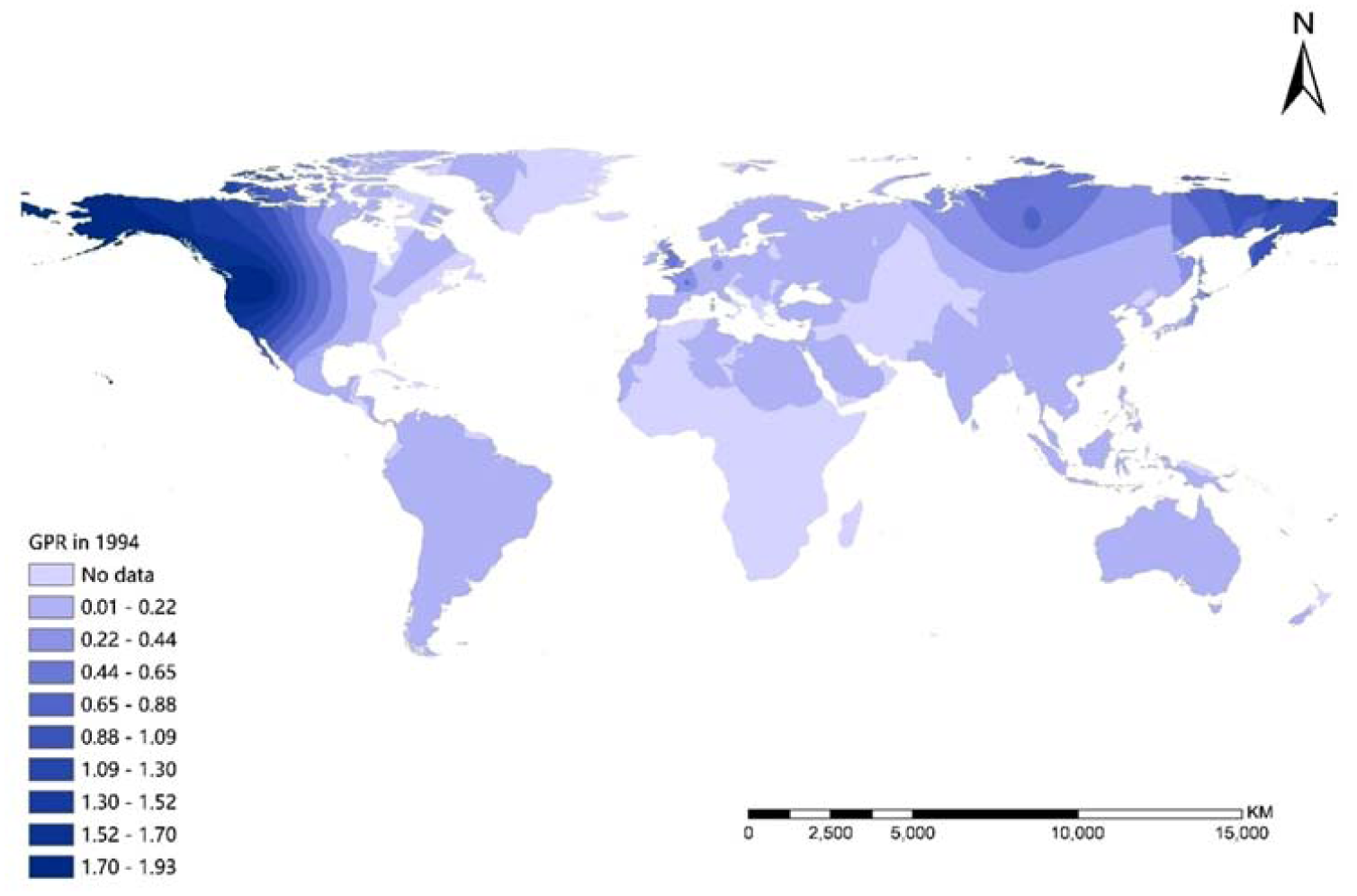
Geopolitical risks in 1994.

Geopolitical risks in 2020.
Geopolitical risk is influenced by a range of dynamic and diverse factors. Firstly, armed conflicts are prominent causes of geopolitical risk (Basham & Catignani, 2018; Lu, 2020), including local armed conflicts and terrorist incidents. However, Bosetti et al. (2021) find that rising temperatures have a less significant effect on the probability of armed conflict in countries with a higher propensity to migrate. Secondly, competition and cooperation for power among countries have long been drivers of geopolitical risk. Some countries may interfere in the internal affairs of others or disrupt the established power order in pursuit of their own interests, thereby creating geopolitical risk for less advantaged countries (Ferguson & Hast, 2018). Thirdly, economic conflicts contribute to geopolitical risk. External geopolitical competitors imposing economic sanctions directly increase geopolitical risk in the targeted country or region. Internal economic factors such as economic uncertainty and financial market turbulence can destabilize economic activities within a country, indirectly leading to an increase in geopolitical risk (Lensink, 1999; Olanipekun & Alola, 2020). Fourthly, resource and environmental factors can trigger geopolitical risk. Environmental degradation and energy scarcity have become increasingly important drivers of geopolitical risk. Conflicts over resources and the environment, particularly in regions like the Arctic and Antarctic, can amplify geopolitical risk (Christoforidou et al., 2023; Engelke & Michel, 2019). Additionally, studies have shown that expanding renewable energy can help reduce dependence on fossil fuels, increase energy diversity, mitigate the risk of energy competition, and reduce geopolitical events (Gielen et al., 2022; Sovacool, 2016). But the rapid development of renewable energy sources such as wind or solar, which require resources such as land, could also trigger more territorial competition and disputes between neighboring countries, as well as heighten geopolitical risk among countries and shape a new global balance. For example, the Danube River runs through nine EU countries and five non-EU countries, and there is always a fragmentation of geopolitical tensions between these countries due to economic aid and possible access to EU rights. All these factors contribute to rising geopolitical risk, with temperature playing a crucial role in influencing geopolitical risk.
Climate Change and Geopolitical Risk
The impact of increasing climate change and geography on the geopolitical landscape may continue to increase, because the impact of geography on geopolitics is permanent. Due to the complex correlation between the global nature of climate change and the local nature of geopolitical risk, different countries or regions make decisions through multiple games at the international and domestic levels. This complexity leads to varying relationships between climate change and geopolitical risk. From an international perspective, climate issues have become a key battleground for developed countries to compete for influence and shape the global governance agenda. The European Union (EU), the United States and its traditional partners such as Canada, Japan, Australia, and the United Kingdom, and the Group of 77 plus China representing developing economies, are the major political forces influencing the global climate response (Mavrodieva et al., 2019). The EU and the U.S.-led alliance seek to set the climate agenda and design frameworks for future cooperation, but their internal coherence and policy consistency vary. Notably, U.S. climate policy has shifted significantly across administrations, for example, withdrawal from the Paris Agreement under President Trump (2017–2020) and renewed commitments during other periods-reflecting the domestic political divisions that complicate its global stance. The difference in institutional discourse power between these blocs depends not only on their positions within the global climate governance system but also on their distinct policy orientations. For instance, developed countries often use climate diplomacy as a geopolitical instrument to secure access to strategic resources such as energy and food, sometimes through imports or pollution displacement, posing challenges for developing nations in livelihoods, housing, health, and adaptation to climate change (Gupta & Chu, 2018). Developing countries, by contrast, aim to accelerate economic growth and narrow the gap with developed economies until they can engage on a more equal footing. Therefore, we propose the first hypothesis:
The impact of temperature rise on geopolitical risk is likely to be heterogeneous across countries due to differences in geographical, socio-economic, and institutional characteristics (Zhao et al., 2021). First, income disparities shape countries’ responses to climate-related shocks. Chu et al. (2023) note that countries at different income levels react differently to energy security risks; in particular, middle-income countries must devote more resources to managing geopolitical tensions, which may crowd out investment in clean energy and hinder environmental sustainability. Second, climatic conditions also matter. Countries located in arid regions are more vulnerable to temperature-induced geopolitical instability than those in temperate regions, as they face greater exposure to water scarcity, food insecurity, and ecological fragility (Madouni, 2025). Third, institutional and governance capacity further reinforces this heterogeneity. Countries with stronger environmental governance tend to adopt stricter climate policies which, although beneficial for environmental outcomes, impose higher socio-economic adjustment costs and intensify domestic pressures, potentially heightening geopolitical sensitivity in vulnerable nations. Therefore, we propose:
Beyond international and domestic disparities, rising temperatures may shape the evolutionary pathways of geopolitical risk through multiple economic and social channels, particularly industrial production, agricultural output, and human development. The manufacturing sector, a cornerstone of the global economy, faces mounting challenges under climate constraints. Although manufacturing provides substantial economic benefits, it also accounts for a disproportionately high share of global energy consumption and greenhouse gas emissions, making it a central target of environmental regulation (Kucukvar et al., 2016). As governments implement stricter carbon standards and energy-efficiency requirements, enterprises must balance profit maximization against mitigation costs (D. D. Wang, 2017). This tension affects industrial competitiveness and may indirectly reshape geopolitical alignments through shifts in trade and production networks.
In agriculture, changing precipitation patterns, persistent droughts, and heatwaves have severely disrupted productivity. For example, in parts of East Africa, wheat yields have declined by as much as 25% in recent decades due to recurring drought events (Abebaw, 2025). The resulting food insecurity erodes national economic stability and can act as a catalyst for social unrest, migration, and transboundary conflict (Akomolafe et al., 2024). From a social resilience perspective, the Human Development Index (HDI) provides an integrated measure of a society’s capacity to cope with climate shocks. Research shows that Official Development Assistance aimed at climate change mitigation can significantly raise HDI levels, particularly in low-income countries, thus strengthening societal resilience and reducing the likelihood that climate stress evolves into geopolitical crises (Yang et al., 2025). Therefore, we propose:
Data and Model
Data
Explained Variables
Following the method adopted by Caldara and Iacoviello (2022), this paper measures geopolitical risk by calculating the proportion of leading newspapers discussing adverse geopolitical events or threats, with a focus on wars, terrorism and tensions between states, and the main data is downloaded from https://www.matteoiacoviello.com/gpr.htm on Jan 18, 2023. This approach comprehensively captures the risks associated with war, terrorism, and political tensions, providing a time-consistent, comprehensive, and real-time measure of geopolitical risk, rather than relying solely on specific geopolitical events. While media-based indicators may involve reporting bias, as governments could suppress or underreport certain events, it mitigates this limitation by relying on multiple independent international news sources and measuring the frequency of risk-related terms rather than official disclosures. Thus, despite minor biases, it remains a widely accepted and methodologically robust proxy for cross-country geopolitical risk. In addition, we replace the dependent variable with the “political stability and absence of violence/terrorism” indicator from the six dimensions of the Worldwide Governance Indicators (WGI). The empirical results remain stable and consistent, indicating that the conclusions of this study are not significantly affected by differences in data sources.
Specifically, the recent gpr index (gpr) uses 10 newspapers and starts in 1985, which mainly includes the New York Times, Wall Street Journal, Washington Post, Chicago Tribune, Los Angeles Times, USA Today; The Guardian, the Financial Times, The Daily Telegraph; and Canada’s Globe and Mail. While the historical index (h_gpr) uses three newspapers and starts in 1900, they are mainly includes New York Times, Washington Post and Chicago Tribune. In this paper, the calculation results of these two indexes of geopolitical risk (h_gpr and gpr) are both used to represent the geopolitical risk in different countries, respectively. The GPR index divides automated text search topics into eight sub-categories: war threats, peace threats, military buildups, nuclear threats, terror threats, beginning of war, escalation of war and war terror acts.
Weather Variables
In this paper, the weather variables considered are temperature (tem); precipitation (pre); dew point (dm); wind speed (si); and sea level pressure (msl), as identified by Lenssen et al. (2019) and Bosetti et al. (2021). To assess annual patterns, the average two-dimensional monthly and daily data of weather variables, collected from MERRA-2e (Global Modeling and Assimilation Office [GMAO], 2015), are used to make annual summations in this paper (GISTEMP Team, 2023). The data set covers the period from 1980 up to 2020. Figure 3, generated using ArcGIS, shows trends of annual average temperature in these 40 countries from 1994 to 2020. Notably, there is a gradual upward trend in the annual average temperature in most of these countries. Countries such as Russia (RUS), Denmark (DNK), and Canada (CAN) experience annual average temperatures ranging from −20° to 0°. However, even in these colder regions, there is a significant rise in the annual average temperature over time.

Temperatures from 1994 to 2020.
Figure 4, generated using ArcGIS, depicts the changing trend of annual mean precipitations in 40 countries from 1994 to 2020. Among them, MYS (Malaysia), IDN (Indonesia), PHL (Philippines) and COL (Colombia) have significantly higher annual precipitations than other countries. Conversely, DEU(Germany), SAU (Kingdom of Saudi Arabia), EGY (Egypt) exhibit a low average annual precipitation. Overall, nearly all countries witnessed irregular fluctuations in precipitation during the period from 1994 to 2020. These fluctuations can be attributed to the intricate influence of various factors such as atmospheric circulation, ocean temperature, and topography. Notably, some countries display a slight upward trend in these fluctuations, particularly in tropical regions and certain high latitudes. This observation may be associated with climate warming and increased water vapor content.

Precipitations from 1994 to 2020.
Control Variables
Control variables mainly encompass years of schooling, population, immigration, military expenditure/GDP, per capita annual GDP growth rate. On one hand, it is expected that years of schooling, per capita annual GDP growth rate could reduce geopolitical risk through lifting the living level and welfare (Islam, 2023; Müller, 2011; Tiwari et al., 2021). On the other hand, an increase in total population is expected to reduce the marginal cost of conflict, while an increase in migration is expected to heighten border conflicts (Soybilgen et al., 2019), Furthermore, a rise in military spending/GDP is projected to increase the likelihood of potential wars, consequently leading to greater geopolitical risk (Karaganov, 2020). All the data are sourced from World Bank (2023) and UNDP (United Nations Development Programme, 2022).
Mechanism Variables
Mechanism variables mainly include annual manufacturing growth rate, human development index and annual wheat yield, and the data related to these variables are obtained from reputable sources such as the World Bank and the United Nations Development Programme (UNDP). It is expected that more wheat yield, human development index and manufacturing growth could reduce geopolitical risk through lifting the living standard and welfare. The growth of the manufacturing industry contributes to the development and stability of the national economy and reduces dependence on imports. The Human Development Index (HDI) is a comprehensive measure of a country’s human development level, first proposed by the UNDP in 1990. It assesses a country’s performance in health, education, and income, providing a measure of human development achievement. The higher the HDI value, the higher the level of human development (H. Wang et al., 2023). Increasing domestic food production helps reduce dependence on imported food, increases farmers’ income, and thus better maintains social stability while reducing geopolitical risk (Sommerville et al., 2014). In addition, increased inflows or outflows of migrants have the potential to increase geopolitical risk. For example, a growing number of migrants can pose challenges to cultural integration and stability. Conversely, geopolitical risks or adverse weather conditions can lead to increased border migrations, creating a strong endogenous correlation. Therefore, migration is not considered as a mechanism variable in this paper (Karaganov, 2020; Bosetti et al., 2021). Descriptive statistics for each variable, including symbols and units, are provided in Table 1.
Data Descriptions.

Model
The data is used to produce a balanced panel for a sample of 40 countries over the period from 1994 to 2020. The model used in this paper estimates the effect of climate change on geopolitical risk according to Chen et al. (2016) and Bosetti et al. (2021):

It is assumed that the explained variable is the geopolitical risk in country i in year t, which is represented by gpr or h_gpr; whetherit is the core explanatory variable; α is the constant term; controls represents the social-economic variables; εit is the error term. Simultaneously, a time-invariant country fixed effect ci is used to control national heterogeneity. The year-fixed effect (denoted by λ t ) is also controlled to remove unobserved factors common to all countries in a given year. To control potential spatial correlations of the error term, the standard errors are clustered by country level. The null hypothesis is β0 = 0, which means that temperature has no effect on geopolitical risk.
The adoption of a relatively parsimonious fixed-effects model is based on the premise that temperature is an exogenous variable determined by natural processes, largely unaffected by reverse influences from political or economic factors across countries (Burke et al., 2015; Dell et al., 2014; Hsiang & Kopp, 2022). Therefore, treating temperature as an external climatic shock in the regression allows for the identification of its causal effect on geopolitical risk within a compact and empirically robust model specification.
Results
Baseline Results
The main effect of climate change on geopolitical risk captured by the coefficients is shown in the first row of Table 2. Accordingly, geopolitical risk increases significantly by 0.0171 to 0.0210 when temperature rises by one unit from column (1) to (8), which is measured by h_gpr or gpr. This confirms that hypothesis 1 is true: rising temperatures enhance geopolitical risks. Wind speed is significantly negative in columns (2), (4), and (7), indicating that greater wind speed has a stronger restraining effect on geopolitical risk.
Baseline Results.

Note. The values in brackets are standard error.
and ** are significance levels of 10% and 5%, respectively.
However, precipitation, dew point, and sea level pressure has no significant relationship with geopolitical risk. There are three possible reasons for these findings. First, natural disasters caused by rising temperatures, droughts and extreme weather could lead to instability and conflict both internally and externally in some countries. For example, in hot and dry weather, countries like Iraq and Algeria may experience instability due to the loss of fossil fuel revenues. The regression results remain robust even after adjusting for different fixed effects, confirming that rising temperatures significantly increase geopolitical risk. Second, as global efforts to address climate change progress, cooperation between countries in terms of natural resources and economic development is increasing, but so is competition. This intensification of competition contributes to a rise in geopolitical risk, particularly due to the significant differences in climate positions between developed and less developed countries. Developed countries, aiming to secure their own economic growth, often seek energy supplies and pollution emission rights from other nations. This further exacerbates instability faced by less developed countries in response to climate change, shaping the global geopolitical risk landscape. Third, dealing with or adapting to climate change requires financial and material resources for both individuals and countries. This inevitably weakens the stable and sustainable supply of other financial inputs.
Robustness Test
To verify the robustness of the regression results, we introduce a one-period lag for the explanatory variables in columns (1) and (2) of Table 3, and a two-period lag in columns (3) and (4). The findings in columns (1) and (2) reveal a periodic lag in the impact of temperature on geopolitical risk, with coefficients of 0.0155 and 0.0200, respectively, indicating a significant positive correlation. The results in columns (3) and (4) demonstrate a two-cycle lag in the effect of temperature on geopolitical risk.
Robustness Test Results.

Note. The values in brackets are standard error.
, **, and *** are significance levels of 10%, 5%, and 1%, respectively.
Although the coefficients slightly decreased compared to the one-period lag results, they remained significantly positive at 0.0150 and 0.0209, respectively. The lag effect of increasing temperature may be attributed to the inertia of natural systems, the lifespan of greenhouse gases, the response of social and economic systems, and the complexity of the climate system. Moreover, the negative relationship between wind speed and geopolitical risk does not withstand the robustness test. Furthermore, we replace the dependent variable with the “political stability and absence of violence/terrorism” indicator from the Worldwide Governance Indicators (WGI). As shown in column (5), the coefficient of temperature remains significant at −0.0763, suggesting that rising temperature also undermines political stability, thereby confirming the robustness of our findings across different measures of geopolitical risk.
Regarding the control variables, education (lnedu) has a significant negative effect on geopolitical risk, indicating that higher education levels enhance governance capacity and institutional resilience, reducing political instability. Population size (lnpp) and economic development (gdp) both show positive and significant effects, suggesting that larger and more developed economies are more exposed to international competition and strategic conflicts. Military expenditure (lnmili) is also positive, implying that greater defense spending reflects heightened security pressures and geopolitical tension. The impact of immigration (immigrant) is positive but only significant in some models, supporting the view that large-scale migration may increase resource pressure, social integration challenges, and thus amplify geopolitical risks.
Heterogeneity Analysis
As the effect of temperature on geopolitical risk may vary across regions or different stages of development. The results of the heterogeneity test on the influence of temperature on geopolitical risk are presented in Table 4. Firstly, temperature has varying effects on developed and under-developed countries. Due to their stronger institutional capacity, diversified economies, and higher military deterrence, developed countries face greater opportunity costs of armed conflict and are therefore more inclined to resolve disputes through diplomatic channels. Moreover, as their economies are less dependent on climate-sensitive sectors such as agriculture, the geopolitical risks arising from rising temperatures may differ substantially from those in developing countries.
Heterogeneous Test Results.

Note. The values in brackets are standard error.
, **, and *** are significance levels of 10%, 5%, and 1%, respectively.
It is found that although the coefficients are positive for both developed and under-developed countries, each unit increase of temperature has a significantly greater impact on geopolitical risk in under-developed countries. The coefficients are 0.0259 and 0.0281 for under-developed countries, compared to 0.0101 and 0.0155 for developed countries. It is worth noting that the majority of carbon emissions contributing to climate change originate from developed countries, whose rapid economic growth and industrialization have historically driven high levels of fossil fuel consumption. Nevertheless, the destabilizing and insecure consequences of climate change are disproportionately borne by under-developed countries, which often lack the institutional and financial capacity to cope with climate-induced shocks. Hence, developed countries have the responsibility to help under-developed countries take action against climate change, for example, through giving financial support or low-carbon technological support.
Additionally, 1990 to 2003 and 2004 to 2020 are taken as two time intervals to verify whether temperature has a heterogeneous effect on geopolitical risk at different time stages. The results show that the coefficients are significantly positive only from 1994 to 2003. However, compared with the previous period, the positive impact of temperature on geopolitical risk has gradually weakened and become insignificant since 2004. This may be attributed to the diffusion of low-carbon technologies, enhanced social adaptability to climate change (Hoffmann & Sgrò, 2011; Owen, 2020), and the stabilizing effects of globalization and international cooperation (Vinke-de Kruijf & Pahl-Wostl, 2016). Furthermore, regional heterogeneity is evident. The temperature-induced rise in geopolitical risk is stronger in arid regions than in temperate regions. The coefficients for arid regions are 0.0217 and 0.0136, while the effect in temperate regions is weaker and statistically insignificant, indicating that arid-zone countries are more vulnerable to climate-driven geopolitical instability due to greater exposure to water scarcity, food insecurity, and ecological fragility. This confirms that hypothesis 2 is true: The impact of rising temperatures on geopolitical risks is heterogeneous.
Mechanism Analysis
This section examines the relationship between rising temperatures and increased geopolitical risk through their impact on the annual growth rate of the manufacturing industry, the human development index (HDI), and the annual wheat yield. The findings demonstrate that as temperatures rise, there is a significant increase in geopolitical risk for countries. Moreover, the growth rate of the manufacturing industry, human development, and wheat yield all experience significant decreases, with coefficients of −0.6413, −0.0024, and −0.0114 respectively. Moreover, when temperature is lagged by one period, the corresponding coefficients become −0.9594, −0.0022, and −0.0129, implying that the adverse impacts on manufacturing performance and agricultural production intensify over time. This indicates that when the temperature lags by one stage, the negative impacts on manufacturing growth and wheat yield are significantly amplified. It also highlights the presence of a time lag in the series of effects caused by rising temperature. This confirms that hypothesis 3 is true: The rise in temperature may affect geopolitical risks through manufacturing growth, a decline in wheat production, and a drop in the human development index.
However, rising temperatures may hinder the progress towards this goal (Ayoo, 2020). This conclusion aligns with the research findings of Chen et al. (2016), Diaz and Moore (2017), and Clayton (2020). Furthermore, when the temperature is delayed by one stage, the coefficients become −0.9594, −0.0022, and −0.0129. This indicates that when the temperature lags by one stage, the negative impacts on manufacturing growth and wheat yield are significantly amplified. It also highlights the presence of a time lag in the series of effects caused by rising temperature (Table 5).
Mechanism Analysis Results.

Note. The values in brackets are standard error.
, **, and *** are significance levels of 10%, 5%, and 1%, respectively.
Predicted effect of climate change on geopolitical risk
Based on the climate change simulation data predicted by HadGEM2-CC (UK Met Office, UK) from Climate Data Store ( https://cds.climate.copernicus.eu/#!/home), this paper focuses on the different Representative Concentration Pathway (RCP) scenarios. These scenarios depict the potential future curves of greenhouse gas concentration changes, which correspond to various levels of increased radiative forcing. Specifically, two representative scenarios, RCP4.5 and RCP8.5, are examined in this paper. RCP4.5 and RCP8.5 signify a projected increase in radiative forcing levels by 4.5 W/m2 and 8.5 W/m2 respectively by the year 2100. Global mean surface temperatures are projected to rise by 1.1°C to 2.6°C in the period of 2081 to 2100, relative to the years 1986 to 2005, for the RCP4.5 scenario. For the RCP8.5 scenario, the projected temperature increase is 2.6°C to 4.8°C, as illustrated in Figure 5.
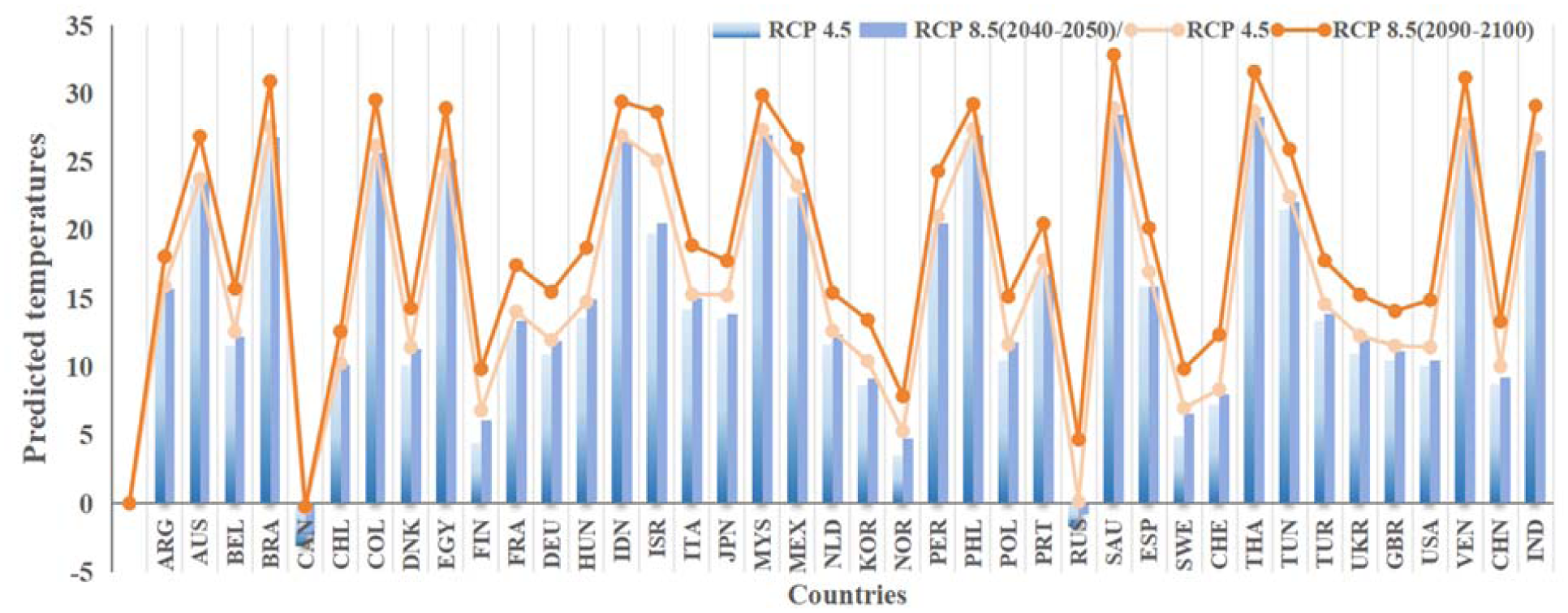
Predicted temperatures under RCP 4.5 and 8.5.
Using the method developed by Kimura et al. (2025), we have obtained the estimated coefficient of the annual mean temperature change between 2040 to 2050 and 2090 to 2100, as well as the baseline from 1994 to 2020, under the RCP4.5 and RCP8.5 scenarios. We project the effects of climate change on geopolitical risk in both medium-term (2040–2050) and long-term (2090–2100) warming scenarios. Table 6 presents the projections of climate change under these different warming scenarios. For instance, under the RCP8.5 pathway, which assumes “business as usual” carbon dioxide emissions, the forecast model suggests that climate change will increasingly contribute to geopolitical risk in the medium and long term. The long-term effect of climate change is almost twice as significant (−0.1199) as the medium-term effect (−0.0433). However, it is important to interpret these results with caution since the projected future climate changes are rough estimates based on constant assumptions other than temperature. As our understanding of climate change improves and low-carbon technologies develop, people may demonstrate better adaptation to climate change in the future. Nonetheless, it is undeniable that taking actions to mitigate the consequences of climate change caused by rising temperatures and deviating from the “business as usual” model should serve as an important motivation for governments to fulfill their responsibilities and obligations regarding climate governance.
Predicted Effect of Climate Change on Geopolitical Risk.

Note. The values in brackets are t.
and ** are significance levels of 10% and 5%, respectively.
Conclusions and Implications
Climate change is a significant driver of social tension and conflict worldwide. It exacerbates tensions by increasing competition for natural resources, with the uneven distribution of global energy resources making it impossible for any country, particularly underdeveloped ones, to ensure energy supply and transition security independently. Previous research has predominantly examined the impact of military factors, migration, and economic development on geopolitical risk, as well as the effects of temperature on migration, food production, economic development, and quality of life. However, there has been limited focus on how unilateral or multilateral cooperation in the global response to climate change reshapes the geopolitical risk landscape.
By analyzing data from 40 countries spanning from 1994 to 2020, this paper systematically explores the correlation between climate change and geopolitical risk, expanding on potential mechanisms beyond the energy transition. The primary finding is that rising temperatures significantly increase geopolitical risk for nations. The study also reveals that the impact of rising temperatures on geopolitical risk is more pronounced in less developed countries or in arid regions. Additionally, it confirms that manufacturing growth, wheat yield, and the Human Development Index are mechanisms through which temperature influences geopolitical risk. These conclusions broaden the scope of research in the field of climate change and geopolitical risk, offering valuable insights for policy recommendations amid the current global geopolitical transformation.
Most of the findings in this paper align with existing research, supporting the notion that rising temperatures increase geopolitical risk by reducing food production, lowering the Human Development Index, and hindering manufacturing growth. Therefore, it is crucial to advocate for the duty-free import of renewable energy through peace treaties, agreements, and negotiations. This approach aims to increase the share of renewable energy in global energy consumption, alleviating the pressure on different countries or regions to mitigate global climate change and maintaining the stability of national geopolitical risk levels. These findings are particularly important for less developed countries, which are disproportionately affected by rising temperatures in terms of geopolitical risk. Developed countries have a greater responsibility to assist and support less developed nations in implementing actions to address climate change. This support is essential to prevent these countries from facing issues such as reduced food production, lower human development, or decreased manufacturing. For example, promoting agricultural technology innovation and intelligent management systems in less developed countries can enhance farmland disaster resistance and improve agricultural adaptability to climate change. Additionally, encouraging the adoption of clean energy and low-carbon technologies can promote efficient resource use, enhance supply chain resilience and diversity, and mitigate the negative impact of climate change on manufacturing, thereby reducing potential geopolitical risks. Moreover, strengthening the intensity and coverage of medical assistance and social security systems in less developed countries, disseminating knowledge on climate disaster management, and training their response capabilities are vital measures. These efforts will help these nations better cope with the adverse effects of climate change.
The empirical results indicate that rising temperatures significantly increase geopolitical risk, particularly in under-developed countries, where weaker institutional capacity, economic vulnerability, and reliance on climate-sensitive industries amplify this effect. In contrast, developed countries, supported by more robust governance systems and diversified economic structures, demonstrate greater resilience to climate-related shocks, and temperate regions similarly exhibit stronger adaptive capacity and stability in responding to climate impacts. The weakening relationship between temperature and geopolitical risk after 2004 may reflect the combined influence of technological progress, international cooperation, and improved adaptive capacity. Nevertheless, the findings should be interpreted with caution. On the one hand, potential spatial associations between countries have not been fully considered; on the other hand, the analysis focuses on long-term temperature trends and does not account for short-term extreme weather events-such as droughts or floods-which may affect the volatility of geopolitical risk and lead to an underestimation of the temperature effect. Future research could employ higher-resolution temporal and spatial data to more accurately capture event-level or regional dynamics and further explore potential explanatory mechanisms, including technological innovation, globalization, and international cooperation.
Footnotes

Funding
The authors disclosed receipt of the following financial support for the research, authorship, and/or publication of this article: National Natural Science Foundation of China (No. 72502121); Shandong Provincial Natural Science Youth Foundation (No. ZR2023QG088); Shandong Provincial Postdoctoral Innovation Project (No. SDCX-RS-202303009); Social Sciences Association Project of Henan Province (No. SKL-2025-1892); Henan Provincial Department of Science and Technology's Soft Science Research Project (No. 242400411077; 252400411094); Key Scientific Research Project of Higher Education Institutions of Henan Province (No. 25A790006); Henan Provincial Philosophy and Social Sciences Planning Project (No. 2024CJJ075); Research Fund Project of Nanyang Normal University (No. 2025BS015); National Science Foundation Sub-project of Nanyang Normal University (No. 2026PY002); National Social Science Sub-project of Nanyang Normal University (No. 2024PY010).
Declaration of Conflicting Interests
The authors declared no potential conflicts of interest with respect to the research, authorship, and/or publication of this article.
Data Availability Statement
The data will be made available on request.