




Abstract
Most studies on drinking water supply seem to focus on efficiency analysis and have failed to analyze effectiveness, cost-effectiveness, and trade-offs in performance management. Using Data Envelopment Analysis (DEA) and Free Disposal Hull (FDH) novel reference technologies, we analyzed the efficiency, effectiveness, and cost-effectiveness, and the social, economic and ecological performance (TBL elements) of 29 municipalities in drinking water supply, in Oromia National Regional State. The results from 42 (efficiency), 173 (effectiveness), and 37 (cost-effectiveness) DEA and FDH models on production model criterion and TBL elements reveal that performance of many municipalities was weak, and the municipalities encountered trade-offs on the production model criterion and TBL elements. We argue that inter-organizational bench-learning can improve performance, reduce trade-offs, and respond to the effect of climate change on the drinking water supply. To this end, we argue for the need to map peers for inter-organizational bench-learning. We identified five inter-organizational bench-learning strategies and drew implications. The article contributes to performance management literature and the debate on sustainable development.
Keywords
Introduction
The UN in the Sustainable Development Goals (SDGs) envisions achieving economic, social, and ecological goals, and the sixth UN SDG aims to ensure universal access to drinking water by 2030 (UN, 2015). The UN Human Rights Council also emphasizes the human right to water (Chociej & Adeel, 2012; UN Human Rights Council, 2011). However, climate change presents society with an unprecedented challenge (Chini & Stillwell, 2018; Drechsel et al., 2022; UN, 2015). It restricts access to drinking water and increases water scarcity, especially in Africa (Mwiturubani & Van Wyk, 2010; Oluwasanya et al., 2022; UN, 2020).
Wicked problems, such as climate change, are complex in nature, lack simple solutions (McConnell, 2017), and cannot be solved by a single organization or actor (Christensen et al., 2019; Termeer et al., 2019). It requires resilience and effective coordination, negotiation, and partnership between multiple actors at all levels (Christensen et al., 2019; Drechsel et al., 2022).
Besides climate change, the trade-offs in using water between economic, social, and ecological goals affect the human right to drinking water and accountability for performance. For example, increased water consumption for agricultural and industrial purposes (economic) restricts access to adequate and equitable drinking water (social goal) and increases environmental degradation (ecological) (Axworthy & Sandford, 2012). In addition, due to the New Public Management’s cost recovery principle (efficiency), water utilities could neglect social performance (effectiveness), and the trade-off would escalate if ecological objectives and cost-effectiveness were added (Debela, 2017).
Despite the highlighted challenges, studies on drinking water supply have limitations. First, several studies appear to focus on efficiency analysis; trade-offs in performance management have been largely missing from drinking water supply studies. Scholars have not analyzed the trade-offs between efficiency, effectiveness, and cost-effectiveness and the trade-offs between economic, social, and ecological goals.
Second, they did not provide methodologies and strategies for generating actionable knowledge and solutions to improve performance and accountability for performance and ensure the human right to water. For instance, a generic study by Gonzalez de Asis et al. (2009) on drinking water supply has not mentioned the concept of bench-learning, which helps to produce knowledge that meets the daily needs of managers. Third, studies on drinking water supply in Ethiopia have not used the concept of Triple Bottom Elements (TBL), which is crucial from a strong sustainability viewpoint (Mori & Christodoulou, 2012). Fourth, the Ethiopian studies have not used Data Envelopment Analysis (DEA) and Free Disposal Hull (FDH), which are increasingly used in the West to analyze the performance of water utilities (Debela, 2017).
Building on the social constructivist perspective of organizational learning and Pawlowsky’s (2001) organizational learning framework and drawing on DEA and FDH reference technologies and the production and TBL models, and analyzing the trade-off in drinking water supply in 29 municipalities in Oromia National Regional State, Ethiopia, this article contributes to filling the highlighted gaps. The study answers the research questions: What is the performance trade-off in Grade 2B municipalities in the Oromia National Regional State in the drinking water supply? And what are the features of peer dynamics for inter-organizational bench-learning for Grade 2B municipalities in the Oromia National Regional State to improve drinking water performance?
The article makes several contributions to the debate on access to drinking water and sheds light on how to improve performance and increase accountability. First, it shows the importance of analyzing trade-offs in drinking water supply, identifying performance targets and mapping dominant peers generated by several DEA and FDH model specifications. Second, it argues that inter-organizational bench-learning will help to minimize the trade-offs in urban drinking water supply and respond to the effects of climate change. Third, it distinguishes five inter-organizational bench-learning strategies to improve performance.
The article proceeds as follows. The next section provides theoretical and analytical frameworks of the study. The research methodology section follows. In the fourth section, the results are presented. Finally, concluding remarks are given.
Pawlowsky’s Organizational Learning Framework and the Social Constructivist Perspective to Organizational Learning
Argyris broadly points out that “the theory of organizational learning must take into account the interplay between the actions and interactions of individuals and the actions and interactions of higher-level organizational entities such as departments, divisions, or groups of managers” (Argyris, 2004, p. 8). This understanding, however, seems to be limited to learning within a single organization. Yet, building on the social perspective on organizational learning, this research argues that organizational learning can occur both within and between organizations. The social perspective on organizational learning argues that organizational learning is not a unilateral process but occurs in the social context and system, with organizations allowing individuals to learn and jointly construct understanding (Raz & Fadlon, 2006).
This study adopted Pawlowsky’s organizational learning framework and the social constructivist perspective of organizational learning for three reasons. First, both are complementary; they emphasize social interaction, flexibility, double-loop learning, reflection, and implementation (Chiva & Alegre, 2005; DeFillippi & Ornstein, 2003; Pawlowsky, 2001).
Second, Pawlowsky (2001) identified a four-step learning process, which fits with the social constructivist perspective on organizational learning. The first phase (identification or creation) allows learners to identify and create relevant information for learning. In the second phase (diffusion), learners exchange and disseminate knowledge to improve the common understanding. In the third phase (integration), learners integrate shared knowledge and develop equal understanding at all levels (from the individual to the system). In the implementation stage, the last phase, learners implement and institutionalize shared knowledge.
Third, Pawlowsky’s organizational learning framework and the social constructivist perspective of organizational learning embarrass the concept of bench-learning. Bench-learning refers to mutual learning between a group of actors who continuously learn from each other to improve performance and accountability (Băcală & Sala, 2014). Sustainable bench-learning is crucial to tackling complex problems such as climate change (Docherty et al., 2003).
The TBL and the Production Model as Analytical Frameworks
This study used the TBL and the Production Model analytical framework, which are complementary. While the TBL is used to analyze organizational performance on social, economic, and ecological dimensions, including drinking water supply (Akhmouch & Correia, 2016; Neto, 2016), the production model is relevant to analyzing the performance of organizations or programs on three measures: efficiency, effectiveness, and cost-effectiveness (Pollitt & Bouckaert, 2017). The TBL concept is crucial in sustainability assessment (Pope et al., 2004). It is particularly relevant for analyzing the performance of urban services, as cities mainly contribute to socio-economic development than environmental benefits (Mori & Christodoulou, 2012). Using the TBL element and the production model criteria not only increases the span and depth of the performance analysis but also enhances accountability for performance. Figures 1 and 2 show TBL elements and the production model elements.

TBL model.

The production process model.
The TBL reveals the municipalities and the public sectors, in general, need to be resilient in the economy—efficiency (cost recovery and financial sustainability), social (affordability), and ecological justice (sustainable water withdrawals) at the same time (Flint, 2013). As shown in Figure 2 (right), the organization/program converts inputs through activities into quantifiable outputs (products/services), and outputs produce outcomes/impacts (intermediate results and final results) (Pollitt & Bouckaert, 2017; Pollitt & Dan, 2013). Efficiency refers to the ratio of inputs to outputs; effectiveness is the ratio of outputs to outcomes; and cost-effectiveness is the ratio of inputs to outcomes (Fogarty & Mugera, 2013; Van Dooren et al., 2015).
Trade-Offs
Pollitt and Bouckaert (2017) define trade-offs as situations in which decision-makers are forced to balance different needs but cannot satisfy all of them concurrently. Municipalities, therefore, would encounter trade-offs in urban drinking water supply and addressing climate change; it is difficult for decision-makers to implement the TBL elements and the three production model performance criteria simultaneously without having less of the other. Decision-makers, for example, may not be able to balance the increased competition for water between different actors for economic benefits; the increased need for drinking water supply due to population growth at an affordable price (social), and reduce the overexploitation and pollution of water resources (ecology) (United Nations Development Programme [UNDP], 2006). Climate change increases the challenge, and the relationship between economic, social, and ecological performance could be opposite (Belu, 2009). For example, rapid economic growth in BRICS countries has negative effect on global climate (Ulucak et al., 2020, p. 814), with South Africa, for example, becoming one of the top 20 CO2 emitters in the world (An & Mikhaylov, 2020). Addressing unfulfilled interest leads to a cyclical pattern (Lieberherr, 2016; Pollitt & Bouckaert, 2017). Tables 1 and 2 illustrate the possible trade-offs between TBL elements and the performance criterion of the production model.
The TBL Performance Matrix.

Source. Debela et al. (2020).
Production Model (Performance Measures) Matrix.

Source. Debela (2017).
The tables show that, in the worst-case scenario, an organization cannot achieve all of the elements of TBL and the three performance measures of the production model. Second, with the exception of the high-high-high scenario, the public sector (municipalities) encounter trade-offs. However, the nature of the trade-offs is different.
Research Methodology
This study applied complementary DEA and FDH reference technologies, which are data-driven, deterministic, and non-parametric, and are used to compare the performance of organizations or organizational units called Decision Units (DMUs) that use multiple similar inputs and produce similar outputs (Cooper et al., 2006; Zhu, 2009). The application of several outputs and inputs differentiates DEA and FDH from parametric methods such as Stochastic Frontier Analysis (SFA) (Molinos-Senante et al., 2015).
Second, unlike SFA method, for example, where the functional assumption is mandatory (Smith & Street, 2005), DEA and FDH do not require a cause-effect relationship between variables (Cooper et al., 2006; Jacobs et al., 2006). Both DEA and FDH apply the Linear Programing and drops unrealistic assumptions which is particularly relevant when the market is volatile (An et al., 2021) and when the relationship between multiple inputs and outputs is complex or unknown (Cooper et al., 2006).
Third, DEA and FDH determine the relative performance of DMUs and identify peers and targets for weak DMUs (Cherchye et al., 2000; Cook & Seiford, 2009). They are increasingly used in performance analysis of the water sector, although DEA is used more widely than the FDH (Debela, 2017). However, limited research used DEA to analyze the sustainability of economic, social, and environmental systems (Saen et al., 2020).
DEA and FDH models could be input-oriented or output-oriented. While in input-oriented models weak DMUs have to reduce the inputs proportionally, in output-oriented models they should proportionally increase the outputs (Gabrielian, 1999).
In both reference technologies, the performance of DMUs depends on the number of inputs and outputs; the more the number of variables, the greater the number of DMUs identified as best practice (Cooper et al., 2006). The main difference is that FHD drops the convexity assumption of DEA and assumes strong free disposability in inputs and outputs (Cooper et al., 2006; Stroobants & Bouckaert, 2014). Second, FDH postulates the variable return on investment (VRS) assumption and hence differs from Charnes, Cooper, and Rhodes’s (CCR) DEA, which assumes a constant return to scale (CRS). However, it is similar to Bankers, Charens, and Cooper’s (BCC) DEA, which also holds the VRS assumption. Third, FDH produces relatively many best practice DMUs than DEA, but weak DMUs in FDH remained weak in DEA too.
This article applied output-oriented the (BCC) DEA variant and FDH not only because both assume VRS (Cook & Seiford, 2009; Zhu, 2009) but also because they are more suitable for managerial use than CCR (Cherchye & Van Puyenbroeck, 1999). The similarity of the assumptions ensures the comparability of results and appropriateness of identified peers and performance targets for weak DMUs. Interestingly, since the results are indisputable for managers and policy-makers, the output-oriented DEA and FDH enhance inter-organizational bench-learning, especially in times of complexity and uncertainty (Cooper et al., 2006; De Borger et al., 1994; Zhu, 2009).
Case Selection
This study used the Most Similar System Design (MSSD) case study strategy. It analyzes the performance of 29 Grade 2B municipalities in Oromia National Regional State in the drinking water supply. These municipalities are in the same region (Oromia), were established as municipal governments (Oromia National Regional State [ONRS], 2003) and have a municipal water and sanitation company that is responsible for the efficient and effective supply of drinking water (ONRS, 2004).
Variables and DEA and FDH Models
This article is based on empirical data collected for PhD research in 2015. Table 3 report input, output and intermediate outcome variables. To address the effects of environmental factors and ensure the comparability of DMUs, the study used the urban population as a non-discretionary input (Jacobs et al., 2006).
Variables and Their Description.

Source. Debela (2017) and Debela et al. (2020).
Data Collection
We collected inputs and outputs data from Water Supply and Sewerage Service Enterprise of Selected 29 Municipalities. To obtain secondary data on input and output variables, we developed a data collection format in consultation with drinking water experts working with Oromia Water and Energy Bureau. Next, we obtained support from the Oromia Water and Energy Bureau, and the Bureau officially requested Urban Water Supply and Sewerage Services Enterprises of the selected municipalities to submit data. To ensure timely submission, we telephoned the water and sewerage enterprises. We asked some enterprises to resubmit their data to ensure completeness and consistency. In general, secondary quantitative data collection took about 3 months. We filtered our data and used data from 2010 to 11 to 2014 to 15, which are consistent and reliable. In this paper, we used only the 2014 to 2015 data sets.
We conducted a citizen satisfaction survey to obtain data on intermediate outcome variables. We developed a seven-point Likert scale survey items (1 = Strongly disagree, 2 = Disagree, 3 = Somewhat disagree, 4 = Undecided/neutral, 5 = Agree somewhat, 6 = Agree, and 7 = Strongly agree) based on citizen-centered performance measures identified by a single case study (Debela & Troupin, 2017), and national, regional, and international documents review. We translated the survey into Afan Oromo and pre-tested the instruments. Afan Oromo is an official language of the Oromia National Regional State and is spoken by Oromos and some non-Oromos living in the region.
To ensure representativeness, we further classified the target groups (respondents) as to those living in the center, middle and periphery, based on urban geography. We administered the survey to households and institutions (public and private) including users and non-users of drinking water services, supplied by the Urban Water Supply and Sewerage Service Enterprise, in the 29 Grade 2B municipalities by trained data collectors and their assistants between August and September 2015. The principal data collectors were the academic staffs of the Public Service College of Oromia (now named Oromia State University), who were traveling to a different part of Oromia to offer a tutorial class to distance learners of the college. Their assistants were students of the college and live in the targeted towns/municipalities (Grade 2B towns).
To aid data collection, we developed data collection guide and signed contract agreements with the principal data collection agents. We asked respondents to consider 1 year of service (2013–14 to 2014–15) and answer satisfaction statements. We aggregated citizen satisfaction survey data at the municipality level (for detail, see Debela, 2017).
DEA and FDH Models Specifications
To ensure the principle of exhaustiveness and examine the effects of the DEA and FDH model specifications on performance and peers for inter-organizational bench-learning, we formulated 42 (efficiency), 173 (effectiveness), and 37 (cost-effectiveness) DEA/FDH model specifications by gradually increasing the number of variables (Zhu, 2009).
To minimize the effect of the number of variables, we applied the rule of thumb that the number of the DMUs should be at least three times greater than the sum of the input and output variables in the DEA/FDH model formulation (Cooper et al., 2006; Mukokoma & van Dijk, 2013). In addition, though multicollinearity problems are not an issue in DEA and FDH, we excluded strongly correlated variables from the model specifications as much as possible. Exceptions were staff and total expenditure, which we used concurrently in a few models (see Debela, 2017). Table 4 reports the number of DEA/FDH model specifications on the production model and TBL elements (see also Debela, 2017). The table clarifies that the number of model specifications varies on TBL elements (horizontal) and production model (vertical). For example, on the social dimension of TBL, two models were on efficiency, 48 were on effectiveness, and 12 were on cost-effectiveness.
Production Model and TBL Elements and Number of DEA/FDH Model Specifications.

Source. Author.
Results
DMUs Performance and the Trade-Offs
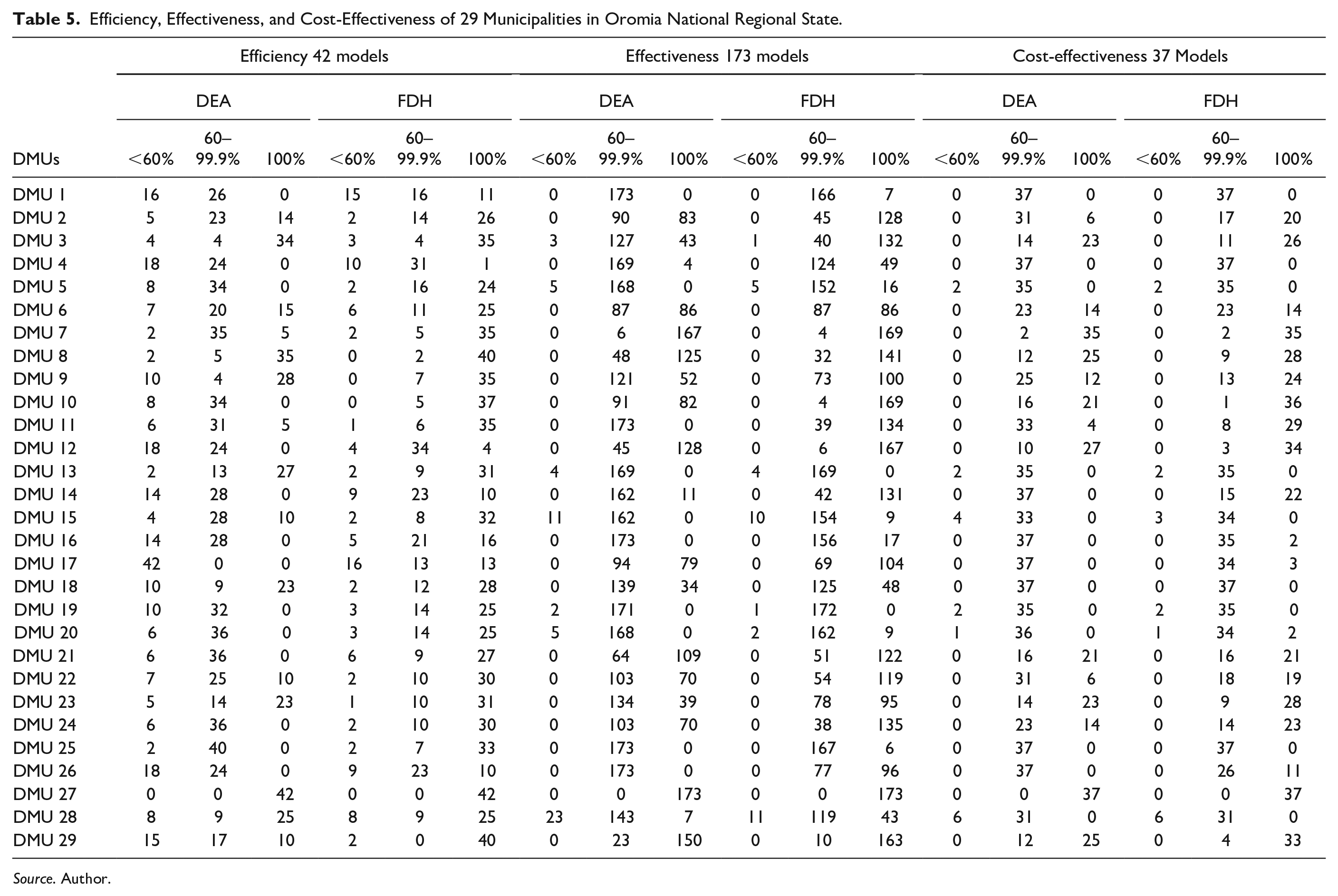
As expected, in the DEA and the FDH, many DMUs did not balance efficiency, effectiveness, and cost-effectiveness. In both reference technologies, only DMU 8, DMU 9, and DMU 27 were relatively better. Many weak DMUs performed better on effectiveness and cost-effectiveness than on efficiency. However, the extent of the trade-off is higher in DEA than in FDH. In addition, FDH sets relatively easily achievable performance targets for weak DMUs. Table 5 shows the results of the DEA and FDH model specifications.
Efficiency, Effectiveness, and Cost-Effectiveness of 29 Municipalities in Oromia National Regional State.
Source. Author.
To systematically identify the trade-offs between the production criteria, we designated the performance of a DMU as low if it is inefficient/ineffective/cost-ineffective in more than or equal to 50% of the DEA/FDH model specifications. Such subjective and generic reference points cannot do justice to the variation in performance. For example, not all DMUs with a greater than 50% performance have a similar target. However, arguably the simplification enables assessing the relative performance of the DMU and can stimulate the debate on accountability for performance and inter-organizational bench-learning. Even with unadjusted DEA and FDH results (see Table 6), this applies to best practice by default that happens due in the absence of comparable peers.
Performance Trade-Off in Unadjusted DEA and FDH.

Source. Debela (2017).
Table 6 shows that 2 DMUs in DEA and 13 DMUs in FDH were fully socio-managerial. The performance of 16 DMUs in DEA and 3 DMUs in FDH was low. DMU13, DMU18, and DMU28 were relatively efficient (managerial), and DMU12 was relatively effective and cost-effective (social) in both reference technologies. In FDH, many DMUs have improved their performance and minimized trade-offs.
Interestingly, a new picture emerges when best practice by default phenomena (which occurred due to the lack of comparable peers) and the performance of DMUs on production criteria and TBL when we take into account. Figure 3 visualizes the performance of the DMUs on the TBL and production elements. We labeled DMUs that are a best practice by dominance with a deep green color (100%) and light green color (over 75%), DMUs with a combination of best practice by default and performance (on average) with yellow color, and weak DMUs with red.

Performance trade-offs on production model criterion and TBL elements.
Figure 3 clearly shows that many DMUs encounter trade-offs between the production model and the TBL elements in DEA and FDH, even with the maximum number of variables. In terms of efficiency criteria, most DMUs performed better economically and socially but remained weak on ecological performance. On the effectiveness and cost-effectiveness criteria, on the other hand, several DMUs were relatively better on the social dimension but poor on economic and ecological dimensions. Specifically, in both reference technologies, nine DMUs (DMU1, DMU4, DMU16, DMU17, DMU19, DMU20, DMU25, DMU26, and DMU28) were weak. Three DMUs (DMU7, DMU8, and DMU27) were relatively best at minimizing trade-offs in DEA as well in FDH. The figure shows that all DMUs, including DMU27, had a best practice by default phenomenon both in DEA and FDH.
Inter-Organizational Bench-Learning as Performance Improvement Strategies
We distinguish five inter-organizational bench-learning strategies which would help to improve performance and minimize trade-offs (see Figure 4).

Five inter-organizational bench-learning strategies for performance improvement.
Peers for Inter-Organizational Bench-Learning
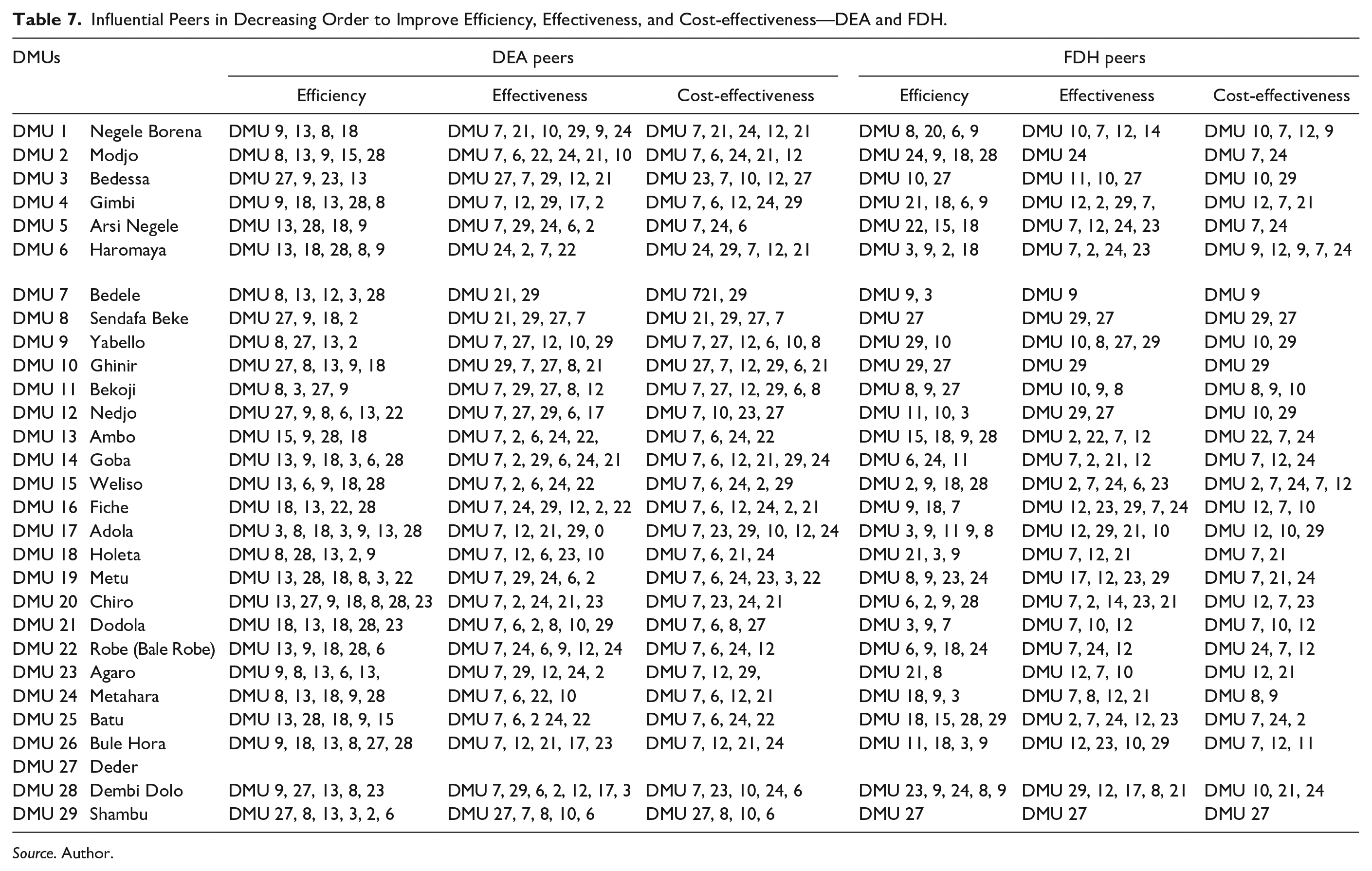
The results in Table 7 show that peers for inter-organizational bench-learning are dynamic, and the most influential DEA and FDH peers are not necessarily similar. Indeed, some peers both in DEA and FDH remained unchanged. Since FDH generates peers based on existing DMUs and identifies only one peer, unlike DEA, which identifies peers based on virtual DMUs and distinguishes more than one peer, peers identified by FDH are indisputable. Yet, weak DMUs can prioritize the most influential peers for inter-organizational bench-learning.
Influential Peers in Decreasing Order to Improve Efficiency, Effectiveness, and Cost-effectiveness—DEA and FDH.
Source. Author.
The best DMUs, by practice, are useful for inter-organizational bench-learning to improve performance and accountability for performance. The limited number of the best DMUs, in particular, suggests the need for co-innovation and continuous learning, which are also critical to responding to the serious impacts of climate change on drinking water supply.
The increasing the number of DMUs by default with an increasing number of variables (model specification), especially in FDH also establish important insights in performance management and accountability for performance (see also Debela, 2017; Stroobants & Bouckaert, 2014). An emblematic example of best practice by default phenomena in FDH is DMU27.
The difference in the influential peers between DEA and FDH suggests the need to map peers to improve performance and accountability for performance. The dynamism and stability of the peers show that inter-organizational bench-learning creates a win-win situation for all learners; it enables DMUs to learn from their context and others. DMUs that dominated others on efficiency but were weak on other dimensions can learn from DMUs identified as best practices on (effectiveness) and or (cost-effectiveness). In DEA, to improve efficiency, DMU 13 and DMU 9, for example, can learn from each other as they identified themselves as peers in some models. DMU 13 can learn from DMU 7, DMU 6, DMU 24, and DMU 22 to improve effectiveness and cost-effectiveness. Except for DMU 7, all DMUs can learn from DMU 13 to increase efficiency. For efficiency improvement, DMU 13 was not influential in FDH. DMU 27, in general, was not among the most influential peers, suggesting the necessity of identifying best practices by default phenomena.
Discussions
Consistent with the literature on DEA and FDH, the results reveal that the performance of DMUs depends on DEA and FDH model specifications and the relevance of gradually increasing the number of variables to examine DMUs performance (Debela, 2017; Stroobants & Bouckaert, 2014). The results also underline the necessity of mapping peers for inter-organizational bench-learning and identifying DMUs with best by practice phenomena (Debela, 2017). From a methodological perspective, the results suggest the importance of using different model DEA and FDH model specifications to make better conclusions. From managerial and policy perspectives, the complementary results from the DEA and FDH models on various combinations of TBL and production model elements and peers for the weak DMUs are crucial to enhance inter-organizational bench-learning and co-innovation and respond pragmatically to the effects of climate change on the drinking water supply. To this end, weak DMUs need to choose the appropriate inter-organizational bench-learning strategy and use their peers as a reference (Molinos-Senante et al., 2015). The dynamism of best-practice DMUs identified by the novel reference technologies (DEA and FDH) and the inter-organizational bench-learning strategies would improve the interaction and dialog between DMUs and enable them to understand and minimize trade-offs.
According to the Pawlowsky’s (2001) learning framework and the social constructivist perspective to organizational learning the results allows the DMUs to pragmatically identify relevant information for learning. The performance score and peers facilitate the exchange of ideas and the diffusion of shared knowledge and understanding among the DMUs. Next, DMUs can apply shared knowledge to day-to-day organizational activities; manage drinking water supply; and respond to the effect of climate change. Finally, the continuous and cyclical engagement and interactions between the DMUs improve the DMUs ability to coproduce knowledge and to institutionalize it in the organizational system and in the culture.
Conclusions and Implications
The empirical results from DEA and FDH model specifications show the performance of many DMUs in drinking water supply on production model criterion and TBL elements was low, particularly in DEA, and no DMUs dominated others in all DEA and FDH models. Moreover, most DMUs encounter trade-offs, especially in DEA, suggesting that the DMUs must make considerable efforts to achieve the overarching economic, social, and ecological goals and ensure universal access to drinking water by 2030. The performance targets identified by DEA and FDH from various model specifications and peer dynamics would enable DMUs to improve their performance. The peers stimulate inter-organizational bench-learning to generate actionable knowledge to reduce trade-offs, institutionalize performance management culture and address the challenges of climate change.
From methodological, policy, and managerial perspectives, the empirical results can motivate dialog between DMUs and other stakeholders on progress toward achieving SDG 6, addressing climate change, and ensuring human rights to water. The input, output, and intermediate outcome variables and the DEA and FDH model specifications would stimulate further research on sustainable development and public sector accountability in general and urban drinking water, particularly at the local level. The five inter-organizational bench-learning strategies would also be of greater interest to researchers and practitioners.
Finally, while decision making and dialog, it is crucial to take into account the limitations of DEA and FDH, such as the sensitivity of results to the selection of the variables, the sensitivity of results to the number of the variables and model specifications, the assumption of correct data measurement (Cooper et al., 2006; Jacobs et al., 2006; Molinos-Senante et al., 2015). Overall, however, the study contributed to research on drinking water supply from the methodological, managerial, and policy perspectives and to the literature on performance management.
Footnotes
Acknowledgements
This study has been carried out in the framework of the academic cooperation to development project “Professionalizing Ethiopian Public Administration to Support Development Practitioners” between KU Leuven, Ambo University, and Addis Ababa University, financed by VLIR-UOS (Belgium). The author-earnestly thank these institutions. I am also indebted to Prof. Geert Bouckaert for his professional advice and feedback.
Declaration of Conflicting Interests
The author declared no potential conflicts of interest with respect to the research, authorship, and/or publication of this article.
Funding
The author received no financial support for the research, authorship, and/or publication of this article.
An Ethics Statement
Not applicable. The research does not involve experiment with humans and animals. Nor does it directly expose research respondents to any risk.
