




Abstract
This research employs panel data from five rounds of the China Family Panel Studies (CFPS) spanning from 2012 to 2020 to explore the effects of land transfer decisions on rural household resilience and to uncover the mechanisms driving these effects. We employ a probabilistic moment-based approach to measure resilience and use an instrumental variable (IV) technique to address the endogeneity problem. The results indicate that land inflow has a negative impact on the resilience of rural households in China, whereas land outflow enhances their resilience. The primary factor contributing to the negative impact of land inflow on resilience is the decreased capacity for adaptation and transformation. Land outflow positively influences the capacities for absorption, adaptation, and transformation. However, this positive effect is relatively weaker for rural households with overage workers and a higher proportion of female workers. These findings have policy implications for refining land transfer policies, bolstering the resilience of rural households, and fostering rural economic development.
Plain language summary
This study investigates how decisions about transferring land affect the ability of rural families in China to cope with and recover from risks and shocks. The findings show that renting in more land actually makes it harder for rural families to adapt to changes, while renting out land can improve their ability to withstand, adapt and transform in face of difficulties. However, the benefit of transferring out land is less for families with older or predominantly female workers. These insights suggest that more effort should be devoted in adjustments to land transfer policies to make a big difference in strengthening rural communities and promoting economic growth in the countryside.
Keywords
Introduction
Among the 17 Sustainable Development Goals established by the United Nations, the elimination of all forms of poverty globally is cited as a top priority. Currently, unsustainable poverty escapes represent a significant challenge facing most developing countries, as external shocks often cause many households to fall back into poverty. China has achieved a great victory in the fight against poverty by eliminating absolute poverty in 2020. However, the phenomenon of returning to poverty persists, particularly in some deeply impoverished rural areas (Xu et al., 2023). Consequently, the Chinese government has emphasized the imperative to curb and prevent returning to poverty. In this context, it is crucial to explore how rural households can increase their resilience against adverse welfare shocks.
In China, smallholders remain the primary agricultural operators, yet it is becoming increasingly difficult for rural households in China to achieve a sustainable livelihood through traditional agricultural production. Insufficient land resources and land fragmentation limit rural households’ capacity to increase agricultural production and develop modern agricultural practices. This hampers the commercialization process of agriculture, leading to a decline in farmers’ income (Zhou et al., 2019). In addition, smallholders are confined to small parcels of land, making it difficult for rural households relying solely on agriculture to recover from external shocks such as unfavorable weather conditions, pest invasions, or outbreaks of disease (Jamshidi et al., 2019). These factors contribute to the lack of resilience among China’s rural households, making them highly susceptible to falling into poverty traps.
To address the predicament faced by rural households, the Chinese government issued the “Opinions on Guiding the Orderly Transfer of Rural Land Operation Rights to Develop Moderately Large-Scale Agricultural Operations” in 2014, which supported and encouraged land transfer by rural households. Theoretically, under the market mechanism, rural households can achieve Pareto efficiency through land transfer, thereby improving their welfare levels. Families with greater agricultural production capabilities and fewer nonfarm employment opportunities can rent-in more land to expand farm operations, thus increasing agricultural income (Peng et al., 2020). Moreover, households with comparative advantages in nonfarm employment over agricultural production can gradually exit agriculture by renting-out their land and engaging in more stable and remunerative nonfarm economic activities (R. Li et al., 2019). Consequently, land transfer is expected to serve as an effective anti-poverty strategy, as proposed by Ravallion (2012). By enhancing the productivity of farming households and accumulating resources to withstand various adverse impacts, this approach strengthens the resilience of rural households.
In reality, however, due to imperfections in labor, credit, and other factor markets, the actual impact of land transfer on rural household welfare is mixed. Some studies point out that land transfer positively affects rural households’ income by achieving economies of scale, improving agricultural technological efficiency, and promoting investment in agricultural land to enhance the quality of agricultural products (Deininger et al., 2017; Lu et al., 2019). Land transfer practices have also facilitated rural labor movement to urban areas, increasing the rural workforce engaged in nonfarm activities (Chernina et al., 2014). However, there is evidence that land transfer has not increased rural household income (L. Zhang et al., 2018). Moreover, household members who have long engaged in traditional agriculture face disadvantages in the nonfarm employment market, especially for the older population lacking relevant skills (Tong et al., 2017). Overall, there is still considerable debate over the role of land transfer in improving rural household welfare and reducing poverty (Keswell & Carter, 2014; C. Li et al., 2021; Varga, 2020).
The absence of vulnerability and capability perspectives may be a significant reason for the controversies in the literature. From a vulnerability perspective, improving rural households’ welfare and reducing poverty depend on two key factors: the profitability of current livelihood activities and the stability and sustainability of these livelihoods. However, most studies on the welfare effects of land transfer focus only on the former, that is, the influence of land transfer on current well-being, while they neglect issues related to the risks and vulnerability of households’ livelihoods after land transfer. From a capability perspective, escaping poverty is not a one-way street, and households may cycle between falling into and escaping from poverty. More importantly, how land transfer shapes the capacity of households to sustain poverty escape, namely their resilience in recovering from current shocks and resisting future ones, warrants attention. Although some literature has attempted to explore the welfare effects of land transfer on rural households from the perspectives of vulnerability and capability, these efforts either overlook the discussion of households’ resilience capabilities within a vulnerability framework or are limited by small cross-sectional samples from specific regions, lacking a forward-looking examination of vulnerability (Eskander & Barbier, 2023; Guo et al., 2019).
To fill the above research gaps, this study integrates risk shocks with capability theory, embedding vulnerability within a clearly defined resilience capacity framework. Meanwhile, using a probabilistic moment-based approach to measure resilience (Cissé & Barrett, 2018), this study examines the long-term impact of land transfers on the well-being of rural households from a forward-looking perspective. Compared with previous studies, the marginal contributions of this paper are as follows: First, this paper constructs a resilience capacity analysis framework from a vulnerability perspective, systematically exploring how land transfers affect the resilience system of rural households by analyzing their coping strategies under various degrees of shocks. Second, based on five rounds of large-sample microdata (2012–2020 China Family Panel Studies data) and a moment-based resilience metric, this study uses the instrumental variable (IV) method to estimate the causal effects of land transfers on the resilience of rural households, providing the long-term view of research on the welfare impacts of land transfers. Finally, based on the above analysis, this paper further explores the heterogeneous impacts of land transfers on the resilience of some vulnerable groups, providing insights for more targeted and nuanced land transfer development policies.
Background and Theoretical Analysis
Institutional Background of Land Transfer
In this study, “land transfer” refers to the transfer of rural land operation rights within China’s public land ownership system. According to the Constitution of the People’s Republic of China (PRC), rural land is collectively owned. The Household Responsibility System (HRS) implemented in the early 1980s distributed land-use rights to individual rural households based on family size, which initially significantly enhanced agricultural productivity but subsequently caused severe land fragmentation (Tan et al., 2006). As rural-urban migration intensified in the following decades, many rural laborers migrated to cities, resulting in large amounts of farmland being abandoned. To address these challenges, the Chinese government deepened its land property rights reforms by subdividing land rights, establishing a distinctive institutional arrangement known as the “separation of three rights” (Ye, 2015). Specifically, village collectives retain ownership of the land, rural households possess the land-contract rights, and land operation rights can be legally transferred to other agricultural entities. Importantly, during the transfer of operation rights, rural households retain their contract rights, enabling them to earn rental income by transferring their land-use rights (Q. Wang & Zhang, 2017).
The policy and legal framework supporting land transfer has been gradually developed and refined through a series of government initiatives and legislative measures. In 2001, the Communist Party of China (CPC) Central Committee issued the “Notice on the Transfer of Land-Use Rights of Peasant Household Contracted Land,” which explicitly emphasized that land transfer must adhere to the principles of legality, voluntariness, and compensation. Subsequently, in 2002, the National People’s Congress enacted the “Rural Land Contract Law of the People’s Republic of China,” providing the foundational legal basis for land transfer. The central government’s 2014 No. 1 Policy Document further advanced this framework by proposing the “separation of three rights” system, which seeks to “uphold collective ownership, stabilize household contract rights, and activate land operation rights.” To ensure the stability of property rights necessary for land transfer, the Chinese government also launched a comprehensive program for rural land confirmation, registration, and certification (Song et al., 2020). These land system reforms reflect China’s strategic approach to introducing market mechanisms to promote agricultural modernization while maintaining the foundational principle of collective land ownership, aiming to address the constraints inherent in fragmented smallholder agriculture.
Three Dimensions of Rural Household Resilience
Resilience refers to the capacity to resist, recover from, or adapt to unexpected events and changes (Béné et al., 2014). Resilience often encompasses multiple dimensions that enable individuals to cope with various shocks and stressors. The literature conceptualizing resilience as a capacity highlights three dimensions constituting this capability: absorptive capacity, adaptive capacity, and transformative capacity (Béné et al., 2016).
First, in situations where shocks are relatively small, resilience manifests as absorptive and maintenance capacities. Absorptive capacity requires individuals to formulate ex-ante coping strategies to ensure sufficient redundancy and buffering resources to withstand the damage caused by shocks (Cutter et al., 2008). Rural households employ absorptive coping strategies against risks primarily through formal and informal means. Formal insurance mechanisms refer to participation in nationally mandated social safety net programs, such as health insurance and social pensions. These programs aim to provide crucial support to individuals during economic hardship, preventing asset depletion. Evidence suggests that sustained participation in such social protection schemes helps enhance households’ resilience (Abay et al., 2022). In developing countries, when access to formal insurance mechanisms is limited, savings become the primary informal absorptive coping strategy for most rural households (Nguyen et al., 2020). Precautionary savings theory posits that increasing savings levels are a rational response for households in anticipation of future income declines due to uncertainty (Lugilde et al., 2019). As a buffering resource, savings can be used to smooth consumption when households encounter shocks. It significantly mitigates the impact of shocks on households and helps households recover from shocks more quickly (Do, 2023; Mahmud & Riley, 2021).
Second, when absorptive capacity is exceeded, individuals will demonstrate adaptive capacity. Adaptability reflects a flexible, gradual adjustment to maintain functional and structural stability (Meuwissen et al., 2019). The diversification of income sources is often an indicator of rural households’ ability to flexibly adjust their agricultural activities and labor allocation (Birthal & Hazrana, 2019; W. Liu et al., 2020; Michler & Josephson, 2017), thereby reducing their dependence on a single risk factor. When one industry is adversely affected, income or resources from other sources can provide a buffer to mitigate the effects of such shocks (Arslan et al., 2018). For rural households, income source diversification mainly includes the diversification of income types and multiple job holdings. The diversification of income types reflects the multiple income channels available to households. For example, rural households can diversify their income risks by engaging in agricultural production and nonfarm employment, thereby earning both operational and wage income. Multiple job holdings reflect households’ flexible employment, positively impacting future job mobility and career prospects (van der Ploeg & Ye, 2010).
Finally, if households’ development slows down or even deteriorates due to certain fundamental factors, it is difficult to sustain long-term development on the basis of absorptive and adaptive capacities alone. At this point, transformation becomes imperative because the changes required to counteract external risks go beyond incremental adjustment. The output of the traditional agricultural sector is constrained by limited land resources, leading to diminishing marginal returns for the entire sector in the absence of technological advancements and marketization, and rural households face increasing pressures to survive (Scott et al., 2018). Low agricultural returns and livelihood pressures result in “agricultural involution,” where rural households allocate labor inputs to anomalous levels with low marginal yields, by trading labor time for increased total output (D. Wang et al., 2023). Such development lacks sustainability, and rural households would fall into poverty traps when their marginal output approaches zero and their livelihoods still cannot be sustained. According to the Lewis model, surplus labor from traditional agriculture must transition to the nonfarm sector to break through development bottlenecks. This labor migration typically follows two paths: one is to participate in wage employment in the nonagricultural sector, while the other is to participate in entrepreneurial activities and become self-employed (Choithani et al., 2021; Sen et al., 2021).
In summary, absorptive capacity focuses on resisting and buffering external shocks, adaptive capacity emphasizes flexible adjustments to environmental changes, and transformative capacity underscores profound changes in household livelihood structures. These three dimensions of capacity complement each other, forming the household resilience system to cope with different levels of external shocks. Building upon the connotations of resilience within these three dimensions, this study constructs a conceptual framework to explore the impact of land transfer on the resilience of rural households in China.
Impact Mechanism of Land Transfers on Rural Household Resilience
The Effect of Land Transfer on Households’ Absorptive Capacity
The Impact on Rural Households’ Participation in Social Security Programs
China’s formal social security system is primarily built around urban labor markets, where labor laws require employers to purchase their employees’ five types of social insurance, including medical and pension insurance. After renting-in land, rural households require greater time investment in agricultural activities and, due to the need to tend crops, find it challenging to leave rural areas to seek nonfarm work in cities. Instead, they usually engage in casual work in nearby small towns to participate in nonfarm activities (L. Zhang et al., 2018). Workers in informal sectors face barriers to accessing formal social protection (Kucera & Roncolato, 2008). As a result, renting-in land typically reduces rural households’ likelihood of accessing social insurance provided by formal employment.
To strengthen the social safety net in rural areas, the Chinese government introduced medical and pension insurance schemes for rural residents, namely, the New Rural Cooperative Medical Insurance (NRCMI) and the New Rural Social Pension Insurance (NRSPI) in 2002 and 2009, respectively. Participation in insurance is voluntary. The government subsidizes the primary funds for such social protection schemes, but rural residents still bear some expenses. Rural households that rent-in land can increase their income from agricultural production and thus have more resources to participate in these two essential social insurances. Hence, renting-in land may have minimal negative impact on the participation of rural households in formal social security programs.
Rural households that rent-out land are no longer restricted by location and time when engaging in nonfarm activities. Therefore, family members can freely seek job opportunities in cities (Ma & Tang, 2020). Urban labor markets are relatively mature, and under labor law protections, rural household members working in cities are more likely to participate in urban employee social insurance (Q. Gao et al., 2012). Additionally, because income from urban nonfarm employment generally exceeds that from agricultural production, most migrant workers can purchase medical and pension insurance for other family members who are living in rural areas. Therefore, renting-out farmland is expected to increase rural household participation in formal social security programs.
The Impact on Rural Household Savings
Land inflow increases rural households’ cultivated land area, which is conducive to forming economies of scale, thereby increasing savings by increasing their income (Ye, 2015). However, large-scale operation, on the one hand, requires families to expand their investment in agricultural production, and on the other hand, it also increases their susceptibility to fluctuations in agricultural product markets, which may reduce household savings (Bhalla, 1978; Bhatia et al., 2015). If the positive and negative effects offset each other, land inflow will not significantly affect household savings.
In contrast, the income of households that transfer out land to participate in nonfarm wage employment is relatively stable, which helps households formulate savings plans. Additionally, family members participating in nonfarm employment also have the opportunity to receive subsidies and other employee benefits provided by companies, helping alleviate the family’s financial burden and thus increasing savings (da Corta et al., 2018). Therefore, land outflow is expected to increase household savings.
Overall, land inflow may have a limited impact on rural household participation in social security programs and savings and thus may not significantly affect household absorptive capacity. Land outflow may promote broader participation in social security programs of rural households and increase household savings, thereby enhancing household absorptive capacity.
The Effect of Land Transfer on Households’ Adaptive Capacity
The Impact on Rural Household Income Type Diversification
This study distinguishes four types of income: wage income, operational income, transfer income, and property income. Theoretically, increased labor input in agricultural production limits opportunities for lessee households to engage in nonfarm work. In reality, however, most rural households do nonfarm work during the off-season of agricultural production. If lessee households can combine off-farm employment with on-farm work, land inflow will not sever the household’s sources of wage income (L. Zhang et al., 2018). Land is the most critical asset for China’s rural households, and their property income mainly comes from land rental through land transfers. Lessee families seldom lease their land again to receive rental income, thus reducing opportunities to acquire property income. Transfer income mainly comes from grain subsidies and retirement pensions. According to policy guidelines issued by the Ministry of Finance and Ministry of Agriculture and Rural Affairs, grain subsidies should be paid directly to households that plant grain. Lessee households are more likely to participate in agricultural production, increasing their probability of receiving grain subsidies. In addition, consistent with the reasoning for the insurance participation of lessee households, land inflow may have no significant impact on the acquisition of pensions. Hence, the effect of renting-in land on the transfer income source may be positive. Analyzing the four types of income sources together, land inflow may not exert a notable influence on diversifying the income sources of rural households.
For households renting-out land, their primary source of household income relies on wage income. Although land outflow reduces the possibility of households engaging in large-scale agricultural production, if families opt to retain some land for small-scale agricultural production, allowing them to remain in agriculture while engaging in off-farm work, or if they shift from agricultural production to industrial or commercial operations, then their operational income sources will not be interrupted (He et al., 2022). The rents obtained from leasing out land will provide lessor households with property income. Regarding transfer income sources, lessor households are more likely to receive pensions due to increased participation in pension insurance schemes. Meanwhile, if they still maintain some land for planting grain, they still have a chance to obtain grain subsidies. Renting-out land at least may not decrease the probability of obtaining a transfer income source for rural households. Therefore, based on the analysis of the above four sources of income, land outflow is expected to promote the diversification of household income types.
The Impact on Rural Households’ Multiple Job Holdings
Agricultural production requires significant labor input, particularly for households renting-in land, which compels them to prioritize agricultural work. Previous studies highlight the trade-off between renting-in land and nonfarm job opportunities (Z. Liu et al., 2017; J. Zhang et al., 2019). Hence, even if lessee households can engage in nonfarm employment, they are less likely to handle many nonfarm jobs simultaneously. However, lessor households have the time and energy to take on multiple part-time jobs. Suppose that the labor market can provide suitable opportunities for part-time work. In that case, households can manage multiple jobs by scheduling work time effectively, thus avoiding significant impacts on livelihoods from losing one job.
Overall, land inflow may have an insignificant impact on the diversification of income types of rural households. However, it generally reduces the adaptive capacity of rural households because it reduces the likelihood of holding multiple jobs. Conversely, land outflow is expected to increase the income type diversification of rural households and positively contribute to their potential for obtaining multiple part-time jobs, thereby improving the adaptability of households.
The Effect of Land Transfer on Households’ Transformative Capacity
The Impact on Rural Households’ Employment Transition
The relationship between land transfers and employment transition can be understood through the lens of asset specificity theory (Williamson, 1985). Lessee households tend to continuously engage in agricultural work, which leads to an increase in both human and physical capital specificity over time. As households rent-in more land, they often invest in agricultural machinery, which is characterized by high acquisition costs, low liquidity, and limited compatibility with other industries (Traversac et al., 2011). These specialized physical assets, combined with the accumulation of agriculture-specific skills, raise the transaction costs for households attempting to transition to nonfarm employment (Coggan et al., 2017). Consequently, land inflow inhibits the employment transition process for these households. In contrast, land outflow can liberate labor and other productive capital from the agricultural sector, promoting rural labor participation in nonfarm employment by reducing human and physical capital specificity (Z. Liu et al., 2017).
The Impact on Rural Households’ Entrepreneurial Transition
Land inflow provides favorable conditions for entrepreneurial transition among rural households. First, lessee families typically opt to carry out entrepreneurial activities within the agricultural industry chain in rural areas. Land inflow provides the necessary space for entrepreneurial activities, channeling land toward entrepreneurial entities with higher land utilization efficiency, thereby attracting farmers with advanced skills, accumulated capital, and the ability to identify business opportunities to engage in entrepreneurship in rural areas (Bu & Liao, 2022; Démurger & Xu, 2011). Second, land inflow helps alleviate the financing constraints faced by entrepreneurial households. Liquidity constraints resulting from inadequate financial capital are a common challenge for rural households undertaking entrepreneurial transformation (Aretz et al., 2020; Hewitt et al., 2018). However, the revision of the “Rural Land Contract Law” in 2018 allowed land operation rights to be used as collateral for financing from financial institutions, making land a widely held mortgageable asset among rural households and playing an essential role in facilitating their access to credit capital (Qin et al., 2020).
Land outflow also has a positive impact on the entrepreneurial transition of rural households. First, for households transferring out the land, it is more convenient to participate directly in mature industrial and service industry chains in urban areas, where business opportunities are more accessible than in rural areas. Second, land outflow promotes nonagricultural employment, and the human and social capital accumulated by household members in nonfarm employment processes is conducive to their perception, identification, and utilization of entrepreneurial opportunities (Lans et al., 2014; Pindado et al., 2018). Finally, land outflow boosts rural migrants’ willingness to integrate into the local society, which benefits entrepreneurship success (Hu & Chen, 2024; Zou et al., 2022).
In general, land inflow may inhibit the transition of rural households’ livelihoods to nonagricultural employment, but it provides some conveniences for entrepreneurial transition. Therefore, the impact of land inflow on the transformative capacity of households depends on whether they can participate in agricultural value chains through entrepreneurship and the transition from traditional to modern agriculture. Land outflow is expected to positively impact households’ employment transition and entrepreneurial transition.
The total effect of land transfers on the resilience of Chinese rural households depends on their actual effects on their absorptive, adaptive, and transformative capabilities and the relative magnitude of these effects. The conceptual framework of this study is displayed in Figure 1.

Conceptual framework of the effect of land transfer on rural household resilience.
Research Design
Data Source
The data for the study were obtained from the China Family Panel Studies (CFPS) conducted by Peking University, which is a national longitudinal survey project that covers various research topics. The baseline survey of the CFPS project commenced in 2010 and has been conducted every 2 years since then, employing a three-stage implicit stratification sampling method. Families identified in the baseline survey were designated as permanent tracking targets. The CFPS maintains high household retention rates, consistently reinterviewing around 85% of recruited participants in each wave, which ensures the ongoing representativeness of the sample, particularly for rural households (Huangfu, 2024). This study includes the latest publicly available data from the CFPS, which most accurately reflects the recent developments and changes in rural China.
After matching and merging household data with individual data in the database, the following preprocessing was conducted on the sample data, carefully designed to preserve both the representativeness and reliability of the final sample: (1) Sample households without agricultural household registration were excluded to align with the study’s focus on rural populations. (2) Families tracked between 2012 and 2020 were preserved to create a five-period balanced panel. (3) Samples with missing observations for the core variables were eliminated to preserve data quality. (4) A conservative trimming process was applied to the top and bottom 1% of all continuous variables to control for the abnormal impact of extreme values while preserving the integrity and representativeness of the sample. (5) Linear interpolation was used to address missing values for a few control variables. The final sample consists of 2,289 households and 11,445 observations from 24 provinces in China, ensuring a broad geographic representation of rural China.
Empirical Strategy
To estimate the causal effect of land transfer on rural household resilience, the following empirical model is constructed:

where
If the decision to transfer land was random, estimating Equation 1 by ordinary least-squares (OLS) would yield the average causal effect of land transfer on rural households’ resilience. However, the decision to transfer land is clearly far from random and is primarily influenced by various characteristics of rural households. For example, if families choosing to rent-in land are more skilled in agricultural production, the OLS estimates would exaggerate the impact of land inflow on resilience. Moreover, as an economic decision of the household, land transfer decisions might, in turn, be influenced by the resilience of households. Therefore, despite controlling for multiple aspects of household characteristics, it is still not guaranteed that the endogeneity problem has been resolved, undermining the consistency of the OLS estimates.
To overcome this challenge, this study employs an IV strategy to estimate Equation 1 and incorporates year and province fixed effects. More specifically, this study instrument for the variable Landin(Landout)it using the land transfer situation at the village level, namely the land inflow rate and land outflow rate (He et al., 2022). The first-stage regression of the IV strategy is then given by:
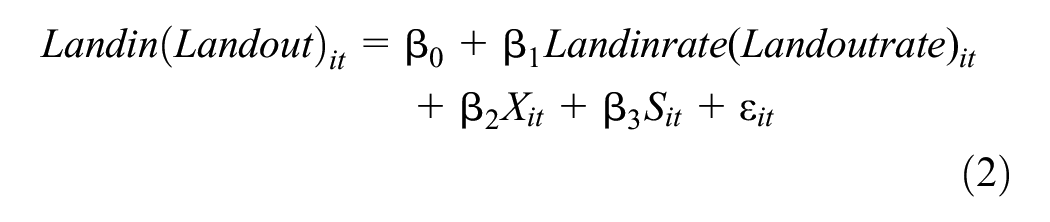
where Landinrate(Landoutrate)it is the land inflow and outflow rate perceived by household i in year t, and the coefficient
The land inflow rate (or land outflow rate) is calculated by determining the proportion of households that have rented-in (or rented-out) land among other sample households within the same village, excluding the household itself. The IV must satisfy the relevance assumption and exclusion restriction. The relevance assumption requires the land transfer rate to correlate strongly with households’ land transfer decisions. The literature shows that land transfer decisions exhibit herd effects (Qiu et al., 2020), indicating that household production decision behaviors influence each other. The greater the proportion of land transfer in the village, the more likely households are to have information about the forms, lease terms, and returns of land transfer, thus increasing their likelihood of participating in land transfer. The exclusion restriction mandates that the land transfer rate can affect resilience only through its impact on households’ land transfer behavior. Since the land transfer behavior of neighboring households in the village represents their own changes in resource allocation, it does not directly affect the resilience of the sample households.
Variable Selection
Dependent Variable: Rural Household Resilience
Currently, resilience measures fall into two main categories. One group of research captures the characteristics of resilience across various dimensions by employing multidimensional indicators or simplifying these sets of indicators into indices using methods such as entropy (Quandt et al., 2019; Stanford et al., 2017; Woolf et al., 2016). Another group of research conceptualizes resilience as a normative welfare standard similar to the poverty concept. A representative definition conceptualizes resilience as the probability that an individual maintains at least a certain minimum standard of living conditional on various observable characteristics (Barrett & Constas, 2014). To capture the stochastic and nonlinear nature of welfare dynamics, this paper adopts a normalized resilience measurement approach proposed by Cissé and Barrett (2018) and sets up the resilience measurement model as follows:

where Wit denotes the well-being of household i in year t,
The measure of well-being is crucial for estimating resilience in Equation 3. Commonly used welfare indicators include herd size, per capita expenditures, children’s physical health status, and subjective well-being measures (Barrett et al., 2021). Considering that one-dimensional measures such as expenditure and income are particularly prone to measurement error (Barrett & Carter, 2013), the Livelihood-Weighted Asset Index (LWAI) is used in this study as a well-being indicator (Adato et al., 2006). The index reflects the marginal contributions of various types of capital to livelihoods and is more suitable for depicting the well-being of rural Chinese households under diversified asset portfolios (Yao et al., 2023). Additionally, one unit of the LWAI represents the asset poverty line, which corresponds to an asset portfolio that provides a livelihood level at the poverty line, making it an appropriate choice for the normative well-being threshold. The estimation results of the LWAI are presented in Appendix A. Finally, the conditional mean and variance are estimated using Generalized Linear Models (GLM) and Bootstrap methods (Appendix B). The resilience of households is then computed under the assumed gamma distribution, representing their conditional probability of being above the asset poverty line.
Explanatory Variables: Land Inflow and Outflow
This research sets land inflow and land outflow as two dummy variables. If a rural household engaged in renting-in land within the past 12 months at the time of the survey, the land inflow dummy is assigned a value of 1. Otherwise, it is assigned a value of 0. The assignment method for the land outflow dummy follows the same rules.
Control Variables
To mitigate the impact of omitted variables, this study controls for relevant variables across three dimensions: household head characteristics, family characteristics, and community environment. The selection of these control variables aims to capture key demographic, socioeconomic, and environmental factors influencing household resilience in the context of land transfers, while maintaining the statistical integrity of our model by avoiding multicollinearity and ensuring data quality and availability.
The basic characteristics of the household head include gender, age, marital status, political identity, and years of education. Squared age is also controlled to account for life cycle effects (Cissé & Barrett, 2018). These factors have been shown to be significantly correlated with both land transfer decisions and households’ ability to withstand external shocks (McLaughlin, 2017; Melketo et al., 2021; Su et al., 2018; Vaitla et al., 2020; J. Wang et al., 2020). At the family level, household size and dependency ratio are controlled as they are crucial in understanding labor availability and economic burden, directly impacting household resilience and their capacity to engage in and benefit from land transfers (L. Gao et al., 2019; Melketo et al., 2021). Family members’ health status is controlled to capture the potential impact of health on household resilience (Diwakar & Shepherd, 2022). Family resources, such as the size of cultivated land and agricultural subsidies are included as controls since they are important factors that affect farmers’ decision on land allocation and poverty dynamics (Peng et al., 2020). To further control for nonmaterial characteristics in the resilience system of rural households, this paper also adds social capital (per capita expenditure on gifts) as a control variable (Woldehanna et al., 2022). At the community level, the village’s topographical features and climatic environment characteristics (whether it is a frequent natural disaster area) are controlled, as these factors may influence household resilience by shaping agricultural productivity, access to natural resources, and vulnerability to climate shocks (Jha et al., 2021; H. Li et al., 2024).
Risk Variables
Cissé and Barrett (2018) used exogenous weather shocks to capture the potential economic risks pastoralists face, as droughts could lead to significant cattle mortality in their research context. However, given the diversity of income sources among Chinese rural households, this study classifies the risks faced by households based on income type. Specifically, this paper assesses the degree of risk based on the uncertainty of wage, operational, transfer, and property income. The measure of income uncertainty is the adjusted deviation rate of each type of income, reflecting the level of volatility in unexpected income fluctuations compared to expected income (J. Wang, 2010). The formula for the adjusted deviation rate is:
A complete list of variables and their definitions are displayed with descriptive statistics in Table 1.
Variables, Definitions, and Descriptive Statistics.

The village’s terrain includes six types: mountains, plateaus, hills, plains, grasslands, and fishing villages. This article considers hills, plains, grasslands, and fishing villages as plain terrains, while mountains and plateaus are regarded as hilly terrains.
Empirical Results
Baseline Regression
Table 2 reports the regression results of the impact of land transfer on rural households’ resilience using OLS and the two-stage least squares (2SLS) approach. The coefficient of the OLS estimator for land inflow in column (1) is close to zero and lacks statistical significance at the 10% level. As discussed, this is likely due to a positive bias in the estimates caused by self-selection among the lessee households. After addressing the endogeneity issue with IV techniques, the results of the second-stage estimation in column (3) indicate that transferring-in land harms household resilience, which is statistically significant at the 1% level.
Results of OLS and 2SLS Estimates.

Note. Robust standard errors in parentheses. ***p < .01. **p < .05. *p < .10.
The statistic of the underidentification test is Kleibergen-Paap rk LM, and the statistic of the weak identification test is Kleibergen-Paap rk Wald F.
One sample with negative LWAI is dropped since the well-being indicator cannot be negative in resilience estimation.
In columns (4) and (6), the OLS and 2SLS estimates of the effect of land outflow on household resilience are positive and statistically significant at the 1% level. This suggests that land outflow has a positive effect on enhancing household resilience. Additionally, the 2SLS estimate of the land outflow coefficient is 0.025, approximately three times the OLS estimate. This may be because Chinese rural households have strong attachments to their land, and they choose to rent out their land only when the utility derived from supplementing their income through renting-out land exceeds the satisfaction of retaining their land. Given the diminishing marginal utility of income, households with high resilience are often unwilling to rent-out their land for what they consider to be insignificant rental income, leading to an underestimation of the average treatment effect of land outflow.
Columns (2) and (5) report the first-stage regression results of the 2SLS regression. The land inflow and outflow rates positively contribute to the decisions to rent-in and rent-out land, validating the herd effects of land transfer. The Kleibergen-Paap rk LM statistics in the underidentification tests exceed the critical values, further confirming the relevance assumption. Additionally, the Kleibergen-Paap rk Wald F statistics are larger than 16.38 (10% maximal IV size), indicating that no weak IV problem occurs.
In addition, several interesting findings arise from the control variables used in the regression analysis. Female-headed households are found to be less resilient, which is consistent with findings in other literature (Fuller & Lain, 2020). The results also show that marital status is negatively correlated with household resilience. This may reflect potential disharmony in spousal relationships within rural households, as conflicts between husbands and wives can negatively affect family resilience. Material assets (such as cultivated land) and nonmaterial assets (such as human capital, social capital, and political capital) positively impact household resilience, indicating the crucial role that assets play in resisting economic shocks (Ansah et al., 2022; Pacoma & Delda, 2019). Finally, shocks such as illness and natural disasters seriously threaten rural households’ livelihoods. A higher proportion of family members with illnesses and living in areas prone to natural disasters significantly reduces the resilience of rural households.
Robustness Tests
This study conducts the following three robustness tests to confirm the validity of the results:
(1) Substitution of the dependent variable measure
Resilience reflects a range of capabilities that allow rural households to achieve long-term poverty escape, even in the face of shocks and stresses, where a higher level of resilience means avoiding falling into chronic poverty or only temporarily escaping poverty. Therefore, referring to the analysis framework on resilience by Diwakar and Shepherd (2022), this study uses whether a household can sustain escape from poverty as an alternative resilience indicator. A sustained escape from poverty is defined, according to Eichsteller et al. (2022), as household expenditure consistently exceeding the poverty line across all three consecutive surveys from 2016 to 2020. The regression results are shown in columns (1) and (4) of Table 3.
Results of the Robustness Test.

Note. Robust standard errors in parentheses.
p < .01. **p < .05.
(2) Substitution of the risk measure
Some scholars use a specific standard deviation variable as a proxy for risk because the standard deviation reflects the degree of variation between groups, and this degree of difference is an important factor contributing to perceptions of uncertainty. Referring to Ito and Kurosaki (2009), who used the coefficient of variation of precipitation to measure the uncertainty of agricultural climate, this study recalculates the income risks for the resilience estimation and the regression analysis using the coefficient of variation (CV) of various types of income within households in the district, with regression results displayed in columns (2) and (5) of Table 3.
(3) Expansion of the sample scope
This study adds additional samples to verify the robustness of the baseline results. Specifically, rural households that participated in the survey continuously for four rounds from 2014 to 2020 are included in the sample. The regression results are presented in columns (3) and (6) of Table 3.
All the estimation results in Table 3 indicate that land inflow significantly reduces the resilience of rural households. In contrast, land outflow significantly enhances the resilience of rural households, suggesting that the estimation results of the baseline regression are robust.
Mechanism Analysis
To further explore the mechanism of the impact of land transfer on household resilience, this section will examine the effects of land transfer on household absorptive capacity, adaptive capacity, and transformative capacity, based on the conceptual framework built in “Background and theoretical analysis” section.
Absorptive Capacity Mechanism
Participating in social security programs and increasing household savings contribute to households’ ability to absorb the impacts of shocks. This study uses the average participation in medical and pension insurance, calculated as the number of members with medical and pension insurance divided by household size, to represent households’ participation in social security programs. Meanwhile, the total cash and deposit amount per capita is used to represent the household savings. These two variables are regressed against the land transfer decision using the same IV approach as in the baseline analysis.
The regression results are shown in Table 4. In column (1), the estimated coefficient of land inflow on rural household participation in social security programs lacks statistical significance. This suggests that the two social security programs for rural residents partly compensate for the deficiencies of formal insurance mechanisms in rural areas. However, since land inflow limits rural household members’ opportunities to obtain insurance provided by formal nonfarm employment, land inflow has no significant overall impact on household insurance participation. Column (2) presents the estimation results of the impact of land inflow on household savings, and no significant effect is found. This result indicates that the positive effect of expanding agricultural operation scale on savings may be offset by the negative effect on savings resulting from increasing production investment and being more susceptible to agricultural market fluctuations. Consequently, renting-in land has no statistically significant impact on household savings. Overall, land inflow has no significant effect on households’ absorptive capacity.
Results of Testing the Absorptive Capacity Mechanism.

Note. Robust standard errors in parentheses.In mechanism analysis, the results of underidentification test and weak-identification test remain the same as in the baseline result.
p < .01. **p < .05.
Columns (3) and (4) present the estimation results for land outflow. Consistent with theoretical expectations, land outflow significantly increases household participation in insurance and savings. Rural households can build more robust buffering mechanisms for future uncertainties through land outflow, enhancing their resilience to risks and stressors.
Adaptive Capacity Mechanism
This study measures the level of income type diversity among rural households by calculating the number of different types of household income. Specifically, if a household has any of the following: wage income, operational income, transfer income, or property income, it is counted as one and summed accordingly. To assess the impact of land transfer on the multiple job holdings of family members, the number of part-time jobs per active worker in a household is used to represent part-time job diversification.
The IV estimation results of renting-in land on income type diversification and holding multiple jobs are shown in columns (1) and (2) of Table 5. The results in column (1) indicate that land transfer-in has no significant impact on income type diversification. A probable reason for this is that, on the one hand, lessee households can balance agricultural production and nonagricultural employment. On the other hand, the negative impact of land inflow on property income sources offsets the positive impact on transfer income sources, resulting in an insignificant total effect on income type diversification. In column (2), the estimated coefficient of land inflow on part-time job diversification is negative and statistically significant at the 5% level, indicating that renting-in land reduces the likelihood of household members engaging in multiple jobs simultaneously, weakening the diversification strategy of rural households. Overall, land inflow reduces the adaptability of rural households.
Results of Testing the Adaptive Capacity Mechanism.

Note. Robust standard errors in parentheses.
p < .01. **p < .05.
Column (3) displays the estimation results of land outflow on income type diversification. The estimated coefficient of land outflow is 1.098 and is statistically significant at the 1% level, indicating that households transferring out land increase the number of income types by more than one on average. As discussed earlier, property income provided by land outflow may be the main reason for the increase in income types. However, the estimation results in column (4) suggest that land outflow does not increase the diversification of part-time jobs among household members. This may be due to a certain degree of mismatch in the part-time labor market, where migrant workers of lessor families cannot meet the requirements of part-time work regarding working hours and job content. Overall, land outflow still positively impacts the adaptive capacity of rural households.
Transformative Capacity Mechanism
To examine the effect of land transfers on rural households’ transformative capacity, this study employs the proportion of wage income to total income and a binary variable indicating whether household members engage in individual business operations or start private enterprises as proxy variables for employment transition and entrepreneurial transition, respectively.
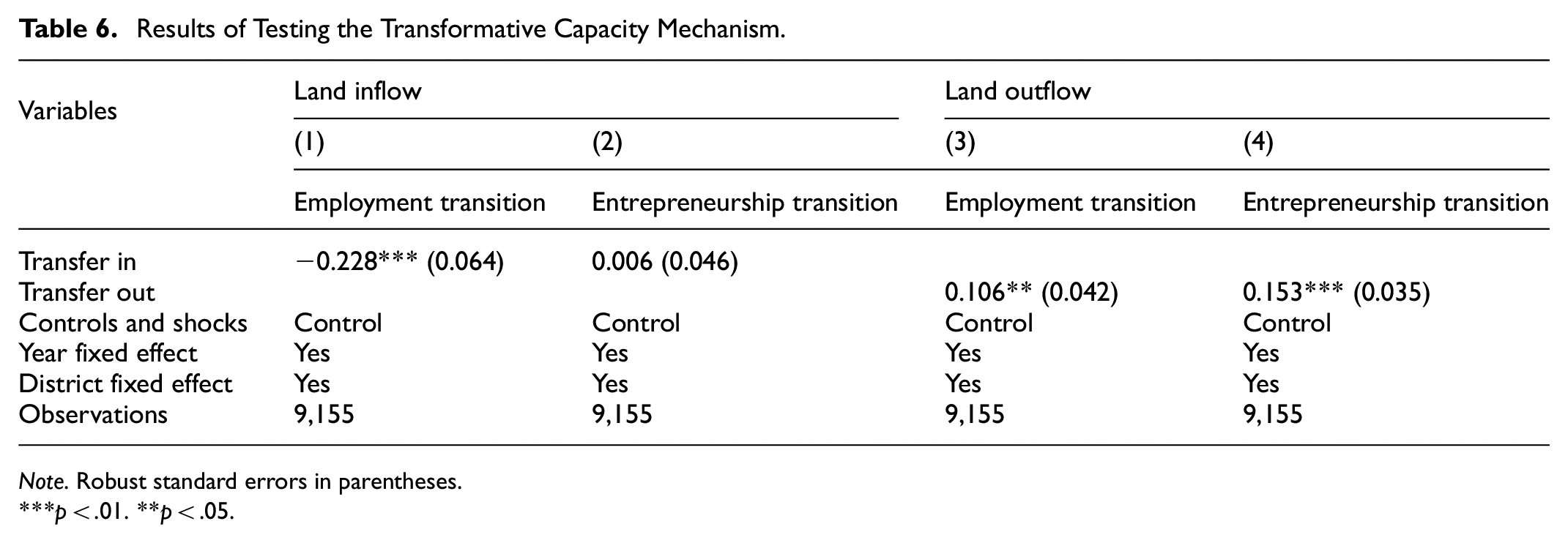
Column (1) in Table 6 presents the IV regression results of the impact of land inflow on employment transition. The estimated coefficient of land inflow is negative and statistically significant at the 1% level, suggesting that land inflow has a negative effect on household labor participation in nonagricultural salaried employment. This is because land and labor are complementary inputs in agricultural production. Land inflow increases the scale of agricultural production for lessee households, making them more inclined to allocate their labor to agricultural production rather than nonagricultural employment. Therefore, renting-in land suppresses the employment transition of these households. The empirical results in column (2) show that land inflow does not have a significant causal effect on rural households’ participation in entrepreneurial activities. This indicates that most rural households that transfer in land expand their production scale without changing their operational model. Thus, land inflow does not facilitate the entrepreneurial transition of rural households.
Results of Testing the Transformative Capacity Mechanism.
Note. Robust standard errors in parentheses.
p < .01. **p < .05.
Column (3) of Table 6 presents the estimated results of the impact of land outflow on nonagricultural employment transformation. Land outflow significantly increases the proportion of household wage income, indicating that it promotes rural household engagement in nonagricultural employment. Additionally, in column (4), the estimated coefficient of land outflow on rural household entrepreneurial transformation is positive and significant at the 1% level. This shows that land outflow also positively affects rural households’ entrepreneurial transition. These results show that land outflow eliminates the restrictions of agricultural production on rural household labor engagement in nonagricultural work, promotes the transition of households’ livelihoods to nonagricultural employment, and facilitates the process of entrepreneurial transition in rural households.
Heterogeneity Analysis
Overage Workers
The legal retirement age in China is at most 60 years. Workers who continue to work beyond this age limit are known as “overage workers.” Traditionally, elderly people in rural China have to continue farm work through old age until they are no longer physically capable (Ning et al., 2016). For rural migrant workers in cities, pension standards are often insufficient to sustain their livelihoods. Coupled with the desire to relieve their children’s burden of eldercare, they also tend to delay retirement to earn more money while they can still work. As the aging of the Chinese population intensifies, the phenomenon of overage labor within rural households is becoming increasingly common (Cao et al., 2020).
This study constructs a dummy variable for overage labor to examine the heterogeneity of the impact of land transfer on the resilience of households with overage workers. This dummy variable is assigned a value of one if the average age of the household’s active workers is 60 years or older and zero otherwise. The overage labor dummy is then included in the regression equation along with its interaction term with land transfer, with the regression results shown in columns (1) and (2) of Table 7.
Results of the Heterogeneity Analysis.

Note. Robust standard errors in parentheses. ***p < .01. **p < .05. *p < .10.
The results show that the interaction between land transfer-in and the overage labor dummy lacks statistical significance, suggesting that overage labor does not exacerbate the negative impact of land transfer-in on resilience. This may be because the widespread adoption of agricultural mechanization makes the age of the labor force no longer a significant limitation for expanding the agricultural production scale through land transfer-in. However, the interaction between land transfer-out and the overage labor dummy variable is negative and statistically significant at the 5% level, suggesting that land transfer-out has a less beneficial impact on resilience for households with overage workers. This can be attributed to the fact that overage migrant workers constitute a particularly vulnerable segment of the urban labor market. For instance, various regions throughout China have implemented regulations prohibiting overage workers from participating in the construction industry. Consequently, these workers face significant obstacles and challenges in re-employment.
Female Workers
According to the literature on resilience, due to factors such as restricted social norms, employment discrimination, and a lack of land security, females are often less resilient than their male counterparts (Fuller & Lain, 2020; Perez et al., 2015). Based on these findings, this study introduces a dummy variable for female workers, which is defined as one if female workers constitute more than half of the household labor force and zero otherwise. The interaction term between the female worker dummy variable and the core explanatory variables is incorporated into the regressions for heterogeneity analysis, as shown in columns (3) and (4) of Table 7. The regression results indicate that a high proportion of female workers within the household does not influence the negative effect of land transfer-in on household resilience. However, the coefficient of the interaction term between land transfer-out and the female labor dummy variable is negative and statistically significant at the 1% level. This suggests that households with a high proportion of the female labor force may not experience a significant promotion effect of land transfer-out on resilience. After renting-out land, there could be resistance in the transition process of female laborers participating in nonagricultural employment, including potential instances of gender discrimination in the labor market.
Discussion
The above empirical analysis shows that, overall, land inflow weakens rural household resilience, while land outflow enhances it. In comparison to existing literature on land transfer, which mainly focuses on direct economic outcomes such as income and productivity (Deininger et al., 2017; L. Zhang et al., 2018), this study introduces a new resilience perspective to these findings. By shifting the focus to resilience, our study emphasizes the importance of considering the long-term impacts of land transfer policies, particularly in the context of rural development and sustainable poverty alleviation.
Interestingly, the findings on the negative impact of land inflow on resilience contrast with previous studies that have emphasized its positive effects on agricultural productivity and rural incomes (Lu et al., 2019; L. Zhang et al., 2018). This discrepancy can be attributed to our focus on resilience rather than immediate economic benefits. In the long term, expanding land holdings may expose rural households to greater risks, as larger farms are more vulnerable to substantial losses in the event of a failed harvest (Huang et al., 2014). In contrast, the positive impact of land outflow on resilience is consistent with studies identifying the significant role of transferring out land in alleviating multidimensional poverty for rural households (C. Li et al., 2021; S. Liu et al., 2024). Our study extends this literature by demonstrating that the welfare gains from land outflow can translate into improved household resilience, suggesting that policies promoting land outflow may have positive long-term welfare effects beyond temporary poverty alleviation.
The analysis of the underlying mechanisms reveals that the negative impact of land inflow on resilience is primarily due to the reduction in adaptive and transformative capacities. In terms of adaptive capacity, lessee households are less likely to engage in multiple jobs simultaneously, thus weakening their diversification strategies. This result highlights the trade-offs between agricultural specialization and livelihood diversification faced by rural households (Jin et al., 2021; Michler & Josephson, 2017). Lessee households, in pursuit of economic efficiency, often tend toward agricultural specialization. However, an excessive focus on specialization may constrain their potential for livelihood diversification, which is critical for long-term resilience (J. Zhang et al., 2019). Similarly, in terms of transformative capacity, agricultural specialization leads to increased physical and human capital specificity related to agriculture, thereby creating high transaction costs that hinder lessee households’ transition to non-agricultural employment (Williamson, 1985). Surprisingly, although land inflow creates favorable conditions for entrepreneurial transition for rural households, there is no evidence of increased entrepreneurial activity among lessee households. This may be explained by three main reasons in the Chinese context: First, most lessee households currently engaging in entrepreneurial activities start with small home-based businesses in rural areas. They use their residential properties as the foundation for their business operations, relying on the agricultural industry chain to conduct agricultural product processing, rural tourism, and other rural businesses (Mason et al., 2011). Due to their small scale and lack of standardized production processes and environments, such enterprises often lack legitimacy and are subject to certain restrictions in terms of market access, sales channels, and financing (Lent et al., 2019). Although transferred land can serve as collateral to alleviate the liquidity constraints of rural entrepreneurs, this policy was implemented only after 2018, and its effects may not yet be significant. Second, the agricultural industry chain in most rural areas of China is incomplete, and the degree of industry integration is insufficient, which limits business opportunities in rural areas. Specifically, the agricultural industry chain in China is short, with insufficient backward extension of the primary industry. Under such circumstances, rural households cannot benefit from the value-added returns of the entire agricultural industry chain. Even when possessing the financial capital and land assets necessary for entrepreneurial involvement, lessee households are often reluctant to engage in entrepreneurial activities. Finally, successful entrepreneurial transition requires households to have specific entrepreneurial skills, such as communication, planning, and marketing abilities. However, due to the lack of entrepreneurial skills training and corresponding entrepreneurial consulting services in current rural China, many households may be unable to make this transition (Welsh et al., 2016).
Unlike land inflow, the positive impact of land outflow on all three dimensions of resilience (absorptive capacity, adaptive capacity, and transformative capacity) is primarily attributable to its role in facilitating the transfer of household agricultural labor to non-agricultural sectors. It is well established that due to China’s long-standing policy of prioritizing industrialization, the agricultural sector continues to lag behind the industrial sector (J. Zhang et al., 2019). Consequently, the significant income differential between nonfarm and farm work motivates rural households to seek nonfarm employment opportunities (Y. Liu, 2017). Land outflow allows households to access these opportunities, increasing savings and insurance participation, thus enhancing absorptive capacity. Additionally, as lessor households develop non-agricultural skills and expand their social networks through participation in nonfarm activities, their capacity for livelihood transformation improves (Lans et al., 2014; Pindado et al., 2018). Furthermore, the rental income generated from land outflow diversifies the income sources of lessor households, thereby strengthening adaptive capacity. However, the heterogeneity analysis reveals weaker positive impacts of land outflow for households with older workers and a higher proportion of female workers. This result aligns with previous studies that emphasize the challenges the elderly and women face in transitioning to non-agricultural employment (Ning et al., 2016; Perez et al., 2015). It implies that if rural household members are unable to secure employment in urban areas after transferring out their land, they may face a risk of deteriorating resilience (Xie, 2019). This finding contributes to the growing literature on the differential effects of livelihood transitions across various demographic groups (Fuller & Lain, 2020; Tong et al., 2017).
Conclusions and Policy Implications
By analyzing panel data extracted from five consecutive waves of the China Family Panel Studies (CFPS) spanning from 2012 to 2020 and comprising 2,289 households, this study investigates the impact of land transfer on the resilience of rural households in China. Compared to prior research on the welfare effects of land transfer, the main contribution of this study is its adoption of a vulnerability and capability-oriented perspective that emphasizes the long-term impact of land transfer on household welfare. Moreover, in terms of methodology, this study constructs a resilience analysis framework and employs IV methods to correct the endogeneity problem in empirical analysis. The findings shed important light on the extent to which recent policies promoting land transfer in China have achieved long-term welfare improvement for rural households and sustainable poverty escape.
In general, land inflow negatively affects the resilience of rural households in China, whereas land outflow strengthens it. When exploring the underlying mechanisms, this study decomposes household resilience into three key dimensions: absorptive, adaptive, and transformative capacity. The results show that decreases in adaptive capacity and transformative capacity are the main reasons for the negative impact of land inflow on household resilience, manifested as a decline in the diversity of part-time jobs for lessee households and obstacles in transitioning to nonagricultural employment and entrepreneurship. For households transferring out land, their capacities are improved to varying degrees across the three dimensions. Furthermore, heterogeneity analysis indicates that the positive impacts of land outflow on resilience are relatively weaker for rural households with overage laborers and a greater proportion of female laborers. This phenomenon may be related to the exclusion of these relatively vulnerable groups from the urban labor market.
The findings have profound policy implications. First, as land outflow positively impacts rural household resilience, the government should encourage households to transfer idle land and engage in nonagricultural employment and entrepreneurship. Specifically, local governments should streamline the land transfer process and strengthen the publicity of relevant policies to encourage households to transfer idle land, thereby increasing property income and promoting income diversification. Moreover, the government should establish employment information platforms to provide timely and effective employment information and job-matching services for households seeking nonagricultural employment. Additionally, relevant entrepreneurial skills training and financial support should be offered to households intending to start businesses. In addressing employment and re-employment issues among vulnerable groups, efforts should be made to promote the integration of urban and rural labor markets, eliminating age and gender discrimination in urban labor markets.
Second, more support should be given to households transferring in land. Uncertainty in agricultural production still exists, and with the expansion of the operational scale, the production risks of households transferring in land also increase. Therefore, promoting agricultural insurance can reduce the impact of extreme weather or pest infestations on rural households transferring in land. Furthermore, the government should enhance the formal social security mechanism in rural areas and bolster the supervision of nonagricultural labor markets in rural areas to ensure basic job insurance coverage for workers engaged in nonagricultural employment.
Finally, the government should develop rural industry and optimize its structure by promoting the multifunctionality of agriculture and fostering new forms of industries, such as rural tourism and e-commerce. Insufficient rural industrial development, incomplete industrial chains, and inadequate infrastructure are important factors hindering the entrepreneurial transition of households involved in land transfer. Promoting rural industrial development can create numerous business opportunities locally, encouraging entrepreneurship and improving local nonagricultural employment. Such development strategies not only help address the challenges faced by rural overage labor and female labor in urban labor markets, providing them with more opportunities to engage in nonagricultural economic activities in the surrounding rural areas but also contribute to the promotion of the urbanization process, diversification of local services, and reduction of inequality between urban and rural areas.
Limitations and Future Research Scope
While this study provides valuable insights into the relationship between land transfer and rural household resilience in China, several limitations should be acknowledged. First, a key constraint lies in the use of secondary data from the CFPS database. Although CFPS offers comprehensive panel data spanning multiple years, the pre-designed questionnaires were not specifically tailored to measure household resilience. This mismatch between available variables and ideal resilience indicators may limit our ability to fully capture the complexity of absorptive, adaptive, and transformative capacities that constitute household resilience. Future research could build on the theoretical framework proposed in this study and collect primary data designed to measure these three dimensions of resilience more comprehensively. Second, the findings of this study are rooted in the context of China’s unique land institutional framework, where land is collectively owned and farmers hold only land contract and use rights. This institutional arrangement governing land transfers in China differs fundamentally from private land ownership systems prevalent in many other countries. As a result, the observed effects of land transfers on rural household resilience may not be directly applicable to contexts with private land ownership systems. Future research is recommended to explore whether similar resilience dynamics emerge under alternative land institutional arrangements to provide a broader comparative understanding.
Footnotes
Appendix A
Appendix B

Ethical Considerations
The China Family Panel Studies (CFPS) project team adheres to relevant regulations by regularly submitting ethical review or continuous review applications to the Peking University Biomedical Ethics Committee. All data collection activities are conducted only after obtaining ethical review approval. As a longitudinal tracking study, the project team submits continued review applications to the ethics committee in subsequent survey years; however, the CFPS project’s ethical review approval number remains consistent across all survey waves as IRB00001052-14010.
Consent to Participate
All participants provided written informed consent prior to participating.
Funding
The author(s) disclosed receipt of the following financial support for the research, authorship, and/or publication of this article: This work was supported by the National Social Science Fund of China [grant number 23&ZD112, 18BRK003].
Declaration of Conflicting Interests
The author(s) declared no potential conflicts of interest with respect to the research, authorship, and/or publication of this article.