




Abstract
The principal defense of compulsory voting suggests that it bridges socioeconomic inequalities by fostering a higher, and hence less socioeconomically biased, turnout. However, this article argues that this does not automatically translate into a less biased political voice because compulsory voting also generates socioeconomically biased invalid votes, which is demonstrated on the case of Ecuador. Normatively, we deny the existence of a general moral and legal duty to vote, which would justify compelling a citizen to vote. Achieving higher levels of social equality does not automatically take priority over a citizen’s rights to liberty and conscience. Furthermore, we object in general to the paternalistic justification of compulsory voting made by its defenders. Thus, we find that instituting compulsory voting as an instrument of reducing class inequalities is unwarranted both empirically and normatively.
Introduction
Perhaps the key argument in favor of compulsory voting builds on the notion that compulsion, through its positive effects on voter turnout, reduces inequality both in terms of political and social fairness. We question this argument on both normative and empirical grounds. Normatively, compulsory voting is problematic in several aspects. Some of its defenders try to establish a duty to vote and label those who do not participate in voting as free riders. We think that this description is not valid. Second, we aim to refute the idea that compulsory voting is an appropriate tool to achieve a higher level of socioeconomic equality and ensure everyone that their political rights have fair value. In our opinion, more equal political participation could be achieved by other means less inimical to personal liberty and autonomy.
Empirically, we show in the case of Ecuador—one of the few countries where compulsory voting is strictly enforced by a system of sanctions—that compulsory voting has failed to safeguard more equal access to the political system for different socioeconomic groups. Compulsory voting generates both higher turnout rates as well as higher rates of invalid voting. Although turnout rates are negatively associated with income inequality (consistent with what the proponents of the inequality-bridging effects of compulsion would predict), the staggering amounts of invalid votes are strongly negatively associated with income inequality. As invalid votes do not determine political outcomes, we suggest that switching to obligatory voting does not solve the problem of a socioeconomically unequal voice in politics. It merely transforms the problem from an unequal voice in low turnout, low-invalid-voting countries (in voluntary voting systems) to a similarly unequal voice in high turnout, high-invalid-voting countries (in compulsory voting systems).
The Issue
Arend Lijphart famously advanced the case for compulsory voting based on the argument that near-universal turnout induced by compulsion erases the inequality gap in participation between social groups (Lijphart, 1997). Because “. . . the inequality of representation and influence are not randomly distributed but systematically biased in favor of more privileged citizens—those with higher incomes, greater wealth, and better education—and against less advantaged citizens” (Lijphart, 1997, p. 1), it follows that (an especially low) turnout is class-biased. As near-universal turnout means a less unequal and less socioeconomically biased turnout, it follows that measures to increase turnout (with compulsory voting chief among them) contribute to resolving the “central unresolved dilemma of democracy” (Lijphart, 1997). Simply put, “where voting is voluntary, the views that contribute to policymaking are skewed towards the rich, and the result is a widening of the wealth gap.” (Birch, 2009a, p. 23)
There is evidence to support the partial arguments in such a causal sequence. Quasiexperimental evidence from an Argentine survey shows that mandatory voting attenuates skill and socioeconomic bias in political participation as turnout by less skilled citizens is boosted substantially more than turnout by more advantaged citizens by voting compulsion (Jaitman, 2013), and another investigation similarly found that compulsory voting narrows the education gap and political knowledge gap in voting (Dassonneville, Hooghe, & Miller, 2017). A comparison of 28 industrial nations in a hierarchical framework concludes that compulsory voting reduces inequalities in turnout among groups based on education because under this system, a quasiuniversal turnout is achieved (Gallego, 2010). Other cross-national research has identified further equalizing effects of compulsory voting whose operation narrows the gender gap in voting and empowers women to become more engaged with the electoral process by seeking more political information or feeling more closely attached to parties (Córdova & Rangel, 2017). The equalizing effect is also operative with respect to many other political, demographic, and socioeconomic factors that norrmally motivate turnout under voluntary voting systems (Singh, 2015).
As parties design their programs to reflect the views of the electorate, rather than of the whole population (Birch, 2009b), such equalizing effects of compulsory voting should also generate policies supportive of more income redistribution and hence lower income inequality. For example, where voting is compulsory, governments tend to spend more on health services as a share of their total expenditure (O’Toole & Strobl, 1995), lending support to such policy-changing effects of voting compulsion. Cross-national evidence finally supports the hypothesis that countries with strict enforcement of sanctions for nonvoting (though not all compulsory voting systems) feature a more equal distribution of incomes than countries with voluntary voting or where compulsion is not enforced (Birch, 2009b; Chong & Olivera, 2008). Abolishing compulsory voting in Venezuela has led to an increase in income inequality supporting the Lijphart thesis (Carey & Horiuchi, 2017).
There is also significant evidence for the second association that is crucial to our argument, namely, that compulsory voting also substantially increases the rate of invalid voting. This has been the unequivocal finding of cross-national comparative studies on invalid voting (Power & Garand, 2007; Reynolds & Steenbergen, 2006; Uggla, 2008), although the relationship appears to be strongly conditioned by voter efficacy with compulsory voting exercising the strongest effects, when the stakes of the electoral competition are diminished (Kouba & Lysek, 2016). Although the strong correlation between compulsory voting and high rates of invalid ballots is rarely disputed, there is no consensus over the nature and meaning of such invalid ballots. Invalid votes could still signify a meaningful response of politically engaged voters to a deficient political offer (Driscoll & Nelson, 2014). However, there is also substantial evidence from the study based on the cross-national survey data that invalid voting induced by compulsory voting laws is driven by a lack of information and interest, political distrust and negative attitudes toward democracy (Singh, 2017). In Latin America, invalid voting is often most frequent among those with less education and levels of political knowledge (Katz & Levin, 2016). At the same time, it increases turnout among those voters who are less engaged in politics, and who are at the same time more likely to cast an invalid ballot (Cohen, 2018).
This is consistent with other problematic attitudinal effects of compulsory voting identified by recent research. Although compulsory voting (substantively or slightly) increases trust in political institutions, yet at the same time, it negatively affects forms of societal engagement other than turnout, suggesting that the participatory effects of mandatory voting cancel each other out (Lundell, 2012). Concomitant evidence from subjective reactions among young British voters suggests that the introduction of compulsory voting might be counterproductive and serves to reinforce existing feelings of resentment (Henn & Oldfield, 2016). Such reinforcing effects of compulsory voting on the negative orientations toward democracy and system legitimacy are amply documented in another comparative study (Singh, 2018).
We, therefore, view invalid voting as a product of compulsory voting through which politically disinterested, less educated, less informed, and unengaged voters express the lack of interest in the political choice, or the elections themselves. Moreover, self-reported invalid voting—from which such inferences are drawn—underestimates the extent of invalid votes due to voting compulsion because invalid votes are also likely to arise from an unintentional voting error, which the voter cannot communicate in surveys (Hill & Young, 2007; Kouba & Lysek, 2016; McAllister & Makkai, 1993; Power & Garand, 2007; Reynolds & Steenbergen, 2006). Such votes—that appear in the aggregate-level figures of the overall voting results, but not in individual-level survey responses—in turn are likely to be handed out by the less educated (Hill & Young, 2007; McAllister & Makkai, 1993; Power & Garand, 2007; Reynolds & Steenbergen, 2006) and less politically informed citizens. This only aggravates the problem. Invalid ballots induced by compulsory voting systems not only do not decide representation, but also generally fail to represent specific political interests.
Our aim is not to question the associations between compulsory voting and socioeconomic equality identified by comparative research, but rather to question the principal causal mechanism linking compulsory voting and income equality as well as the normative basis for instituting voting duty based on such associations. The first section presents the argument that in several respects the defense of compulsory voting fails to justify it within the framework of a liberal–democratic political system. The second section tests the principle observable implication from the causal claim that compulsory voting bridges socioeconomic biases in representation. It does so by testing the main research hypothesis that invalid voting is negatively associated with income inequality in the case of the compulsory voting system of Ecuador.
Should Political Inequality Be Reduced by Compulsory Voting?
We first tackle the issue of whether it is justifiable on normative grounds to oblige voters to participate to close the inequality gap in electoral participation. For Lijphart and other proponents of compulsory voting, it is a morally permissible and effective remedy for the consequences of declining and increasingly unequal turnout in liberal democracies for the subsequent reasons: (a) higher turnout translates into higher representativeness of democracy and also more equal political participation, (b) voting is necessary to provide the public good of democracy and a compulsion to vote curbs the immoral practice of free riding of nonvoters on those willing to vote, (c) legal sanctions for nonvoting are relatively negligible and these kinds of infringements on personal liberty are overweighed by the benefits compulsory voting yields, (d) the right to not take part in voting is insignificant. We are not satisfied with all of these justifications for compulsory voting, as we describe in several arguments below.
Higher turnout leads to higher representativeness, or so many defenders of compulsory voting conjecture. But is that so? Our basic argument here is that an enlarged pool of voters will necessarily be less informed, therefore, depressing the potential higher level of representativeness the compulsory voting would like to achieve. A majority of studies show that those who do not vote are those who are younger, poorer, less informed, and less interested in politics. We should presume (along with the empirical studies cited in the previous section) that if more people vote, this will decrease the number of informed votes in the electorate. There will be more votes cast, but they will also be less informed. It is possible that higher turnout will on occasion strengthen left-wing political parties, but it is also highly likely that many of these votes would be invalid, protest votes or so-called “donkey votes.” Furthermore, compelling more people to vote would not have a positive effect on the quality of democracy, unless by quality we mean that there is a particular kind of policy we want to strengthen through the establishment of compulsory voting. But that would presuppose that certain political ideologies or policies are per se more valuable than others, which is hardly in accordance with the tradition of democratic governance. We should rather seek for how to ensure more informed voting, but that hardly would be a result of simply making more people actually go out to vote. Even if compulsory voting contributed to poorly educated voters becoming more informed about politics, this effect is offset by its effect on depressing their interest in politics and becoming more politically alienated (Carreras, 2016). On the contrary, it is more probable that if everyone votes, the median vote will be less informed and, therefore, more biased, thus not leading to a higher representativeness under compulsory voting.
Crucially, we think that the interests of the least advantaged in liberal democratic societies are primarily focused on structural inequalities that contributes to their low socioeconomic position in society than on the inequality of the turnout, which is more of a symptom of these structural inequalities. It just seems more pressing to tackle the inequalities in education, workplace, health care, or the justice system than to rely on the quite optimistic claim that more equal turnout would be the most effective way to tackle the inequalities that plague modern democratic societies. Even though there are studies that find empirical linkages between the presence of compulsory voting and higher levels of social spending (see Carey & Horiuchi, 2017; O’Toole & Strobl, 1995), there are many countries characterized by high levels of social cohesion, a strong welfare state and an egalitarian social and political ethos that do not have compulsory voting (e.g., the Scandinavian countries). Compulsory voting thus is neither a sufficient, nor necessary factor for dealing with the issues of making certain social classes less advantaged than others.
Defenders of compulsory voting (such as Birch, 2009a; Lacroix, 2007) insist that to assure the fair value of political liberties, it is necessary to lower inequality in society, which could be achieved (in part) by making more people vote through compulsory voting. Lacroix uses John Rawls’s definition of fair political liberties as justification for compulsory voting. For Rawls, fair value of political liberties is maintained when “citizens similarly gifted and motivated have roughly an equal chance of influencing the government’s policy and of attaining the positions of authority irrespective of their economic or social class” (Rawls, 2001, p. 46). But that does not mean that we can or should make voting compulsory as one of the solutions for making political liberties more of a value for individuals. For Rawls, there is a legitimate reason for restrictions of basic liberties only if it satisfies the condition that this restriction will strengthen the total system of basic liberties (Rawls, 1971). That holds for the extent of such liberties as well as their security and fair value (Pogge, 2007). Rawls clearly means here that the fair value of political liberties should be ensured if I choose to take part in politics. Not that I am not autonomous if I do not or we do not see any compelling reason as to how nonvoting presents a danger to keeping the whole system of basic liberties in place.
The normative defense of compulsory voting stands on the idea that participation in elections is a moral (civic) duty. Nonvoting, on the contrary, presents a breach of moral duty and nonvoting citizens are kind of free riders, that is, they reap the benefits of the public good of democratic political decision making without contributing. Thus, nonvoting is like not paying taxes and using various public goods without sharing the burdens. But apart from a superficial resemblance between these two cases, are they analogical? If we do not pay taxes or refuse to contribute to national social insurance, the result may be the collapse of the distribution of some public goods made possible only by individual contributions. In this sense, it is not clear whether nonvoting is a significant threat to personal liberties or democratic decision making as such, because the danger that no one would vote seems negligible. What is more important is that Lijphart’s defense of compulsory voting presupposes that the primary contribution to building a more democratic and equal society is to go voting. But that is manifestly untrue, because it is perfectly possible that many citizens work for the society’s common good in a different way than just through taking part in elections (we are following the general argument of Brennan & Hill, 2014, Chap. 2). Some people take credit for generating a large part of their country’s GDP (gross domestic product), others take part in social services, education, or health care and still others care about politics and go vote (with various overlaps between these groups of citizens). Why should, for example, my contribution to democratic society as a university lecturer (who does not vote) count as less important than somebody else’s contribution by voting? In the same vein, we know that a strong civil society is good for the quality of a democracy, but we do not compel people to establish nonprofit organizations, volunteer for providing care of the elderly, provide education for children from poor families in their free time, and so on.
Furthermore, it is very hard to make a coherent picture regarding the claim that people who do not vote are generally those socially and politically marginalized and at the same time selfish and immoral because they reap the benefits of the system upheld by more disciplined people who attend elections regularly. It seems that the necessary component of the concept of free riding is that the free riders unjustly gain some substantive benefits of a certain general good without contributing to sustain the conditions generating this or that general good. But it would be really strange for proponents of compulsory voting to say that socially and politically disadvantaged nonvoters gain unfair benefits from a democratic political system relative to those who do vote regularly. It is precisely those disadvantaged and marginalized groups that vote the least and have low sociopolitical status at the same time.
We find compulsory voting unjustifiably paternalistic. Unlike the myriad of occasions when we are justifiably made to perform certain actions (paying taxes, stopping at red lights, driving on the assigned side of the road, etc.), in case of the duty to vote, there is no comparable justification for such regulation of individual actions. Paternalism could be roughly defined as “the interference with a person’s liberty of action justified by reasons referring exclusively to the welfare, good, happiness, needs, interests or values of the person being coerced” (Dworkin, 1972, p. 65). Defenders of compulsory voting claim that the coercion involved is negligible or absent, because nobody is actually forced to vote, only to attend the elections. Therefore, the charge of paternalism in the case of compulsory voting is misguided (Lacroix, 2007; see Engelen, 2009). Contrary to claims of proponents of compulsory voting in systems practicing it, there is criminal liability attached to nonvoting, which puts a significant amount of pressure on nonvoters and nonvoting may result in prison sentences, problems at work or reduced access to social services (see Lever, 2009). Even though in many states that practice compulsory voting this duty is rarely enforced and many exemptions are granted, it is precisely this fact of a quite opaque and normatively suspect system of who and when will be exempted from the duty to turn out at the elections that should lead us to reject the idea of compulsory voting. Exemptions from legally binding duties are always controversial, because they usually present significant obstacles to the legal equality of citizens. Therefore, compulsory voting still amounts to coercion and making people vote should be rightfully seen as an example of unjustified paternalism.
Paternalism is of course not always bad and there are many cases of paternalistic policies, which the majority of society would find rational and justified (e.g., laws against dueling, compulsory use of seatbelts, regulations for handling hazardous materials, etc.). Using one influential defense of paternalism by Gerald Dworkin (1972), we may claim that “paternalism is justified only to preserve a wider range of freedom for the individual in question.” From this point of view compulsory voting is not justified, because there are many other (yet less effective) ways of increasing voter turnout that are not coercive. And Lijphart and others cannot tell us why we should not try to attract more people to vote by alternative ways rather than compelling them by using the coercive nature of the state. We agree here with Dworkin (1972) that in all cases of paternalistic intervention there must be a heavy and clear burden of proof placed on the authorities to demonstrate the exact nature of the harmful effects (or beneficial consequences) to be avoided (or achieved) and the probability of their occurrence. (p. 83)
Furthermore, we cannot simply assume that every act of voting is in the self-interest of this or that particular voter, because he or she could have many reasons to feel that a particular act of voting is detrimental to his or her ideological, social, or economic interests. Therefore, making the vote legally mandatory does not sufficiently respect people’s voluntary decision not to vote. Proponents of compulsory voting claim that the right not to vote is either nonexistent, superficial, or trivial. We do not agree with this statement, because having not only the right not to vote, but also completely ignore the whole electoral process has its important place in democratic politics. As Lever (2010) points out, Rights to abstain, to withhold assent, to refrain from making a statement or from participating may not be very glamorous, but can be nonetheless important for all that. Rights to abstain, no less than rights of anonymous participation, enable the weak, timid and unpopular to protest in ways that feel safe, and that require little coordination and few resources. (p. 911)
However, the problem with compulsory voting runs deeper. Compulsory voting infringes on individual rights in an inappropriate way, because it builds upon a restrictively perfectionist version of liberalism, which could not be reasonably justified to all citizens in democratic states. Perfectionism rejects the standard liberal claim that a person is autonomous only if outside values and norms (or duties) governing her or his deliberation are accepted by him or her upon critical reflection (see Rawls, 1996). Perfectionists challenge that view because there are some completely objective values that should govern one’s actions even against the wishes and voluntary decisions of individuals or groups (see Hurka, 1993). Perfectionist liberals target the prevalent liberal idea that the liberal state’s policies should be neutral and respect individual autonomy. Take the Lacroix account, for example, where she claims that compulsory voting strengthens individual autonomy (see Lacroix, 2007). She claims that people should be compelled to vote because otherwise governments would not be appropriately controlled by the majority of citizens and that would mean a loss to everyone’s autonomy. Thus, her defense of compulsory voting is founded on an idea that the act of voting (or tuning out at the elections to be more precise) has to take preference over some other goals individuals might have at the time. The problem here is that by establishing a duty to vote, we claim that a certain action (voting in this case) is necessary for citizens to fully realize their fundamental purposes. Defenders of compulsory voting say that other actual desires than voting are not rational and they make people less free. That may be true in the case of constitutional fundamentals as individual liberties, protection of minorities, freedom of speech and religion, existence of competitive elections and rule of law, and so on, but not in the case of voting. If there are alternative ways to solve at least partially the problem of low turnout without restricting individual liberties, we should take such a course (see Dworkin, 1972).
Many of those compelled to vote will not vote due to a greater interest in politics or societal issues, but simply because of the fact of compulsion being in place. Lijphart understands anything beyond mandatory presence at the voting booth is a breach of fundamental personal liberties, most likely the freedom of conscience (Lijphart, 1997). Therefore, in all probability compulsory voting does not translate to the desired goal of upholding the duty to vote, because proponents of compulsory voting themselves stated in many books and articles that a duty to vote will not be legally compulsory. It is a very well-known empirical fact that turnout falls sharply after compulsion is removed, as happened in the Netherlands, for example. We should thus assume that many voters do not vote because compulsory voting made them appreciate fulfilling their duty to vote, but they have voted only because the presence of a legally enforceable compulsion.
To sum up, if the goal is to undermine sources of political domination in democratic society (e.g., the effect of class status on voter turnout) and achieve higher levels of social, economic, and political equality, we should probably be concerned with ensuring that more people vote conscientiously, in a more informed way and, crucially, try to mitigate the problem of significant structural inequalities within liberal democracies. Focusing too much on compulsory voting could lead to a situation in which we focus too much on inequality in turnout but fail to tackle much more severe and significant inequalities. Proponents of compulsory voting presuppose that higher turnout will lead to changes in the policy-making process, because politicians will be forced to reflect more the needs of people from lower social strata, who otherwise do not vote in significant numbers. However, there are no a priori reasons why this should be case. From these reasons, we conclude that, normatively speaking, compulsory voting brings unjustified limits to individual liberties that are not consistent with the tradition of democratic governance and that its impact on policy outcomes is speculative and overly optimistic.
Is Political Inequality Reduced by Compulsory Voting?
Although we submit that the high turnout induced by mandatory voting may equalize turnout among socioeconomic groups, we question the assumption that this automatically translates into a more equal political voice for these groups. Not all votes are used to select political representation. Although turnout is indeed boosted by compulsory voting, it may not be the case that it also increases the number of votes that are actually used to influence the election result and hence policy making. Specifically, we refer to the often-neglected dimension of electoral participation—invalid votes—that are cast by voters but that do not count for the election result. Available comparative evidence univocally reports significant contributions of compulsory voting to invalid voting rates across countries (Kouba & Lysek, 2016; Power & Garand, 2007; Reynolds & Steenbergen, 2006; Uggla, 2008). This association is presumably explained by the fact that voters who would normally abstain under voluntary voting instead register their disinterest or discontent by casting a blank or null ballot in compulsory voting systems for fear of sanctions against nonvoting. At the same time, compulsory voting induces the turnout of higher shares of those who are more likely to commit an unintentional voting error due to ballot complexity or lack of competence. These votes are then counted as invalid although the voter expressed a positive preference. In Latin American comparison, legislative turnout is boosted by 5.4 percentage points for every one point increase on the 4-point scale of the severity of compulsory voting used (from voluntary voting systems to systems featuring enforced sanctions for nonvoting) controlling for other variables (Fornos, Power, & Garand, 2004). Yet, every such increase on the same scale is also associated with a 2.8 percentage point increase in the incidence of invalid voting (Power & Garand, 2007). Although compulsory voting boosts turnout, it at the same time reduces the share of votes that are actually used for seat distribution.
The sole fact of having too many invalid votes does not by itself pose a problem for the hypothesis about the equalizing effects of compulsory voting. It may still be the case that the share of valid votes used to elect representatives is more equal across income or education groups under compulsory voting than under voluntary voting; or it may not. If invalid voting is systematically related to inequality (and we propose that the less advantaged—the less educated and poorer—are more likely to cast an invalid ballot, intentionally or not), then the political leverage of the less wealthy and less educated is smaller than that of their more fortunate compatriots. The consequence for social fairness is the same as in low-turnout, high-inequality elections: less of a political voice for the disadvantaged. This is an empirical question, which we try to approach by using data on the 2009 legislative election in Ecuador. We hypothesize that negative associations between invalid voting and inequality in election settings where the incidence of invalid voting almost equals abstention rates indicate that compulsory voting fails to secure an equal political voice among socioeconomic groups. Our main research hypothesis is that the more socioeconomically equal a region is, the fewer invalid votes are cast there.
Income inequality has been shown to be a strong predictor of invalid voting in Latin American comparisons, as a one-point increase in income inequality (measured on the 0-100 scale of the Gini index) is expected to decrease invalid voting rates by half a percentage point (Power & Garand, 2007). Turnout tends to be lower in unequal societies leading to a situation where the electorate is composed disproportionately of voters with high socioeconomic status who are less likely to cast an invalid ballot (Power & Garand, 2007). Those who are less educated and have a lower socioeconomic status are expected to be more likely to cast an invalid ballot because of their higher propensity to commit a voting error, and because of their lower political competence and indifference. We selected the case of Ecuador for three reasons. It features one of the strictest sanctions associated with not voting in Latin American comparison. Voting is compulsory in Ecuador for literate persons and those below the age of 65 years. The sanctions for nonvoting (an equivalent of 10% of a unified monthly wage, or about US$34 in 2014) are enforced. This places Ecuador in the group of only four Latin American countries (together with Bolivia, Uruguay and Peru) where compulsory voting is most strictly enforced with sanctions in place (Payne, Zovatto, & Mateo Díaz, 2006). Second, Ecuador exhibits a large subnational geographical variation on various dimensions of inequality. Finally, rates of invalid voting in Ecuador rank among the highest in Latin America with the implication that high turnout figures (which include both valid and invalid ballots) in this country do not automatically correspond to voters’ decisions to cast a positive ballot for a party or a candidate. At the same time, some caveats are in order when using a single case study such as this one. The argument rests on the notion that invalid voting in Ecuador is (to a large extent) a product of its compulsory voting laws, although we do not observe this directly due to the indeterminacy of single-case research designs. Other traits of Ecuadorean society, institutions, and politics could also contribute to its elevated invalid voting rate. On the contrary, both the overwhelming evidence from existing research that this causal effect is operative (e.g., Hill & Young, 2007; Kouba & Lysek, 2016; McAllister & Makkai, 1993; Power & Garand, 2007; Reynolds & Steenbergen, 2006; Uggla, 2008) as well as the large magnitude of the effect of compulsory voting on invalid ballots, suggest that compulsory voting is a crucial causal factor.
The legislative elections of 2009 were carried out under a complicated open list PR electoral system. Voters cast their votes in two multimember tiers: one national district and their corresponding regional district. The unusual feature of the Ecuadorean system is that voters may choose whether to vote for the whole party list or whether to cast nominal votes for specific candidate(s). The adjudication of seats to party lists proceeds by using the Hare quota (Freidenberg, 2011). We focus on elections for the provincial deputies because these constitute the majority (103) of the total 124 deputies. These were elected in 24 electoral districts (provinces) ranging in magnitude from seven two-seat districts to the largest 17-seat district of the Guayas province. We use geographically aggregated data at the level of the 221 Ecuadorean cantones (administrative districts). Although the problems of ecological inference limit the usefulness of regionally aggregated data, using individual-level estimates is unfortunately not possible in this research context. We hypothesized that a large part of invalid voting is driven by an unintentional voting error, which would not appear in individual responses and any such survey-based estimates would be biased. We, therefore, opted for regionally aggregated data, which include both intentional and unintentional invalid voters. This solution has a distinct advantage over an individual-level analysis, even though this presents a trade-off with the distinct advantage of individual-level data, namely, avoiding the ecological inference problem. Still the threat of ecological fallacy looms large and no inferences about individual behavior can be directly made using aggregate variables. Out of the 10.5 million eligible voters in the 2009 elections for congressional deputies at the provincial level, 24.3% abstained, whereas 18.3% cast a null or blank vote. Almost one quarter (24.1%) of all votes cast were invalid (blank or null ballots). Disaggregating this measure at the canton level furthermore reveals a great variation in invalid voting, ranging from 8.3% to 51.0% with a mean of 27.6%. 1 Figure 1 plots the relationship between invalid voting and the Gini index of income inequality with possible values from 0 (perfect equality) to 1 (perfect inequality). 2 Figure 2 visualizes the relationship between invalid voting and educational attainment (measured by the percentage of illiterates in a given canton).
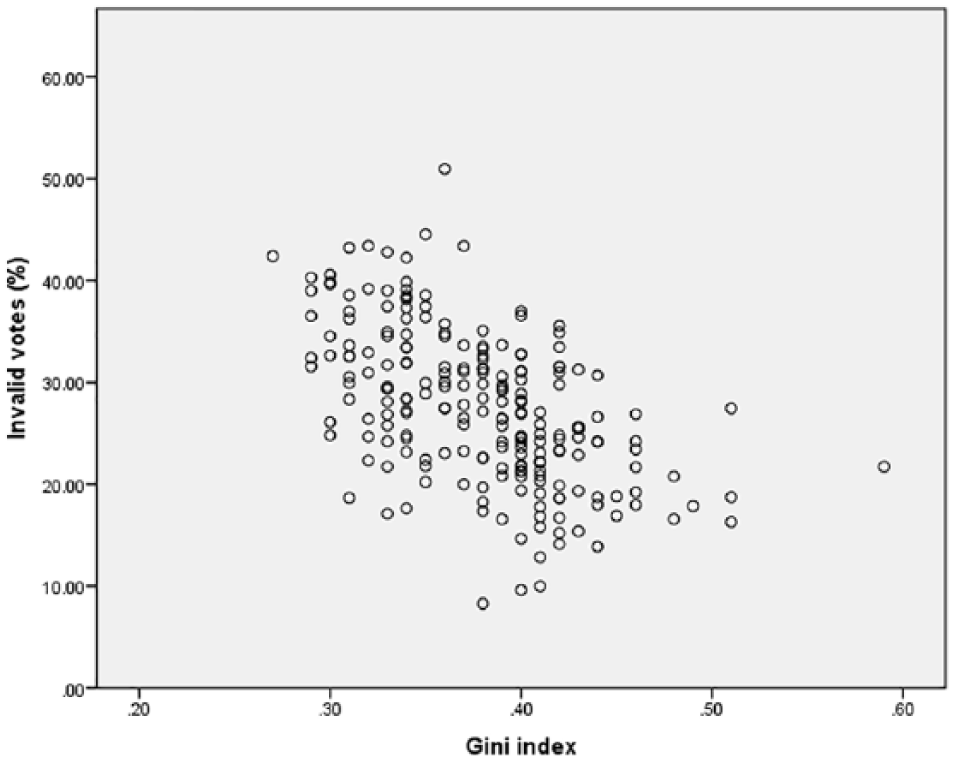
Relationship between income inequality and invalid voting.

Relationship between illiteracy and invalid voting.
The relationships of invalid voting to both indicators are moderately strong and in the expected direction. Income inequality is negatively associated with invalid voting (Pearson r = −.54, significant at the 0.001 level) meaning that more equal societies contribute a higher share of invalid ballots than unequal societies. Illiteracy rates are positively correlated to invalid voting (Pearson r = .55, significant at the 0.001 level). There is only a weak correlation between illiteracy and income inequality (Pearson r = −.12, not significant at the 0.05 level) signifying that both variables measure different sources of invalid voting. In other words, voters from highly unequal and more literate districts have a much larger political voice because their voting makes a larger difference for who wins the elections. This reproduces a pattern of inequality whereby the views of less advantaged citizens are more weakly represented in politics.
We also check the evidence for potentially confounding variables by controlling for variables hypothesized to influence the incidence of invalid voting. The possibility of casting an invalid vote is increased under complex ballot designs (Power & Garand, 2007; Reynolds & Steenbergen, 2006). In open list systems, as the district magnitude rises and the voter must make more complex decisions, the incidence of invalid voting should be higher either because committing an error is easier, or because the complexity of the political market places a heavier burden on the voters’ decision (Power & Garand, 2007). We use the measure of the district magnitude (the number of deputies elected in a district) where the voter cast the ballot to capture this effect. The level of urbanization was found to be a significant predictor for depressing invalid voting perhaps because voters in urban areas are more exposed to the political information necessary for making their informed electoral decision and casting a valid ballot (Power & Garand, 2007). The urban–rural character is measured as the percentage share of rural households on the total number of households in every canton. 3 Features of political competition are also instrumental in explaining invalid voting as less closely fought electoral contests and elections with a dominant party reduce the salience of elections and hence the probability of casting a valid ballot (Uggla, 2008). Closeness is operationalized here as the margin of victory between the percentage share of the winning party and the second most voted party. The Laakso–Taagepera index of the effective number of parties at the district level is used to assess the degree to which political competition is concentrated among one or few parties and to what degree it is fragmented. 4 Summary statistics for all variables are presented in Table 1.
Summary Statistics.

The results are presented in Table 2 (Model 1). 5 They confirm the expectation that income inequality reduces the share of invalid votes. A 0.01 increase in the Gini index is associated with half a percentage point decline in invalid voting. This is a sizable effect considering the large range of inequality across Ecuadorean districts (from a minimum of 0.27 to a maximum of 0.59). The effects of literacy are also strong as a one-point increase in the share of illiterates is expected to increase invalid voting by 0.7 of a percentage point. Of the control variables, the coefficients of the share of rural households, district magnitude, and margin of victory all point in the hypothesized direction and are statistically significant. Urbanization, closeness of elections, and small districts all help reduce the share of invalid votes. Party system fragmentation, on the contrary, helps in the proliferation of invalid ballots.
Determinants of Invalid Voting and Abstention in the 2009 Ecuadorean Legislative Election (OLS Regression).

Note. Standard errors in parentheses. OLS = ordinary least squares.
p < .05. **p < .01. ***p < .001.
Model 2 presents results with abstention as the dependent variable (calculated as the percentage share of registered voters who did not turn out). Even under compulsory voting turnout is biased against less educated citizens as the coefficient for illiteracy rates is again positive and significant as in the invalid voting model. More illiterate regions are doubly underrepresented compared with cantons with more literate voters: first by lower turnout and second by fewer valid ballots cast. The coefficient on the income inequality index is significant but points in the opposite direction than in the invalid voting model. This is supportive of the claim that compulsory voting bridges the income-inequality gap in turnout as more equal societies contribute a higher share of votes then unequal societies. Controlling for other variables, while a 0.01 increase in Gini coefficient yields a 0.43 percentage point decrease in turnout (Model 2), it at the same time increases the share of valid votes by 0.52 percentage points (Model 1). Considering the comparable (in size) incidence of abstention and invalid voting in the Ecuadorean elections we conclude that whatever gains for representation a system of compulsory voting has delivered in terms of more socioeconomically equal turnout, these are effectively erased by an increased incidence of invalid voting.
Conclusion
Compulsory voting is thought to increase electoral participation and thereby contribute to equalizing the political voice across income or education groups. However, a countervailing tendency of compulsory voting is to generate large proportions of invalid ballots. As invalid voting is strongly related to income inequality and low education, we conclude that whatever benefits in terms of equal voice are associated with higher turnout under compulsory voting, these are effectively erased by the high share of socioeconomically biased invalid votes that do not count for determining political representation. We presented evidence supportive of this conjecture from Ecuadorean 2009 elections where one quarter of all votes casted were invalid and one quarter of all registered voters abstained. In other words, the fact that turnout becomes less socioeconomically biased through compulsory voting does not automatically translate into less socioeconomically biased political representation (or political voice). This finding offers different lenses to the affirmation that while compulsory voting makes turnout more egalitarian, it does not make the candidate selection more equitable due its effects on invalid ballots (Cohen, 2018). Consequently, ballot spoilage generated by compulsory voting may have negative effects on the legitimacy of elected authorities, offsetting the contribution of higher turnout.
Our findings give further support to arguments that focus on the weakened link between vote choice and political preferences under compulsory voting relative to voluntary voting. This research does not question the reductive effect of compulsory voting on socioeconomic biases in turnout, but notes that voters induced by voting compulsion are less likely to vote in accordance with their wants and needs (Selb & Lachat, 2009). Not only are wealth disparities in the electorate bridged by compulsory voting, but also electorates become more equal with respect to their levels of infomation, political knowledge, or apathy as the least informed, least knowledgeable, and most apathetic are thrown into the electoral process by voting compulsion (Singh, 2015). This problem is manifested in a number of ways, and invalid voting is but one of them. The equalizing effect of compulsory voting diminishes voter stratification based on political knowledge or education, and induces voters to favor parties further away from their own ideological positions relative to voluntary voting systems (Dassonneville et al., 2017). Similarly, compulsory voting serves to increase the share of uninterested and less knowledgeable voters whose vote is less consistent with their own preferences (Selb & Lachat, 2009). It has been shown to disproportionately attract voters who are unlikely to cast well-reasoned ballots because they are generally more disinterested, unengaged, and view elections as pointless (Singh, 2016). Votes under compulsory voting are cast randomly, and voters are less attached to political parties and ideological convictions (Singh, 2016). Because invalid votes under compulsory voting are cast exactly by such—less engaged and less interested voters (Singh, 2017)—such invalid ballots should be considered as poor reflections of voter preferences.
This empirical evidence presented here supports some of the normative arguments against compulsory voting. In general, we claimed that presenting compulsory voting as justified (either in instrumental or intrinsic way) would clash with the deep conflict of worldviews among citizens in a democratic society. Because there are no a priori reasons to think that under the system of compulsory voting, citizens will generally identify more with the duty to vote, there is a looming danger, that making voting compulsory might lead to further alienation from democratic politics.
Footnotes
Declaration of Conflicting Interests
The author(s) declared no potential conflicts of interest with respect to the research, authorship, and/or publication of this article.
Funding
The author(s) received no financial support for the research, authorship, and/or publication of this article.
