




Abstract
Classic models of democratic political behavior imply that eliminating opportunities to vote early in person (EIP) negatively affects the political participation of voters who prefer to use that option. Nevertheless, several U.S. state legislatures recently passed or proposed laws to scale back their EIP voting operations. Such efforts have met with opposition, as both academic researchers and federal courts have found that minority voters, especially African Americans, now utilize EIP voting at significantly higher rates than White voters. Prior to the 2012 presidential election, this argument was central to a federal court’s decision to temporarily block legislation in Ohio that sought to cut several days from the state’s EIP voting period. A post-election legal battle is reconsidering this matter, and the outcome will shape Ohio’s voting rules going forward. This article contributes empirical results to the discourse by estimating EIP voting take-up rates, by race, during the 2008 and 2012 U.S. presidential elections in Ohio’s three largest counties. Ecological inference models reveal that African Americans in all three study areas voted EIP at substantially higher rates than White voters during both elections. These results are supported by decile tables that report early voting behavior for relatively racially homogeneous geographies, and by geovisualizations that depict direct relationships between the spatial distributions of minority persons and EIP voting usage. Collectively, the findings suggest that the potential effects of Ohio’s proposed policy changes would not be equally distributed between racial groups.
Introduction
Political science theory has long held that lowering the costs of voting increases electoral participation (Downs, 1957; Highton, 2004; Riker & Ordeshook, 1968). One implication of this conclusion is that adding more—and more convenient—forms of political participation to the voting options menu will lead to greater voter turnout (Gronke, Galanes-Rosenbaum, Miller, & Toffey, 2008; McDonald & Popkin, 2001; Neeley & Richardson, 2001; Stein, 1998). In response to this observation, jurisdictions across the United States are embracing methods of “convenience voting,” such as no-excuse absentee balloting and voting in person before Election Day. Indeed, over the past two decades, casting ballots other than at the precinct place on the day of an election has become commonplace in American politics (Gronke, Galanes-Rosenbaum, & Miller, 2007; Gronke et al., 2008). Among the variety of convenience voting options presently in use, there is a “[r]apidly expanding list” of U.S. jurisdictions that offer early in person (EIP) balloting opportunities to their electorates (Gronke et al., 2008, p. 441). Although the precise rules and hours of availability for this voting method vary between and within states, the general idea is that voters are permitted to cast ballots prior to an election, in person, at satellite polling stations or county elections offices (Gronke, 2008). Such programs expand an eligible individual’s set of voting options, which effectively reduces participation costs, and can therefore boost overall turnout (Gronke et al., 2008).
Despite this common perception that turnout is positively related to the diversity and quantity of voting opportunities (Gronke et al., 2008; McDonald & Popkin, 2001; Neeley & Richardson, 2001; Stein, 1998), several U.S. state legislatures recently passed or proposed laws designed to scale back their statewide EIP voting operations (Brennan Center for Justice, 2012; Hasen, 2013). Popular justifications for such policy changes include increasing efficiencies in or reducing the costs of elections (e.g., Enns, n.d.; Viewpoint Florida, 2011). However, many observers question whether the motivations for these policies are purely administrative (Hasen, 2013). For instance, some civil rights advocates claim that cutting back on EIP voting programs disproportionately affects minority voters, insofar as minorities seem to exercise the option at greater rates than White voters (NAACP, 2011). Other participants in the discourse take this line of reasoning further into the realm of politics, by suggesting that minority voters tendentially affiliate with the Democratic Party; hence, any policy changes that disproportionately affect minority voters will also disproportionately affect one of the major U.S. political parties relative to its rival(s) (Greenblatt, 2011).
Casting the partisan dimension of the above argument aside, the preceding observations do speak to a need to address the question of who votes EIP. Regardless of legislative intent, if minorities in fact utilize EIP voting in greater proportions than White voters, then changes to such institutions can have inequitable effects. Previous studies have concluded that the universe of convenience voters in general is dominated by relatively wealthy, politically informed, and educated individuals, and that White voters frequently possess these characteristics at higher rates than racial and ethnic minorities (Alvarez et al., 2009; Berinsky, 2005). Nevertheless, a growing body of research is finding that, for EIP balloting more narrowly, the opposite situation might hold (Alvarez, Levin, & Sinclair, 2012; Kropf, 2012; Robbins & Salling, 2012). Federal courts even acknowledged recently that minority and low-income voters often exhibit higher propensities to vote EIP compared with other socioeconomic and demographic groups (Hasen, 2013; Obama for America [OFA] v. Husted, 2012 [see Preliminary Pretrial Order]). Thus, there is no clear-cut answer to the aforementioned “who” question, and this ambiguity creates a demand for new empirical research on the topic (e.g., Gronke et al., 2007).
The current article begins to fill this gap by empirically estimating EIP voting behavior, by race, during the 2008 and 2012 presidential elections for the three largest counties in the state of Ohio: Cuyahoga, Franklin, and Hamilton. The article relies on King’s (1997) method of ecological inference to produce its estimates, which are supported with decile tables and geovisualizations. By focusing on the largest counties in Ohio, the article intends to, first, study the early voting behavior of a relatively large share of voters in the state and, second, offer immediate contributions to Ohio’s early voting policy discourses. Explicitly, newly passed legislative measures in Ohio aimed at reducing EIP voting opportunities were temporarily blocked by a federal court prior to the 2012 presidential election, and a post-election legal battle will now determine the (immediate) fate of the Ohio early voting policy going forward (NAACP v. Husted, 2014; OFA v. Husted, 2012 [see Preliminary Pretrial Order]). This article seeks to add timely evidence to these current legal and political proceedings.
Critically, the findings produced herein broadly support the growing narrative that minority voters, particularly African Americans, cast EIP ballots at higher rates than White voters. This finding implies that more African Americans than Whites in Ohio’s largest counties would have to adjust their voting behavior under the proposed EIP voting rule changes. It is plausible that similar voting patterns are present elsewhere within Ohio, as well as in jurisdictions across the United States. Thus, assertions that minority voters will be disparately affected by reductions in EIP voting opportunities (e.g., NAACP, 2011) are seemingly well founded. These observations have important implications for public policy.
Background
A detailed overview of convenience voting is beyond the scope of this article, and such information can be found in the work of Gronke (2008) and his collaborators (Gronke et al., 2007; Gronke et al., 2008). The objective here is to identify the racial characteristics of one specific class of convenience voters: those who cast ballots in person prior to Election Day. The decision to focus on race as opposed to other characteristics that influence political behavior, such as age, gender, education, or income, is based on the present state of legal affairs in the American voting rights community. Briefly, several U.S. states that recently faced or are facing opposition to their efforts to change EIP voting rules have been challenged under the federal Voting Rights Act (e.g., State of Florida v. U.S., 2012). For many challenged jurisdictions, this places a burden of proof on the state to demonstrate that proposed early voting reforms will not have retrogressive effects on minority voting efficacy once they are implemented (e.g., Hasen, 2013). More explicitly, the new rules cannot decrease the strength of minority voters, which includes increasing their costs of voting, relative to the status quo ( Voting Rights Act 42 U.S.C. 1973 ). 1 In debating the merit of cutting back on EIP voting opportunities, then, it is of crucial importance to determine whether or not minorities and Whites utilize the method at differential rates, and, by extension, whether different racial groups will be disparately affected.
Empirical evidence related to this question is somewhat mixed, though this situation might be an artifact of timing. For instance, prior to the 2008 U.S. presidential election, American political scientists supported the idea that convenience voters as a whole were politically active, well educated, and members of higher income classes—attributes often associated disproportionately with White voters. In fact, Berinsky (2005) described this perspective on convenience voting as the “single conclusion” among political science scholars. Yet, whereas such a conclusion might have been appropriate at the time of that writing, more recent studies intimate that the unparalleled efforts of the 2008 Barack Obama presidential campaign to get-out-the-vote early among minority voters possibly brought about a change point in group convenience voting behavior (e.g., Alvarez et al., 2009; Gronke, Hicks, & Toffey, 2009; Hood & Bullock, 2011). Namely, there is growing evidence of an inchoate shift in the electorate, whereby minority voters in many jurisdictions now appear to have a greater propensity than White voters to cast EIP ballots (Alvarez et al., 2009; Alvarez et al., 2012).
Consider, for example, that judges in a recent federal election law case denied the state of Florida preclearance to decrease its existing early voting time period because known (administrative) data showed that minority voters exercised the EIP option at significantly higher rates than White voters in four out of the prior five federal elections, including at a substantially higher rate in the 2008 presidential election (Hasen, 2013). This observation led the judges to opine that such a pattern is likely to continue into the future (State of Florida v. U.S., 2012 [see Per Curium Opinion]). Unlike the Florida example, though, most states, including Ohio, do not collect racial information on individual voters (e.g., King, 1997, 1999; Orey, Overby, Hatemi, & Liu, 2011; Roch & Rushton, 2008; Weaver, 2014). This means that the majority of U.S. states cannot appeal to known administrative data to describe EIP voting patterns by race in their jurisdictions, for the simple reason that such data do not exist. In that sense, the earlier “who votes EIP” question can be an extremely difficult one to answer.
To address this challenge, comparable studies for Ohio have adopted a proportionality rule, or “neighborhood model,” to allocate EIP voters to racial groups using population data from the U.S. Census Bureau. Under this rule, EIP voters are aggregated to census geographies, and the percentage of the census population in a given geographic unit that is, say, African American, is assumed to equal the African American share of EIP voters in that area (Robbins & Salling, 2012). For example, if the racial composition of census tract XYZ is 40% African American, and if 100 EIP ballots were cast in tract XYZ, then according to the proportionality assumption, tract XYZ is home to 40 African American EIP voters. Although findings from neighborhood model studies for Ohio (Robbins & Salling, 2012) fit with the recent literature suggesting that minorities vote EIP at higher rates than Whites (Alvarez et al., 2012; Kropf, 2012), the proportional allocation method is not a reliable technique for inferring group voting behavior (Garza v. County of Los Angeles, 1990; King, 1999; O’Loughlin, 2000). For these reasons, the current article relies instead on King’s (1997) method of ecological inference (King’s EI) to derive estimates for EIP take-up rates by race. King’s EI has been viewed favorably by federal judges in voting rights cases (Greiner, 2007), and it is used widely in similarly motivated social science research (Liu, 2001; Orey et al., 2011; Roch & Rushton, 2008; Tolbert & Grummel, 2003; Tolbert & Hero, 2001; Voss, 1996, 2000; Voss & Miller, 2001). Nonetheless, the method is not without its critics (Anselin & Cho, 2002; Calvo & Escolar, 2003; Cho, 1998; Freedman, Klein, Ostland, & Roberts, 1998; Greiner, 2007), and, consequently, the estimates that it produces are supported by, and discussed within the context of, supplementary decile analyses and geovisualizations (refer to the “Data and Method” section below).
Study Area and Regional Context
In 2005, all registered voters in Ohio were granted eligibility to vote in person during the full 35-day period prior to Election Day, including weekends (OFA v. Husted, 2012 [see Opinion and Order Granting Preliminary Injunction]). Following a series of proposals to change that program, the Ohio state legislature passed rules in 2011 and 2012 to end EIP voting for all voters on weekends, and to terminate the EIP balloting period for non-military voters on the Friday before an election. Under the original regulations, this latter termination date fell 3 days later, on the Monday immediately prior to Election Day (OFA v. Husted, 2012 [see Opinion and Order Granting Preliminary Injunction]). Shortly after their passage, these proposed rule changes were legally challenged by the 2012 presidential campaign of Barack Obama (OFA), which sought to maintain the full 35-day EIP voting period that was implemented in 2005. OFA argued that EIP voters disproportionately tend to be members of minority groups—especially African Americans—and the working class, and thus, shortening the EIP voting period would unduly harm these historically disadvantaged populations (Hasen, 2013; OFA v. Husted, 2012 [see Opinion and Order Granting Preliminary Injunction]). To support this assertion, OFA pointed to election studies that utilized the proportional rule (i.e., neighborhood model) with U.S. census data to estimate the minority share of Ohio’s EIP voter universe. Perhaps the most influential of these studies found that more than half of 2008 EIP voters hailing from Ohio’s largest county, Cuyahoga County, were African Americans (Robbins & Salling, 2012).
Ultimately, these arguments and empirical findings factored into a federal judge’s decision to grant OFA a preliminary injunction, thereby temporarily upholding the existing (i.e., 2005) Ohio early voting period (Hasen, 2013; OFA v. Husted, 2012 [see Opinion and Order Granting Preliminary Injunction]). Currently, the court is preparing to hear additional arguments from civil rights groups and the state of Ohio, as there remains uncertainty over the fate of Ohio’s early voting period (OFA v. Husted, 2012 [see Preliminary Pretrial Order]; NAACP v. Husted, 2014). Accordingly, the issue is not necessarily settled either legally or as a public policy matter. For that reason, studies that aim to systematically estimate the differences between racial group EIP voting take-up rates—both for other study areas in Ohio and for more elections—are potentially valuable new contributions to the discourse. It is toward these ends that the subsequent analyses are directed.
Data and Method
Following the examples set forth by research that entered into the Ohio early voting legal proceedings prior to the 2012 general election (OFA v. Husted, 2012; Robbins & Salling, 2012), this article examines EIP voting behavior for Ohio’s three largest counties—Cuyahoga, Franklin, and Hamilton (Figure 1). Although it would perhaps be preferable to conduct the analysis for all counties in the state, necessary voter data (as discussed below) are maintained by individual county-level Boards of Elections (BOE). As a consequence, data must be acquired by public information requests on a county-by-county basis. It follows that all data management and processing operations must similarly occur on a county-by-county basis. To perform such activities for all 88 Ohio counties would be quite demanding. In an effort to economize, this article focuses only on the three counties named above. By design, the selected counties contain the three most populated cities in Ohio, as well as a large number of suburban and low-density communities. What is more, the selected counties are geographically dispersed throughout the state (Figure 1), and they contain nearly 30% of Ohio’s voting-age population (VAP) and registered voters (Ohio Secretary of State). Arguably, three counties with significant urban settlements cannot possibly represent a full cross-section of an 88-county state. However, if any potentially disproportionate impacts from the desired election law changes are observed in these large population regions, then one can conclude (with some confidence) that a sufficiently sizable bloc of Ohio voters—again, the three counties are home to roughly 30% of all registrants in the state—might be negatively affected by the rule changes. Such a result would argue against rushing into the proposed policy changes, and instead suggest that additional analyses ought to be undertaken.

Study areas: Cuyahoga, Franklin, and Hamilton Counties, Ohio, USA.
Having specified the study areas, the U.S. census tract is selected as the geographic unit of analysis for its advantages with respect to data availability and completeness. In contrast to smaller census block groups or census blocks, only a negligible number of census tracts in the study areas are unpopulated and/or not matched to voters who participated in the selected elections (Table 1). Such “zero” units are generally dropped from the analysis when constructing the bounds needed to estimate early voting rates by race using King’s method of EI (see, for example, King, 1997, p. 79). The upshot is that very few census tracts must be dropped from the analysis to facilitate the desired estimation procedure, which is not true of smaller spatial units. That being said, for each census tract in each county, data were collected on four quantities of interest: (a) the number of voters who cast EIP ballots in the 2008 and 2012 presidential elections; (b) the number of individuals who cast any type of ballot in these elections, that is, the number of voters who participated; (c) the size of the VAP; and (d) the racial characteristics of the VAP.
Characteristics of the Analytical Samples.

Note. VAP = voting-age population; EIP = early in person. *Board of elections data are taken to be “known data” for this quantity (see next column).
Official county-level elections results are from http://www.sos.state.oh.us/SOS/elections.aspx.
Census tracts were dropped from the analysis for having (a) zero VAP or (b) a number of voters geocoded to it that exceeded the VAP.
Data on individual voters who participated in the selected elections (Quantity 2) and lists of voters who cast EIP ballots during those elections (Quantity 1) were obtained through public information requests made to the relevant county BOEs. All voter records were then batch geocoded in Esri ArcGIS 10.1. The resultant data points were aggregated to census tracts, where they were merged with 2010 U.S. decennial census tract-level VAP data (Quantities 3 and 4). The 2010 decennial census figures are used for at least two reasons. First, federal district court judges in OFA v. Husted (2012, see Opinion and Order Granting Preliminary Injunction) recently relied on a study of the 2008 general election to form their judicial opinion, and that study instructively used 2010 census VAP data (Robbins & Salling, 2012). Second, reliable full count tract-level data for the years 2008 and 2012 are not available. Thus, the (known) 2010 data are a convenient compromise. Table 1 summarizes the key information from each county-specific data set.
Alongside the summary data, Table 1 also reports a handful of negligible discrepancies between the voter data furnished by the County BOEs, the official turnout results available on the Ohio Secretary of State Elections website, and the fraction of voters that were successfully georeferenced (and hence, included in the analysis). Because the voter files did not come with metadata indicating how queries to select general election voters were performed, it is not possible to pinpoint the exact reasons for the discrepancies between the official turnout figures and the number of records in the BOE data sets; however, given that the differences are sufficiently small, it is reasonable to assume that they will not affect the analyses. Moreover, insofar as the data were received directly from the BOEs through public information requests, they are taken to be reliable. Finally, the sufficiently high percentages of voter records from the BOE data files that were successfully matched during the geocoding processes add to our confidence in the analytical samples (Table 1, columns 5 and 9).
As stated earlier, because the vast majority of states do not capture data related to an individual’s race or ethnicity during the voter registration and ballot casting processes, racial group disparities in voter participation or the type of ballot cast cannot be ascertained from most state registration records alone (King, 1997, 1999; Orey et al., 2011; Roch & Rushton, 2008). Rather, to evaluate these questions, voter records must be merged with data from other sources—here, the U.S. Census Bureau—that collect racial information on a superset (voting-age persons) of the target population (voters). When aggregated and overlaid, these multiple data layers begin to reveal details about the unobserved behavior of interest. One technique for deducing early voting behavior by race with such data is to examine the take-up of EIP voting in relatively racially homogeneous geographies, and to hypothesize that the behavior observed therein is relatively representative of voters from the given racial group (Brace, Handley, Niemi, & Stanley, 1995).
In Table 2, decile analyses reveal that voters in relatively homogeneous African American census tracts (≥90% of VAP) in Cuyahoga, Franklin, and Hamilton Counties utilized EIP voting at substantially higher rates than voters in largely non–African American (<10% of VAP) tracts during the 2008 and 2012 elections. Consequently, it is sensible to expect that more sophisticated statistical estimation techniques will find that African American voters use EIP voting at much higher rates than, for instance, White voters, in the study areas.
Early Voting Use Rates in the Three Study Areas, by % African American (Black) VAP.

Note. VAP = voting-age population; EIP = early in person.
Values reflect sample statistics (refer to Table 1 for a description of the samples); All VAP data come from the 2010 U.S. decennial census.
Conclusions drawn about individuals based on aggregate data in this fashion, so-called “ecological inferences,” are often necessary in social science research (King 1997, 1999). Nevertheless, the homogeneous geographies approach to making such inferences is not the only option. Indeed, a large body of statistical literature explores ways to overcome the EI problem (Anselin & Cho, 2002; Calvo & Escolar, 2003; Duncan & Davis, 1953; Goodman, 1953; Grofman & Migalski, 1988; King, 1997). This article uses King’s (1997) “solution” to the problem (King’s EI) to estimate EIP usage by race. King’s EI is widely used in studies of group voting behavior (Liu, 2001; Orey et al., 2011; Roch & Rushton, 2008; Tolbert & Grummel, 2003; Tolbert & Hero, 2001; Voss, 1996, 2000; Voss & Miller, 2001; Weaver, 2014), and it has gained “favorability” among federal judges in voting-related cases (Greiner, 2007; Withers, 2001). It is, therefore, considered to be an “established method” for this type of research (Collett, 2005).
For present purposes, King’s EI involves first estimating voter turnout by race for each county of interest, by drawing on known census tract-level data for the (a) size of tract VAP, (b) percentage of VAP that voted in the selected elections, and (c) racial breakdown of tract VAP. Following existing Ohio early voting studies (Robbins & Salling, 2012), we focus here on two racial groups: non-Hispanic Whites (White), and non-Hispanic African Americans (Black). For each of these racial groups, turnout estimates for all tracts in each of the three counties are first constrained by deterministic (feasible) bounds based on the observed U.S. Census data (King, 1997). Next, all feasible turnout values for each census tract are analyzed in the context of maximum likelihood to derive point estimates and standard errors for tract-level racial group turnout (Roch & Rushton, 2008). The point estimates for turnout are then used to generate “step two” estimates of EIP take-up rates by race for each county, via estimating second-step King’s EI equations in much the same way as above (King, 1997; see also Roch & Rushton, 2008). These quantities allow one to draw conclusions about whether minorities—in this case, African Americans—utilized EIP voting disproportionately relative to Whites in the selected Ohio counties during the 2008 and 2012 general elections. Answering this question is of central importance for managing conflicts in Ohio and throughout the United States over proposed cutbacks to EIP voting opportunities (e.g., Brennan Center for Justice, 2012; Greenblatt, 2011; Hasen, 2013; NAACP, 2011; OFA v. Husted, 2012 [see Opinion and Order Granting Preliminary Injunction]; Robbins & Salling, 2012; State of Florida v. U.S., 2012 [see Per Curium Opinion]).
Finally, because King’s (1997) method is not without critics (e.g., Anselin & Cho, 2002; Calvo & Escolar, 2003; Cho, 1998; Freedman et al., 1998; Greiner, 2007), the EI estimates are supported with geovisualization techniques that make use of choropleth mapping and three-dimensional extrusion to simultaneously map two geographic distributions across the three county study areas. The distributions of interest are (a) African Americans as a fraction of VAP and (b) EIP votes as a fraction of all ballots cast. The resultant three-dimensional maps further support the notion that EIP voting is not equally practiced by members of different racial groups.
Results
The global results from estimating the basic King’s EI county-level models for White and African American voters are presented in Table 3. For each county, a Step 1 EI model first estimates racial group turnout as a fraction of racial group VAP. A Step 2 model then estimates racial group usage of the EIP ballot option as a fraction of group turnout from the Step 1 model (e.g., King, 1997; Roch & Rushton, 2008). Each global estimate is listed in Table 3 with its corresponding standard error and the approximate number of individuals included in the given category. The latter quantity is calculated by distributing the King’s EI (%) estimate through the relevant population count. Falling in line with contemporary academic literature (e.g., Gronke et al., 2009) and reports by civil rights groups that study the effects of the Barack Obama candidacy on minority electoral participation (e.g., NAACP, 2011), the Step 1 EI estimates reveal that the turnout gap between African Americans and Whites is closing. In fact, for Cuyahoga County, the estimated African American turnout exceeded the estimated White turnout in 2008, and this difference increased in magnitude in 2012. Hence, the Step 1 EI estimates comport with the idea that the Obama candidacy potentially reshaped the electorate to include more traditionally underrepresented voters relative to all previous presidential elections (Gronke et al., 2009).
Global King’s EI Estimation Results.

Note. EI = ecological inference; VAP = voting-age population; EIP = early in person.
More central to this article, Step 2 estimates for the group rates of EIP voting are extremely racially unbalanced. In 2008, African Americans in Cuyahoga County were approximately 26 times more likely than Whites to vote EIP, and approximately 20 times more likely than Whites to exercise the option in 2012. To put this difference in perspective, in both 2008 and 2012, African Americans accounted for an estimated 29% of the overall electorate; yet, the racial group represented a staggering 77% of the EIP voter universe. This substantial disproportionality implies a crucial difference in inter-group voting preferences, and it suggests that minority voters are likely to be negatively affected if opportunities to vote EIP are eliminated. Similar results hold for Franklin and Hamilton Counties. In Franklin County, African American voters utilized EIP voting at roughly a four-to-one rate relative to Whites in the 2008 and 2012 presidential elections, and the same ratio was approximately nine-to-one for Hamilton County. As is estimated to be the case in Cuyahoga County, the early voter universes in both Franklin and Hamilton Counties were significantly, disproportionately African American when compared with the White and Black shares of the jurisdictions’ overall voter turnout (Table 3).
Notably, the EI estimation results are highly consistent with the homogeneous geographies (decile) analyses from the “Data and Method” section (Table 2). This consistency lends credibility to the EI output from Table 3. Still, to add more depth to the results, Figures 2 to 4 map the geographic distributions of African American voting-age persons in each county, by census tract, relative to the county’s tract-level EIP take-up rates. For each figure, census tracts that are symbolized with blue hues represent areas where African Americans make up relatively small shares (≤40%) of total tract VAP. Tracts that are symbolized with red hues are those territories where African Americans hold relatively strong majorities (>60%) in the local VAP. The vertical height of each tract corresponds to its average EIP take-up rate over the course of the 2008 and 2012 presidential elections. That is, the height (extrusion) is calculated by adding a given tract’s 2008 EIP take-up rate to its 2012 EIP take-up rate, and dividing by two. Height, therefore, falls in the range of zero to one. Note that the average EIP take-up rates are mapped in the figures for economy, rather than creating separate figures for each election. Mapping the averages not only cuts the number of necessary figures in half, but also, it eliminates somewhat redundant information, as the patterns for 2008 and 2012 do not show much temporal change (or spatial variation from the average patterns).

Cuyahoga County, average EIP take-up relative to African American VAP.
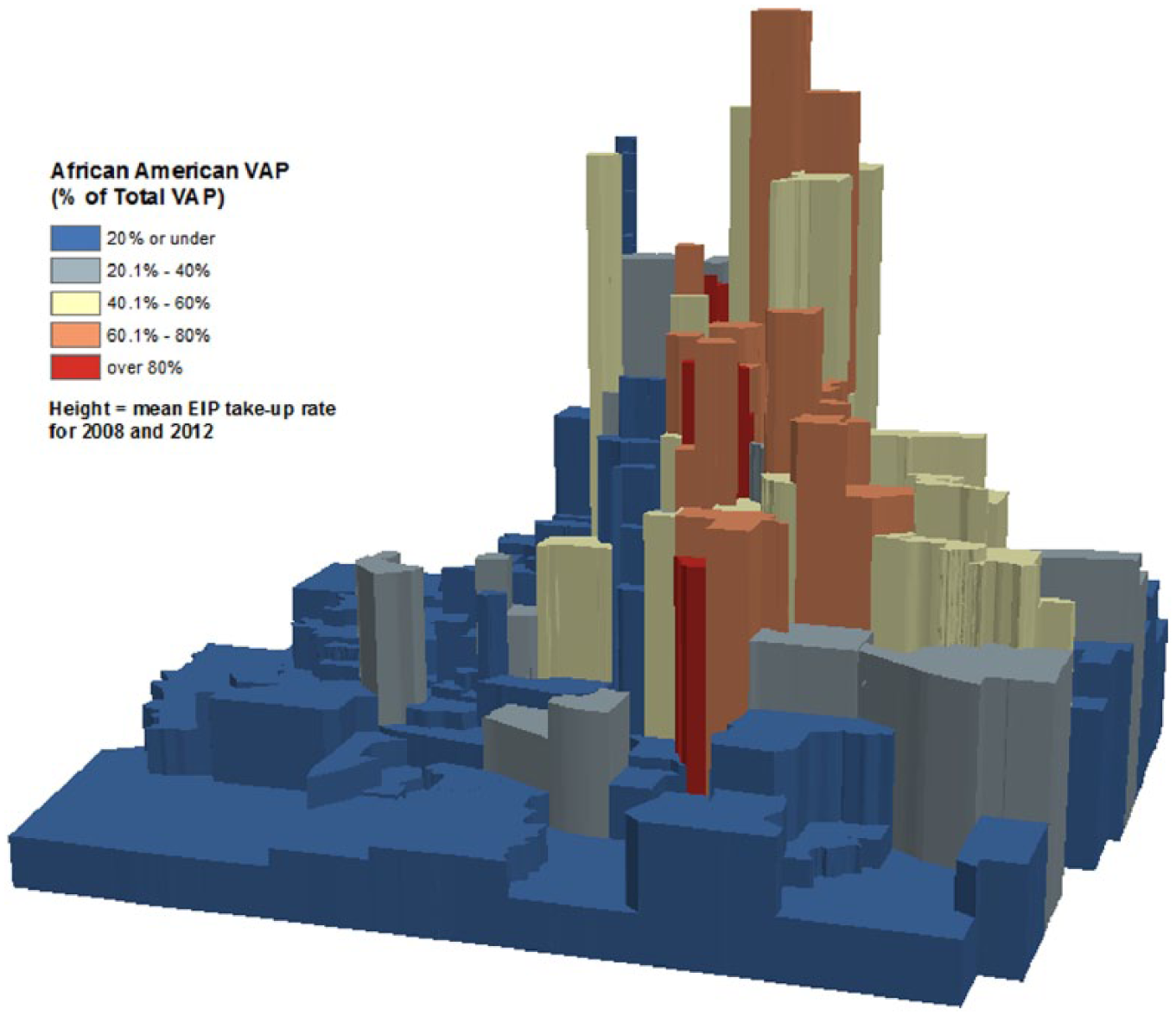
Franklin County, average EIP take-up relative to African American VAP.

Hamilton County, average EIP take-up relative to African American VAP.
In all three figures it is evident that, in the main, tracts where African Americans make up a majority of the VAP are also those tracts where EIP usage is greatest in magnitude. This pattern is particularly striking in Cuyahoga County (Figure 2), where the “red” tracts tower over all but one “blue” tract. Falling in line with the decile analyses (Table 2) and the EI results (Table 3), Figures 2 to 4 support the hypothesis that the negative effects from scaling back EIP institutions in Ohio will not be equitably distributed between all racial groups in the state (e.g., Hasen, 2013; OFA v. Husted, 2012 [see Opinion and Order Granting Preliminary Injunction]; Robbins & Salling, 2012).
Discussion
The results presented in the preceding two sections offer consistent quantitative support for the notion that minorities in Ohio, especially African Americans, tend to vote EIP at much higher rates than White voters. In consideration of prior empirical work (Alvarez et al., 2012; Kropf, 2012), as well as anecdotal evidence from electoral politics (Gustafson, 2008), this finding is not altogether unexpected. What makes the results somewhat surprising, though, are the magnitudes of the estimated disproportionalities between White and African American EIP voting take-up rates. Earlier estimates derived under the proportional rule or “neighborhood model”—that is, by assuming that the fraction of VAP within a given observational that is African American is strictly equal to the fraction of EIP votes cast by African Americans in the same area—suggested that about half of Cuyahoga County’s 2008 EIP voters were African Americans (Robbins & Salling, 2012). In contrast, estimates derived using King’s EI method, which are supported by supplementary decile analysis (Table 2), suggest that African Americans consistently accounted for more than three quarters of the Cuyahoga County EIP voter universe during both the 2008 and 2012 presidential elections, and between 42% and 72% of all EIP voters in Franklin and Hamilton Counties. One potential reason for the large discrepancy between the neighborhood and EI estimates for Cuyahoga County is that by limiting a racial group’s share of the EIP universe to equal that group’s share of the overall VAP, the neighborhood approach likely misrepresents the behavior of minority voters in predominantly non–African American geographies (e.g., compare the first and last rows in each decile table contained in Table 2); where King’s EI method allows for more possibilities. Nevertheless, prior to the 2012 presidential election, federal judges relied exclusively on proportional (neighborhood) estimates when they decided to temporarily block Ohio’s proposed early voting changes (OFA v. Husted, 2012 [see Opinion and Order Granting Preliminary Injunction]).
It is worth mentioning, then, that the findings from this article imply that the extent of the adjudged “injury” to minority voters from Ohio’s proposed rule changes might be even greater than what the court acknowledged at the time of its decision. In that sense, one can speculate that if federal judges temporarily blocked the proposed early voting cutbacks in the state based on proportional estimates of EIP voting by race in one large county, then, given the King’s EI estimates derived hereinbefore for Ohio’s three largest counties, the current round of legal proceedings is likely to disfavor policies that will decrease early voting opportunities in the state.
Conclusion
It is almost tautological to claim that a policy that reduces EIP voting opportunities in a given jurisdiction will negatively affect voters who prefer to use the EIP option. Thus, the question at issue in the legal discourse is not whether cutting back on early voting operations will affect existing early voters—it is whether or not such changes will affect those voters equitably. Along these lines, the results from above reaffirm prior claims that minority voters, particularly African Americans, account for a disproportionately large share of the EIP voter universe in Ohio (Robbins & Salling, 2012). Although this is not to say that minority voters in Ohio’s largest counties will necessarily be excluded from voting because of the proposed state law changes, a practical interpretation of the results is that eliminating opportunities to vote EIP effectively raises the cost of voting for more African Americans than for Whites. This is the case because the former group contains substantially more EIP voters, both in relative and absolute terms, than the latter (Table 3). Hence, more minority voters than White voters in Ohio will face new adjustment costs under the proposed rule changes. That being said, political science literature collectively agrees that voting costs and political participation are inversely related (e.g., Downs, 1957; Gronke et al., 2007; Gronke et al., 2008; Highton, 2004; McDonald & Popkin, 2001; Neeley & Richardson, 2001; Riker & Ordeshook, 1968; Stein, 1998). Therefore, any negative turnout effects caused by a shortened early voting period, should that outcome occur, will most likely be driven by decreases in minority participation. Put differently, regardless of the intent of the early voting law changes, based on the racial disparities observed in early voting behavior, the new rules could have an inequitable effect in Ohio’s largest counties.
In this context, although the present study focused only on the two most recent presidential elections in three Ohio counties, more and more evidence is accumulating to suggest that African American voters across the United States prefer to exercise EIP voting options at greater rates than Whites (Alvarez et al., 2009; Alvarez et al., 2012; Kropf, 2012). For example, in the state of Florida, where racial data are collected on individual voters, a federal three-court judge in 2012 denied the state preclearance for proposed reductions in the number of days it offers EIP balloting, given that racial minorities were found to vote EIP at substantially higher rates than Whites (State of Florida v. U.S., 2012 [see Per Curium Opinion]). Similar to Florida, Georgia collects racial data on individual voter registrants, and studies of early voting behavior in that state find a “higher incidence of [EIP] turnout” among African Americans, especially for the 2008 presidential election (Hood & Bullock, 2011).
Considered in tandem with this complementary evidence based on known racial group voting behavior, the foregoing results imply that policies that set out to eliminate convenience voting opportunities should not be pursued in isolation of empirical insights into the racial characteristics of affected voters. Additional research on the topic, especially in the form of program evaluations that identify causal relationships between new early voting policies and voter turnout, is needed to explore actual behavioral adjustments, by race, to the types of cutbacks discussed throughout this article. At present, however, based on the current state of the literature, it is prudent to recognize that further legislative action toward the early voting reductions in Ohio and elsewhere in the United States demands greater attention to the racial context of the proposed rule changes.
Footnotes
Acknowledgements
The author thanks Sonia Gill, Esquire of the Lawyers’ Committee for Civil Rights Under Law for making public information and data access requests to the Cuyahoga, Franklin, and Hamilton County Boards of Elections on the author’s behalf.
Declaration of Conflicting Interests
The author(s) declared no potential conflicts of interest with respect to the research, authorship, and/or publication of this article.
Funding
The author(s) received no financial support for the research and/or authorship of this article.