



Abstract
This study examines the effect of social media use on voter turnout. Given that different social media platforms provide different types of content and people use different social media platforms for different purposes, this study argues that there exist differentiated relationships between different types of social media and voter turnout. Using an original panel data set for the 2018 Taipei mayoral election in Taiwan, this study evaluates how five different types of social media—Facebook, LINE, YouTube, Instagram, and PTT—influence voter participation. The empirical results show that people with frequent use of Facebook and PTT are more likely to vote, whereas the frequent use of YouTube and Instagram decreases voter turnout. Furthermore, the use of LINE has no influence on voter participation. Overall, this study reveals that different types of social media exert heterogeneous effects on voter turnout and suggests that when it comes to the influence of social media on voter turnout, we should pay attention to not only the frequency of social media use but also the purpose of social media use.
Introduction
Social media has played a significant role in our daily life, tremendously changing the way we interact with other people. The 2019 Global Digital suite of reports from We Are Social and Hootsuite reveals that there are 3.48 billion social media users in 2019, that is, 45% of the world’s population. While social media has been largely used for recreational and relational purposes, it is noted that more and more people have relied on social media for news and information, particularly among younger people. According to a survey conducted by Pew Research Center in the United States in 2016, 35% of the respondents between the ages of 18 and 29 indicate that social media is the “most helpful” source of information about the 2016 presidential election, whereas network television news and local TV news are still the most popular platforms for learning about the presidential campaign among those aged 50 and older (Mitchell et al., 2016). Furthermore, a Pew Research Center survey conducted in 2018 demonstrates that about two-thirds (68%) of American adults get news from social media sites and Facebook is the most widely used social media platform for news in the United States (Matsa & Shearer, 2018). On the other hand, the 2015 Taiwan Communication Survey shows that 65% of Taiwanese people use social media. Although there is a great variation in social media use among different age groups ranging from 70% for people aged 65 years and older to 98% for those aged 18 to 29, overall the proportion of Taiwanese people using social media is quite high. Moreover, a large proportion of Taiwanese people use social media to obtain information about politics and public affairs, ranging from 77% for people between the aged 50 and 64 to 92% for those aged 18 to 29. To sum up, social media has become a key source for people to gather and absorb political information.
Given the growing role of social media in individual consumption of political information, it is required to understand how social media influences individual political participation. However, the relationship between social media and political participation has received relatively sparse scholarly attention in Asia. Previous studies have identified the effect of Internet on individual political participation (e.g., Polat, 2005; Vissers & Stolle, 2014; S.-I. Wang, 2007; Xenos & Moy, 2007), and indicated that people who use the Internet for political information more frequently are more likely to engage in politics, although there exist different mechanisms that connect Internet use with political engagement. In light of prior research on the relationship between Internet use and political participation, it is inferred that social media as an information source and as a communication medium should be relevant to individual political participation.
This study aims to examine the effect of social media use on voter turnout—one of the most common forms of political participation. Particularly, this study focuses on the case of Taiwan where social media has played a vital role in political campaigns and elections (C.-Y. Chen & Chang, 2019). Political parties in Taiwan have placed high emphasis on social media campaigns in elections and paid special attention to social media used by young people because they use social media as the main channel to follow election information. Therefore, Taiwan makes a good case for looking at the association of social media with individual voting behavior. The empirical results of this study confirm the significant relationship between social media use and individual turnout decisions, but different types of social media have different effects on voter participation. To sum up, this study sheds light on the role of social media in individual political participation and helps us to understand the significance of social media in politics.
The rest of this paper is structured as follows. Section 2 provides a theoretical framework to explain the mechanism of how social media could influence individual turnout decisions and formulates the hypotheses for empirical testing. Section 3 describes the data, operationalization of variables and statistical methods. Section 4 reports the empirical results of the relationship between social media use and voter turnout. Finally, section 5 summarizes the key findings of this study and discusses the implications for future research.
Theoretical Framework for Social Media and Voter Turnout
People are increasingly using social media platforms to search for information and turning away from traditional media, such as television, radio, newspapers, and magazines (Mangold & Faulds, 2009). For instance, the consumers are increasingly using various social media platforms such as Facebook and YouTube to look for information and even share their opinions about products and services they consume (Huete-Alcocer, 2017). Accordingly, a large amount of studies has examined how social media could shape the consumers’ perceptions of brands and influence consumer behavior in the field of business (e.g., Hajli, 2014; Laroche et al., 2013; Schivinski & Dabrowski, 2016). With regard to the discipline of political science, the Arab Spring in 2011 (e.g., Wolfseld et al., 2013) as well as the 2008 and 2012 Obama campaigns (e.g., Bimber, 2014) have raised scholarly interest in how social media might affect individuals’ participation in political life. There is also an existing scholarship to support the expectation that candidates choose different social media campaign strategies (Nawara & Bailey, 2017). In general, two main theoretical perspectives have been proposed to explain the mechanism of how social media use could influence individual political participation.
The first theoretical perspective argues that social media could serve as a platform for gathering information or news from a variety of sources, such as family members, friends, political elites, political parties, or media organizations (Dimitrova et al., 2014; Gil de Zúñiga et al., 2013; Towner, 2013). According to a report from the Reuters Institute for the Study of Journalism (Newman et al., 2018), approximately three quarters of Taiwanese people use social media for any purpose (primarily Facebook and LINE) and more than half (56%) use them for news. While people might be exposed to political information and news incidentally on social media (Fletcher & Nielsen, 2018), it has been documented that people who possess more information about politics tend to exhibit higher levels of political participation and prior research has found the connection between the role of social media in information provision and political participation. Specifically, Gil de Zúñiga et al. (2012) reveal that informational use of social media exerts a significant and positive influence on individual engagement in political action, both online and offline. Similarly, Towner (2013) examines the impact of attention to specific forms of social media on young adults’ online and offline political participation as well as voter turnout during the 2012 United States presidential campaign, finding that attention to political information on social media, particularly Facebook, Twitter, and blogs, leads to increased offline and online political participation among young adults, but has no relationship with voter turnout. Zhang et al. (2013) also have similar findings that reliance on social media of all kinds (i.e., Facebook, Google plus, Twitter, and YouTube) for political information is positively associated with political participation both online and offline. Furthermore, Dimitrova et al. (2014) utilize panel data on the 2010 Swedish election to analyze the relationships between digital media and participation in election campaigns, demonstrating that the use of social media for political information is one of the strongest predictors of political participation. In short, this theoretical perspective is mainly derived from studies of traditional media showing that those who use media to get information about politics are more likely to be politically knowledgeable and engaged (Eveland & Scheufele, 2000; McLeod et al., 1999). In the same vein, information provided by social media can make citizens politically sophisticated and take active participation in political activities.
The second theoretical perspective focuses on the role of social media in creating social network ties that could allow for political mobilization and communication among social media users. On the one hand, social media can expand the scope of social networks, and thus increase individual chance of exposure to mobilization information, which in turn motivates people to participate in politics. On the other hand, social media can increase the speed and interactivity of communication, and thus social media users are able to quickly exchange opinions and ideas about specific political events, fueling their interests in taking part in political activities. It has been observed that social media has become the pivotal coordinating tool for the major political movements in the world. For instance, Breuer et al. (2015) identify social media as an important catalyst for protest mobilization during the Tunisian revolution in late 2010 and early 2011, whereas Tufekci and Wilson (2012) reveal that social media use by utilizing Facebook for interpersonal communication greatly increases the probability that Egyptians participated in the Tahrir Square demonstrations in 2011. Furthermore, the recent series of protests occurring in Hong Kong in 2019 also point out the significance of social media in collective action. Specifically, the protesters in Hong Kong use social media platforms as the means of communication to collectively decide when, where and how to protest (Lai & Wu, 2019). While previous studies have mainly examined the mobilization and communication effects of social media on protest participation, Bond et al. (2012) demonstrate that political mobilization messages delivered to 61 million Facebook users could directly influence political self-expression and information seeking, further increasing the probability that an individual voted in the 2010 United States congressional elections. In light of the above discussions, it is evident that social media can stimulate political participation by mobilizing individuals and communicating effectively with other people.
Overall, the above two theoretical perspectives—regardless of whether social media is used for political information or for mobilization and communication—indicate that social media use should be positively associated with political participation. That is, people who are more frequent users of social media are more likely to participate in politics. A meta-analysis conducted by Boulianne (2015) confirms the positive relationship between social media use and participation, but it is noted that only half of the coefficients for the relationship between social media use and participation achieve statistical significance among 36 studies with a total of 170 coefficients. Furthermore, Boulianne (2015) finds that social media use is more likely to produce a statistically significant positive effect on civic engagement and measuring participation as protest activities is more likely to generate a positive effect, but the coefficients for the relationship between social media use and protest participation are not more likely to be statistically significant compared to other measures of participation. Another meta-analysis performed by Skoric, Zhu, Goh, & Pang (2016) also suggests that social media use has a positive relationship with political participation carried out online and offline. By contrast, there is little evidence that social media use would increase people’s likelihood of voting or campaign participation. Similarly, Groshek and Dimitrova (2011) find no significant effect of social media use on vote intention in the 2008 United States presidential election. Therefore, although it is theoretically expected that the frequent use of social media should be conducive to greater voter turnout, there are inconsistent empirical findings on the effect of social media use on voter participation—either positive effect (Bond et al., 2012) or no effect (Boulianne, 2015; Groshek & Dimitrova, 2011; Towner, 2013). To clarify the relationship between social media use and voter turnout, this study argues that social media can enhance voters’ information about candidates and elections and thus they will be more likely to vote. Social media can play a significant role in the learning of political information and studies have demonstrated that the potential for users to learn political information from social media does exist (Bode, 2016).
Accordingly, this study assumes that when people use social media more frequently, they should be more likely to acquire political information that is conducive to individual political participation. However, it is noted that different social media platforms provide different types of content and people use different social media platforms for different purposes and thus there might exist differentiated relationships between different types of social media and voter participation. Specifically, this study focuses empirical analysis on five types of social media: Facebook, YouTube, LINE, Instagram, and PTT which are the most commonly used social media platforms in Taiwan. Compared to the other four types of social media, PTT might be a relatively less known platform by people residing outside Taiwan. PTT founded by a group of students at National Taiwan University in 1995 is the largest terminal-based bulletin board system (BBS) in Taiwan and is currently maintained by the Electronic BBS Research Society. It is estimated that there are more than 1.5 million PTT registered users and over 150,000 users are on PTT during peak hours (B. Chen, 2017). PTT has more than 20,000 discussion boards covering a variety of topics including politics. On the other hand, although Twitter has been widely used in most countries, the number of Twitter users is still much lower than that of users on the other social media platforms in Taiwan. Therefore, this study does not include the question about the use of Twitter in the survey. As demonstrated by the report from the Reuters Institute for the Study of Journalism (Newman et al., 2018), more than half of Taiwanese people use Facebook (56%) and LINE (53%) for news, whereas more than one-third (38%) of Taiwanese people use YouTube for news. By contrast, the percentages of Taiwanese people who use PTT or Instagram for news are only 17% and 7%, respectively. Generally speaking, social media use could be classified into informational, expressive, relational, and recreational types. The first three are of greater importance for political participation, whereas recreational use appears to be less important. Skoric, Zhu, & Pang (2016) carry out a meta-analysis using published empirical research on the role of social media in promoting political participation in China, Hong Kong, Singapore, South Korea, and Taiwan. They find that expressive use of social media has a moderately strong relationship with political participation, informational and relational uses have small relationships, while recreational use has a very weak relationship with political participation. Furthermore, politicians use different types of social media for different purposes. By using data from Germany, Stier et al. (2018) demonstrate that candidates prefer to use Twitter for the commentary of politics and unfolding campaign events, whereas they prefer Facebook for campaigning and mobilization purposes. As a result, this study contends that the five types of social media targeted here might have different effects on voter turnout in Taiwan given the fact that they play different roles in Taiwanese politics.
One the one hand, Facebook, LINE, and PTT are the major social media platforms used by candidates and the public for electoral purposes and political information in Taiwan. First of all, prior research has identified that Facebook could effectively allow supporters to connect with electoral campaigns and share information with their friends. Barack Obama’s Facebook campaigns provide evidence that Facebook has become a dominant electoral force driving people to view campaign materials and cast ballots (Lin, 2017). There is no exception for Taiwan that the majority of candidates use Facebook as a standard campaigning tool by creating fan clubs on Facebook to share their campaign information and connect with the electorate. Teresi and Michelson (2015) examine the effect of exposure to political messages via Facebook on the likelihood of voting, finding that encouragements to vote delivered through Facebook have substantively large effects on voter turnout. Therefore, this study argues that people who use Facebook more frequently are more likely to be exposed to campaign news and information either intentionally or incidentally, further increasing their likelihood of voting. Second, it has been observed that in Taiwan, candidates have also heavily used LINE to disseminate campaign-related information and mobilize voters, especially core supporters. Thus, people who use LINE more frequently are more likely to obtain information about voter mobilization and then go out to vote. Lastly, PTT has provided a significant platform for Taiwanese people to discuss political, social, and economic issues and made major contributions to some social movements such as Sunflower Student Movement in 2014 (Tung et al., 2016). More importantly, political parties and candidates have regarded PTT as a major tool to manipulate public opinion in Taiwan because the newspaper and television media have monitored PTT for the latest updates and used it as a news source. Candidates have made great efforts to disseminate information favorable to themselves or unfavorable to their opponents on PTT. Consequently, people who use PTT more frequently are more likely to gain political and election information and go to the voting booth.
On the other hand, in Taiwan, political parties and candidates have rarely utilized YouTube and Instagram for electoral purposes and both YouTube and Instagram mainly serve as entertainment platforms (Herhold, 2018). Accordingly, people who use YouTube and Instagram more frequently are less likely to be exposed to political and campaign information either intentionally or incidentally. In studies on traditional media, entertainment use is found to have a negative influence on social capital, political knowledge, and political efficacy, all of which are significantly associated with political participation (e.g., Lake et al., 1998; Valentino et al., 2009; C.-H. Wang, 2015). Furthermore, Prior (2005) shows that people who prefer entertainment become less likely to learn about politics and go to the polls. Based on these results, this study infers that people who prefer entertainment from social media such as YouTube and Instagram would tend to be less likely to vote. To sum up, given that the informational use of social media is generally associated with the greater likelihood of political participation and the recreational use of social media is adverse to political participation, this study argues that there exist differentiated relationships between different types of social media and voter turnout. Specifically, this study comes up with the following hypotheses for empirical test:
Hypothesis 1: people who use Facebook, LINE, and PTT more frequently are more likely to turn out to vote.
Hypothesis 2: people who use YouTube and Instagram more frequently are less likely to turn out to vote.
Data, Measurement of Variables and Methods
Some might suspect that there exists reverse causality between social media use and voter turnout. That is, people with a higher likelihood of voting are more likely to use social media more frequently for information seeking. To relieve the problem of reverse causality to some extent, we conducted a panel survey during the 2018 Taipei mayoral election campaign with the aim to examine the effect of social media on voter turnout. One of the major strengths of panel data is that we can control for many unobserved characteristics as we compare people to themselves over time (Mutz & Dilliplane, 2011). Given that people might overreport or misreport their use of social media after the election, moreover, including the pre-election voting intention in the model would increase the precision of estimates (i.e., reducing the standard errors of major variables) Specifically, the questions about social media use were asked in the pre-election survey, whereas the turnout question was asked in the post-election survey. Therefore, we could ensure that the direction of influence goes from social media use to voter turnout. Nonetheless, this study does not intend to overemphasize the causal relationship between social media use and voter turnout and calls for more sophisticated research designs to assess causality in the future. Besides, the 2018 Taipei mayoral election is suitable to explore the relationship between social media use and voter turnout because four out of five mayoral candidates had heavily utilized social media, especially Facebook, for election campaigns. They not only posted campaign information but also made and shared campaign videos on Facebook. Additionally, many people followed the candidates’ Facebook fan pages. For example, the incumbent mayor, Ko Wen-je, had more than 2 million people to follow his Facebook fan page, which implies that any election information about Ko could be quickly disseminated and shared. Therefore, this study assumes that people who used social media during the election campaign were very likely to directly or indirectly receive information about the 2018 Taipei mayoral election.
Two telephone surveys were fielded by the Election Study Center at National Chengchi University before and after the 2018 Taipei mayoral election that took place on November 24, 2018. Specifically, the pre-election survey was conducted from November 16 to November 20, 2018, whereas the post-election survey was executed from November 28 to November 30, 2018. A total of 1,087 respondents participated in the pre-election survey and 665 of them completed the follow-up survey after the election, yielding the attrition rate of approximately 38.8%. We examine whether there are significant differences in social media use between the respondents who completed the second wave of the survey and those who only completed the first wave and find no significant differences between them in terms of using Facebook, YouTube, LINE, Instagram, and PTT. Since the question about voter turnout used as the dependent variable is asked in the post-election survey, this study could only use the sample size of 665 for empirical analysis. Moreover, due to missing data on analytical variables, the resulting number of observations for empirical analysis is reduced to 527. Using panel data, this study can reveal the within-person difference. We do not find any significant differences between the respondents without missing data on analytical variables and those with missing data in terms of demographic characteristics such as education, age, and gender. To produce generalizable findings, we employ the post-election weights generated by the raking process according to population distribution of sex, age, and education in Taipei to estimate the relationships between the variables of interest. The operationalization of analytical variables is explained as follows.
The dependent variable of this study is voter turnout. Specifically, the respondents are asked which mayoral candidate they voted for in the post-election survey and this study recodes the answers as 1 if the respondents voted for one of five mayoral candidates or cast invalid ballots and 0 if the respondents abstained from voting in the 2018 Taipei mayoral election. Therefore, voter turnout is treated as a dichotomous variable coded as 1 for the respondents who voted and 0 otherwise. To explain voter participation, this study focuses on social media use, especially in terms of individual use of five types of social media as mentioned previously—Facebook, YouTube, LINE, Instagram, and PTT. The respondents are asked to indicate how frequently they use the above-mentioned social media platforms individually on a four-point scale in the pre-election survey. We employ standard measures of use of different social media platforms and the respondents are asked to answer how frequent they use each platform. The higher value signifies the more frequent use of some type of social media. Given that the questions about social media use are asked in the pre-election survey and the question about voter turnout is asked in the post-election survey, it is assumed that social media use influences voter turnout and not vice versa.
In order to correctly estimate the relationship between social media use and voter turnout, this study controls for some variables relevant to individual turnout decisions. First, prior research has demonstrated that citizens who cast ballots in one election are more likely to go to the polls in the future (Gerber et al., 2003). Thus, this study generates a dichotomous variable gaging whether the respondents voted in the 2014 Taipei mayoral election and codes it as 1 for the respondents voted and 0 otherwise. Second, people who have plans for how they are going to vote on election day are more likely to vote (Nickerson & Rogers, 2010). Thus, this study creates another dichotomous variable assessing whether the respondents would go to vote and codes it as 1 if they clearly express their intentions to vote in the pre-election survey and 0 otherwise. Third, political interest has been identified as one strong predictor of political engagement (Prior, 2018), so this study controls for political interest and operationalizes it by asking the respondents to indicate how frequently they discuss election issues with their family members and friends. The variable of political interest is coded to range from 1 to 4 and the higher value indicates the higher level of political interest. Fourth, it is well-known that party identification plays an important role in individual turnout decisions (Campbell et al., 1960) and hence, this study generates a variable to assess strength of partisanship that ranges from 1 to 4. The higher value means a stronger attachment to a political party. Finally, this study includes demographic characteristics in the analysis, including education, age, and gender. Education is treated as a dichotomous variable by classifying the respondents into two categories: college degree or higher and high school diploma or lower. The respondents with a high school diploma or lower are treated as the reference group. Age is measured by the number of years since birth, whereas gender is a dichotomous variable coded as 1 if the respondents are female and 0 if the respondents are male. It is noted that all explanatory variables are measured in the pre-election survey, so this study can ensure that voter turnout measured in the post-election survey cannot influence all explanatory variables. Table 1 reports descriptive statistics of variables used for empirical analysis.
Descriptive Statistics of Variables.

To examine the effect of social media use on voter turnout, this study would mainly rely on the findings from the binary logistic regression analysis given the dichotomous nature of the dependent variable—voter turnout. Specifically, this study would estimate two binary logit models: the first model simply includes the variables of social media use and demographic characteristics in order to understand the net effect of social media use on voter turnout, whereas the second model enters attitudinal variables into the regression model to see if the relationship between social media use and voter turnout still holds. In general, the binary logistic regression model can be presented in the following form:

where
Empirical Results
Before estimating the relationship between social media use and voter turnout, this study begins with a description of people’s behavioral patterns in terms of social media use. While an absolute majority of the respondents (63.6%) rely on radio and televisions news to obtain information about the election, it is noted that more than one-tenth of the respondents (13.2%) mainly use social media for acquiring election information (see Figure 1). This indicates that traditional media is still the main source of election information for electors. On the other hand, nearly one-tenth of the respondents (8.9%) participate in the candidates’ social media activities by sending a thumbs-up signal on Facebook, joining the LINE group, or subscribing to a YouTube channel. Furthermore, about one-tenth of the respondents (10.3%) share the candidates’ status updates or messages via social media such as Facebook, LINE, and YouTube. Overall, it seems that social media is a great supplement to, not a substitute for, other ways of gathering election information.

Main source of getting information about the mayoral election.
Prior research has demonstrated significant differences in demographic characteristics among users and non-users of social media. In general, social media users are younger and better educated than non-users (Mellon & Prosser, 2017), and women are more likely than men to use social media (Tufekci, 2008). Therefore, this study examines whether different demographic characteristics lead to different behavioral patterns of social media use. Figure 2 clearly shows that people with a college degree or higher use all five social media platforms (i.e., Facebook, LINE, YouTube, Instagram, and PTT) more frequently than their counterparts, but there is no significant gender difference in terms of social media use (see Figure 3). Besides, it is found that there are significant negative correlations between age and the use of five types of social media platforms (see Figure 4), indicating that as age increases, people are less likely to use social media. Thus, in line with previous studies, the above findings reveal that social media users and non-users have significant differences in demographic characteristics.

Frequency of social media use by education.

Frequency of social media use by gender.

Correlation between age and frequency of social media usage.
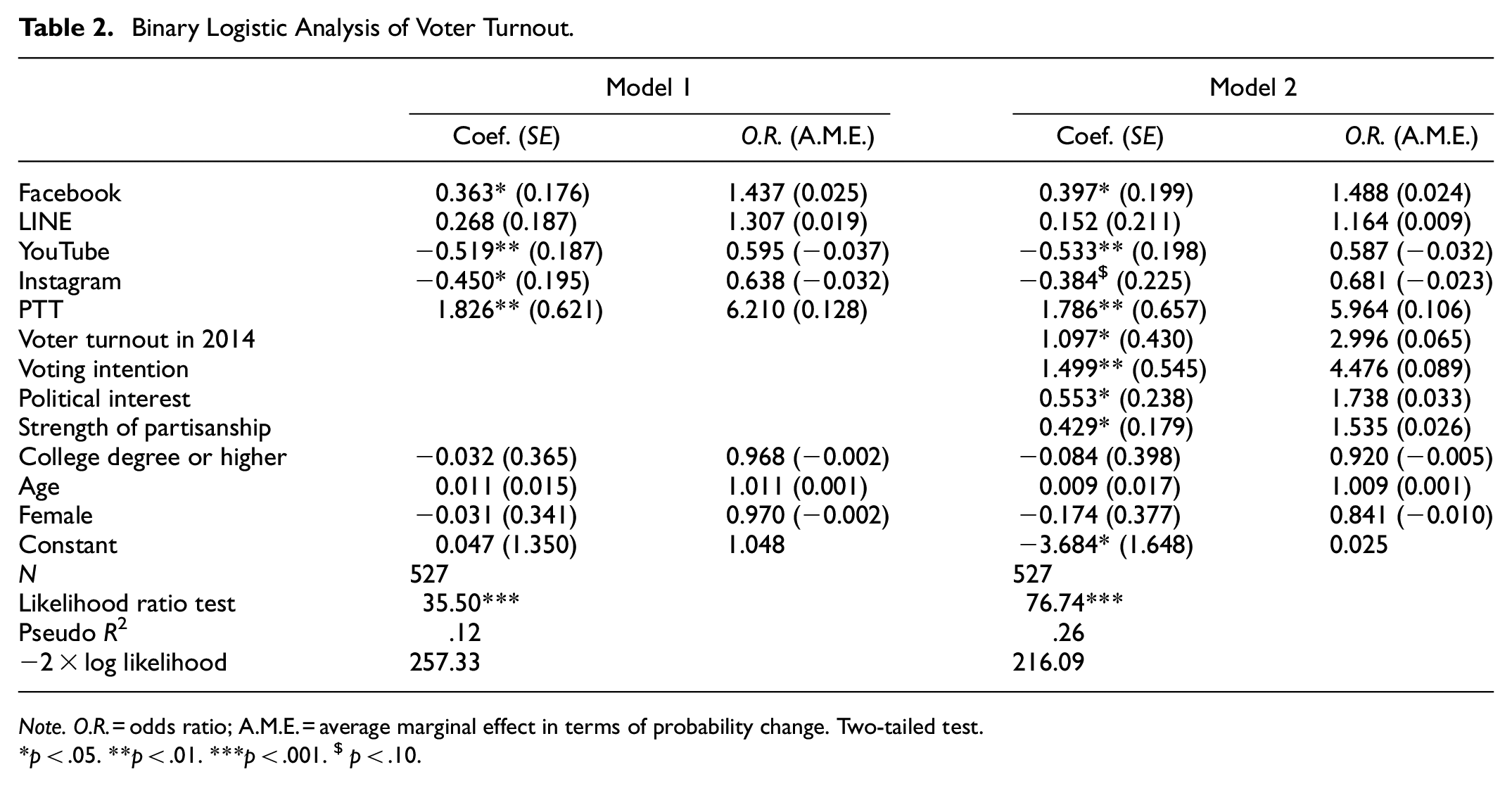
After briefly discussing people’s behavioral patterns of social media use, this study switches attention to the relationship between social medial use and vote turnout. First, this study estimates the binary logit model that includes the variables of social media use and demographic characteristics. As demonstrated in Model 1 of Table 2, four out of five variables of social media use have significant effects on voter turnout, but the directions of the coefficients are not always consistent with the theoretical expectation. Specifically, as expected, the variables of Facebook and PTT exert significant positive effects on vote turnout. That is, people who use Facebook or PTT more frequently are more likely to vote. However, it is found that the variables of YouTube and Instagram are significantly negatively associated with voter participation. That is, people who use YouTube or Instagram more frequently are less likely to go to the voting booth. Furthermore, the use of LINE has no relationship with voter turnout. The above findings indicate that different social media platforms have heterogeneous effects on individuals’ turnout behavior. One possible explanation is that people who use Facebook and PTT are more likely to be exposed to election and mobilization information that then stimulates them to vote. Facebook is the primary and dominant social media platform in Taiwan and almost all candidates set up the Facebook fan pages during the election (Lin, 2017). Therefore, the frequent users of Facebook should have a higher likelihood of exposure to election and mobilization information. On the other hand, PTT is the primary forum for political discussion and the cyber army had used PTT to promote a certain candidate and denounce his rivals for ballots during the 2014 Taipei mayoral race (Ko & Chen, 2015). Consequently, the frequent users of PTT also ought to be more likely to be exposed to election and mobilization information. By contrast, people mainly use YouTube and Instagram for the purposes of entertainment and social networking (Herhold, 2018), and thus the use of YouTube and Instagram provides little help to people for gathering political information.
Binary Logistic Analysis of Voter Turnout.
Note. O.R. = odds ratio; A.M.E. = average marginal effect in terms of probability change. Two-tailed test.
p < .05. **p < .01. ***p < .001. $p < .10.
The above findings lend some support to the relationship between social media use and voter turnout. Next, this study estimates another regression model that includes more attitudinal variables associated with voter participation to check whether the observed relationships between social media use and voter turnout remain statistically significant. This study also investigates whether multicollinearity poses a threat to the precision of the estimate coefficients. The result from the multicollinearity test shows that the values of variance influence factor (VIF) for all explanatory variables are less than 2, indicating that there is no problem with multicollinearity in the model. As displayed in Model 2 of Table 2, while the variables of Facebook, YouTube, and PTT are still statistically significant at the .05 or .01 level, the coefficient for the variable of Instagram simply achieves the significance level of .10. In general, the findings reveal that social media use still plays a significant role in individual turnout decisions even after controlling for important attitudinal determinants of voting behavior. Specifically, on average, a one unit increase in the frequency of Facebook use is associated with a 2.4% increase in voter turnout, whereas a one unit increase in the frequency of PTT use could increase the probability of voting by 10.6%. By contrast, on average, a one unit increase in the frequencies of YouTube and Instagram use would decrease the probability of voting by 3.2% and 2.3%, respectively. Among five types of social media, it appears that the use of PTT has a larger effect on voter turnout. To clearly demonstrate the substantive effect of social media use on voter turnout, this study further computes and plots the predicted probabilities of voting for the use of Facebook, YouTube, and PTT. Since the variable of Instagram fails to attain statistical significance at the conventional level of .05, this study chooses not to report the predicted probability of voting with the 95% confidence interval for Instagram use. As displayed in Figure 5, the more frequent use of Facebook would increase the predicated probability of voting from 86.8% to 94.2% by holding all other variables at their observed values. Nevertheless, the more frequent use of YouTube would decrease the predicated probability of voting from 95.4% to 85.6% (see Figure 6). Finally, Figure 7 demonstrates that the predicted probability of voting would increase from 88.8% to 99.8% with the increase of PTT use, holding all other variables at their observed values. It is noted that although overall the use of PTT has a positive effect on voter turnout, its marginal effect is getting smaller, implying that PTT makes a difference to users and non-users with regarding to voter participation, but once people use PTT, the frequency of PTT use seems to carry less weight in their turnout decisions.
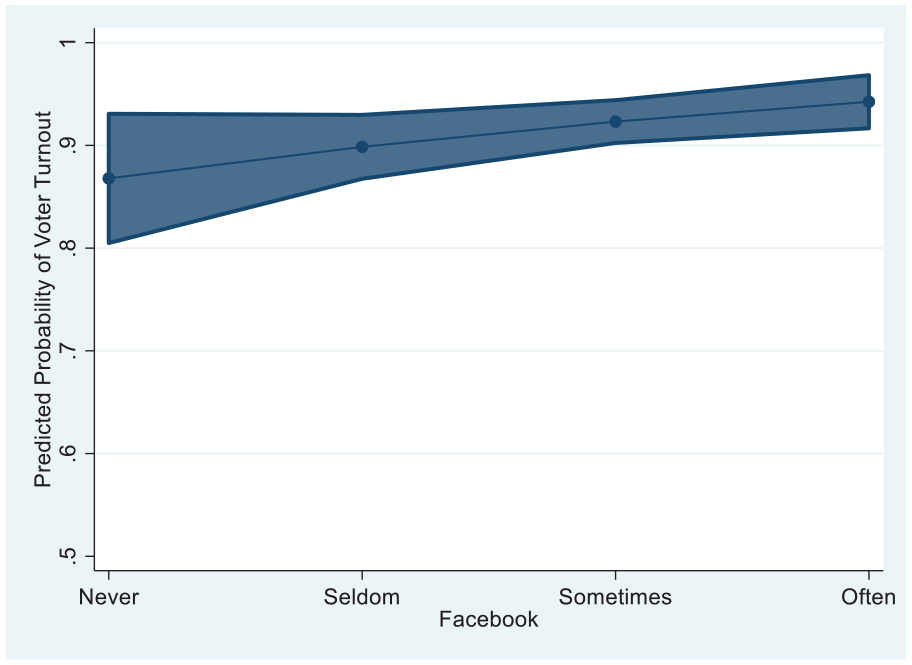
The effect of Facebook on voter turnout.

The effect of YouTube on voter turnout.

The effect of PTT on voter turnout.
In addition to the effect of social media use on voter turnout, this study also finds, consistent with previous studies, some variables that provide explanatory power for individual turnout decisions. That is, people who voted in the past election are more likely to cast ballots and those who clearly express their voting intentions are more likely to vote as well. Specifically, people who voted in the 2014 Taipei mayoral election are 6.5 percentage points more likely to vote in 2018 than their counterparts, whereas people who report voting intentions are 8.9 percentage points more likely to vote than those who do not display voting intentions. Furthermore, people with higher levels of political interest and stronger levels of party identification are more likely to cast ballots, again confirming the significance of political interest and party identification in voter participation.
To sum up, the above findings demonstrate that social media plays a non-trivial role in driving individuals’ turnout behavior. While previous studies have argued that the use of social media should have a positive effect on voter turnout, this study shows that different types of social media have different effects on voter participation perhaps because people are more likely to be exposed to politically relevant information from some social media platforms and are less likely to obtain political information from the others. Besides, the inclusion of important explanatory variables of voter turnout has little or no influence on the relationships between the use of five social media platforms and voter turnout, which corroborates the importance of social media in individuals’ turnout behavior.
Conclusion
Social media has drastically changed the way people interact and communicate as well as how politics operates. It has been observed around the world that elected officials and governmental institutions have widely used social media such as Facebook, Twitter, and YouTube to disseminate information about government policies and interact with citizens. Moreover, candidates for public office have increasingly utilized social media for political campaign because social media can facilitate the rapid and broad dissemination of political information and allow for direct contact with voters. There is no exception for Taiwan where elected officials and political candidates have made efforts to run the Facebook fan pages and people are increasingly using social media for political news and information. This study aims to examine how the use of five social media platforms including Facebook, LINE, YouTube, Instagram, and PTT influences individual turnout behavior in Taiwan. Empirical evidence shows that people who use Facebook and PTT more frequently are more likely to vote, but those who use YouTube and Instagram more frequently are less likely to go to the voting booth. The findings suggest that different types of social media exert heterogeneous effects on voter turnout and thus the use of social media is not always conducive to voter participation, depending on the likelihood of exposure to political information and the purpose of social media use—entertainment, social networking, or political information gathering. Only when people use social media for political information will they be more likely to vote. By contrast, the use of social media for recreational purpose and social networking has no influence on individual turnout decisions (T.-L. Wang, 2013). Therefore, when it comes to the influence of social media on voter turnout, we should pay attention to not only the frequency of social media use but also the purpose of social media use.
Although this study provides some evidence on the relationship between social media use and voter turnout, it is acknowledged that this study fails to offer a complete picture of the mechanism of how social media influences individual turnout decisions given that the measurement of social media use simply focuses on the frequency of social media use in this study. To precisely gage the political consequences of social media use, it might be more appropriate to assess individual use of social media specifically for gathering political information, instead of general purpose. However, as demonstrated by past studies (e.g., Dimitrova et al., 2014; Towner, 2013; Zhang et al., 2013), when the measurement that focuses on informational use of social media is used, there is often a positive relationship between social media use and political participation. Therefore, while this study measures general use of social media use, this study provides a more conservative estimate of the relationship between social media use and voter turnout. In other words, even though people do not intend to use social media for political purposes, they are still likely to be exposed to political information on social media platforms and further increase their intentions to participate in politics. Consequently, we should not ignore the intangible impact that social media might have on individual political behavior. Furthermore, this study assumes that people who use specific types of social media such as Facebook, LINE, and PTT more frequently should have more political information that then motivates them to vote. To test this theoretical mechanism, it should be more appropriate to perform mediation analysis to see whether political information can mediate the effect of social media use on voter turnout. Unfortunately, due to data limitations, this study fails to take political information into consideration and calls for more research into the relationship between social media use and individual level of political information.
Finally, this study simply addresses the relationship between social media use and voter participation using a sample from people living in Taipei and thus the findings might not be generalized to the entire Taiwanese population. More data need to be collected in order to see whether the findings of this study still hold for the whole Taiwan population. Besides, given that prior research has demonstrated the influence of social media on collective action (e.g., Breuer et al., 2015; Margetts et al., 2015; Tufekci & Wilson, 2012), it is worthwhile to investigate how social media use affects Taiwanese people’s participation in collective action and other political activities in the future. On the other hand, the popular use of social media has also raised serious concerns about fake news. Since social media platforms can facilitate rapid dissemination of information, it is much easier for people to get a variety of information, but at the same time, it is difficult for people to differentiate true from false information on social media. Therefore, people might receive wrong and even fabricated information on social media that might further mislead them to take political action which does not meet their best interests. Given the prevalence of fake news on social media, people need to come up with a way to identify false information when using social media. This is especially important for those who heavily rely on social media for political information. As a result, when we examine the influence of social media use on individual political behavior, we should pay attention to frequency, content as well as information quality in the use of social media.
Footnotes
Declaration of Conflicting Interests
The author(s) declared no potential conflicts of interesto/or publication of this article.
Funding
The authors disclosed receipt of the following financial support for the research, authorship, and publication of this article: This work was supported by the National Science and Technology Council and Yushan Young Scholar Program from the Ministry of Education in Taiwan.
