




Abstract
Talent management is of strategic importance for organizations across the globe. Organizations face formidable challenges in managing talent. Although talent management is gaining attention in emerging economies such as India, there is scanty research in integrated talent management practices in the context of developing markets. This study reviews the existing but scattered measurement scales of talent management processes. Using a systematic scale development approach, the authors employ exploratory as well as confirmatory factor analyses with a sample of 506 employees from 17 organizations across three industries to develop an Integrated Talent Management Scale (ITMS). Numerous statistical tests were performed to establish the reliability and validity of the scale. The analysis confirmed the theoretically identified dimensions of talent management, namely, identifying critical positions (ICP), competence training (CT), development (D), and reward management (RM). The study makes an important contribution by constructing and validating an ITMS that would enable researchers and practitioners to measure talent management and its outcomes in a comprehensive manner.
Introduction
Talent management is of strategic importance for organizations across the world in the 21st century (Boudreau & Ramstad, 2007; Cappelli, 2008; Collings & Mellahi, 2009; Ready & Conger, 2007). Most organizations that operate globally face formidable challenges in talent management. This is more severe in emerging markets and particularly in India, where there is a dearth of talented aspirants to meet the needs of the industry. A McKinsey study reported that only 10% to 20% of the university graduates are employable. According to Holland (2008, p. 24), “they lack the necessary training, language skills and cultural awareness.” Organizations face challenges in recruiting and retaining talented professionals. The attrition rate in some sectors is very high and especially in information technology and business process outsourcing sectors is in the region of 40% to 45% (Bhatnagar, 2007).
The necessity for managing talent effectively is being recognized by organizations. There is an increased attention in the area of talent management and job performance (Björkman, Fey, & Park, 2007; Chambers, Foulon, Handfield-Jones, Hankin, & Michaels, 1998). There is a growing recognition of the unmistakable value of talent as an effective instrument and how it serves organizations as a basis of competitive advantage (Björkman et al., 2007; Chamber et al., 1998; Lewis & Heckman, 2006). Most multinational organizations recognize that recruiting people for pivotal positions is essential for developing and sustaining a competitive advantage (Collings & Mellahi, 2009; Tarique & Schuler, 2008). Collings and Mellahi (2009) have broadly defined talent management as “talent management involves systematic identification of key positions which differentially contribute to the organization’s sustainable competitive advantage, the development of a talented pool of high potential and high performing incumbents to fill these roles and the development of a differentiated human resource architecture to facilitate filling these positions to ensure their continued commitment to the organization.”
There has been scanty research in emerging economies, particularly India, with respect to taking an integrated approach to talent management practices, that is, identifying and assessing talent, identifying pivotal positions, training and development and reward management (RM), and engagement and organization commitment of professional talent. Studies focusing on integrated talent management practices in Indian organizations are very limited. This study encompassing organizations in India is an attempt to bridge this gap. This article identifies existing scales from previous studies for measuring various constructs in talent management. The “Literature Review” section provides an overview of talent management, approaches to talent management, and identifies constructs and validated scales for their measurement. The following section presents the methodology adopted. The developed model is presented in Figure 1. The analysis of data and conclusions are presented, and implications for practice and contribution of the study are discussed. The limitations of the study and suggestions for further research are provided in the concluding section.

CFA model.
Literature Review
Background
There is a growing interest and hence a spike in literature related to talent management. The case study approach is predominant. Many studies are based on unreliable evidence to prescribe best practices in talent management. No peer-reviewed articles were found prior to 2006, and for the period 2007 to 2014 (both years included), only 96 full text format articles were found according to Eva Gallardo-Gallardo and Marian Thunissen (2016). Collings, Scullion, and Vaiman (2011) concluded that the field has moved from “infancy to adolescence,” due to the major contributions from North American thinking and research. The U.S. context has a major influence on the debate. Talent management research is mostly in the context of multinationals and private sector organizations (Thunissen, Boselie, & Fruytier, 2013).
Definition and Meaning of Talent
There is a copious amount of research available on talent management as an human resource (HR) initiative but both academics and practitioners are not “precise about what they mean by the term ‘talent’ in organisations and the implications of defining talent for talent management practice,” according to Tansley (2011, p. 454). Progressively, more and more organizations have come to recognize the importance of identification of talent for enhanced performance in organizations (Collings & Mellahi, 2009). Interestingly, however, there is a lack of consensus among human resource management (HRM) practitioners in defining, identifying, and measuring organizational talent. Organizations have developed their own understanding of talent and hence do not follow any prescribed definitions. Hence, there is no unanimity on a single definition of talent.
Talent Management Approach
A number of approaches to talent management has been recorded in the literature listed in the Table 1. The approaches can be classified as organizational and individual. The most common approach among the organizations has been the exclusive positions approach. The individual approach has been innate and nurtured. This essentially means organizations have considered talented people as exclusive and have identified critical positions. The innate approach to talent relates to identification of ability of talent. The organizational focus is on training and developing talented individuals to make sure that they are committed to the organization. The interpersonal and intrapersonal approach ensures the performance of talent with respect to organization and individual benchmarks for excellence.
Talent Management Approaches.

Source. Researcher’s distillation.
Talent Management Processes
Talent management processes are an important element of the management of HRs system in an organization. Theoretical studies in the field of business strategy have enhanced the importance of HR in creating a lasting competitive advantage. The resource-based view (RBV; for example, Barney, 1991, 1986) of organizations has influenced firms to craft a business strategy focused on developing resources that can add value and make it difficult for competitors to replicate, thus creating sustained competitive advantage. Researchers in the field of HR have tried to establish a link between HR practices and firm performance. The focus of research has been largely on individual HR practices like compensation (e.g., Gerhart & Milkovich, 1990) or selection (e.g., Terpstra & Rozell, 1993). This has not yielded any tangible results, and hence, there has been a broader focus on how HRM as an integrated management approach may influence and create a lasting competitive advantage for organizations. Boxal and Purcell (2002) suggested a strategic approach with well-designed and congruent HR practices which will ensure better organizational effectiveness and performance. Huselid (1995) and Jackson and Schuler (1995) were exceptions to this approach which assume that formation of HR activities alone can manage all employees in an organization. Lepak and Snell (1999) suggested that employees can be differentiated on the basis of their uniqueness and the value of their contribution to the organization. The uniqueness and value of human capital will be high when the focus is on internal development and relationship is organization focused. This is expected to result in committed employees. In extremely competitive and changing environments, employees are expected to shoulder bigger roles and this is deemed essential for organizational attainments (Lawler, 1994; Parker, 1998). Therefore, identifying critical positions (ICP) and selecting the talent to occupy these positions could result in greater commitment among employees which would result in enhanced firm performance.
The emphasis of HR practices is to build on the motivation, commitment, and development of those in pivotal positions. Boxall and Purcell (2011) noted that the nature of the contract has moved from a short term to a long term approach and the nature of the pyschological contract is more relational than transactional. The primary purpose of implementation of a talent management system in an organization is to improve the essential skills and capabilities of people who occupy pivotal positions and recognize and reward those who contribute value and build an organization’s competitive advantage (Collings & Mellahi, 2009). Thus, the talent management process involves subprocesses which focus on ICP, competence training (CT), development (D), and RM.
Identifying Critical Positions
This scale is built on the premise that ICP is fundamental to any talent management system. According to the exclusive and position approach to talent management, identifying talented people and developing them is the first stage in any talent management process (Collings & Mellahi, 2009). Organizations recognize the need for differentiation of roles within the organizations. The roles are differentiated on the basis of the strength of the impact of roles that contribute to organization performance. The focus of organizations is on strategic over nonstrategic roles (Becker & Huselid, 2006). The key is to identify “A” players and focus on practices that would enable the organization to train, develop, and retain them. Some researchers stress on the importance of the identification of key positions (Boudreau & Ramstad, 2005, 2007) which have the potential to impact organization outcomes and drive competitive advantage of firms. Talent management is conceived as a process that transforms an input to an output. One of the primary inputs is ICP. The internal training and development of the talented is important for organizations to enhance performance (Lepak & Snell, 2002). The processing of these inputs is assisted with the deployment of appropriate HR policies. The resultant output is desired behaviors of people which contribute to organization performance. The contention of practitioners of talent management is that building a talent pool by identifying and acquiring talented people to fill critical positions will ensure appropriate behaviors that are important for the effective performance of the organization.
Competence Training
The RBV advocates shifting emphasis from industry factors toward internal human capital resources as sources of competitive advantage. This strengthens the growing acceptance of internal resources as sources of competitive advantage and validates the assertion of HR researchers that people are strategically important to organization success. When the knowledge base of employees becomes a key differentiator and a source of competitive advantage, organizations would rightfully invest heavily in training and development of firm-specific skills required for attaining the competitive edge. Investment in training initiatives is seen as an investment in building organization capability through competency-based HRs. The approach is to differentiate organizations on the basis of firm-specific competencies and encourage a set of related behaviors. Training is employed to enhance job skills, to prepare talented people for the advancement in their careers, and to keep pace with changing job requirements aligned with changing business needs in a dynamic business environment.
Development
David McClelland (1973) proposed the idea of “competency based human resources” as a differentiator of organization performance. Boyatzis (2008, p. 5) defined competency “as a capability or ability and a set of related behaviours called intent.” This is the behavioral approach to talent. The development of talent represents an important constituent of the overall talent management process (Cappelli, 2009). While CT is focused on enhancing skills on the current job, the need for development is important to meet future requirements necessitated by the ever changing business environment and the need for organizations to align with them. Talent development has been defined as “Talent development focuses on the planning, selection and implementation of development strategies for the entire talent pool to ensure that the organization has both the current and future supply of talent to meet the strategic objectives and that development activities are aligned with organizational talent management processes” (Garavan, Carbery, & Rock, 2011, p. 6). High potential talents characteristically deliver consistently good results. They are also adept at acquiring expertise in new areas very quickly and are driven by a strong desire to achieve excellence (Ready et al., 2010). They are found to exhibit a relentless focus on learning, and have the capacity to assess risks quickly. Talent can be termed as the development of a small group of individuals who possess managerial and leadership competencies. There is lack of consensus on whether talent development should be focused on the few or everyone in the organization and the type of talent that should be part of the development process (Iles et al., 2010). A study by CIPD (2011) suggests a mix of various approaches. A clear statement of the development needs, development of pathways, and an effective system of HR practices to identify, assess, and nurture talent is necessary. Talent development is founded on the ability, motivation, and opportunity (AMO) framework to elicit desired behaviors for successful organization performance. To elicit desired behaviors, organizations provide feedback and incentives that support the desired behaviors. Competence development is to ensure that talents have a multiple career path which meets the talents’ expectations consistent with their ability and performance.
Reward Management
A RM system consists of policies, practices, processes, and procedures (Armstrong, 2001). Employees may seek value in different ways. Both intrinsic and extrinsic forms of reward are important for the motivation of an individual engaged at work (Cox, 2005; Greenberg & Colquitt, 2005).
Several studies related to motivation have been found in literature focused on the nature of rewards impacting individual performance in an organization. The earliest research is from Vroom (1964) who propounded his “expectancy theory” which introduced a qualitative and quantitative dimension to rewards. Herzberg (1968) in his two-factor theory proposed that motivators work in a dual continuum from satisfaction to no satisfaction and highlighted that intrinsic factors such as career advancement, recognition, responsibility, and a sense of achievement from doing meaningful work are greater motivators than financial rewards like pay and incentives. There is an ongoing debate about the impact of intrinsic and extrinsic factors acting as a motivator for individual performance. Various researchers have examined both intrinsic and extrinsic factors in the context of the cognitive development theory and the self-determination theory. Ryan and Deci (1985, 1987) treated both intrinsic and extrinsic motivators as distinct from each other. They also suggest that the same factors that may create intrinsic motivation because of feelings of self-determination can also promote extrinsic motivation and they act reciprocally. Harackeiwicz and Sansone (1991) proposed a model of intrinsic motivation wherein rewards that are contingent on performance cause individuals to care more about doing the task well, compared with a performance objective with feedback without a reward. Performance contingent rewards produce greater intrinsic motivation. Rewarding quality of performance enhances perceived competence which in turn stimulates greater intrinsic interest. Employees with strong performance-reward expectations display an increased perception of the value of performance. External contingencies such as rewards, feedback about performance, and strict deadlines can reduce motivation of the individual as they are perceived as controlling and intrusion into the autonomy. Lepper and Henderlong (2000) suggested that intrinsic and extrinsic motivation both operate simultaneously and are not reciprocal. Sansone and Smith (2000) opined that extrinsic motivation is a trigger for intrinsic motivation and will result in motivating the individual to devise interest enhancing strategies to improve performance. The nature of the relationship between intrinsic and extrinsic motivation factors is complementary to each other and will result in enhanced performance of the individual. Thus, RM is an important factor in the talent management process.
The dimensions of talent management, namely, ICP, CT, D, and RM, have been identified through literature review and constitute the framework, and a distinctive feature of this framework is that it captures all the major dimensions of talent management process. The working definitions of the variables in this study are mentioned in Table 2.
Names of Constructs and Their definitions.

Source. Prepared by researchers.
ICP = identifying critical positions.
Method of Research
Objective
The attempt is to crystallize an instrument covering constructs of talent management and to evolve an Integrated Talent Management Scale after due validation.
Development of the Instrument
This study perused scales and instruments that were developed and validated by other researchers. We have used the same instrument, but modified them without altering the original meaning and intent to create better clarity and understanding among the respondents, and this has facilitated comparison across cultures (Yu, Lee, & Woo, 2004). A thorough literature survey was conducted and various instruments relevant for the study were identified. Table 3 provides details of the researchers and the study from where it was gleaned. An email was sent to the respective researchers for seeking their consent before using the questionnaires in this study. Table 3 presents a list of various instruments perused and items that were selected from the instruments.
Number of Items in Constructs and Sources.

Source. Chen (2012) and Hung (2013).
Content Validation and Content Adequacy
The questionnaire perused and presented earlier had been employed in Western settings. Hence, a need was felt to review the number of items and adapt their language for convenience of use and better understanding of the executives in Indian organizations. The instrument had 37 items. The items were shared with a panel of two expert researchers in the HR domain with a request to review the scale items against each construct. This resulted in shortlisting of 30 items for the final instrument. Some items were removed and some were modified. In addition, a few items were also added which were found relevant for the study. The questionnaire consisted of 30 items and was sent to a second panel of experts consisting of four HR research scholars and three practitioners from industry who were HR heads of business organizations for their review and comments. On the basis of their review, some of the questions were modified and some were deleted and the final instrument contained 26 items for the purpose of the study. Table 4 represents the Integrated Talent Management Scale.
Integrated Talent Management Scale.

Source. Chen (2012) and Hung (2013).
Note. ICP = identifying critical positions; CT = competence training; D = development; RM = reward management.
Data Collection
Seventeen organizations participated in the survey and the number of responses received was 562. Each case was reviewed for cleanliness of data and to ascertain whether there were any discrepancies. While checking for individual case discrepancies, case screening was resorted to. In this review, the researcher looked for missing values and incomplete responses. The researcher identified 56 responses after review. These respondents failed to respond to more than 10% of the questions and hence were not considered (Hair, Anderson, Babin, & Black, 2010). Some of the cases had missing values and the missing values were imputed using median. To check for variable discrepancies, variable screening was performed by two methods. First, we checked the variable missing data by calculating the frequency of the entire dataset. There were no missing values. The final list of items is 506. Second, the researcher assessed the normality of the data. Absolute normality of data is rare (Micceri, 1989). However, the skewness and kurtosis were found to be in acceptable limits (Table 5).
Values of Skewness and Kurtosis.

Profile of Respondents
The profile of the respondents was heterogeneous (Table 6). The respondents (N = 506) were from three industries, namely manufacturing (n = 192), information technology and information technology enabled services (n = 159), and banking and financial services (n = 155). Samples were drawn from 17 organizations, seven from the manufacturing sector and five organizations each from the banking and financial services and information technology and information technology enabled services. All the organizations were large and have more than 1,000 employees. They were categorized on the basis of level of employment, function, and work experience, respectively, in which 31% were from junior, 50% were from middle level, and 19% were from senior level. In all, 20% of respondents were from marketing, 12% were from finance, 30% were from HRs, 17% were from operations, and 22% were from other functions. In terms of work experience, there were five different categories. Respondents with work experience ranging from 1 to 5 years were 39%, 6 to 10 years were 32%, 11 to 15 years were 18%, 16 to 20 years were 8%, and more than 20 years were 2%. This work experience may not necessarily be in the same organization. The sample is heterogeneous and fairly representative of the population under study.
Descriptive Statistics of Respondents.

Source. Prepared by researchers.
Analysis of Data
Exploratory Factor Analysis (EFA)
To determine the correlation between the variables in the dataset, an EFA was performed with SPSS 21. The principal components analysis was chosen for performing the rotation with varimax rotation and 12 iterations. The Kaiser normalization was used as an extraction method. Eigenvalues greater than 1.0 was considered as the basis for the four factors identified. The results of the Bartlett’s test of sphericity are provided in Table 7.
Sampling Adequacy test.

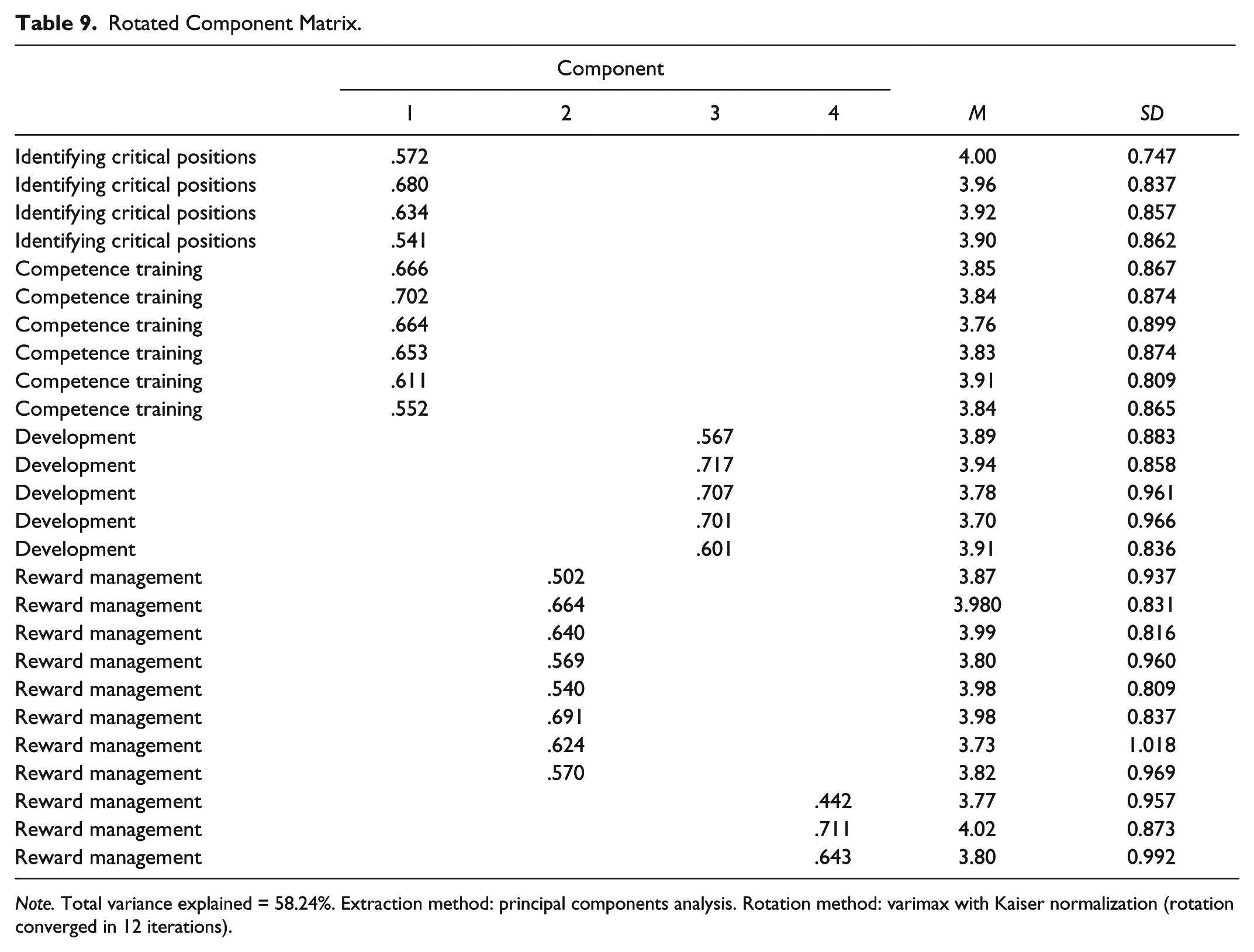
The suitability of the data for factor analysis was tested using Kaiser–Meyer–Olkin (KMO) test. In our study, the value was found to be 0.952 which is considered as very good, and the data are suitable for factor analysis. The Bartlett’s test of sphericity is a good indicator of the strength of the relationship among variables. This test helps us to ascertain whether there is a relationship between the variables. In our study, the Bartlett’s test was significant indicating the fitness of the sample for factor analysis. Thereby, it was considered appropriate to conduct the EFA (see Table 9). The reliability of the four factors was found to be .809 which is considered adequate. The factors and their alpha values are depicted in Table 8.
No. of Items in Factors and Alpha Values.

Source. Prepared by researchers.
Note. ICP = identifying critical positions; CT = competence training; D = development; RM = reward management.
All the alpha values are considered above the acceptable range and hence found to be adequate. The factor loading varied between a low of 0.442 and a high of 0.717. A total variance of 58.24% was explained by four factors. The factor “ICP” explained 43% of the total variance. The factor “CT” explained 7% of the total variance, and each of the factors “D” and “RM” accounted for 4% of the total variance. The mean scores and standard deviations of all factors and the results of the EFA are provided in Table 9. The factor loadings range from a minimum of 0.442 to a maximum of 0.717 which is found satisfactory.
Rotated Component Matrix.
Note. Total variance explained = 58.24%. Extraction method: principal components analysis. Rotation method: varimax with Kaiser normalization (rotation converged in 12 iterations).
Confirmatory Factor Analysis (CFA) Model
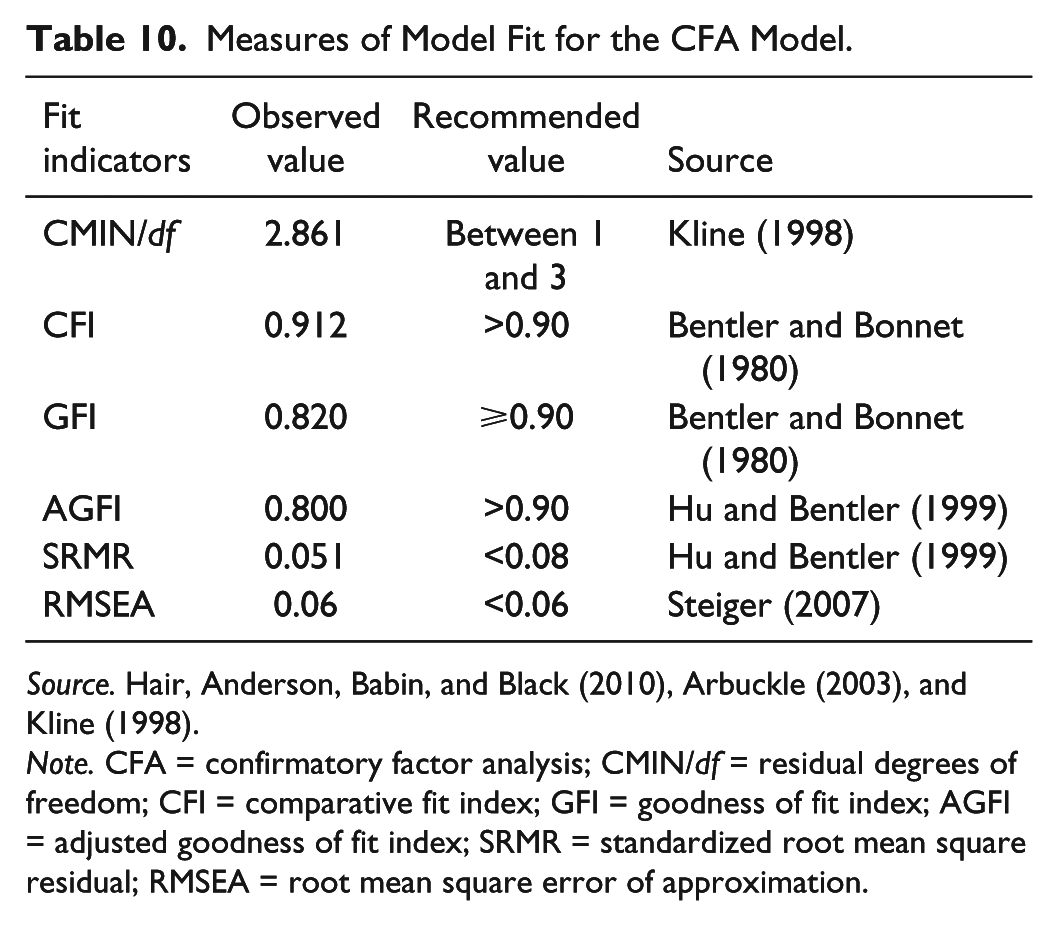
CFA follows after EFA, and it helps to determine the factor structure of the dataset and is generally recommended to overcome some of the limitations in the EFA. EFA is generally driven by data which is dependent on a number of subjective decisions to be taken by the researcher. By employing CFA, the researchers can cross validate the factor structure in an appropriate way. Validity assessment is done mainly to make the results factor more robust and stable. The factors ICP, CT, D, and RM were grouped together and a CFA was conducted, and the items loading on each factor were specified and the model was tested. The CFA output includes fit indices. We have used “Maximum Likelihood Method” to test the model fit. We have chosen normed chi-square; root mean square error of approximation (RMSEA), which is an absolute fit index; and comparative fit index (CFI). The model fit indices are shown in Table 10. It is observed that the model factor structure has a good fit as the observed value of chi-square/df is 2.81 which meets the criteria that is less than the recommended value of 3.0. The CFI is 0.912 and the RMSEA value is 0.06 which meets the prescribed criteria of less than 0.8.
Measures of Model Fit for the CFA Model.
Source. Hair, Anderson, Babin, and Black (2010), Arbuckle (2003), and Kline (1998).
Note. CFA = confirmatory factor analysis; CMIN/df = residual degrees of freedom; CFI = comparative fit index; GFI = goodness of fit index; AGFI = adjusted goodness of fit index; SRMR = standardized root mean square residual; RMSEA = root mean square error of approximation.
Reliability and Validity of Constructs.

Note. CR = composite reliability; AVE = average variance extracted; ICP = identifying critical positions; CT = competence training; D = development; RM = reward management.
Discussion
The above fit indices show that the model is a good fit. All the constructs were evaluated independently for statistical significance. The standardized factor loadings are greater than 0.6 and p value is found significant at .01. Composite reliability values greater than .7 reflect good reliability. The composite reliability of all the constructs was greater than .8 and ranged from .814 to .887 (see Table 8). Average variance extracted (AVE) is a strict measure of convergent validity, and all the constructs were found to have an AVE value of more than 0.5 with the exception of “RM” (see Table 11).
Results of Correlation Enquiry.

Note. ICP = identifying critical positions; CT = competence training; D = development; RM = reward management.
Correlation is significant at the .01 level (two-tailed).
The loadings on all the factors were above the recommended value, that is, 0.5 (Hair et al., 1998). “AVE is a more conservative measure than CR (Composite Reliability), on the basis of CR alone, the researcher may conclude that the convergent validity of the construct is adequate, even though more than 50% of the variance is due to error” (Malhotra & Dash, 2011, p. 702). The most accepted measure of measurement of reliability is the Cronbach’s alpha (Hogan, Benjamin, & Brezinski, 2000; Iacobucci & Duhachek, 2003; Peterson, 1994). Alpha values of greater than .7 are accepted (Hair et al., 2010; Nunally, 1978). The Cronbach’s alpha for all the constructs were found to be above the acceptable range, as shown in Table 8. This is required for measurement scales to be robust. A strong internal consistency was found among the constructs in this study.
Convergent and Discriminant Validity of Scale
To examine the convergent validity of the scale, it is necessary to determine whether the items of measurement exhibit a strong correlation with the theoretical construct. Ideally, the level of standardized loadings for reflective indicators is 0.7 but a measure of 0.4 is considered an acceptable level for large sample size. All factor loadings are greater than 0.4 and range from 0.442 to 0.717 (see Table 7). They were also found to be having a p value of .05 which is significant.
Thus, the scale possesses convergent validity. Discriminant validity is the extent to which a construct is distinct from other constructs. Discriminant validity is checked by comparing the AVE’s with the squared correlation for each of the constructs. The results showed that the AVE for each pair of the four dimensions was greater than the squared correlation for the same pair. Hence, the conclusion was that the scale possesses discriminant validity (Fornell & Larcker, 1981).
Conclusion
The suggested talent management scale consists of four constructs, namely, ICP, CT, D, and RM. These four dimensions of the talent management process were identified through extensive literature review. Our approach is consistent with the workforce differentiation approach through identification of critical positions (Boudreau & Ramstad, 2005, 2007; Collings & Mellahi, 2009; Huselid et al., 2005). Our approach resonates with the AMO model (Applebaum et al., 2009; Bailey et al., 2001) which states that employee performance is a function of ability, motivation, and opportunity. Our study adopts the human capital approach and is consistent with the differentiated HR architecture (Lepak & Snell, 1999) of internal development as a strategy for developing talent. RM is an important element of the talent management process, and this is consistent with the social exchange theory which represents an exchange relationship between an organization and its employees.
Researchers who have followed the model fit approach have paid greater attention to fit indices. The model developed in this study had good fit indices, and hence, we can conclude that it has acceptable psychometric properties. This study was conducted with previously developed scales in a Western setting and was modified to suit Indian settings. The simplifying of the items from the original could have created measurement invariance. The 26-item Integrated Talent Management Scale with some rephrasing to suit Indian organizations performed better than the original study.
Impact of the Study
The primary effect of this study is the creation of an Integrated Talent Management Scale comprising of four constructs, namely, ICP, CT, D, and RM. First, organizations implementing talent management strategies could use this information to design their talent management practices based on these constructs. Second, the availability of an integrated scale would enable researchers and practitioners to measure talent management and its outcomes. Third, the availability of scale for measurement of talent management would enable organizations to study the effectiveness of their talent management strategies and their outcomes. Fourth, in the present study, the number of variables explained only 58% of the variance, and hence, researchers can explore and identify other constructs impacting talent management. Finally, the validated talent management would enable researchers to study the implementation of talent management with large samples with confidence.
Limitations and Suggestions for Future Research
First, this study used several previously developed and validated instruments which were originally developed in other countries by various researchers. This study took place in India among Indian organizations and differences are expected to occur. India is a predominantly a collectivist society and the culture has been found to be high in power distance (Hofstede, 2001). The employees in India are comfortable with and accept power and influence in organizations. A collectivist orientation suggests that individual reward and recognition practices may have to be different as the motivational impact of rewards do not have the same effect as in Western settings (Hofstede, 2001). These differences can diminish the consistency of some of the variables in the instruments despite a meticulous process of verifying and modifying the language in the instruments for the Indian context.
Although all necessary steps were taken to review and modify the instrument with the help of experts to ensure completeness, it is also almost impossible to produce perfectly equivalent meanings and all respondents may not have understood the language of the instruments in the same manner. These problems were expected to happen while using the instruments for the study.
Third, most of the data are provided by the individual by his or her own volition. Most individuals want to appear good in the eyes of others and this may have prompted respondents to provide socially desirable answers. This study had assured respondent’s confidentiality; however, it is unlikely to have eliminated the allure of “social desirability” in responses.
The fourth limitation of this study is that these tests were not designed for testing causal relationships. It was meant to study potential relationships through correlations. The fifth and final limitation of this study was the generalizability of results. The samples were drawn from across the organization and the sample size from each of these organizations was small. While generalizing the results, extreme care must be exercised.
Footnotes
Declaration of Conflicting Interests
The author(s) declared no potential conflicts of interest with respect to the research, authorship, and/or publication of this article.
Funding
The author(s) received no financial support for the research, authorship, and/or publication of this article.