




Abstract
Consumer loyalty is crucial to a company’s performance and significantly influences its development trends. Customer trust and satisfaction form the foundation for establishing consumer loyalty, with perceived value, perceived quality, and service quality serving as prerequisites for gaining this trust and satisfaction. However, the extent to which live broadcasts can be effectively utilized for brand marketing to improve consumer loyalty has not been fully explored. Thus, this study aims to examine how live broadcasters and brand image can increase consumer loyalty. Based on 266 data surveys collected from live streaming users, our statistical analysis reveals that brand image and broadcaster influence are vital in promoting perceived value, perceived quality, and service quality to further increase customer trust and satisfaction, thereby enhancing consumer loyalty. Our findings also provide theoretical and practical insights into improving customer loyalty.
Introduction
In China, many online users view live programs daily, with live streaming seamlessly integrated into their routines (Chen et al., 2020). In this context, live streaming has gained considerable popularity, emerging as a viable network operational model. It has been widely applied on social networking platforms like Douyin, Kuaishou (Liu et al., 2022), Facebook, and YY Live, which have been pivotal in promoting webcasting.
Social-based webcasting combines live broadcasting, online shopping, and social networking functionalities, resulting in a combination that delivers interactivity, entertainment, and authenticity. Customers can ask questions at their convenience, and live broadcasters can respond promptly in real-time. Furthermore, customers can directly place orders following purchase recommendations (Xiao et al., 2022). A live broadcaster can engage with consumers through two-way real-time communication, presenting product information in diverse formats. Their personable demeanor and expert knowledge can mitigate customer uncertainties and increase confidence (Liu et al., 2022). Their amalgamation of professional expertise and personality encourages consumers to make purchase decisions and potentially engage in repeat purchases, standing as the central responsibility of the broadcaster (Y. Chen et al., 2020). Through marketing strategies, the information disseminated by live broadcasters can significantly shape consumers’ product perceptions and even influence their decision-making processes (Ho et al., 2022). Broadcasters introduce products and demonstrate their usage addressing real-time questions from the audience to effectively mobilize customer participation (Y. Chen et al., 2020). Prominent live broadcasters can foster a favorable broadcast environment and provide authentic customer experiences. This, in turn, can bolster customer rapport and facilitate transactions (Cao et al., 2022). Therefore, this study explores how live broadcasters’ influence impacts perceived value, perceived quality and service quality, thereby increasing customers’ trust, satisfaction, and loyalty.
Brand image also plays a role in this process, as it represents the amalgamation of brand information and consumer experiences that take shape within consumers’ minds. It embodies the associations formed when purchasing products, directly influencing consumer loyalty (Rivai et al., 2023). To attract new customers, an enterprise must augment customers’ perception of the value of its products and services, alongside constructing a distinct and unique brand image (Omoregie et al., 2019). The notable positive correlation between image and loyalty demonstrates that a robust brand image can bolster consumer loyalty (Hasan et al., 2020). A company with a strong brand image tends to elevate customer satisfaction, adding value and enhancing overall company performance. Thus, it is imperative for a company to diligently uphold its brand identity (Wahyuni & Ghozali, 2019). When a brand gains customer recognition, the associated company can effectively curtail marketing expenses while benefiting from word-of-mouth promotion initiated by customers, augmenting its influence (Chung & Park, 2017). Therefore, this study also explores how brand image impacts perceived value, perceived quality and service quality and influences trust, satisfaction, and loyalty. While there is considerable research on the internet, social platforms, and live streaming, there is limited literature specifically dedicated to exploring the use of social platforms for brand marketing. To address this research gap, this study concentrates on the impacts of live broadcaster influence and brand image and examines the relationships among perceived value, perceived quality, service quality, customer trust, satisfaction, and loyalty. This study introduces a three-path cross-level mediation model and validate it using structural equations. This approach aims to offer valuable theoretical guidance for merchants in formulating effective online sales strategies.
Our study is organized as follows: Part 2 introduces the theoretical background of concepts such as consumer perceived value and trust in live broadcasts. Part 3 examines model and hypothesis development, while Part 4 introduces the research methods and results. Part 5 explains the theoretical and managerial implications, as well as limitations and future research directions. Part 6 concludes the study.
Theoretical Background
Perceived Value
Consumers make choices regarding products or services based on their individual needs, and they gage product value through evaluations from others. An enterprise’s heightened perceived value correlates with increased customer satisfaction (Suwono & Sihombing, 2016). Perceived value is the disparity between the price consumers are willing to pay and the actual cost. This value can be assessed through price-related considerations and psychological perspectives. When consumers note that the actual price is lower than anticipated, their perceived value increases. Perceived value substantially influences consumption behavior and fosters loyalty (Hasan et al., 2020). It embodies consumers’ recognition of utilitarian and hedonistic aspects. It also involves assessing the trade-off between product cost and quality, attaining perceived benefits, and serving as a driving force for consumers to engage in shopping behaviors. Gaging customers’ perceived value allows enterprises to anticipate customers’ valuations and consequently predict their loyalty (Luo & Ye, 2019).
Consumers comprehensively assess a product’s value when communicating and interacting with a live-streaming host. A higher perceived value tends to correspond with greater consumer satisfaction and heightened loyalty toward the merchant (Y. Chen et al., 2020). Perceived value holds significant weight for customers in the context of webcasting. The acknowledgment of brands and companies, as well as the cost-effectiveness of products, substantially impact consumer loyalty. Live broadcasters should be attuned to customers’ perceived value and shoppers’ psychological inclinations. Elements like status, coupons, discounts, and similar incentives often heighten perceived value among consumers (Sun et al., 2019). Customer perceived value is a subjective assessment of product performance and is pivotal for companies seeking a competitive edge in the market. The rationale behind consumer purchasing decisions often hinges on products’ elevated perceived value, thereby influencing customer preferences and shopping intentions, ultimately fostering loyalty (Alex & Thomas, 2011).
Perceived Quality
In live streaming, consumers judge product quality through visual perception and trust in a live broadcaster. A reputable and well-regarded live broadcaster can significantly and positively influence the audience’s perception of product quality. When products are perceived as being of good quality during a live broadcast, customers are likelier to purchase those products (Xu et al., 2021). Perceived quality refers to customers’ assessments of the cost-effectiveness of products and services, reflecting their perceptions of those products. It primarily manifests through service and product quality. While service quality pertains to the dependability and responsiveness of post-sales service, product quality alludes to a product’s satisfactory performance (Samudro et al., 2020). Perceived quality encapsulates the customer’s viewpoint regarding the dependability and consistency of a company’s product, which is intertwined with consumers’ shopping motivations and personal preferences. Thus, elevating consumers’ awareness of product quality can effectively stimulate their purchasing behavior (Shanahan et al., 2019).
Perceived quality involves customers’ perceptions of a product’s anticipated superiority over alternatives. When a product effectively fulfills users’ anticipated needs, their perception of its quality is elevated. Thus, enterprises must strive to meet customers’ expectations to uphold and strengthen their loyalty (Alex & Thomas, 2011). Perceived quality, influences consumers’ decision-making processes. Consumer loyalty can be impacted by live broadcasters’ product introductions, along with social feedback from fellow customers (Das, 2014). Consumers form psychological assessments of a product significantly influencing their shopping intentions. Hence, business managers should be attentive to consumers’ perception biases, ensuring product quality is accurately evaluated. This entails focusing on esthetics and quality and ensuring live broadcasters offer clear explanations to consumers (Saleem et al., 2015).
Service Quality
Enhancing service quality contributes to promoting product quality, aiding companies in bolstering profitability and overall performance. Moreover, it enables managers to identify issues and cater to consumer needs (Seth et al., 2005). Service quality is intricately linked to factors such as product input costs, customer satisfaction, and customer turnover rates. Enterprises place significant emphasis on service quality, prioritizing customer service. They devise tailored service strategies and invest in staff training to elevate overall service standards (Saravanan & Rao, 2007). Customers’ assessments of service quality are rooted in their perceptions. This evaluation is conducted by comparing consumers’ initial predictions with the service they eventually received. When a customer perceives that the service received surpasses their initial expectations, it indicates that the company’s service quality is of a high standard (H. Lee et al., 2000). Service quality encompasses various dimensions, including response speed, esthetic design, and after-sales services. It is pivotal in influencing customer satisfaction and stimulates customer engagement, feedback, and other related activities, ultimately fostering positive consumption behavior outcomes (Ho et al., 2007).
Trust
Customer trust signifies confidence in a company’s integrity and consistency in delivering services without deceit or concealment of information. This perception of fair and transparent transactions significantly influences consumer satisfaction (Muharam et al., 2021). Establishing a trust-based relationship with customers is critical for a company in fostering customer repurchase rates. Furthermore, it can lead customers to recommend trusted brands to others (Suwono & Sihombing, 2016). Trust is cultivated in a company when its services align with customer needs. This trust subsequently sustains customers’ purchasing behaviors. Thus, consumer trust is pivotal in nurturing their loyalty (Hasan et al., 2020).
Satisfaction
Satisfaction is a subjective sentiment that consumers experience concerning whether the received product or service aligns with their anticipated outcomes. Products that either meet or surpass expectations tend to yield high satisfaction, whereas those that fall short of expectations result in lower satisfaction (Darwin et al., 2019). Customer satisfaction encapsulates the emotions experienced before and after making a purchase. It essentially represents the disparity between their perceptions during shopping and their service expectations. This satisfaction is elevated when the post-use experience surpasses expectations (Massoudi, 2020).
Customer satisfaction pertains to customers’ accumulated experiences after purchasing a product or service. It is pivotal for gaging enterprise recognition. Enhancing satisfaction can cultivate customer trust (Muharam et al., 2021). Customer satisfaction is shaped by the interplay between product and service expectations and actual experiences. The satisfaction customers derive from service outcomes directly influences the strength of the relationship between enterprises and customers. Products garnering high satisfaction are likelier to be frequently used by customers (Omoregie et al., 2019).
Loyalty
The repeated use of products and services embodies consumer loyalty. Companies can cultivate enduring customer relationships through establishing loyalty (Darwin et al., 2019). Customer loyalty is contingent upon individual preferences and strongly correlates with factors such as brand image, service quality, and suitability. Enterprises should prioritize cultivating loyalty by implementing a marketing-mix strategy to incentivize users to sustain purchasing behaviors (Massoudi, 2020). Customer loyalty is molded by shopping experiences and post-sales feedback, frequently shaping subsequent purchasing behavior. This phenomenon has garnered significant business attention (Muharam et al., 2021). Loyalty signifies the customer’s endorsement of a company’s brand and products, serving as a crucial avenue for success in market competition. Loyal customers believe that a company’s products are superior and, as a result, are less inclined to opt for substitutes. This sentiment concurrently boosts repurchase tendencies and promotes active recommendations of a company’s products (Suwono & Sihombing, 2016).
Loyal customers are widely recognized as valuable assets, as they display a propensity for repeated future purchases or usage. Enhancing customer satisfaction can be achieved by eliciting feedback and information from customers. This elevated level of satisfaction can engender an even higher degree of loyalty (Kim et al., 2009). A customer consistently purchasing products from the same company signifies their loyalty. This often stems from their perception of highproduct value, heightening their satisfaction, which, in turn, positively impacts their loyalty (Hasan et al., 2020). Consumer loyalty to a corporate brand can be assessed through the frequency of product purchases and their engagement with competitors’ products. Given the relatively minor distinctions between products enterprises offer, gaining customers is crucial for sustaining loyalty (Ozdemir et al., 2020).
Hypotheses Development
Live Broadcasters’ Influence and Perceived Value
Broadcasters must cater to customers’ entertainment psychology through innovative and personalized approaches. As value co-creators, consumers derive practical, entertainment, and social value by engaging in live video broadcasts, interacting with broadcasters and other users, and contributing to an information pool through gifts and comments. Through these broadcasts, consumers can learn about product features and interact with broadcasters to obtain more information about shopping discounts (Zhou et al., 2021). Broadcasters influence sales through their roles as opinion leaders. Consumers’ perceptions of live broadcasters’ professionalism, credibility, attractiveness, interactivity, and affirmation of the broadcast platform’s perceived value, as well as trust and satisfaction, directly or indirectly impact consumers’ online stickiness and continued purchases (Meng & Lin, 2023). Thus, we present the following hypothesis:
Brand Image and Perceived Value
A successful brand image grants consumer a sense of ownership and delivers significant market information. Customer value creation is crucial for building a successful brand image (L. C. Huang et al., 2019). Consumers tend to favor brands with higher perceived quality, value, satisfaction, and loyalty (Tu, 2013). Consumers tend to believe that a positive image indicates a brand’s capability to provide high value and satisfaction. Brand image can enhance a product’s perceived value and significantly influence the decision-making process, ultimately leading to an increased intention to repurchase (L. Chen et al., 2019). A product with a high perceived value can influence consumers’ brand trust. Thus, perceived value is a fundamental prerequisite for brand trust and positively impacts brand preference (DAM, 2020). The perceived value that customers derive from a brand can take on functional and emotional dimensions or a symbolic nature (Chae et al., 2020). Consumers can develop a preference for a brand based on perceived value, ultimately forming brand loyalty (Othman et al., 2017). Thus, we present the following hypothesis:
Live Broadcasters Influence and Perceived Quality
Through broadcasters “ recommendations, consumers can promptly choose good quality products, significantly improving shopping efficiency. E-commerce live sales enable the real-time video display of products and online conversations between shoppers and broadcasters (Zhou et al., 2021). Live broadcasting utilizes advanced information technology, such as real-time streaming and content distribution networks, to provide consumers with accurate and authentic product information. The strong real-time interaction effects offer consumers more comprehensive product details. Real-time communication and interaction with the product can significantly reduce consumers” uncertainty (H. Chen et al., 2022). In line with live streaming characteristics, we employ real-time interactions, responsiveness, and empathy as metrics to gage customers’ quality perceptions (Zhang et al., 2021). Thus, we present the following hypothesis:
Brand Image and Perceived Quality
Consumers tend to favor brands perceived as high quality, allowing the brand to achieve a distinctive market positioning. Brands considered to be of high quality can often command higher prices. Furthermore, high-quality brands can result in repeat product purchases, leading to brand loyalty. (Khan et al., 2019). The perceived quality of a product influences its brand image. Brand image refers to consumers’ perceptions of a specific brand, and a product’s image can be influenced by brand perception (Arjuna & Ilmi, 2020). A key factor influencing brand image is perceived quality. Perceived quality is determined by whether consumers’ overall perception of a product aligns with their expectations (Izzati, 2019). High perceived quality can enhance brand image, consequently increasing consumer loyalty (Setyawan, 2020). This underscores the necessity for companies to consistently uphold the highest quality products and services. In doing so, they can establish a robust image in consumers’ minds, reinforcing positive perceptions and deterring them from switching to other brands (Mulyati, 2018). Product quality exerts a substantial positive influence on brand image. This implies that as product quality improves, consumers’ trust in a brand’s image increases (Diputra & Yasa, 2021). Thus, we present the following hypothesis:
Live Broadcasters Influence and Service Quality
Consumers watch live broadcasts to learn about a product through demonstrations and explanations by the broadcaster. This process allows consumers to ask questions and engage in real-time interaction (Zhu et al., 2021). Factors such as product or service quality, the live broadcast shopping environment, the shopping experience, and customer interaction with broadcasters or other customers are key elements in enhancing customers’ perceived value (Cao et al., 2022). Customers’ perceived service quality can be categorized into information and interaction quality. Live broadcasters can provide a large number of customers with useful information on service quality on the live broadcast platform. This allows customers to obtain information more efficiently with less time and effort (Zhang et al., 2021). Responsiveness signifies response speed to information, while personalization reflects the customization of information or services to align with user needs. When responsiveness or personalization is strong, customers perceive a higher service quality (Kang et al., 2021). Consumers pose real-time questions during live broadcasts, allowing broadcasters to promptly gather feedback. This feedback loop enables broadcasters to enhance their services, more effectively addressing customer trends and needs (Wongkitrungrueng & Assarut, 2020). Thus, we present the following hypothesis:
Brand Image and Service Quality
Delivering excellent service quality to customers can impact all aspects of a company. Companies can enhance their brand image by delivering excellent services and encouraging consumers to give positive evaluations (Wijaya et al., 2020). Providing good service is one of the most critical factors in attracting customers. A positive brand image and perceived service quality reflect complex and diverse associations that influence consumers’ subjective perceptions of a brand, which can lead to customer satisfaction and foster loyalty (Mehta, 2020). Service quality is an antecedent to brand image, customer satisfaction, and loyalty. In a competitive landscape, companies should consistently deliver high-quality services and cultivate positive brand images to achieve customer satisfaction and loyalty (DAM, 2020). Consumer awareness of a company’s products is intricately linked to brand image and service quality, fostering satisfaction, loyalty, and a willingness to recommend products to others (Wahyuni & Ghozali, 2019).
Perceived Value and Trust
The perceived value generated by live broadcasters is anticipated to positively influence consumer trust. Customers can evaluate a product or service before purchasing based on its perceived value, influencing their trust and subsequent decisions. As perceived value rises, so does user trust (Handi et al., 2018). Trust exerts a highly positive impact on perceived value. A company can effectively acquire and retain customers by enhancing customer trust and perceived value (Dutta et al., 2017). In the context of perceived value theory, economic value is regarded as a predominant factor in consumer preferences, which is sustained by cultivating trust through their value perceptions, reinforcing the connection between brands and customers (Ha, 2021). Perceived functional value directly impacts trust, while perceived emotional value concurrently influences trust and consumers’ purchase intentions (Watanabe et al., 2020). Customers’ perceptions of value generate trust through the mediating influence of satisfaction. The more value is perceived, the more positively satisfaction is impacted, resulting in a higher level of trust (Omoregie et al., 2019). When customers determine that the benefits of a product or service outweigh the sacrifices made, their perceived value is high. Furthermore, heightened value enhances customers’ inclination to repurchase products (Usman, 2017). Perceived value derives from consumers’ assessment of a product’s utility, and purchase intentions tend to be higher than when based on consumption. Beyond consumer willingness, trust also elevates the likelihood of consumers opting for certain products (Chae et al., 2020). Accordingly, we present the following hypothesis:
Perceived Quality and Trust
When consumers assess perceived quality, they tend to associate it with price, leading to an evaluation of the product’s cost-effectiveness. Individual perceptions of product quality vary, influenced by factors such as brand recognition and live broadcasters, which ultimately shape consumer trust (Djakasaputra et al., 2020). Diverse customers are influenced by their individual needs and consumption circumstances, resulting in varying assessments of perceived quality. Perceived quality is inherently subjective, differing among customers based on their needs and expectations. Enhancing perceptions of quality in accordance with individual preferences can bolster trust in a product (Kurniawan, 2014). Premium-quality products innately positively influence customer trust. Customers’ assessments of product quality are subjectively formed by considering internal and external product aspects. Brands contribute to building trust, and perceived quality is the fundamental basis for establishing this trust (Alhaddad, 2015a).
Consumers tend to assess product quality based on their previous shopping experiences. Those who perceive a product as high quality tend to trust a company’s offerings. Hence, we present the following hypothesis:
Service Quality and Trust
Trust is a subjective attitude that customers hold toward an enterprise. It stems from their belief that the enterprise’s services can fulfill their needs and expectations. It strengthens the relationship between the two parties and helps manifest customer loyalty. Good quality service is a prerequisite for earning customers’ trust (Boonlertvanich, 2019). Service quality ensures product sales by enabling customers to purchase products that meet their needs. Service quality allows companies to ensure the authenticity of product promotion and the security of customers’ personal information. Consumers’ perceptions of service quality are mirrored through the quality of a company’s sales and the interactive services its employees offer. Trust in a company stems from its sense of responsibility and reputation, and service quality is the foundation for establishing this trust. Only by delivering service quality that meets customer satisfaction can enterprises earn their trust (Chiou, 2006). Therefore, we present the following hypothesis:
Perceived Value and Satisfaction
When consumers contrast online and offline products and find that the items acquired through live streaming offer value for their money, their satisfaction and shopping intentions toward live streaming companies increase. Perceived value is constructive in influencing satisfaction (C.-H. Lee & Chen, 2021). During webcasts, companies present diverse content enabling the audience to engage with fellow viewers through chat channels. This setup fulfills social networking desires and enhances the overall shopping experience. The skilled video explanations provided by live broadcasters can elicit feelings of happiness and excitement in the audience, augmenting perceptions of value among consumers and increasing satisfaction (Li et al., 2022). Perceived value significantly influences consumer behavior, and the assessment of this value directly shapes their satisfaction. Empirical research has indicated that a high perceived value is essential for satisfaction (Ryu et al., 2008). Traditional offline shopping and modern online shopping both highlight the significance of perceived value. Therefore, we present the following hypothesis:
Perceived Quality and Satisfaction
A company can manage a product’s perceived quality from its external image design to its content quality. The greater the perceived product quality, the higher user satisfaction is, as these two factors positively correlate (Tsiotsou, 2005). Enterprises can influence and enhance the perception of product quality by emphasizing the perceived value of their offerings and consequently elevating customer satisfaction (Saleem et al., 2015). Consumers are more inclined to purchase high-quality items during their shopping experiences. Typically, the extent to which a company’s products align with customer expectations directly influences their satisfaction. In general, satisfaction with a brand improves over time with prolonged usage. This is associated with an enhanced perception of quality and an elevated level of satisfaction (Yu et al., 2005). Through a factor analysis of customer satisfaction, it has been determined that perceived quality is crucial, particularly for branded goods; thus, perceived quality holds the potential to positively impact satisfaction (Gordius et al., 2015). Satisfaction is based on perceived quality and arises from customers’ product assessments. These two elements are closely interconnected. Therefore, we present the following hypothesis:
Service Quality and Satisfaction
Service quality is fundamental for achieving customer satisfaction, representing customers’ emotions and evaluations of enterprises, and acting as a supplementary mechanism for product sales. Customer satisfaction is achieved by providing high-quality services (H. Lee et al., 2000). Service quality encompasses intangible services, the overall organizational atmosphere, and the process of serving customers. It is crucial in shaping customer satisfaction. Service quality significantly influences customers’ experiences, representing a comprehensive assessment of a merchant’s products from a customer’s perspective. This, in turn, impacts the customer’s shopping decisions (Aleksandër & Çerri, 2012). Consumers can perceive service quality as a memory embedded in their consumption experiences. It encompasses customers’ positive reactions to whether the products provided by enterprises during consumption have met their needs. Service quality’s connection to customer satisfaction is strong and rises when it aligns with customer expectations (Jiang & Lu Wang, 2006). Research has indicated that customer service quality impacts customer satisfaction and the likelihood of repurchasing. Satisfaction is intricately linked with service quality and influences customers’ behavioral intentions to a certain extent. To achieve high customer satisfaction, enterprises must enhance service quality by gaining insights into customers’ genuine needs and offering personalized services (Dado et al., 2012). As a result, we put forward the following hypothesis:
Trust and Loyalty
Trust is a key metric for companies to sustain their market share and enhance customer loyalty (Darwin et al., 2019). It represents an enduring, interactive relationship. As consumer trust in a brand increases, so does their loyalty; thus, prolonged trust fosters lasting loyalty. Trust is a pivotal gage of loyalty (W.-K. Chen et al., 2021). It positively influences transaction behavior and helps alleviate consumers’ perceived risks associated with online transactions. Building a foundation of consumer trust is crucial for the impacts of live broadcasters and corporate brand promotion (Lu & Chen, 2021). From a psychological perspective, trust signifies customers’ reliance on a specific brand. Thus, marketers should closely monitor customers’ attitudes and product repurchases. A substantial level of consumer trust frequently leads to a strong sense of corporate loyalty (Alhaddad, 2015a). Therefore, we present the following hypothesis:
Satisfaction and Loyalty
A favorable brand image enhances customer satisfaction and fosters loyalty, making customers less likely to switch to competitors (Rivai et al., 2023). When the products or services offered by an enterprise align with the promises made before and during sales, effectively delivering value to customers, customer satisfaction is heightened. This elevated satisfaction leads to establishing strong loyalty and nurturing devoted consumers, which is of utmost importance for business operations (Ernest et al., 2021), as customers will only continue purchasing services and products when satisfied. This implies that companies must enhance customer satisfaction to maintain loyalty. Customer satisfaction is an internal psychological sentiment indicating contentment with products and services. Highly satisfied customers are more likely to develop loyalty. When choosing among similar products, they will prioritize the brand of the company they are loyal to (Saleem et al., 2015). If customers are satisfied with a product and service while participating in a live broadcast, their inclination to make immediate or future purchases will notably increase demonstrating the positive connection between satisfaction and loyalty (Hur et al., 2013). Therefore, we present the following hypothesis:
The research model presented in this article is formulated based on the aforementioned research, as illustrated in Figure 1.

Research model.
Methods and Results
Building on prior research, this study developed a testing scale and questionnaire. A sample survey was conducted, and firsthand data was gathered through online questionnaires, ensuring the research’s authenticity and accuracy. This study employed a 7-point Likert scale. The utilization of a Likert scale represents a classic approach to transforming qualitative research into quantitative data. This scale categorizes each attribute value of a variable into criteria ranging from 1 to 7, 7 = “Strongly agree”; 6 = “Agree”; 5 = “slightly agree”; 4 = “Neutral”; 3 = “Slightly disagree”; 2 = “Disagree”; 1 = “Strongly disagree” (Tarka, 2017). The variable design is illustrated in Table 1.
The Survey Instrument.

Samples
An online questionnaire survey was conducted to study consumers’ shopping behavior via live streaming on social platforms. The data collection occurred within a two-week timeframe in China. A total of 300 questionnaires were gathered, and after eliminating invalid responses, 266 questionnaires were considered for research. This sample indicates an effective return rate of valid questionnaires at 88.67%. Basic participant information was collected, encompassing gender, age, education level, occupation, usage frequency, primary social platforms, and income level. The summary of the results from the frequency analysis of the respondents is presented in Table 2.
Basic Respondent Information.

Reliability and Validity
We assessed the reliability and validity of the data sample utilizing Cronbach’s alpha coefficient. If Cronbach’s alpha values exceed .7, the model’s reliability is valid. To gage the sample’s reliability, the Average Variance Extracted (AVE) was employed for testing purposes. If the AVE values for all indicators exceed 0.5, the model’s validity is dependable (Fornell & Larcker, 1981). Software was utilized to analyze the reliability and validity of the samples for testing.
Through exploratory factor analysis (EFA), the Kaiser-Meyer-Olkin (KMO) value was determined to be 0.915, exceeding the minimum threshold of 0.6 and satisfying the necessary prerequisites for factor analysis. Additionally, the data successfully passed Bartlett’s sphericity test (p < .05), affirming its suitability for factor analysis. Confirmatory factor analysis CFA was conducted for a comprehensive set of eight factors and 27 analysis items. The fitting indices for Tib1, Bri2, Bri4, Pev3, and Seq3 did not meet the specified requirements. Consequently, these factors were eliminated. The results suggest that χ2/df = 1.753, RMSEA = 0.053, RMR = 0.046, CFI = 0.954, and NNFI = 0.945. The fit index indicates a reasonably well-fitting model. Table 3 illustrates that the AVE values corresponding with all eight factors exceed 0.5, suggesting that the data from this analysis exhibit strong convergent validity (Shrestha, 2021). The model demonstrates acceptable internal consistency and reliability with Cronbach’s α exceeding 0.7. Moreover, as the AVE is above 0.5, the model’s validity is considered reliable.
Reliability and Validity.

Hypotheses Testing
The Bootstrap sampling test method was employed for conducting a mediation effect study, utilizing a sampling number of 5,000 iterations. In examining the mediation path “Broadcaster influence + Brand image ⇒ Perceived value + Perceived quality + Service quality ⇒ Loyalty,” the results indicate that the 95% confidence interval (95% CI: 0.089–0.334) does not encompass 0. This observation confirms the existence of the mediating effect path. Concerning the mediating path “Broadcaster influence + Brand image ⇒ Trust + Satisfaction ⇒ Loyalty,” the 95% confidence interval (95% CI: −0.053–0.089) includes 0. This suggests there is no mediating effect path. Following this, we analyzed the chain mediation effect path. When considering the mediation path “Broadcaster influence + Brand image ⇒ Perceived value + Perceived quality + Service quality ⇒ Trust + Satisfaction ⇒ Loyalty,” the 95% confidence interval (95% CI: 0.333–0.559) does not encompass 0. This strongly suggests the presence of the mediating effect path.
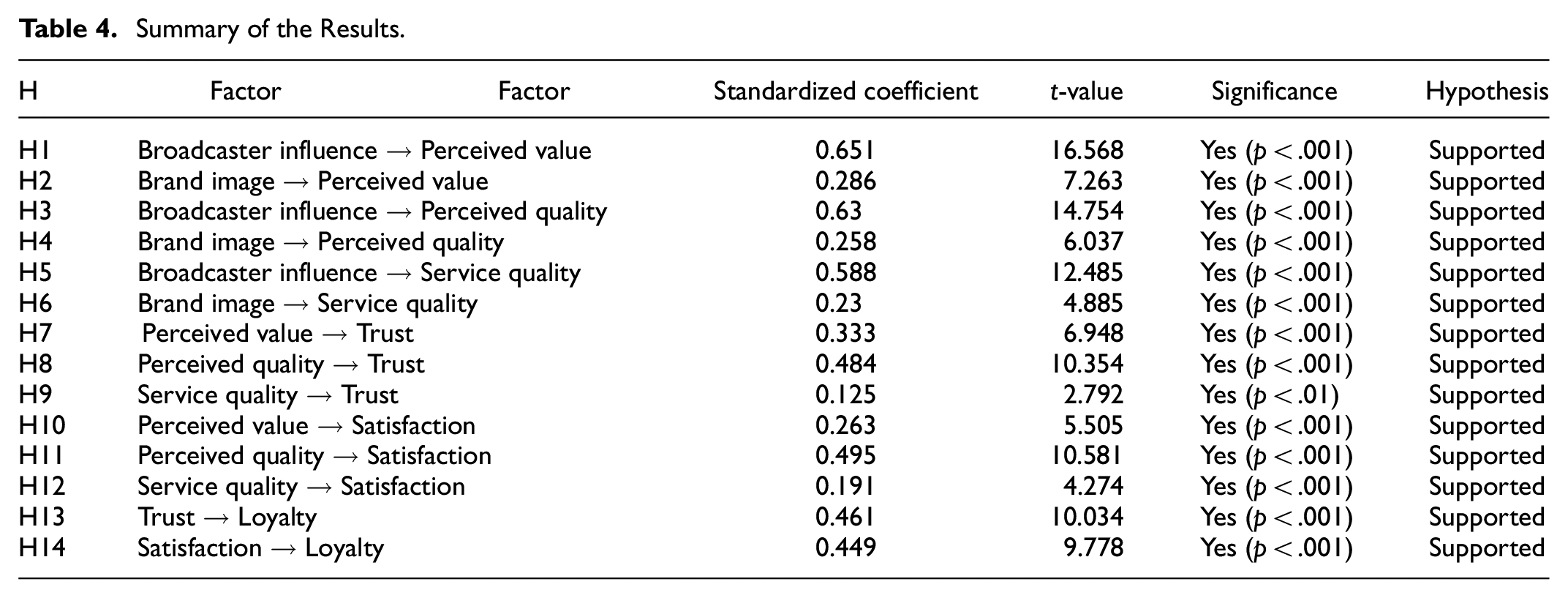
Live broadcasters’ influence positively affects perceived value (path coefficient = 0.651, p-value < .001), as does brand image (path coefficient = 0.286, p-value < .001), supporting Hypotheses 1 and 2. Live broadcasters’ influence positively affects perceived quality (path coefficient = 0.63, p-value < .001), and brand image also positively affects it (path coefficient = 0.258, p-value < .001), supporting Hypotheses 3 and 4. Live broadcasters’ influence positively affects service quality (path coefficient = 0.588, p-value < .001), as does brand image (path coefficient = 0.23, p-value < .001), supporting Hypotheses 5 and 6. Perceived value positively impacts trust (path coefficient = 0.333, p-value < .001), perceived quality positively influences trust (path coefficient = 0.484, p-value < .001), as does service quality (path coefficient = 0.125, p-value < .001), supporting Hypotheses 7 to 9. Perceived value positively influences satisfaction (path coefficient = 0.263, p-value < .001), as does perceived quality (path coefficient = 0.495, p-value < .001), and service quality also positively influences satisfaction (path coefficient = 0.191, p-value < .001), supporting Hypotheses 10 to 12. Trust positively influences loyalty (path coefficient = 0.461, p-value < .001) as does satisfaction (path coefficient = 0.449, p-value < .001), supporting Hypotheses 13 and 14. These results are shown in Table 4 and Figure 2.
Summary of the Results.

Structural model results.
Discussion
Theoretical Implications
The primary theoretical contribution of this study lies in its proposal of a novel model that addresses how companies can bolster consumer loyalty through live broadcasts on social platforms. Our research results indicate that utilizing professional broadcasters and establishing a strong brand image contribute to perceived value, perceived quality, and service quality, further fostering consumer trust and enhancing satisfaction, subsequently promoting customer brand loyalty. This aligns with previous research indicating that brand image enhances consumer loyalty (Hasan et al., 2020). Our findings contribute to the existing literature by revealing the underlying mechanism that links broadcaster influence and brand image to customer loyalty.
Firstly, our findings show that broadcasters’ influence and brand image impact perceived value, perceived quality, and service quality. A broadcaster’s professional explanations are crucial in enhancing customers’ perceived value. Broadcasters can leverage their professional knowledge to shape brand value in a real-time interactive manner, helping to mitigate consumers’ uncertainty about a product. This approach enables consumers to make more informed decisions and potentially purchase fewer products. Investing time and energy into obtaining product information, participating in limited-time sales and applying discount coupons can directly impact consumers’ perceived value. These activities can alter attitudes, cater to diverse needs, and leverage brand image to create added value for customers.
Secondly, our results reveal that perceived value, perceived quality, and service quality increase customer’s trust and satisfaction. The greater a customer’s recognition of a brand and the higher they perceive the quality and value of the associated products or services, the more their satisfaction and trust are elevated. Perceived quality serves as a prerequisite for establishing trust, while perceived value acts as a prerequisite for customer satisfaction. The provision of high-quality service can enhance customer satisfaction. When consumers’ expectations are met, it fosters trust in a brand. While improving service quality may increase company costs (Walsh & Beatty, 2007), we believe it also has the potential to positively affect customers’ trust and satisfaction. This is particularly true when focusing on providing personalized services to customers. The existing literature (Lee et al., 2021; Lu & Chen, 2021; Xu et al., 2021) has emphasized that enhancing customer perceived value is pivotal in strengthening customer trust. Consistent with this, marketing strategy combinations, including discounts, can strengthen customers’ perceived value and increase trust and satisfaction.
Finally, we found that customer’s trust and satisfaction facilitate their loyalty. Trust serves to diminish perceived risks in online transactions. Moreover, highly satisfied people are more likely to exhibit increased loyalty, prioritizing brands when choosing between similar products. To maintain customer loyalty, companies must focus on enhancing customer satisfaction. The greater the consumers’ trust in a brand, the more loyal they are to the company. Cultivating consumer trust and increasing satisfaction is crucial for building brand loyalty, mitigating potential risk factors such as customer churn, and improving brand image, aligning with previous research (Hasan et al., 2020). Loyal customers may also voluntarily share content through social platforms, thereby expanding the scope of brand communication through word-of-mouth recommendations.
Managerial Implications
The results of this study contribute to management practice, building on previous research that has demonstrated the link between customer trust and loyalty (Hasan et al., 2020). However, our research further demonstrates that brand marketing through professional broadcasters uniquely taps into customers’ perceived value, enhancing trust and building loyalty. Given the abundance of brands on the market, it is crucial for broadcasters to effectively communicate brand image to customers. Thus, it has become increasingly practical and vital for companies to enhance customer loyalty by reaching large audiences via brand communication on social platforms.
Second, companies conducting live broadcast promotions on social platforms should choose highly professional broadcasters, provide thorough professional training, and select peak time periods for live broadcasts. Our research aligns with previous findings indicating that professional broadcasters are more persuasive (Y. Chen et al., 2020), as consumers perceive the value and quality of a brand through the broadcaster’s explanation. To support this, enterprises also must enhance their brand value and better meet customer needs.
Third, cultivating consumer loyalty is a long-term process, and companies must consistently engage in brand marketing, utilizing a combination of online and offline methods for publicity. Companies must also leverage existing loyal customers to engage in fission marketing through social media, implementing prize-based forwarding activities to stimulate users’ desire to share recommendations. Enterprises must also encourage users to create brand-related user-generated content (UGC) to enhance user stickiness and trigger dissemination. The core idea of fission marketing is to create interesting and shareable content, providing users with opportunities to participate and share, thereby achieving widespread dissemination of brands and products.
Finally, our research results indicate that to build trust and maintain customer loyalty, its crucial to enhance customers’ perceived value and perceived quality, as well as a company’s service quality. Organizations can appropriately increase the intensity of the distribution of red envelopes, coupons, discounts, etc., to enhance customers’ perceived value. Additionally, offering free shipping, free exchanges, and other value-added services can contribute to this effort.
Limitations and Future Research Directions
The limitations of this paper are evident in its scope. While the study examines consumer loyalty, it primarily focuses on aspects such as live broadcaster influence, brand image, perceived value, perceived quality, and service quality. However, consumer loyalty encompasses numerous dimensions that this study does not cover comprehensively. This limitation can potentially impact the depth of understanding regarding loyalty. Future research endeavors should aim to broaden the scope of loyalty research by exploring additional dimensions. This could involve studying consumer behavior at psychological and personal preference levels, as well as investigating shopping motivations based on specific consumer behaviors. This would consequently offer more robust reference recommendations for merchants and enhance overall enterprise performance. Secondly, another study limitation is the sample size. With only 266 valid data points, the analysis might not be fully comprehensive. Furthermore, most participants are young individuals, which could impact the generalizability of the findings. Thus, it is imperative that future studies significantly broaden the sample size and leverage a more diverse and extensive dataset for the analysis of social platforms.
Thirdly, it is important to note that consumer loyalty primarily signifies users’ intentions and may not necessarily translate into final transactions. Upholding customer loyalty remains a crucial facet of a company’s marketing strategy. However, future studies should focus on transforming loyal customers into enthusiastic advocates. This approach aims to boost purchase frequency and leverage the word-of-mouth impact generated by these dedicated fans to further promote a company. An upcoming research avenue involves evaluating user purchase intentions and constructing a consumer purchase prediction model using data from customer surveys. This endeavor aims to assist merchants in accurately anticipating sales trends, thereby optimizing product sales and production strategies.
Finally, a promising future research direction involves incorporating consumer perception variables, such as perceived function, excitement, utility, habit, performance, etc. This extension aims to deepen the connection between research on brand image and consumer loyalty, offering valuable insights into the literature on customer loyalty in the field of consumption.
Footnotes
Declaration of Conflicting Interests
The author(s) declared no potential conflicts of interest with respect to the research, authorship, and/or publication of this article.
Funding
The author(s) received no financial support for the research, authorship, and/or publication of this article.

Data Availability Statement
The dataset generated during and/or analysed during the current study are available from the corresponding author on reasonable request.