




Abstract
The Regan Attitudes Toward Non-Drinkers Scale (RANDS) is a relatively new alcohol-related measure. Findings suggest that higher scores on the RANDS (denoting stronger endorsement of negative beliefs about non-drinkers) are related to higher self-reported levels of alcohol consumption. Available evidence also suggests that the measure is factorially unidimensional and possesses good scale score reliability (α coefficients > .80) and construct validity. However, the test–retest stability and predictive validity of the RANDS have not been investigated. The current study addressed this omission by distributing the scale to 120 Irish university students at two points in time (1 to 4 weeks apart). To examine the validity of the RANDS, other measures (e.g., alcohol consumption, motives to drink alcohol, and sensation-seeking), commonly employed in studies of drinking behavior, were used. Results indicated that the intraclass correlation coefficient (ICC) for the total RANDS was substantial (.86), suggesting it is a stable measure of attitudes toward non-drinkers. Scores on the RANDS correlated significantly with self-reported alcohol consumption, binge-drinking, and motives to drink. Finally, regression analyses demonstrated that the RANDS, measured at Time 1, accounted for unique variance in risky drinking measured at Time 2.
Keywords
The Regan Attitudes Toward Non-Drinkers Scale (RANDS; Regan & Morrison, 2011) was developed to address a gap in the literature whereby individuals may consume alcohol to avoid the social costs attributed to being a non-drinker. To date, the RANDS has been used in several published studies (e.g., Regan & Morrison, 2011, 2013). Findings suggest that those who score highly on the RANDS—denoting stronger endorsement of negative attitudes toward non-drinkers—tend to consume greater quantities of alcohol more frequently. Among Irish-based respondents, this construct also has been associated more consistently with self-reported alcohol consumption than variables routinely assessed in alcohol research such as sensation-seeking and peer pressure.
The results of these studies suggest that the RANDS possesses good psychometric characteristics. A single-factor solution, with all items relating to the concept of the social cost of non-drinking, was identified in multiple confirmatory factor analyses (e.g., Regan & Morrison, 2011, 2013). Readability statistics also suggest that the RANDS is a highly comprehensible measure (e.g., Flesch Reading Ease = 72.9; Flesch-Kincaid Reading Grade = Grade 5.8 [Grade 6 is considered the optimal readability for the general population: Farr, Jenkins, & Paterson, 1951; Fung, Willer, Moreland, & Leddy, 2006, p. 892]). Finally, the confirmation of hypotheses focusing on the relationships between attitudes toward non-drinkers and a range of variables used in alcohol research (e.g., group and subjective norms, motives to drink, and sensation-seeking) provide strands of evidence attesting to the construct validity of the RANDS. To illustrate, participants who believed their peers and friends supported alcohol consumption evidenced more negative attitudes toward non-drinkers.
In multiple studies, with diverse samples (Regan & Morrison, 2011, 2013, 2016), scale score reliability has been good, with 95% confidence intervals (CIs) for Cronbach’s alpha suggesting that alpha coefficients less than .80 are unlikely to occur. However, due to the relatively recent emergence of attitudes toward non-drinkers as a psychological construct, other forms of psychometric assessment, in particular test–retest reliability and predictive validity, have not been conducted on the RANDS.
Reliability Testing: Test–Retest
A critical, though routinely overlooked, dimension of reliability is test–retest (see Charter, 2003; Hubley, Zhu, Sasaki, & Gadermann, 2014; Weafer, Baggott, & de Wit, 2013). Findings from a prevalence study in 2000 found that while internal consistency, which was estimated using Cronbach’s alpha, was assessed in over two thirds of the studies reviewed, less than 20% of the studies reported test–retest reliability (Hogan, Benjamin, & Brezinski, 2000). The scarcity of studies utilizing a test–retest design is due, in part, to the resource intensiveness necessary to undertake administration to the same participants on multiple occasions.
Limiting assessment of reliability to Cronbach’s alpha provides no information on the temporal stability of participants’ responses (Weng, 2004). The reliability of a measurement tool across multiple time points—during which the influence of measurement error on participants’ responses is assessed (Weng, 2004)—is a key element of a scale’s psychometric integrity, as inconsistent measures of participants’ responses may result in misleading scientific conclusions (Krosnick & Berent, 1993; Weir, 2005). Given the RANDS’ status as a newly developed scale assessing a novel construct, detailed information is needed with regard to psychometric characteristics such as test–retest reliability (de Zwart, Frings-Dresen, & Van Duivenbooden, 2002).
Predictive Validity
All of the published research using the RANDS (e.g., Regan & Morrison, 2011, 2013) has relied on concurrent self-report data. Thus, the present study offers new information about the predictive validity of the RANDS by investigating the correlations between scores on this measure, taken at Time 1, and risky drinking behavior, taken at Time 2.
Rationale
The objectives of this study were threefold. First, the test–retest reliability (i.e., temporal stability) of the RANDS was evaluated. Second, the predictive validity of the RANDS was ascertained by investigating whether scores on this scale (measured at Time 1) could predict alcohol consumption (measured at Time 2). Third and finally, the practical significance of the RANDS was scrutinized by gauging whether attitudes toward non-drinkers would account for incremental variance in alcohol consumption, when factors commonly assessed by researchers such as motives to drink and sensation-seeking are taken into consideration. Hierarchical multiple regression analyses were used to test both Objectives 2 and 3.
Method
Study Design
A prospective study design was used, with a 1 to 4 week lag-time between survey administrations, consistent with published test–retest assessments of alcohol-related measures (Gruenewald & Johnson, 2006; Hettema, Miller, Tonigan, & Delaney, 2008).
Participants
A total of 130 individuals participated in this study, 1 all students attending a large university in the west of Ireland. The sample was comprised of 106 females (81.5%) and 24 males (18.5%). Participants’ mean age was 20.56 (SD = 5.26), and 111 (85%) were Irish nationals. No additional demographic information was collected. Ten participants reported being non-drinkers (or had reported not drinking in the previous 12 months), and so were excluded from analyses, leaving a final sample of 120 (22 males and 98 females).
Measures
Time 1 measures
Alcohol Quantity/Frequency (QF)
Participants were asked five questions about prior/current drinking behavior (Ramstedt & Hope, 2005): (a) usual amount of standard drink consumption (USDC; that is, average number of drinks per day of drinking; Rehm et al., 2003); (b) monthly alcohol consumption (MAC); (c) yearly alcohol consumption (YAC); (d) binge-drinking occasions in the previous month (BDM); and (e) binge-drinking occasions in the previous year (BDY).
Three of the items were used by Ramstedt and Hope (2005): (a) frequency (How many times during the last 12 months); (b) (30 days have you been drinking beer or wine/cider/spirits?). Response options were daily, 4-5 days a week, 2-3 days a week, once a week, 2-3 days a month, once a month, one or a couple of days a year (deleted for past 30-day use), and never; (c) quantity (When you drink beer or cider/wine/spirits, approximately how many bottles/glasses/single measures, etc. do you drink?). This was an open-ended response option, re-coded to derive the usual standard drinks consumption (USDC: Rehm et al., 2003). The answers to the frequency and quantity questions were calculated into monthly and yearly totals (MAC and YAC). Thus, if an individual selected daily and reported consuming two small glasses of wine, the total score was 2 (drinks) × 365 (days) = 730; if an individual selected 4-5 days a week and reported drinking 5 pints of beer, the total score was 4.5 (days) × 52 (weeks) × 5 (drinks [= 10 standard drinks]) = 2,340.
A fourth, screening, question was, “on a single occasion, have you ever consumed alcoholic beverages corresponding to at least one bottle of wine, or seven single shots of spirits, or six premixed spirit drinks, or 4 pints of beer?” The response options were yes/no. Those who answered yes were then instructed to respond to the final related questions: If yes, please state how often in the last 30 days (or 12 months) you have consumed this amount (i.e., frequency of risky/binge-drinking in past month [BDM] and past year [BDY]). The same eight response alternatives listed above were used. The answers were then calculated into a yearly total.
Drinking Motives Questionnaire–Revised (DMQ-R)
This 20-item scale measures motives to drink alcohol across four factors (i.e., social, coping, enhancement, and conformity). It uses a 6-point Likert-type scale (1 = never; 6 = almost always). Total scores (within each subscale) can range from 5 to 30, with higher scores denoting stronger endorsement of positive reinforcement received through consumption of alcohol. Findings, in general, suggest the DMQ-R (Cooper, 1994) is a valid instrument when distributed to adolescents and young adults (e.g., Kuntsche & Kuntsche, 2009; MacLean & Lecci, 2000).
RANDS
This 11-item scale (e.g., I would hate to be a non-drinker) uses a 5-point Likert-type response format (1 = strongly disagree, 5 = strongly agree). Total scores can range from 11 to 55 with higher scores denoting more negative attitudes toward non-drinkers. Across three studies, Regan and Morrison (2011, 2013) report that the RANDS evidences good scale score reliability, good convergent validity, and a unidimensional factor structure.
Time 2 measures
QF
See description under Time 1 measures (e.g., Ramstedt & Hope, 2005).
Alcohol-related problems
Eight items were used to assess this construct (e.g., During the past 12 months have you gotten into a fight when you had been drinking?) using a dichotomous Likert-type scale (1 = true, 2 = false [reverse coded]). Total scores can range from 8 to 16, with higher scores denoting increased reporting of problems due to drinking. While there is precedence for use of this eight-item scale in Irish university samples (e.g., Ramstedt & Hope, 2005), there is not much available evidence relating to its psychometric properties.
Brief Sensation-Seeking Scale (BSSS)
This eight-item measure (e.g., I like to do frightening things) uses a 5-point Likert-type scale (1 = strongly disagree, 5 = strongly agree) (e.g., Hoyle, Stephenson, Palmgreen, Lorch, & Donohew, 2002). Total scores can range from 8 to 40, with higher scores denoting greater sensation- seeking. Hoyle et al. (2002) offer evidence attesting to the psychometric soundness of the BSSS.
RANDS
See description under Time 1 measures (e.g., Regan & Morrison, 2011).
Social-Desirability Scale (SDS-17)
This 16-item scale (Stöber, 2001) measures participants’ engagement in socially desirable responding (e.g., I always admit my mistakes openly and face the potential negative consequences). It uses a dichotomous response format (1 = true; 2 = false), with total scores ranging from 16 to 32 (higher scores indicate stronger social desirability bias). Stöber (2001) suggests that the SDS-17 is psychometrically sound.
Statistical Analysis
Participant data were analyzed using the SPSS programme (Version 21). Descriptive statistics are presented, stratified by time of measurement, followed by reliability analyses of the RANDS (Cronbach’s alpha and the three indicants of test–retest: (a) a paired samples t test, which allows one to determine whether total scale scores differed between two measurement periods; (b) a Pearson’s correlation coefficient, which assesses the strength of association between scores at Times 1 and 2; and (c) intraclass correlation coefficients (ICCs), which serve as a relative index of reliability and represent the proportion of variance in a set of scores that is attributable to between-subjects variability (Weir, 2005). Then, the predictive and construct validity of the RANDS are tested using hierarchical multiple regression analysis and correlation coefficients.
Procedure
All respondents completed their questionnaires within a class setting. Prior to completing the questionnaire, individuals were told that participation was strictly voluntary; no self-identifying details were being gathered thereby safeguarding anonymity; and questions could be omitted at the discretion of the respondent.
Results
Descriptive Statistics
Time 1
Means, standard deviations, and alpha coefficients, for all Time 1 variables, are listed in Table 1. Scores were below the midpoint on the RANDS as well as the coping and conformity motive scales, indicating that respondents did not evidence high levels of these constructs. For the Enhancement and Social Motives subscales, scores were above the midpoint, suggesting that individuals reported, at least, moderate levels of drinking for enhancement and social reasons. The alpha coefficients for the RANDS and DMQ-R (all four subscales) were > .80, which denotes good scale score reliability (Carmines & Zeller, 1979).
Means, Standard Deviations, and Alpha Coefficients, for Key Variables.

Note. CI = confidence interval; RANDS = Regan Attitudes Toward Non-Drinkers Scale; M_E/_C1/_C2/_S = drinking motives_enhancement/coping/conformity/social; BSSS = Brief Sensation-Seeking Scale; SDS = Social-Desirability Scale; USDC = usual standard drink consumption; Y/MAC = yearly/monthly alcohol consumption; BDY/M = binge-drinking occasions yearly/monthly; AlcProbs = measure for alcohol-related problems (Time 2 only).
Not all measures were assessed at both T1 and T2.
Time 2
Means, standard deviations, and alpha coefficients, for all Time 2 variables, are provided in Table 1. Scores were below the midpoint on the RANDS, the SDS-17, and the scale assessing alcohol-related problems. Thus, respondents (a) did not strongly endorse negative attitudes toward non-drinkers, (b) did not evidence social desirability bias, and (c) did not report experiencing problems stemming from alcohol use. The mean score on the indicator of sensation-seeking (BSSS) was slightly above the midpoint, which reflects modest levels of this construct among participants. As noted at Time 1, the alpha coefficient for the RANDS was > .80. For the SDS-17 and the BSSS, alpha coefficients were satisfactory: αs (in order) = .73 and .77, although the alpha coefficient for the Alcohol-Related Problems measure was subpar (.65).
Test–Retest Reliability Analyses of the RANDS
Using a paired samples t test, no difference in mean scores on the RANDS was observed, t(119) = −1.15, p = ns, d = .36. The overall correlation between scores on the RANDS at Times 1 and 2 was .73, p < .001. Finally, ICCs were computed (for each item and the total scale score, respectively) using a two-way random effects model (Broglio, Ferrara, Macciocchi, Baumgartner, & Elliott, 2007; Weir, 2005). With each set of two-way data (i.e., random or mixed), there are two ICCs: Consistency or Agreement. The latter, which is also known as criterion-referenced reliability, was chosen, as this ICC takes total score variance as its denominator, contrasting with Consistency, in which comparative judgments are made about the objects of measurement (McGraw & Wong, 1996).
According to Landis and Koch (1977), the strength of test–retest agreement for ICC can be classified as follows: <.20 is poor; .21 to .40 shows fair agreement; .41 to .60 indicates moderate agreement; .61 to .80 denotes substantial agreement; and .81 to 1 indicates almost perfect agreement (also see Cicchetti, 1994). In the current study, all 11 items had single measure ICCs suggesting at least moderate agreement (ICCs ranged from .47 to .64). However, for the total RANDS’ score, the average measure ICC indicated a high level of agreement (.86, 95% CI = [.80, .90]; see Table 2).
RANDS’ Intraclass Correlation Coefficients (Indicating Level of Agreement Between Time 1 and Time 2): Individual Items, 95% CIs, and Scale Total.
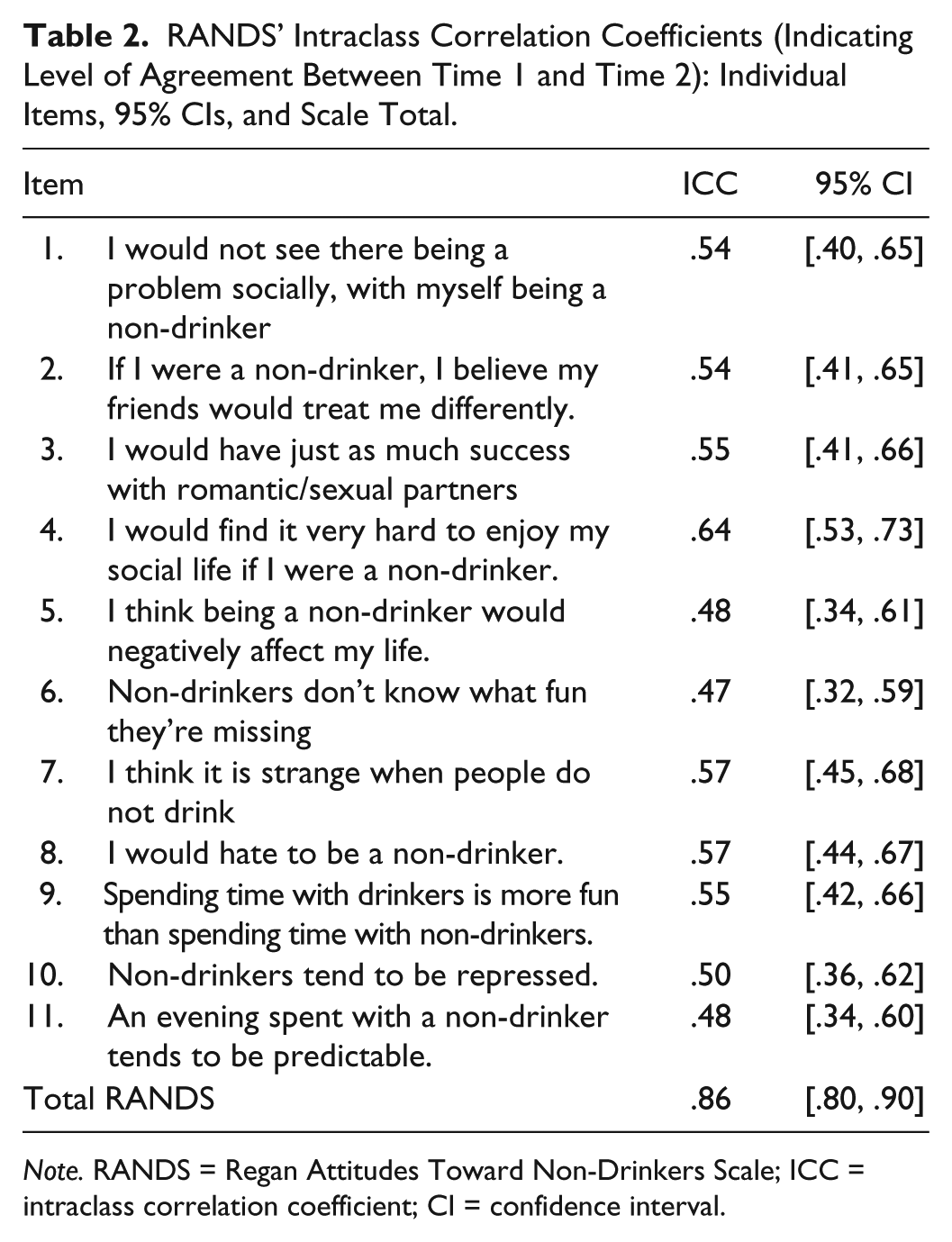
Note. RANDS = Regan Attitudes Toward Non-Drinkers Scale; ICC = intraclass correlation coefficient; CI = confidence interval.
The RANDS and Alcohol Consumption
Correlations were computed between scores on the RANDS, indicants of alcohol consumption, drinking motives, sensation-seeking, and social desirability bias. As expected, scores on the RANDS at Time 1 correlated significantly with all drink indicators (Times 1 and 2: all ps < .01 2 ; see Table 3). The direction of these correlations suggests that respondents evidencing more negative attitudes toward non-drinkers also consumed more alcohol, engaged in risky drinking behavior, and were more likely to endorse various motives for alcohol consumption. No statistically significant associations were noted between scores on the RANDS and either sensation-seeking or social desirability bias. The latter finding is particularly important as it suggests that individuals’ scores on the RANDS are not contaminated by a desire to provide “socially appropriate” responses.
Correlations Between RANDS and Indicants of Alcohol Consumption.

Note. RANDS = Regan Attitudes Toward Non-Drinkers Scale; USDC = usual standard drink consumption; Y/MAC = yearly/monthly alcohol consumption; BDY/M = binge-drinking occasions yearly/monthly; Risk = Risky drinking (composite score of all 5 drink indices)
= p < .05.
Multiple Regression Analysis
To reduce the number of regressions that were conducted, principal components analysis (PCA) was performed on the five drink indicants. The Kaiser-Meyer-Olkin measure of sampling adequacy, for Times 1 and 2 were .76 and .62, respectively, and Bartlett’s test of sphericity was statistically significant for both, suggesting the data were appropriate for PCA. Single component solutions were obtained (Time 1 eigenvalue = 3.48, 69.9% of the variance; Time 2 eigenvalue = 3.87, 77.35% of the variance). Based on the direction of the loadings, this component was labeled “risky drinking” (i.e., all drink indicants were higher, which, particularly for binge-drinking constitutes higher frequency of risky drinking occasions).
Multicollinearity, particularly among drinking motives subscales, was not problematic. 3 As well, for all regression analyses the Durbin-Watson statistic approximated 2, suggesting that autocorrelations among residuals were not of concern, and maximal values for Cook’s distance were less than 1 suggesting the absence of outliers.
To investigate whether the RANDS accounted for incremental variance in the component score of “risky drinking” at Time 1, a hierarchical regression was conducted. Step 1 involved the drinking motives (enhancement, social, conformity, and coping), and Step 2 involved the RANDS. Step 1 was statistically significant, F(4, 111) = 8.65, p < .001, adjusted R2 = .21. Step 2 accounted for incremental variance, F change (1, 110) = 4.73, p < .05, adjusted R2 = .24. Inspection of this final model, F(5, 110) = 8.1, p < .001, adjusted R2 = .24, revealed that two predictors were p < .05: drinking for enhancement motives, β = .35, t = 2.43, and the RANDS, β = .23, t = .17. The squared semi-partial correlations, denoting the unique variance accounted for in the “risky drinking” component by each predictor, were (in order): .05 and .04. Thus, participants who reported more negative attitudes toward non-drinkers and also indicated that they drank to achieve a positive mood reported greater levels of “risky drinking.”
Another hierarchical regression was conducted for the Time 2 measures. Specifically, Step 1 involved sensation-seeking and Step 2 involved the RANDS. Step 1 was statistically significant, F(1, 87) = 4.34, p < .05, adjusted R2 = .04. Step 2 accounted for incremental variance, F change (1, 86) = 31.81, p < .001, adjusted R2 = .29. Inspection of this final model, F(2, 86) = 18.84, p < .001, adjusted R2 = .29, revealed that only the RANDS emerged as a statistically significant predictor, β = .51, t = 5.64, p < .05, of “risky drinking.” The squared semi-partial correlation was .27 suggesting that stronger endorsement of negative attitudes toward non-drinkers was associated with greater levels of “risky drinking.”
Predictive Utility of the RANDS
A regression analysis was conducted to assess the predictive utility of measures taken at Time 1 in relation to last 30-day binge-drinking at Time 2. While in the previous regression analyses the component titled “risky drinking” was the criterion variable, as the two administrations were ≤ 30 days apart, in this analysis only “recent binge-drinking” was assessed as a proxy of risky drinking behavior. Scores on the RANDS at Time 1 were significantly correlated with binge-drinking at Time 2 (r = .39, p < .01).
Step 1 involved the drinking motives which were significantly correlated with binge-drinking (enhancement and social), and Step 2 involved the RANDS. Step 1 was statistically significant, F(2, 87) = 6.30, p < .01, adjusted R2 = .11. Step 2 accounted for incremental variance, F change (1, 86) = 18.17, p < .01. Inspection of the final model, F(3, 86) = 11.08, p < .001, adjusted R2 = .28, revealed that only the RANDS emerged as a statistically significant predictor: β = .46, t = 4.26, p < .01. The squared semi-partial correlation was .17; thus, the stronger the endorsement of negative attitudes toward non-drinkers, the greater the risk for recent binge-drinking.
Discussion
Given that the RANDS is a relatively new measure of drink-related attitudes, there are numerous gaps in understanding with respect to the instrument’s psychometric properties. In the current study, the test–retest reliability of the RANDS was investigated and the results were promising. The overall ICC was substantial (.86), and the scale score reliability of the RANDS, across two testing sessions, was strong; a finding congruent with results provided earlier by Regan and Morrison (2011, 2013). Evidence of the RANDS’ equivalence between testing sessions is a useful addition to elucidating the scale’s psychometric characteristics.
The RANDS was also significantly related to all drink measures, and in regression analyses was more strongly associated with problem drinking than commonly assessed measures such as motives to drink and sensation-seeking. This confirms findings from previous studies utilizing the RANDS and adds to the growing evidence-base (Regan & Morrison, 2011, 2013, 2016) that a focus on attitudes toward non-drinkers may have a significant role to play in terms of alcohol consumption.
Of particular note is that the current study provides new data in relation to the RANDS’ predictive validity, with results suggesting that attitudes toward non-drinkers—more so than traditionally assessed motives for alcohol consumption—significantly predicted recent binge-drinking. The RANDS, and the broader concept of “the non-drinker” (e.g., Conroy, Sparks, & de Visser, 2015) may therefore have utility via the attenuation of risky drinking (Dzialdowski, Heather, & Crawford, 1988). For example, findings from a recent intervention study, which examined mental exercises focused on episodic non-drinking during hypothetical social occasions, suggested that modifying negative perceptions relating to non-drinkers/non-drinking may play a role in reducing risky drinking (Conroy et al, 2015 4 ). While males, to date, have tended to score higher on the RANDS, nonetheless the findings in this study also suggest that the RANDS is a useful predictor of problematic drinking among females. As female drinking has been shown to be increasing over time (Meng, Holmes, Hill-McManus, Brennan, & Meier, 2014), use of the RANDS, and a wider focus on the concept of the “non-drinker” as a modifying variable, may be a useful addition to the alcohol-intervention literature. Given the within-subjects nature of the data in the current study, it may be useful to leverage these retest findings as support for future intervention development studies (Thomas, Higgs, & Dourish, 2016).
Limitations
Several limitations warrant mention. First, a relatively small number of participants (N = 120) were surveyed, most of whom were female. It is recommended that researchers target larger and more diverse samples to address this matter. Second, while a retest period of 1 to 4 weeks is common in research of this kind (e.g., Gruenewald & Johnson, 2006; Hettema et al., 2008), the need to assess the stability of the RANDS over longer periods would be a useful way to increase our understanding of the stability of this construct. For example, attitudes toward non-drinkers espoused by young individuals may change during the transition from secondary school to university, wherein there is traditionally a smaller cohort of non-drinkers. A related limitation was that, while the second testing session for all participants occurred 1 to 4 weeks after the first, the specific week within that period was not noted. As test–retest analysis based on week could not be conducted, it is possible that ICCs for participants completing the two RANDS testing sessions 1 week apart may differ from ICCs obtained by those completing the RANDS 2 or 3 weeks apart. Finally, while QF indices (i.e., what quantity of alcohol consumed on how many days?) possess the advantages of brevity and ease of administration and, thus, are the most common measurement approach (Greenfield & Kerr, 2008), they possess well-known methodological problems. Specifically, due to a focus on average drinking, they do not capture sporadic and non-patterned drinking (Sobell et al., 2003). A discrete approach could be the timeline follow-back method, which although longer to administer, is more precise in its measurement (e.g., Sobell & Sobell, 1992).
Conclusion
This study suggests that the RANDS possesses good test–retest reliability, as measured by mean score comparisons, Pearson correlations, and ICCs. Importantly, the RANDS appears to have potential as a predictive tool for risky drinking. Further examination of gender, age, and cross-cultural invariance could be important as a way to enhance and widen the potential utility of this measure in alcohol research conducted in Ireland and internationally.
Footnotes
Declaration of Conflicting Interests
The author(s) declared no potential conflicts of interest with respect to the research, authorship, and/or publication of this article.
Funding
The author(s) disclosed receipt of the following financial support for the research, authorship, and/or publication of this article: While the author(s) received no specific financial support for the research and/or authorship of this article, the senior author’s doctoral research, of which this study was a component, was funded in part by a Lady Gregory Fellowship, from the College of Arts, Social Sciences, & Celtic Studies at the National University of Ireland, Galway.