




Abstract
We examined the effect of local or global processing bias (in the Navon task) on the acquisition of spatial knowledge from maps and route videos. Before spatial learning, participants completed a 5-min Navon task (biased toward global or local stimuli). After participants studied a map or route video, route knowledge was measured using a route distance estimation task, and survey knowledge was measured using a straight-line distance estimation task and map-sketching task. We found that participants in the global group performed better in the straight-line distance estimation task, and their sketch maps were more accurate in both overall configuration and interlandmark relationships compared with those of participants in the local group, regardless of learning materials. We conclude that Navon-induced biases influenced both the encoding and the visuospatial transformation of spatial knowledge.
Introduction
The Navon task (Navon, 1977) is a well-known letter identification task in which large letters constructed from a number of much smaller letters are presented as stimuli; participants respond to either the large or small letters while ignoring the other type. This Stroop-like task is used to orient participant attention globally or locally. Consequently, in a follow-on task, participant attention can be shifted to the global level after continual responses to large Navon letters and to the local level after continual responses to small Navon letters.
An example for the effectiveness of the Navon task for biasing response in follow-on tasks is the capacity of the task to influence face recognition (Macrae & Lewis, 2002; Weston & Perfect, 2005). For face recognition, researchers generally agree that global processing facilitates recognition, whereas local processing interferes with recognition (Schooler, 2002; Tanaka & Farah, 1993; Tanaka & Sengco, 1997; Young, Hellawell, & Hay, 1987). For example, when compared with performance on an unrelated task, a participant’s recognition of a suspect’s face was better after a global Navon task and worse after a local Navon task (Macrae & Lewis, 2002). In contrast, the recognition of face halves is enhanced by the local Navon task, presumably because local features become the critical clues without holistic information (Weston & Perfect, 2005). In summary, global or local Navon processing prior to encoding might encourage a holistic or featural strategy, respectively, and influences the subsequent memory performance (Lloyd-Jones, Brandimonte, & Bäuml, 2008). However, it is still unknown whether such perceptual biases only influence perceptual processes, such as the selection of encoding information, or also influence higher level processes, such as the mental transformation of representations.
The present study focuses on the processing bias in spatial learning. Because the environment surrounding us contains various types of information, such as landmarks, routes, and map-like views, spatial learning processes are complex and multifaceted. Previous studies showed that people use different strategies to acquire spatial knowledge, such as survey/route strategies (Pazzaglia & De Beni, 2001; Prestopnik & Roskos-Ewoldsen, 2000; Shelton & Gabrieli, 2004) and visually/spatially dominated strategies (Aginsky, Harris, Rensink, & Beusmans, 1997). Such strategies influence both the selection of spatial information and construction of mental representation, and greatly affect the performance of spatial knowledge acquisition and path-finding (Janzen, Schade, Katz, & Herrmann, 2001; Pazzaglia & De Beni, 2001). Some studies found that inducing direct verbal or spatial strategies during encoding indeed affected the acquisition of spatial knowledge (Fiore & Schooler, 2002; Wen, Ishikawa, & Sato, 2014). Furthermore, previous works on working memory showed that the perceptual processing of information (i.e., verbally or visually/spatially dominated perceptual strategies) is linked to the quality of spatial knowledge acquisition (Gyselinck, Meneghetti, De Beni, & Pazzaglia, 2009; Meilinger, Knauff, & Bülthoff, 2008; Nori, Grandicelli, & Giusberti, 2009; Wen, Ishikawa, & Sato, 2011, 2013). Those studies indicated that the selection of encoding information and encoding strategy may greatly influence the performance of spatial tasks.
In the present study, we examined whether the Navon-induced processing bias could influence the acquisition of two known types of spatial knowledge, route and survey knowledge (Taylor & Tversky, 1992), from different learning materials (i.e., a map or route video). Route knowledge refers to sequences of landmarks and associated actions (e.g., turns), whereas survey knowledge is configurational or map-like information and may therefore be represented holistically. The two types of spatial knowledge could be developed from both route-perspective and map-perspective learning, even after a short exposure to a novel environment (Ishikawa & Montello, 2006). Spatial knowledge acquisition could be greatly influenced by individual learning strategies (Aginsky et al., 1997; Pazzaglia & De Beni, 2001; Prestopnik & Roskos-Ewoldsen, 2000; Shelton & Gabrieli, 2004) and learning materials (Hirtle & Hudson, 1991; Münzer, Zimmer, Schwalm, Baus, & Aslan, 2006; Sholl, 1999). In the present study, we manipulated processing bias (global vs. local) with a 5-min Navon task prior to spatial learning from either a map or a route video. We then compared survey and route knowledge between groups under two conditions of processing bias: global and local. 1 In the case of learning from a map, both global (e.g., the overall relationship between landmarks) and local information (e.g., the series of landmarks along a route) could be directly learned from the learning material. Therefore, survey and route knowledge learned from a map directly reflect the encoding of global/holistic and local/featural information, respectively. However, in the case of learning from a route video, the perceptual input is mainly local and featural, while global representation of the whole environment requires mental transformation. Therefore, route knowledge learned from a route video reflects the direct encoding of local/featural information, while survey knowledge learned from a route video reflects the processing of mental transformation. If Navon-induced biases only affect the selection of information but not the processing style, they should greatly influence the spatial learning from a map rather than learning from a route video. If Navon-induced biases also affect the processing style, they should influence the learning of survey knowledge from both a map and a route video. The answer to the research question of whether and how inducing perceptual processing bias (i.e., global/local bias) affects spatial learning can extend our understanding of the perceptual aspect of spatial knowledge acquisition and help us understand more about the best information to be provided for spatial learning.
Method
Participants
The participants were 40 university students (female = 26, male = 14), who received modest monetary compensation. The mean age was 21.3 years (SD = 1.8). The study was approved by the ethics committee of the Department of Psychology, Keio University. All participants gave written informed consent prior to participation.
Design
The study followed a 2 (between-participant; bias group: global, local) × 2 (within-participant; learning material: map, route video) mixed factorial design. Participants were randomly assigned to one of two groups: global (n = 20; 12 female, eight male), and local (n = 20; 14 female, six male).
Materials
Spatial stimuli consisted of maps and videos of two routes through northeastern wards of Tokyo (Figure 1; for each area, both a map and video were prepared). The lengths of the two routes were 1,370 and 1,286 m, respectively. The two study areas were novel for all the participants, and the novelty was confirmed after the experiment. The use of learning materials (i.e., map/video) and learning order was counterbalanced among participants.
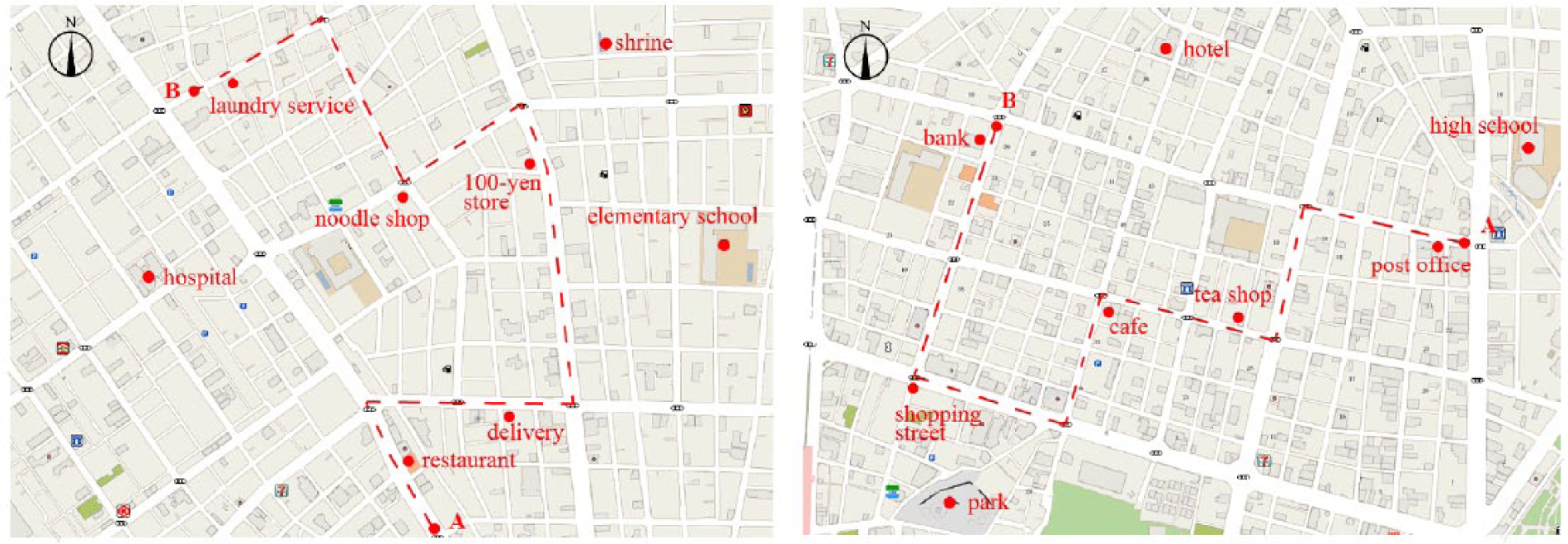
Map stimuli for spatial learning.
Each map showed a route marked with a dashed red line and having five turns. Each map also had eight landmarks indicated with red circles; five were located along the route and three appeared elsewhere on the map. The landmarks were of the type typically found in cities (e.g., school, post office, and restaurant). Additional map information included a compass (showing north), landmark names, street names, and several icons representing well-known retail chain stores (Figure 1). Route videos were constructed by videotaping (from a car driving at an average speed of 20 km/h) the same routes used in the maps. A video camera with a wide conversion lens was set on a tripod fixed onto the passenger seat of a car; horizontal and visual angles were 65° and 46°, respectively. Temporary stops (e.g., at intersections) were edited out of the final video. Each video was 4-min long, and the five route landmarks were indicated to participants by an arrow pointing to the landmark and a label on the screen display (Figure 2). The buildings and places used for landmarks, while distinct, were of types occurring commonly in city scenes.

Snapshot from one experimental route video.
For the Navon task, stimuli were constructed of numbers instead of letters (Figure 3) because our participants were Japanese speakers and probably more sensitive (when compared with English speakers) to numbers than to English letters. Participants responded (by pressing a key) to indicate whether the small or large (in physical size) numbers were odd or even. Interval distances between the small numbers were adjusted in a preexperiment to control (make equivalent) precedence of the large and small Navon stimuli.

Example for a Navon stimulus.
Procedure
Participants were tested individually while seated in a chair with their chin on a chin rest. The Navon task and videos were presented on a 22-inch widescreen monitor positioned 52 cm from the chin rest. Before testing, participants completed the Santa Barbara Sense-of-Direction (SBSOD) scale, which consisted of 15 7-point Likert-type items concerning navigational abilities, preferences, and experiences (Hegarty, Richardson, Montello, Lovelace, & Subbiah, 2002). The SBSOD scale was used to post-confirm whether individual spatial abilities differed between groups.
Before testing, participants also received instructions for the experimental tasks: map study, distance estimation, map-sketching, and the Navon task. Participants then completed 40 Navon practice trials followed by the 5-min Navon task. Participants in the global group indicated whether the large number on the monitor was an odd or even number by pressing one of two keys as quickly and correctly as possible (according to task instructions). In contrast, participants in the local group indicated whether the small number was an odd or even number. After the Navon task, all participants were presented with a map (on an A4 sheet of paper, 297 mm × 210 mm, 1:2500) and given 4 min to memorize it. After studying the map, participants completed the route distance estimation, straight-line distance estimation, and map-sketching tasks. An answer sheet was provided for participants to record responses in each task. For the two distance estimation tasks, the route from start to end was defined as being 100 arbitrary units in length. Participants individually estimated the route length (route distance estimation task) and straight-line distances between 10 pairs of landmarks (straight-line distance estimation task). Landmark pairs were printed on A4 sheets, and the participants wrote their answers on the same sheet. Landmark pairs were randomly generated for each participant. The two distance estimation tasks for each participant used different combinations of landmarks, but the same landmarks were used several times. The tasks were printed in a fixed order on the task sheets, but participants were permitted to review and revise their answers. The task order was designed to encourage participants to first recall route knowledge rather than survey knowledge, following the notion that survey knowledge is more complicated than route knowledge. In the map-sketching task, participants drew sketch maps (on a blank A4 sheet of paper) of the previously learned map in as much detail as possible.
After the map study and other tasks (distance estimation, straight-line estimation, and map sketching), participants completed a “reset” 1-min Navon task. For this task, participants indicated whether the large and small numbers differed from one another according to whether the numbers were odd or even. The requirement to pay attention to both the large and small numbers was designed to remove existing bias to ensure that the second Navon task (the same task as the first one for each individual) induced the same level of bias for the route learning as that for the map learning. After the reset Navon task and a 5-min rest, participants received instructions for the route video task. Before viewing the route video, participants completed the 5-min Navon task again. After watching the route video, participants completed the two distance estimation tasks and the map-sketching task. On average, study participation took 60 min.
Results
For the distance estimation task, we examined participant performance in terms of the slope and intercept of individual linear regression between the actual and estimated distance (Figure 4). The slope reflects the precision of distance estimation (i.e., a larger estimation for a longer distance). On the contrary, the intercept reflects the overall bias in the memory of distance: a positive intercept indicates overestimation, while a negative intercept indicates underestimation. We conducted 2 × 2 (Navon group, between-participant, global vs. local × learning material, within-participant, map vs. route video) mixed ANOVAs for the slopes and intercepts in both the route and survey distance estimations. For the slope in route distance estimation, the main effect of group, the main effect of learning material, and the interaction between group and learning material were all nonsignificant, Mglobal = 0.91, SEglobal = 0.03, Mlocal = 0.95, SElocal = 0.03, F(1, 38) = 0.69, p > .250, = 0.02; Mmap = 0.93, SEmap = 0.03, Mvideo = 0.93, SEvideo = 0.03, F(1, 38) = 0.01, p > .250,

Individual linear regression under each condition in the distance estimation task.
For the slope in straight-line distance estimation, the main effect of group was significant, Mglobal = 0.65, SEglobal = 0.06, Mlocal = 0.47, SElocal = 0.06, F(1, 38) = 4.62, p = .038,
For the map-sketching task, we analyzed participant performance using the Gardony Map Drawing Analyzer (GMDA, Gardony, Taylor, & Brunyé, 2016). This novel open-source software package for sketch map analysis provides multiple quantified indices that assess both the overall landmark configuration and interlandmark spatial relationships. We used 15 and 12 landmarks to analyze the sketch maps after learning from a map and a route video, respectively, including five turning points along each route. The number of landmarks in the learning of the route video was less because three off-route landmarks presented on the map were not visible in the route video. Finally, sketch maps drawn after the learning of the route video was rotated to make the start direction match the orientation of the map. We used four indices provided by GMDA: root of canonical organization, canonical accuracy, distance accuracy, and angle accuracy (Figure 5). Canonical organization provides a measure of configural accuracy and completeness of a sketch map, and its root corrects the linear relationship between the value and the number of drawn landmarks. This index is influenced by the number of missing landmarks: omitted landmarks decrease the score. Canonical accuracy is identical to canonical organization but only considers the accuracy of drawn landmarks. Distance accuracy measures the accuracy of scaling of distances between landmarks. Angle accuracy measures the accuracy of angles between landmarks. In summary, the roots of canonical organization and canonical accuracy measure the overall configuration accuracy of a sketch map, and distance accuracy and angle accuracy measure the interlandmark configuration (Gardony et al., 2016). All the indices range from 0 to 1 with larger values indicating higher accuracies.

Mean GMDA scores of the sketch map under each condition.
We conducted 2 × 2 (Navon group × learning material) mixed ANOVAs on the above GMDA scores. For all the four indices, the main effect of learning material was significant: for the root of canonical organization, Mmap = 0.93, SEmap = 0.01, Mvideo = 0.85, SEvideo = 0.02, F(1, 38) = 21.34, p < .001,
In addition, we did not control the sense of direction between groups, but we measured the self-reported SBSOD scale (Hegarty et al., 2002) to check whether people in the two groups had a difference in their sense of direction. SBSOD did not differ significantly between groups, Mglobal = 3.2, SEglobal = 0.22; Mlocal = 3.7, SElocal = 0.28; t(38) = 1.88, p = .182, Cohen’s d = 0.43.
Discussion
The present study examined the influence of Navon-induced processing bias on the acquisition of spatial knowledge from maps or route videos. We found that global bias resulted in better learning of survey knowledge compared with local bias, regardless of learning materials. Specifically, the participants in the global group estimated straight-line distances more precisely and drew more accurate sketch maps compared with the participants in the local group, regardless of learning materials. As described in “Introduction” section, if Navon-induced biases only affect information selection for encoding, they should only influence the learning of maps. On the contrary, if Navon-induced biases also affect mental transformation, they could influence the learning of both maps and route videos. Our findings suggest the latter case, showing that the biases probably influenced both the selection of perceptual input and the mental transformation of spatial knowledge.
During map learning, people took a survey perspective, and the visual information necessary to form this perspective was acquired from a map. In our study, when participants were biased toward global processing (by the Navon task), global/configural information was attended to and likely facilitated the acquisition of survey-type knowledge. In contrast, when participants were biased toward local processing, their processing of global/configural information was likely to be less attended. Our result is consistent with a previous study, which found that the acquisition of survey knowledge from maps is subject to a verbal overshadowing effect (Fiore & Schooler, 2002). The Navon-induced bias probably affected the selection of information during the encoding of spatial knowledge, while both the global configuration and local/featural information were available from the learning material. In addition, although we did not find the effect of learning material in the straight-line distance estimation task, the results of sketch maps clearly showed that the learning of survey knowledge from a map is better than from a route video.
For spatial learning with route videos, only local/featural information was visually available from the learning material, while the global configuration of the environment required a mental transformation (Wen et al., 2011). Such transformation could occur simultaneously with the learning of landmark and route knowledge during exposure to a novel environment. Our finding of better survey knowledge in the global group than in the local group after the learning of a route video indicated that the Navon-induced processing bias not only affected the selection of perceptual input (in the map learning) but also improved the mental transformation of spatial knowledge (in the learning of the route video). Participants with global bias were more likely to make an effort to mentally construct a global map of the learning environment compared with participants with local bias. Previous studies reported an important role of visuospatial working memory in such mental transformation (Coluccia, 2008; Coluccia, Bosco, & Brandimonte, 2007; Wen et al., 2011, 2013). By combining our findings with these previous studies, it is likely that Navon-induced global bias may promote or improve visuospatial processing.
In the present study, we used the Navon task to induce either global or local processing bias in subsequent spatial learning. Although several previous studies have showed significant effects of such cross-task processing biases (Macrae & Lewis, 2002; Weston & Perfect, 2005), it was unknown whether such biases could affect higher level processing rather than only perceptual processing. Our results indicated that Navon-induced biases may not only affect information selection during encoding but also affect mental transformation. However, the effectiveness of Navon-induced bias remains controversial (Lawson, 2007). We believe that the influence of processing bias induced by a simple perceptual task on higher level processing is worth further examination.
We did not vary the order of learning material between participants in the present study. All the participants learned a map before a route video. This may have encouraged a “pre-activation” of visuospatial working memory, which was important for the acquisition of survey knowledge during the subsequent learning of a route video. This procedure might contribute to the effect of Navon-induced biases. Specifically, if the participants did not actively use a mental map during the learning of a route video, the Navon-induced biases might not be able to affect the encoding of survey knowledge. Finally, in the present study, we only used the route distance estimation task to examine route knowledge. Route distance estimation was also considered to reflect survey knowledge in literature, as it measures configural knowledge and contains metric information, particularly in the learning of a map. It is worth further examining the influence of Navon-induced biases on the acquisition of route knowledge using more featural tasks such as the judgment of the turning direction.
Finally, although we did not include a control group in the main results, we acquired a sample of 12 participants who did the main spatial learning tasks but did not do any Navon task (see Supplementary Material S1 for the results). There was no difference in the distance estimation task between the control group and the two Navon groups. However, the results of the sketch map task showed that though task performance was comparable between the global and control groups, the local group drew worse sketch maps than the control group (see S1 for statistics). We suggest that this was probably because participants tended to use a global strategy at default as they knew that they need to do straight-line distance estimation and draw maps. However, the participants in the local group were encouraged to focus on local features, which may have resulted in poorer survey knowledge. However, because participants in our control group did not do an irrelevant task that lasted the same amount of time as the Navon tasks, they probably underwent less cognitive load overall, in comparison with the global and local groups. To examine the exact influence of Navon-induced biases, including both processing style and cognitive load, it would be worth directly comparing the nonbiased group with the Navon-biased groups in a future study.
In summary, the present study demonstrated that a Navon-induced processing bias influenced the acquisition of survey knowledge from both maps and route videos. Participants in the global bias group estimated straight-line distances between landmarks more precisely and drew better sketch maps compared with participants in the local bias group. Our findings suggest that Navon-induced biases are likely to influence both information selection and visuospatial processes during spatial learning.
Supplemental Material
supplementary_file – Supplemental material for Impact of Navon-Induced Global and Local Processing Biases on the Acquisition of Spatial Knowledge
Supplemental material, supplementary_file for Impact of Navon-Induced Global and Local Processing Biases on the Acquisition of Spatial Knowledge by Wen Wen and Hideaki Kawabata in Impact of Navon-Induced Global and Local Processing Biases on the Acquisition of Spatial Knowledge
Footnotes
Declaration of Conflicting Interests
The author(s) declared no potential conflicts of interest with respect to the research, authorship, and/or publication of this article.
Funding
The author(s) disclosed receipt of the following financial support for the research, authorship, and/or publication of this article: This work was supported in part by JSPS KAKENHI Grant No. 16H01515.
Notes
Author Biographies
References
Supplementary Material
Please find the following supplemental material available below.
For Open Access articles published under a Creative Commons License, all supplemental material carries the same license as the article it is associated with.
For non-Open Access articles published, all supplemental material carries a non-exclusive license, and permission requests for re-use of supplemental material or any part of supplemental material shall be sent directly to the copyright owner as specified in the copyright notice associated with the article.
