




Abstract
The current study assessed and demonstrated the impact of perceived knowledge and perceived susceptibility about COVID-19 on travelers’ intentions for safe destination choice in case when the COVID-19 pandemic is being controlled by crowdedness (i.e., human crowdedness and spatial crowdedness) and monetary promotions. The reliability and validity of the proposed research model were tested by using regression analysis and covariance structural equation modeling. The results revealed a significant effect of perceived knowledge and perceived susceptibility on behavioral intention. It was evidenced that increasing knowledge and susceptibility of COVID-19 is necessary. The moderating effects of human crowdedness, spatial crowdedness, and monetary promotions were also examined through SPSS Process Macro v3.5 and invariance test. In addition, differences in demographic variables (gender, age, annual income, marital status, and ethnic background) on the research model were unveiled. Lastly, both theoretical values and practical implications of this study were discussed.
Keywords
Introduction
From the beginning of 2020 until now, the outbreak of COVID-19 pandemic has had a massive negative impact on most of the industries worldwide, nevertheless the negative effect on the tourism industry is among the most notable (Cheung et al., 2021; Han et al., 2021; J. J. Kim et al., 2021; J. H. Kim et al., 2021). By decreasing international tourist flows by 60% to 80% in 2020 (UNWTO, 2020), the ability to identify the global tourism system’s overall framework shifted from the over-tourism of the past to almost a non-tourism of today (Avraham, 2021; Gössling et al., 2021). As a result, the decline in outbound spending has taken a heavy toll on related service industries such as transportation, tourism activities, restaurants, retail and entertainment. The World Travel and Tourism Council (WTTC) estimated that COVID-19 inflicted at least $22 billion in sizeable damages to the global tourism industry (Gereffi, 2020). After the World Health Organization (WHO) issued frequent warnings, countries took many positive measures to control the outbreak of COVID-19. For example, many countries restricted their citizens’ social behaviors, disallowing large-scale group activities, suspending all public events, commercial activities and even sports competitions, while making local tourist destinations inaccessible (Gössling et al., 2021; Itani & Hollebeek, 2021). These measures to large extent proved to be positive in providing people’s physical health safety, however, many negative effects have been experienced by many countries’ tourism industry (Zaman et al., 2022).
In addition, due to the labor-intensive nature of tourism, the international tourism industry has transitioned from the boom of the past to one of the most depressed sectors. Moreover, not only has this severely affected the national economies of many countries, but it has also led to thousands of jobs being threatened (Sigala, 2020). Thus, the US appears to be one of the most severely affected countries by the COVID-19 pandemic as the pandemic continues to ravage the world economy. Among the confirmed COVID-19 cases worldwide, the US has 81.02 million confirmed cases as of 05/10/2022 (WHO, 2022). However, vaccines for COVID-19 have been developed, and numerous countries have been vaccinating their citizens in an active manner, offering the hope that the COVID-19 pandemic will eventually be thing of the past (J. J. Kim et al., 2021; J. H. Kim et al., 2021). Therefore, with few studies examining travelers’ knowledge and perceptions of pandemics, it is particularly important to predict and examine the factors that influence travelers’ knowledge of COVID-19 on behavioral intentions for safe destinations. The findings of Han et al. (2020), Luo et al. (2021) indicated that people’s knowledge of disaster and pandemic perceptions is an important factor in increasing important factor in consumers’ positive behavioral intentions. Up to now, studies exploring traveler behavior after experiencing a global-scale crisis have mostly been conducted with a focus on terrorist attacks (Sun & Luo, 2022), natural disasters (Ritchie & Jiang, 2019), and political issues (H. Zhang et al., 2019). In contrast, studies on crises brought about by pandemics (Middle East respiratory syndrome-MERS, Severe acute respiratory syndrome-SARS, Influenza A virus subtype H1N1) have mostly centered on health-seeking behaviors (Luo et al., 2021; Tang & Wong, 2004). While regarding COVID-19, it is important to explore the degree of influence of objective gist, in addition to considering the influence posed by people’s subjective perceptions and attitudes. The contagious nature of COVID-19, coupled with the high rate of transmission characteristics of mutated COVID-19, has prevented normal leisure activities in many countries (Wachyuni & Kusumaningrum, 2020), which has resulted in customizing restrictive regulations regarding limiting the number of visitors to specific spaces, maintaining safe distances in restricted spaces, etc. (Quan et al., 2021). The relevant policies introduced by the state have reduced the access of consumers due to a certain extent. As a result, conducting monetary promotions has become a major means for many companies and businesses to attract consumers. With these elements in mind, this study aims to explore the specific factors that influence the process of generating tourist behavior intentions through the subjective perception of risk, crisis and related knowledge of the pandemic by travelers. Specifically, this study survey was conducted with participants who are living in the US as it investigates their approach toward international tourism once COVID-19 pandemic is considered to be controlled with minimal adverse effects. Furthermore, in this study the researchers have also explored the moderating effects of peculiar factors that are capable of influencing people’s behaviors.
This study aims to reveal the factors that are able to influence the behavioral intentions of international tourism once the COVID-19 epidemic has abated and to provide empirical evidence of future preparedness for tourism stakeholders. For this purpose, this study assumes the following objectives. First, the study explores the effects of people’s perceived knowledge and perceived susceptibility with regards to approach behavioral intentions. Second, the moderating effect of the structural model is examined separately by two different statistical programs, aiming to investigate whether there is variability in the analytical results of human crowdedness, spatial crowdedness, and monetary promotions from the same data. Finally, the study investigates the existence of significant differences in demographic variables regarding perceived knowledge, perceived susceptibility, and approach behavioral intentions after the COVID-19 pandemic. In order to further elaborate and summarize the theoretical underpinnings of all the variables involved in this study (perceived knowledge, perceived susceptibility, behavioral intention to travel to safe destinations, perceived crowdedness, and monetary promotion) and the relationships between the variables in the constructed theoretical model. A detailed description is provided in the next section.
Literature Review
Perceived Knowledge and Behavioral Intention to Travel to Safe Destinations
For human behavior, knowledge is a necessary construct (Laroche et al., 2001; Pradeep et al., 2021). According to D’Souza et al. (2007), all people have extensive knowledge and deep understanding of something, and as preference toward this thing is generated, trust will be increased in this way. Namikawa et al.’s (2008) study shows the importance of knowledge as an indispensable factor in individual behavioral decisions. Moreover, people collect, organize, and use information through their knowledge (Amin & Tarun, 2021). Thus, knowledge influences the extent to which information is used in behavioral decisions and how tourists evaluate products (Karl, 2018). In turn, the level of tourist knowledge about the destination and the tourism product is commonly considered to be an essential concept in explaining tourists’ decisions formation and behaviors (Bausch et al., 2021; Sirakaya & Woodside, 2005). Also an important construct that has long been used to explain tourists’ behavioral intentions toward tourist destinations (Chan et al., 2014). In prior studies, some researchers have described perceived knowledge as measuring personal awareness and comprehension of relevant content, current circumstances, and tourism activities for tourism destinations (Kain et al., 2019; Namikawa et al., 2008). Perceived knowledge is also considered to be included in the concept of cognition and has an important role in tourist preferences and decisions about tourism behavior (Yu et al., 2021).
Moreover, the possession of much knowledge is essential to the intentions of tourists’ decision-making behaviors (Chan et al., 2014; K. Y. Chen & Lee, 2017; Han et al., 2020). Thus, tourists will unconsciously avoid specific behaviors when they possess a low level of knowledge. It also implies that tourists will reduce the risk and uncertainty associated with the lack of knowledge by not engaging in a particular tourism behavior without fully possessing the relevant knowledge (Huifeng et al., 2020). In addition, tourists will be more willing to engage in decision-making behaviors when they self-perceive that they have greater knowledge about the destination as compared to others (Han et al., 2020; Karl, 2018). Hence, perceived knowledge of COVID-19 in this study refers to the cognitive evaluation of international tourists’ ability to recognize and understand COVID-19, the harmfulness of COVID-19, its severe impact on tourism, and other related issues in the context of pandemic outbreaks. Thus, based on the aforementioned discussion, the researchers develop the following hypothesis:
Perceived Susceptibility and Behavioral Intention to Travel to Safe Destinations
Perceived susceptibility is considered to explain individuals’ subjective perceptions of risks and hazards and is also considered to be a personal belief about vulnerability to infection (Janz & Becker, 1984). Thus, subjective perceptions of susceptibility are essential in behavioral theory (Vollrath et al., 1999). The degree of perceived susceptibility is capable of provoking subjective evaluative behavior (Çetinsöz & Ege, 2013). Janz and Becker (1984), Matiza (2022) argue that perceived susceptibility is instrumental in motivating positive health behaviors in individuals when there is a threat to their health. In the tourism industry, prior research examined the issue of traveler health risks and concluded that reducing risk perception is able to help assess the impact of traveler travel behavior (Janz & Becker, 1984; Tang & Wong, 2004). In addition, several studies have investigated the idea that perceived susceptibility has a significant relationship with travel destinations and travel behaviors. Also, people will opt out of particular travel behaviors when their safety is not ensured (Al-Ansi et al., 2019; Simpson & Siguaw, 2008). When people perceive susceptibility and hazard, most tend to cancel their trips (Çetinsöz & Ege, 2013; Li et al., 2018; Loureiro & Jesus, 2019). Consequently, perceived susceptibility is one of the factors that influence behavioral intentions.
Through prior research, it has been found that tourists’ perceived susceptibility is influenced by threat factors and responses regarding the evaluation of the destination, and there is a significant relationship between perceived susceptibility to international travel and behavioral intentions (Chu et al., 2020; Rubin et al., 2009; Tang & Wong, 2004). Therefore, anxiety and perceived COVID-19 susceptibility following the pandemic are important in reducing people’s proactive travel planning behaviors. However, this perceived susceptibility in the context of the COVID-19 pandemic is limited in relevant studies. Accordingly, the researchers venture the hypothesis that perceived pandemic susceptibility would potentially affect behavioral intentions even when the COVID-19 pandemic is in remission. In other words, after perceived pandemic susceptibility, people would be more inclined to travel to safe areas and approach behavioral intentions to safe destinations. Thus, the hypothesis established for perceived susceptibility is that:
Moderating Role of Perceived Crowdedness
Perceived crowdedness refers to people’s subjective evaluation of ambiance and environmental density in a given space (Heung & Gu, 2012; Quan et al., 2021; Tse et al., 2002). Therefore, people subconsciously refer to perceived crowdedness as a clue to judge the potential behavioral intentions while in a particular environment (Y. Wang & Li, 2019). In the field of tourism, crowdedness is commonly interpreted as a feeling brought about by the tourist’s facilities or the narrow field of activity during the travel activity (Q. Jin et al., 2016). It is also considered that the sense of crowdedness caused by human factors, including excessive number of visitors blocking the sight of other tourists and overly close contact between people are prone to negative effects (Wu et al., 2018). Therefore, in the service industry, perceived crowdedness is typically divided into two dimensions and those are human crowdedness and spatial crowdedness (Tse et al., 2002). Human crowdedness is defined as the perception of crowding due to the excessive number and density of people in a given environment. The human crowdedness affects people positively or negatively in different environments (D. Y. Kim & Park, 2008; Nusairat et al., 2020). Spatial crowdedness refers to the perception of environments consisting of a higher density of non-human components (Stokols, 1972). A limited space will result in a state of spatial overload when there is a surge of visitors, leading to a negative impact from visitors (Tse et al., 2002).
Previous studies have shown that some people consider a restaurant with high human crowdedness to be offering high-quality service, delicious meals, and a high level of popularity. As a result, positive intentions toward approach behavior becomes favorable (D. Y. Kim & Park, 2008; Quan et al., 2021; Tse et al., 2002). Conversely, a portion of the population believes that an increase in encounter rates within restaurants and exceeding the limits of environmental or social resources will have a negative impact on the space they belong to (D. Y. Kim et al., 2010). Furthermore, in retail stores with numerous branches and hotels with small spaces, people will perceive crowdedness due to the overall congested environment and atmosphere without adequate space (Ali & Amin, 2014). In restaurants, people will perceive overcrowding in case when there is the high number of tables placed within a small space. Thus, such conditions will have a negative impact on consumers’ subjective evaluation and approach behavioral intentions (Heung & Gu, 2012; Quan et al., 2021; Ryu & Han, 2010). In addition, the findings of many prior studies have confirmed that there is a significant relationship between perceived crowdedness and approach behavioral intentions (Nusairat et al., 2020; Ryu & Han, 2010). However, during the COVID-19 pandemic, uneasiness is triggered when people move around in confined spaces as they provoke fears of COVID-19 infection. Furthermore, it also causes a consequent decrease in personal approach behavioral intentions. Similarly, people are more inclined to travel to vast areas with a smaller population density for activities during the COVID-19 pandemic (Quan et al., 2021; D. Wang et al., 2021; X. Wang et al., 2021). Thus, this study builds on prior studies’ validation results and uses perceived crowdedness as a moderating variable in order to explore whether there is a significant moderating effect of the proposed structural model. The hypotheses are established as follows.
Moderating Role of Monetary Promotions
The term “monetary” implies a certain transaction that involves money, while monetary promotions is money related stimulus that has the potential to capture ones’ attention as it offers cost saving in a form of a reduced cost or an added amount of the product. Moreover, Price is one of the most salient cues that enable consumers to engage in decision-making behaviors, as it is dominant factor that leads to a satisfactory transaction (Gorji & Siami, 2020; J.-H. Kim & Min, 2016). Price is also considered to be one of the most favorable marketing tools that stimulates the positive behavioral intentions of customers (C.-F. Chen & Chen, 2010; Dodds et al., 1991; D. Wang et al., 2021; X. Wang et al., 2021; Wu et al., 2018). Accordingly, with monetary promotions used as a notable price cue, many companies aim to attract consumers to develop positive behavioral intentions, enhance the companies’ sales, and improve economic efficiency (Campbell & Diamond, 1990; Yang et al., 2016; K. Zhang et al., 2020). Lee et al. (2008) considered monetary promotions as specialization and personalization offered by firms to satisfy consumers’ needs. It induces consumers to purchase the firm’s products at more reasonable prices and increases purchasing affordability (Chandon et al., 2000). Not only that, but monetary promotions are also intended to guide consumers to purchase preferred products with low prices and encourage them to purchase more products. From consumers’ perspectives, monetary promotions satisfy consumers’ purchase needs by providing them with tangible benefits (Ravi & Bhagat, 2017; Rittichainuwat, 2006). When consumers’ expectations of benefits are met or exceeded, they acknowledge received such tangible benefits in form of overall satisfaction. This motivates consumers to evaluate the service process and the purchased product as favorable. Moreover, a positive impact can be seen in a form of consumers increased behavioral intentions toward future purchase (Büttner et al., 2015).
Additionally, monetary promotions are extensively used in the tourism industry (hotels, airlines, and restaurants) in the form of various types of value-added and complimentary giveaways, including limited-time discounted rates, holiday coupons and value packages among many others (Crespo-Almendros & Del Barrio-García, 2016; Santos de Oliveira & Caetano, 2019). Yang et al.’s (2016) findings showed that monetary promotions divert new consumers and help companies expand their relationships with customers. Most of the customers are more receptive to new things provided that there are reasonable prices and promotions that enable more interaction (D. Wang et al., 2021; X. Wang et al., 2021). While many prior studies address monetary promotions, most of the studies have only explored consumers’ purchasing behaviors (Crespo-Almendros & Del Barrio-García, 2016; Gorji & Siami, 2020; J.-H. Kim & Min, 2016; D. Wang et al., 2021; X. Wang et al., 2021; Wu et al., 2018), and thus the theoretical basis in the tourism industry is reflected inadequately. In particular, various countries are working to stop the spread of the virus infection in order for the COVID-19 pandemic to end as quickly as possible. Due to this, high-volume flights reduced in frequency, and there was a shutdown of tourist destinations and a general depression of hotels bookings. Consequently, the availability of monetary promotions in the tourism industry has been reduced. Therefore, monetary promotions refer to the moderating role of the structural model on tourism companies to attract more people to engage in tourism behaviors after the COVID-19 pandemic has been alleviated. Thus, the hypotheses proposed are as follows.
Demographic Characteristics
Demographics represent a significant factor that can influence people’s behaviors and attitudes. This metric consists of diverse social elements (Moutinho, 1987; Zhu & Deng, 2020). In this study, demographic characteristics include gender, age, marital status, education level, income, and ethnic background. In response to gender differences, several studies have indicated that males are concerned with more health-related information in their lives, and a greater sense of crisis regarding COVID-19 is more present than it is for females (Untaru & Han, 2021; Van der Vegt & Kleinberg, 2020). Therefore, most males collect information about precautions and learn more about the content of their concerns in order to reduce their sense of crisis (Van der Vegt & Kleinberg, 2020). In addition, the results of various scientific studies have made the statement that males are more susceptible to the virus than females (J.-M. Jin et al., 2020). Thus, this is why a significant difference in the attitudes of males and females toward COVID-19 is present (J.-M. Jin et al., 2020). Furthermore, through the findings of Khan et al. (2019) and Untaru and Han (2021), it has been found that the younger age of the person implies that a lower level of attention to crisis risk is observed, and also that younger people will exhibit stronger behavioral intentions to travel. On the contrary, people with older age showed higher levels of concern about the pandemic. As a result, older people deliberately reduce their travel plans or do not engage in travel activities in the event of a crisis.
In addition, it is also suggested that due to the limited knowledge that is available to young people, the awareness of precautionary measures is not as strong as it is among older people (Hutchins et al., 2020). Consequently, a decrease in mitigating behavior toward the virus will be observed, which leads to an increased risk of transmission (Hutchins et al., 2020). The results of Zhong et al. (2020) also validated the fact that younger males have a greater likelihood of negative behavioral intentions with less knowledge of the crisis. In addition, both high and low levels of income have a substantial effect on people’s attitudes and behaviors when they encounter a crisis (Belot et al., 2020; Untaru & Han, 2021). People with higher incomes will have a greater perception of danger, and thus more attention will be paid to protection (Pieh et al., 2020). They are also more willing to engage in tourism activities in a safer environment (Belot et al., 2020). In contrast, people with lower incomes are less able to perceive risks and prevent crises (Belot et al., 2020; Pieh et al., 2020). Therefore, their willingness to travel and behaviors toward tourism activities are considered weaker (Belot et al., 2020; Pieh et al., 2020; Untaru & Han, 2021). Moreover, Han et al. (2021) and Soiné et al. (2021) demonstrated that the perception of financial risk is more vital among Europeans in the context of a pandemic outbreak, whereas there is no significant difference for perceived health risks from pandemics among people of different ethnic backgrounds. Additionally, peoples’ attitudes and behavioral intentions will differ based on marital status. J.-M. Jin et al.’s (2020) research revealed that married people have a stronger sense of attention and responsibility for their families, and that they will conduct appropriate protective measures when facing a crisis by adequately understanding how to handle the crisis. Also, by gathering extensive knowledge of defense measures, a positive attitude and behavioral intentions will be induced (Zhong et al., 2020).
Many previous studies have analyzed the relationship between people’s attitudes and behavioral intentions based on demographic characteristics (Belot et al., 2020; Chua et al., 2019; Han et al., 2021; Hutchins et al., 2020; Moutinho, 1987; Untaru & Han, 2021; Van der Vegt & Kleinberg, 2020; Zhong et al., 2020; Zhu & Deng, 2020). Therefore, on the basis of the results presented above, this study explores the variability in perceived knowledge, perceived susceptibility, and behavioral intention based on demographic variables (gender, age group, income, ethnic background, and marital status). Thus, the following hypotheses are formulated.
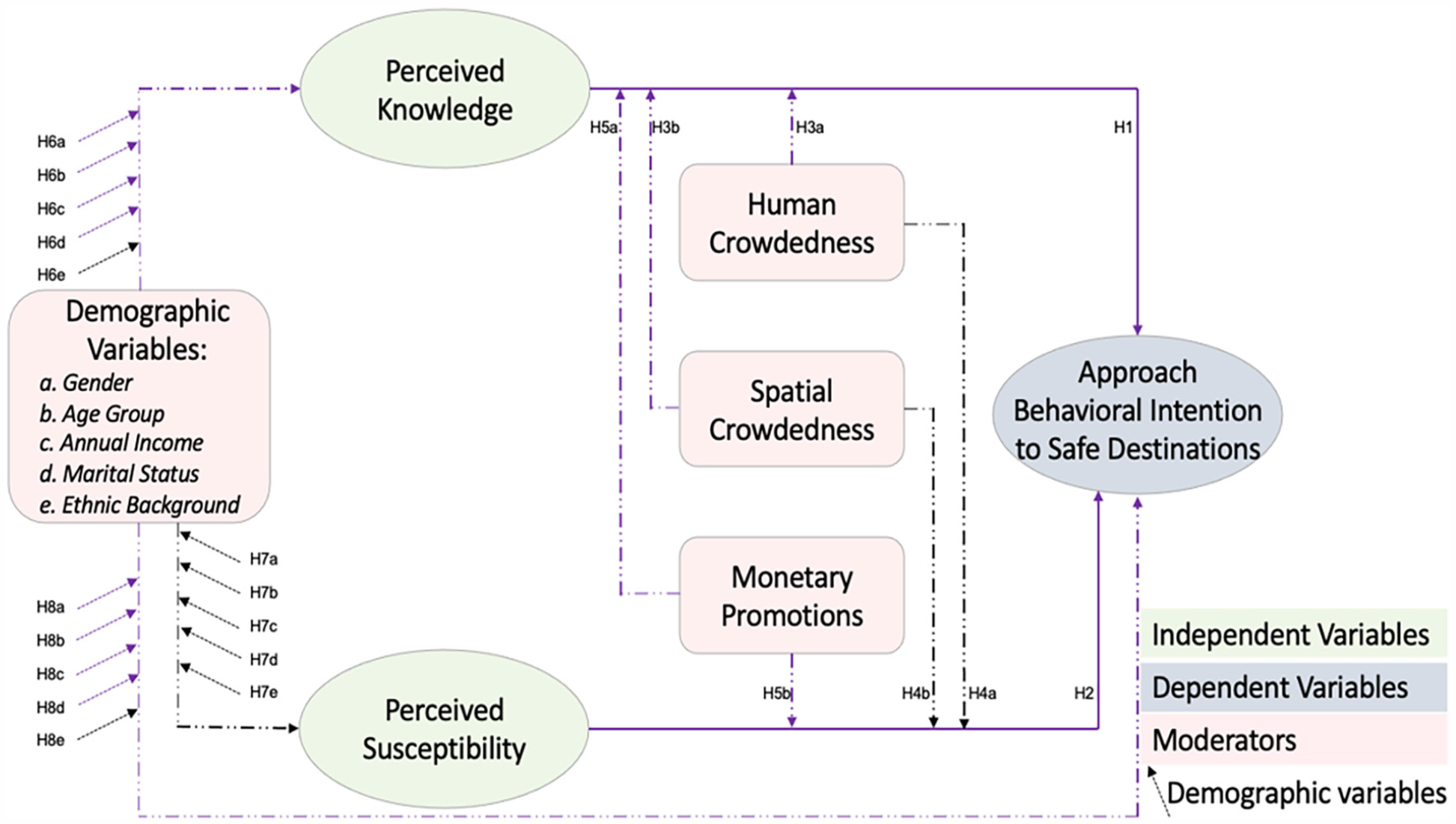
This study conceptualized the research framework highlighting the relationships among perceived knowledge, perceived susceptibility, and behavioral intention to safe destinations. Furthermore, the researchers included crowdedness (i.e., human crowdedness, spatial crowdedness) and monetary promotion as potential moderators on the relationships among perceived knowledge, perceived susceptibility, and behavioral intention to safe destinations. Finally, with the importance of demographic variables (i.e., gender, age, annual income, marital status, and ethical background), the researchers argue that perceived knowledge and perceived susceptibility may vary based on these demographic variables. The conceptual research model is displayed in Figure 1.
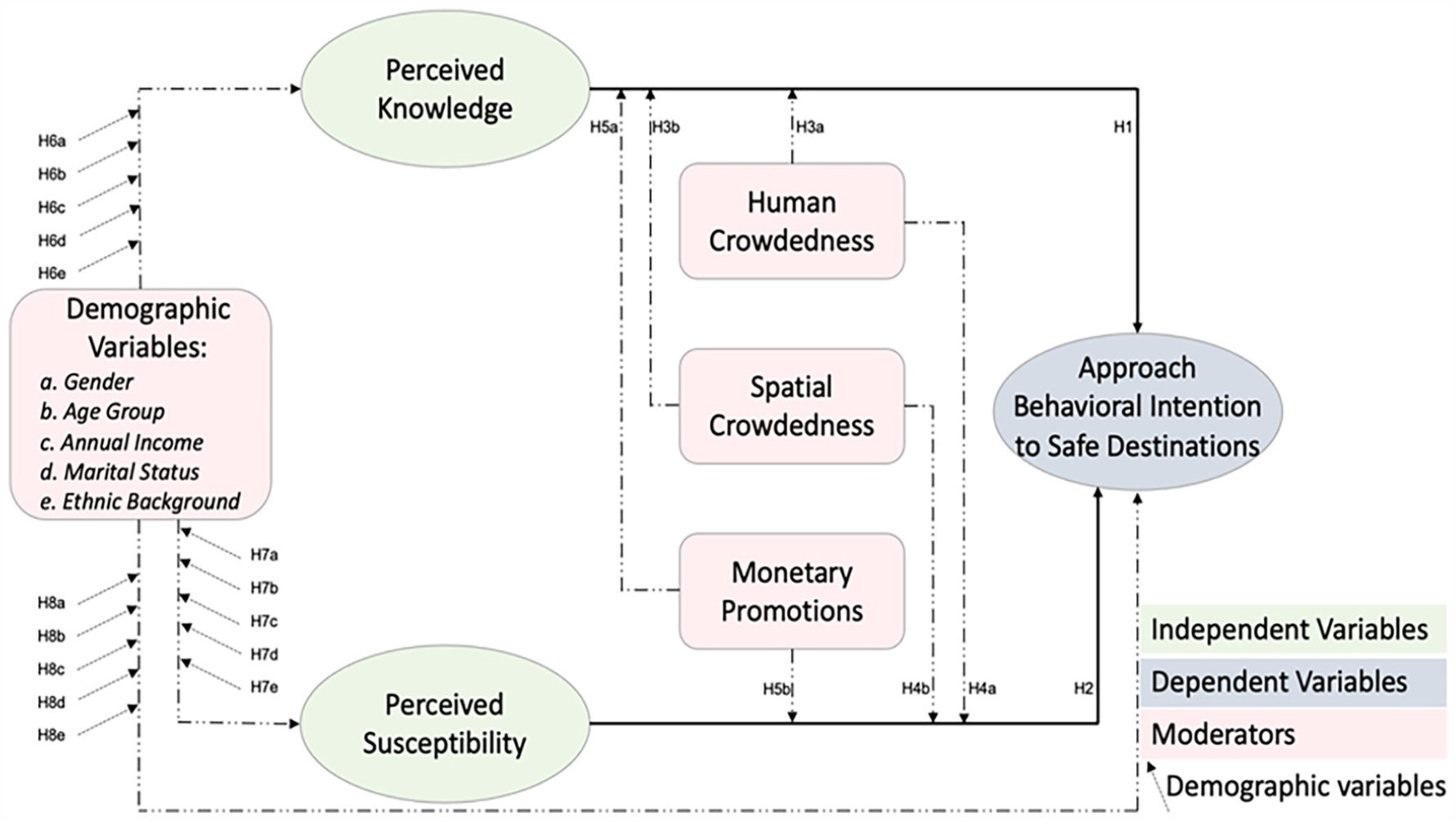
Research model.
Methodology
Measurement Items
Building on previous studies the researchers extracted partial elements and constructed measurement items which are applicable to this study. Precisely, Measurement of perceived knowledge with three items (Karl, 2018; Han et al., 2020), which included “compared with the average person, I know the facts about COVID-19.” Use three items to assess perceived susceptibility (Çetinsöz & Ege, 2013; Al-Ansi et al., 2019), which included “if I were to contract COVID-19 while traveling, then the disease will have a severe negative impact on me.” Approach behavioral intentions to safe destinations were measured using five items (Tang & Wong, 2004; Huifeng et al., 2020; Chu et al., 2020), which included “I intend to travel to a safer destination than a tourist destination in a country seriously affected by the COVID-19 outbreak within three years after the pandemic has ceased.” Human crowdedness is evaluated by two items (Heung & Gu, 2012; Quan et al., 2021), which included “because of the huge number of tourists, I feel crowded in many tourist sites.” Spatial crowdedness was measured using two items (Tse et al., 2002; Quan et al., 2021), which included “because of the spatial crowdedness, I often feel stuffy in many tourist sites.” Monetary promotions were measured using three items (Büttner et al., 2015; J.-H. Kim & Min, 2016), which includes “Hospitality businesses should use price discounts more frequently than non-hospitality businesses when the COVID-19 outbreak is under control and its adverse impact is minimal.” In this study, the measurement items of all study variables were assessed by a 7-point scale, ranging from “1-strongly disagree” to “7-strongly agree.”
Data Collection and Samples
This study was conducted through a professional questionnaire collection agency in the United States, and an email with a link to the questionnaire was sent to potential participants in April 2020 in order to ensure that there was no discrepancy with previous travel activity experience. Only participants who were 18 years of age or older, resided in the United States, and had previous travel experience were the eligibility criteria for this study. All potential participants received the email were informed of the study statement through the email content (emphasizing the absolute confidentiality of the participant’s answers), and that participation in the survey was completely voluntary. Nearly 900 questionnaires were collected as a result of this process. After eliminating errors, missing data, and invalid responses, a total of 325 valid questionnaires were screened for data analysis in this study. In addition, the entire collection process of this study strictly followed the Declaration of Helsinki. Given the observational nature of this study and the absence of any involvement of therapeutic medications in the course of the study. Therefore, formal approval from the Institutional Review Board of the local ethics committee was not required.
Among the 325 respondents, while 46.8% were female, 53.2% were male foreigner tourists. The average age of participants was 36.2 years and ranged from 17 to 76 years. About 67.7% had married. In addition, about 42.8% reported that the graduate degree was the highest level of education. Also, the annual household income (before taxes in the dollar) of the respondents was 48.9% with $100,000 or higher, which was followed by 13.5% who reported earning between $85,000 and $99,999. About 55.7% of the respondents reported that the last time they were traveled abroad was within 6 months. Majority of the respondents (76.3%) were Caucasian/white. The profiles of the respondents are shown in Table 1.
Demographic Characteristics of Respondents (n = 325).

Data Analysis
Since previous studies have tested the validity and reliability of the measurement instruments used to gather the data, performing a pretest was not required. Due to the high efficiency of SEM in assessing measurements and building structural models, as well as the increase in the use of diverse methodologies in the social sciences in recent years. SEM has become a relatively important statistical concept in the research field (Dash & Paul, 2021; Hair et al., 2017). Of these, CB-SEM and PLS-SEM are frequently used to evaluate structural models. As the research model and hypotheses proposed in this study have been extensively tested and validated by prior studies. Namely, the proposed theoretical framework needs to be confirmed and tested rather than tested for conceptual development and predictive purposes (Dash & Paul, 2021). Furthermore, the use of CB-SEM is particularly prominent in the field of tourism research, fully enriching the statistical base of the study (Nunkoo et al., 2013). Therefore, CB-SEM was used in this study to further test the theoretical framework by constructing a structural equation model based on the research model through AMOS 26.0 program. Both convergent and discriminant validity analyses were performed with confirmatory factor analysis (CFA) data to test the validity of the measurement models. The researchers also test the reliability of the model using the composite reliability coefficient. In addition, the moderating effects of human crowdedness, spatial crowdedness, and monetary promotions were examined. This study utilized 5,000 replications of bootstrap resampling and built on model 1 from the SPSS process macro (v3.5) plug-in developed by Hayes (2017). Not only that, but also conducted invariance test through AMOS 26.0 to investigate the chi-square differences.
Results
EFA and Regression Analysis by SPSS 26.0
The data results from SPSS 26.0 showed that the entire Cronbach alpha is higher than .70, representing an acceptable internal consistency. The subsequent factor analysis yielded a Kaiser-Meyer-Olkin (KMO) coefficient of .828, which is greater than the significance of .50, proving that the factor analysis data are appropriate. Details regarding the factor analysis, correlation and reliability analysis are presented in Tables 2 and 3. In addition, the results of the regression analysis indicated that perceived knowledge has a significant effect on the behavioral intentions to approach a safe destination (β = .159, t = 2.798). Meanwhile, the effect of perceived susceptibility on the behavioral intentions to approach a safe destination is also significant (β = .175, t = 3.083). Thus, the results obtained are supportive of both H1 and H2. The results of the regression analysis are presented in Table 4.
Correlations by Using SPSS.
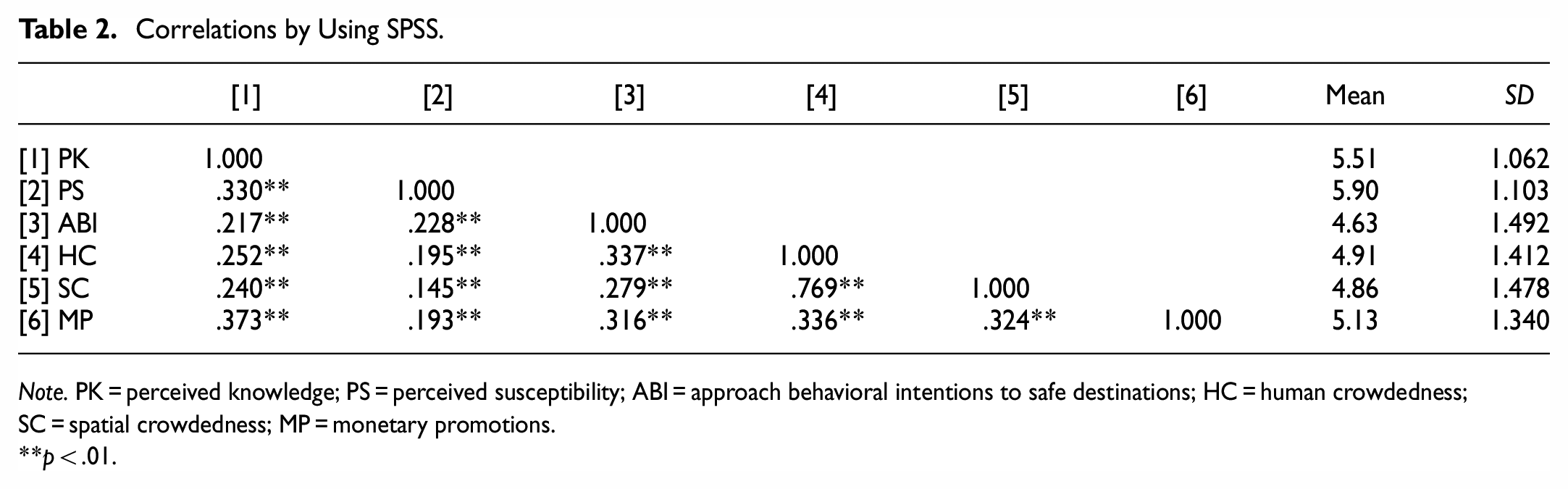
Note. PK = perceived knowledge; PS = perceived susceptibility; ABI = approach behavioral intentions to safe destinations; HC = human crowdedness; SC = spatial crowdedness; MP = monetary promotions.
p < .01.
Reliability and EFA Analysis.
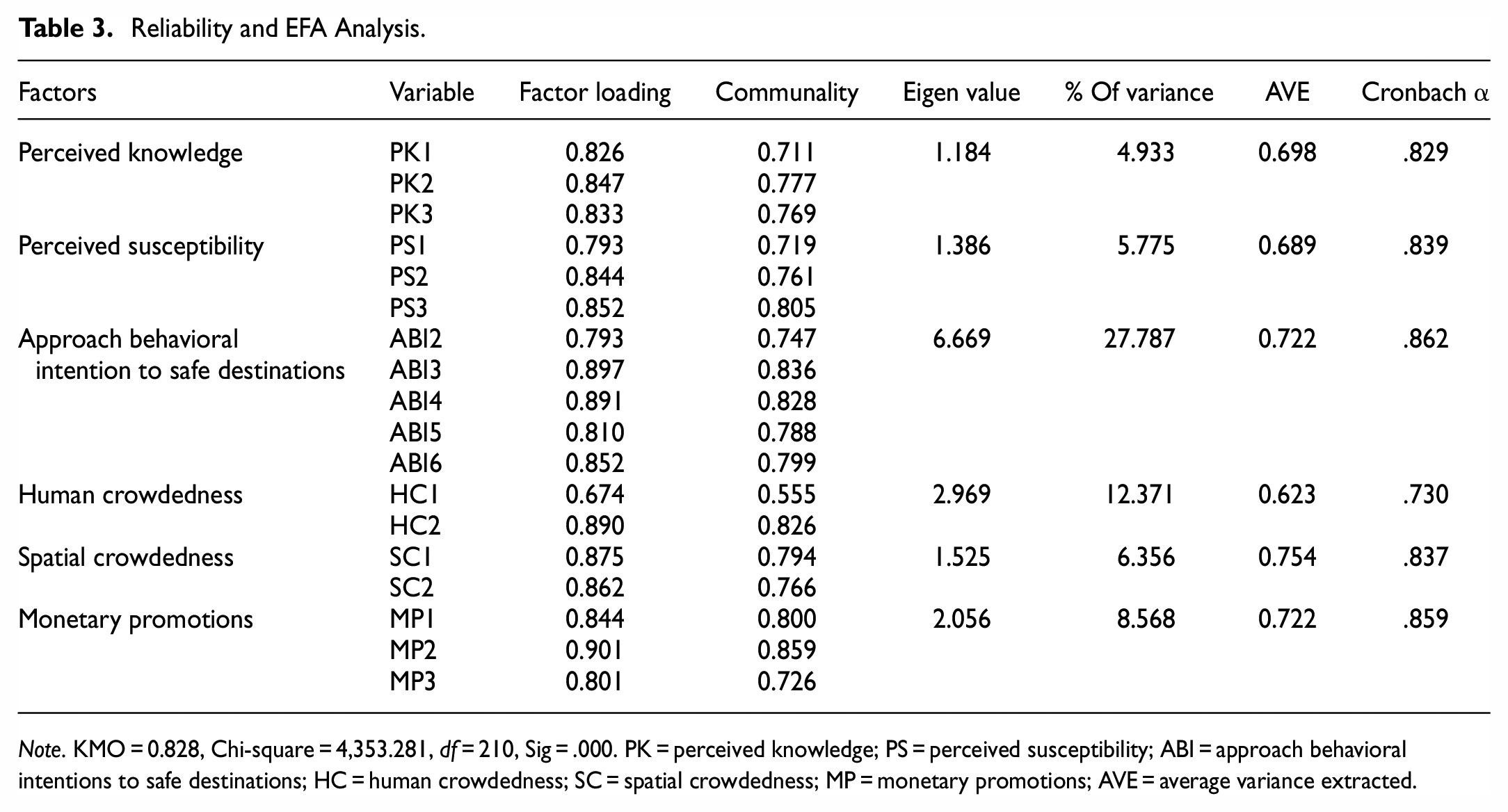
Note. KMO = 0.828, Chi-square = 4,353.281, df = 210, Sig = .000. PK = perceived knowledge; PS = perceived susceptibility; ABI = approach behavioral intentions to safe destinations; HC = human crowdedness; SC = spatial crowdedness; MP = monetary promotions; AVE = average variance extracted.
Results of Regression Analysis.

Note.
p < .01.
CFA and Structural Model Evaluation—Used AMOS 23.0
A confirmatory factor analysis (CFA) is performed by using the statistics program AMOS 23.0 against which a measurement model was constructed. As shown by the results, the overall goodness-of-fit of this measurement model (χ2 = 486.231, df = 166, χ/df = 2.929, p < .05, GFI = 0.885, IFI = 0.904, TLI = 0.864, CFI = 0.902, RMSEA = 0.077) is revealed in the interval of appropriate levels. Additionally, all values of the composite reliability (CR) in the measurement model (perceived knowledge = 0.782, perceived susceptibility = 0.752, proximity behavioral intention = 0.714, human crowding = 0.651, spatial crowding = 0.675, and monetary promotion = 0.738), as well as the average variance extracted (AVE) values (perceived knowledge = 0.631, perceived susceptibility = 0.617, and proximity behavioral intention = 0.666, interpersonal crowding = 0.630, spatial crowding = 0.724, and monetary promotion = 0.683) are both greater than the cutoff values proposed by Hair et al. (2016). In addition, the for all six variables (perceived knowledge = 0.795, perceived susceptibility = 0.785, intentions to approach behavior = 0.816, human crowdedness = 0.794, spatial crowdedness = 0.851, and monetary promotions = 0.826) are all greater than the correlation coefficient values between the variables. Thus, the internal consistency, convergent validity, and discriminant validity of the measurement scales in this study are able to demonstrate the significance. The details of the results regarding the correlations and assessment of the measurement model are presented in Tables 5 and 6.
Correlations by Using AMOS.

Note. PK = perceived knowledge; PS = perceived susceptibility; ABI = approach behavioral intentions to safe destinations; HC = human crowdedness; SC = spatial crowdedness; MP = monetary promotions. Coefficient in bold:
A Confirmatory Factor Analysis of the Measurement Items.

Note. Goodness-of-fit statistics for the baseline model: χ2 = 486.231, df = 166, χ2/df = 2.929, p < .05, GFI = 0.885, IFI = 0.904, TLI = 0.864, CFI = 0.902, RMSEA = 0.077. PK = perceived knowledge; PS = perceived susceptibility; ABI = approach behavioral intentions to safe destinations; HC = human crowdedness; SC = spatial crowdedness; MP = monetary promotions; AVE = average variance extracted; CR = composite reliability.
The applicability of the model is tested with structural equation modeling and yielded that the model contains an appropriate level of goodness-of-fit statistics (χ2 = 103.310, df = 48, χ/df = 2.198, p < .05, GFI = 0.954, IFI = 0.950, TLI = 0.914, CFI = 0.948, RMSEA = 0.061). Thus, the extent to which this model accounts for approach behavioral intentions in the context of the COVID-19 pandemic is indicated to be qualified. Furthermore, approximately 12.4% of the total variance in the dependent variable-approach behavioral intentions is explained by its antecedent variables. According to our results, it is indicated that the relationship between both perceived knowledge (β = .165, p < .05) and perceived susceptibility (β = .278, p < .01) to approach behavioral intentions is significant. Thus, the researchers found support for Hypothesis 1 and 2 (See Table 7).
The Structural Model Evaluation.

p < .05. **p < .01.
Results of Moderators
Moderation Results—SPSS PROCESS MACRO V3.5
Following the guidance of Hayes (2017), the researchers conducted SPSS PROCESS MACRO tests regarding the moderating effects in the structural model. To examine the moderating effects of human crowdedness, spatial crowdedness and monetary promotions, the researchers tested for interaction effects through automatic software calculations, which also generate the proportion of variance explained by the moderating effects of human crowdedness, spatial crowdedness, and monetary promotions (the increase in R-squared due to the interaction). In addition, each path of the structural model was tested with model 1 of the SPSS PROCESS MACRO (Hayes, 2017). The bias-corrected 95% confidence intervals (CI) are also estimated using a bootstrap process of 20,000 samples. The results of the analysis showed that within the context of the COVID-19 pandemic, the interaction between perceived knowledge (β = .133, SE = 0.076, p > .05) and human crowdedness (β = .306, SE = 0.056, p < .001), which is the product term was presented a significant relationship (ΔR2 = .014, β = .105, SE = 0.044, p < .05) with 95% CI in the range of 0.017 to 0.192. And the product term between perceived knowledge (β = .169, SE = 0.078, p < .05) and spatial crowdedness (β = .229, SE = 0.053, p < .001) was not significant (ΔR2 = .009, β = .084, SE = 0.047, p > .05), and 95% CI ranges from −0.008 to 0.176 (See Table 8). Thus, while H3a was supported, H3b was not supported.
Moderation Results. [Perceived Knowledge]—SPSS Process Macro v3.5.

Note. PK = perceived knowledge; ABI = approach behavioral intentions to safe destinations; HC = human crowdedness; SC = spatial crowdedness; MP = monetary promotions; DV = dependent variable; IV = independent variable; CI = confidence interval.
p < .05, **p < .01. ***p < .001.
According to Table 9, human crowdedness (ΔR2 = .002, β = .042, SE = 0.045, p > .05), and spatial crowdedness (ΔR2 = 0.001, β = .030, SE = 0.044, p > .05) were not significant in terms of their moderating effects. In other words, the interaction of perceived susceptibility with crowdedness (i.e., human crowdedness and spatial crowdedness) was not significant. Therefore, hypotheses H4a, and H4b were not supported.
Moderation Results. [Perceived Susceptibility].

Note. PS = perceived susceptibility; ABI = approach behavioral intentions to safe destinations; HC = human crowdedness; SC = spatial crowdedness; MP = monetary promotions; DV = dependent variable; IV = independent variable; CI = confidence interval.
p < .01.
A significant interaction was observed with perceived knowledge (β = .121, SE = 0.080, p > .05) when monetary promotions (β = .267, SE = 0.063, p < .001) is the moderator variable (ΔR2 = .010, β = .107, SE = 0.054, p < .05) with 95% CI in the interval of 0.000 to 0.213. Thus, hypotheses 5a was supported. However, monetary promotions (ΔR2 = .002, β = −.047, SE = 0.048, p > .05) were not significant in terms of their moderating effects. Thus, H5b was not supported. The details of the data analysis are displayed in Tables 8 and 9 and Figure 2.

Interactions through SPSS PROCESS MACRO.
The Invariance Model Results
The researchers examined the moderating effects of the structural model through a comprehensive assessment of invariance tests. Responses regarding human crowdedness, spatial crowdedness, and monetary promotions answered by 325 participants are classified into two groups, high and low, by K-Means cluster analysis in SPSS. Namely, separated into a low level of human crowdedness (n = 95) and high level of human crowdedness (n = 230), low level of spatial crowdedness (n = 103) and high level of spatial crowdedness (n = 222), and low level of monetary promotions (n = 95) and high level of monetary promotions (n = 230). The corresponding one path is then equivalently restricted in each nested model by the AMOS program and compared with the baseline model. The baseline model had goodness-of-fit statistics at the appropriate level when testing for human crowdedness (χ2 = 235.444, df = 144, χ2/df = 1.635, p < .05, GFI = 0.915, IFI = 0.953, TLI = 0.929, CFI = 0.952, RMSEA = 0.044). Whereas the results of the Chi-square test indicated a significant relationship between perceived knowledge and approached behavioral intentions (Δχ2 [1] = 2.896, p < .05), and the path between perceived susceptibility and approach behavioral intentions is not significantly (Δχ2 [1] = 0.003, p > .05). Goodness-of-fit statistics for the baseline model are appropriate when the moderating variable is spatial crowdedness (χ2 = 232.848, df = 144, χ2/df = 1.617, p < .05, GFI = 0.917, IFI = 0.955, TLI = 0.932, CFI = 0.953, RMSEA = 0.045). Moreover, a moderating effect existed between perceived knowledge and approach behavioral intentions (Δχ2[1] = 4.513, p < .05), whereas the relationship between perceived susceptibility and approach behavioral intentions is non-significant (Δχ2[1] = 0.438, p > .05). Furthermore, the researchers found that the paths from perceived knowledge (Δχ2[1] = 4.511, p < .05) and perceived susceptibility (Δχ2[1] = 4.978, p < .05) to approach behavioral intentions are both significant when the moderation effect of monetary promotions is examined. And the baseline model is measured by the appropriate level of goodness-of-fit statistics (χ2 = 254.885, df = 144, χ2/df = 1.770, p < .05, GFI = 0.909, IFI = 0.941, TLI = 0.911, CFI = 0.939, RMSEA = 0.049). Therefore, hypotheses H4a and H4b are not supported, and hypotheses H3a, H3b, H5a, and H5b are supported. Details about the results are shown in Table 10. In addition, due to the hypotheses H4a and H4b are not valid. And interactions based on the two-way interaction graphs are not significantly effective. Hence, the moderating effect of three variables is further clarified through the two-way interaction graphs with only supported hypotheses H3a, H3b, H5a, and H5b shown in Figure 3.
The Invariance Model Results.

Note. PK = perceived knowledge; PS = perceived susceptibility; ABI = approach behavioral intentions to safe destinations; HC = human crowdedness; SC = spatial crowdedness; MP = monetary promotions.
p < .05. **p < .01.

Two-way interactions with moderators (human crowdedness, spatial crowdedness, monetary promotions).
Differences of Demographic Variables
In order to test the effect of demographic variables (gender, age group, annual income, ethnic background, and marital status) on the three variables of the structural model, a t-test was conducted to verify if there are differences based on gender. A significant difference between males and females in terms of perceived knowledge (t = 2.819, p < .01) and intention to approach behavior (t = 4.191, p < .001) is indicated by the results. Furthermore, by using one-way ANOVA to test the other four demographic variables, a significant difference between age groups on perceived knowledge (F = 3.352, p < .01) and approach behavioral intentions (F = 2.924, p < .01) is demonstrated. Not only that, but there is also a significant difference between annual income on perceived knowledge (F = 4.194, p < .001) and approach behavioral intentions (F = 2.684, p < .05). Meanwhile, differences in perceived knowledge (F = 7.092, p < .01) and approach behavioral intentions (F = 7.344, p < .01) are also significant between single, married, and others. In addition, the results of five demographic variables revealed non-significant results in the test for differences on perceived susceptibility. Moreover, the findings showed that the difference in ethnic background is not significant for any of these three variables. Therefore, five variables of demographic characteristics are not significantly different on perceived susceptibility, which means that hypotheses H7a, H7b, H7c, H7d, and H7e are rejected. Also, there are non-significant differences in perceived knowledge and approach behavioral intentions by ethnic background. Hence, hypotheses H6e and H8e are not supported. In addition, demographic characteristics including gender, age group, annual income, and marital status showed significant differences in both perceived knowledge and approach behavioral intentions. Thus, hypotheses H6a, H6b, H6c, H6d, H8a, H8b, H8c, and H5g are supported. Details are presented in Table 11 and Figure 4.
ANOVA and t-Test Results: Differences by Gender, Age Group, Annual Household Income Level, and Ethnic Background.

Note. PK = perceived knowledge; PS = perceived susceptibility; ABI = approach behavioral intentions to safe destinations.
p < .05. **p < .01. ***p < .001.

Results of means comparison of model outcomes by demographics variables.
Discussions
The COVID-19 pandemic, which has been raging for quite some time, has severely affected people’s behavior and posed many challenges for all tourist destinations worldwide (Itani & Hollebeek, 2021). At present, since the global is gradually in the situation of advancing vaccines, many countries are beginning to liberalize their borders and promote diversified tourism products. As such, it is essential to predict traveler behavior when mass tourism activities resume. This empirical study formulates people’s perceived knowledge, cognitive susceptibility, and proximity behavioral intentions into a structural model, analyzed through two statistical analysis procedures that revealed the roles of crowdedness, monetary promotions, and demographics in the structural model. The analysis of the results in this study showed that people’s perceived knowledge about COVID-19 and perceived susceptibility have a significant positive relationship with approach behavioral intentions and supported hypothesis 1. This result is contrary to the findings of Aranti and Yenita (2020) concluded that the knowledge people acquire related to tourism not directly predict the behavioral intention to visit. However, according to prior research, the greater knowledge that people possess, the more impact the knowledge will have on behavioral intentions (Azizan & Suki, 2013). Moreover, there is a significant positive relationship between people’s perceived susceptibility to COVID-19 and their approach behavioral intentions to traveling to a safe destination, supported hypothesis 2. In comparison, this result is consistent with the study conducted by Li et al. (2018). However, the findings contradict those of Zhao and An (2021), who argued that although pandemic susceptibility is strongly correlated with perceived severity, people focus more on the impact of severity than susceptibility. In addition, the present empirical study, with model 1 of SPSS PROCESS, shows that human crowdedness and monetary promotions have a moderating role in the relationship between perceived knowledge and approach behavioral intentions, which supports hypotheses H3a and H5a (Figure 5). In contrast, utilizing AMOS to test whether the Chi-square difference is statistically significant proves a significant moderating effect of human crowdedness, spatial crowdedness, and monetary promotions for the path of perceived knowledge and approach behavioral intentions. Not only that, but there is also a significant moderating effect of monetary promotions between perceived susceptibility and approach behavioral intentions, which supports hypotheses H3a, H3b, H5a, and H5b (Figure 6). Thus, although scholars widely use both statistical programs, there are subtle differences in the data results. Since perceptions of risk promote people to decrease their actions, with a higher COVID-19 susceptibility, people will travel less to high-risk areas, that is, will prefer to be closer to some safe places. For example, during COVID-19 pandemic, people will tend to travel to less crowded and spacious areas rather than small and dense ones (Quan et al., 2021). Accordingly, there will be appropriate crowd avoidance and social distance to reduce the risk of COVID-19 infection (Itani & Hollebeek, 2021). In turn, with the increase of monetary promotions, it will lead to travelers who perceive more knowledge of COVID-19, have stronger behavioral intentions for tourism activities. This result is contrary to Rittichainuwat (2006), whose findings suggest that disaster-affected destinations do not attract tourists’ intention to visit even if they have a lot of monetary promotions. Although the results are contrary to this study, it is able to demonstrate that in the context of disasters or pandemics, monetary promotions perform an important role in advancing behavioral intentions when tourists perceive relevant knowledge.
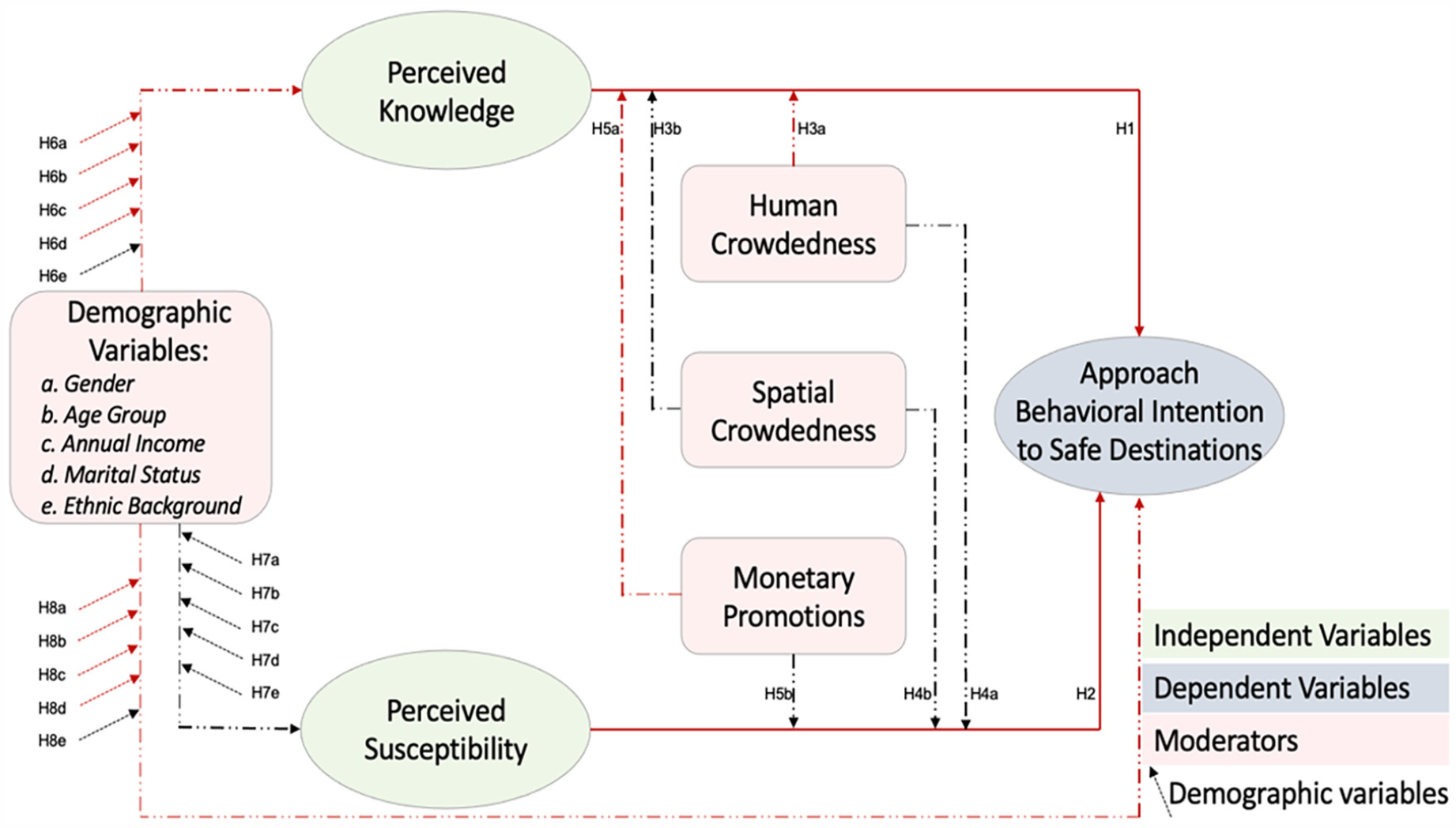
Supported hypotheses obtained through SPSS PROCESS MACRO marked in red.
Supported hypotheses obtained through SEM (AMOS) marked in purple.
Findings from testing demographics (gender, age group, annual income, marital status, and ethnic background) through mean differences showed that there were no significant differences in perceived susceptibility, regardless of gender, age group, annual income, and marital status. This is contrary to previous research findings (J.-M. Jin et al., 2020; Pieh et al., 2020; Zhong et al., 2020). However, a significant difference was obtained for perceived knowledge and behavioral intention by gender, age group, annual income, and marital status. This is consistent with the results derived from prior studies (Hutchins et al., 2020; Pieh et al., 2020; Untaru & Han, 2021; Van der Vegt & Kleinberg, 2020; Zhong et al., 2020). In contrast, ethnic background did not differ significantly in terms of perceived knowledge, perceived susceptibility, and intention to approach behavior. Thus, consistent with Soiné et al.’s (2021) study, the results demonstrate that the pandemics create among people is the same regardless of ethnic background, as pandemics cause unemployment, illness, and trigger upset emotions that are common perceptions of people in general and unrelated to ethnic background.
In addition, this empirical study is conducted through two statistical programs: SPSS PROCESS and AMOS. The analysis reveals the moderating role of crowdedness and monetary promotions. Intriguingly, the researchers obtained different results, namely that the various statistical procedures were able to produce similar but not identical results, or even completely different results. Differences in the results are able to be illustrated by the following elements. Firstly, with the results of Hayes, Montoya, and Rockwood (2017), the researchers find that the SPSS PROCESS uses ordinary least squares to estimate the parameters of each equation, while SEM uses maximum likelihood (ML) rather than estimating the parameters of each equation independently. The difference in mechanism and operation makes the obtained analysis results different. Secondly, the more flexible nature of SEM in terms of model specification and dealing with missing data, along with the ability to account for random measurement error when it comes to exploring the relevant effects of potential variables, are also important enough to attract scholars to choose and use SEM (Hayes, Montoya, & Rockwood, 2017). Not only that, but the use of AMOS also enables the understanding of potential biases and inter-group differences by performing undeformed tests on baseline and nested models of subgroups grouped into two homogeneous groups (Collier, 2020). Therefore, it has also gained the favor of many scholars. However, even though PROCESS is an OLS regression-based tool for modeling observed variables and is susceptible to bias due to random measurement error is one of the weaknesses of regression analysis (Darlington & Hayes, 2017). Scholars have also been able to obtain the moderating/mediating effects in the study model by PROCESS in an automated mode based on a concept diagram/model diagram defined by a specific model number, that is, by inputting the model number (Hayes, Montoya, & Rockwood, 2017). The ease of operation and the clear and easy-to-understand schematic table of results make PROCESS a favorable choice when analyzing mediating and moderating effects (Hayes, 2018). However, many previous researchers have only provided theoretical justification by elaborating the mechanistic principles of a single program. Consequently, the findings of this study, in which two statistical programs with different mechanisms were actually analyzed simultaneously and the significant differences obtained, demonstrate a more intuitive result and rationale for future researchers to select the appropriate program for data analysis.
Implications and Limitations
This study contributed to the knowledge body accordingly in several ways. Firstly, perceived knowledge and perceived susceptibility were theoretically modeled as drivers of people’s behavioral intentions to travel to safe destinations. The findings demonstrate that people’s knowledge of COVID-19 directly affects their behaviors (consumption behavior, tourism behavior, decision-making behavior). Therefore, with the pandemic not being fully mitigated for a long time, only reducing the risk of pandemics in tourist destinations and ensuring the safety of the area can lead to positive behavioral intentions. It is implied that travelers’ knowledge of COVID-19 helps to strengthen existing theories and plays an important role in predicting travel intentions after a weakened pandemic. The basis for the importance of travelers’ knowledge perceptions of specific pandemics is provided, revealing the process of generating behavioral intentions toward tourism. It provides a basis for more tourism industry managers to help develop tourism markets in the future after the pandemic has abated. Secondly, this study verified whether demographic measures differ in their perception of COVID-19. Secondly, this study verified whether demographic measures differ in their perception of COVID-19. The results showed that males had stronger knowledge of pandemics than females, and young people in demonstrated lower knowledge of perceptions. Married participants showed a more conservative sense of preparedness, and the more relevant knowledge perceived, the greater ability to enhance travel intentions. And it was found that ethnic background was no difference. It revealed that people fear the spread of pandemics and that perceptions of pandemics do not differ according to individual characteristics and factors. Finally, this study produced the first analysis of the study results by using two statistical procedures to test for different moderating effects and to elucidate in detail the reasons for the different results. This provides a new perspective to the current understanding of statistical analysis. It also suggests a basis for future researchers to consider when selecting appropriate procedures for data analysis.
The findings of this study provide recommendations for managers and marketers in tourism destinations related to management dimensions. During the period of COVID-19 pandemic, one of the industries considered to have suffered the greatest negative impact is tourism and hospitality industry. Consequently, this study enables us to improve our understanding of the potential factors that influence the behavior of most people when a destination suffers a health crisis. In other words, the results obtained from our study will assist tourism destination managers and marketers to strategize effective campaigns through the potential behavioral intentions of tourists in order to recover from the COVID-19 pandemic after it has been suppressed. Furthermore, the findings indicate that it is most critical to reduce the risk of the region and increase the trust and positive behavioral intention of tourists. Therefore, tourism destination managers should focus their primary efforts on the topic of ensuring health safety. More importantly, the results of the study proved that the moderating effect of monetary promotions had a significant moderating effect on people’s behavioral intentions after the COVID-19 pandemic. Consequently, destination managers and marketers should be aware of both marketing strategies and reassuring advertising campaigns, which include effective monetary promotions, higher destination safety policies, and corporate social responsibility, in order to reverse the negative influences generated by the pandemic, consolidate favorable reputation of the destination, and enhance people’s trust. In addition, the results confirm that differences in ethnic background do not affect people’s behavioral intentions. Thus, it is important for managers to take appropriate safety measures for their jurisdictions. In this way, they can play an important role in attracting positive behavioral intentions from all countries of the world when the pandemic is controlled.
Undeniably, this study contains some limitations that need to be addressed by further research. First, the questionnaires have been administered only to participants in the U.S. and even though the analysis is conducted for different ethnic backgrounds, the results of the study are still restricted. Accordingly, the researchers suggest that future studies could distribute questionnaires to participants in different countries in order to examine further the differences brought by the people and cultures of different countries. Secondly, the data in this study are based on the analysis of the questionnaire results in mid-2020, and since many countries have already begun to administer the vaccine for COVID-19 at the present time, the comparison with the trend in 2020 would demonstrate improvement. Thus, it is possible for future studies to analyze people’s behavioral intentions by comparing them during the outbreak of the pandemic versus after its remission. Thirdly, this study obtained results with differences through two representative programs that are capable of analyzing moderating effects. Hence, future studies could use other programs for comparative analyses based on the direction of this study in order to achieve more meaningful findings. Moreover, the variability of demographic characteristics in this study is conducted by using one method to verify the mean differences with SPSS. Consequently, the researchers recommend that future studies examine demographic variables through multiple statistical programs in order to improve the consistency of the findings. Finally, the dependent variable of the study is the approach of behavioral intentions to travel to safe destinations, as the measured item is the behavioral intention of people after the cessation of COVID-19, but the definition of a safe destination is ambiguous. Therefore, the researchers suggest that future studies further examine the relevant findings based on a multi-directional approach to defining safe destinations (protective measures, local policies, and social responsibility).
Footnotes
Declaration of Conflicting Interests
The author(s) declared no potential conflicts of interest with respect to the research, authorship, and/or publication of this article.
Funding
The author(s) disclosed receipt of the following financial support for the research, authorship, and/or publication of this article: This work was supported by the Ministry of Education of the Republic of Korea and the National Research Foundation of Korea (NRF-2020S1A5A2A01046684).
