




Abstract
Research on hostile media perception (HMP) has suggested that both news slants and partisan source cues influence individuals’ perception of news bias. Yet, relatively little attention has been paid to the possibility that the two message features may interact. Extending the literature on HMP, the present experiment investigates the content-source interaction in the context of President Trump’s policy on immigration, with two audience characteristics as potential moderators: political ideology strength (PIS) and need for cognition (NFC). Results show that (1) the effect of news slants on HMP is greater when the news is from an in-group source and (2) such interaction is more pronounced for those with higher levels of PIS and lower levels of NFC. Implications for our understanding of HMP and for public opinion in an increasingly fragmented and partisan media environment will be discussed.
Keywords
Although two-sided, balanced coverage is still a central value in contemporary journalism (Fico et al., 2004), people are losing faith in the fairness of news media (Patterson, 2019; Pew Research Center, 2018). As the media market has increasingly become niche-oriented and partisan, citizens are often drawn to their favorite news outlets where they find information that is consistent with their political beliefs (Iyengar & Hahn, 2009; Knobloch-Westerwick & Meng, 2009; Stroud, 2010; cf. Guess, 2021; Nelson & Webster, 2017; Wojcieszak & Mutz, 2009). Through selective exposure, a diverging perception that the favored sources are fair whereas the disfavored are unfairly biased is likely to be nurtured and reinforced (Turner, 2007). The divides in news selection and news bias perception are worrisome as they likely lead citizens to discredit news that they disagree with and have different realities in their perception, which eventually makes it difficult for public opinion to be formed based on a common set of facts.
The changing media environment has introduced a new context for hostile media perceptions (HMP) research, which was originally proposed and tested with neutral, non-partisan news. The original HMP literature suggests that partisan viewers tend to judge news about controversial issues to be biased against their own side even when the news is largely two-sided (Giner-Sorolla & Chaiken, 1994; Perloff, 1989; Vallone et al., 1985). However, with the increasing prevalence of partisan news, recent work has started looking at HMP in relation to news message features such as one-sided slant (Gunther et al., 2012; Feldman, 2011) and source affiliation (Reid, 2012; Turner, 2007). Research in this line shows that when exposed to biased news, partisan groups tend to agree on the existence of bias in news but disagree on its severity, with the opponent group having a stronger perception of news bias. As such, although “relative” (Gunther et al., 2001, p. 296), HMP is amplified by message features (i.e., partisan slants and partisan source cues). However, few studies have investigated the interaction between content and source (Gunther et al., 2017).
Against this backdrop, the present study attempts to extend the existing literature of HMP in two ways. First, distinguishing news content and source, we investigate how the two message features interplay in partisan users’ perception of news bias. In reality, it is typical that when consuming news, individuals are exposed to both news content and source, and the two often match. That is, for example, a so-called liberal source’s reporting tends to reflect a liberal view and so does a conservative source (Feldman et al., 2012; Groseclose & Milyo, 2005; Hyun & Moon, 2016). Does this combination amplify partisans’ relative HMP as the two matching factors (i.e., content and source) may work as a double dose of stimulus? Further, what if a news source provides ‘cross-cutting’ information that is inconsistent with its partisan base? For instance, how would partisan viewers react to a CNN report praising President Trump or a Fox News coverage criticizing the president? The mismatch, although relatively infrequent in reality, could be normatively valuable as a balanced coverage, and it is important to examine how partisan viewers assess news bias.
Second, in addition to partisan identification, we consider other audience characteristics such as ideology strength and need for cognition (NFC, Cacioppo & Petty, 1982) as moderating factors of the content-source interaction. As Perloff (2015) notes, HMP is essentially a function of both message features and individual characteristics. This is particularly the case when a message is composed of a matching or mismatching combination of slanted content and a partisan source cue, as it can either activate partisan identity (Reid, 2012) or create cognitive dissonance (Festinger, 1957). We thus expect the motivational and cognitive dispositions—ideological strength and NFC, respectively—to play a role in partisan viewers’ information processing and induce a motivated reasoning (Taber & Lodge, 2006), which eventually influences the way partisans assess news bias. In sum, testing if content and source interact on news bias perception and whether and how audience characteristics moderate the interaction adds another layer to the understanding of HMP in the era of partisan media.
Biased Content and HMP
Drawing on social judgment theory, scholars have looked at how individuals perceive and process biased news (Choi et al., 2009; Gunther et al., 2017). Social judgment theory suggests that individuals in general have three attitudinal latitudes of acceptance, rejection, and non-commitment in their minds, the proportion of which is determined by the strength of ego-involvement (Hovland et al., 1957; Sarup et al., 1991; Sherif & Sherif, 1967). When exposed to a message, individuals judge a psychological distance between the message and self in terms of the three latitudes. If the message is located in the latitude of acceptance, they evaluate it to be more favorable to them than its real position, which occurs through assimilation effects. If it is viewed as being located in the latitude of rejection, they judge it to be hostile to them than its actual location through contrast effects.
When applied to the original notion of HMP (Vallone et al., 1985), social judgment theory suggests that even a neutral news coverage is likely to fall in the latitude of rejection (thus to be viewed as hostile against the self—“absolute HMP”) particularly for those highly involved and partisan because partisan minds extend the latitude of rejection and reduce the latitudes of acceptance and non-commitment. This further explains how partisans would react to one-sided, biased news (Gunther et al., 2017). Overall, it is clear that when exposed to pro-attitudinal content, individuals likely judge the message to be biased in favor of them as they perceive it as falling in the acceptance latitude. Likewise, for counter-attitudinal content, individuals consider it biased against them because it clearly is located in the rejection latitude. Yet, when it comes to partisans (those strongly involved), the friendly and hostile news perceptions based on the direction of bias in the message would likely be asymmetrical as the relative proportion of latitudes of acceptance and rejection is not even (Gunther et al., 2001, 2017). That is, given that the latitude of acceptance for partisans is relatively narrower than their latitude of rejection, the magnitude of positive (or friendly) bias perception for the pro-attitudinal content would be smaller than that of hostile bias perception for the counter-attitudinal content (“relative HMP,” Gunther & Chia, 2001; Gunther et al., 2001).
Drawing on past research, we propose a hypothesis examining partisans’ bias assessment of slanted news, as follows: Partisan participants will perceive counter-attitudinal content to be more unfavorable than pro-attitudinal content (H1).
Biased Source and HMP
News sources, in addition to news content, have drawn scholarly attention in the literature of HMP as many news outlets have been labeled as liberal or conservative in an increasingly fragmented media system (e.g., CNN vs. Fox News, Turner, 2007). Partisans develop certain expectations about political leaning of news sources and selectively choose sources that they expect to provide attitude-consistent information (Stroud, 2010). And, such expectations attached to a news source would likely play a role not only in selecting news but also in processing it.
Drawing on social identity theory (Tajfel, 1982), research on HMP has looked at how individuals’ perception of source bias interplays with their partisan attitudes in the process of interpreting and assessing news (Ariyanto et al., 2007; Hartmann & Tanis, 2013; Kim & Hwang, 2019; Matheson & Dursun, 2001; Reid, 2012). When an individual’s social identity is made salient by an external input, he or she tends to view the situation at hand based on the primed identity (Abrams & Hogg, 1990; Hogg & Reid, 2006). Based on the group identity, individuals categorize their surroundings into either the in-group or the out-group, which leads them to normatively conform to their in-group prototype, a set of properties which represent the group’s uniqueness, while expecting the out-group to follow out-group norms (Campbell, 1958; Reid, 2012). Through the processes, one’s own identity as well as perception of in-group versus out-group differences are reinforced and solidified (Hogg & Reid, 2006).
When viewed from social identity theory, a news source, especially one that is widely known for its political leaning, likely facilitates the self-categorization process as it can make partisan identity salient based on existing beliefs about media bias (Arpan & Raney, 2003; Coe et al., 2008; Reid, 2012). To wit, news sources can be a cue to prime partisan identity. If partisans are exposed to an in-group source, their partisan identity primed by the source cue would lead them to see news content provided by the source through a partisan lens and to perceive it to be more favorable (biased assimilation, Lord et al., 1979). In contrast, if partisans are exposed to news from an out-group source, their primed partisan minds would drive them to assess the news to be more unfavorable to their views, independent of the content of news (Reid, 2012; Turner, 2007).
In sum, as partisans have prior beliefs about political leaning of news outlets, they evaluate a message from an out-group source to be more unfavorable to their side than a message from an in-group source. This leads to the following hypothesis: Partisan participants will perceive news from an out-group source to be more unfavorable than news from an in-group source (H2).
Slanted News Content, Partisan Source Cue, and HMP
As discussed above, we expect that both biased content (H1) and partisan source cue (H2), respectively, influence partisans’ news bias perception. These two hypotheses are used as a build-up toward the central research question of the present study—whether and how the content and source features interplay in the process of shaping news bias perception. To our knowledge, this possibility has rarely been explored in the literature of HMP (cf. Gunther et al., 2017). Indeed, an experiment by Gunther et al. (2017) is one of the few studies looking at the possible interaction. They manipulated both content and source along the lines of “pro-evolution” versus “pro-teach the controversy (TTC)” and tested the content-source interaction against two partisan groups: pro-evolution (National Center for Science Education: NCSE) and pro-TTC (Center for Science and Culture at the Discovery Institute: DI). Their results show that (a) the in-group source attenuates HMP caused by the content slanted against in-group’s position, but not the perception caused by the content slanted in favor of the group’s position; and (b) the out-group source softened HMP caused by the content siding with in-group’s position but not the perception in response to the content slanted against the in-group’ position (p. 377). Also, the content effect (i.e., the difference in bias perception between pro- and counter-attitudinal content) on HMP decreases when the news source is in-group whereas the pattern is reversed when the source is out-group. Yet, because the interaction was observed only for one partisan group (i.e., DI), it is still not clear whether and how content and source would interact. Building on and extending this research, we discuss three possibilities of the interaction on HMP.
First, it is possible that content effect on HMP is amplified by biased sources (Figure 1a). In other words, individuals would perceive stronger HMP when exposed to counter-attitudinal content (e.g., content criticizing in-group targets or praising out-group targets) as compared to pro-attitudinal content (e.g., content criticizing out-group targets or praising in-group targets), and this pattern would be more pronounced when the content comes from an out-group source. This is perhaps because partisans tend to perceive in-group sources to be of high quality and less biased than out-group sources. This asymmetrical perception of source biasedness is driven by an intrinsic motivation to enhance the sense of ego (Brown, 1986; Weinstein, 1980) and in-group identity (Hogg & Reid, 2006; Reid & Hogg, 2005). Due to the differential perception, partisans may think that there is a reason when an in-group source criticizes an in-group target (i.e., counter-attitudinal news from an in-group source), which attenuates HMP. In addition, they may be tolerant of counter-attitudinal news from an in-group source due to in-group favoritism (Hewstone et al., 2002). However, partisans would less likely attempt to see between the lines when an out-group source provides messages criticizing an in-group target as it matches their perception of out-group sources. In this case, HMP would be easily spurred. It is thus expected that content effect on HMP is more pronounced when a news message is from an out-group source.
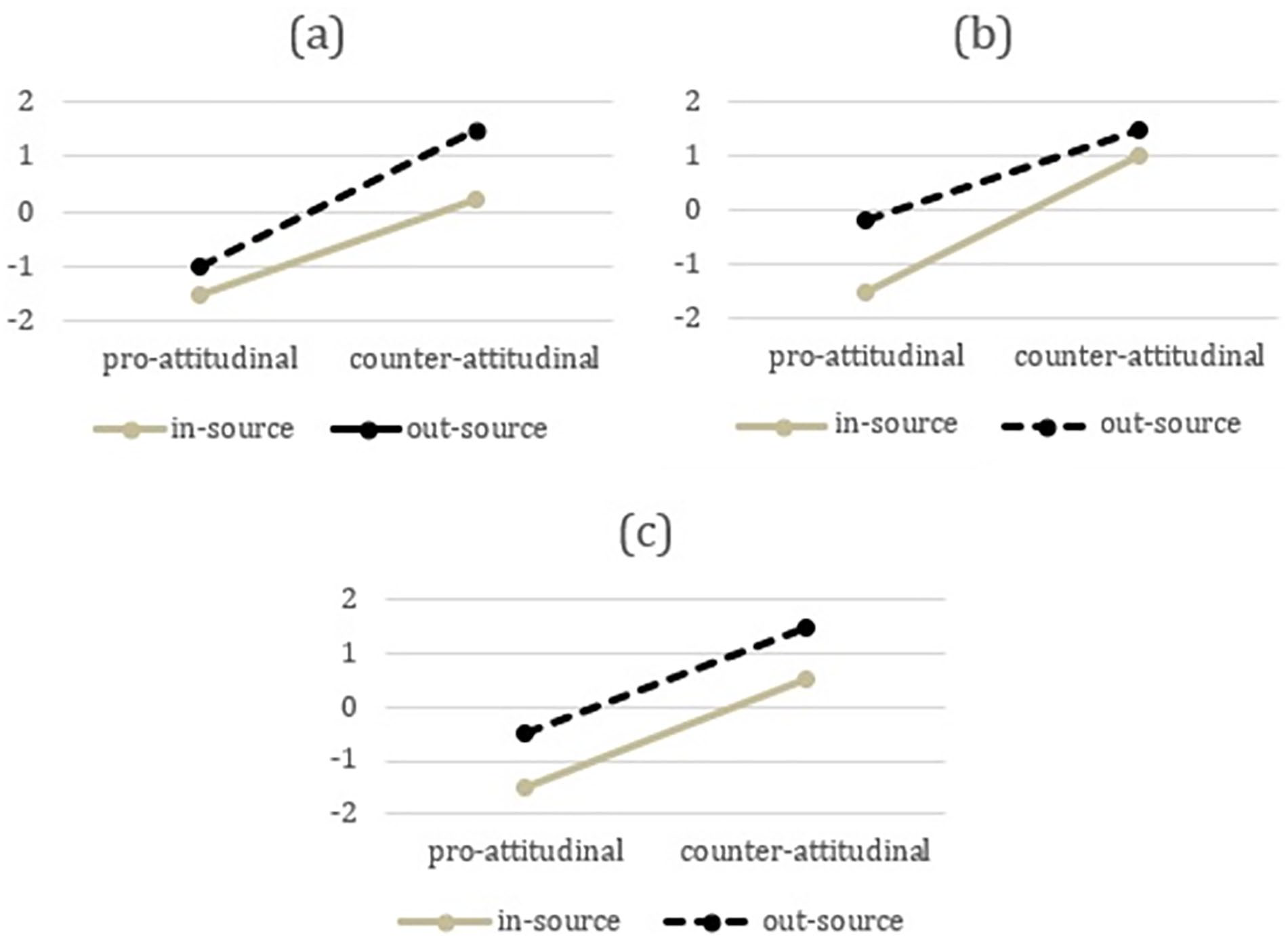
Three proposed interaction patterns.
A second possibility is that there may be a reversed interaction, such that content effect on HMP diminishes when a message is from an out-group source (Figure 1b). In this scenario, due to differential confidence in in- and out-groups (Hogg & Reid, 2006) and self-enhancement motivation in partisans’ mind (Brown, 1986), an in-group source denouncing in-group targets or commending out-group targets would be considered an expectation violation (Burgoon & Jones, 1976) and a betrayal to the shared identity. The belief that in-groups are stronger, more reasonable, and less vulnerable than out-groups (e.g., Hewstone et al., 2002) would likely lead partisans to deny such a message by treating it as an idiosyncratic but serious bias. Further, partisans may be concerned about its potential impact on others as the internal criticism (or in-group recognition of the out-group) could be viewed as more trustworthy and thus harmful. Due to the perceived impact on others, defensive motivation might be activated, which in turn drives partisans to discredit the message (Gunther & Liebhart, 2006; Gunther & Schmitt, 2004; Hartmann & Tanis, 2013). Through these processes, content effect on HMP may be amplified when the source is affiliated with the in-group. On the other hand, it is already expected for an out-group source to criticize an in-group target, which confirms partisans’ existing perceptions of out-groups (i.e., out-group sources being inherently biased, of low quality, and thus, less impactful). In this expectation-confirming context, HMP may not be further amplified.
Last, there may be no interaction between content and source, suggesting that content effect does not vary as a function of source affiliation (Figure 1c). This may occur when one of the two factors dominates the way partisans perceive news bias. For example, a null interaction is possible when the impact of source cue overwhelms the effect of biased content (e.g., Reid, 2012; Turner 2007). That is, as Reid (2012) found, Democrats may not judge a message criticizing the Democratic Party to be unfavorably biased if it comes from a Democratic source. Their group identity may help them contextualize and digest (or even justify) the counter-attitudinal message provided by their in-group source. Likewise, a message from an out-group source may be discredited even when it is pro-attitudinal. In a similar vein, Turner (2007) found that partisans judge news with the Fox News label as conservative while news with the CNN label as liberal even when content is identical. Or, conversely, a null interaction is expected when content effect may overwhelm source effect. For example, Republicans may view news criticizing President Trump as unfavorably biased whether the news comes from a Republican or Democratic source. In this case, partisans’ message bias perception of a counter-attitudinal message as opposed to a pro-attitudinal message may not significantly vary by source affiliation. For instance, Golan et al. (2021) found a null interaction between news sources and headline slants in the context of the US-China trade relation.
In sum, acknowledging the three possibilities, we propose a research question: Does the effect of content (pro-attitudinal vs. counter-attitudinal content) on HMP differ depending on source affiliation (RQ1)?
Political Ideology Strength, Need for Cognition, and HMP
So far, we have discussed how news content and source, separately and jointly, influence HMP. However, HMP is a function of message features as well as audience characteristics (Perloff, 2015; Vallone et al., 1985). In this light, we consider two audience factors (i.e., political ideology strength and need for cognition) which can moderate the interaction between news content and source.
According to Kunda (1990), individuals tend to engage in different reasoning processes guided by two distinct goals, accuracy and direction. Individuals are motivated to carefully process information with cognitive resources when driven by accuracy goals whereas reasoning driven by directional goals leads to motivated information processing in support of their prior beliefs. Political ideology strength (PIS) can affect the content-source interaction on HMP by stimulating directional goals (e.g., Taber & Lodge, 2006). For instance, when partisans high in PIS are exposed to a counter-attitudinal message, the differing bias perception between in- and out-group sources may be strengthened due to their strong political ideology (Reid, 2012). In other words, ideological strength likely influences the self-categorization process in the context of HMP (Kim & Hwang, 2019). Given this, it is plausible to expect the degree of PIS plays a role in the content-source interaction on HMP.
On the other hand, need for cognition (NFC), which refers to “the tendency for an individual to engage in and enjoy thinking” (Cacioppo & Petty, 1982, p. 116), can also be an audience characteristic relevant to the content-source interaction on HMP as this psychological disposition would likely introduce an accuracy goal to partisans’ mind when they assess news bias. Reasoning driven by accuracy goals helps them to process a news message at hand thoroughly and evaluate news bias as correctly as they can (Petty & Cacioppo, 1986). In addition, need for cognition may attenuate partisan beliefs about out-group media. For example, viewers high in NFC are more likely to watch the media that they judge to be distrusted (Tsfati & Cappella, 2005) and they are less likely to rely on source credibility to evaluate news (Kaufman et al., 1999). Thus, partisans high in NFC would be less swayed by pre-existing beliefs (about the in- or out-group targets in the news as well as about the source affiliation) or partisan identity, as compared to their low NFC counterparts, when assessing news bias.
Taken together, given the role of PIS and NFC in information processing and decision-making, it is likely that the pattern of HMP in response to news content and source affiliation differs depending on the two psychological dispositions partisan audiences have. To examine this possibility, the following research question is raised, as follows: Does the interaction between content and source vary as a function of political ideology strength (RQ2) and need for cognition (RQ3)?
Method
Experimental Procedure
Issue context
The hypotheses and research questions were tested in the context of a politically controversial issue, immigration. Immigration has long been a main issue in American politics, and President Trump accelerated political controversies surrounding the issue (Vidal, 2018). President Trump expressed hostility toward illegal immigrants since his electoral campaign. After his inauguration in 2017, he pursued restrictive policies against illegal immigration. For example, he declared to mobilize military forces to block caravans from entering the US and to build the wall on the border with Mexico. His immigration policies quickly became one of the national controversies. Democrats and liberal news media intensely criticized the policies, whereas Republicans and conservative news outlets advocated them. During the period of data collection (February–March 2019), immigration was one of the most prominent issues in the US (Baker, 2019).
Participants
A total of 414 undergraduate students in a university in the western United States participated in the experiment conducted through an online survey platform, Qualtrics. Students were recruited from courses in social sciences and were given course extra credit for their participation. They electronically consented for their participation. Of the participants, 47 outliers in terms of the amount of time spent completing the study (<5 minutes) were dropped, and then additional 42 were excluded due to their neutral position on the issue used in this study. After the data cleaning process, responses from 325 participants were analyzed. Given the average effect size of HMP (r = .30: Hansen & Kim, 2011), an a priori power analysis via G*Power 3 (Faul et al., 2007) showed that a sample size of 166 would be adequate to get power of 0.80. Thus, 325 would be an enough sample size: sex (female, 72%), age in year (M = 20.96, SD = 2.83), ethnicity (Asian, 49%; White, 26%; Hispanic, 17%), grade (senior, 33%; junior, 31%; sophomore, 29%), and issue position (opposer to the president’s immigration policy, 90%). Randomization checks were satisfactory (sex: χ2 (3) = 1.10, ns; age: F(3, 321) = 0.71, ns; ethnicity: χ2 (9) = 9.44, ns; and grade: χ2 (9) = 7.15, ns).
Experimental design and manipulation
We used a two (content: pro-Trump vs. anti-Trump) × two (source: Fox News and CNN) factorial experimental design. First, we made two versions of content favorable/unfavorable to Trump’s immigration policy. Each version provided three arguments to solely support/oppose the policy (i.e., one-sided). These arguments were adopted from actual news editorials from CNN and Fox News then slightly modified for the purpose of our experiment. The length of both news stories is approximately identical (322/324 words). Second, two television news channels (i.e., CNN and Fox News) were used to manipulate source affiliation. Research has demonstrated a tendency that Republicans and conservatives prefer Fox News while Democrats and liberals prefer CNN (Iyengar & Hahn, 2009; Pew Research Center, 2009). To highlight source information and increase the realism of the manipulation, the headline, channel logos, and channel ads were attached as observed in a typical op-ed published on the websites (foxnews.com and cnn.com). Following the experimental design, a total of four fictional editorials were created, and participants were randomly assigned to one of the four conditions. In the analysis, content and source were converted into pro-/counter-attitudinal content and the in/out-group source based on participants’ attitude toward the president’s immigration policy. For those who supported (opposed) the policy, content favorable to the policy was treated as pro-attitudinal (counter-attitudinal) and content unfavorable to the policy as counter-attitudinal (pro-attitudinal). Similarly, for supporters (opposers) to the policy, Fox News was coded as the in-group (out-group) source and CNN as the out-group (in-group) source.
Manipulation check
Participants were asked to assess the two news channels, CNN and Fox News, in terms of partisan leaning (1 = “strongly in favor of Democrats” to 7 = “strongly in favor of Republicans”) and stance on the president’s immigration policy (1 = “strongly oppose” to 7 = “strongly favor”). Results show that Fox News was thought to be closer to the Republican Party (M = 5.63, SD = 1.67) than CNN (M = 2.72, SD = 1.54): t(324) = 18.38, p < .001. Similarly, Fox News was viewed to support the policy (M = 5.22, SD = 1.55) more than CNN (M = 2.58, SD = 1.42): t(324) = 17.96, p < .001. Thus, as intended, two news channels used in our manipulation are viewed as source cues hinting at diverging partisan views in general as well as on the specific issue of immigration.
Measures
HMP
Three questions used in Gunther et al. (2017) were adopted and modified to measure HMP. Participants were asked to indicate if (a) the article they read, (b) the person who wrote the article, and (c) the argument in the article were biased, respectively, on a 11-point scale ranging from “strongly biased against Trump (−5)” to “strongly biased in favor of Trump (5).” A principal component analysis with Varimax rotation confirmed one factor (eigenvalue = 2.86, explained variance = 95%, factor loadings = 0.97–0.98). The three items were first averaged (α = .97) and then converted into a measure of HMP by combining with participants’ own view on the president’s policy. That is, for participants who support the policy, the scores of news bias perception were reversed while the scores of news bias perception were taken as measured for those who oppose the policy. Thus, in the measure of HMP, higher scores indicate higher HMP (from “biased in favor of my view (−5)” to “biased against my view (5)”: M = 0.95, SD = 3.49).
Political ideology strength (PIS)
Political ideology was first measured by a single item using a 7-point scale (1 = extremely liberal to 7 = extremely conservative: M = 3.30, SD = 1.29). The item was then folded to tap the strength of ideology (0 = moderate to 3 = extreme: M = 1.32, SD = 0.92).
Need for cognition (NFC)
Four items were adopted from Cacioppo et al., (1984) to measure NFC: “I would prefer complex to simple problems,” “I like to have the responsibility of handling a situation that requires a lot of thinking,” “Thinking is not my idea of fun,” and “I would rather do something that requires little thought than something that is sure to challenge my thinking abilities.” Participants were asked to indicate how much they agree or disagree with each statement on a 9-point scale (1 = very strongly disagree to 9 = very strongly agree). The last two were reversed coded to indicate NFC. A principal component analysis with Varimax rotation confirmed one factor (eigenvalue = 2.28, explained variance = 57%, factor loadings = 0.66–0.81). The four items were averaged to construct a composite score (α = .75, M = 5.70, SD = 1.36).
Issue involvement
Two items were used to measure issue involvement: “How much are you interested in immigration policy?” (1 = not much interested to 5 = very much interested) and “How important is immigrant policy to you personally?” (1 = not important at all to 5 = extremely important). Scores on these two items were averaged to create an index of issue involvement (r = .56, p < .001: M = 3.21, SD = 0.84).
Issue knowledge
A series of four true-or-false questions were employed to measure knowledge (true = 1/false = 0). Participants were asked to answer the questions about immigration, none of which had anything to do with the content of news manipulation. A principal component analysis with Varimax rotation confirmed one factor (eigenvalue = 1.50, explained variance = 37%, factor loadings = 0.52–0.65). Scores on the four questions were added up to calculate a total score of issue knowledge (M = 2.88, SD = 1.02).
Party identity
A single item was used to measure party identification (1 = a strong Democrat to 7 = a strong Republican: M = 2.89, SD = 1.27).
Analytic Strategy
We first estimated a baseline model including content (0 = pro-attitudinal/1 = counter-attitudinal) and source (0 = in-group/1 = out-group) as predictors of HMP to test H1 and H2. Next, we tested a simple moderation model by adding an interaction term between content and source to examine RQ1. Further, we fitted two moderated moderation models (the third-order moderator: PIS for RQ2 and NFC for RQ3) using PROCESS v3 (Model 3: Hayes, 2018). Issue involvement, knowledge, and party identity were considered as covariates in all models.
Results
H1 predicted that partisans judge counter-attitudinal content to be more unfavorable than pro-attitudinal content. Consistent with the hypothesis, it was found that participants assessed the counter-attitudinal content (M = 3.49, SD = 2.10) was more hostile to their own side than pro-attitudinal content (M = −1.37, SD = 2.83): B = 4.87, SE = 0.26, p < .001, 95% CI = [4.35, 5.39]. Likewise, data also supported H2 which predicted that partisans judge news content from an out-group source to be more unfavorable than news content from an in-group source. Participants rated the op-ed from the out-group source (M = 1.72, SD = 3.24) to be more hostile against their view than that from the in-group source (M = 0.10, SD = 3.57): B = 1.63, SE = 0.27, p < .001, 95% CI = [1.10, 2.16]. Also noteworthy is that while the in-group source op-ed was perceived to be nearly neutral, the out-group source op-ed was perceived to be unfavorable. Accordingly, H1 and H2 are supported (the first column in Table 1).
The Effects of Biased Source and Content on the Hostile Media Perception.

Note. n = 325. #p = .05. *p < .05. **p < .01. ***p < .001. The number in cell is an unstandardized regression coefficient with its standard error in parenthesis.
In RQ1, we proposed three possible patterns of interaction between content and source. Results of the simple moderation model (the second column in Table 1) showed a significant negative interaction (B = −1.43, SE = 0.53, p = .007, 95% CI = [−2.47, −0.40]). Specifically, the content effect (pro- vs. counter-attitudinal; B = 5.62, SE = 0.38, p < .001) was greater when the content was provided by an in-group news channel than when it was by an out-group channel (B = 4.19, SE = 0.36, p < .001). As tested by the interaction term, the difference between two slopes was large enough to be statistically significant, suggesting a significant content-source interaction. To summarize, as illustrated in Figure 2, the results do not confirm the possibility of a synergetic interaction between content and source which predicts amplification of HMP when slant in content matches source bias. Rather, data supported a reversed interaction, indicating that the content effect on HMP diminishes (or increases) when the content is from an out-group source (or from an in-group source). To answer RQ2 and RQ3, we estimated two moderated moderation models. First, results of a three-way interaction involving content, source, and PIS showed a significant negative interaction: B = −1.87, SE = 0.57, p = .001, 95% CI = [−2.99, −0.76] (see the third column in Table 1). To better understand the three-way interaction, we look at conditional two-way interactions between content and source at three different values (i.e., the mean minus 1SD, the mean, and the mean plus 1SD) of the moderator (PIS). As illustrated in Figures 3 and 4, the content-source interaction was only significant (in a negative direction) for participants who had high PIS (Effect = −2.71, F(1, 314) = 17.49, p < .001). The two-way interaction was significant for neither weak PIS group (Effect = 1.04, F(1, 314) = 1.30, ns) nor moderate PIS group (Effect = −0.84, F(1, 314) = 2.34, ns).
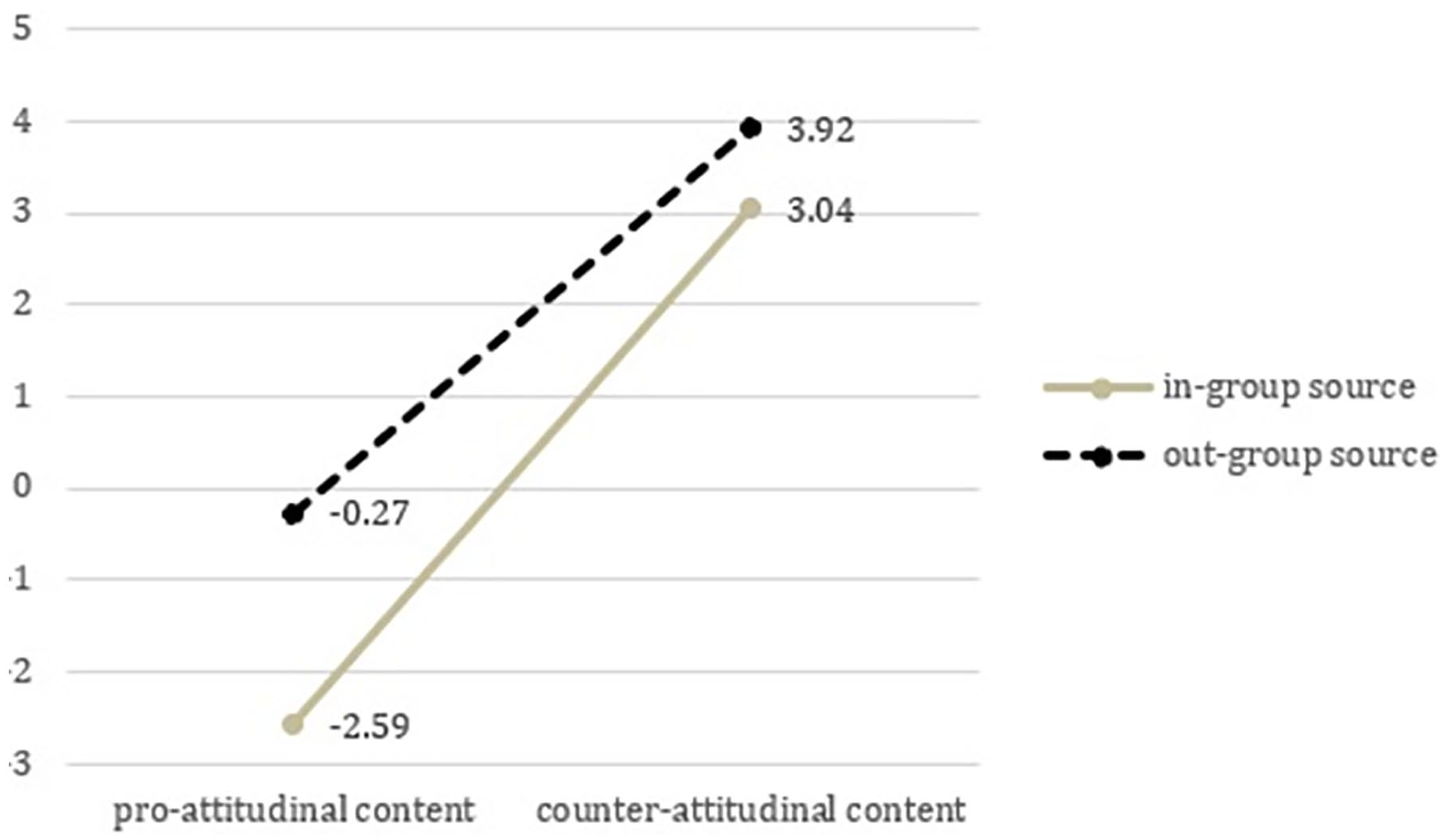
The interaction between Source and Content on the hostile media perception.

The moderated moderation of PIS on the hostile media perception.

The moderated moderation of NFC on the hostile media perception.
On the other hand, data showed a significant positive three-way interaction consisting of content, source, and NFC: B = 0.80, SE = 0.40, p = .050, 95% CI = [0.00, 1.59] (see the last column in Table 1). The results of conditional two-way interactions indicate that the content-source interaction was significant for those low (Effect = −2.55, F(1, 314) = 10.71, p = .001) and moderate in NFC (Effect = −1.38, F(1, 314) = 6.92, p = .009). However, the interaction was not significant for the high NFC participants (Effect = −0.39, F(1, 314) = 0.27, ns).
To summarize, the baseline pattern of content-source interaction (i.e., the effect of news slant on HMP diminishing when the news source is out-group) is more pronounced when PIS is high (RQ2) and NFC is low or moderate (RQ3).
Discussion
Building on and extending previous research, this study investigates whether and, if so, how partisan slant in news content and partisan source cue interact in the process of HMP. Although the two message characteristics have been studied as factors influencing the occurrence of HMP, little is known about how the two interact (cf. Gunther et al., 2017). To begin with, the results of our experiment confirm the findings of previous studies that HMP is induced by slant in news content (Gunther et al., 2012) as well as by partisan source affiliation (Reid, 2012). Specifically, consistent with past work, stronger HMP was observed for counter-attitudinal news, as compared to pro-attitudinal news. Also, HMP was stronger when news was from an out-group source than from an in-group source. As a next step, we tested if content and source interact and found a significant interaction. That is, content effect (i.e., differential HMP between pro- and counter-attitudinal messages) was greater in the in-group source condition than in the out-group source condition. Additionally, the content-source interaction was more pronounced for participants with higher levels of PIS and those with lower levels of NFC.
The pattern of interaction between content and source sheds light on how partisan viewers process and respond to slanted messages delivered by partisan news outlets. For example, when an in-group source praises an out-group’s position, partisans overestimate the degree of bias against their side. Perhaps, this occurs because viewers take it as an unexpected betrayal by a news source that they believe is on their side. For partisan viewers, such news is hard to accept as partisans tend to believe that their side is superior to their opponents (Hogg & Reid, 2006; Vallone et al., 1985), and thus a way to cope with the uncomfortable situation might be to quickly reject it as seriously biased news. Also, a defensive motivation might become activated as well because such news can be viewed as internal criticism which may count as trustworthy by others and thus is harmful to the in-group. This perceived influence likely motivates partisans to strongly discredit the news. On the contrary, when an out-group source commends an out-group’s position, partisans still perceive it to be highly biased against their side but do not necessarily overestimate the bias. This is probably because such news easily confirms viewers’ expectation and does not cause serious cognitive dissonance that needs to be dealt with. Thus, their assessment may not be further influenced by the combination of news slant and source affiliation. That is, for example, a counter-attitudinal message from an out-group source does not synergistically increase HMP. Rather, HMP is amplified in response to a mismatch in which, for example, an in-group source provides news supporting an out-group position. Furthermore, the differential judgment between in-group and out-group sources could be amplified by strong in-group identification. For instance, strong partisans are more motivated to punish unexpected betrayal of the in-group source and discredit the news.
These findings seem to paint a somewhat pessimistic view about journalism and deliberative democracy in the era of politically fragmented media. The partisan audience often, if not always, turn to news outlets, known (or perceived) to be on their side, for political information (Iyengar & Hahn, 2009; Knobloch-Westerwick & Meng, 2009; Stroud, 2010). According to the results of this experiment, it may be the case that partisans would not take counter-attitudinal information seriously even when it is provided by a favored news source. They would rather deny the information and discredit it in an overreacted manner. If the partisan audience does not listen to their preferred media that provide views different from theirs, an opportunity for cross-cutting exposure is missed. Hearing the other side is beneficial (Mutz, 2002) and it could be even more so when the cross-cutting information comes through in-group sources. However, our results suggest the opposite. Furthermore, partisan viewers’ strong bias perception against counter-attitudinal messages from favored media may not only lead them to live in their own information “filter bubble” but also discourage the media system from providing cross-cutting news. These concerns become realistic when we consider the recent move toward the post-truth society (Waisbord, 2018). For example, partisans will frame counter-attitudinal news as “fake news” and blame journalists who write the news even if they have similar political beliefs. Although Trump’s presidency was over, immigration is still a pressing issue, and the pattern of polarized politics and partisan media fragmentation are increasingly more pronounced. Taken together, the aforementioned concerns still remain.
Also noteworthy is that the results of the present study, especially those about the content-source interaction, are partially different from what previous research has found. Gunther et al. (2017) found a significant positive interaction in which the content effect (pro- vs. counter-attitudinal messages) on HMP was greater when the message was from an out-group source. Yet, this interaction was found only for a certain partisan group (i.e., the “pro-teach the controversy” Discovery Institute members). No interaction between content and source was observed for the other partisan group (“pro-evolution” National Center for Science Education). The pattern of interaction in Gunther et al. (2017) differs from what we have found in the present experiment. Our data indicate a negative interaction, such that the content effect on HMP is amplified when the message is from an in-group source. This discrepancy may be due in part to research design-related differences. For example, the partisan group for which Gunther et al. (2017) found a significant positive interaction is the DI members, a group whose position (i.e., pro-teach the controversy) is relatively less prevalent than the other group’s position (i.e., pro-evolution) which “has been consistently upheld over decades of course cases, and is more accepted by the mainstream media” (p. 377). In contrast, as mentioned earlier in the method section, participants in our study were largely opposed to the president’s restrictive immigration policy, and such stance against the president’s policy was not on the minority side of the overall public opinion climate. Rather, given the visible public criticism and negative tone of media coverage about the policy at the time when this study was conducted, the partisan group against the policy might have felt that they were on the majority side. The difference in participants’ perception of relative status (minority vs. majority status) in society may be a cause of the discrepancy in results between two studies. Whether the group status in society matters for the content-source interaction on HMP needs to be tested in future research. It may also be fruitful for future studies to examine the interaction with different identities given that the same person has multiple identities. For example, news sources that prime national identity and headline slants that prime partisan identity had, respectively, a significant effect on HMP although their interaction was not (Golan et al., 2021).
In addition to the two-way interaction between partisan slant in content and partisan source cue, we tested two possibilities of three-way interaction by considering PIS and NFC, respectively, as a potential moderator of the content-source interaction. Results indicate that the pattern of the two-way interaction (i.e., the effect of news slant on HMP being amplified when the news is from an in-group source) is more pronounced when PIS is high and NFC is low. These findings speak to the relevance of considering audience characteristics in HMP research. Among many individual differences, PIS and NFC are particularly important as both have to do with partisan thinking and reasoning which is the central mechanism in HMP. High PIS can easily translate into defensive motivation and directional reasoning when in-group identity is threatened by counter-attitudinal news from an in-group source. In contrast, however, when exposed to slanted news from a partisan source, the partisan audience with high NFC likely engages in thorough information processing and reasoning, being less swayed by defensive motivation and partisan reasoning. This is probably why PIS and NFC were found to moderate the content-source interaction in opposite directions. Previous research has looked into audience- and content-related moderators in HMP, including involvement (Choi et al., 2009; Perloff, 1989), social identity (Ariyanto et al., 2007; Matheson & Dursun, 2001; Reid, 2012), and reach (i.e., the expected size of audiences influenced by messages: Gunther & Liebhart, 2006; Gunther & Schmitt, 2004). Our results also add to a more nuanced understanding of HMP in the increasingly fragmented contemporary media environment.
This study has some limitations. First, this study did not include the neutral condition because the primary focus was on how partisan viewers assess news bias when exposed to explicit biases in both content and source. Although relevant in the context of partisan media, it is also desirable to extend the research design by including neutral conditions with two-sided coverage and an unbiased source because a neutral condition may serve as a baseline (e.g., Golan et al., 2021; Gunther et al., 2017).
Second, all participants were college students recruited from undergraduate courses in a university in the western United States. Although common in experimental research, using college undergraduates at any particular college in a certain location as participants requires caution in interpreting the results. One limitation we acknowledge is that our participants were skewed as opposed to the overall population in their initial position on the issue employed in this study (i.e., immigration) above and beyond any possible unique qualities of American college students in terms of socioeconomic background. Although various dispositional and cognitive factors (i.e., party identification, issue involvement, and knowledge) were controlled as a further safeguard in addition to randomization, the skewness could potentially influence the results reported in this study. In addition, college students are often less politically motivated and partisan than the population. For a more generalizable conclusion, future research should use a broader sample beyond undergraduates at a certain college.
Third, this study employed a single issue in a certain context (i.e., immigration under Trump’s presidency). Although the specific context was appropriate to test our theoretical rationales (e.g., political identity priming and intergroup conflict), it might lead to idiosyncratic results. Furthermore, other countries that adopt different media systems than that of the US would have different results (e.g., North and Central Europe countries: Hallin & Mancini, 2004). Future studies should test the hypotheses in different contexts to enhance generalizability.
Last, we acknowledge that we cannot draw a firm conclusion about the theoretical underpinnings behind the content-source interaction in HMP from a single experiment. We proposed three possibilities regarding the interaction and found one of the three proposed patterns to be the case in the context of our experiment. Yet, the theoretical assumptions on which the interaction pattern observed is based (e.g., self-categorization, social judgment, defensive motivation, motivated reasoning, and so on) still remain unexamined. Future research should test these theoretical mechanisms. This work is only one of few attempts toward theorizing the interaction between partisan slant in news content and partisan source cues on HMP.
Footnotes
Appendix
The Effects of Biased Source and Content on the Hostile Media Perception (ANOVA).

| df | F | p-Value | Partial η2 | |
|---|---|---|---|---|
| Predictors | ||||
| Source | 1 | 36.58 | <.0001 | .103 |
| Content | 1 | 350.38 | <.0001 | .524 |
| Source × Content | 1 | 7.47 | .007 | .023 |
| Covariates | ||||
| Party identity | 1 | 0.75 | .39 | .002 |
| Issue involvement | 1 | 0.13 | .72 | <.0001 |
| Issue knowledge | 1 | 3.34 | .07 | .010 |
| Error | 318 | (5.54) | ||
Note. n = 325. The number in the parenthesis is MSE.
With regard to a two-way interaction between source and content, we ran an analysis of covariances (ANCOVA). Regarding H1, news from an out-group source (Madj = 1.83) was perceived more unfavorable than news from an in-group source (Madj = 0.23). Regarding H2, counter-attitudinal news (Madj = 3.48) resulted in greater HMP than pro-attitudinal news (Madj = −1.43). In addition, a difference between pro-attitudinal and counter-attitudinal news was larger when it came to an in-group source (Difference = 5.62) than an out-group source (Difference = 4.18). In summary, the results of H1, H2, and RQ1 are identical to those in the main text.
Declaration of Conflicting Interests
The author(s) declared no potential conflicts of interest with respect to the research, authorship, and/or publication of this article.
Funding
The author(s) received no financial support for the research, authorship, and/or publication of this article.
Ethical Approval
This study received approval from the IRB at the University of California, Davis (IRB ID: 1349953-1).
