




Abstract
Motor development is affected by maturation and growth but also influenced by the specific environmental and cultural context. Therefore, cross-cultural research can provide information about how different cultural contexts, lifestyles, and physical activity contexts can influence the process of developing motor competence. The purpose of this study was to evaluate aspects of motor competence among children from different cultural backgrounds. The sample of 463 children from 6 to 8 years consisting of 132 Greek children (52.3 % boys), 126 Italian children (53.9 % boys), and 205 Norwegian children (52.7) completed the Test of Motor Competence (TMC) including two fine motor tasks—Placing Bricks and Building Bricks—and two gross motor tasks—Heel to Toe Walking and Walking/Running in Slopes. The results indicate that the Norwegian children performed better in all tests; the differences were statistically significant in all four tasks compared with Italian children and in two tasks compared with the Greek children (Building Bricks and Heel to Toe Walking). Greek children performed significantly better than the Italians in two tasks: Placing Bricks and Heel to Toe Walking. Italian children were significantly faster than the Greek ones in one task: Walking/Running in Slopes. The differences in terms of levels of basic fine and gross motor skills between children from the different countries may be a consequence of both different physical activity contexts and cultural policies, attitudes, and habits toward movement.
Introduction
Motor competence can be conceptualized as an individual’s level of performance when executing different motor acts (Burton & Rodgerson, 2001; Henderson & Sugden, 1992) The term encompasses both fine motor skills/activities, the coordination of small muscle movements such as the fingers, and gross motor skills/activities, which involve the coordination of large muscle groups, and whole body movements (Haga, 2008; Sigmundsson, Lorås, & Haga, 2016). Perspectives from dynamical system theories suggest that the individual is a dynamic system in which the motor behavior changes over time as a result of the interaction of multiple intrinsic (such as muscle strength and brain plasticity) and extrinsic (including environmental conditions or the specific requirements of the movement task or action) factors (Smith & Thelen, 2003; Thelen & Smith, 1994). Haywood and Getchell (2014) define the process of motor development as the “continuous, age related process of change in movement, as well as the interacting constraints (or factors) in the individual, environment, and task that drive these changes” (p. 5). Based on this view, development of motor competence is not only dependent on and affected by growth and maturity but also influenced by the specific environmental context (Thelen & Smith, 1994; Venetsanou & Kambas, 2010). For example, the process of developing the motor milestone crawling involves both intrinsic factors such as necessary strength in the shoulder girdle and hips and extrinsic factors like possibilities for stimuli and experience that improves the infant’s competence in executing the best movement strategy.
An increased amount of evidence indicates that motor competence is associated with multiple aspects of health during childhood (Robinson et al., 2015). It is found to be related to the likelihood of participation in physical activity (Holfelder & Schott, 2014; Lopes, Rodrigues, Maia, & Malina, 2011; Vandorpe et al., 2012), the overall performance on different fitness components (Cattuzzo et al., 2014; Rivilis et al., 2011; Sigmundsson & Haga, 2016), and the magnitude of excessive weight and obesity (D’Hondt, Deforche, De Bourdeaudhuij, & Lenoir, 2009; D’Hondt et al., 2011; Hendrix, Prins, & Dekkers, 2014). Low motor competence, characterized as a marked impairment in the performance of motor skills, is also found to have significant long-term effects on other aspects of development including generation of a variety of emotional, social, and behavioral difficulties (Cairney, Rigoli, & Piek, 2013; Kirby, Williams, Thomas, & Hill, 2013; Lodal & Bond, 2016). As motor competence in children is a potentially important contributor to their health and well-being, the reports of a decline in children’s motor competence for the last decades (Bardid, Rudd, Lenoir, Polman, & Barnett, 2015; Kambas et al., 2012) is worrying.
Cultural context and social and physical environmental aspects influence motor development and motor competence (Adolph, Karasik, & Tamis-Lemonda, 2010; Venetsanou & Kambas, 2010). Although the basic motor functions, including manual, postural, and locomotor skills, are commonalities in different cultures (Adolph et al., 2010), there is clear evidence that considerable cross-cultural variation in motor development exists and that the context in which a child is reared is essential (Cintas, 1989; Hopkins & Westra, 1988, 1990). Bardid et al. (2015) compared the motor competence of children, aged 6 to 8 years, from Australia and Belgium, and revealed significant cross-cultural difference in motor scores by the use of the Körperkoordinationstest für Kinder (KTK) with the Australian children displaying significantly poorer performance. The result was attributed to cultural differences in physical activity contexts, such as policies and common practices in physical education. Moreover, when compared with normed scores, both samples scored significantly worse than children 40 years ago. The authors suggested that the decline in children’s motor competence is a global issue, influenced by increasing sedentary behavior and a decline in physical activity. Even in younger children from 3 to 7 years, Belgian children had a lower performance on the Test of Gross Motor Development, Second Edition (TGMD-2) than the U.S. reference sample (Bardid et al., 2016). Chow, Henderson, and Barnett (2001) report similar findings, as Chinese children between 4 and 6 years performed significantly better in manual dexterity and dynamic balance, measured on the Movement Assessment Battery for Children, compared with American children. In contrast, the American children outperformed the Chinese children in aiming and catching tasks, possibly reflecting different experiences in the preschool period. Among children from 6 to 10 years from Hong Kong and the United States, Chui, Ng, Fong, Lin, and Ng (2007) also reports on cultural differences on manual dexterity and visual motor control all important factors for fine motor skills (measured by the Bruininks-Oseretsky Test of Motor Proficiency [BOTMP]), with children from Hong Kong performing better than the Americans. The education system may influence upon the development of motor competence in childhood (Kambas et al., 2012), through the physical activity curriculum objectives, as well as children’s opportunity to play and participate in sports and physical activity out of school (Logan, Webster, Getchell, Pfeiffer, & Robinson, 2015).
There is currently no gold standard to measure and survey children’s motor performance (Rudd et al., 2016). Nor is there any agreement on which test battery is most appropriate and sufficiently sensitive to illuminate cultural differences (Bardid et al., 2015). Many of the tests are designed to identify special groups with functional problems and limitations, that is, to identify children with motor difficulties, such as the Movement Assessment Battery for Children (Henderson, Sugden, & Barnett, 2007) and TGMD (Ulrich, 2000). One limitation of such tests is that they are not sensitive in both ends of the scoring scale and that ceiling effects may occur. The choice of assessments is highly influenced by the general approaches toward understanding the complexity of motor behavior (Rudd et al., 2016). Different interpretations, definitions, and operationalization of these theoretical constructs of motor performance have influenced the development of test instruments (Larkin & Cermak, 2002), which thereby measure distinct aspects of movement competence (Rudd et al., 2016). Test of Motor Competence (TMC; Sigmundsson et al., 2016) was selected for this study. TMC is designed to be quantitative, simple to administer, applicable for large-group testing, and reliable to assess motor development, both fine and gross motor skills. Compared with many other product-based tests, it is sensitive in both ends of the distribution, that is, providing both above and under average scores. As stated by Bardid et al. (2015), cross-cultural differences should be investigated in all fundamental movement skills, included fine and gross motor skills.
Gender differences in motor competence are often found; however, they are not consistent and the differences appear in different domains. Boys are performing better in ball skills but inferior in manual dexterity compared with girls (Vedul-Kjelsås, Stensdotter, & Sigmundsson, 2013).
Knowledge about general principles of motor development can be applied into education and therapeutic settings (Adolph et al., 2010; Bardid et al., 2015). Cross-cultural research can also provide valuable information about variations in motor development and physical activity behavior in different environments and contexts. This can expand our understanding on how social and physical environments influence children’s opportunities to maintain healthy lifestyles. In this article, we address the following question: Are there cross-cultural differences in fine and gross motor performance between children from Greece, Italy, and Norway, and how are they related to gender? Based on the physical activity curriculum objectives in these countries in addition to the knowledge that about 78% of young children participate in organized sports and physical activity in Norway, it is possible to hypothesize that the Norwegian children may have better motor competence than Greek and Italian children.
Materials and Methods
Participants
The study was conducted in accordance with the Declaration of Helsinki and was issued by and carried out according to the rules of the Norwegian Centre for Research Data in Norway.
The study was accepted and supervised by the Laboratory of Adapted Physical Activity/Developmental and Physical Disabilities of the Department of Physical Education and Sport Science, National and Kapodistrian University of Athens, Greece, and by the Ethic and Scientific Committee of the Associazione Laboratorio 0246 in Treviso, Italy. Before participating in the study, parents provided written consent.
The sample was a convenient sample, and the participants were recruited from three mainstream primary schools in Norway, from schools of the Athens area in Greece and from schools in Treviso, Italy. In all cases, samples included children from a wide range of socioeconomic backgrounds; none of the participating children had any behavioral, neurological, or orthopedic problem or experienced any learning difficulties. The total sample consisted of 463 children with similar and balanced gender distribution.
Test Items and Materials
The test battery, TMC (Sigmundsson et al., 2016), consisted of four different tasks: two were fine motor tasks based on manual dexterity and two were gross motor tasks based on dynamic balance. In all tasks, the performance measure was time to completion in seconds. The participants were given a practice run of all tasks. The TMC has an acceptable internal consistency of the test battery items, as all individual test-item scores correlated positively with the total score with correlations ranging from .48 to .64. TMC has a construct validity of 0.47 to Movement Assessment Battery for Children for 7- to 8-year old children (n = 70) and a test–retest coefficient for the total score of .87(Sigmundsson et al., 2016).
Fine motor tasks
To quantify aspects of fine motor performance, the test battery consisted of two brick handling tasks: placing bricks (PB) and building bricks (BB).
Description
Placing Bricks (PB). 18 square-shaped Duplo™ bricks are to be placed on a Duplo™ board (which has room for 3 × 6 bricks) as fast as possible. The participant is seated at a table and is given a practice run before the actual testing. The bricks were positioned in horizontal rows of three on the side of the active hand and the board held firmly with the other hand. Both hands are tested.
Building bricks (BB). 12 square-shaped Duplo™ bricks are used to build a “tower” as fast as possible. The participant holds one brick in one hand, and one brick in the other. At a signal, the participant assembled the bricks together one after one until all 12 have been put together to form a tower. Neither of the arms is allowed to rest on the table. The bricks should be held in the air all the time. The tasks were conducted with participants sitting comfortably at a table, and time was stopped when the participants released contact with the last brick. Brick handling has been used extensively in previous test batteries for motor performance (Yoon, Scott, Hill, Levitt, & Lambert, 2006).
Gross motor tasks
To quantify aspects of lower extremity motor performance, the test battery consisted of heel to toe walking (HTW) and walking/running in slopes (W/R).
Description
Heel to Toe Walking (HTW). This task is adapted from the tandem walking test (Rinne, Pasanen, Miilunpalo, & Oja, 2001; Rooks, Kiel, Parsons, & Hayes, 1997) and is considered to be a measure of dynamic balance capabilities. Participant are required to walk down a straight line (4.5 m long) marked on the floor as fast as they can place their heel against the toes of the foot in each step.
Walking/Running in Slopes (W/R). This task was an adaptation of the figure of eight test (Johansson & Jarnlo, 1991). The participant starts at the starting point. At a signal the participant walks/runs as fast as possible in a figure of 8 around two marked lines (1 meter in width). Line 1 is one meter from the starting point and Line 2 is 5.5 meter from the starting point. If the participant starts to go on the right side of the Line 1—the subject will go to the left side of line 2, turn around, and go back on the right side of Line 2 and left side line 1—and over the starting point. The time is stopped when the participant arrives the starting point. Participants freely choose which direction they walk/run. The participants were wearing suitable shoes.
General Procedures
Assessments of children were conducted in a quiet and appropriate room at the schools during normal school hours. Testing was conducted by instructors trained in the test protocol. All children were tested individually in a 1:1 setting, and the experimenter explained and demonstrated each test. Verbal encouragement and support where provided throughout the testing procedure. The whole testing procedure lasted for about 10 min.
Data Analysis
Data were analyzed by Kruskal–Wallis test, as the data were not normally distributed, followed by Dunn’s post-test using GraphPad Prism 6 software (GraphPad Software Inc., La Jolla, CA, USA); graphs were produced with Microsoft Office Excel 2007. Statistical significance was set at p < .05.
Results
The Greek population consisted of 132 children ranging in age from 6.30 to 8.70 years (mean ± SD in years: 7.58 ± 0.74 years); the Italian population consisted of 126 children (7.41 ± 0.74 years; range: 6.30-8.76 years) and the Norwegian of 205 children (7.25 ± 0.68 years; range: 6.30-8.70 years). Gender distribution was 52.3%, 53.9%, and 52.7% for boys in Greece, Italy, and Norway, respectively.
As shown in Figure 1, Norwegian children performed better in all tests; the differences were statistically significant in all four tasks compared with Italian children and in two tasks compared with the Greek ones (“Building Bricks” and “Heel to Toe Walking”). Greek children performed significantly better than the Italians in the fine motor skill task “Placing Bricks” and the gross motor skill task “Heel to Toe Walking.” Italian children were significantly faster than the Greek children in the gross motor task “Walking/Running in Slopes.” When data were split for gender (Tables 1 and 2), no statistical differences were found between gender for each nationality in each task; the only exception was seen in the “Walking/Running in Slopes” task for Greek children where the girls performed faster with p value of Dunn’s post-test of .04.

Performances of Greek, Italian and Norwegian children in the four items of TMC.
Performances of Greek, Italian, and Norwegian Boys in the Four Items of TMC.

Performances of Greek, Italian, and Norwegian Girls in the Four Items of TMC.

Most of the differences present between countries for the different test when the entire sample was considered were also maintained when gender separation was introduced in the analysis. Indeed, both boys and girls from Norway performed better in all tasks than their “Mediterranean” counterparts. The differences between groups were less pronounced when data were analyzed per gender, possibly explained by less statistical power when splitting the sample in half. Examples are the tasks Placing Bricks and Walking/Running in Slopes. In the first, the data from boys from the three countries were very similar and with no statistical differences (Figure 2a); on the contrary, in the second differences persisted regardless of gender (Figure 2b).
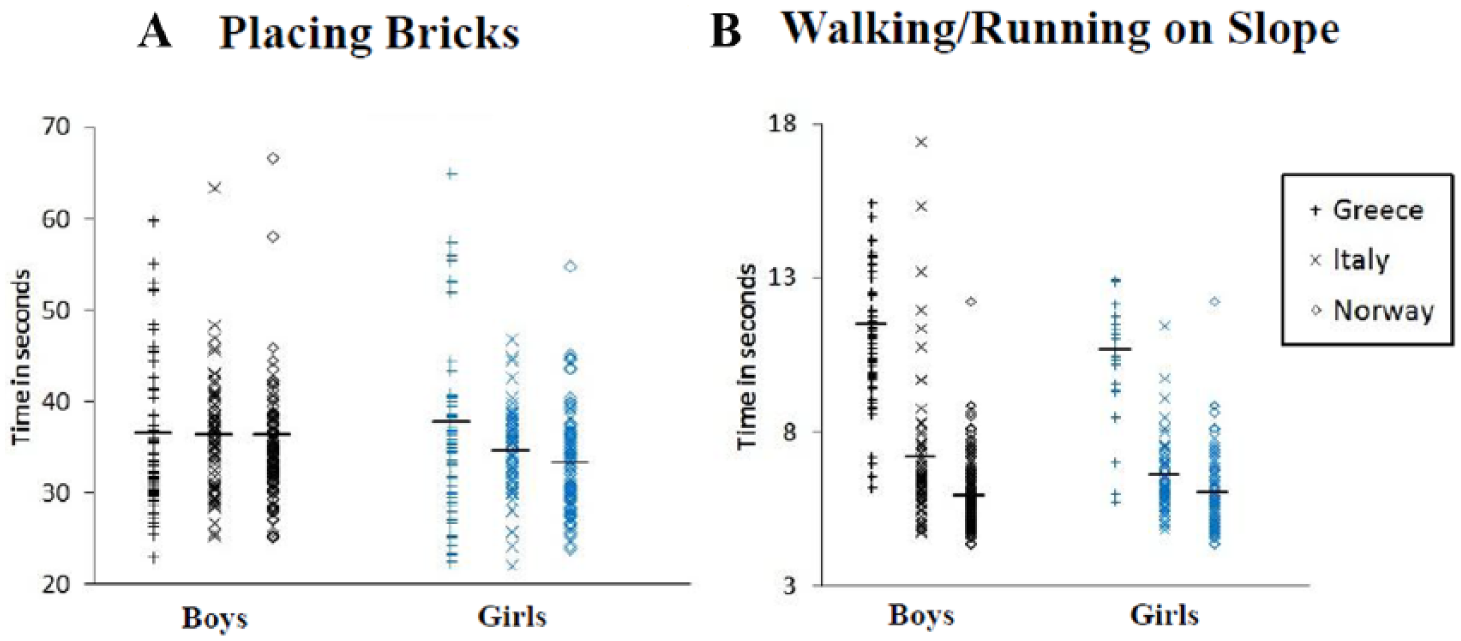
Influence of gender in performance on two items of TMC: (a) fine motor skill test Placing Brick; (b) gross motor skill test Walking/running in slope.
Discussion
Cross-cultural differences in motor competence of 6- to 8-year old children from Greece, Italy, and Norway using the TMC (Sigmundsson et al., 2016) were explored in this study. The findings of this current study indicate that the Norwegian children outperforms the Greek and Italian children on some quantitative elements of motor competence such as fine and gross motor skills including manual dexterity and balance. These results are in line with other studies revealing cross-cultural differences in motor competence between children from different cultures (Bardid et al., 2016; Bardid et al., 2015; Chow et al., 2001; Chui et al., 2007).
The Norwegian children were significantly more competent than Italian on both the fine and gross motor tasks, but only significant better than the Greek children in Placing Bricks and in Walking/Running in Slopes. The findings indicated significant differences between Italian and Greek children in one of the fine motor skills (Building Bricks). Interestingly, these two populations of children (Greek and Italian) differed also in both the two gross motor skills examined; in the Heel to Toe Walking task, Italian children performed significantly worse, whereas they were significantly faster in the task Walking/Running in Slopes. The findings may indicate the specificity of motor skill learning (Drowatzky & Zuccato, 1967; Stöckel & Hughes, 2016) and that specific movement experiences involving practice of different motor tasks are reflected by improved motor performance in these specific skills.
When data were analyzed for gender, no statistical differences were found between genders for each nationality in each test, with the only exception seen in the item Walking/Running in Slopes for Greek children where the girls performed faster (p < .05). These findings may be interpreted in favor of the test properties, that is, the different task are gender neutral. Conclusions about gender differences in motor competence are not consistent; some refer to no gender differences in manual dexterity in children between 9 and 12 years (Dorfberger, Adi-Japha, & Karni, 2009; Vedul-Kjelsås et al., 2013) and other report on differences in favor of girls at the age of 4 years (Sigmundsson & Rostoft, 2003) and in favor of boys at the age of 17 years (Dorfberger et al., 2009). It is possible to argue that some sports and activities are losing their gender-specific associations (Haywood & Getchell, 2014). Nowadays girls and boys are involved in more similar activities, such as use of electronic/online devices, which may result in marginal gender differences in motor skills in some domains (Vedul-Kjelsås et al., 2013).
Most of the differences found between countries for the different motor tasks (when the entire sample was considered) were also maintained when gender separation was introduced in the analysis. The Norwegian girls and boys performed better in all tasks compared with their “Mediterranean” counterparts. In some tasks, cross-cultural differences tend to be less prominent when analyzed on a gender basis, as in the test Placing Bricks where no significant differences were found between boys from the three countries (Figure 2A).
The differences highlighted by our study are multifactorial (Bardid et al., 2015). Anthropometric differences between children of the three nations are unlikely to be a relevant cause, even though Italian and Greek children of age 8 years or more are more frequently overweight (approximately 10% for Norwegian and >20% for the two Mediterranean populations; Wijnhoven et al., 2014). However, most of the data available in the literature indicate that body mass index (BMI) significantly relates with some, but not all, of the motor skill tests in obese children in particular. In the case of the TMC tests use in our study, no relationship was found between proficiency in any of the four tests and BMI or waist size in the Italian population of children (Figures S1 and S2 of Supplementary Material). This indicates that anthropometric characteristics of the children have little if any effect on the proficiency of the children in the four tests of TMC. Thus, the differences in motor skills revealed by our study are unlikely to be due to anthropometric reasons existing among 6- to 8-year-old children of the three nations.
Other cross-cultural differences should be considered instead. Differences in the three countries related to the educational systems and the attention given to physical activities during school time could be probable explanations. Indeed, reports show that Greece, Italy, and Norway have some quantitative differences regarding the education systems and sports culture (European Commission/EACEA/Eurydice, 2013). More specifically, Norwegian students are involved in physical activities at school (478 hr distributed from first to seventh grade) more frequently than the Greek (53 hr per year from first to sixth grade) and Italian students (no PA is planned at school till fifth grade, but the group in this study had 1 hr/week in previous 5 months). The resent study’s authors favor the hypothesis that the differences in motor competences highlighted by our study may be related to differences in physical education curriculum objectives in preschool and elementary school for each country. When investigating the physical education curricula (European Commission/EACEA/Eurydice, 2013), we observed that all European countries formally recognize the importance of physical education and sport at school and promote the acquisition of a considerable repertoire of motor skills which should contribute to the child’s overall development (physical, cognitive, emotional, and social). However, in Norway primary school students spend a higher percentage of their school program devoted to physical education than Greece and Italy (e.g., 10% of the full-time compulsory general education; European Commission/EACEA/Eurydice, 2013). Also, in Norway, besides athletics, dance, games, gymnastics, and swimming, integrated in their curricula are indoor and outdoor activities like winter sports, health and fitness, and adventure. In Italy, schools have autonomy to choose the activities they will implement, while in Greece, schools include activities that are related to the Olympic Idea (e.g., athletics, dance, games, gymnastics, and swimming; European Commission/EACEA/Eurydice, 2013). It can be argued that a PE program promoting a higher amount of physical activity is more likely to influence student’s motor competence (Bardid et al., 2016). In addition, frequency of PE classes per week as well as content and curriculum objectives could also be factors affecting the motor competence of the children (Ericsson & Karlsson, 2014; Iivonen, Sääkslahti, & Nissinen, 2011).
In the Nordic countries (like Norway and Sweden), the eco-early childhood programs (including kindergartens) emphasize the outdoor activities. Spending time in outdoor play in natural environment is found to influence physical activity and motor development in children (Fjørtoft, 2001, 2004). Outdoor activities in the natural environment for young children have become common in several countries in Europe. In Norway, they also have the legislations such as the Kindergarten Act and the Framework plan putting additional focus on body, movement, and health in the kindergarten. No similar attitude is found in the Italian National Indication for School Curricula (Stellacci et al., 2012), which only defines general aims that should be considered when monitoring child motor development.
There is a reciprocal and developmentally dynamic relationship between physical activity and motor competence; participating in physical activity promotes the development of motor skills in young children (Stodden et al., 2008). Regarding children’s participation in physical activity, Kolle, Steene-Johannessen, Andersen, and Anderssen (2010) assessed physical activity objectively by accelerometer among Norwegian 9-year-olds, reporting that 75.2% of the girls and 90.5% of the boys met the Norwegian physical activity guidelines of 60 min of moderate-intensity physical activity per day. A study assessing sedentary time and different PA intensities with accelerometer among 10- to 12-year-old children from Belgium, Greece, Hungary, Netherlands, and Switzerland found that the Greek children spent more time sedentary compared with the other children. Approximately 9.5% of the Greek boys and none of the Greek girls met the recommended PA guidelines of 60 min of moderate to vigorous intensity per day (Verloigne et al., 2012). In Norway 72% of 6-year-old children are participating in organized sports (66.2% of the girls and 77% of the boys), and at the age of 9 years, the amount has increased to 73.3% and 83.8%, respectively (Kolle et al., 2010). In this way, the findings in this study are supported by the dynamical systems view, underpinning that development of motor competence is enhanced by the specific environmental context (Thelen & Smith, 1994) including physical activity (Lopes et al., 2011; Tortella, Haga, Loras, Sigmundsson, & Fumagalli, 2016). Thus, the differences in motor competence between countries may be explained by factors such as differences in curriculum objectives and amount of time spent in different physical activities and movement experiences.
A possible limitation in this study may be the lack of anthropometric measures, such as body composition for the whole population (weight/height and BMI). Nor was any data on physical activity level measured in this study. Also, there may be some limitations of the assessment tool used (TMC) as only four motor tasks represent a picture of an individual’s motor competence.
In conclusion, the data show that differences exist between children of different countries in terms of levels of basic fine and gross motor skills. We suggest that cultural attitudes toward movement and clear indication(s) to preschools/schools concerning the relevance and the execution of physical activities experiences have a strong impact on motor skill development in children.
Supplemental Material
Supplementary_Data_Sheet_1 – Supplemental material for Cross-Cultural Aspects: Exploring Motor Competence Among 7- to 8-Year-Old Children From Greece, Italy, and Norway
Supplemental material, Supplementary_Data_Sheet_1 for Cross-Cultural Aspects: Exploring Motor Competence Among 7- to 8-Year-Old Children From Greece, Italy, and Norway by Monika Haga, Patrizia Tortella, Katerina Asonitou, Sophia Charitou, Dimitra Koutsouki, Guido Fumagalli and Hermundur Sigmundsson in SAGE Open
Supplemental Material
Supplementary_sept – Supplemental material for Cross-Cultural Aspects: Exploring Motor Competence Among 7- to 8-Year-Old Children From Greece, Italy, and Norway
Supplemental material, Supplementary_sept for Cross-Cultural Aspects: Exploring Motor Competence Among 7- to 8-Year-Old Children From Greece, Italy, and Norway by Monika Haga, Patrizia Tortella, Katerina Asonitou, Sophia Charitou, Dimitra Koutsouki, Guido Fumagalli and Hermundur Sigmundsson in SAGE Open
Footnotes
Acknowledgements
The authors thank Associazione Onlus Laboratorio 0246, Treviso, Italy, for supporting with specialized personnel data acquisition in Italy. Also we like to thank all the participating schools in the project.
Authors’ Note
Monika Haga, Patrizia Tortella, and Hermundur Sigmundsson have contributed equally to this work.
Declaration of Conflicting Interests
The author(s) declared no potential conflicts of interest with respect to the research, authorship, and/or publication of this article.
Funding
The author(s) received no financial support for the research, authorship, and/or publication of this article.
Author Biographies
References
Supplementary Material
Please find the following supplemental material available below.
For Open Access articles published under a Creative Commons License, all supplemental material carries the same license as the article it is associated with.
For non-Open Access articles published, all supplemental material carries a non-exclusive license, and permission requests for re-use of supplemental material or any part of supplemental material shall be sent directly to the copyright owner as specified in the copyright notice associated with the article.
