




Abstract
Psychological Capital (PsyCap) has received much attention in industrial-organizational research because it is linked to a broad spectrum of adaptive work-related outcomes. However, few studies have been conducted on PsyCap in non-Western school contexts, especially in the ethnic minority areas of Mainland China. The present study aims to validate the school PsyCap scale, examine the latent mean differences of school PsyCap across Dai and Han groups, and verify the correlation between school PsyCap and academic engagement, achievement emotions, and academic achievement in a sample of 769 Chinese school children (Han students = 249, Dai students = 520) in the seventh and eighth grades. Results demonstrated that the Chinese version of the school PsyCap scale had excellent psychometric properties. Besides, there were no significant differences in the mean level of school PsyCap between the two cultural groups of Chinese Dai and Han. However, the multi-group second-order CFA model showed that the mean level of Dai students’ resilience was lower than that of Chinese Han. The findings also showed that school PsyCap has positive predictive effects on optimal academic outcomes (i.e., academic engagement, enjoyment, and academic achievement) but negatively affect boredom. This study enriches the understanding of school PsyCap from a cross-cultural perspective. Both theoretical and practical implications are discussed.
Keywords
Introduction
Psychological capital is centered on the positive psychological force of human beings, which has positive significance for enhancing an individual’s competitive advantage (F. Luthans et al., 2004). Generally, individuals with a high level of PsyCap would be more confident when facing challenges, persevering toward goals, and sustaining or even bouncing back until they succeed (F. Luthans et al., 2007). That is, PsyCap is a complex of multiple psychological resources (i.e., self-efficacy, optimism, hope, and resiliency), and the development of this psychological state is of significance to individual success (F. Luthans et al., 2005, 2006).
PsyCap has been extensively studied in industrial-organizational contexts, and a growing number of studies have been conducted in Western school-related contexts. However, its effectiveness has rarely been studied in non-Western contexts, especially in the ethnic cultural areas in Mainland China. Most of the existing studies have taken adult employees as participants to explore the validity of the PsyCap scale and the predictive effect of this construct on employees’ success and well-being (e.g., Avey, Wernsing, & Mhatre, 2011; Culbertson et al., 2010; F. Luthans et al., 2006). The four components of the PsyCap construct have been discussed in the educational context. However, quite a few studies have explored the PsyCap construct in educational domain (King & Caleon, 2021), even though the combination of these four components would exert synergistic effects (F. Luthans et al., 2015). In addition, fewer studies are exploring the validity of the PsyCap scale and its relevance to educational outcomes in the school contexts in ethnic minority areas. This study took the Dai and Han secondary school students in the Dai cultural region as participants to explore the validity of the PsyCap scale and the predictive effects of PsyCap on the educational outcomes of achievement emotions, academic engagement, and academic achievement.
The primary purpose of the present study is to verify the validity of the school PsyCap scale in the cultural contexts of Chinese Dai and Han and, on this basis, to compare the school PsyCap level of students from these two cultural groups. Secondly, the predictive effects of school PsyCap on achievement emotions, academic engagement, and academic achievement were verified and compared. Given that the PsyCap construct originated in the Western industrial-organizational context (F. Luthans et al., 2004), verifying whether this scale is valid in Chinese Dai and Han is vital before all else. Besides, whether school PsyCap may predict school-related outcomes (e.g., achievement emotions, academic engagement, and performance) in non-Western contexts (c.f. Chinese Dai and Han) needs to be tested as prior studies have demonstrated the cross-cultural differences in perceived competence, achievement emotions, behavior, and academic performance between Western and non-Western cultural cultures (e.g., Datu & Yang, 2021; Frenzel, Thrash et al., 2007; Zhu & Leung, 2011).
The present study was carried out in Xishuangbanna Dai Autonomous Prefecture (hereafter referred to as Xishuangbanna), located in the far southwest of Yunnan province, China (situated between 21°08′ N and 22°36′ N, between 99°56′ E and 105°50′ E). The Xishuangbanna border connects with Myanmar and Laos, which is also very close to northern Thailand. Here, the Theravada Buddhist Culture (TBC) prevailing in Southeast Asia and the mainstream Chinese Confucian Heritage Culture (CHC) coexist and clash with each other (Davis, 2003; N. Y. Wong, 2008). As the representatives of CHC, the Chinese Han students have been criticized as passive, repetitive, and superficial learners despite their efforts (Kennedy, 2002; Tran, 2013). Chinese Dai mainly gathers in Xishuangbanna. As an ethnic minority in China, the Dai students are deeply influenced by the TBC, and their educational attainment lags behind their Han counterparts (Hannum & Wang, 2012; Yang et al., 2015). Are there differences in key learning-related outcomes such as achievement emotions, academic engagement, and achievement between these two groups of students? If yes, knowing the antecedents (e.g., school PsyCap) of learning-related outcomes would be of great significance to educational practice, especially in minority areas.
Literature Review
School Psychological Capital
Compared with the traditional economic capital, social capital, and human capital, PsyCap is measurable, manageable, and open to development (F. Luthans et al., 2004), and thus its positive role has attracted more and more scholars’ attention both in industrial-organizational and school contexts (Datu et al., 2018; King et al., 2020; Newman et al., 2014). Briefly, PsyCap refers to an individual’s positive psychological state of development when completing a task ( F. Luthans et al., 2007). Similarly, we use school PsyCap to refer to the psychological development of students in the process of completing academic tasks in school contexts. However, as PsyCap is a formative measurement model constructed based on the synchronicity of the academic community, there are controversies about the essential characteristics, components, and synergies of the components of the PsyCap construct.
Firstly, scholars held different views on the essential characteristics of PsyCap. Trait theorists viewed PsyCap as a durable and relatively stable psychological construct acquired via individual self-investment (Hosen et al., 2003). While the state theorists held that PsyCap should be viewed as a state-like attitude toward the current tasks because PsyCap is developable, changeable, and manageable (F. Luthans, 2002; F. Luthans et al., 2007). The bundling theorists believed that PsyCap is composed of multiple components and possesses both trait- and state-like characteristics (F. Luthans et al., 2005). Given that the malleability of PsyCap and its four components are all state-like psychological forces, the essential characteristics of the PsyCap construct would be state-like that can be changed, developed, and managed (F. Luthans et al., 2007).
Secondly, the constructs that were used to represent PsyCap were also controversial. At first, the self-esteem construct was applied to represent PsyCap (Goldsmith et al., 1997). Later, the five constructs of neuroticism, extraversion, openness, agreeableness, and conscientiousness were used to represent PsyCap (Letcher & Niehoff, 2004). Recently, the PsyCap construct composed of Scheier and Carver’s (1985) optimism scale, Snyder et al.’s (1996) hope scale, Wagnild and Young’s (1993) resilience scale, and Parker’s (1998) self-efficacy scale was adopted to measure individuals’ PsyCap. It has become a consensus to use the four components of hope, self-efficacy, optimism, and resilience to represent PsyCap (F. Luthans et al., 2007). Besides, the application scope of the PsyCap, which is described by the four components of hope, self-efficacy, optimism, and resilience, has also begun to expand from industrial-organizational to school contexts (King & Caleon, 2021; King et al., 2020).
Thirdly, the calculation models of PsyCap in the existing studies differed. Though the four components of hope, self-efficacy, optimism, and resilience were used to describe PsyCap, three competing models coexist to calculate PsyCap. The unidimensional model treated all the items of the four subscales as observational variables (Li et al., 2014), the four-factor model viewed the PsyCap construct as four interrelated latent factors (Datu & Valdez, 2016), and the hierarchical model held that the (school) PsyCap was a second-order construct underpinned by its four first-order components of hope, self-efficacy, optimism, and resilience (Datu et al., 2018; King et al., 2020). Taking the secondary school students in Singapore as participants, King and Caleon (2021) compared the model fit of these three models and found that the hierarchical model of (school) PsyCap has the best fit. Given the coexistence of three competing models, more research is needed to verify which model is best for calculating school PsyCap.
School PsyCap and Academic Engagement
Students’ academic engagement in the classroom contains a variety of dimensions, including behavioral engagement (e.g., taking part in classroom activities), cognitive engagement (e.g., self-adjustment or solving academic problems strategically), and emotional engagement (e.g., responding positively to academic tasks) (Fredricks et al., 2004). Although the three dimensions of academic engagement were considered to interact with each other (Fredricks et al., 2004), and the measurement research on academic engagement has begun to distinguish these three subtypes (Betts et al., 2010). However, studies suggest that behavioral engagement, which concerns students’ persistence, focus, questioning, and discussion in the classroom (Cooper, 2014; Fredricks et al., 2004), has a direct impact on academic achievement (Gregory et al., 2014; Lee et al., 2016). This study took behavioral engagement to characterize academic engagement. That is, the more students actively take part in classroom activities, the more knowledge they may learn.
Previous studies conducted in industrial-organizational contexts argued that employees’ PsyCap is positively correlated with adaptive work outcomes such as well-being (Avey, Wernsing, & Mhatre, 2011), employee attitude, and performance (Avey, Reichard et al., 2011). Recently, studies have begun to explore the validation of the PsyCap construct in an educational context (King & Caleon, 2021) and their correlation with variables of study engagement and intrinsic motivation (Siu et al., 2014), subjective well-being (Datu & Valdez, 2016), academic coping (Kirikkanat & Kali, 2018), and academic performance (B. C. Luthans et al., 2012; Ortega-Maldonado & Salanova, 2018). However, except for the Philippines, most existing studies were conducted in the Western context, and few have focused on the Chinese context, especially the minority cultural contexts in China’s frontier areas. Besides, the domain specificity of academic engagement (e.g., Green et al., 2007; Martin, 2008) indicates that academic engagement should be explored in a particular subject area (e.g., mathematics). In this study, we focused on mathematics education in the ethnic minority area of Yunnan Province, China. Therefore, based on the results of previous empirical studies, this study drew the first hypothesis:
School PsyCap and Achievement Emotions
Existing studies verified the correlation between school PsyCap and achievement emotions. For example, Carmona–Halty et al. (2019) found that school PsyCap positively affected positive achievement emotions among Chilean high school students. Further, positive emotions partially mediated PsyCap and well-being (Avey, Wernsing, & Mhatre, 2011), which means that PsyCap is also positively associated with positive emotions in American college seniors’ organizational behaviors. Studies on the correlation between PsyCap and academic emotions were mainly carried out in a Western context and only discussed the positive emotion with the negative emotions untouched. According to the control-value theory, students’ control and value appraisals are the proximal determinants of various achievement emotions, including enjoyment, hope, pride, hopelessness, shame, anger, boredom, anxiety, and relief (Pekrun, 2006). This study focused on enjoyment and boredom for two reasons. First, enjoyment is a positive emotion, and boredom is a negative emotion. Second, enjoyment and boredom are the two most frequent and intense emotions students experience in learning (Goetz et al., 2007; Putwain et al., 2018). Meanwhile, achievement emotions are domain-specific (Goetz et al., 2011), and students would experience various emotions in achievement-related situations (Goetz et al., 2012). In the present study, we addressed the mathematics-related achievement emotions and drew the second hypothesis:
School PsyCap and Academic Achievement
Existing studies highlighted the positive correlation between school PsyCap and academic achievement in school contexts (Carmona–Halty et al., 2019; Datu et al., 2018). It should be noted that academic achievement in the existing studies refers to the average score of multiple subjects (e.g., mathematics and language), which implies that the previous studies were not domain-specific. However, academic engagement, achievement emotions, and academic achievement are domain-specific (Alexander & Judy, 1988; Goetz et al., 2006, 2011; Green et al., 2007; Ouweneel et al., 2014). There are disciplinary differences in students’ academic engagement, achievement emotions, and academic achievement. Therefore, it is necessary to identify the subject domain when examing academic engagement, achievement emotions, and academic achievement. Given that this study concentrated on mathematics education in the ethnic minority area of Mainland China, the possible correlations between school PsyCap and the mathematical achievement of secondary school students were also examined. The third hypothesis is:
Aims of the Present Study
In addition to testing the above three research hypotheses, the validation of the school PsyCap Scale and the cultural differences in the predictive effects of school PsyCap on mathematics-related achievement emotions, academic engagement, and academic performance were also examined. In total, the present study has three main objectives. The first objective was to verify the validity of the school PsyCap scale among Dai and Han secondary school students in China, which would lay the foundation for the subsequent measurement and comparison of school PsyCap across Dai and Han groups. The second objective was to know whether there are significant latent mean differences in school PsyCap across Dai and Han groups. The third objective was to test the three hypotheses of this study. After the validity of the school PsyCap scale was verified in Dai and Han groups, how school PsyCap would predict the outcomes of achievement emotions, academic engagement, and academic achievement was explored in Dai and Han groups.
Given that the demographic variables of gender and age could affect achievement emotions (Frenzel et al., 2007), academic engagement (Watt et al., 2012), and academic achievement in mathematics (DiPerna et al., 2005), both gender and age were entered as covariates in examining the relationship between school PsyCap and achievement emotions, academic engagement, and academic achievement in mathematics education.
Methods
Participants
The participants were 769 Chinese Dai and Han secondary school students in the seventh and eighth grades. The participants came from a middle school in Xishuangbanna Dai Autonomous Prefecture, a major gathering area of the Dai ethnic group in China. Among them, 520 were Dai students (male n = 259, female n = 261; mean age = 13.07, SD = 0.73), and 249 were Han students (male n = 138, female n = 111; mean age = 13.17, SD = 0.76). Han students are greatly influenced by the CHC in their learning process (Leung, 2001; Watkins & Biggs, 2001) and they were treated as the representatives of CHC in this study. While the Dai students in Xishuangbanna are deeply influenced by the TBC (Davis, 2003), the present study regarded the Dai students as the representatives of TBC.
The questionnaire survey was conducted in Menghan junior high school for two reasons. First, Menghan junior high school is the only junior high school in Menghan Town, Xishuangbanna, China. Second, the preliminary investigation found that Dai and Han people are the two main ethnic groups in Menghan Town and Dai culture is rich and rarely sinicized. All seventh- and eighth-grade students were invited to participate in the survey. The participants and their mathematics teachers provided written informed consent before conducting the questionnaire survey. Besides, verbal informed consent was also obtained from participants’ parents or legal guardians.
Procedure
The scales of school PsyCap, achievement emotions, and academic engagement were all translated from English into Chinese and backtranslated by bilingual researchers to ensure the survey would have equivalence both in English and Chinese versions. Then, the wording of some items was reviewed and revised to adapt to the participants’ cognitive ability levels. The survey took about 30 min. Participants completed this survey in mathematics class under the guidance of their mathematics teachers.
Measures
Mathematics-Related School PsyCap
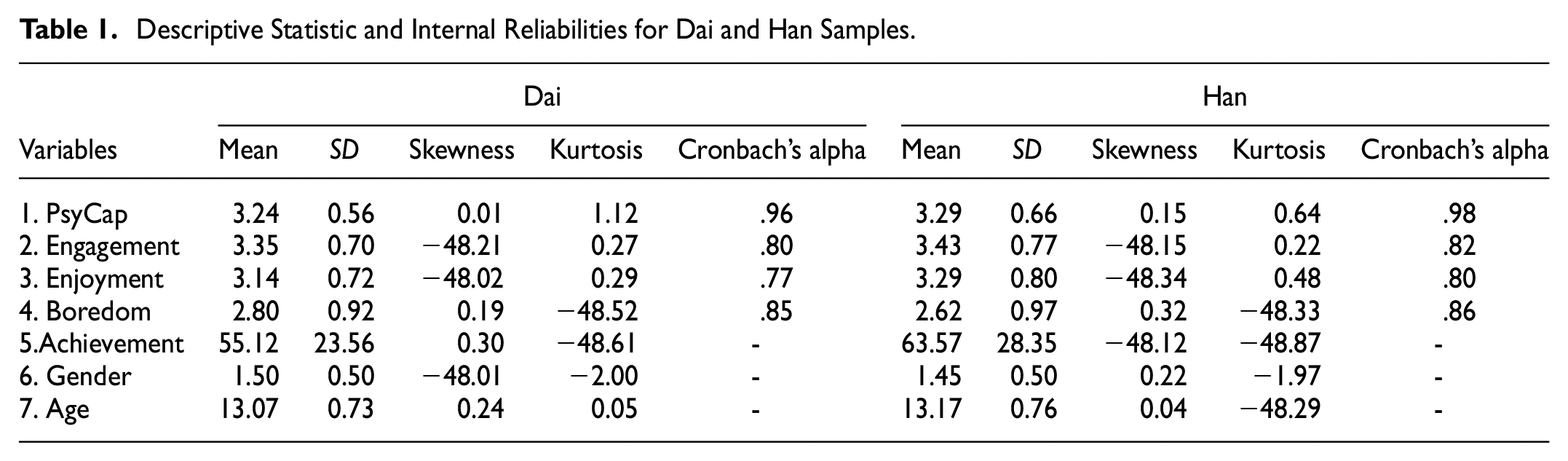
The 15-item Chinese version of the school PsyCap scale was adapted from King and Caleon’s (2021) School PsyCap Scale. The school PsyCap scale was first adapted to assess secondary school students’ mathematics learning. Then the mathematics-related school PsyCap scale was translated into Chinese. The 15-item Chinese version of the school PsyCap scale was composed of four subscales: (1) Hope subscale (e.g., “if I have problems in mathematics learning, I could think of many ways to solve them.”), (2) Self-efficacy subscale (e.g., “I feel confident that I can learn what is taught in mathematics class.”), (3) Resilience subscale (e.g., “I think I am good at dealing with academic pressures on mathematics.”), and (4) Optimism subscale (e.g., “I always look on the positive side of things in learning mathematics.”). The school PsyCap was measured using a 5-point Likert scale (1 = strongly disagree to 5 = strongly agree). The reliability and validity of this scale have been verified in existing literature (Kang & Wu, 2022; Kang et al., 2021), and the internal consistency of this scale was also acceptable in both ethnic groups (see Table 1).
Descriptive Statistic and Internal Reliabilities for Dai and Han Samples.
Academic Engagement
The academic engagement was measured by the four-item behavioral engagement that was adapted from Skinner and colleagues’Engagement and Disaffection Scale (Skinner et al., 2009). Participants responded to items (e.g., “I try hard to do well in mathematics class.”) on a 5-point Likert scale. The internal consistency of this scale was acceptable both in Dai and Han groups (see Table 1).
Enjoyment and Boredom in Learning Mathematics
The achievement emotions of enjoyment and boredom in mathematics were measured using the respective class-related scales from the Achievement Emotions Questionnaire-Mathematics (Pekrun et al., 2011). Both mathematics-related enjoyment (e.g., “I enjoy my mathematics lessons.”) and mathematics-related boredom (e.g., “I think that mathematics lessons are boring.”) were measured using four items. These two scales’ internal consistency was acceptable in Dai and Han groups (see Table 1).
Academic Achievement
The present study collected participants’ final mathematics exam scores (0–100 points) to represent their mathematics academic achievement. The mathematics examination papers were uniformly assigned by the Education Bureau of Xishuangbanna Dai Autonomous Prefecture, and the results can faithfully reflect participants’ mathematics academic achievement. The higher the score, the higher the participants’ academic achievement in mathematics.
Data Analysis
Data were analyzed using latent structural equation modeling (SEM) with Mplus 8.0 (Muthén & Muthén, 2017). Given that the psychometric properties of the school PsyCap scale were not assessed in Dai and Han groups and three competing models of school PsyCap coexist (i.e., the unidimensional model, the four-factor model, and the hierarchical model) (Datu & Valdez, 2016; King & Caleon, 2021; King et al., 2020; Li et al., 2014), detailed item analyses and a series of confirmatory factor analysis were firstly conducted to explore the psychometric properties and the proposed model of school PsyCap. Secondly, a multi-group confirmatory factor analysis was conducted to test latent mean differences in school PsyCap across Dai and Han groups. Thirdly, the relationships between school PsyCap and academic engagement, achievement emotions, and academic achievement in Dai and Han groups were explored using SEM.
Appropriately 1.2% of the 769 samples included missing responses, and the Expectation-Maximization (EM) technique was applied to handle the missing data. The present study adopted the traditional cutoff criteria indicative of excellent and adequate cutoff to assess the model fit of all latent constructs. The cutoff values were: (1) both comparative fit index (CFI) and Tucker-Lewis index (TLI) are greater than or equal to 0.95 and 0.90, respectively; (2) root mean square error of approximation (RMSEA) ≤0.06 and ≤0.08; (3) standardized root mean square residual (SRMR) are less than or equal to 0.08 and 0.10, respectively (Chen, 2007; Hu & Bentler, 1999).
Results
Psychometric Properties of the School PsyCap Scale for the Dai and Han Samples
The psychometric properties of the school PsyCap scale for the Dai and Han samples were firstly examined, laying the foundation for the subsequent analyses. First, detailed item analyses were conducted. Second, three competing CFA models were tested to determine the factorial structure of the school PsyCap scale across Dai and Han groups.
Item-Level Analyses
Item analyses were conducted for both the Dai and Han groups, including item means and variances, distributional properties, corrected item-total correlations, and Cronbach’s alpha reliability with respective deletion of items, to examine the psychometric properties of the school PsyCap scale in these two groups. The results are shown in Tables 2 and 3, respectively.
Item-Level Analysis of the School Psychological Capital Scale in the Dai Group.

Item-Level Analysis of the School PsyCap Scale in the Han Group.
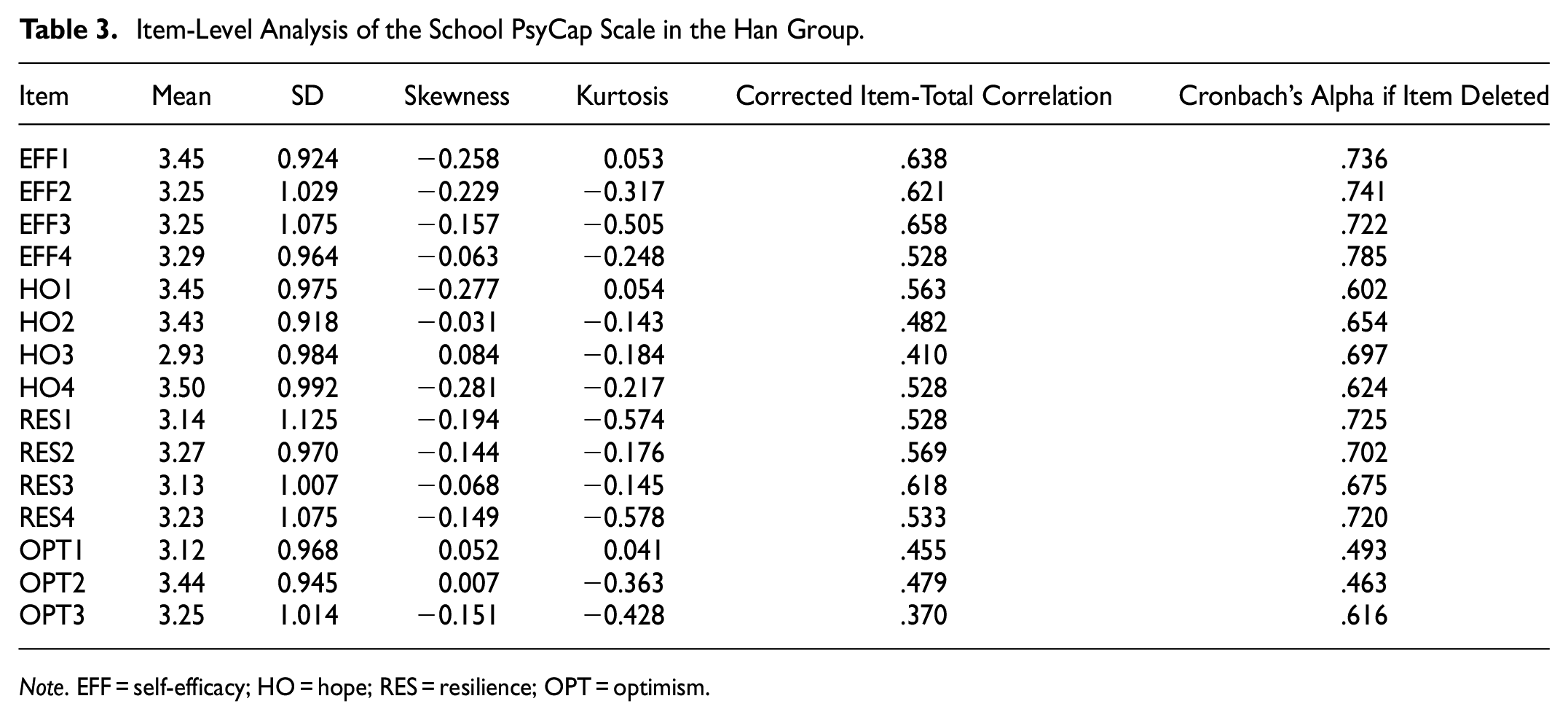
Note. EFF = self-efficacy; HO = hope; RES = resilience; OPT = optimism.
Each item’s skewness and kurtosis values were within ±2 and ±7, respectively, indicating that all the items demonstrated good normality (Finney & DiStefano, 2006). In these two groups, except for three items whose corrected item-total correlations were slightly lower than 0.40 but higher than the minimum value of 0.30 (Cristobal et al., 2007), all the rest were above 0.40. The Cronbach’s alpha reliability for the total school PsyCap scale was α = .96 for the Dai sample and α = .98 for the Han sample. The Cronbach’s alpha reliability was also examined for each of the four dimensions of school PsyCap, and the results showed that the reliability indices of all the subscales were acceptable: self-efficacy (Dai α = .79; Han α = .90), hope (Dai α = .69; Han α = .71), resilience (Dai α = .64; Han α = .77), and optimism (Dai α = .60; Han α = .68).
Then, item deletion was used to check whether it would result in Cronbach’s alpha indices for the specific subscales increasing or decreasing when one specific item was deleted. For example, when the item “If I have problems in school, I could think of many ways to solve them” was deleted, we checked whether the Cronbach’s alpha for Hope subscale would increase or decrease. This procedure was conducted for each of the 15 items of the school PsyCap scale for both Dai and Han samples. The results indicated that deleting any item would decrease Cronbach’s alpha reliability for both samples.
Confirmatory Factor Analysis (CFA)
A series of confirmatory factor analyses were conducted to check the psychometric properties of the school PsyCap scale. Three competing models were conducted for each sample to check which model fits the data well. Model 1 was a unidimensional model that posited all 15 items loaded on an omnibus PsyCap construct. Model 2 was a four-factor model with four intercorrelated latent constructs: self-efficacy, hope, resilience, and optimism. Model 3 was a hierarchical model that posited school PsyCap as a second-order latent factor underpinned by the four first-order latent factors of self-efficacy, hope, resilience, and optimism.
As shown in Table 4, the unidimensional model was inadequate for both Dai and Han samples, while the four-factor and hierarchical models had a good fit. Although the latter two models (i.e., the four-factor model and the hierarchical model) had enough fit, this study adopted the hierarchical model for the following reasons. Previous research indicated that PsyCap is best conceptualized as a hierarchical construct (F. Luthans et al., 2007). Secondly, the target coefficient is usually used to determine whether a scale should be considered a second-order one (Marsh & Hocevar, 1985). The ratio of the chi-square value of Model 2 to the chi-square value of Model 3 in the Dai and Han groups were 0.94 and 0.97, which indicated that the fit of the hierarchical model is significantly better than that of the four-factor model.
CFA Results of the Three Competing Models for Dai and Han Samples.

p < .001.
The results indicated that the Chinese version of the school PsyCap scale obtained good validity and reliability for both Dai and Han samples. Also, the results demonstrated that the hierarchical model of school PsyCap had the best fit for the data for both Dai and Han samples, suggesting that school PsyCap should be viewed as a higher-order latent variable underpinned by the four first-order variables of self-efficacy, hope, resilience, and optimism.
Multi-Group Second-Order CFA Model of the School PsyCap
Given that school PsyCap was viewed as a second-order latent construct for both Dai and Han samples, multi-group second-order CFA was conducted to assess the measurement invariance of the school PsyCap scale across Dai and Han groups. Subsequently, the latent mean differences of school PsyCap across Dai and Han groups were examined. Following the procedures recommended by Wang and Wang (2019), three steps were sequentially executed to test the factorial invariance in a second-order CFA model: (1) the second-order configural invariance of the school PsyCap was carried out; (2) the second-order measurement parameters were carried out, including the second-order factor loadings and intercepts of the first-order factors; (3) the invariance of the second-order structural parameters (i.e., second-order factor mean) was tested.
Second-Order Configural CFA Model
In this study, the school PsyCap was a second-order construct underpinned by its four first-order indicators of self-efficacy, hope, resilience, and optimism. In the second-order configural CFA model, the measurement and structural parameters can be freely estimated, and covariances between the residual terms of the first-order factors were all set to 0. Moreover, for model identification, intercepts of the first-order factors and means of the second-order factors were set to 0.
The results showed that the second-order configural model fits the data well: χ2 = 418.726; df = 170; p < .001; χ2/df = 2.46; RMSEA = 0.062 90% CI [0.054, 0.069]; SRMR = 0.042; CFI = 0.938; TLI = 0.923. Therefore, the results of the configural model can be used as the baseline values to which the subsequently specified restricted models are compared.
Analysis of Invariance of Second-Order Factor Loadings
The invariance of first-order factor loadings and item intercepts is the prerequisite to testing second-order factor loadings’ invariance. Thus, the following two parts aim to identify whether the first-order factor loadings and item intercepts are invariant across the two groups and check whether the second-order factor loadings are equal across the two groups.
Measurement invariance of the first-order CFA model is established if ΔCFI was smaller than 0.010, ΔRMSEA was smaller than 0.015, and ΔSRMR was simultaneously smaller than 0.030 (Chen, 2007; Cheung & Rensvold, 2002). In Table 5, ΔCFI, ΔRMSEA, and ΔSRMR all satisfy the above criteria, indicating that configural, metric and scalar invariances were established in the first-order factor of school PsyCap. That is, factor loadings and item intercepts of first-order factors were invariant across Dai and Han groups.
The Invariance of First-Order Factor Loadings and Item Intercepts.
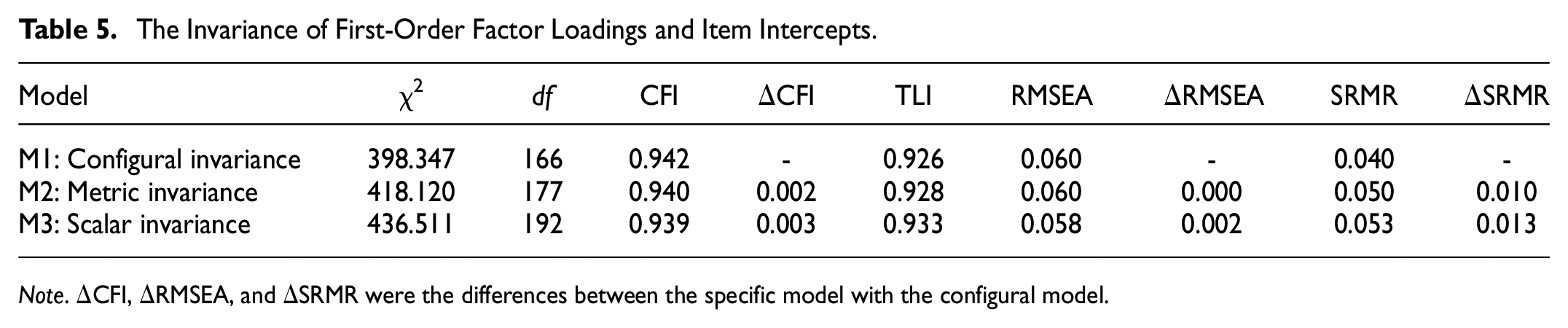
Note. ΔCFI, ΔRMSEA, and ΔSRMR were the differences between the specific model with the configural model.
After the invariance of the first-order factor loadings and item intercepts were confirmed, the relations between the four first-order factors (i.e., self-efficacy, hope, resilience, and optimism) and school PsyCap were invariant across the two samples were examined. Specifically, we imposed equality restrictions on all first- and second-order factors and then compared model fit between the current model and the second-order configural CFA models. The model fit of current model was acceptable: χ2 = 466.964; df = 199; p < .001; χ2/df = 2.35; RMSEA = 0.059 90% CI [0.052, 0.066]; SRMR = 0.057; CFI = 0.933; TLI = 0.929. Comparing with the second-order configural CFA model, we gained the following results: ΔCFI = 0.938 to 0.933 = 0.005 < 0.010, ΔRMSEA = 0.062 to 0.059 = 0.003 < 0.015, and Δ SRMR = 0.057 to 0.042 = 0.015 < 0.030. The above analyses indicated that the first- and second-order factor loadings were invariant across Dai and Han groups. Therefore, the factor mean differences across Dai and Han could be compared next.
Testing Latent Mean Differences on School PsyCap Across Dai and Han Samples
In a second-order CFA model, factor mean differences mean to test the invariance of the first-order factor intercepts and the invariance of the second-order factor means. In testing the invariance of the first-order factor intercepts, the mean of the second-order factor was set to 0, and the intercept of first-order factors was set free. This study treated the Dai group as a reference group while Han and Dai groups were compared. The estimates of the first-order factor intercepts of the Dai group were all 0, and the estimates of the first-order factor intercepts of the Han group were the group differences in the first-order factor intercepts. Since the mean of the second-order factor was fixed at 0, the differences in the intercepts of first-order factors reflected the differences in the means of the first-order factors. As shown in Table 6, the estimates of the first-order factor intercepts for Han groups were: self-efficacy (0.069, p = .239), hope (0.058, p = .275), resilience (0.107, p = .039), and optimism (0.000, p = .999), that is, the levels of resilience among Dai was significantly lower than that of Han group, but there were no significant differences for the mean levels of self-efficacy, hope, and optimism.
Testing First-Order Factor Means Invariance Across Dai and Han Groups.

Next, the difference in second-order factor means (i.e., school PsyCap) among Dai and Han groups was studied. In this procedure, the first-order factor loadings, second-order factor loadings, and first-order intercepts were equally constrained across Dai and Han groups. For model identification, some of the item intercepts were fixed to known values. In this study, we set the intercept of the last item in each of the four first-order factors (self-efficacy, hope, resilience, and optimism) in each group to know values (based on previous results). The results indicated that the estimated mean of the second-order factor school PsyCap for Han students is 0.040 (p = .177), which indicated that there is no significant difference in the school PsyCap between Dai and Han students.
In short, the results revealed that measurement invariance of the school PsyCap scale was established across Dai and Han groups, which provided the prerequisite for meaningful comparison of school PsyCap across these two groups. There were no significant differences between Dai and Han samples in school PsyCap, self-efficacy, hope, and optimism. However, the mean level of resilience of Dai students was significantly lower than that of Han students.
School PsyCap as a Predictor of Academic Outcomes
After the psychometric properties of the school psychological capital scale were established, we moved to investigate the relationships between school PsyCap and academic engagement, achievement emotions, and academic achievement in Dai and Han groups using SEM.
Descriptive Statistic and Bivariate Analysis
The Pearson correlation coefficients between school PsyCap and various indices of academic functioning are presented in Table 7. In both samples, school PsyCap was positively related to behavioral engagement, enjoyment, and mathematics achievement and negatively related to boredom. Because gender and age were significantly associated with all the measurement variables of the present study, these two variables were controlled in subsequent analyses.
Bivariate Correlations for Dai and Han Samples.

Note. The correlations above the diagonal are for the Han sample, and correlations below the diagonal are for the Dai sample.
p < .05; **p < .01.
Separate SEMs for the Dai and Han Groups
As shown in Figure 1, the Dai and Han samples’ SEM models were carried out separately. Specifically, school PsyCap as a predictor variable of behavioral engagement, enjoyment, boredom, and mathematics achievement. Gender and age were included as covariates.

School PsyCap as the predictor of academic outcomes in mathematics education.
Results revealed that the proposed model had a good fit index for the Dai sample: χ2 = 761.307; df = 386; p < .001; χ2/df = 1.97; RMSEA = 0.043 90% CI 0.039, 0.048]; SRMR = 0.046; CFI = 0.931; TLI = 0.923. The Han model showed good model fit as well: χ2 = 651.295; df = 384; p < .001; χ2/df = 1.70; RMSEA = 0.053 90% CI [0.046, 0.060]; SRMR = 0.056; CFI = 0.921; TLI = 0.911. Besides, both in Dai and Han samples, school PsyCap positively predicted mathematics-related behavioral engagement, enjoyment, and academic achievement. At the same time, the negative correlation between school PsyCap and boredom was also confirmed. The results revealed that all three hypotheses of this study were supported.
School PsyCap has a significant predictive effect on the learning-related outcomes (i.e., behavioral engagement, achievement emotions, and academic performance) in both Dai and Han groups. However, as shown in Figure 1, the predictive effects of school PsyCap on dependent variables are not consistent. First, the predictive power of school PsyCap on behavioral engagement is more potent than that of the other three dependent variables. Accurately, school PsyCap accounted for 48.2% and 62.9% of the variance in behavioral engagement levels among Dai and Han students, respectively. Second, the predictive power of school PsyCap on academic enjoyment was second only to that on behavioral engagement. School PsyCap accounted for 41.7% and 54.3% of the variance in predicting academic enjoyment among Dai and Han students, respectively. Third, the predictive power of school PsyCap on academic boredom was inferior to that of academic enjoyment. About 18.0% and 24.3% of the variance in academic boredom can be explained by school PsyCap, respectively. Lastly, school PsyCap demonstrates the lowest predictive power on academic achievement, with R-squared = 0.045 and R-squared = 0.069 among Dai and Han students, respectively.
The predictive power of school PsyCap on the learning-related outcomes exhibits cultural differences. From a comparative perspective, the predictive effects of school PsyCap on behavioral engagement, academic enjoyment and boredom, and academic achievement among Dai students are lower than those among Han students. For example, the predictive effect of school PsyCap on behavioral engagement shows that school PsyCap demonstrates a higher predictive effect on behavioral engagement for Han students (R-squared = 0.629) than the Dai students (R-squared = 0.482). Similarly, the R-squares for academic enjoyment are 0.543 and 0.417 for Han and Dai, respectively, indicating that the predictive effect of school PsyCap on academic enjoyment is higher in Han students than in Dai students. The R-squares for academic achievement are 0.069 and 0.045, showing that the predictive effect of school PsyCap on academic achievement is higher in Han students than in Dai students. School PsyCap accounted for 18.0% of the variance in academic boredom in Dai students, which is lower than Han students (R-square = 0.243).
Discussion
The present study has three main objectives. Firstly, this study adapted the school psychological capital scale (King & Caleon, 2021) and verified its validity in the school contexts of the Dai cultural region in China. Secondly, the influence of cultures (i.e., TBC and CHC) on secondary school students’ level of school PsyCap was compared. Thirdly, the predictive effects of school PsyCap on the mathematics-related educational outcomes of academic engagement, academic achievement, and achievement emotions were comparatively verified.
This empirical study demonstrated that the 15-item school PsyCap scale has good psychometric properties and is invariant across Dai and Han cultures. Further, the model fits of the unidimensional model, four-factor model, and second-order model of the school PsyCap were tested in the Dai and Han groups. The target coefficients showed that the school PsyCap should be viewed as a second-order construct underpinned by its four first-order factors of hope, self-efficacy, resilience, and optimism in TBC and CHC contexts. The finding that school PsyCap should be regarded as a second-order construct is in line with previous studies in an industrial-organizational context (F. Luthans et al., 2006) and educational literature using other Asian students (i.e., secondary school students in Singapore and the Philippines) as participants (King & Caleon, 2021; King et al., 2020). In this study, the school PsyCap scale’s validity was first examined both in TBC and CHC contexts. Besides, taking secondary school students as participants, the two cultural traditions also empirically proved the second-order structure of school PsyCap. Most PsyCap measures in the literature take the Western population, particularly North Americans, as the sample. For the validity of construct might vary across different cultures (King & McInerney, 2014), the present study contributed to the literature by widening the application scope of the school PsyCap scale to the Dai and Han cultural contexts.
The mean levels of school PsyCap across Dai and Han cultures, including first-order and second-order factors, were also compared. The multi-group second-order CFA showed that the second-order CFA model of school PsyCap demonstrates configural invariance. The first-order factors have strong measurement invariance (i.e., invariance of factor loadings and item intercepts), and the second-order factor loadings were also invariant. These measurement invariances further demonstrated the Chinese version of the school PsyCap scale’s applicability in Dai and Han cultural contexts. Except for the level of resilience, there were no significant differences in the mean level of first-order factors and second-order factor school PsyCap between the Dai and Han groups. The difference in the resilience dimension is not unrelated to the cultural values of these two student groups. To CHC students, filial piety is strongly valued (Hui et al., 2011; Hwang & Han, 2010; Leung, 1998), and achieving excellent grades has become the way for them to practice filial piety (Tao & Hong, 2014). And for TBC students, achieving enlightenment by walking the Middle Path is highly valued (Gamage, 2010), and they would rarely persevere to get good grades because ego-cling is considered the obstacle to enlightenment ( N.-Y. Wong et al., 2012). Therefore, the resilience level of TBC students is lower than that of CHC students, and the difference in cultural values plays a vital role.
The relationships between school PsyCap and educational outcomes of mathematics-related academic engagement, achievement emotions, and academic achievement were established in CHC and TBC contexts. That is, hypotheses 1 to 3 were fully supported. School PsyCap was positively related to academic engagement, enjoyment, and academic achievement, and negatively related to the negative achievement emotions of boredom. These results are consistent with the previous studies (Datu & Valdez, 2016; King & Caleon, 2021; King et al., 2020). For example, King and Caleon (2021) found that school PsyCap positively predicted engagement and positive affect and negatively predicted negative affect in the Singaporean context. According to the control-value theory, achievement emotions are domain-specific (Pekrun, 2006, 2009). In addition, academic engagement has also been proven to be domain-specific (Green et al., 2007). Unlike the previous studies, this study focused on a single subject (i.e., mathematics) and verified the correlations between school PsyCap and key learning-related outcomes (i.e., academic engagement, achievement emotions, and academic achievement) in Dai and Han cultural contexts.
School PsyCap has homogeneous predictive effects on behavioral engagement, academic enjoyment and boredom, and academic achievement in the two cultural groups, but there are distinctions in predictive power. This study provided evidence that students (Dai and Han students) with a high level of school PsyCap would experience more frequent academic enjoyment, demonstrate a higher level of behavioral engagement, achieve high academic performance, and experience a relatively low level of academic boredom. These findings are consistent with the existing literature that school PsyCap positively affects learning-related outcomes (e.g., Datu et al., 2018; Kang & Wu, 2022; King & Caleon, 2021; King et al., 2020). Furthermore, the predictive power of school PsyCap on behavioral engagement, academic enjoyment and boredom, and academic achievement among Han students are more robust than those among Dai students. The present study demonstrated that cultural factors influence the predictive power of school PsyCap on educational outcomes.
Limitations, Implications, and Conclusion
Three limitations need to be noted. First, the range of achievement emotions needs to be extended. The present study focused on the two most frequent and intense achievement emotions students may experience (i.e., enjoyment and boredom) in mathematics learning. However, the other achievement emotions such as pride, hope, relief, anxiety, shame, anger, and hopelessness (Pekrun, 2006; Pekrun & Stephens, 2010) should also be examined in the future study to have a comprehensive understanding of the relationship between school PsyCap and achievement emotions. Second, the selection range of the TBC representatives needs to be expanded to the Pan-Tai community. The present study took Dai students in Xishuangbanna Dai Autonomous Prefecture, China, as TBC representatives. However, the border areas of Southwest China and Southeast Asia (e.g., Thailand, Laos, and Myanmar) constitute a Pan-Tai community (Davis, 2003), which implies that future study needs to select TBC participants from a broader scope. Third, school PsyCap, academic engagement, and achievement emotions were measured at the same time. Although the influence of school PsyCap on the educational outcomes of mathematics-related academic engagement, achievement emotions, and academic achievement was examined, however, causal relations could not be established due to the cross-sectional design of the present study. Hence, longitudinal and intervention design studies are suggested to clarify the causal relations between school PsyCap and academic engagement, achievement emotions, and academic achievement.
This study verified the relationships between school PsyCap and academic engagement, achievement emotions, and academic achievement. The implication is that teachers and educators seeking to boost students’ academic engagement and achievement or striving increase positive emotions and decrease negative emotions in mathematics education may find that helping students to maximize the level of school PsyCap construct would be suitable for both their emotions and educational outcomes. The state-like school PsyCap is open to development (F. Luthans & Youssef-Morgan, 2017) and, when strengthened, would benefit the educational outcomes. Instructional studies indicated that providing clear expectations for students (Eley & Stallman, 2014), providing positive performance feedback (Honicke & Broadbent, 2016), and increasing students’ control and choice over their studies (Rand et al., 2020) are all effective ways to enhance students’ school PsyCap. Besides, given that the predictive power of school PsyCap on educational outcomes was culturally sensitive, educators and teachers are recommended to consider students’ cultural backgrounds when giving full play to the positive role of school PsyCap.
This study indicated that the 15-item school PsyCap scale was applicable both in the CHC and TBC contexts, and this construct was best regarded as a second-order construct underpinned by its four components of hope, resilience, self-efficacy, and optimism. Besides, no latent mean differences in school PsyCap was found between Dai and Han samples. Lastly, this study also demonstrated that school PsyCap was closely correlated with educational outcomes of academic engagement, achievement emotions, and academic achievement in mathematics education. Compared with traditional capitals (i.e., economic capital, social capital, and human capital), it is more cost-effective to boost students’ educational outcomes by enhancing their school psychological capital (F. Luthans et al., 2004). Therefore, teachers and educators would do well to promote students’ academic engagement, achievement, and positive emotions as well as alleviate students’ negative achievement emotions via the enhancement of the school PsyCap.
Footnotes
Appendix: Measurement items
Items for mathematics-related school psychological capital scale (The original version was written in Chinese)
Items for behavioral engagement scale (The original version was written in Chinese)
Items for enjoyment scale (The original version was written in Chinese)
Items for boredom scale (The original version was written in Chinese)
Acknowledgements
We would like to express our great appreciation to the principal, teachers and students who actively participated in the survey.
Declaration of Conflicting Interests
The author(s) declared no potential conflicts of interest with respect to the research, authorship, and/or publication of this article.
Funding
The author(s) received no financial support for the research, authorship, and/or publication of this article.
Ethics Statement
The present study was approved by the Human Research Ethics Committee (Reference No.: EA 2003020) of the Univerisity of Hong Kong.
