



Abstract
This study aims to reveal how different cultural values are institutionalized within platform rules, specifically by examining how the privacy policies and terms of service of six major social media platforms in China and the United States embody and shape users’ rights, obligations, and behavioral boundaries. A semantic network analysis is first employed to cluster the texts and identify the dominant values prioritized by platforms in both countries. Subsequently, Hofstede’s cultural dimensions model is applied to explore the cultural differences underlying these value orientations. Findings suggest that while both Chinese and American platforms prioritize legality and security, their focus diverges: Chinese platforms emphasize user behavior regulation, whereas American platforms emphasize sharing. Through Hofstede’s model, cultural dimensions explain these value differences, with China’s higher scores in collectivism, long-term orientation, restraint, and power distance leading to a stronger emphasis on user behavior regulation. In contrast, the U.S., characterized by higher individualism, short-term orientation, indulgence, and lower power distance, encourages user information sharing. This study not only broadens the research perspective on social media privacy policies and terms of service through comparative analysis but also extends Hofstede’s framework into the context of the platform society and develops a dynamic “Hofstede–Values” model. In practice, the findings provide insights for transnational platform managers to formulate more targeted global strategies and contribute to safeguarding the common interests of humanity in the digital age.
Plain Language Summary
This study compares the privacy policies and terms of service of six social media platforms from China and the U.S., analyzing the values reflected in their texts. Using Hofstede’s cultural dimensions model, the study dissects these values. Findings suggest that both countries prioritize legality and security, with China emphasizing user regulation and the U.S. focusing on sharing. Additionally, through Hofstede’s model, the differences in cultural dimensions elucidate the disparities in values, constructing a dynamic relational model between the framework and the cultural values uncovered. This research not only offers a new perspective on the cross-cultural characteristics of social media privacy policies but also provides valuable insights for global internet policy-makers.
Keywords
Introduction
As information and communication technologies proliferate, accompanied by increasing national and corporate investments, digital platforms have become deeply integrated into all facets of political, economic, and cultural life, influencing every aspect of global society (Plantin & Punathambekar, 2019). Amid the intensifying geopolitical rivalry between China and the U.S. (Liu & He, 2023) and the rise of a platform society (Van Dijck et al., 2018), social platforms have become key topics of discussion among politicians, investors, and the media in both countries. The continuous emergence of new issues has made the comparative study of digital platforms in China and the U.S. a central focus of contemporary research.
Privacy is one of the most crucial concepts on digital platforms (Hartzog, 2017, 53), highlighting the significance of privacy policies and terms of service as integral components of these platforms. Generally, a privacy policy is a legal document in which a website informs its users about how their personal data will be handled (Costante et al., 2012), while terms of service require users to agree to certain conditions in order to access the platform’s services. Together, these documents outline the “owner’s expectations of user participation, covering aspects ranging from acceptable content and copyright to the use of personal information and user conduct” (Stein, 2013, 354). Despite their importance, users often fail to approach privacy policies and terms of service with the seriousness they deserve. Researchers have referred to the act of reading and agreeing to these documents as “the biggest lie on the internet” (Obar & Oeldorf-Hirsch, 2020), employing methods such as surveys, content analysis, and experiments to examine various facets of this issue. These include the textual length of privacy terms and service agreements (Obar & Hatelt, 2019) and attitudes toward these documents among different age groups such as teenagers and the elderly (Goyeneche et al., 2024; Obar & Oeldorf-Hirsch, 2022). Beyond the attitudes, motivations, and behaviors measurable through quantitative methods, the values embedded in privacy policies and terms of service subtly influence individual users, the media environment, and broader societal mechanisms. It is widely believed that values are deeply rooted in specific cultural contexts and are inseparable from the formation and development of cultures (Hall, 1973). Consequently, incorporating cultural factors into the analysis is crucial when examining the privacy policies and terms of service of digital platforms. In recent years, interest in cross-cultural analysis of privacy policies has been steadily increasing. Studies on users’ perceptions of privacy policies on social media platforms (Li et al., 2020) and e-commerce websites (Broeder, 2020), as well as the impact of these perceptions on users’ engagement with platform services, have highlighted the significant role of cultural differences. A literature review on privacy policies of digital platforms has incorporated cultural differences into its analytical framework, suggesting that such an approach aids researchers in understanding the interactions between users and privacy policies within cross-cultural contexts (Li, 2022).
However, research using semantic network analysis and textual analysis to dissect the underlying values of privacy terms is relatively scarce. Although some studies have conducted beneficial explorations (Scharlach et al., 2024), these have been based solely on the U.S. and have not been carried out in a cross-national or cross-cultural context. While numerous comparative studies of digital platforms in China and the U.S. have provided preliminary analyses of the textual characteristics of privacy policies and terms of service (Tang & Lai, 2018), they have yet to explore in depth the values implicit in these documents. As America and China are major players in the internet economy, the values embedded in the privacy policies and terms of service of its social media platforms should be studied from a cultural comparative perspective. To address these gaps, this study employs Hofstede’s cultural dimensions theory as a framework, specifically, this framework includes the dimensions of individualism/collectivism, indulgence/restraint, long/short term orientation, power distance, uncertainty avoidance, and masculinity/femininity. This study conducts a combined semantic network and textual analyses of the privacy policies and terms of service of six digital platforms—three each from China and the U.S., aiming to explore the textual differences in platform policies between the two countries and the deep-seated sociocultural factors driving these differences. As cultural contexts play a crucial role in shaping privacy norms and user behaviors, a cross-national and cross-cultural analysis is essential for a deeper understanding of the values embedded in social media privacy policies. Consequently, this study obtained specific texts of the privacy policies and terms of service for three digital platforms from each country (China: Weibo, Douyin, WeChat; U.S.: X, TikTok, Facebook). This approach seeks to examine how platforms in both countries convey their values through privacy policies and terms of service, highlighting the similarities and differences in the values presented by these platforms, as well as the textual variations in the policies and the underlying sociocultural factors that drive these differences.
This paper offers two significant contributions. First, platforms in both China and the U.S. highlight security and legality as core values in their privacy policies and terms of service. American platforms more prominently emphasize the value of sharing, while Chinese platforms focus more on regulatory values. Second, within the framework of Hofstede’s cultural dimensions, various cultural differences impact platform values in distinct ways. The study suggests that, in addition to cultural factors, the profit-driven nature of platforms is the primary reason behind the differences in the values reflected in the privacy policies and terms of service of platforms in the two countries. Moving forward, how to prevent the erosion of common human interests in the wave of platform society may become a key concern for researchers, policymakers, platform operators, and users alike. Theoretically, this study enriches research on social media privacy policies and terms of service by examining differences in values, expands the application of the Hofstede framework within social media research, and develops a dynamic “Hofstede–Values” model.. Practically, this study aids transnational social media managers in better considering their global operational strategies.
Literature Review
The Representation of Values in Social Media Privacy Policies and Terms of Service
Social media platforms have become an integral part of modern society, deeply embedded in the online lives of billions. However, the growing frequency of privacy infringements linked to social media use has brought ethical and moral issues into sharp focus. Research using grounded theory has examined the ethics of social media platforms, revealing that the design and development processes have significant implications for enduring ethical challenges (Geeling & Brown, 2021). A researcher argues that the privacy policies of Meta and Twitter may raise ethical concerns (Hanlon & Jones, 2023). The evaluation of ethical beliefs and moral standards varies across countries and regions, shaped by subjective judgments and prevailing societal values (Kroener et al., 2021). This influence, deeply rooted in diverse cultural backgrounds, can give rise to potential cultural conflicts (Giorgi et al., 2015; Leidner, 2010; Leonardi, 2011). Studies have highlighted a series of online disputes between China and India regarding TikTok, centered around issues of user privacy, cybersecurity, and content moderation (Mishra et al., 2022). The formulation of social media policies is deeply intertwined with values, leading to divergent perceptions among nations and ultimately revealing the underlying logic of cultural conflicts. Social media privacy policies and terms of service reflect the values of their designers, shaped by their cultural backgrounds. A study conducted a longitudinal analysis of TikTok’s privacy policy and revealed that the values reflected in the text have undergone significant changes over time, with an increasing emphasis on privacy, security, and fairness (Chan et al., 2023). One scholar has pointed out that TikTok’s policy texts reflect value orientations of “positivity, proactivity, and precision,” particularly demonstrating a distinctive logic of platform governance in the protection of minors through tiered management and content segregation (Turvy, 2025). This finding suggests that in shaping values, social media platforms rely not only on traditional frameworks of legal compliance but also on governance discourses to construct legitimacy. Many users express concerns about privacy but are confronted with lengthy and complex texts, leading to individual differences in interpretation (Obar & Oeldorf-Hirsch, 2020). At a deeper level, the values reflected in these texts can cause global misunderstandings about privacy policies and terms of service, further amplifying privacy concerns. On the surface, digital service providers disclose data privacy policies to users, but these disclosures often fail to be effective in practice (Nissenbaum, 2011). The evolution of such policies is often not the isolated product of a single platform but situated within a broader pattern of “platform interdependence.” Against the backdrop of generative AI and content governance, different platforms continuously draw on, adapt to, and adjust one another, thereby jointly shaping a cross-platform value framework (Su & Chan, 2025). This phenomenon reveals that the value orientations embedded in platform policies are not static but are dynamically generated through competition and imitation. It is clear that, despite the fact that privacy policies and terms of service are imbued with cultural values and sometimes lead to cross-cultural conflicts, users typically pay little attention to the specific meanings and content of these texts. As a result, these values are neither accurately nor effectively communicated to users. Furthermore, if users reject the conditions outlined in privacy policies, they risk having their access to services terminated. This creates a dilemma where social media subtly coerces users into agreeing to these policies and acknowledging their inherent values, without adequately protecting the users’ primary interests.
Digital service providers, when formulating platform policies, often embed legal terms that reflect deep-seated national intentions and societal values. However, when users tacitly agree to these terms, it further demonstrates that the attitudes and values of policymakers may be ineffective in reaching the broader social media user base. Driven by national legal requirements, the desire to optimize user experience, and their own developmental needs, social media platforms continuously strive to balance various interests in supporting information management, thus highlighting the platform’s focus on user data handling (Kruck et al., 2002). This focus is not independent of platform ideologies, which are, in turn, rooted in national ideologies and societal systems. Existing research, through an analysis of the terms of service of digital platforms and their guiding principles, suggests that these terms should align with societal values in order to curb irregular platform behaviors and regulatory abuses (Montalbano, 2022).
Comparative Analysis of Privacy Policies and Terms of Service on Chinese and American Social Media Platforms
As the two largest economies in the world, China and the United States have given rise to numerous internet companies with vast business operations and extensive user bases. Embedded deeply in various facets of societal life, platforms from both nations not only generate significant economic benefits but also play a central role in the ongoing competition between the two superpowers. Both Beijing and Washington view these platforms as crucial tools for advancing their geopolitical and economic interests (Rolf & Schindler, 2023). Whether it’s American platforms such as Google, Amazon, Meta (formerly Facebook), and X (formerly Twitter), or Chinese platforms like Tencent, Alibaba, ByteDance, and Baidu, their inception, growth, and expansion are closely tied to the broader trends of digitalization and platformization in global societal development, while also being deeply influenced by the political, economic, and cultural structures unique to each country (Davis & Xiao, 2021). In light of this, researchers have conducted extensive comparative studies on platforms from both countries, aiming to explore the distinct developmental paths of internet platforms. With regard to the focus of this paper on privacy policies and terms of service, existing research primarily examines the policies themselves, as well as the differences in individual usage patterns among users.
Research on the privacy policies and terms of service of platforms operating in both China and the United States has particularly focused on platforms like Douyin and its international counterpart, TikTok, which, although under the same corporate umbrella, cater to massive user bases in both countries. Studies suggest notable differences between the privacy policies and terms of service aimed at Chinese users versus international users (including those in the U.S.; Jia & Ruan, 2020). Kaye et al. (2021) introduced the concept of “parallel platformization,” arguing that, despite efforts to maintain their affiliation through user interface design, the regulatory environment in China causes Douyin’s policies to display distinct ideological characteristics, while TikTok, under the influence of policies in the U.S. and other regions, focuses more on the use of the platform by children and adolescents. Moreover, researchers have also analyzed digital platforms operating in similar business domains but owned by different tech companies in China and the U.S., revealing significant operational differences. While not all related studies directly address privacy policies and terms of service, their findings still provide valuable insights for this study. For example, in comparing user agreements for WeChat and WhatsApp, as well as Weibo and Twitter, Stockmann et al. (2020) observed that, unlike WhatsApp and Twitter—which operate with less government interference and looser content boundaries—WeChat and Weibo offer greater transparency regarding permissible content and exhibit more pronounced government control. Additionally, platforms in both countries tend to differentiate their user agreements based on the legal and cultural norms of various regions.
Differences in individual social media usage between users in China and the U.S. represent another key focus of comparative research on digital platforms between these two countries. Although existing studies have not explicitly addressed the attitudes, motivations, and behaviors of users from both nations toward privacy policies and terms of service, findings on cultural differences affecting privacy perceptions (Wang et al., 2011) and the greater emphasis on privacy protection by American users compared to those from collectivist cultures like China (Jackson & Wang, 2013) suggest significant variations in user perceptions of these policies, with cultural factors playing a crucial role. Indeed, not only between China and the U.S., but also across different countries and regions, users exhibit marked differences in attitudes, motivations, and behaviors toward platform privacy policies and terms of service. Among the many factors contributing to these differences, culture is a key element (Cho et al., 2009). For example, differences in power distance may shape users’ perceptions of privacy policies and, consequently, their trust in the platform (Wu et al., 2012). A meta-analysis indicates that although the cultural dimensions of indulgence/restraint do not significantly moderate the relationship between privacy concerns/literacy and privacy management behaviors, the complex reasons behind cultural differences warrant further validation in a cross-cultural context (Baruh et al., 2017). Such transnational studies reinforce the significant role of cultural factors.
Hofstede’s Cultural Dimensions Model and Its Application in Social Media Research
Culture, defined by Tylor (1889, p. 1) as “knowledge, beliefs, art, morals, laws, customs, and any other capabilities and habits acquired by humans as members of society,” represents one of the most expansive and profound aspects of human societies. Tylor’s definition suggests that the origins and evolution of values are deeply embedded in specific cultural environments. Therefore, when examining the similarities and differences in the values expressed in the privacy policies and terms of service of social media platforms in China and the United States, it is crucial to consider the cultural differences between the two countries as a significant influencing factor. Hofstede’s cultural dimensions model provides a framework for cross-cultural research that is applicable to both quantitative and qualitative studies. Since its introduction in Hofstede (1984), and subsequent revisions and expansions, the model has evolved to include six dimensions: (a) Power Distance, (b) Uncertainty Avoidance, (c) Individualism/Collectivism, (d) Masculinity/Femininity, (e) Long/Short Term Orientation, and (f) Indulgence/Restraint (Hofstede, 2011). Despite criticisms regarding survey correlations, cultural homogeneity, statistical completeness, and missing dimensions (Shaiq et al., 2011), Hofstede’s model remains a seminal tool in cross-cultural research. Its broad applicability across numerous countries and regions, and its depth in covering various cultural aspects, have made it widely used in comparative communication studies within a cross-cultural context. In communication studies, Hofstede’s model has demonstrated strong explanatory power in areas such as presence of fake news (Arrese, 2022), marketing communications (Vollero et al., 2020) and media trust (Huber et al., 2019).
In social media research, Hofstede’s cultural dimensions model has been proven to explain user behaviors across different regions (such as hashtagging; Sheldon et al., 2019). Specifically regarding privacy in social media, scholars have extensively applied Hofstede’s model to explore issues such as users’ trust in social media privacy protection and their motivations for using social media across different cultural contexts (Abbas & Mesch, 2015; Alshare et al., 2019). In comparing the privacy policies and terms of service of social media platforms between China and the U.S., prior research highlights significant differences in individual users’ perceptions of privacy, privacy concerns, and their attitudes toward privacy policies and terms of service across different countries and regions. These differences are largely influenced by the cultural contexts in which the privacy policies and terms of service are formulated. Hofstede’s cultural dimensions model offers a valuable framework for explaining the cultural differences that contribute to variations in the texts of privacy policies and terms of service. Further evidence indicates that cultures characterized by collectivism and lower levels of uncertainty avoidance are more inclined to hold positive attitudes toward emerging digital agents, such as virtual influencers, thereby confirming from the user side the explanatory power of cultural dimensions for platform interaction and risk perception (Rizzo et al., 2025). From the platform side, social media platforms’ preferences regarding dimensions such as individualism/collectivism, power distance, and uncertainty avoidance shape user participation patterns through the design of functions and rules, suggesting that value orientations at the textual level and platform mechanisms jointly influence behavioral outcomes (Han et al., 2024). At the same time, research also reminds us that social media itself is facilitating a value shift from collectivism toward individualism, a macro-level transformation that may in turn affect the logic and rhetorical style of privacy policies and terms of service (Arya, 2024). A broader comparative study further finds that cultural contexts not only alter modes of use but also influence users’ subjective evaluations of platform safety and privacy through emotional consequences, thereby providing a psychological mechanism that complements cross-cultural interpretations of privacy policy texts (Sajid et al., 2024).
In summary, the existing literature on the values expressed in social media privacy policies and terms of service is limited, often focusing on privacy ethics, legal provisions, and the interests of users. However, the literature also highlights the influence of diverse cultural values on these privacy policies and terms of service, which will inform the analysis in this paper. Comparative studies on digital platforms in China and the U.S. have comprehensively outlined the actions of various actors such as internet companies, governments, and individuals in the era of platformization, discussing differences in policy environments, cultural backgrounds, and social development as key aspects of textual content and consumer behavior. Nevertheless, these studies have not provided an in-depth analysis of the similarities and differences in the values expressed in privacy policies and terms of service within a cross-cultural context. While individual-level research has empirically tested the impact of cultural differences on user privacy perceptions and personal privacy management, a deeper exploration of values is still needed. As social media becomes increasingly embedded in daily life, its values subtly influence those of users, highlighting the need for research into the values embedded in social media platforms (Scharlach et al., 2024). The privacy policies and terms of service aimed at users offer tangible textual materials for examining the values of social media. Moreover, given that the largest internet technology companies and most deeply embedded super-platforms in the world are based in the two largest economies, comparative studies of the values expressed in the privacy policies and terms of service of social media platforms in China and the U.S. are essential for understanding the broader trajectory of social media values. Existing studies using Hofstede’s cultural model to analyze social media have largely focused on individual-level analysis, with less attention given to the impact of cultural differences on the texts of privacy policies and terms of service and the values they reflect.
Research Design
Research Question
This paper aims to address the following research question:
Research Methodology
To conduct a comparative analysis of the values underlying the privacy policies and terms of service of social media platforms in China and the United States, this study employs a mixed-methods approach. It begins with a semantic network analysis to encode the text and produce initial descriptive statistical results. Subsequently, it utilizes textual analysis, combined with Hofstede’s cultural dimensions framework, for a deeper exploration of these findings. Compared with traditional methods based on word frequency statistics or simple content analysis, the approach adopted in this study places greater emphasis on structural relationships and cross-cultural explanatory power, thereby enabling a systematic interpretation of value differences (Chakraborty et al., 2025; Guo et al., 2022).
Semantic Network Analysis
Semantic network analysis is a network analysis method based on the pairing relationships of shared meanings. This method initially represents information content as a network of objects, extracting specific research subjects or aggregating objects into more abstract categories of actors and issues (van Atteveldt, 2008). Semantic network is mainly composed of vertices and edges, vertices can be assigned meanings or be labeled, and they can represent concepts, objects, or individuals; edges can have direction or be labeled, and they represent relationships or associations (de Barros Pereira et al., 2022). Unlike traditional content analysis, semantic network analysis does not rely on pre-existing theoretical categories, allowing for the emergence of unexpected new meanings (Rice & Danowski, 1993). This aligns the research more closely with the inherent logic of the text and societal reality. In cross-national social network text research, semantic network analysis has been applied (Luo et al., 2021), demonstrating its strong explanatory power for cross-cultural texts.
Textual Analysis
Textual analysis is a research method that derives theoretical significance through in-depth examination of specific texts or by establishing connections between different texts. It emphasizes a deep understanding of media content, with the advantage of uncovering profound, implicit meanings. For this study, textual analysis is conducted on the privacy policies and terms of service of Chinese and American social media platforms, building on the foundation laid by semantic network analysis. Using NVivo 12 for three-level coding, the study identifies the values emphasized by each country and applies Hofstede’s cultural dimensions model for an in-depth analysis.
Platform Selection and Data Collection
In selecting the privacy policies and terms of service for analysis, this study follows Obar and Wildman’s (2015) definition of social media platforms, which are characterized as internet applications based on Web 2.0, where user-generated content is vital, and individuals and groups create user-specific profiles on websites or apps designed and maintained for social media services. These platforms facilitate the development of online social networks by linking individual profiles with those of other individuals and/or groups. Based on these criteria, three categories of social media platforms with large user bases and high penetration rates in China and the US were identified: microblogging, short video, and content sharing and instant messaging. Based on the number of global active users, ultimately, six platforms were selected for analysis as outlined in Table 1. The data on the parent company and user numbers are sourced from the “Digital 2023 Global Overview Report,” jointly released by the professional social media analysis companies We Are Social and Meltwater. It’s noteworthy that despite functional differences between Facebook and WeChat, both platforms are based on real interpersonal relationships like school or work connections and have been the subjects of pioneering comparative studies on social media in China and the US (Montag et al., 2018). Therefore, this research compares Facebook and WeChat as representatives of the content sharing and instant messaging categories. At the same time, although the U.S. Congress passed legislation in March 2024 to ban TikTok from operating in the U.S., ByteDance (the parent company of TikTok) and the U.S. government are still engaged in a tug-of-war over this issue. Moreover, in the 2024 U.S. presidential election, candidates from both parties have utilized TikTok as a key platform for disseminating their political views and attracting supporters. Therefore, there is still no definitive “roadmap” for TikTok to cease operations in the U.S. As a result, selecting TikTok’s privacy policy and terms of service as a sample for comparative analysis in this study remains reasonable and representative. The data collection and analysis of TikTok for this study were completed prior to the passing of the legislation in March 2024, ensuring that the study captures the functional role and impact of TikTok in both countries during a period of full operation.
Selection of Social Media Platforms in China and the United State.

In March 2024, this study collected the privacy policies and terms of service for X, TikTok, and Facebook tailored to the American market, as well as Weibo, Douyin, and WeChat for the Chinese market. This resulted in a dataset comprising 12 documents. The length of texts for platforms targeting the American market ranged from 3,350 to 6,991 words. The lengths of texts for Chinese platforms was measured in Chinese characters, with specific details provided in Table 2. It’s important to note that the privacy policies and terms of service intended for the Chinese market were primarily in Chinese. For this research, these documents were first translated into English. Subsequent comparative analyses of text lengths, semantic network analyses, and text analyses were then conducted on the translated versions.
Overview of Text Length.

Building on the preliminary text length statistics, this study constructed keyword co-occurrence matrixes for the privacy policies and terms of service of platforms in both China and the U.S. to facilitate semantic network analysis. After segmenting the texts from both countries into words and excluding function words such as prepositions and particles, keywords that appeared ten or more times were selected for the corpus (China = 424, U.S. = 339). Based on this, the study adopted Heinich’s (2020) conceptualization of values as principles, combined with the operational standards set by Scharlach et al. (2024), where a keyword is considered significant if it (a) can guide decisions or behaviors, (b) has positive associations, and (c) is applicable across multiple contexts. From the texts of both countries, the top 10% of keywords that either possess value-oriented attributes or are significantly associated with values were selected. This encoding rule follows the practice of consensus qualitative research (Hill et al., 1997), with two coders consulting multiple times to reach agreement on the coding rules before proceeding with the formal encoding process.
Research Findings
Semantic Network Analysis
After selecting keywords and generating co-occurrence matrixes, this study imported the data into Gephi for visualization. As depicted in Figures 1 and 2, under the same modularity coefficient (0.98), the privacy policies and terms of service of Chinese platforms displayed four main semantic clusters with a modularity resolution of 0.212. In contrast, the American platforms showed three primary clusters, with a modularity resolution of 0.214.
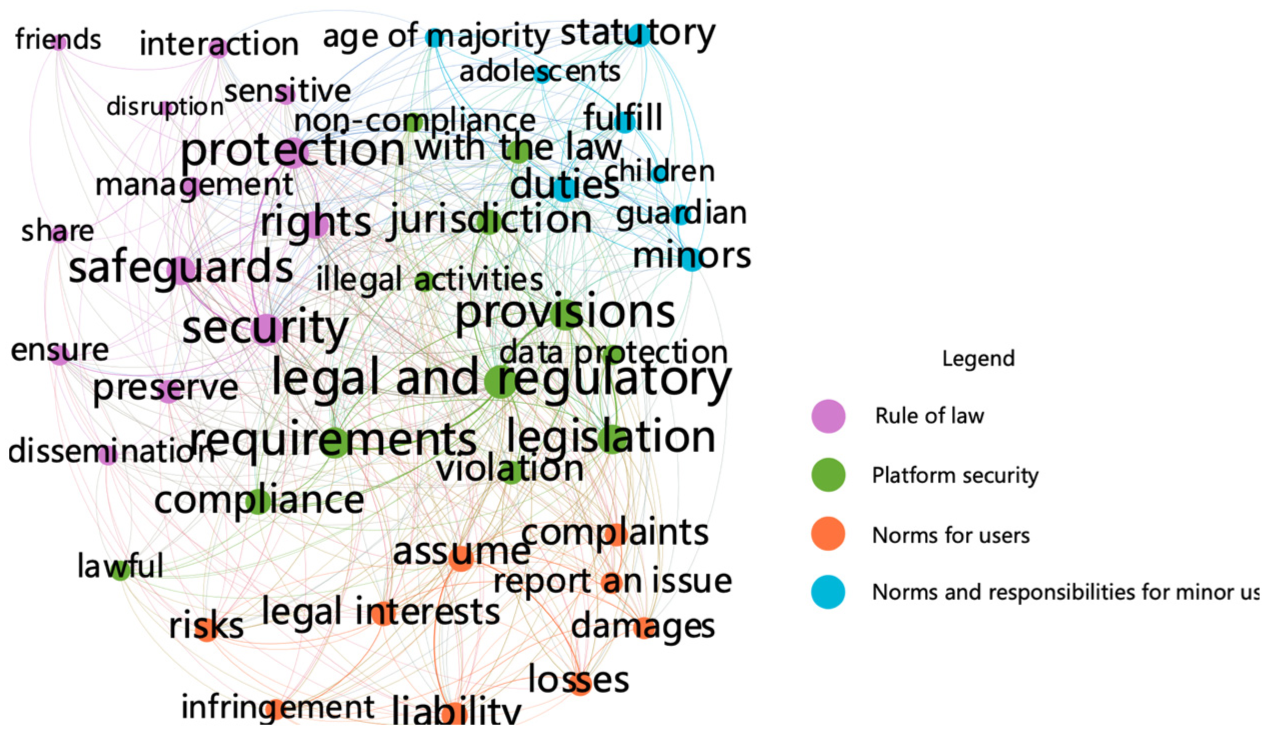
Semantic network analysis of Chinese platforms’ privacy policies and terms of service.

Semantic network analysis of American platforms’ privacy policies and terms of service.
Semantic network graphs show that the values presented in the privacy policies and terms of service of Chinese platforms predominantly emanate from keywords emphasizing rule of law such as legal regulations, requirements, and stipulations. These expand to cover aspects such as platform security management (security, protection, safeguards), norms for daily user operation (liability, assume, legal interest), and behavioral norms and guardian responsibilities for minor users (minors, guardians, duties). In contrast, the values manifested in the privacy policies and terms of service of American platforms are more dispersed, primarily revolving around keywords like share, public, and engage which denote sharing; law, legal, and applicable, which denote rule of law; and security, safety, and integrity which reflect safety. The Chinese texts exhibit stronger institutionalized expressions centered on “normative governance,” while the American texts display more functional expressions centered on “sharing/expression.” These contrasts provide structural clues for subsequent cross-cultural comparisons. Such differences are not merely “mapping phenomena” but can also be understood as networked projections of value structures: value elements shaped by different political-economic contexts are relationally articulated through textual practices, corresponding to the visualized institutional logics of principle-based and rule-based orientations. To further address the research questions, this study will revert to the specific texts of privacy policies and terms of service and their contexts for a more detailed exploration based on the descriptions from semantic network graphs.
Similarities and Differences in the Values Presented in Privacy Policies and Terms of Service by Platforms in China and the U.S
Commonality 1: Adherence to Relevant Laws
Delineating legal boundaries for social media—aimed at curbing its unchecked expansion and mitigating its negative effects—while better harnessing its foundational role in the 21st-century digital public sphere, is not only a theoretical perspective in academia (Balkin, 2021) but also a practical action undertaken by governments worldwide, including those of China and the U.S. This policy direction underscores adherence to law as a highly valued principle across platforms in both countries. Platforms in both nations base user privacy protection, content management, and dispute resolution on legal regulations, often reflected in statements such as, “Terms used in this policy, unless otherwise agreed, are interpreted in accordance with applicable data protection laws” (Weibo, 2022), and “Our regulators require us to provide detailed descriptions to fulfill our legal obligations” (X, 2023a). Moreover, when requesting users to disclose or share information, platforms often reference legal statutes or judicial demands, as seen in statements like, “We access, preserve, use, and share your information in response to legal requests, such as search warrants, court orders, production orders, or subpoenas” (Facebook, 2023). Through such formulations, platforms not only legitimize the collection of user data but also firmly integrate themselves into national legislative and judicial systems. Furthermore, while American platforms’ statements are relatively broad, defining prohibited content as “unlawful, misleading, discriminatory, or fraudulent” (Facebook, 2022), Chinese platforms explicitly list categories of prohibited content. Nevertheless, platforms in both countries regard legal regulations as essential references, underscoring their reliance on the law to discipline and control user behavior. U.S. social media platforms often employ generalized legal clauses to connect risks with dispute resolution processes, whereas Chinese social media platforms tend to adopt itemized provisions that specify rules, scenarios, and responsible parties. This pattern of a “shared source of legitimacy—divergent paths of elaboration” reveals both commonalities and differences, providing a logical foundation for subsequent security and compliance clauses.
Commonality 2: Emphasis on Security
In platform governance, national authorities prioritize the security of social platforms as a critical aspect of legislative and administrative processes. Simultaneously, users’ perceptions of security play a significant role in shaping their experiences (Redmiles et al., 2019). As a result, platforms in both China and the U.S. emphasize security as a key value in their privacy policies and terms of service, which is evident in the clustering distribution and centrality values of semantic networks. However, a detailed contextual analysis reveals that while security values are shared between the platforms of the two countries, there are nuanced differences in their specific manifestations.
In the privacy policies and terms of service of platforms in both China and the U.S., the value of security is reflected in commitments to user safety, as seen in phrases such as “We place a high value on your security” (Douyin, 2024a). In situations involving personal and property safety, platforms assert that “any use of or reliance on any content or materials posted via the service is at your own risk” (X, 2023b), framing security responsibility as a shared obligation between the platform operator and the user. This mutual responsibility facilitates disclaimers that absolve platforms of liability. Notably, a closer connection between safety and legal terms suggests that Chinese platforms place a greater emphasis on security. Calzada (2022) observes that the Chinese government frames its social media privacy regulations around “protecting individuals, society, and particularly national security.” In other words, from the perspective of Chinese platform operators, platform security is not only concerned with safeguarding personal information and business data at the micro level but is also intrinsically linked to national cybersecurity. Accordingly, security is not treated as an isolated section but functions as a “backbone value” that runs through data processing, content governance, and user obligations. This structural difference implies that U.S. platforms place greater emphasis on managing risks through procedures and notifications, whereas Chinese platforms focus on preventing risks through upfront regulations and tiered management. In other words, the same core value of “security” is embedded within different institutional logics shaped by cultural dimensions.
American Platforms’ Emphasis on Sharing
As a foundational activity of Web 2.0 (John, 2013), sharing is regarded as one of the most important values within social media platforms. In the discourse surrounding the Internet in the West, particularly in the United States, sharing plays a pivotal role. Conversely, in the Chinese context, sharing not only facilitates the integration of interpersonal relationships at the micro level but also connects political and social order at the macro level (Zhao & John, 2022). However, an analysis of the semantic networks and their clusters generated from the privacy policies and terms of service reveals that, while American platforms emphasize the value of sharing, Chinese platforms do not explicitly reference this value in their privacy policies and terms of service.
Specifically, compared to Chinese platforms that associate sharing with data and information, American platforms are more inclined to link sharing with the dissemination of personal information and user-generated content. This aligns with the vision of internet pioneers like Tim Berners-Lee (1996), who advocated for an open, collaborative, and compliant digital world, as well as the initial focus of Web 2.0 on user engagement and content creation. This legacy encourages users to freely express themselves and share content they deem important, as seen in statements like, “We want people to use Meta products to express themselves and share content that matters to them” (Facebook, 2022), which promote self-expression and the creation of rich, engaged online communities. Beyond public interest, commercial interests are also deeply intertwined with sharing. Privacy policies and terms of service reveal that, in the context of advertising and marketing, user personal information may be shared with third parties for commercial purposes, yet despite such declarations, users often fail to realize that their data has become a commodity for platform transactions. Ghosh (2020, pp. 30–38) argues that what was once a forum for positive sharing has now morphed into a vehicle for advancing a cutthroat capitalist industry. Parallel to this shift, the emphasis on sharing in American platform privacy policies and terms of service is increasingly transitioning from fostering harmonious interpersonal relationships to capturing greater commercial benefits for the platform. Therefore, “sharing” in the United States is not only a social logic but also the product of the intersection between individualistic culture and the profit-driven nature of platforms: individual expression is absorbed into commercial mechanisms, forming a value chain in which “data becomes capital.” By contrast, Chinese platforms elaborate less on the value dimension of “sharing” in their privacy policies and terms of service, instead indirectly shaping its boundaries through data compliance, contextualized authorization, and behavioral regulation.
Chinese Platforms’ Emphasis on Normative Regulation of Actors
In the governance of social media platforms, the United States and China have developed two distinct models: the American model, primarily shaped by commercial and administrative forces (O’Hara & Hall, 2018), and the Chinese model, which places greater emphasis on the responsibilities of various actors under stronger state involvement. Although in practice, platforms in both countries tend to delegate more regulatory responsibilities to external participants (Chin et al., 2022), American regulatory policies are more aligned with the concept of “negative liberty” (Schauer, 2004), which focuses on limiting government intervention and allowing greater individual freedom.
In the privacy policies and terms of service texts, Chinese platforms place greater emphasis on the behavioral norms of actors compared to their American counterparts, achieving internet governance by clearly defining the scope of actions for various entities. Government intervention in Chinese social media is more pronounced, and the formation of privacy policies and terms of service often reflects official discourse. User behavior is strictly controlled, with penalties such as bans for non-compliance. As previously mentioned, the semantic networks of Chinese platform privacy policies and terms of service highlight keywords like legal regulations, requirements, and stipulations, which occupy a central position. The texts link different actors within the social media ecosystem through detailed elaborations on user behavior norms, seen in sections such as “content publishing norms” (Douyin, 2024b), “users must adhere to the following principles during the use of Weibo services” (Weibo, n.d.), and “user behavior norms” (WeChat, n.d.). These norms generally align around themes such as national security, ethnic unity, information dissemination, citizen rights, and platform norms, with clear and comprehensive guidelines. Platforms in China reduce uncertainty through upfront regulations, incorporating individual responsibility into collective order, thereby forming a stable institutional triangle of “norms–security–order.” By contrast, U.S. platforms place greater emphasis on rights remedies and procedural justice in similar clauses, leaving broader room for interpretation and discretion. These differences do not imply superiority or inferiority but rather reflect distinct regulatory environments, public expectations, and commercial rhythms.
The Influence of Cultural Dimensions on Privacy Policies and Terms of Service in Chinese and American Platforms
According to data from Hofstede’s cultural dimensions model released in 2015, the scores and absolute differences in the six cultural dimensions for China and the United States are shown in Table 3. Rutherford and Tuntivivat (2024) suggest that the six dimensions of this model can establish an idealized dynamic relationship model with characteristic terms that reflect the socio-ecological and value orientations between different cultures. Based on this, the current study attempts to establish connections between the Hofstede’s cultural dimensions and the values highlighted by social media platforms in China and the United States, as discussed earlier and illustrated in Figure 3. This analysis aims to provide a deeper interpretation, thereby addressing Research Question 3.
Comparison of Cultural Dimension Scores Between China and the U.S.*
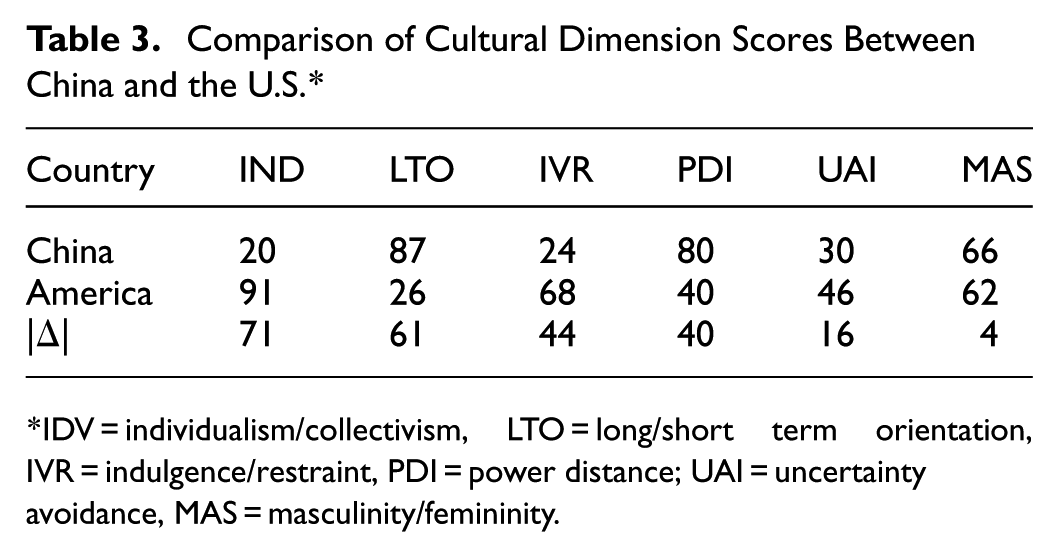
IDV = individualism/collectivism, LTO = long/short term orientation, IVR = indulgence/restraint, PDI = power distance; UAI = uncertainty avoidance, MAS = masculinity/femininity.

Dynamic relational model between Hofstede’s cultural dimensions and the values presented in the privacy policies and terms of service of Chinese and American social media platforms.
Starting with the individualism/collectivism dimension, which measures whether a society prioritizes individual or collective interests, there is a clear contrast between American and Chinese social media platforms. American platforms, rooted in individualism, emphasize the value of sharing in their privacy policies and terms of service, reflecting the individualistic nature of their users. In contrast, Chinese platforms, shaped by collectivism, prioritize the value of security, especially national security, in their policies. Research suggests that users in individualistic cultures primarily use social media for information-seeking, while those in collectivistic cultures use it for socialization and self-presentation (Kim et al., 2011; Schaffer & Debb, 2020). In line with this, American platforms highlight the value of sharing to cater to the individualistic information consumption patterns of their users, thereby expanding their user base and enhancing engagement. While both Chinese and American platforms emphasize security, the approach differs: American platforms view security as a relationship between the platform and its users, whereas Chinese platforms, with a collectivist outlook, frame the platform as part of the nation, aligning individual security, platform stability, and national strategic security.
The Long/Short Term Orientation dimension reflects how much a culture values long-term success over short-term gratification. China tends to emphasize long-term orientation, while the United States focuses on short-term gains. In terms of sharing values, American social media platforms encourage free expression in their privacy policies and terms of service, aligning with American users’ preference for immediate gratification. By promoting such sharing, platforms aim to rapidly circulate content, generating large pools of data for economic gains. While these platforms present short-term sharing as beneficial for shaping the digital public sphere, the excessive flow of ephemeral information can lead to chaos, obscuring meaningful discussions in a sea of redundant content. In contrast, regarding adherence to legal norms, American platforms typically present legal provisions in vague terms, whereas Chinese platforms offer more detailed and specific guidelines. Reflecting their short-term orientation, American platforms, eager to minimize investment return cycles, avoid imposing strict legal boundaries that might hinder users’ pursuit of immediate gratification. In contrast, Chinese platforms, shaped by a long-term orientation, use legal frameworks to clearly define user behavior, helping ensure the long-term sustainability of the online ecosystem.
The Indulgence/Restraint dimension concerns the fulfillment and enjoyment of basic human desires. The United States scores significantly higher on this dimension than China. As previously discussed, Chinese platforms emphasize national security in their safety values and focus on regulating the behavior of various actors through their normative values. In contrast, American platforms primarily advocate for user safety, with relatively vague statements about user norms. Looking at the history of internet development, limiting the excessive indulgence in entertainment is seen as a way to cultivate a healthier digital space, underscoring the public value of the internet. Combining the insights from the individualism/collectivism and long/short-term orientation dimensions, it is clear that American social media users, who prioritize personal interests and short-term gratification, tend to view platforms as tools for pleasure with less concern for their broader societal impact. Platforms, driven by economic interests, naturally support this outlook, minimizing behavioral restrictions under the guise of ensuring user safety, especially when entertainment is a key driver. On the other hand, Chinese users, who are more focused on collective benefits and long-term consequences in their media consumption, are more willing to forgo personal indulgence—even if it means reduced entertainment options—because they recognize the role of the internet in assisting state governance and maintaining national security. This aligns with their cultural traits of higher restraint.
In the Power Distance dimension, which relates to how cultures handle human inequality, China scores higher than the United States. Hofstede (1985) argued that cultures with low power distance tend to emphasize individualism, while those with high power distance are more inclined toward collectivism. The social structure of China, shaped by historical evolution and societal mechanisms, reflects a hierarchical order, which Fei (1992) described as the “differential mode of association.” In this context, social media platforms play a crucial role in how individuals establish and maintain social relationships, effectively accumulating social capital. In the privacy policies and terms of service of Chinese platforms, the high-power distance is evident through the emphasis on behavioral norms for various actors. These platforms often lay out strict guidelines and regulations, reinforcing authority and control over user behavior. In contrast, American platforms, shaped by a social ecology that values more egalitarian principles, generally avoid imposing such normative controls on users. Highlighting regulatory measures in privacy policies and terms of service is often ineffective in the U.S. and can even lead to backlash from users and civic organizations. Instead, American platforms are more inclined to encourage open expression and sharing, appealing to users who are accustomed to an environment where hierarchical distinctions are less pronounced. This difference in how power and authority are conceptualized helps explain the contrasting values of norm enforcement and sharing between Chinese and American platforms in their respective privacy documents.
The Uncertainty Avoidance dimension measures how cultures manage the uncertainties arising from unexpected events and non-conventional environments, typically through formalized channels. Although the United States scores higher than China in this dimension, both countries are considered to have relatively low levels of uncertainty avoidance globally. This tendency is particularly reflected in their respective values regarding adherence to laws and the emphasis on norms. American platforms, in general, use vague language to reflect a more flexible approach to managing uncertainties. In contrast, Chinese platforms are more explicit, often citing specific legal statutes to define clear boundaries for user behavior, alongside informal expressions such as “the creation, reproduction, publication, and dissemination of content prohibited by laws and administrative regulations are forbidden” (Douyin, 2024b). Cultural factors, alongside differences in political and judicial systems, influence how platforms in both countries express the values of legal adherence and norm enforcement. In the U.S., the federal structure and case law system make it difficult for platforms to cite uniform national laws to regulate user behavior and mitigate uncertainties. By contrast, China’s centralized administrative, judicial, and legislative systems establish predefined behavioral boundaries for social media and its users, while still allowing some operational flexibility in managing unforeseen risks due to the ambiguity of certain terms.
In the Masculinity/Femininity dimension, which assesses whether individuals or organizations are more competitive, ambitious, and achievement-oriented, China and the U.S. score similarly. Both countries, amidst the waning phase of the rapid growth period of the Internet, share the goal of generating new economic opportunities while ensuring the sustainable development of the digital ecosystem. From the platform’s perspective, operating within a legal framework not only provides corporate legitimacy but also helps mitigate regulatory risks. By emphasizing comprehensive security—including data security, privacy security, operational security, and national security—platforms in both countries demonstrate to regulators that their operations fall within acceptable bounds for maintaining social stability. Simultaneously, this focus on security reflects a commitment to safeguarding users’ individual interests, facilitating sustainable economic growth, and fostering a positive social reputation. This convergence in values explains why, despite cultural differences, both Chinese and American social media platforms prioritize adherence to legal norms and security in their privacy policies and terms of service. The U.S. approach emphasizes “procedures–flexibility–post-hoc remedies,” while the Chinese approach highlights “rules–ex ante constraints–hierarchical management.” It should be noted that culture is not a single causal factor but interacts with platforms’ profit-driven nature and regulatory regimes: the same profit-seeking motive is “heterogeneously expressed” through different cultural and institutional filters, resulting in distinct clause structures and value weightings. This finding provides a mechanism-level explanation for the semantic network differences identified earlier and lays the groundwork for the subsequent discussion on the interaction between culture and profit motives.
Discussion, conclusion, and limitations
Discussion
In the era of the “Platform Society,” social media has emerged as an unstoppable force, becoming the primary channel of communication in today’s world. As social media values become more ingrained through its global proliferation, these values are not only reflected in the interactions between users and platforms but also embedded in the texts of privacy policies and terms of service. The evidence presented in this study shows that Chinese and U.S. social media platforms exhibit significant differences in regulatory orientations and value expressions, which in turn shape users’usage habits, information filtering, and expressions of cultural identity. These documents, in turn, serve as the foundational infrastructure of social media, shaping user experiences and expectations. The values reflected in the text illustrate the differences between China and the United States in platform regulation, which may influence users’ social media usage habits and, in turn, affect their information filtering practices and expressions of cultural identity. The United States, representative of a capitalist system, and China, representative of a socialist system, exhibit markedly different economic, political, and socio-cultural backgrounds. Indeed, our analysis reveals significant differences in the texts of social media privacy policies and terms of service. This difference can be reasonably explained within the framework of Hofstede’s cultural dimensions. Specifically, we will discuss the following five points. First, security, as a shared value between China and the United States, reflects different intrinsic orientations, aligning with the characteristics of individualism and collectivism. Individualism and collectivism represent the fundamental value orientations of a nation and society, influencing macro-national policies, meso-level organizational management, and micro-level user representations. Additionally, the indulgence vs. restraint dimension similarly reflects China’s macro-level emphasis on national security, focusing on social stability and preventing extreme events, whereas the United States emphasizes users’ life experiences and downplays regulation of information flow. Second, under the long-term vs. short-term orientation dimension, we observe differing goals for platform development in China and the United States, indicating that the influence of this value leads to variations in content presentation and user expression. Third, high power distance often shapes normative social structures, encouraging Chinese users to adhere to platform regulations, which can result in content homogenization and ultimately create echo chambers. In contrast, American users, influenced by low power distance, tend not to passively comply with platform rules but instead seek a social comfort zone. Fourth, both China and the United States are characterized as low uncertainty avoidance countries, exhibiting flexibility, ambiguity, and uncertainty in the formulation of privacy policies. This reflects how the world’s first and second largest economies address emergencies and mitigate uncertainties as an important issue. Finally, the masculinity versus femininity dimension further corroborates the regulatory models of these two superpowers during their steady development phase, positioning security as the primary goal for platforms. Moreover, the study focuses on providing insights for operators and managers of transnational digital platforms: identifying and respecting cultural differences will be key for platforms to truly achieve global operations. In other words, cultural dimensions are not merely a simple footnote to the outcomes but function as generative mechanisms that drive value choices and institutional arrangements. This also explains why, even under similar global compliance pressures, Chinese and U.S. social media platforms maintain divergent emphases on the values of “sharing” and “regulation.”
Based on this study’s analysis of the similarities and differences in the values expressed in the privacy policies and terms of service of social media platforms in China and the United States, this study argues that cultural differences provide the “direction,” while profit logic provides the “drive.” The external narratives of compliance, security, sharing, and regulation articulated by platforms ultimately serve the continuous inflow and transformation of data. Currently, user data has become one of the most valuable assets and a key source of profit growth for platforms. Consequently, the values that platforms present externally ultimately serve their business goals—specifically, to “facilitate the continuous influx of user data” (Sanders, 2023). In practice, platforms perpetuate what is often referred to as “the biggest lie on the internet” (Obar & Oeldorf-Hirsch, 2020) through lengthy, complex privacy policies and terms of service, which obscure platforms’ underlying intentions from users. At the same time, they package these profit-driven values with mainstream, value-aligned expressions such as adhering to laws, ensuring security, encouraging sharing, and regulating behavioral boundaries. Platform values are not governed by a single logic but are the outcome of interactions between culture and profit within institutional practice: profit objectives provide the drive, while cultural structures set the boundaries, together shaping the value order expressed in texts. Thus, profit motives do not diminish cultural differences but are “heterogeneously expressed” through cultural and institutional filters, eventually sedimenting into distinct textual structures and governance tools. The same commercial drive follows different pathways across contexts: in one case reducing frictions in data circulation, in the other reducing governance and security risks—both ultimately aiming at a sustainable balance between profit and risk control. This strategy not only legitimizes users’ open sharing of their data with platforms but also unwittingly transforms their data into raw materials for platform capitalism.
At the intersection of globalization and platformization, compliance and security are emerging as a “universal grammar” of cross-border operations. The key challenge lies in ensuring compliance and security while preventing singular economic motives from eroding the public interest. This challenge is likely to become a central concern for both academia and industry. Furthermore, while the Hofstede framework used in this study is effective for delineating cultural differences, the increasing homogenization of platform-related texts between China and the U.S.—two countries with significant cultural contrasts—raises important questions. Specifically, it remains to be seen whether different nations and cultures can preserve their distinctive cultural characteristics within the expanding platform society. Additionally, the continuing relevance of the Hofstede cultural dimensions framework in addressing new phenomena and challenges in platform societies will be an important area for future research.
Conclusion
This study analyzes the privacy policies and terms of service of three major social media platforms from both China and the United States, using semantic network analysis and textual analysis to explore the implicit values embedded within these texts. It is argued that platforms in both countries emphasize adherence to law and security as core values within their privacy policies and terms of service. Furthermore, American platforms highlight values promoting sharing, while Chinese platforms emphasize user behavior norms. To explore the cultural factors influencing these value differences, this study incorporates the Hofstede cultural dimensions framework and constructs a dynamic relational model, aiming to examine how cultural differences between China and the U.S. shape the values expressed through their privacy policies and terms of service.
Limitations and Future Research Directions
The limitations of this study are as follows: Firstly, in the context of the platform society, platforms such as e-commerce, mobile payments, and search engines, just like social media platforms, occupy significant roles in daily life. However, due to the differences in their core business models, the privacy policies and terms of service of these platforms may differ from those of social media platforms. This study did not compare platforms across multiple fields. Secondly, beyond China and the US, which are representative of major internet economies, platform economies in other countries also show vibrant development. Additionally, both China and the U.S. have localized their privacy policies and terms of service to accommodate regions outside their home countries. However, this study focuses solely on China and the U.S., without including an analysis of other countries. Moreover, while this study explores the value differences in social media privacy policies and terms of service based on cultural distinctions between countries, it is important to note that these differences are also influenced by a range of factors beyond culture, including political and economic elements. Lastly, this study explored platform values only at the textual level and did not further investigate from the perspectives of platform developers and users.
In future research, scholars could explore the values underlying the privacy policies and terms of service across different types of platforms. Researchers could also conduct more extensive comparative studies across countries, considering multidimensional differences. One potential research direction could involve comparing the privacy policies and terms of service of digital platforms in the “Global South” with those of platforms in Western developed countries, analyzing them within the broader context of political, economic, and cultural relationships. Such research could provide insights into the global regulation of privacy policies and inform best practices for platform governance in diverse cultural and economic contexts. In terms of research methodology, future studies could employ qualitative approaches, such as in-depth interviews, to collect richer first-hand data from frontline staff or active users, thereby offering a more comprehensive and multi-perspective discussion of the values embedded in social media platforms.
Footnotes

Funding
The authors disclosed receipt of the following financial support for the research, authorship, and/or publication of this article: This research was funded by The National Social Science Fund of China grant number 21&ZD313 and 24BXW026.
Declaration of Conflicting Interests
The authors declared no potential conflicts of interest with respect to the research, authorship, and/or publication of this article.
Data Availability Statement
The data that support the findings of this study are available from the corresponding author upon reasonable request.