




Abstract
Cultural artifacts such as children’s storybooks may serve to facilitate learning of emotion display norms. We compared emotion displays in European American and Mexican books to infer cultural differences between the mainstream and a heritage culture to ultimately explore acculturation orientation in Hispanic storybooks. Totally, 1,059 images were coded from 10 popular storybooks from each cultural group. We focused on emotion type (positive, negative socially engaging, and disengaging) and intensity of expression. Context variables such as social partners and gender were also compared. Positive emotions were dominant in all groups, occurring most in Hispanic storybooks; Mexican and Hispanic storybooks displayed negative socially disengaging emotions less than negative socially engaging emotions. Hispanic storybooks displayed lowest intensity of expression, especially for female characters. Results indicated that Hispanic storybooks showed similarities to the mainstream culture in general features and similarities to the heritage culture in emotion-type display. However, some emotion norms deviated from both groups, indicating minority effects of Hispanic culture.
Cultures differ in emotion display rules (Matsumoto et al., 2008), which are the rules that guide the appropriate expression of emotions by defining how, when, and to whom emotions are expressed. Similarly, cultures also differ in preferences for certain type of emotions (e.g., De Leersnyder, Kim, & Mesquita, 2015; Eid & Diener, 2001; Mesquita & Leu, 2007). Young children acquire these culture-specific emotion norms through their parents’ emotion socialization strategies (Friedlmeier, Corapci, & Cole, 2011), as well as their exposure to cultural artifacts such as children’s storybooks (Tsai, 2007; Vander Wege et al., 2014). Many children’s storybooks contain displays of different types of emotion, as well as different levels of expression intensities. These cultural artifacts may reflect culturally acceptable emotion norms, and exposure to these emotion displays is a viable source for children to learn about and value cultural affective states (Tsai, 2007).
Former studies compared positive emotions in Chinese and American storybooks (Tsai, Louie, Chen, & Uchida, 2007) and positive and negative emotions in Romanian, Turkish, and European American storybooks (Vander Wege et al., 2014). The goal of this study was to expand upon previous research of emotion displays in popular children’s storybooks in a few ways. First, we aimed to replicate the Vander Wege and colleagues’ (2014) study by incorporating children’s storybooks (ranging in recommended age of 2-6 years) from Mexican and Hispanic 1 cultures into the comparison with the European American storybooks 2 . Second, we explored the acculturation orientation of Hispanic storybooks to test whether the represented emotion norms were similar to a heritage culture (Mexican) or host culture (i.e., mainstream European American). Third, to validate the presence of general cultural differences in these storybooks, we analyzed whether nonemotion context features (e.g., social context, representation of gender) showed expected differences based on cultural norms as reported in cross-cultural studies. Popular children’s literature may not only reflect cultural norms of emotions (e.g., Tsai et al., 2007; Vander Wege et al., 2014), but also social norms. Although most popular Mexican storybooks selected for the analysis were translations of non-Mexican stories, we still assumed that the illustrations in these storybooks reflected and represented traditional norms (as described in the following section) rather than a shift toward new norms. To accomplish the main goal of this study, which was to infer acculturation orientation of Hispanic storybooks, we used a two-step process. First, we established existing differences between the host (i.e., mainstream European American) culture and a heritage (i.e., Mexican) culture. Once those differences were established, the information was used to determine the degree to which the Hispanic storybooks reflected the norms of a heritage culture (i.e., Mexican) versus the host culture (i.e., mainstream European American).
Cultural Norms for Mexico and the Two Ethnic Groups in the United States
Hispanics compose the second largest ethnic group in the United States following Whites, making up 18% of the population in 2016 (Flores, 2017). Within this ethnic group, 63.3% (36 million) are of Mexican origin, making Mexico the largest origin country of Hispanics in the United States, followed by Puerto Rico (5 million) and El Salvador (2 million; all statistics as of 2015; Flores, 2017). Accordingly, Mexicans greatly influence “the demographic behavior” of Hispanics in the United States—as well as American attitudes toward this ethnic group (Durand, Telles, & Flashman, 2006, p. 67). In this study, we selected Mexican culture to refer to the most popular heritage Hispanic culture in the United States, and as such, that arguably has the strongest influence on what media artifacts are created, consumed, and marketed to the Hispanic population in the United States.
Compared to the United States, Mexico is qualified as more collectivistic (Hofstede, 2001). Similar to other Latin American countries, Mexico is high in hierarchy and embeddedness—two main components of collectivism (Schwartz, 2008). Latin American cultures such as Mexico embrace values of connectedness, for example, “familismo” (i.e., strong commitment to family harmony; Luna et al., 1996; Sabogal, Marín, Otero-Sabogal, Marín, & Perez-Stable, 1987; Schwartz, 2007) and “simpatía” (i.e., proper conduct in social interactions; Durik, Hyde, Marks, Roy, Anaya, & Schultz, 2006), which are central features of interdependent self-construal (Kitayama, Markus, & Kurokawa, 2000). Individualistic cultures foster independent self-construal by perceiving themselves as unique, exhibiting open expression of the self (Matsumoto et al., 2008), and attributing uniqueness to oneself (Matsumoto, 1990), which are typical characteristics of the mainstream culture in the United States (Kitayama et al., 2000). To validate the presence of these cultural norms in the storybooks, we expected cultural differences in nonemotional storybook features. For example, compared to Mexican storybooks, European American storybooks should place more emphasis on the individual via more depictions of the protagonist throughout the story and fewer characters per page.
Besides differences in individualistic and collectivistic orientation, Mexican families tend to endorse values such as machismo and marianismo. Machismo is defined as a negative aspect of masculinity that includes traits such as dominance, aggression, and chauvinism (Ojeda & Piña-Watson, 2014), and marianismo is defined as “a multidimensional gender role construct that is based on three central cultural tenets: familismo, respeto [(obedience and duty)], and simpatía” (Piña-Watson, Castillo, Jung, Ojeda, & Castillo-Reyes, 2014, p. 115). An example of a marianismo value based on the cultural idea of familismo is the belief that women should be in charge of preserving family harmony and child rearing (Piña-Watson et al., 2014). Furthermore, when compared with the United States, Mexico makes stronger gender role distinctions in socialization practices (Cauce & Domenech-Rodriguez, 2002; Gamble, Ramakumar, & Diaz, 2006; Romero, Cuéllar, & Roberts, 2000). Therefore, given the existing literature on male dominance and strong differentiation of gender in Mexican culture, we expected more displays of male characters in Mexican storybooks than in European American storybooks.
For Hispanic storybooks, we explored whether the represented cultural norms of these storybooks more closely aligned with norms represented in the Mexican or European American storybooks. The rationale for the aforementioned expectation stems from evidence suggesting that acculturation orientation is a bilinear process that may reflect the adoption of mainstream European American cultural norms norms (see Berry, 1997). As such, we seek to establish whether and how acculturation orientation might be captured in cultural norms reflected in Hispanic children’s storybooks.
Impact of Cultural Norms on Emotion Displays
Past research suggests that parents foster positive emotions in their infants and children in a universal way (see Cole & Tan, 2007). Similarly, studies of emotion in children’s storybooks demonstrated strong predominance of positive over negative emotion displays across all cultural groups (e.g., Vander Wege et al., 2014). Based on the previous evidence, we expected that positive emotion displays would be more prevalent in the storybooks for the three cultural groups. In contrast, the salience of negative emotion displays may vary across cultures. For example, cultures with an independent self-construal do not restrict socially disengaging emotions (Kitayama et al., 2000). Accordingly, we expected that European American children’s storybooks would display negative socially engaging and disengaging emotions at a similar rate. In contrast, cultures with an interdependent self-construal endorse socially engaging emotions (i.e., those that restore harmony) more than socially disengaging emotions (i.e., those that restore independence; Kitayama et al., 2000). Therefore, we expected that Mexican storybooks would display more negative socially engaging emotions (e.g., sadness, guilt) than negative socially disengaging emotions (e.g., anger, disgust).
Studies have documented gender differences in emotional expressivity across cultures. Gender differences in emotional expressivity have been well documented for European Americans (see Brody, 1999, 2000; Grossman & Wood, 1993). For example, compared to European American males, their female counterparts express most emotions at a higher frequency (Fabes & Martin, 1991), and express and verbalize more negative socially engaging emotions (Timmers, Fischer, & Manstead, 1998). In addition, empirical studies have found that European Americans endorse gender stereotypes of emotion (i.e., belief that women express more stereotypical “feminine” emotions such as distress, love, and sadness) more than Hispanics (Durik et al., 2006). In addition, European Americans also endorse stronger gender differences in emotion display rules compared with Canadian and Japanese individuals (Safdar et al., 2009). As mentioned earlier, gender role differences are more clearly defined in Mexico (e.g., machismo, marianismo), and machismo has been found to be associated with restrictive emotionality (Ojeda & Piña-Watson, 2014). With this, we expected that both European American and Mexican male characters would express emotion less frequently than female characters in these storybooks, and Mexican male characters even less than European American males.
Intensity of Expression
Cross-cultural studies on emotion display rules show a positive relation between individualism and strength of emotion expression (Matsumoto et al., 2008; van Hemert, Poortinga, & van de Vijver, 2007). In other words, individuals in individualistic societies express emotions more intensely. This relation, however, only exists for positive emotions (e.g., happiness, surprise) and not negative ones (Matsumoto et al., 2008). Individualistic cultures endorse higher emotional expressivity because of the emphasis they place on independence of the self, and emotions are seen as authentic personal experiences; on the contrary, collectivistic cultures emphasize interdependence, which requires more control of emotion displays because of values such as group harmony (Suh, Diener, Oishi, & Triandis, 1998). As such, we expected higher intensity of emotion expression in European American compared with Mexican storybooks, especially for positive emotions (Matsumoto et al., 2008).
Furthermore, cultural differences in the intensity of emotion expression are a function of social context. This means that the strength of the emotion expression may vary as a result of the social context in which the individual is embedded at any given moment. In collectivistic cultures, the in-group is composed of an entire interconnected network, including family members, nuclear and extended relatives, and other individuals who are at close physical proximity, such as neighbors (Hofstede, 2001). Given the importance of the in-group to collectivistic societies, conformity to social norms is emphasized in to ensure group harmony (Matsumoto, 1990). On the contrary, in individualistic societies, the distinction of in-group and out-group is not as evident (Matsumoto, 1990), as others are often thought of as individuals rather than categorized into groups. As such, individualistic societies do not have a strong need for group identification (Matsumoto et al., 2008).
In general, individualistic cultures endorse higher expressivity of negative emotions with in-groups and more positive emotions to out-groups (Matsumoto et al., 2008). This is because individualistic cultures are less attached to their in-groups and group conformity is not emphasized as much, as is the case in collectivistic cultures (Matsumoto et al., 2008). In contrast, collectivistic cultures endorse greater expression of more positive emotions to in-groups and more negative emotions to out-groups, as endorsing negative emotions to in-groups threatens group harmony (Matsumoto et al., 2008). In this study, we defined in-group as familiar relatives and acquaintances (e.g., parent, sibling, friend), and out-group as unfamiliar individuals (e.g., teacher, classmate). Therefore, we expected that European American storybooks would display an overall higher intensity of emotion expression with in-groups than out-groups especially for negative emotions. In addition, we expected that European Americans would display positive emotions more strongly to out-groups, whereas Mexican storybooks would display stronger positive emotions to in-groups and stronger negative emotions to out-groups.
Acculturation Orientation in Hispanic Storybooks
Few studies have explored the emotion characteristics of Hispanics regarding emotion display rules, judgment of relevance of emotions, and intensity of emotion expression (exceptions are Durik et al., 2006; Matsumoto, 1993); therefore, we explored the acculturation orientation of these characteristics in the Hispanic storybooks. The level of acculturation orientation can vary across different domains; immigrants may adopt the mainstream norms in public contexts, but still maintain heritage culture norms in private life contexts (Celenk & van de Vijver, 2011). Similar to the idea of differing norms in certain contexts, it is possible that the acculturation orientation of general cultural norms (e.g., gender norms, individualism and collectivism related norms) represented in the nonemotional storybook features of Hispanic storybooks may act as a differing context from the orientation of emotion norms in these storybooks. For example, Hispanic storybooks may display similarities to mainstream European American culture in nonemotional storybook features (e.g., gender and protagonist distribution), which represent general cultural norms, while at the same time align with the heritage Mexican culture on emotion norms displays in the storybooks (e.g., frequency of specific emotion types). Therefore, we were interested to see in which domains—general norms or emotions norms—Hispanic storybooks were similar to or different from the mainstream European American and heritage Mexican culture.
Summary of Main Hypotheses and Research Questions
Nonemotional storybook features
To validate cultural norm differences, we expected that European American storybooks would reflect more individualist characteristics (fewer figures per page, more protagonist depictions) and less predominance of male figures than Mexican storybooks.
Emotion displays
Three main hypotheses were derived: First, we expected that compared to female characters, male characters would express no emotions (i.e., neutral emotional depiction) at a higher frequency, especially Mexican male characters; second, all storybooks would display a higher frequency of positive emotions; third, Mexican storybooks would display a higher frequency of negative socially engaging and lower frequency of negative socially disengaging emotions, whereas European American storybooks would have a similar rate of negative socially engaging and disengaging emotions.
Intensity of expression
Two hypotheses were derived: First, European American storybooks would display higher intensity of emotion expression than Mexican storybooks, especially for positive emotions; second, we expected that European American storybooks would display higher intensity of expression of positive emotions to out-groups than in-groups, and higher intensity of expression of negative emotions to in-groups than out-groups, whereas Mexican storybooks would display the opposite pattern.
Acculturation orientation
As mentioned above, the nonemotional storybook features and emotion displays in the Hispanic storybooks will be explored by analyzing the relation between the heritage and mainstream cultures.
Method
Selection of Storybooks
The storybooks were selected based on the following criteria: (a) popularity, (b) codable features of characters, and (c) storyline.
a. Popularity was taken as a first important criterion. For the European American storybooks, popularity was assessed based on Amazon lists (see Table 1). Popularity of Mexican storybooks was more difficult to assess given that the country does not have a widely used online retailer such as Amazon that would allow for a quick assessment of the most frequently bought children’s storybooks. Nevertheless, we found a list with the most popular children stories published in “el Foro Latino” (Latino forum). All storybooks were published by a Mexican or Spanish publisher (see Table 1), and storybooks had new illustrations provided by a Mexican/Spanish illustrator (though information about illustrators was only provided for four storybooks). Amazon lists were consulted for the popularity of Hispanic children’s storybooks. Besides popularity, the Hispanic storybooks were also selected based on the background of the author and the illustrator. These storybooks required that at least the illustrator was from a Hispanic background or grew up in a Spanish-speaking community. Finally, out of the 10 Hispanic books, four were written in both English and Spanish, five in English only, and one in Spanish only.
b. Other criteria for book selection also established that the selected storybooks must include characters with codable features, which included distinctive eyes, eyebrows, and mouths.
c. The storyline criterion required that each storybook contained a narrative, not just pictures with unrelated content. In addition, it was required that the text was minimal and the images were dominant, that is, both words and pictures could narrate the story equally, as is typical for storybooks for preschool children. Books with animals as characters were acceptable if the animal had obvious humanistic features (e.g., facial cues such as eyes, eyebrows, and mouth) that were codable. In addition, animal characters had to talk, as shown by the storyline text, and they had to show humanlike thoughts during the story. Given that the storybooks from Mexico and some Hispanic storybooks were in Spanish, a research assistant who is a native Spanish speaker translated all of the storybooks to English to ensure understanding of the storyline text among the coders.
Book Titles of the Selected Books.

Originally published in 1972.
Old Danish fairy tale first published in Danish (1843).
Publisher did not specify year of publication.
Publisher: Grupo Editorial Garcia S.A. de C.V. (Mexico).
Canadian Book, originally published in 1986.
Old European folk tale first published in German (1812).
Publisher: Ediciones Saldaña, S.A. (Spain).
Old European fairy tale first published in Italian (1550-1553).
Originally an English play (UK, 1904), adapted later as a novel (UK, 1911).
Illustrations by Carlos Busquets.
Old Danish fairy tale first published in Danish (1837).
Old English fairy tale first published in English (UK; 1837).
Old French fairy tale first published in French (1697).
Old European fairy tale first published in French (1697).
Original published in Italian (1883).
Old English fairy tale first published in English (UK, 1621).
Procedure
Codable characters were identified in each storybook and numbered to ensure consistency of coding across raters. For a character to be codable, the character’s face had to be fully visible and show distinctive eyes, eyebrows, and mouths. Only characters in the story (not on the cover, title pages, etc.) were coded. Three research assistants (two American and one Mexican) coded all of the storybooks. A majority rule was applied for the final qualitative codes, and a fourth rater settled disagreements (about 10%).
Measures
Emotion coding
We followed the coding system for emotion norms of Vander Wege et al. (2014) and added three more distinct emotions. Global emotion coding was conducted using several criteria to distinguish and reliably code emotion displays. The coders were trained in facial expression codes based on the Facial Action Coding System (FACS; Ekman & Friesen, 1978) and body posture coding to get a detailed insight into emotion coding. For body posture, we identified 25 emotion-related postures from Kudoh and Matsumoto (1985). Examples of action units used to distinguish emotion displays include inner and outer brow raised for expressions of fear, and upper lid raised for surprise. Similarly, examples of posture characteristics used to indicate emotions include holding the chin in both hands for fear, and tilted head and hands on hips to indicate emotions of pride. In the end, the main task of the coders was to evaluate the global emotion as a synthesis of facial expression, posture characteristics, and to match with context of the story for the following reasons: First, FACS only refers to six basic emotions; second, the postures are equivocal in their relation with a specific emotion (e.g., head down can mean disappointment, sadness, embarrassment or nonemotional state such as deep thinking); and third, illustrators do not necessarily follow naturally occurring micro-expressions (e.g., eye brows are presented unchanged in spite of strong emotion signs portrayed in the mouth region). Therefore, we combined these elements to create a more specific and reliable coding system.
Altogether, 17 distinct emotions were differentiated and grouped into three emotion types: positive emotions (happiness, surprise, pride, self-confidence, relaxation, liking); negative socially engaging emotions (fear, sadness, shame, confusion, worry, guilt, disappointment, embarrassment); and negative socially disengaging emotions (disgust, anger, dislike). Characters coded as having an “ambiguous” or no emotional expression were given an emotion type of “none” and were kept only for descriptive measures and were not used in the principal analysis. Interrater reliability for global emotion assessment across the three raters and the three different cultures was “moderate;” mean Cohen’s κ = 0.58 ranging from 0.49 to 0.66. Interrater reliability for emotion type across the three raters was “good,” (mean κ = 0.66) ranging from 0.60 to 0.72. All p values were < .001. Interpretations of kappas based on Altman (1991).
Intensity of expression coding
The intensity of expression of the global emotions was qualified at a 4-point scale: 0 = no emotion, 1 = weak intensity, 2 = medium intensity, 3 = strong intensity. Intensities coded as 0 were not used in the principal analysis. Three areas were analyzed to assess intensity: mouth, eyes, and posture (see Cole, Wiggins, Radzioch, & Pearl, 2007). Therefore, if all three elements contributed to the emotional display, intensity was coded 3, if any two of the areas were present, intensity was coded 2, and coded 1 for only one area being present. If a specific posture was not present or contributing to the emotional display, other emotional indicators were analyzed in substitution for posture, for example, tears, and hand gesture. Intraclass correlation coefficient (ICC) for average measures across the three raters for intensity reported r(374) = .87 for European American storybooks (p < .001) with 95% confidence interval (CI) = [0.83, 0.90], r(650) = 0.85 for Hispanic storybooks (p < .001) with 95% CI = [0.82, 0.88], and r(688) = 0.79 for Mexican storybooks (p < .001) with 95% CI = [0.75, 0.83]. ICC results indicate that reliability was “good” across all raters and cultural groups (see Koo & Li, 2016).
Nonemotional storybook features
Gender of character was coded for each figure with 0 = not known, 1 = male, 2 = female. Nonhuman characters such as animals were coded for gender if there were obvious features present such as clothing, hairstyle, etc. Interrater reliability for gender across the three raters was “very good”; mean κ = 0.91 ranging from 0.84 (“very good”) to 0.98 (“very good”). All p values were < .001. Protagonist was coded if the figure was the main character, or protagonist, in the story. Interrater reliability across the three raters was also “very good;” mean κ = 0.89 ranging from 0.78 (“good”) to 0.96 (“very good”). All p values were < .001. The characters were also coded for social partners present during the coded situations. Four types of partners were differentiated: 1 = alone (no partner present), 2 = in-group (familiar relatives: parent, sibling, or familiar acquaintances; best friends), 3 = out-group (unfamiliar persons: teacher, classmates, and distant relatives), 4 = mixed (familiar and unfamiliar persons are present, e.g., mom, friends, and strangers). Context was used to code for social partners in certain situations in which the character may have been drawn alone, but the story referenced the character being with other people, for example, inside a classroom with other students but drawn alone. These situations were coded according to context and not the illustration because it was the author’s intention to place the character within the social environment written. Interrater reliability across the three raters was “good”; mean κ = 0.76 ranging from 0.49 (“moderate”) to 0.97 (“very good”). All p values were < .001. Interpretations of kappas based on Altman (1991).
Data Analysis
Statistical tests used in this study include log-linear analyses to compare relative frequencies across multiple levels of independent variables (e.g., culture, gender, social context) and interactions of these variables. Log-linear analysis can be compared with an ANOVA but with a categorical dependent variable, and uses a chi-squared approximation. We also used chi-squared tests of independence for specific comparisons. Finally, ANOVA was used to compare quantitative data across the three cultures (number of figures and intensity of expression). All statistical tests were conducted using Statistical Analysis Software (SAS).
Results
Cultural Differences in Nonemotional Storybook Features
Number of figures
There was a total of N = 1,059 codable storybook characters. This number of characters was similar across the three ethnic groups (European American n = 367; Hispanic n = 327; Mexican n = 365), χ2(2) = 2.88, p = .24. In contrast to our expectation, the total number of figures (codable and noncodable) per page was similar across cultures, F(2, 27) = 1.04, p = .37 (European American M = 2.37, SD = 1.85; Hispanic M = 1.99, SD = 0.95; Mexican M = 2.84, SD = 0.94).
Protagonist
The protagonist was depicted in 28.61% (n = 303) of all cases. Log-linear analysis displayed that the frequency of protagonist characters varied across the three cultures, χ2(2) = 28.87, p < .001. Contrasts revealed that European American storybooks had the greatest frequency of protagonists (n = 139, 37.88%), followed by Hispanic storybooks (n = 92, 28.14%), and Mexican storybooks had the least (n = 72, 19.73%).
Gender
Log-linear analysis displayed that the gender distribution varied by ethnic group (the unknown gender characters were removed for the analysis), χ2(2) = 24.59, p < .001. Contrasts revealed Mexican storybooks had significantly more male (n = 250, 69.64%) than female characters (n = 109, 30.36%) compared with the two other groups. European American and Hispanic storybooks did not significantly differ in gender distribution (European American male n = 193, 53.76%, female n = 166, 46.24%; Hispanic male n = 175, 53.52%, female n = 152, 46.48%).
Frequency of Emotion Displays
No emotion displays
A total of 104 (9.80%) figures were coded as having no emotion type (European American n = 47; Hispanic n = 47; Mexican n = 10). Chi-squared analysis revealed a significant difference in gender distribution of these figures with no emotion type, χ2(1) = 18.31, p < .001, as there was a higher frequency of male characters (n = 72, 71.29%) than female characters (n = 29, 28.71%). Log-linear analysis displayed no significant difference in gender distribution of these figures by culture, χ2(2) = 1.28, p = .53 (European American male n = 32, 71.11%, female n = 13, 28.89%; Hispanic male n = 35, 74.47%, female n = 12, 25.53%; Mexican male n = 5, 55.56%, female n = 4, 44.44%).
Specific emotion types
After removing the figures with no emotion type from the data set, the total number of figures analyzed was n = 955. Positive emotion type had an obvious predominance for all three cultures (78.43%, n = 749), with happiness the most prevalent (66.81%, n = 638), then surprise (8.59%, n = 82). Liking, pride, relaxation, and self-confidence were all somewhat rare occurrences (1.15%, n = 11; 0.73%, n = 7; 0.63%, n = 6; 0.52%, n = 5) with neither liking nor pride ever appearing in Mexican storybooks, and neither liking nor self-confidence in Hispanic storybooks. Hispanic storybooks displayed positive emotion type significantly more frequently (87.86%, n = 246) than the other cultures (Mexican: 75.21%, n = 267; European American: 73.75%, n = 236), χ2(2) = 20.08, p < .001.
Negative socially engaging emotions were the next most prevalent emotion type (14.35%, n = 137), with global emotion distributed in order of descending frequency: sadness (5.13%, n = 49), worry (4.61%, n = 44), fear (2.62%, n = 25), confusion (1.15%, n = 11), shame (0.31%, n = 3), disappointment and embarrassment (0.21%, n = 2), and guilt (0.10%, n = 1). Neither shame nor disappointment were displayed in Hispanic storybooks or Mexican storybooks. Embarrassment was not displayed in any European American storybooks, and guilt was only displayed in Hispanic storybooks.
Negative socially disengaging emotions were displayed the least in all three cultures (7.23%, n = 69). The most prevalent of these emotions was anger (4.92%, n = 47), then dislike (1.88%, n = 18), then disgust (0.42%, n = 4). Neither dislike nor disgust were displayed in Hispanic storybooks. Disgust was not displayed in Mexican storybooks, either.
Both Mexican and Hispanic storybooks displayed more negative socially engaging emotion type (18.31%, n = 65; 10.71%, n = 30) and less negative socially disengaging emotion type (6.48%, n = 23; 1.43%, n = 4), whereas European American storybooks displayed the same frequency for both types of negative emotion (13.13%, n = 42), χ2(2) = 17.90, p < .001. Hispanic and Mexican storybooks did not significantly differ (see Figure 1).
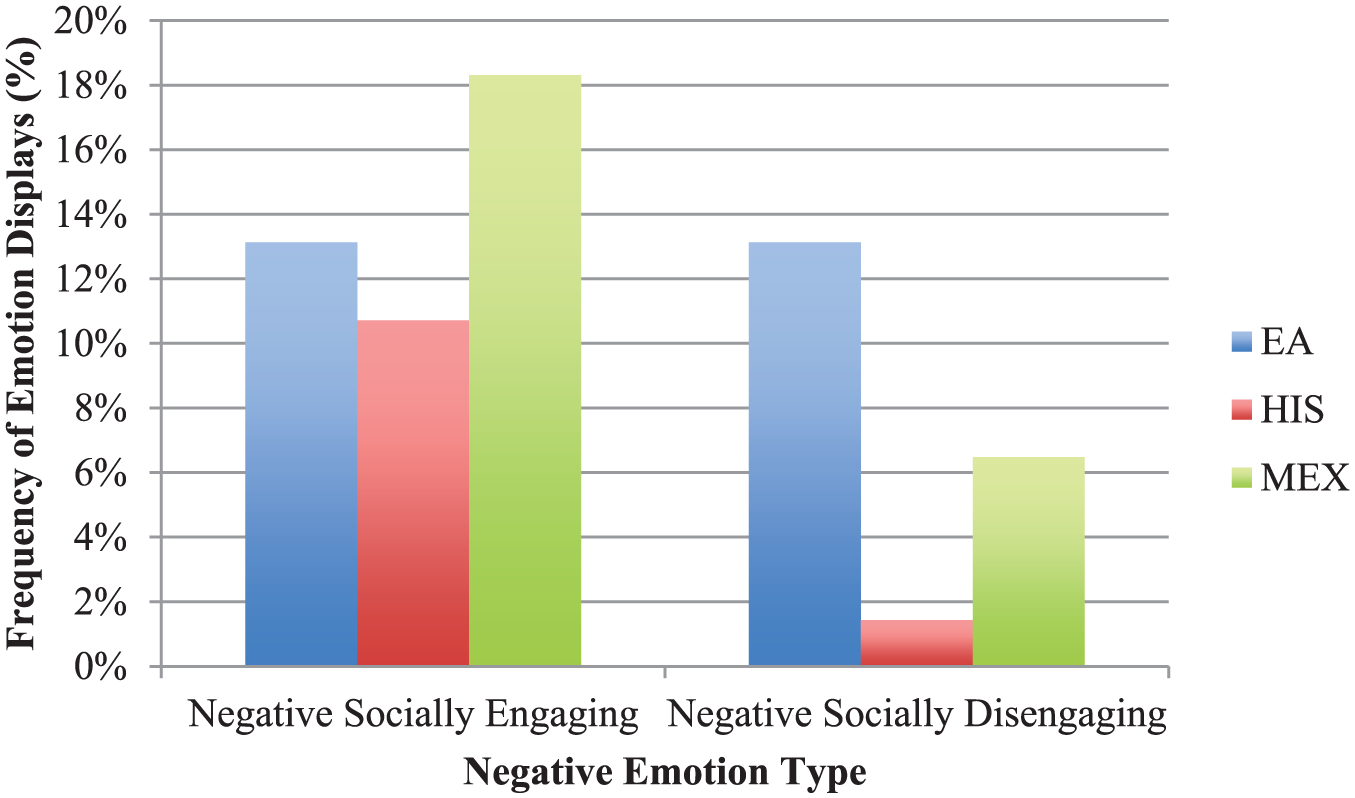
Frequencies of negative emotion-type displays by storybook culture.
Intensity of Expression
For the intensity of expression analysis, negative socially disengaging emotions were not included due to the low sample size in Hispanic storybooks (see above). Therefore, we ran a 3 (culture: European American, Mexican, Hispanic) × 2 (emotion type: positive, negative socially engaging) × 2 (social context: in-group, out-group) × 2 (gender: male, female) ANOVA with intensity of expression as the dependent variable. We also used a least-squares means method because of the variance in sample sizes. Emotion type displayed an overall main effect, F(1, 773) = 23.15, p < .001, with negative socially engaging emotions displaying higher intensity M = 2.41 (SE = 0.08) than positive emotions M = 1.99 (SE = 0.03). The anticipated interaction of culture and emotion type was not significant, F(2, 773) = 2.10, p = .1229. However, there still was a cultural effect, as Hispanic storybooks displayed the lowest intensity of expression, and this difference was qualified by a significant interaction effect of culture and gender, F(2, 773) = 3.83, p = .0222. Hispanic females displayed the lowest intensity (M = 1.73, SE = 0.10) compared with all other groups except Hispanic males (M = 1.99, SE = 0.12; see Figure 2). The expected three-way interaction for culture, emotion type, and social context was also not significant, F(2, 773) = 1.84, p = .1601. No significant main effects or other interaction effects for social context were found.

Mean intensity of expression estimates by culture and gender.
Summary of Results
There were no cultural differences in number of storybook characters or number of figures per page. European American storybooks had the most protagonist characters, followed by Hispanic storybooks, and Mexican storybooks had the least protagonists. Next, Mexican storybooks had more male than female characters, whereas both European American and Hispanic storybooks had more equal gender distribution. Overall, more male characters than female characters displayed no emotion, and there were no cultural differences in this gender distribution. Positive emotions were more dominant across cultures, and Hispanic storybooks displayed these emotions more frequently than the other two cultures. As for negative emotion types, Mexican and Hispanic storybooks were similar, as they both displayed more negative socially engaging emotion type and less negative socially disengaging, while European American storybooks displayed a more balanced distribution of the two negative emotion types. Overall, negative socially engaging emotion type displayed higher intensity of expression, and there was no interaction of culture and emotion type. Across emotion types, Hispanic books displayed the lowest intensity of expression, as a result of an interaction of culture and gender; Hispanic female characters displayed the lowest intensity of expression compared with all other cultural and gender combinations except for Hispanic male characters. Social context was not a significant factor in intensity of expression. Finally, we would like to state that the complete new recoding of the emotion displays for the same European American books as in the study by Vander Wege et al. (2014) led to consistent results strengthening the validity of the previous coding by replicating similar results.
Discussion
The goal of this study was to compare cultural emotion norms as represented in emotion displays in Mexican, Hispanic, and European American storybooks with an emphasis on Hispanic acculturation. As a first step to investigate the acculturation orientation of Hispanic storybooks, we assumed cultural differences between the mainstream (i.e., European American) and heritage (i.e., Mexican) groups. European American storybooks were expected to display a wide range of emotions including negative socially disengaging emotions that threaten the relationship with others, and high endorsement of intensive emotion expressions, which are seen as typical of an individualistic culture with an independent self-construal. On the contrary, Mexican storybooks were expected to display more restricted salience of emotions, especially socially disengaging emotions (e.g., anger), and less intensive emotion expressions, which are seen as typical of a collectivistic culture with an interdependent self-construal. Second, we identified whether the emotion norms represented in Hispanic storybooks reflected an acculturation orientation that adopted the emotion norms of the mainstream culture (i.e., European American) or maintained the emotion norms of a heritage culture (i.e., Mexican), as evident by the differences between the emotions displays found in the European American and Mexican storybooks.
Nonemotional Storybook Features
To validate the assumption that these media reflect general cultural norms, cultural nonemotional features (e.g., gender, frequency protagonist was depicted) were tested first. The validation was partly confirmed. As expected, European American compared with Mexican storybooks displayed a higher representation of protagonists, reflecting stronger independence norms by focusing on the individual; the hero is the focal point of the story. Furthermore, European American compared with Mexican storybooks displayed more balanced gender distribution, which may represent stronger gender equality, or the influence of Mexican values distinguishing strong gender roles such as machismo and marianismo (Cauce & Domenech-Rodriguez, 2002; Gamble et al., 2006; Romero et al., 2000). Evidence for fewer figures per page in European American storybooks was not supported, as this feature did not differ across cultures.
Emotion Displays
The proportion of nonemotional displays did not differ between European American and Mexican storybooks. Furthermore, in both groups, more male characters displayed no emotion type compared with female characters, supporting the idea that females express emotions at a higher frequency compared with males (Fabes & Martin, 1991). A stronger gender effect was expected for Mexican storybooks compared with European American storybooks, as Mexico endorses higher differentiation of gender role expectations (Cauce & Domenech-Rodriguez, 2002; Gamble et al., 2006; Romero et al., 2000) and emphasizes values restricting emotionality of males, such as machismo (Ojeda & Piña-Watson, 2014). However, this was not supported. Lack of emotional expression does not necessarily mean that the character suppresses an emotion, but that he or she may show a neutral face given the current event and context. The fact that authors and illustrators depicted more males without emotion expression points to a general gender-specific norm that seems to be common in both cultural groups.
Frequencies of emotion displays in media such as children’s storybooks allow inference regarding the relevance and salience of type of emotions (Vander Wege et al., 2014). A high versus low number of displays of a certain emotion (e.g., pride or sadness) may indicate high versus low relevance of the emotion for this respective culture. As expected, positive emotions had an obvious predominance in all of the storybooks, providing support to a universal encouragement of positive emotions (see Cole & Tan, 2007). The hypotheses for negative emotion display were confirmed; compared to European American storybooks, Mexican storybooks displayed less negative socially disengaging emotions (e.g., anger), which is reflective of an interdependent self-construal. These results are consistent with other studies that have found that collectivistic countries (e.g., Romania and Turkey), which emphasize an interdependent self-construal, also display negative socially disengaging emotions less frequently (Vander Wege et al., 2014). In addition, compared to Mexican storybooks, European American storybooks exhibited a more balanced display of socially engaging and disengaging negative emotions, which emphasizes free expression and is suggestive of an independent self-construal.
Intensity of Expression
The hypothesis that European American storybooks would display higher intensity of emotion expression compared with Mexican storybooks, especially for positive emotions, was not confirmed. Storybooks from both cultures displayed similar intensities of emotion expression, and no interaction was found for valence of emotion. The rejection of this hypothesis can be explained in a few ways: First, Mexican culture is collectivistic (Hofstede, 2001), which suggests that interdependence may be mostly achieved by relatedness and strong, close relationships (Kitayama et al., 2000). These relationships may in turn allow stronger expression of emotions compared with other collectivistic cultures such as East Asian countries, in which interdependence is achieved by conformity to social norms and hierarchy, which may require higher control of emotion expressions (Güngör, Karasawa, Boiger, Dinçer, & Mesquita, 2014). Also, a higher endorsement of emotion expression in Mexico was also demonstrated in the display rule study by Matsumoto et al. (2008), in which Mexico was placed relatively high in endorsement of overall expressivity compared with other countries with similar collectivistic orientation such as Hong Kong, Malaysia, China, and Japan (see Matsumoto et al., 2008).
The hypothesis that individuals in collectivistic cultures convey less intense negative emotions toward in-groups, as they strive for higher group cohesion and harmony than those in individualistic cultures, was not confirmed for storybook characters in the respective Mexican and European American cultures; this is because the intensity of emotion expression was not different between in-group and out-group. There are two main post hoc explanations for these findings. First, most of the negative emotions were socially engaging emotions and these emotions do not threaten the relationship with in-group members. To the contrary, emotions such as sadness, fear, or disappointment present the person in a submissive state that asks for support. Second, the definition of in-group and out-group members is not clear-cut in the literature (see Safdar et al., 2009). The fact that we included peers and distant relatives as part of the out-group may also reduce the potential effect of in-group/out-group on intensity of expression.
Acculturation Orientation in Hispanic Storybooks
The analyses for the Hispanic storybooks support a domain-specific acculturation orientation regarding the comparison between general norms (i.e., gender norms, cultural syndromes of individualism and collectivism) and emotion norms. The nonemotional storybook features pointed to an acculturation orientation characterized by adopting the mainstream (European American) culture. The nonemotional storybook features displayed a balanced gender distribution of characters similar to the European American storybooks. Although the emphasis of a protagonist character was weaker than in the European American storybooks, the emphasis was still significantly higher than in the Mexican storybooks, which may reflect an ongoing cultural adoption of the individualistic American norms. In contrast, emotion norms as reflected in the Hispanic storybooks showed a different acculturation orientation, namely pointing to maintenance of heritage (Mexican) culture norms. Similar to the Mexican storybooks, negative socially disengaging emotions were less salient than negative socially engaging emotions.
Interestingly, some results of emotion displays could not be interpreted in the framework of acculturation orientation as they differed from both groups. These results may be better interpreted in light of the minority status of Hispanics. Hispanic storybooks displayed a higher frequency of positive emotions than the other two cultures, which could be attributed to overemphasizing the desire for a positive emotional experience (see Consedine, Magai, Horton, & Brown, 2012). Hispanic storybooks displayed lower intensity than the other two cultures, especially female characters. The low intensity of expression in Hispanic storybooks may also be interpreted based on the minority status of this cultural group; belonging to a minority group may require a stronger need to control emotion expression to facilitate the adaptation to the host culture (e.g., Consedine et al., 2012). The lower intensity of expression may also reflect low social power (see Keltner, Gruenfeld, & Anderson, 2003).
Limitations
The findings in this study should be interpreted in light of several limitations. First, it is important to consider that while we use Mexico in this study to represent a heritage Hispanic culture, as the majority of Hispanics in the United States are of Mexican origin, there are other origin countries that account for the Hispanic population in the United States, such as Puerto Rico, El Salvador, and Cuba, for example (see Flores, 2017). Therefore, we acknowledge that the books chosen in the study to represent Hispanic culture may reflect an array of values, beliefs, and overall heritage customs that may stem from various cultural backgrounds, and therefore, may not solely reflect a Mexican background. For example, the balanced gender distribution in Hispanic books could alternatively reflect maintenance of Salvadoran cultural norms, as El Salvador is categorized as a feminine country and, therefore, supports more gender equality (Hofstede, 2001). As such, future studies should investigate the influence of other possible heritage cultures on Hispanic media in the United States.
Also, it can be criticized that the selection of the Mexican storybooks does not contain folktales representative of Mexican culture. Two arguments need to be considered here. First, translations of old and foreign stories typically come with new illustrations done by members of the respective culture. Similar to Tsai et al. (2007), our analysis is focused on the character depictions and not on the storyline. Second, at the time of the search and media selection, the best available information about the most popular Mexican children’s storybooks led to the selection of these storybooks. The popularity criterion was preferred as these media represent concurrent cultural preferences compared to folktales that are not read in a widespread way, but are passed down through the cultural tradition of storytelling. In a study of storytelling in Mexican homes, it was found that the discourse of style of folktales is not that of a storybook, but rather that of a family conversation (Reese, 2012). As such, no folktales were included in the established popularity list for Mexican storybooks. Furthermore, the results support the view that the illustrations in the popular Mexican storybooks reflect rather general traditional norms.
Beyond this analysis, it was interesting to note how detailed information about authors, the origins of stories, translators, illustrators, and modifications of original text were not mentioned at all. Sometimes, the storyline is changed from the original and it is not clear from which template the lines are taken or if they were just modified by the translator. It could be an interesting extension of the project to analyze versions of the same storybook in different languages and illustrations.
The number of coded storybooks was small and should be expanded in the future to better capture how storybooks may reflect cultural emotion norms. Such expansion would be important to increase the rate of negative socially disengaging emotions—whose prevalence rate was especially low in Hispanic storybooks—to analyze this type of emotions in more detail. Furthermore, we also exclusively focused on the pictorial displays. It would be interesting to add content analysis of the text, especially analyzing whether emotions are included in the narrative, and if so, how these emotions are worded.
Finally, young children do not always consume storybooks alone, given that parents or caretakers will read them with the child, or read them to the child. As a result, it is important to examine how parents or caretakers present the emotional context in these media to the children, as this may be another emotion socializing mechanism.
Conclusions and Outlook
The study showed several systematic differences of emotion displays between European American and Mexican children’s storybooks that may represent culture-specific emotion norms. The identification of emotion norms in media such as children’s storybooks is an important approach to identify culture-specific emotion norms. Such specific norms can serve as a meaningful framework for future studies about emotion socialization with the respective cultural groups because these norms, related beliefs, and socialization practices can vary between cultures with similar general cultural norms (Halberstadt & Lozada, 2011).
This study has demonstrated that acculturation strategies of Hispanic culture in the United States may reflect a domain-specificity model regarding general norms and emotion norms due to the variation in context of cultural adoption and cultural maintenance (see Celenk & van de Vijver, 2011). Cultural adoption of the mainstream (European American) culture occurred in the domain of nonemotional storybook features, as observed by balanced gender distribution and a higher display of protagonist characters compared with Mexican storybooks. In contrast, emotion norms in the Hispanic storybooks partly pointed to maintenance of a heritage culture, but the represented norms mostly point to the minority status. As media such as children’s storybooks continue to influence children’s emotional development, it is important to document the similarities and differences of emotion norms across ethnic groups to which children are exposed, especially in a diverse setting such as the United States.
Footnotes
Declaration of Conflicting Interests
The author(s) declared no potential conflicts of interest with respect to the research, authorship, and/or publication of this article.
Funding
The author(s) disclosed receipt of the following financial support for the research, authorship, and/or publication of this article: This research was funded by the Modified Student Summer Scholars (MS3) program on behalf of the Office of Undergraduate Research and Scholarship (OURS) of Grand Valley State University.
Notes
Author Biographies
 ).
).