



Abstract
This study explores the intricate relationships between job satisfaction, organizational commitment, and turnover intention among Basic Education and High School teachers in Manabí, Ecuador. Utilizing structural equation modeling on a sample of 6,316 teachers, our investigation reveals significant insights into the dynamics of teacher retention within the educational system. Findings indicate a positive association between normative commitment and both intrinsic and extrinsic job satisfaction, alongside a negative effect with turnover intention. Moreover, both intrinsic and extrinsic satisfactions exhibit a negative relationship with turnover intention, underscoring the pivotal role of job satisfaction in teacher retention. This research contributes to the limited literature on these variables in the Latin American educational context, emphasizing the necessity of fostering organizational commitment and job satisfaction to enhance teacher retention and, by extension, educational quality. The study’s implications suggest that educational policies should prioritize the improvement of job satisfaction and organizational commitment as strategic measures to mitigate teacher turnover, thereby ensuring a stable and motivated teaching workforce essential for educational excellence.
Keywords
Introduction
Job satisfaction is defined as a positive and gratifying emotional state, derived from the subjective appreciation of individual work experiences (Conley & You, 2016). This variable has been extensively examined from both intrinsic and extrinsic perspectives (Maryam et al., 2021; Pérez et al., 2023; Zhu et al., 2022), covering various aspects of the employee’s work experience.
According to the literature, intrinsic factors of teachers’ job satisfaction include a sense of achievement, recognition, the nature of work, responsibility, opportunities for promotion and personal development, autonomy, and colleague support (Khany & Tazik, 2016; Sumanasena et al., 2020). On the other hand, extrinsic factors encompass external elements such as salary, job security, and working conditions (Hur & Bae, 2021).
In summary, while intrinsic job satisfaction is directly related to the task or work activity, extrinsic satisfaction is associated with external rewards linked to the job. Evidence suggests that satisfied teachers are more likely to remain in their institutions, contributing positively to their productivity and quality of work. Conversely, dissatisfaction is linked to an increased turnover intention, adversely affecting performance and organizational effectiveness (Ennida & Allouani, 2023).
The concept of organizational commitment was introduced by social psychologists in the 1950s to understand why some employees stay with their organizations while others decide to leave (Phetsombat & Na-Nan, 2023). However, it was not until the 1970s that organizational commitment emerged as a significant field of study in organizational behavior and management research.
This commitment has been conceptualized as a psychological state comprising three dimensions: an emotional attachment to the organization, a normative obligation, and a perception of continuity that recognizes the costs associated with leaving the organization (Allen & Meyer, 1991; Ennida & Allouani, 2023; Matherly et al., 2022; McInerney et al., 2015). From the perspective of the Ecuadorian educational sector, this research has focused on two of the three dimensions of the Allen and Meyer (1991) model: affective and normative commitment, while the commitment to continuity, following the steps of Zopiatis et al. (2014), has been approached from the perspective of turnover intention. This is because the continuance dimension, based on the perceived cost of leaving the organization, may not adequately reflect current labor market realities, where factors such as labor mobility and access to new opportunities are becoming increasingly relevant (Ruesga et al., 2014). Incorporating turnover intention instead of continuity provides a better understanding of how job satisfaction influences organizational commitment from a contemporary perspective.
Affective commitment refers to the positive emotional connection employees feel toward their job, colleagues, and organization, considered in the educational context as the emotional attachment, identification, and involvement of a teacher in the school (Meredith et al., 2023). Normative commitment, meanwhile, is related to the employee’s sense of obligation to adhere to the organization’s norms and regulations (Fernandez, 2013). Studies like that of Vidic et al. (2022) have shown that teachers with a high degree of commitment are more dedicated to their work and more willing to contribute to school objectives, reducing their turnover intention.
Although job satisfaction and organizational commitment are distinct concepts, they are interconnected. Job satisfaction represents an affective response to specific aspects of work, while commitment refers to an affective response to the organization as a whole (Conley & You, 2021). Conversely, a lack of commitment and job satisfaction is associated with a higher turnover intention, defined as the desire to leave the current position, whether within the same institution or for another, or even to completely abandon the profession (González-Escobar et al., 2020).
Teacher turnover can be categorized into three types: (a) definitive abandonment of teaching, (b) transition to administrative or leadership roles within the educational sector, and (c) voluntary departure to another educational establishment. Turnover intention is influenced by multiple factors, including job dissatisfaction and the absence of organizational commitment, salary, school organization, autonomy, resources, burnout, understanding of the school’s cultural context, interpersonal relationships, and opportunities for professional growth (Kelly et al., 2019; McInerney et al., 2015).
Among these factors, job satisfaction and organizational commitment are particularly significant because they often act as overarching indicators that reflect teachers’ perceptions of their work environment, resources, and relationships within the school (Lopes & Oliveira, 2020). Focusing on these two aspects can help mitigate challenges such as burnout, restricted autonomy, and strained interpersonal dynamics (Richards et al., 2019). Thus, educational institutions must prioritize teachers’ job satisfaction and organizational commitment to minimize turnover intention and retain high-quality educators.
Retaining the best teaching professionals is a pressing challenge for educational systems due to its direct impact on the quality of education. In Ecuador, the centralized model of teacher recruitment and assignment stands in contrast to decentralized systems like those in the United States, where school districts autonomously manage these functions (Carver-Thomas & Darling-Hammond, 2017). This centralized approach faces specific challenges, such as bureaucratic hurdles in recruitment processes, mandatory rural placements, and difficulties in managing dismissals.
Scientific literature highlights that centralized models, while aimed at ensuring equitable resource distribution, often lack flexibility to adapt to local needs and dynamics (Harris, 2020). In the Ecuadorian context, this rigidity exacerbates challenges in attracting and retaining teachers, particularly in rural areas, due to unfavorable working conditions and the absence of adequate incentives (Bertoni et al., 2018). Additionally, complex administrative processes can discourage both prospective candidates and in-service teachers (Johnson, 2017). Comparative studies of educational systems in Latin America, such as the one conducted by Bruns and Luque (2014), have shown that while centralized policies are useful for reducing inequalities in access to education, they require adjustments to ensure teacher stability in hard-to-reach areas.
These findings emphasize the importance of studying the Ecuadorian context to propose more effective policies that not only reduce teacher turnover but also strengthen the overall educational system. Furthermore, the lack of updated and consistent data on teacher satisfaction, commitment, and turnover in Ecuador—particularly in the largely rural province of Manabí—presents additional challenges. This study is therefore essential to understand how these dynamics impact teachers. Its results could contribute to the design of strategies aimed at ensuring greater teacher stability, thereby improving access to and equity in education across Ecuador.
Based on the above, this study aims to determine the relationship between job satisfaction, organizational commitment, and turnover intention among Basic Education and High School teachers in the province of Manabí, Ecuador, to fill existing gaps in the scientific literature on these constructs in the educational context.
Conceptual Framework and Theoretical Model
The link between job satisfaction, organizational commitment, and turnover intention is understood when three theoretical perspectives are articulated: First, the Self-Determination Theory (Deci & Ryan, 2000), which explains how the satisfaction of basic psychological needs (autonomy, competence, and relatedness) promotes intrinsic motivation and, consequently, greater job satisfaction. Second, Herzberg’s Two-Factor Theory (Herzberg et al., 1959), which supports the existence of motivator (intrinsic) and hygiene (extrinsic) factors as determinants of job satisfaction and, in turn, of the intention to stay. Finally, the Three-Component Model of Organizational Commitment by Allen and Meyer (1991), which explains the role of affective and normative commitment as predictors of work behavior, functioning as emotional bonds that discourage turnover intention, functioning as an emotional bond that discourages the external intention to seek other employment.
Job Satisfaction and Organizational Commitment
In the educational field, addressing teachers’ job satisfaction and commitment is crucial to mitigate the global shortage of professionals in the sector and promote their well-being, as well as that of the students (Lopes & Oliveira, 2020; Toropova et al., 2021). Teaching is a profession that demands a plethora of emotions (Peng et al., 2023); the commitment and satisfaction of teachers reflect the experiences and conditions offered by educational institutions and the educational system. When teachers achieve positive professional development, they are intrinsically motivated and feel a greater commitment to their work (Malm, 2020; Nazari & Karimpour, 2022). From Deci and Ryan’s (2000) self-determination theory, this intrinsic motivation is explained by the satisfaction of the basic needs for autonomy, competence, and relatedness. Therefore, educational institutions that foster teacher decision-making, formative feedback, and supportive relationships reinforce teachers’ satisfaction and commitment.
Regarding the relationship between affective commitment and extrinsic job satisfaction, Nazir et al. (2016) highlight that there is a positive association between satisfaction derived from extrinsic benefits and affective commitment. Affective commitment can influence teachers’ extrinsic job satisfaction in several ways. By establishing an emotional connection with their work, teachers are likely to value the tangible rewards associated with it, such as salaries, benefits, and external recognition (Khuram et al., 2022; Täht et al., 2023). Additionally, this affective commitment can motivate educators to exert more effort in their teaching roles, which can lead to better outcomes and, in turn, greater extrinsic rewards (Castro et al., 2023). On the other hand, when teachers perceive that their efforts are adequately recognized and rewarded, they are more likely to develop a positive emotional connection and feel valued, which can strengthen their affective commitment (Bradbury & Wilson, 2020; Jiang et al., 2021; Simonton et al., 2022).
Strengthening teachers’ emotional bonds depends on the quality of their relationship with their students (Cseplö et al., 2022; Kim, 2022). The benevolence and concern shown by the teacher for their students’ actions create a trustful atmosphere in the classroom (Weinstein et al., 2022). In terms of self-determination theory, these practices nurture the need for relationships between teachers and students, as they enhance both autonomous motivation and intrinsic motivation based on interest in the activity, and translate into greater job satisfaction.
Work commitment is negatively relationship with burnout, which occurs when teachers feel demotivated and lose their commitment to the profession due to work overload, lack of resources, and prolonged stress (Burić et al., 2023; Jeon et al., 2022). In this situation, emotional intelligence and resilience can mitigate the negative effects on the teaching collective (Ellison & Mays-Woods, 2019; Washburn et al., 2021). Consequently, managers’ concern for the well-being and success of teachers, along with strategies to reduce work-family conflict, positively contribute to affective commitment, thus alleviating the emotional exhaustion of education professionals (Richards et al., 2019; Zhou & Li, 2022).
Since Herzberg et al. (1959), evidence indicates that the nature of the work and opportunities for professional development act as motivators that drive intrinsic satisfaction and affective commitment, whereas supervision, procedures, and compensation operate as extrinsic conditions that prevent dissatisfaction and contribute to normative commitment by fostering perceptions of organizational justice. Teachers who have a high level of normative commitment to their school organization also tend to have high levels of intrinsic job satisfaction (Araoz & Ramos, 2021; Toropova et al., 2021). Maryam et al. (2021) assert that intrinsic satisfaction significantly and positively influences both affective and normative commitment. While Valaei and Rezaei (2016) concluded that factors such as salary, promotion, additional benefits, supervision, operational procedures, and the nature of the work have a positive relationship with both affective and normative commitment. Despite these contributions, it is important to highlight that the relationship between the variables mentioned in specific academic contexts in developing countries, such as Ecuador, has been scarcely investigated.
Based on self determination theory, Herzberg’s two factor framework, and Allen and Meyer’s three component model, we expect teachers’ affective and normative commitment to be positively related to both intrinsic and extrinsic job satisfaction. Given the limited evidence from developing-country systems such as Ecuador, we expect these relationships to hold in this context as well. Accordingly, we propose the following hypotheses:
Job Satisfaction, Organizational Commitment, and Turnover Intention
The growing turnover intention among employees represents a significant challenge to organizations (Redondo, 2021), endangering not only employee productivity but also organizational stability (Meyer et al., 2019). Scientific literature has explored the relationship between various types of satisfaction, organizational commitment, and turnover intention. For instance, Akosile and Ekemen (2022) discovered that intrinsic satisfaction derived from job satisfaction has a negative relationship with turnover intention. Haque et al. (2018) suggest that affective commitment acts as a partial mediator in the relationship between turnover intention and employees in direct supervisory roles, emphasizing its influence on job stability. This pattern is consistent with Deci and Ryan’s (2000) self-determination theory, which holds that when a worker has autonomy, feels competent, and maintains supportive relationships, their intrinsic motivation increases, their affective commitment is strengthened, and turnover intention decreases.
In the educational sector, research indicates that teachers satisfied with their job are less likely to leave their profession (Whipp & Salin, 2018), while those dissatisfied are more inclined toward turnover (Madero, 2019; Shim et al., 2022; Thomas et al., 2020; Q. Zhang et al., 2022), contributing to high dropout rates that detrimentally affect education quality (Torres, 2020). Teacher burnout, resulting from emotional and physical exhaustion, stands as a primary reason for teachers considering job abandonment (Li & Yao, 2022; Zhao et al., 2023). Additionally, teachers from lower socioeconomic schools, feeling more emotionally drained, express a desire for transfer to other institutions (Van Eycken et al., 2022).
The link between affective commitment and turnover intention in teaching underscores the importance of emotional investment in retaining educational professionals (Torres, 2020). Teachers with high affective commitment are not only committed to their job responsibilities but are emotionally engaged with their work (Nalipay et al., 2019). This emotional bond among teachers, in accordance with Allen and Meyer’s (1991) three-component model, leads them to develop their affective commitment and may be accompanied by normative commitment, thereby decreasing turnover intention. Empirical evidence shows that affective commitment to the organization and the profession is negatively related to turnover intention, as teachers with a high level of affective commitment will have fewer intentions of leaving the organization and their profession (McInerney et al., 2015). This aligns with evidence that positive teacher emotions significantly impact professional practices, learning, commitment, and student outcomes (Burić & Frenzel, 2021).
Upon reviewing studies that assessed the relationship between normative commitment and turnover intention, it was found that normative organizational commitment is significantly and negatively related to teachers’ turnover intention, as those teachers who endorse a high level of normative commitment will express a weak desire to leave the organization and the profession (McInerney et al., 2015). Moreover, Maryam et al., (2021) indicate in their research that the dimensions of organizational commitment show a significant negative influence on teachers’ turnover intention, emphasizing commitment as a deterrent against definitive departure from educational institutions or the teaching career.
The relationship between extrinsic job satisfaction and turnover intention involves multiple interconnected factors such as salary, class size, student behavior, workload, educational resources, lack of administrative support, or autonomy restrictions (Gaete et al., 2017; H. Zhang et al., 2023), potentially leading to teacher demotivation and contemplation of job departure. Moreover, the absence of social and professional recognition can exacerbate extrinsic job dissatisfaction, with teachers seeking validation for their efforts. Addai et al. (2018) revealed a significant negative correlation between overall job satisfaction and turnover intention among public school teachers in Ghana, highlighting salary satisfaction as a negative predictor of turnover intention.
Therefore, enhancing remuneration emerges as an effective strategy to boost teacher engagement and likelihood of retention within educational settings (Li et al., 2021). Additionally, teachers experiencing administrative support, positive student behavior, and recognition of autonomy report higher job satisfaction and commitment, reducing turnover intention (André et al., 2023; Conley and You, 2017; Ortan et al., 2021).
Synthesizing this theoretical and empirical background, we expect turnover intention to be inversely associated with teachers’ affective and normative commitment, as well as with intrinsic and extrinsic facets of job satisfaction. Accordingly, we advance the following hypotheses regarding turnover intention:
Methodology
Research Design
This study adopted a research design grounded in a positivist paradigm. Data were analyzed using covariance-based structural equation modeling (CB-SEM) to test the proposed relationships among affective commitment, normative commitment, intrinsic and extrinsic job satisfaction, and turnover intention. It is a cross-sectional correlational study based on data that has already occurred—no variables were manipulated—making it suitable for (a) estimating the strength and direction of associations in a large population of primary- and secondary-school teachers and (b) simultaneously evaluating measurement quality and structural paths. By integrating measurement and structural models in a single analytical framework, CB-SEM offers greater control over measurement errors than traditional regression techniques and provides global fit indices that assess the robustness of the theoretical model.
Instruments
The methodology for measurement was based on previously validated instruments, implementing a quantitative questionnaire to assess the hypothesized relations, drawing from the works of González Santa Cruz et al. (2014), Burić and Moè (2020), and Zopiatis et al. (2014). These tools were carefully adjusted to align with the specific characteristics of our geographical context in a developing country such as Ecuador and the research theme. The instrument was structured into three sections. The first section measured job satisfaction. The second section focused on assessing work engagement and turnover intention, with 29 items measured using a 1-5-point Likert scale, distributed across five constructs. The third section collected demographic and contextual data for a more robust analysis. The questionnaire underwent a pilot test to ensure its reliability and address potential inconsistencies.
Data Collection
The study targeted a population of 19,296 teachers of Basic General Education and Baccalaureate in the province of Manabí, Ecuador. The teachers were contacted with the support of regional educational managers and participated in an online survey conducted between January and April 2022. The survey, distributed through Google Forms, received 6,316 responses, representing 32.73% of the target population. Despite the high participation rate, the methodology employed was exhaustive sampling rather than probabilistic, ensuring significant representativeness of the results. The survey took approximately 6 min to complete, and participants were assured of voluntariness, anonymity, confidentiality, and informed consent. The research adhered to ethical protocols approved by the Ministry of Education, following the principles and recommendations of the Declaration of Helsinki.
Data Analysis
For data analysis, AMOS software (V.20) and Structural Equation Modeling (SEM) were utilized, a method validated in scientific literature to determine relationships between constructs and validate proposed theories. The use of SEM is valuable when the main objective is to test and validate a theoretical model with multiple relationships between unobservable constructs (such as organizational commitment or turnover intention) using multiple indicators, which enhances the precision of the analysis compared to methods based solely on observed variables. SEM includes an analysis of the overall fit of the theoretical model to the empirical data, providing information on the consistency of the proposed model, and accounts for errors associated with measurements, thereby improving the reliability of the results. The ratio between the sample size and the number of observed variables exceeded the 10-to-1 criterion suggested by Thompson (2000). The hypothesized model examined five latent variables: Affective Organizational Commitment (AOC), Normative Organizational Commitment (NOC), Intrinsic Job Satisfaction (IJS), Extrinsic Job Satisfaction (EJS), and Turnover Intention (TI).
The SEM analysis was conducted in two stages: The first, the measurement model analysis and validity, evaluating the reliability and validity of the constructs.
The second, the structural model analysis, testing the hypotheses presented in the model (Figure 1). The detailed results of these analyses are provided in the subsequent section.

Proposed theoretical model linking job satisfaction, organizational commitment, and turnover intention (Hypotheses H1–H8).
Demographic Profile of Participants
The final composition of the sample, consisting of 6,316 valid participants, revealed that approximately 51.6% are teachers at the Basic Education level. A further 19.4% perform teaching roles at both Basic and Secondary Education levels, while the remaining proportion is dedicated exclusively to Secondary Education. The data indicates a predominance of females in the teaching profession, representing 70.8% of the total participants, suggesting a notable gender disparity. Regarding salary conditions, there is observed to be a limitation in remuneration, with 95% of respondents reporting a net salary of less than 1,000 US dollars, highlighting the modesty of income in this sector. The majority of these professionals, specifically 94.1%, are employed by government entities. Additionally, it is important to note that approximately 48.7% and about 45% of the teachers have less than 10 years of tenure in the sector, indicating a relative professional youth within the group studied. Table 1 summarizes the data on the sociodemographic profile.
Sociodemographic Profile.

Results
Analysis of the Measurement Model
The elements used in this research were adapted from previous works. The analysis of the measurement model began with an Exploratory Factor Analysis (EFA) to obtain the factors first. This process allowed the complexity of the dataset to be reduced by grouping a significant number of items into a reduced number of dimensions based on their similarity (Lévy & Varela, 2006). The EFA generated five factors (AOC, NOC, IJS, EJS, and TI), accounting for over 61% of the explained variance, grouping the 29 items (10 related to organizational commitment, 14 to job satisfaction, and 5 to intention to leave). The elements pertaining to each of the variables that constitute the measurement scale are located in Annex I. Subsequently, Harmon’s one-factor test was applied to the data (Chakraborty et al., 2021) to ensure that there was no dominant factor accounting for more than 50% of the variance.
Once the constructs have been defined, the measurement model must be specified. This model is essentially a Confirmatory Factor Analysis, in which the relationships between observed and latent variables are examined. The parameters estimated in the measurement model were statistically significant (p < .05), with factor loadings above 0.5 (Table 2), indicating a satisfactory saturation of all items with their respective latent variables.
Measurement Model, Indicator Loadings, and Construct Validity.
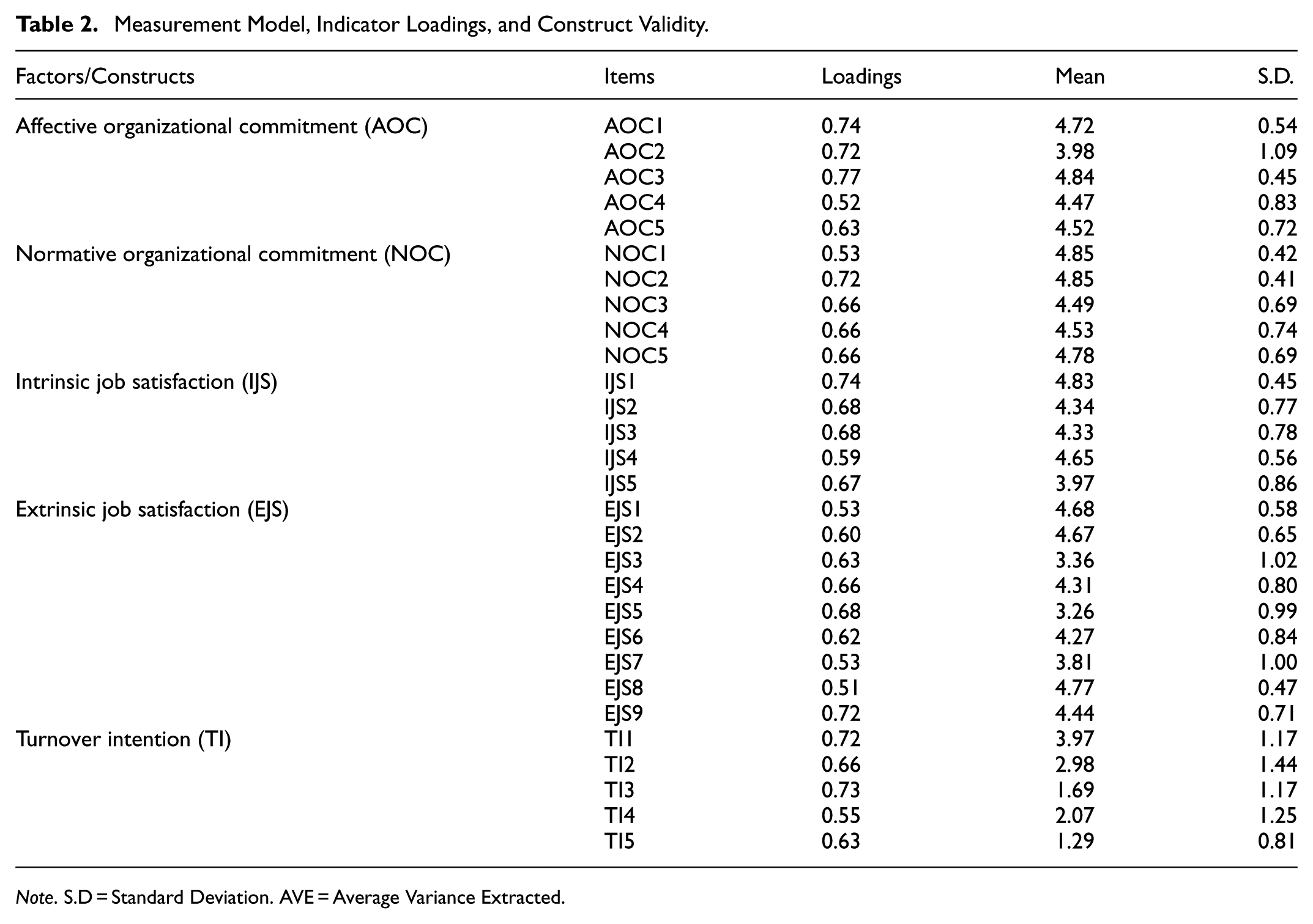
Note. S.D = Standard Deviation. AVE = Average Variance Extracted.
To evaluate the structural fit of the hypothetical model, goodness-of-fit measures were utilized. Although a non-significant Chi-square value generally indicates an acceptable model, this measure is often disregarded due to frequently reported significance, attributed to sample size limitations and its sensitivity to the likelihood ratio test index (Bentler & Bonett, 1980). The analysis yielded a Chi-square (X2) value of 1,441.572 with 534 degrees of freedom (p = .000). Given this, the CMIN/DF ratio (X2 divided by degrees of freedom) was considered a more appropriate metric, with values below three indicating an acceptable fit (Tabachnick & Fidell, 2013). The model showed a CMIN/DF of 2.700, which is considered adequate.
The internal consistency of the items was evaluated using Cronbach’s Alpha (α), yielding values above .70, necessary to consider the scale reliable (Hair et al., 2021). Additionally, composite reliability (ρc) was used, recommending values above .7 for modest reliability, and preferably higher than .8 for greater reliability (Calvo, 2013). The obtained values for Cronbach’s Alpha (α) and composite reliability (ρc) indicated acceptable internal consistency, ranging from .79 to .86 and exceeding .75, respectively (Table 3).
Internal Consistency, Convergent Validity, and Discriminant Validity.

Note. α = Cronbach’s Alpha. ρc = Composite reliability. AVE = average variance extracted.
Squared root of AVE on the diagonal.
Correlations between constructs below the diagonal.
Finally, the model’s convergent validity was examined through the average variance extracted (AVE) (Fornell & Larcker, 1981), recommending values above 0.5 to indicate that more than 50% of the variance of the constructs is due to their indicators (Hair et al., 2021). The results showed that this condition is met for all the constructs evaluated (Table 3).
Regarding the goodness-of-fit indices (Table 4), both absolute and incremental, they showed satisfactory results. The NFI, TLI, and CFI indices exceeded the threshold of 0.90, the X2/df recorded a value of 2.73, and the RMSEA a value of 0.039 with a confidence interval of 0.036 to 0.059, confirming the suitability of the proposed model (Galindo-Domínguez, 2020). These results indicate that the measurement model is robust and sustainable.
Model Goodness of Fit Indices.

Structural Model
The results of the structural model in Figure 2 show the path coefficients associated with the seven hypotheses proposed. The findings provided sufficient support for seven of the eight hypotheses proposed in this study’s model. No relationship was found between affective organizational commitment and intrinsic job satisfaction. The results of the hypothesis tests are illustrated in Table 5.
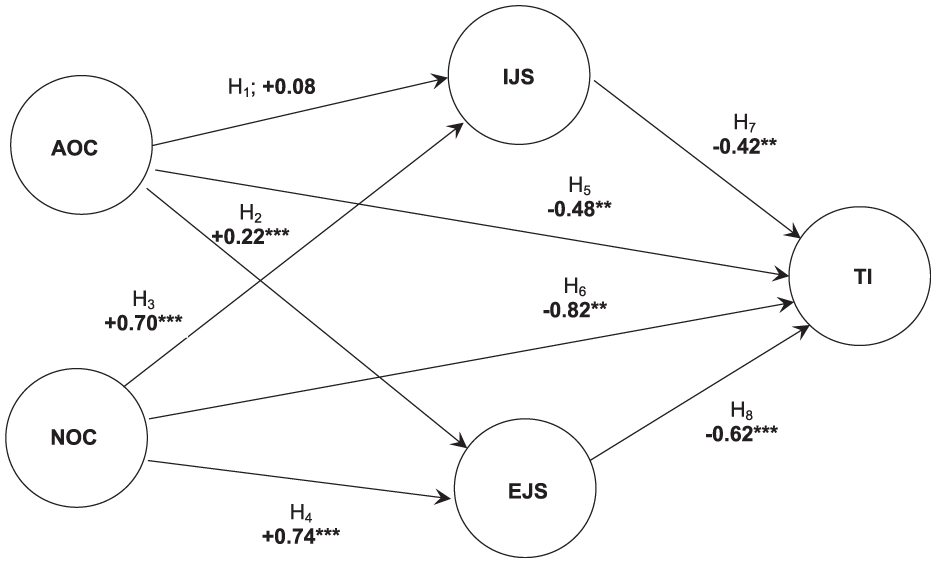
Structural model. Standardized coefficients.
Model Results—Direct Effects.

Note. Coefficient (β), p (Sig. p-values < .05, one-tailed test).
p < .05 **p < .01 ***p < .001.
The model proved to be highly explanatory, capturing 68.9% (R2 = .689) of the total variance in turnover intention.
Discussion and Conclusions
Discussion
The aim of this study has been to determine the relationship between affective and normative commitment, and the dimensions of job satisfaction—both intrinsic and extrinsic—, along with the turnover intention among primary and secondary school teachers in the province of Manabí, Ecuador. These findings contribute to addressing the significant gap in the scientific literature within the Latin American educational context and hold both academic and practical implications that can be beneficial for enhancing teachers’ well-being and their commitment to the teaching profession. These considerations are particularly relevant in the field of education, as teaching is an emotionally demanding profession that significantly impacts the physical and psychological health of educators (Luque-Reca et al., 2022) and has an undeniable influence on the quality of education.
The results fit Self-Determination Theory (Deci & Ryan, 2000): teachers who perceive autonomy, competence, and relatedness show higher intrinsic job satisfaction and, indirectly, lower turnover intention. The consistent link between intrinsic satisfaction and reduced intention to resign corroborates the findings of Addai et al. (2018) and Shim et al. (2022), suggesting that meeting basic psychological needs serves as a motivational buffer even in resource-limited settings such as rural Manabí. Conversely, a negative relationship between extrinsic satisfaction and turnover intention supports the studies of Herzberg et al. (1959), which argue that extrinsic factors become decisive when they are absent—an occurrence common in Latin-American educational systems.
Unexpectedly, affective organizational commitment did not predict intrinsic job satisfaction, whereas normative commitment emerged as the dominant predictor of both intrinsic and extrinsic satisfaction and, ultimately, turnover intention. This nuance enriches Allen and Meyer’s (1991) Three-Component Model by showing that, in high power-distance cultures, moral obligation to the institution can outweigh personal attachment as an explanatory mechanism. Similar cultural shifts have been reported in Chinese (Hong et al., 2023) and Pakistani (Maryam et al., 2021) studies, where normative ties are reinforced by social expectations of loyalty.
The results of this study suggest that affective commitment showed no significant association with intrinsic job satisfaction (Hypothesis 1 was rejected), although it did identify a slight positive and significant relationship with extrinsic job satisfaction, leading to the acceptance of Hypothesis 2. In contrast, a strong positive relationship was found between normative organizational commitment and both intrinsic (Hypothesis 3) and extrinsic job satisfaction (Hypothesis 4). This suggests that neither type of organizational commitment is a significant predictor of job satisfaction in the educational context, as also observed by Naderi (2012). This contrasts with numerous previous studies, which analyzed the intrinsic and extrinsic components of job satisfaction separately and found a positive relationship with both affective and normative organizational commitment (Namasivayam & Zhao, 2007; Yousef, 2000), with affective commitment generally showing a stronger association with job satisfaction (Froese & Xiao, 2012; Kang et al., 2021; Kuruüzüm et al., 2009), since affective commitment, defined by the emotional connection and positive bond that employees develop toward their work and organization, fosters a greater appreciation for tangible and intangible rewards, such as recognition, benefits, and the quality of interpersonal relationships in the workplace (Khuram et al., 2022; Nazir et al., 2016)
Additionally, the results confirm the existence of a negative relationship between affective organizational commitment and teachers’ turnover intention, supporting Hypothesis 5. This finding aligns with the studies by Da’as et al. (2019) and McInerney et al. (2015), highlighting the importance of affective commitment in teacher retention by fostering a sense of belonging and purpose in their work, which can act as a protective factor against the intention to leave the profession.
Normative organizational commitment emerged as the most significant predictor of turnover intention among all the relationships examined in this study, supporting Hypothesis 6. These findings strongly reaffirm the results of Zhu et al. (2022), who concluded that normative commitment, grounded in teachers’ personal convictions about the importance of education and their role as educators, generates an intrinsic sense of obligation to fulfill their professional responsibilities, thereby reducing the likelihood of considering leaving their career.
A significant negative association was found between intrinsic job satisfaction and turnover intention (Hypothesis 7). This finding is consistent with the scientific literature documenting a similar relationship between job satisfaction and turnover intentions in educational contexts (Addai et al., 2018). According to Hong et al. (2023), for teachers, a high level of job satisfaction leads to greater commitment, motivation, enjoyment, and ultimately, a higher likelihood of remaining in their position.
In line with Ingersoll and Smith (2003), who examined the factors associated with teachers’ intentions to leave the teaching profession, the findings of this study indicate a direct and significant relationship between extrinsic job dissatisfaction and teacher turnover (Hypothesis 8). Similarly, Hong et al. (2023) suggest that teachers in Singapore, who enjoy better extrinsic working conditions than their Chinese counterparts, exhibit higher job satisfaction and lower intentions to leave their positions. This underscores the importance of addressing and fulfilling teachers’ extrinsic needs—such as effective school management, quality teacher training, satisfactory remuneration, and job incentives—as essential measures to promote the retention of the best educators.
Academic Implications
The findings of this study contribute to the academic discourse surrounding job satisfaction, organizational commitment, and turnover intention within the educational sector, particularly in under-researched contexts such as Ecuador.
This study presents two main academic implications. First, the lesser or non-significance of affective organizational commitment compared to normative commitment suggests that, in certain organizational or cultural contexts, loyalty and a sense of obligation to the organization may be stronger determinants of job satisfaction and employee retention. This finding highlights the inherent limitations of universal conceptualizations of organizational commitment, such as the Allen and Meyer (1991) model, which may not fully account for cultural or sectoral variability in the relative influence of commitment dimensions.
Second, this research validates normative commitment as the strongest predictor of turnover intention, surpassing affective commitment. This result challenges prevailing theories that traditionally prioritize affective commitment as the primary determinant of employee retention.
These findings underscore the need to develop more integrative theoretical frameworks that incorporate contextual factors and the unique labor dynamics of organizations in complex or collective environments. This is particularly relevant in Latin American contexts, where cultural and structural characteristics may distinctly shape organizational dynamics. Such new theoretical approaches could provide a more nuanced and applicable understanding of organizational commitment, enriching academic discourse and practical strategies in talent management. The proposed model in this research also serves as a foundation for future studies to explore sectoral differences, cross-cultural comparisons, and longitudinal impacts of interventions targeting job satisfaction and organizational commitment.
Implications for the Educational Sector and Future Research
The findings of this study may have implications for educational policies in Ecuador. To address the retention of the best teachers, it is essential for educational institutions to focus on strengthening organizational commitment and improving job satisfaction. Strategies such as the development of recognition programs, the creation of a collaborative work environment, and the promotion of professional development opportunities can be effective.
Furthermore, it is crucial that educational policies consider the implementation of support systems that address both the professional and personal needs of teachers. This includes ensuring adequate working conditions, offering resources and training, promoting a work environment that values and respects the teaching profession, and strengthening alignment between institutional and personal values, without forgetting the extrinsic conditions, especially regarding the low salary level that Ecuadorian teachers receive.
The study also underscores the importance of conducting additional research to better understand the specific factors influencing commitment and job satisfaction in different educational contexts in Ecuador. This will allow for the development of more focused and effective strategies to improve the quality of education and the work experience of teachers.
Study Limitations
The study presents several limitations. Firstly, the existing literature on job satisfaction and organizational commitment in the Latin American educational context, and especially in Ecuador, is scarce, which has prevented the comparison of these results with another impactful research. Another limitation of this research is that the survey was conducted virtually, excluding teachers who do not regularly access their email, which may introduce a certain bias, However, the significant number of responses received −32.73% of the target population—adds robustness to the findings, ensuring that the results remain highly meaningful and reflective of broader trends within the studied context.
Footnotes
Annex
Dimensions of the Exploratory Factor Analysis.

| Items | Affective organizational commitment (AOC) | Loadings |
|---|---|---|
| AOC1 | When I talk to my friends, I tell them that my school is a great place to work | 0.74 |
| AOC2 | I would accept almost any kind of assignment to continue working here | 0.72 |
| AOC3 | I am proud to say that I am part of this school | 0.77 |
| AOC4 | I am glad I chose this school to work at and not others I considered joining at the time | 0.52 |
| AOC5 | For me, this is the best school to work at | 0.63 |
| Normative organizational commitment (NOC) | ||
| NOC1 | I am willing to make a great effort to contribute to the success of this school | 0.53 |
| NOC2 | I feel a great deal of loyalty to this school | 0.72 |
| NOC3 | I feel that my values and the values of the school management are very similar | 0.66 |
| NOC4 | I care very much about the future of this school | 0.66 |
| NOC5 | The school management helps me to feel motivated to do my job | 0.66 |
| Intrinsic job satisfaction (IJS) | ||
| IJS1 | Taste for teaching | 0.74 |
| IJS2 | Possibility of personal development with their work | 0.68 |
| IJS3 | Autonomy | 0.68 |
| IJS4 | Usefulness of their work for students | 0.59 |
| IJS5 | Dedication and interest of students in studying and learning | 0.67 |
| Extrinsic job satisfaction (EJS) | ||
| EJS1 | Relations with colleagues | 0.53 |
| EJS2 | Relations with school management | 0.60 |
| EJS3 | School facilities and equipment | 0.63 |
| EJS4 | Recognition for a job well done | 0.66 |
| EJS5 | Financial remuneration received | 0.68 |
| EJS6 | Prestige or social recognition of their profession | 0.62 |
| EJS7 | Training, courses received at the Educational Institution | 0.53 |
| EJS8 | Relationships with students | 0.51 |
| EJS9 | Form of organization/management of the Educational Center | 0.72 |
| Turnover intention (TI) | ||
| TI1 | I would not mind working in another profession if the type of work had the same conditions | 0.72 |
| TI2 | In my current circumstances, it would hardly affect me to have to leave this educational system | 0.66 |
| TI3 | It is not worthwhile to remain working in this school indefinitely | 0.73 |
| TI4 | I often disagree with the school’s policy on teacher-related issues | 0.55 |
| TI5 | The decision to work in teaching was definitely a mistake on my part | 0.63 |
Acknowledgements
We would like to thank the University of Córdoba, the Higher Polytechnic School of Agriculture and Livestock of Manabí“Manuel Félix López” ESPAM-MFL, and the Zonal coordination four of the Ministry of Education of Ecuador.
ORCID iDs

Ethical Considerations
Institutional Review Board Statement
The study was conducted in accordance with the Declaration of Helsinki, and approved by the Institutional Review Board of Universidad de Córdoba (protocol code 2015/00559 approved on 19 December 2015).
Consent to Participate
Informed consent was obtained from all subjects involved in the study. The survey included a header indicating the purpose of the research and the complete confidentiality and anonymity of the responses.
Funding
The authors received no financial support for the research, authorship, and/or publication of this article.
Declaration of Conflicting Interests
The authors declared no potential conflicts of interest with respect to the research, authorship, and/or publication of this article.
Data Availability Statement
The raw data supporting the conclusions of this article will be made available by the authors on request.