



Abstract
Reports of men as primary abusers in child abuse consultations have risen annually in Japan. Masculinity traits such as aggression and dominance over women have been associated with violence among male abusers, potentially fostering acceptance of corporal punishment. This study examined the relationship between gender role attitudes and acceptance of corporal punishment among male university students. In 2020, an anonymous cross-sectional web-based survey was conducted with 1,365 engineering undergraduates; 107 responded (7.8%), and 87 were included in the final analysis. The survey included 22 abuse-related behaviors and standardized scales of gender role attitudes. Hierarchical multiple regression analysis revealed that students with more egalitarian gender role attitudes and those who viewed corporal punishment as unnecessary were significantly less likely to endorse corporal punishment as a disciplinary strategy. These findings suggest that stereotypical gender role beliefs may contribute to tolerance of violent disciplinary practices. Future research should examine how family environments, experiences of corporal punishment, and socioeconomic factors shape these attitudes, while educational efforts from adolescence onward are essential to foster a society free from abuse.
Plain Language Summary
In Japan, reported child abuse cases continue to rise, and fathers are increasingly identified as the main abusers. We wanted to know whether young men’s gender role beliefs are related to how they view corporal punishment in child-rearing. In 2020, we surveyed male university students about their opinions on corporal punishment and gender roles; 87 students provided complete responses. Students with more egalitarian views, such as believing that men and women should share household responsibilities, were less likely to accept corporal punishment as a form of discipline. Those with more traditional gender role views or who believed corporal punishment was necessary were more likely to tolerate it. These findings suggest that stereotypical ideas about masculinity may encourage acceptance of violent discipline. Challenging gender stereotypes among young men and promoting the message that corporal punishment is harmful may help create a society that does not tolerate abuse and better protects children’s well-being.
Introduction
The Child Abuse Situation in Japan and Its Psychosocial Effects on Children
In the post-war era in Japan, as the nuclear family has become more prevalent and community relationships have weakened, and thus, isolated mothers have been rearing their children alone at home, sometimes with high levels of parenting anxiety (Kit et al., 2022; Nishimura, 1998), which can develop into child abuse (Crouch & Behl, 2001; Taylor et al., 2009). In Japan, the collection of statistics on the number of child abuse consultation cases began in 1990, when child abuse had started to become a social problem. In 2001, 23,274 consultation cases were reported, but this number has been increasing yearly, reaching 207,660 in 2021 (Ministry of Health, Labour and Welfare, 2001, 2023). In other words, the number of consultations increased about 8.9-fold over a 20-year period. Maltreatment during childhood can lead to personality disorders in adulthood (Battle et al., 2004), and brain damage among abused children is significant (Tomoda et al., 2011).
Changes in Child-rearing Styles in Japan and Their Impact on Child Abuse
With changes in the social structure in Japan, women have recently started entering the workforce in far greater numbers (Cabinet Office, 2022), and childcare is now being provided in dual-earner households (Ministry of Health, Labour and Welfare, 2019). Accordingly, fathers are increasingly participating in childcare, which the Japanese government is encouraging through a variety of projects. While it is widely considered good for men to be more involved in childcare at home, their increased contact with children inevitably increases the chances of conflict.
Regarding child abuse consultations in Japan, in 2021, biological mothers were the primary abusers, reported in 47.5% of cases, whereas biological fathers were the reported abusers in 41.5% of cases (Ministry of Health, Labour and Welfare, 2023). Based on a comparison with 2011, abuse by biological mothers had decreased by 11.7%, whereas abuse by biological fathers had increased by 14.3% (Ministry of Health, Labour and Welfare, 2011). In Japan, 24.2% of men took childcare leave in 2022 (Ministry of Health, Labour and Welfare, 2022), and the amount of time spent on housework and childcare was about 2 hr per day (Ministry of Internal Affairs and Communications, 2022). By contrast, mothers spend about 7.5 hr per day on housework and childcare, clearly indicating that Japanese men spend less time participating in housework and childcare than do their counterparts around the world. Despite their relatively short child-rearing time, fathers have a high abuse rate (Koso, 2020), and thus, it is feared that the abuse rate will increase further as men continue to participate more frequently in child-rearing in the future.
In this study, we use the term “child abuse” in a broad sense that is consistent with the World Health Organization’s concept of child maltreatment and the Japanese Child Abuse Prevention and Treatment Act. It refers to acts of commission or omission by a parent or other caregiver toward a person under 18 years of age that involve physical abuse, emotional or psychological abuse, sexual abuse, or neglect, and that cause or risk harm to the child’s health, survival, development, or dignity within a relationship characterized by responsibility, trust, or power. In the Japanese legal framework, child abuse is further classified into four types: physical abuse, sexual abuse, neglect of care or protection, and psychological abuse (Ministry of Justice, 2022; World Health Organization [WHO], 2024).
Global Patterns in the Acceptability and Use of Corporal Punishment
Preventing violence against children requires, among other measures, preventing the use of corporal punishment in the home. International evidence also suggests that the acceptability and use of corporal punishment remain high, particularly in settings where traditional child-rearing norms are strong. In a nine-country study, Lansford et al. (2010) reported that roughly half of children aged 7–10 years had experienced mild corporal punishment and about 13%–14% had experienced severe corporal punishment during the previous month, with the lowest prevalence in Sweden and the highest in Kenya. A global analysis by the United Nations Children’s Fund (UNICEF, 2014) similarly found that around six in ten children aged 2 to 14 years are regularly subjected to physical punishment at home, even though only about three in ten adults worldwide believe that physical punishment is necessary to properly raise a child, highlighting a gap between norms and practice. In Sweden, where all corporal punishment of children has been prohibited since 1979, public support for corporal punishment has continued to decline and child abuse mortality is now rare, suggesting that legal and policy reforms can gradually shift both attitudes and behaviors (Durrant, 1999). In contrast, recent Indonesian data from the 2021 National Survey on Children and Adolescents’ Life Experience indicate that 46.2% of children aged 13 to 17 years have been exposed to at least one form of violence, including 13.8% who reported physical violence, despite ongoing efforts to strengthen child protection policies (Amalia et al., 2025). Taken together, these findings suggest that in countries where traditional parenting norms remain influential, physical punishment and other forms of violence against children continue to be widely used disciplinary strategies, even as their acceptability is increasingly questioned at the policy and societal levels.
Acceptability of Corporal Punishment in Child-rearing in Japan
In Japan, the Child Abuse Prevention and Treatment Act was amended to prohibit parents from using corporal punishment in child- rearing at home, and these provisions came into force in 2020 (Ministry of Justice, 2022). However, two in five adults still approve of corporal punishment as discipline, including a relatively high percentage of males. In addition, a relatively high percentage of parents in their 40s and 50s approve of corporal punishment (Save the Children, 2021). However, adults are not the only ones who approve of corporal punishment; a 2020 survey found that a certain number of children approve of all forms of corporal punishment, and that the level of approval increases with age (Save the Children, 2021).
Discipline has been conceptualized as a caregiver’s act to promote the development of children’s self-regulatory functions (Nishizawa, 2020). In this sense, discipline refers to caregivers’ non-violent, educational practices that help children understand social rules and gradually regulate their own emotions and behavior. By contrast, corporal punishment has been defined as “an act (punishment) that intentionally causes physical pain or discomfort” (Ministry of Health, Labour and Welfare, 2020b, p. 5). Although corporal punishment is often justified by caregivers as a means of “discipline,” its primary function tends to be to silence the child or obtain immediate obedience in accordance with the caregiver’s convenience, rather than to foster the child’s autonomy and self-regulation (Nishizawa, 2020). The fear and pain brought about by corporal punishment freeze the child, and even if the child temporarily follows the parent’s instructions, this short-term compliance cannot be regarded as evidence that the child’s self-regulatory functions have been promoted (Nishizawa, 2020). Thus, discipline and corporal punishment differ not only in methods (non-violent vs. physically painful) but also in their goals and psychological mechanisms (supporting self-regulation vs. coercing obedience through fear). In the present study, we therefore do not treat corporal punishment as a form of discipline; rather, we regard them as qualitatively distinct practices. Cultural and religious backgrounds have been found to have a significant influence on attitudes toward the acceptability of corporal punishment (Son et al., 2017), and parents who have experienced corporal punishment personally tend to use it in child-rearing; this is referred to as an intergenerational chain (Fulu et al., 2017). These findings are consistent with a large body of evidence showing that corporal punishment is associated with a range of negative outcomes in children across cultures (Gershoff & Grogan-Kaylor, 2016). Although the law has been revised, it is difficult to promote behavior change unless parents change their perception that corporal and other forms of punishment should not be used as a form of discipline. However, it is difficult to change attitudes in adulthood, which suggests the necessity to promote understanding of appropriate child-rearing from adolescence.
Gender Role Views in Japan
Gender stereotypes generally involve women having communal characteristics such as affection, empathy and patience, and men having agentic characteristics such as aggression, ambition and courage (Eagly et al., 2020; Newport, 2001). In addition, a stereotypical belief is that men are not well suited for childcare (Sczesny et al., 2022). In Japan, only 6.6% of kindergarten teachers (Ministry of Education, Culture, Sports, Science and Technology, 2021) and 4.0% of nursery school teachers (Ministry of Health, Labour and Welfare, 2020a) are male, and these percentages are not significantly different from those in other countries (OECD, 2023). Sczesny et al. (2022) reported that the risk of potential abuse may be one of the reasons why men are not commonly involved in childcare. It is also possible that masculinity traits such as aggression, competitiveness, and dominance over women (Maccoby, 1990; Thompson & Pleck, 1986) can easily lead to violence (Nakamura, 2020). These attitudes may lead to the widespread acceptance of corporal punishment.
Theoretical Framework (Social–Ecological Model)
Taken together, these patterns in Japan motivate a brief conceptual grounding to clarify how beliefs about gender roles may translate into attitudes toward corporal punishment practices. We adopt a public-health social-ecological perspective in which attitudes toward corporal punishment reflect influences at the individual, relationship, community, and societal levels (Belsky, 1980; WHO, 2016). At the individual level, gender-role socialization explains how internalized gender norms are formed through family, school, and peer contexts (Bussey & Bandura, 1999). Furthermore, social-cognitive/learning processes suggest that beliefs about what counts as legitimate authority and acceptable discipline are shaped by observing how caregivers or teachers respond to children (e.g., pain-based versus non-violent strategies) and by whether those responses are rewarded or sanctioned in their social environment (Bussey & Bandura, 1999). Consistent with these perspectives, we treat egalitarian gender-role beliefs as the key predictor and attitudes toward the acceptability of corporal punishment as the attitudinal outcome. This framing also aligns with public-health guidance emphasizing multilevel strategies to prevent violence against children (WHO, 2016).
Aim of This Research
In this study, “gender role views” are defined as the social expectations and norms regarding behaviors and personalities deemed appropriate for men and women, as well as the self-concepts of behaviors based on these expectations and norms (Suzuki, 1994), and “attitudes toward the acceptability of corporal punishment” are defined as the awareness of recognizing but not tolerating acts that are contrary to the benefits of, or cause physical or mental harm to, children as corporal punishment.
Based on the above, to clarify the association between gender role views and attitudes toward the acceptability of corporal punishment among adolescent males prior to child-rearing, our research question in this study was whether gender role views among adolescent males are related to their attitudes toward the acceptability of corporal punishment. We hypothesized that those with an egalitarian as opposed to a traditional gender role view would not accept corporal punishment as a form of discipline.
Methods
Design and Sample
This cross-sectional study, approved by the Ethics Committee of Nagasaki University Graduate School of Biomedical Sciences (No.: 20070910-2), was conducted using anonymous self-report questionnaires from September 8th to 30th, 2020.
Participants and Recruitment
A web-based questionnaire was used to collect data from male university students enrolled in the Faculty of Engineering at a national university in western Japan, spanning first- through fourth-year students. We focused on male engineering students because they represent a cohort of young men who are likely to become fathers in the near future, making their attitudes toward corporal punishment relevant for future parenting practices. In addition, this single-faculty focus reflected a feasibility partnership with the university that enabled secure access to the sampling frame while maintaining anonymity and data security. Given this sampling frame and the modest response rate, our objective was to estimate within-cohort associations rather than to produce population-representative estimates.
Procedures and Consent
Before responding, the students had to read an explanation of the study contents, including the issues of child abuse and corporal punishment. The questionnaire took about 10 min to complete, and the participants were informed that they could withdraw at any time during the study for any reason, and that not participating would not affect their evaluation from lecturers. The information sheet also explained that some questions might cause psychological discomfort and that students could skip any question or discontinue the survey without penalty. Contact information for the principal investigator was provided so that students could raise any questions or concerns about the study. After reading the explanation, the students had to press a button to indicate that they understood and agreed with the explanations. Responding to the questionnaire was considered to indicate consent to participate. To protect confidentiality, only the survey responses were used for analysis, and only aggregated results are reported so that no individual participant can be identified. The survey data were stored on a password-protected USB device, and access was limited to the research team and managed by the project leader. In accordance with the research protocol and the ethics committee’s regulations, the data will be retained for a limited period and then securely deleted.
Measures
The questionnaire consisted of items regarding basic attributes and several scales to measure attitudes toward the acceptability of corporal punishment and other states. The questionnaire also asked about the necessity of corporal punishment and spanking as discipline in the following sentence: “Do you think it is necessary to use corporal punishment and spank a child in terms of discipline?” The response options were “yes,”“somewhat,”“rarely,” and “not at all.”
Attitudes Toward the Acceptability of Corporal Punishment
The child abuse-related behavior scale developed by Lee and Yasuyama (2002) has been used to assess adolescents’ degree of acceptability toward child abuse. This scale is composed of 22 abuse-related behaviors, including harsh verbal scolding, spanking (buttocks), and leaving the child alone while crying. Some of the behaviors on this scale are similar to the Parent–Child Conflict Tactics Scales (Straus et al., 1998). The scale used in the present study to analyze the actual conditions and perceptions of discipline and abuse are based on a survey conducted by the “Women’s Issues Study Group” in Japan in 1991 (Hagiwara & Iwai, 1998), a survey conducted by the Centre for the Prevention of Child Abuse in 1999 (Centre for Child Abuse Prevention, 1999), and the behaviors presented as specific examples of abuse by the Ministry of Health, Labour and Welfare of Japan. The 22 behaviors are scored on a three-point Likert-type scale (1 = Acceptable as discipline, 2 = Not sure, 3 = Consider it abuse).
The scores of the 22 items were summed to assess the degree to which students tolerate corporal punishment as discipline. This variable was designated as the “Attitudes toward the acceptability of corporal punishment (AACP) score,” with the total score ranging from 22 to 66 points, and higher scores indicating the non-acceptance of corporal punishment. In other words, the higher the score, the more likely the respondent believed that corporal punishment should not be used as discipline in the home.
Short-form of the Scale of Egalitarian Sex Role Attitudes
The Short-form of the Scale of Egalitarian Sex Role Attitudes (SESRA-S) is composed of 15 items that measure the level of egalitarian attitudes toward sex roles (Suzuki, 1994). The scale includes items such as beliefs about women’s employment, shared family responsibilities between men and women, and views on combining motherhood with work. Each item is scored on a five-point Likert-type scale ranging from 1 (“strongly disagree”) to 5 (“strongly agree”). The scores of the 15 items are then summed for a total egalitarian sex role attitude score ranging between 15 and 75 points. High scores indicate an egalitarian attitude toward sex roles, whereas low scores indicate more traditional-oriented attitudes. In a previous study, Cronbach’s alpha coefficient for the SESRA-S was .91 and the test–retest correlation coefficient was .89 (Suzuki, 1994).
Positive Image Toward the Family
An instrument called “Positive Image toward the Family” evaluated the image the respondent had regarding their family. This instrument was developed by Sakama et al. (1999). It is composed of seven questions, assessing percieved family support and emotional understanding (e.g., receiving help when in trouble and feeling understood and accepted by one’s family). Each question is scored on a three-point Likert-type scale ranging from 0 (No) to 2 (Yes). The scores of these seven items are summed to give a total Positive Image toward the Family score, which ranges from 0 to 14, with higher scores indicating that the respondent has a more positive image toward the family. This scale has an estimated internal consistency (Cronbach’s alpha) of .82 (Sakama et al., 1999).
Knowledge Regarding Child Abuse
To assess knowledge regarding child abuse, we asked whether the respondents knew about any national campaigns on child abuse, the child abuse law, obligations to notify the authorities when abuse is discovered as stipulated by that law or how to notify the authorities. Each of the five questions is worth two points, and thus, 10 points are awarded for answering all questions correctly.
Statistical Analysis
As a preliminary analysis, univariate analysis was used to assess the association between the AACP score and other variables. Consequently, hierarchical multiple linear regression analysis was conducted with the AACP score as the dependent variable. In all regressions, the variables were entered at four steps in the following order: Step 1, demographic data; Step 2, Knowledge regarding child abuse and positive image toward the family; Step 3, SESRA-S; and Step 4, Necessity of corporal punishment. A two-tailed p-value < .05 was considered significant. All statistical analyses were performed using SPSS software, version 25.0 for Windows (IBM, Tokyo, Japan).
Results
For clarity, higher scores on the acceptability of corporal punishment index denote lower acceptance of corporal punishment; interpretations below follow this coding. Among the 1365 students who were studying in the faculty of engineering and enrolled in the first to fourth grades, 107 (7.8%) responded to the survey. After excluding 20 respondents because of incomplete responses, a total of 87 students were analyzed. Table 1 shows the students’ demographic characteristics. The mean age (standard deviation [SD]) of these students was 20.2 years (SD 1.5), and 87.4% had a sibling(s). The mean AACP score was 57.2 (SD 4.5), and Cronbach’s alpha was .727. The mean of SESRA-S score was 58.8 (SD 6.4), and Cronbach’s alpha was .736. In total, 37.9% of the students answered that it was necessary or somewhat necessary to use corporal punishment in child-rearing.
Participants’ Demographic Data and Scores on Each Scale (N = 87).
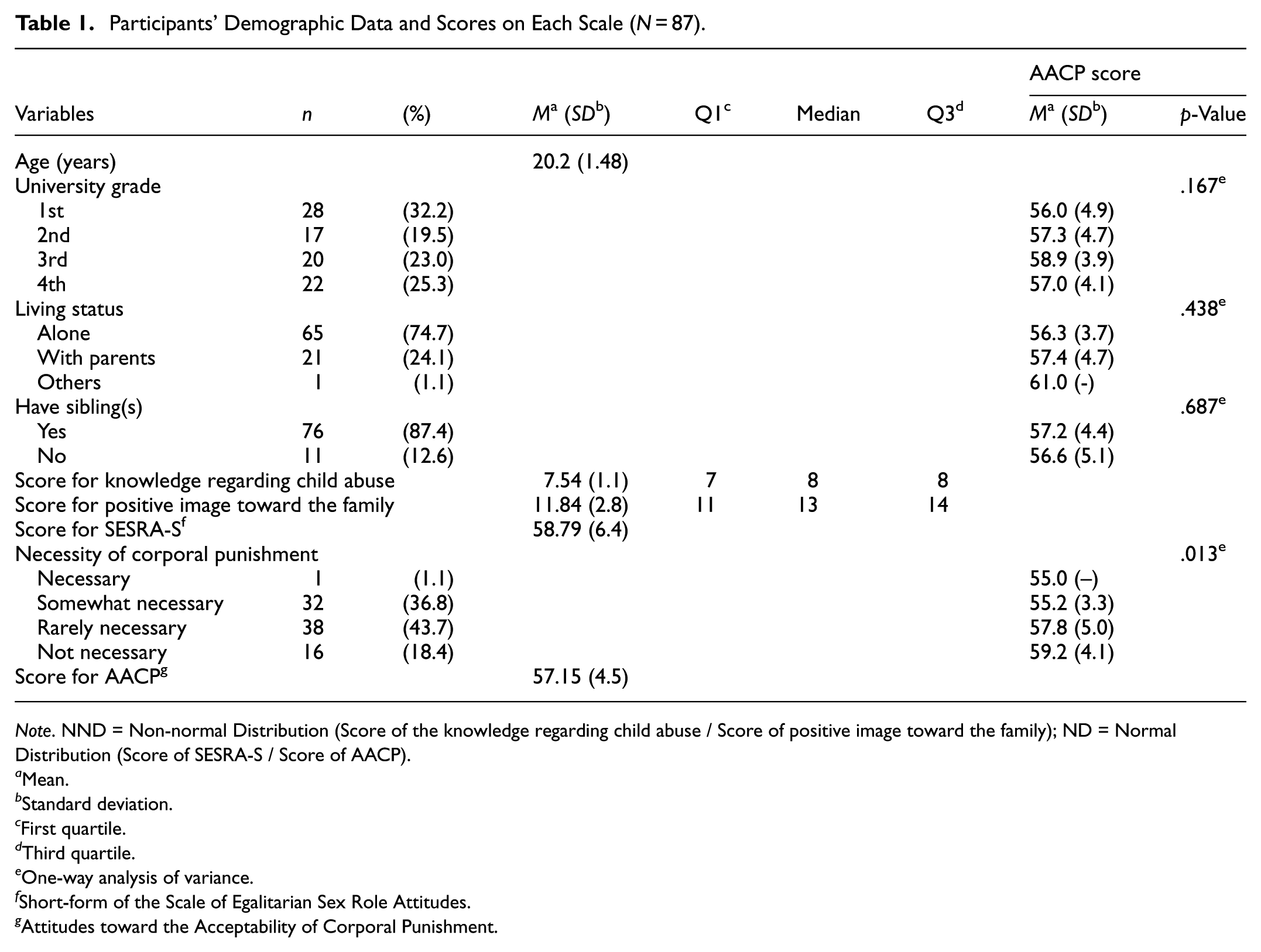
Note. NND = Non-normal Distribution (Score of the knowledge regarding child abuse / Score of positive image toward the family); ND = Normal Distribution (Score of SESRA-S / Score of AACP).
Mean.
Standard deviation.
First quartile.
Third quartile.
One-way analysis of variance.
Short-form of the Scale of Egalitarian Sex Role Attitudes.
Attitudes toward the Acceptability of Corporal Punishment.
As shown in Table 1, AACP scores did not differ significantly by university grade, living status, or having siblings. The only background variable that showed a significant difference in AACP scores was the belief in the necessity of corporal punishment (p = .013), with students who perceived corporal punishment as unnecessary tending to have higher AACP scores than those who believed it to be necessary.
Table 2 shows the students’ AACP responses. Overall, most behaviors were judged as abuse rather than acceptable discipline, with only a small number of acts perceived as potentially acceptable. Regarding the 22 behaviors, only harsh verbal scolding was rated as acceptable as discipline by more than half of the students (54%). For slapping, 35.6% of the students rated slapping the hands as acceptable as discipline, 19.5% spanking (buttocks) and 11.5% slapping the head. About 30% to 40% of the students selected Not sure for these actions. In addition, 10.3% of the students rated leaving a child alone while crying as acceptable as discipline, whereas 48.3% selected Not sure, indicating uncertainty whether it constituted discipline or abuse. Similarly, 8.0% of the respondents rated putting a child outside (e.g., on a balcony) as acceptable as discipline, while 33.3% selected Not sure. For the other acts, more than 70% of the respondents considered them abusive, and 10% to 30% selected Not sure. None of the students rated acts 8, 12, 13, 16–18, 21, and 22 as acceptable as discipline.
Results Regarding Attitudes Toward the Acceptability of Corporal Punishment (AACP) (N = 87).

Note. Item labels are abbreviated for publication and do not reproduce the full original wording. The full set of items is available in the original source (Lee & Yasuyama, 2002).
Table 3 shows the correlation coefficients among the main study variables. Higher AACP scores were modestly but significantly correlated with higher SESRA-S scores (r = .261, p < .05). Those who thought it was not necessary to use corporal punishment in child-rearing had significantly higher AACP scores (r = .338, p < .01). Moreover, significant correlations were seen between positive image toward the family and the perceived non-necessity of corporal punishment (r = .268, p < .05), and between age and SESRA-S scores (r = .223, p < .05). Overall, these coefficients indicate small-to-moderate associations among the key attitudinal variables.
Correlations Among Variables (N = 87).

Attitudes toward the Acceptability of Corporal Punishment.
Short-form of the Scale of Egalitarian Sex Role Attitudes.
Necessity of corporal punishment was scored on a four-point Likert-type scale as follows: (1) Necessary. (2) Somewhat necessary. (3) Rarely necessary. (4) Not necessary.
p < .05, **p < .01.
Next, hierarchical multiple linear regression analysis was performed to determine the factors associated with AACP scores (Table 4). In Steps 1 and 2, no significant positive associations were found in regard to AACP scores. However, in Step 3, a significant association between SESRA-S and AACP scores was observed, with unstandardized regression coefficient (B) = 0.17, standard error (SE) = 0.08, standardized regression coefficient (β) = .25, p = .031. Moreover, in the final model (Step 4), SESRA-S remained a significant predictor (B = 0.15, SE = 0.07, β = .21, p = .048) and perceiving corporal punishment as unnecessary was also associated with higher AACP scores (B = 2.24, SE = 0.64, β = .37, p < .001). In the final model, these variables together explained approximately 21% of the variance in AACP scores, indicating that while the model accounts for a modest proportion of the variance, SESRA-S and the perceived non-necessity of corporal punishment play notable roles in shaping attitudes.
Variables Associated With Attitudes Toward the Acceptability of Corporal Punishment (AACP) (N = 87), Hierarchical Multiple Linear Regression Analysis was Performed.

Note. Variables were entered at four steps in the following order:
Step 1: Demographic data; Step 2: Knowledge regarding child abuse and positive image toward the family; Step 3: SESRA-S; and Step 4: Necessity of corporal punishment.
Short-form of the Scale of Egalitarian Sex Role Attitudes.
Unstandardized regression coefficient.
Standard error.
Standardized regression coefficient.
Discussion
The present study investigated factors associated with attitudes toward the acceptability of corporal punishment among Japanese male undergraduate engineering students. The results indicated that students with egalitarian gender role attitudes were significantly less likely to accept corporal punishment as a form of discipline. Moreover, corporal punishment was significantly more acceptable among those who thought it was a necessary form of discipline.
Attitudes Toward the Acceptability of Corporal Punishment Scores
The study participants were all male students without children. We were unable to identify any previous studies targeting students, which limits our discussion, so we compared the present results with those of a previous study conducted in 2010 that targeted fathers of preschool children (Lee & Tsumura, 2014). In that survey, the three acts that fathers considered acceptable as discipline were Harsh verbal scolding (71.0%), Spanking (buttocks) (69.6%), and Slapping the hands (60.1%). By contrast, the proportion of participants in the present study who thought that these three acts were acceptable as a form of discipline was significantly lower, even though characteristics such as age and whether the child was in foster care differed. Conversely, compared with the university students in the present survey, a higher proportion of fathers in the previous survey considered the behaviors of Leaving a child unclothed (78.2% in the present survey vs. 89.9% in the previous survey) and Forced haircut (80.5% in the present survey vs. 87.7% in the previous survey) to be abusive. Because cultural backgrounds and intergenerational chains play significant roles in attitudes toward the acceptability of corporal punishment (Fulu et al., 2017), the environmental factors in which both targets were reared also need to be analyzed. In terms of the environment, many factors have changed significantly over the past 20 years in Japan, including the enactment and revision of the Child Abuse Prevention and Treatment Act (Ministry of Justice, 2022), publicity and awareness campaigns such as Child Abuse Prevention Month and the Orange Ribbon Campaign, media reports of cruel and abusive deaths and educational content at schools. Such changes in the environment may have contributed to increased interest in and awareness of child abuse.
Egalitarian Gender Role Views
The university students in the present survey demonstrated more egalitarian gender role views compared with previous studies. For example, a 1998 study conducted on male undergraduate and graduate students at 4-year colleges in Tokyo and its suburbs (Takahashi & Obuchi, 2000) found that the mean SESRA-S score was 50.6, compared with 58.8 in the present study. Moreover, in a 2018 study conducted on male non-medical undergraduate students (Minamimae et al., 2020), the mean SESRA-S score was 56.9, which was also lower than that found in the present study. These findings might reflect recent social trends toward promoting gender equality and encouraging the participation of men in childcare.
Relationship Between Gender Role Views and Attitudes Toward the Acceptability of Corporal Punishment
The results of the present analysis showed that students with egalitarian gender role views were significantly more likely to have attitudes toward the non-acceptance of corporal punishment. In the final regression model, the standardized regression coefficient for SESRA-S was β = .21, indicating a small-to-moderate association between more egalitarian gender role attitudes and higher AACP scores even after adjusting for other variables. Importantly, this association remained significant even after adjusting for the belief that corporal punishment is necessary for discipline in the final regression model, indicating that broader gender role attitudes exert an independent influence on young men’s acceptance or rejection of corporal punishment. In a previous study, Iwai (2010) reported that the stronger the stereotypical gender role view, the more likely the person was to tolerate corporal punishment, which is similar to the results of the present study. A study by Marks et al. (2009) reported that families with traditional gender role views may have a more authoritarian parenting style. They also reported that gender role views in the home are likely to affect children, as the children of parents with traditional gender role views also tend to have traditional gender role views. These intergenerational transmission patterns have also been documented in recent studies involving single-parent families, highlighting how parental gender-role attitudes shape children’s broader social and disciplinary beliefs (Chen et al., 2024). It is possible that the adolescents in this study who held traditional gender role views may have grown up under an authoritarian parenting style, suggesting that their upbringing in such an environment may have influenced their attitudes toward discipline and resulted in a broader acceptance of corporal punishment in child-rearing. Beyond these individual-level associations, our findings may also have broader cultural implications in Japan. Male students who endorsed more egalitarian gender role attitudes were less likely to accept corporal punishment. This pattern suggests a shift away from rigid norms of masculinity, such as the idea that men must act as strict authority figures, and a shift toward greater support for non-violent, communication-oriented parenting. If these changes in gender norms continue when these men become parents, they may weaken the intergenerational transmission of corporal punishment. They may also help create a more favorable cultural climate for educational initiatives and public policies that promote positive discipline in Japan.
Perception of the Necessity of Corporal Punishment in Child-rearing and Attitudes Toward the Acceptance of corporal Punishment
In the present study, we identified an association between attitudes toward the acceptability of corporal punishment and the belief that corporal punishment is necessary for discipline. In other words, those who thought that corporal punishment was necessary for discipline were more likely to have difficulty deciding whether the 22 surveyed acts were necessary for discipline. In the final regression model, perceiving corporal punishment as unnecessary was associated with higher AACP scores, with a standardized regression coefficient of β = .37. This represents a moderate association and suggests that students’ explicit beliefs about the necessity of corporal punishment play a substantial role in shaping their attitudes. One factor that has been suggested to contribute to the need for corporal punishment as a form of discipline is an intergenerational link (Gonzalez et al., 2022; Lomanowska et al., 2017). Cross-cultural studies have also shown that mothers who endorse corporal punishment may inadvertently promote more externalizing behaviors (e.g., aggression, defiance, and rule-breaking) in their children, reinforcing the intergenerational transmission of harsh discipline (Lansford et al., 2014). Such findings imply that caregivers’ attitudes—particularly those of mothers, who often serve as the primary disciplinarians in many cultural contexts—can play a crucial role in shaping children’s behavioral outcomes. Kitano et al. (2018) insisted that childhood experiences with corporal punishment influence attitudes toward the endorsement of corporal punishment in adolescence. In the present study, we did not ask the participants about their experiences of corporal punishment. To clarify what factors are related to attitudes toward accepting abuse/corporal punishment in the future, it will be necessary to include the subjects’ care environments, especially whether they have experienced abuse or corporal punishment, in the analysis.
Practical Implications
From a prevention perspective, our findings suggest that promoting egalitarian gender norms among young men may be an important component of efforts to reduce corporal punishment. In this study, male students with more egalitarian gender role attitudes were less likely to accept corporal punishment. This indicates that weakening rigid expectations that men should act as strict authority figures may help foster greater support for non-violent, rights-respecting approaches to childrearing.
Given that our participants are university students who may become fathers in the near future, university-based education could be one promising setting for such efforts. For example, formal curricula that integrate content on gender equality, human rights, and children’s rights with education on non-violent discipline may help shape attitudes before students take on parenting roles. At the same time, attitudes toward gender and authority begin to form much earlier in life. Therefore, from a life-course perspective, integrating education on egalitarian gender norms and children’s rights into primary and secondary school curricula may be an important upstream strategy. Such education could emphasize that both boys and girls have the right to choose their future roles and occupations, and that all children have the right to grow up free from violence, including corporal punishment.
Limitations
External Validity and Selection Bias
The low response rate (7.8%) and the voluntary, out-of-class web mode may have induced selection on unobservables (e.g., greater social awareness or more egalitarian views among respondents, or—conversely—heightened interest in disciplinary topics). Because higher AACP scores indicate lower acceptance of corporal punishment, selective participation of more egalitarian/issue-aware students could inflate the mean AACP score relative to the source population. The direction and magnitude of any bias remain uncertain.
Disciplinary and Contextual Heterogeneity
Estimates were obtained from a single engineering faculty at one university. Both baseline levels (disciplinary baselines) and the strength of the SESRA–AACP association (slope) may differ across majors (e.g., under restricted variance in more egalitarian cohorts the association may attenuate). Institutional and regional contexts (campus culture, faculty norms, broader social norms) may also shift intercepts and slopes.
Unmeasured Confounding and Sample Size Limitations
Several potential confounders were not measured (e.g., respondents’ own exposure to corporal punishment, family socialization and parenting norms, household socioeconomic conditions, cultural/religious background), which may have biased estimates of the association between SESRA-S and AACP scores. These constructs were omitted due to constraints on questionnaire length and concerns about respondent burden, and future studies should incorporate such contextual variables. In addition, the sample size, although adequate for our main regression models, may have limited statistical power to detect small effects, and larger, more diverse samples will be needed to confirm the robustness and generalizability of these findings.
Self-report and Measurement Bias
All measures were self-reported, which may introduce social desirability and recall biases and limit precision. Because higher AACP scores reflect lower acceptance of corporal punishment, social desirability could lead to underreporting of corporal punishment approval, potentially inflating mean AACP; the net magnitude remains uncertain.
Conclusion
The results of the present study indicated an association between attitudes toward the acceptability of corporal punishment and gender role views. These two factors are largely influenced by the family. In the future, it will be necessary to analyze additional factors related to attitudes toward the acceptability of corporal punishment, including more detailed information on the environments in which the participants were reared, their experiences of corporal punishment and socio-economic status, and community- and society-level influences such as local norms and policy implementation. Further studies with larger samples and students from different faculties and universities would help to confirm whether our findings are generalizable to other groups of young adults. Longitudinal designs that follow young people over time, as well as qualitative studies using interviews or focus groups, could also clarify how attitudes toward corporal punishment and gender roles develop and change. It is difficult for professionals to intervene to prevent corporal punishment that takes place in the privacy of the home. However, it is possible to change the social environment, and thus, it is important to continue to communicate the importance of creating a society free of all forms of abuse from adolescence or earlier through various educational efforts, including the establishment of new laws.
Footnotes
Acknowledgements

Ethical Considerations
This study was approved by the Ethics Committee of Nagasaki University Graduate School of Biomedical Sciences (No.: 20070910-2).
Consent to Participate
Before participating, students read an online explanation of the study contents, including sensitive topics such as child abuse and corporal punishment. They were informed that participation was voluntary, they could withdraw at any time without penalty, and non-participation would not affect their evaluation by lecturers. Consent was indicated by pressing a button to confirm understanding and agreement, and completion of the questionnaire was considered to indicate consent to participate.
Consent for Publication
Not applicable, as the study did not include any identifiable personal data.
Author Contributions
I certify that all authors have read and approved the content of the submitted manuscript. Hashimoto, Kawabata, and Kit collected the data. Kit, Miyazaki, Hashimoto, Kawabata, Astuti, and Honda designed the study, analyzed the data, contributed to the interpretation of the findings from the analysis and logically composed and revised the manuscript. Kit conceptualized the study and wrote a draft of the manuscript.
Funding
The authors disclosed receipt of the following financial support for the research, authorship, and/or publication of this article: This study was supported by JSPS KAKENHI Grant No. 21K11143.
Declaration of Conflicting Interests
The authors declared no potential conflicts of interest with respect to the research, authorship, and/or publication of this article.
Data Availability Statement
Due to privacy and ethical restrictions, the datasets generated and analyzed during the current study are not publicly available.