




Abstract
Despite the evidence for existing biases in social judgment, people often fail to recognize biases in their own social judgments. This study investigated whether people become aware of their own susceptibility to various biases by experiencing visual illusions that challenge confidence in personal perceptions. A total of 88 participants were grouped by whether or not they gazed at illusory motion graphics and by whether they rated themselves or others on bias susceptibility. Participants who gazed at visual illusions rated themselves as having more biases in their social judgments than participants who did not see visual illusions. These findings suggest that bias denial may partially result from insufficient opportunities to recognize inaccuracies in personal perceptions.
Introduction
As research has shown in the past few decades, a person’s social judgment is often influenced by motivational and cognitive biases that compromise objectivity in social perceptions (for reviews, see Gilovich, 1991; Nisbett & Ross, 1980). Despite this evidence of existing biases in social judgment, people often fail to recognize those biases in their own social judgments, even while they detect them in judgments made by others (bias blind spot: Pronin, Lin, & Ross, 2002).
This asymmetry in bias perception has been attributed to “naive realism” (e.g., Pronin et al., 2002), a conviction that one perceives objects and events “as they are”—in other words, that there is an objective reality that is in a one to one correspondence with one’s own perceptions (Ross & Ward, 1995, 1996). According to this construct, the reason we assume our social judgments are free from bias is because we believe that “we see the thing as it is” (for a review, see Pronin, Gilovich, & Ross, 2004). However, this explanation for the unawareness of biases in one’s own judgments is only a theoretical assumption that has not been well explored experimentally.
Prior research has hinted at possible factors that may contribute to sustaining unrealistic personal beliefs when making social judgments. First, people are seldom confronted with events that illustrate judgment inaccuracies. Daily life may be too complex to permit clear determinations of judgment accuracy. Although people may occasionally be confronted with instances that question their sense of objectivity (e.g., other people responding to issues and events differently), they tend to focus on information that supports their own opinions and deny the validity of contradictory information (confirmatory bias; Lord, Ross, & Lepper, 1979). Thus, it is plausible to assume that people will not notice their susceptibility to biases without confronting clear demonstrations of their own false or inaccurate perceptions.
Perceptions vary on a continuum from simple ones (e.g., sensory perception of physical objects) to complex ones (e.g., opinions in politics). Some researchers have pointed to the possibility that certainty in sensory perception plays a role in driving human overconfidence in one’s own social judgment. Ishii (2005) and Pronin et al. (2004) pointed out that naïve realism of “I see the world as it is” may cause few difficulties in daily life insofar as our concern is with the experience of physical objects. In addition, Pronin et al. (2004) suggested that the “naïve realism conviction began with physical perception and generalized to complex social events and political issues” (p. 783).
Banaji and Greenwald (2013) suggested that biases in social judgments and errors in sensory perception are similar because both are the results of unconscious and automatic mental work that consists of their perceptions. According to them, “it (visual illusion) serves as a vivid illustration of a signal property of the mind—it does a great deal of its work automatically, unconsciously, and unintentionally” (Banaji & Greenwald, 2013, p. 5). Thus, visual illusion might be a good example of unconscious processes constructing human perception.
One study (Hart, Tullett, Shreves, & Fetterman, 2015) tested the effect of reminding people of their unconscious and automatic mental work on their confidence in their social judgment. In their study, participants who were not only given explanations of unconscious and automatic mental work but were also exposed to optical illusions lost confidence in their social judgment, as compared with participants who were only given the explanations. With this result, it is not clear whether experiencing optical illusions only without any explanations is effective, and why people become less confident of their social judgment; however, this result seems to imply that it might be difficult for people to dismiss firsthand experiences of sensory perception error rather than mere warnings about their subjectivity.
In the context of these arguments, it was hypothesized that people become more aware of their susceptibility to biased perceptions if they encounter clear demonstrations that personal sensory perceptions are not necessarily accurate. To test this hypothesis, visual illusions were used as stimuli to target and challenge habitual reliance on personal sensory perceptions. Unlike Hart et al. (2015), explanations of naïve realism were not used as stimuli in this study.
Visual illusions are characterized by visually perceived images that convincingly differ from objective reality and physical properties (Kitaoka, 2008). At least momentarily, experiencing visual illusions would remind a viewer of personal fallibility in sensory perception, as this is a condition when viewers are able to recognize the mismatch between a perceived image and objective reality.
Among the various types of visual illusions, motion illusions were used as stimuli in this experiment. Motion illusion is an optical illusion in which a static image appears to be moving due to the cognitive effects of interacting color contrasts and shape position (Goldstein & Brockmole, 2016). Therefore, people would be naturally aware that their perception of motion should not reflect the physical properties of a real-world object when an illusory motion graphic is printed on a sheet of paper; this is because such graphics cause people to perceive “moving” graphics even while they are simultaneously aware that the graphics illustrated on a sheet of paper should not be actually moving. Both the appearance of the presented graphics and their feeling about the appearance of the presented graphics were confirmed as a manipulation check in this study.
Our goal was to investigate whether people might better realize their own susceptibility to various biases in their own social judgments if they encounter clear demonstrations of their own sensory perception errors. To achieve this goal, the effect of visual illusion on susceptibility to various biases in both own and average others’ social judgments was examined. If, as predicted, exposure to errors in their OWN sensory perception makes people aware of the uncertainty of their OWN perception, experiencing illusion affects susceptibility to biases only in their OWN social judgment, but not in OTHERS’ social judgment. This is because uncertainty about their OWN sensory perception might relate to uncertainty about their OWN social perception, while uncertainty about their OWN sensory perception has nothing to do with uncertainty about OTHERS’ social perception. Even if there is a slight possibility that uncertainty about one’s OWN perception caused by visual illusion generalized to that of OTHERS’ perception, confronting visual illusion would not induce incremental awareness of biases in OTHERS’ social judgment. This is because, as previously mentioned, it is well known that people do not believe the objectivity of OTHERS’ social perception from the beginning; people are usually aware of biases in OTHERS’ social judgment without being exposed to visual illusion (Pronin et al., 2002).
Method
Participants
Eighty-eight undergraduates (age range = 19-23; M = 20.72, SD = 1.08; 38 male, 50 female) from a university in western Japan participated in this study. Participants were recruited either in public spaces on the university campus (n = 65) or in the classroom (n = 23). All participants were provided with snacks as compensation for taking part in the study. Following the ethical guidelines of the Japanese Psychological Association, all participants were informed that their responses would be anonymous and that they could withdraw at any time during the study.
Experimental Design
A 2 (visual illusion exposure vs. no exposure) × 2 (Ratings of Self vs. Ratings of Other) factorial between-subjects design was used. Participants were randomly divided into four groups: (a) visual illusion exposure-Rating of Self (n = 22), (b) no exposure-Rating of Self (n = 22), (c) visual illusion exposure-Rating of Other (n = 21), and (d) no exposure-Rating of Other (n = 23).
Procedure
The experiment was conducted in small groups (two or four people) who were told that they would take part in an “evaluation of pictures and persons’ impressions” right at the outset.
Experimental manipulation: Challenging habitual reliance on sensory perception
Half of the participants received booklets that consisted of three pieces of paper, with one illusory motion graphic printed on each page. These images are provided in Appendix A. The other half received the same booklet, but with control graphics that were similar to the illusory motion graphics in color and shape, but without any motion illusion (see Appendix B). Participants were told to fix their eyes on the graphics until the experimenter cued them to go to the next page. Participants gazed at each graphic for 40 s. Participants were told that they would be asked to provide their thoughts on the graphics later.
Measurement of perceived bias
Next, participants were asked to respond to each item on a bias impression questionnaire. This questionnaire began with “Psychologists have claimed that people in general show the tendencies described below.” Seven specific motivational and cognitive biases were described: self-serving attribution for success versus failure, dissonance reduction after making a free choice, the positive halo effect, biased assimilation of new information, reactive devaluation of proposals from one’s negotiation counterparts, the fundamental attribution error (FAE) in “blaming the victim,” and judgments about the “greater good” that were influenced by personal self-interest. These seven biases were taken from previous research on the “bias blind spot” (Pronin et al., 2002).
1
All the descriptions used the neutral term “effect” or “tendency” rather than the nonneutral term “bias.” For example, self-serving attribution bias was described as
a tendency to regard successes as the result of personal qualities, such as drive or ability, but to regard failures as the result of external factors, luck or some type of situational cause.
Half of the participants from each of the visual illusion exposure and no exposure groups were asked about their own susceptibility to each of the seven biases (i.e., “To what extent do you believe that you show this tendency?”) while the other half of each group were asked about the susceptibility of an imagined average student at the same university to these biases (i.e., “To what extent do you believe that other, average students show this tendency?”). Ratings were made on a 9-point scale from 1 (not at all) to 9 (strongly).
Finally, participants were asked to respond to two questions intended to confirm how the illustrations had appeared to the participants, and how they had felt about the appearance of the illustrations. The first question asked participants to answer how the illustration looked by making a selection from three options (1. in motion, 2. not sure, and 3. at rest). The second question asked the degree of surprise the participants experienced by the appearance of the illustrations. “How surprised were you about how the illustrations looked? If you saw an illustration that looked like it was moving/at rest, how surprised were you about it?” This question was scored on a Likert-type rating scale (1 = not at all surprised, 5 = extremely surprised). Last, participants were questioned regarding their awareness of the experiment’s purpose using the following questions: “What do you think the purpose of the experiment was?” and “What do you think this experiment was trying to study?”
Analysis
Each participant’s responses to the seven bias items were averaged to create a bias perception index for that participant. To examine the main prediction, a 2 (self vs. other) × 2 (illusion vs. control) analysis of variance (ANOVA) was performed on the composite scores of the bias perception measure.
Results
Just as planned, data from any participants who failed to complete the questionnaire (n = 6) or who expressed thoughts about the two studies being related (n = 1) in the questions probing for awareness of the experiment’s purpose were excluded. In addition, responses from participants who evaluated the control graphics as moving were removed (n = 4), resulting in a final sample size of 77 students.2,3 The number of participants in each condition was then 18 participants in the control/self-rating condition, 21 participants in the control/other rating condition, 19 participants in the illusion/self-rating condition, and 19 participants in the illusion/other rating condition.
Manipulation Checks
Participants reported being more surprised by the illusion condition than by the control condition (control: M = 1.33, SD = 0.66; illusion: M = 3.05, SD = 1.27), t(55.36) = –7.41, p < .0001, d = 1.70, indicating that illusion group participants were more personally and emotionally impacted by the experience of gazing at visual illusions than were the control group participants who did not have this exposure.
Participants’ responses to the measurement of the perceived bias of the seven bias items were reliable (Cronbach’s α = .79). Each participant’s responses to those seven bias items were averaged to create a bias perception index for each participant. Examination of the bias perception scores in the control condition revealed that participants who rated their own bias susceptibility gave lower bias ratings than did participants who answered in terms of the average student (self: M = 3.74, SD = 1.21; others: M = 5.83, SD = 0.97), t(37) = –5.98, p < .0001, d = 1.91. This finding is consistent with the results of previous studies (e.g., Pronin et al., 2002), and it replicates naïve realism.
Dependent Measure
Participants’ bias perception scores were analyzed using a 2 (target: self vs. other) × 2 (presented graphics: illusion vs. control) between-subjects ANOVA. There was a main effect of target, indicating that participants in the Rating of Self condition, compared with those in the Rating of Other condition, perceived the target as more biased, F(1, 73) = 36.87, p < .0001, ηp2 = .34. There was no main effect of the presented graphics, F(1, 73) = 1.74, ns, ηp2 = .02.
These main effects were qualified by a significant interaction, F(1, 73) = 4.82, p < .05, ηp2 = .06. Consistent with our hypotheses, simple-effects tests showed that perceived susceptibility to bias in one’s own social judgments were higher among the participants in the illusion condition than the participants in the control condition (control: M = 3.74, SD = 1.21; illusion: M = 4.63, SD = 1.33), F(1, 73) = 5.95, p < .05, ηp2 = .08. In contrast, perceived susceptibility to bias in average others’ social judgment did not show any group difference between the control condition and the illusion condition, F(1, 73) < 1, ns, ηp2 = .01.
Comparing the bias perception scores about oneself and others in the illusion condition, participants who rated themselves reported less bias susceptibility than did the participants who rated average others (self: M = 4.63, SD = 1.33; others: M = 5.61, SD = 0.87), F(1, 73) = 7.44, p < .01, ηp2 = .09. The results are reported in Figure 1.
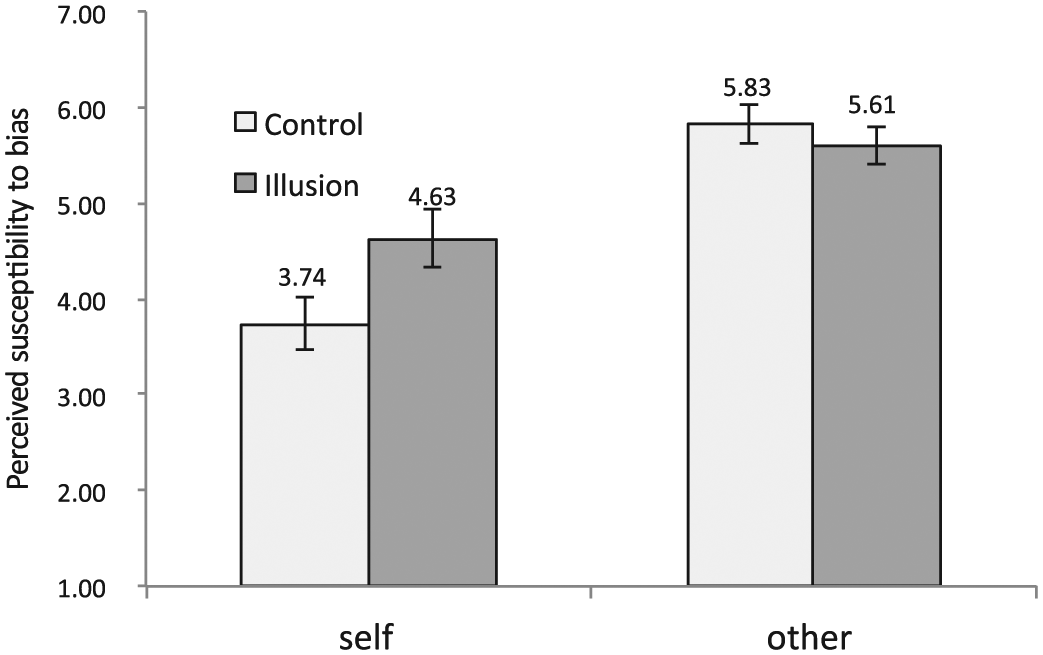
The effect of exposure to visual illusions on the perceived susceptibility to bias in social judgments of the self and of others.
Discussion
First, in the control group, the participants who rated themselves perceived less bias than those who rated others. This confirms the “bias blind spot” and replicates the results from previous research (Pronin et al., 2002). As exposure to visual illusions increased awareness of bias in one’s own social judgments, our primary prediction was also supported. This implies that lack of opportunity to experience clear gaps between personal perception and objective reality might be contributing to unawareness of biases in one’s own social perception. The increased perception of bias was not merely an effect of experiencing visual illusions because the incremental change in the perception of bias due to exposure to illusory images was found only in the self-rating condition, not in the other-rating condition.
While exposure to visual illusions was shown to increase the awareness of bias in one’s own social judgments, participants perceived fewer biases in their own social judgments than in those of an average student even after being exposed to visual illusions. Therefore, exposure to visual illusions can be said to influence bias perception in one’s own social judgment, but its influence is insufficient to make the bias blind spot completely disappear.
A question concerned with the ways by which people realize the existence of bias has been proposed: “Under what circumstances do people seem to recognize rather than overlook or deny their susceptibility to bias?” (Kennedy & Pronin, 2008). However, few empirical studies have sought to investigate the ways and circumstances that enable people to recognize biases and thereby advance this research. One study (Pronin & Kugler, 2007) showed that people were more likely to acknowledge their own susceptibility to various social biases after reading an article about the unconscious mental work that shapes human behavior and judgment. The present study used an experiential task instead of an explanation task to remind participants that personal perceptions do not always reflect objective reality.
Limitations of the present study and its implications are as follows. First, in this study, it was assumed that confronting the gap between one’s perceived image and objective reality in sensory perception causes one to recognize that one’s own social perceptions are not necessarily an accurate reflection of the social world. As previously mentioned, the result of Hart et al. (2015) also seems to imply that there is a relationship between regarding one’s social perception as absolute and experiencing optical illusion. However, the present study does not provide direct evidence for these underlying mechanisms. Further study will be needed to clarify this mechanism.
Second, the results presented here showed only short-term effects, and it remains unclear how long these effects might last. Even though almost all people have previously experienced visual illusions, they still tend to believe that they are free from bias. Future research might address the duration of this effect and what may be needed to show long-term effects.
Conclusion
Overall, the current study showed that people become aware of various biases in their own social judgment by experiencing visual illusions that remind them of uncertainty in their sensory perceptions. Seeking ways to have people acknowledge their subjectivity would be meaningful for mutual understanding, because the blindness to biases in one’s own social judgment was reported as one of the causes for interpersonal conflicts when people have opposing views (Kennedy & Pronin, 2008; Pronin, Kennedy, & Butsch, 2006; Reeder, Pryor, Wohl, & Griswell, 2005).
However, this article was not designed to argue that overconfidence in one’s sense of social objectivity should always be undermined. In ordinary life, doubting one’s own perception, especially doubting every single instance of one’s own sensory perception, would bring us a substantial amount of inconvenience. Considering the point that many cognitive errors that arise do support personal, societal, or even evolutionary advantages (Haselton & Buss, 2000), blindness to one’s own biases might be a product or by-product of adaptation (e.g., reducing cognitive loads). With this point of view, further studies need to explore ways and mechanisms that make people realize their subjectivity without those adaptive sides, if any, impaired.
Footnotes
Appendix A
These graphics were presented to participants in the “illusion condition.”
Appendix B
These graphics were presented to participants in the “control condition.”
Acknowledgements
The author thanks Prof. Yumi Endo (Kansai University) for insightful comments on this work.
Author’s Note
The results of this experiment were presented at the 13th annual Meeting of the Society for Personality and Social Psychology (February, 2012), San Diego, CA, USA.
Declaration of Conflicting Interests
The author(s) declared no potential conflicts of interest with respect to the research, authorship, and/or publication of this article.
Funding
The author(s) disclosed receipt of the following financial support for the research, authorship, and/or publication of this article: This work was supported by special funding for the promotion of internationalization of research activities by the Japanese Group Dynamics Association.