




Abstract
People do not respond directly to the risks around them, but rather to their perception of those risks. These perceptions can be affected by many factors, including the degree to which people feel protected, and within that context beliefs in guardian angels or spirits can be a significant factor in some cases. In a survey of risk perception, it is shown that this belief does correlate with how people perceive risk, but in a complex way that may increase or decrease risk-taking behavior, with the latter being the more dominant theme.
Introduction
The belief that angels can protect people from evil has a long history, for example as shown by the Prayer to St. Michael written by Pope Leo XII in 1886 (Raccolta, 2003):
Saint Michael the Archangel, defend us in battle. Be our protection against the wickedness and snares of the devil. May God rebuke him, we humbly pray; and do Thou, O Prince of the Heavenly Host—by the Divine Power of God—cast into hell, Satan and all the evil spirits, who roam throughout the world seeking the ruin of souls.
According to the Catholic Encyclopedia (n.d.), Angels are spiritual beings who are intermediate between God and human beings. Often their role is as a messenger to humankind. Biblical interpretations also include the notion that each individual soul has an appointed guardian angel. Spirits are thought of in very different ways, not necessarily related to God. For example, according to the “Spirit Guides” published in Crystalinks Metaphysics and Science Website, 1 they are “entities who watch, teach, heal, and help.” In Shamanistic cultures, guardian spirits and spirit helpers empower the shaman with special powers that help him in spiritual journeys or healing (Ellen, 1991). According to the Encyclopedia Britannica Academic Edition, guardian spirits are “supernatural teacher, frequently depicted in animal form, who guides an individual in every important activity through advice and songs; the belief in guardian spirits is widely diffused among the North American Indians.”
Many people in the world have a belief in some form of guardian angel or guardian spirit, and there is anecdotal evidence that these spirits or angels help people in need (Box 1). The Catechism of the Catholic Church, 2nd Edition (336) says, “From infancy to death human life is surrounded by their (the angels) watchful care and intercession. Beside each believer stands an angel as protector and shepherd leading him to life.” Other biblical quotes include the following:“The angel of the LORD encampeth round about them that fear him, and delivereth them” (Psalms 34:7); “In all their affliction he was afflicted, and the angel of his presence saved them: in his love and in his pity he redeemed them; and he bare them, and carried them all the days of old” (Isaiah 63:9); “My God hath sent his angel, and hath shut the lions’ mouths, that they have not hurt me: forasmuch as before him innocency was found in me; and also before thee, O king, have I done no hurt” (Daniel 6:22).
People’s Belief in Guardian Angels: A Selection of Quotes From Various Websites.
“I didn’t actually see an angel but I know for sure, that an angel saved not only my life, but my father and my sister’s life.” (http://www.squidoo.com/an-angel-saved-my-life) “. . . in my heart I knew to thank God for sending angels to help me on this very cold and dark winter’s night.” (http://hubpages.com/hub/An-Angel-Saved-My-Life)
“I was 7 or 8 when my angel saved my life.” (http://www.wirenot.net/X/Stories/Angel_2/Angel_T-V/theangelthatsavedmylife.shtml)
“I am convinced that God permitted one of our guardian angels to perform the miracle that saved our lives.” (http://www.catholic.org/saints/angelstories/read.php?story=123)
“He says that He’s going to order His angels to protect you wherever you go. Now, He will order angels to protect you.” (http://www.patrobertson.com/Teaching/Psalm91_5.asp)
“When you just avoid being hit by a badly driven car, that is usually the guardian angel at work.” (http://www.esatclear.ie/~cammalot/guardianangel.html)
As well, the following prayer, commonly referred to on Catholic prayer websites, supports the notion of a personal guardian angel:
Guardian Angel Prayer:
Angel of God, My Guardian Dear to whom God’s love commits me here. Ever this day be at my side to light and guard and rule and guide. Amen.
Angels are also present in the religions of Islam (Al-Fawzaan, 2005) and Judaism (Dennis, 2004); even further back in time ancient civilizations such as Assyria and Babylon recorded visitations from divine creatures.
The theme of guardian angels or spirits is evident in art and entertainment (e.g., in the film “It’s a Wonderful Life,” 1946 directed by Frank Capra, the suicide of George Bailey is prevented by his guardian angel). This film ranks first on the Cheers List and third on the Fantasy List of the American Film Institute (n.d.). Examples of the current importance of guarding angels or spirits to many people are evident on websites devoted to discussions of how people were saved by their guardian angel (see Box 1 for examples). Some websites are specifically devoted to providing education on spirit guides (D. Taylor, n.d.), to better enable people to access and deal with their guardian spirits appropriately. As well, there are numerous books written about angels, which often include specific references to guardian angels or spirits (e.g., Valentine, 1999; Williams, 2007; Lucie-Smith, 2009).
How people perceive, feel about, and respond to risk is a function of many factors (Slovic, 2000). One factor that may be important to some individuals is the degree to which they feel protected. This protection could be from institutions or people in authority, or for some people from guardian spirits/angels or God. The effect of a belief in guardian spirits or God may be significant; one web-based survey (AngelArt-Gallery, 2006) by AngelArt-Gallery of 1,416 people found that 94.6% of the responders stated that they believed in angels (note that this is not an unbiased sample). It may be that such beliefs affect peoples’ perceptions and behaviors, and the purpose of this article is to address the question, “Is a belief in guardian spirits or angels correlated to people’s perception of risk, and as a result their risk-taking behaviors?” The working hypothesis the authors used in this study was that a belief in guardian spirits would, in some cases, be associated with a decreased risk perception and therefore an increase in risk-taking behavior.
Literature Survey
Various studies have examined the effect of fatalism and faith-based perspectives on risk perception and behavior (e.g., Sims & Baumann, 1972; Douglas & Wildavsky, 1982; Bankoff, 2004; Paradise, 2006; Gaillard & Dibben, 2008), and have suggested that it can be significant. One study on risk perception discusses the teachings of Puritan ministers throughout history, such as the belief that “the lives of all men are in God’s hands” (Smith & Hacker, 1996). Some religious texts support the view that disasters result from divine punishment, 2 and these views are sometimes evident in post-disaster attempts to provide meaning about these terrible events (Gillard & Paton, 1999; A. J. W. Taylor, 1999; Waldman, 2005). Hewitt (2009) included examples of this effect in developing nations with respect to natural hazards. Adams (1995) in his discussion of risk as an interactive, reflexive phenomenon and the risk thermostat notes the importance of belief systems, in particular, how a belief in guardian angels or religious belief can introduce a chaotic, unpredictable element into risk-balancing behaviors.
Gregerson (2003) explains that “the concept of risk and risk-taking behaviour exemplifies how scientific and religious thought models interact in coping with uncertainty in everyday life,” and that rational and religious thoughts intertwine to affect a human’s perception of risk, including perceptions about natural disasters. Gregerson provides an interesting addition to the study of faith and risk, explaining that the way God has created the world actually invites a risk-taking attitude considering that the benefits of risk-taking outweigh damages; risk-taking behavior allows people to explore new territories. This concept is important because it suggests that people may choose to venture into risky territory to take advantage of the world that God created. In other studies of religion and risk, religious belief has been shown to minimize stress levels and provide a sense of comfort in risky situations (Billig, Kohn, & Levav, 2006), potentially increasing an individual or community’s decision to engage in risky behavior.
A study of the influence of religion on risk perception in Agadir, Morocco (Paradise, 2005), notes that “the human mind work[s] to make sense out of perceived chaos and potential danger often using familiarity and knowledge to assist in lessening the perceived risk of an imminent problem or danger.” This can be especially true in religious communities, such as Agadir. It has been found in this region that risk perception is more formed by religious beliefs than by experience.
Another relevant study in the relationship between faith and risk perception (Bjonness, 1986) of the Sherpas in the Himalaya of Nepal notes that their response to mountain hazards depends greatly upon their Buddhist beliefs, which considers the human a part of nature. Due to their dependency on the forces of nature in such a mountainous habitat, the Sherpas originally provided sacrifices to the Gods to avoid the damaging impacts of nature. The prevailing attitude in the region is acceptance of the inevitable. An interesting attribute of the Sherpas is that despite this attitude, they still take measures to prevent minor hazards, while acknowledging that major hazards cannot be controlled. Their interpretation of hazards is that they are “supernatural when they harm the village and natural when they warn the village.” The Sherpas are known for their risk-avoiding strategies that incorporate practical and religious rituals with the recognition of the duality of natural and supernatural influences (Bjonness, 1986).
The importance of studying this topic is emphasized by Chester (2005) who notes the “urgent need for dialogue between those who hold religious views on disaster losses, and hazard analysts and planners who view losses in wholly naturalistic terms.” For this reason, this topic is of importance to those who develop community plans for disaster mitigation, preparedness, response, and recovery.
As noted above, people respond to their perceptions of risk, which are modulated by many factors (Slovic, 2000, 2010). Of these, dread has been noted as being very important, and increasingly recent publications have emphasized the importance of the affective component of risk perception as opposed to cognitive inputs (Loewenstein, Weber, Hsee, & Welch, 2001). In addition, there are a number of social factors that affect risk-related behaviors as portrayed in the social amplification of risk discussed by Pidgeon, Kasperson, and Slovic (2003) and Kasperson et al. (1988), including the role of the press, social values, and how signals are filtered and decoded. When it comes to personal experiences with guardian spirits, the roles of filtering and decoding are undoubtedly very important.
Survey Design
The survey, as it involved human subjects, was vetted by the Research and Ethics Committee at the Faculty of Liberal Arts and Professional Studies at York University. Interviews were either web-based using SurveyMonkey or done in person. It was mostly qualitative in nature, with the interviewers providing a space for the interviewees to think and then respond in their own way to the questions. Where it was deemed helpful, the interviewers would prompt the interviewees to pursue any lines of thought that appeared promising. The survey was administered by graduate students in the Master of Disaster and Emergency Management program of York University. They were careful to be neutral during the interviews and not to let their own viewpoints affect the responses or interview process. Three of the four interviewers believe in some form of angel or spirit, with one of the three specifically believing in a personal guardian angel or spirit. Prior to interviewing, the researchers discussed the need to avoid language, tone of voice, or non-verbal communications that would indicate a lack of neutrality, and engaged in role-playing to practice this.
The survey consisted of three sections: (a) Understanding Risk (four questions), (b) Faith and Risk (seven questions), and (c) Demographics (seven questions). The purpose of the first section was to get a sense for risk preferences by noting how the interviewees view risk, what sort of risky behavior they participate in, and why they choose to do so. The second section explored the effect of their belief system on risk preferences. The third section provided information on age, gender, marital status, children, education, spiritual belief, and ethnic group. It was made clear to the interviewees that participating in the survey and/or answering any particular question were completely optional. Surveys were anonymous and confidential, and each interviewee signed an informed consent document before being interviewed. The survey was designed to take less than 30 min, and in many cases took less than 5 min.
The subjects were selected using three methods; the first group was students in the graduate program of disaster and emergency management, the second group was students randomly selected as they walked around campus, who were approached to see if they were willing to be interviewed. The third group was composed of individuals known to the researchers, being either family, friends, or colleagues. There were no significant differences in risk perception between the three groups. About half of the interviewees consisted of students at York University. Almost all interviewees live in the Greater Toronto Area, Ontario, Canada. This area is a multi-cultural setting with a very diverse set of ethnic and religious backgrounds.
The interviewers had mixed perspectives of the level of comfort of the interviewees. One noted that verbal interviews were more uncomfortable for the interviewees than written responses; when writing as opposed to answering questions orally it seemed that they were more honest and comfortable with their answers. Another interviewer said that the individuals being interviewed appeared to be very comfortable answering the questions though it was clear that many of the questions involved individuals thinking about things for the first time. This was particularly evident with the question “how do you define risk?” The third interviewer noted that comfort level varied, from joking and laughing about the questions, to declining to answer because they were too personal for them. All the interviewers felt that the questions were answered honestly.
Descriptive Statistics
One hundred ninety-eight people were interviewed, 77 using the online tool SurveyMonkey and the remainder through personal interviews. Forty-six percent of the interviewees were of age 30 years or less while the oldest was 85. This age distribution is mainly because much of the survey work was done on campus. In all, 58% were female and 42% were male; 44% were either married or living with a partner, 45% were single, and 11% were divorced, separated, or widowed; 46% had no children.
Ninety-two percent of the interviewees have post–high school education with 33% percent having some level of graduate studies. Thirty-one different ethnic backgrounds and 26 different faiths (including agnostic and atheist) were self-identified, the largest being Jewish (13%) and Roman Catholic (11%). Roman Catholics were the only group predisposed to a belief in a personal guardian spirit, occupying 12% of the “yes” group as compared with 7% of the “no” group.
In answer to the question, “Do you believe you have a personal spirit or supernatural power that watches over and protects you?” 45% answered yes and 54% answered no. Of those who indicated that they have a personal guardian spirit, 70% (n = 80) indicated that they interact with them and 69% (n = 77) indicated that the spirit intervenes on their behalf.
Of those who believe in guardian spirits, 68% indicated that it affected their risk-taking behavior. Of the 23 respondents who provided more explanation, 15 people indicated that these beliefs led to a reduction in risk-taking behavior, with 13 of those 15 believing in a personal guardian spirit. As compared with the 15 people who reduced their risk-taking behavior, only 8 people indicated an increase in risk-taking behavior. Of those 8, 4 believed in a personal guardian sprit. There is a clear preference for spiritual beliefs to be associated with a decrease in risky behavior, particularly for those who believe in personal guardian spirits.
Several people who answered “yes” as to whether their beliefs affected their risk-taking behavior do not believe in a spirit or God who personally watches over them. This resulted from moral or ethical codes, either personal or related to religious beliefs. Of the group who do not believe that they have a personal guardian spirit but still are religious, 14% indicated that God had still intervened on their behalf.
Each interviewee was asked to rate the riskiness of driving 20 km/hr over the speed limit (Figures 1-3) on a risk scale of 1 to 5 (5 being the riskiest level), as well as driving at that speed on a windy road or after a few drinks. Driving 20 km/hr over the speed limit was chosen because it results in significant increases in risk; about 40% for an impact, about 35% for a serious injury, and about 29% for a fatality (Paine & Fisher, 1996).

Perceived risk profile of survey respondents for driving 20 km/hr over the speed limit, for those who believe in guardian spirits and for those who do not.
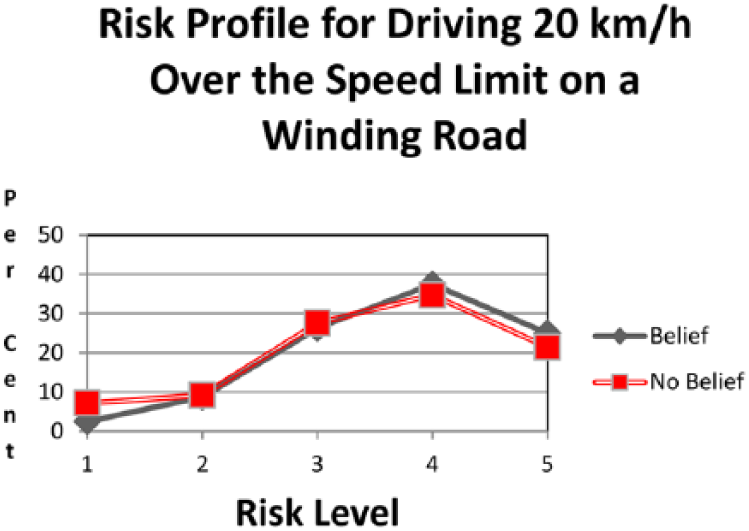
Perceived risk profile of survey respondents for driving 20 km/hr over the speed limit on a winding road.

Perceived risk profile of survey respondents for driving 20 km/hr over the speed limit after having a few drinks.
Figures 1 to 3 show the perceived risk profiles for these three scenarios. The “Belief” curve represents those who answered “yes” to the question, “Do you believe you have a personal spirit or supernatural power that watches over and protects you?” The “No Belief” curve represents a “no” answer.
The addition of a windy road or a few drinks made no difference to the statistics. There does appear to be a difference for the case shown in Figure 1/Table 1. A student t test indicates that the difference in mean risk level between belief and non-belief is not significant. However, using a z-ratio test for the significance of the difference between the proportion of risk preferences at the 1 to 2 level as compared with the proportion at the 3 to 5 level is significant at a 90% confidence level (Table 1).
Proportion of Risk Levels 1 and 2 for Driving 20 km/hr Over the Speed Limit for Those Who Believe in Guardian Spirits and for Those Who Do Not (Figure 1).

Note. Proportion = (n at 1-2 risk level) / n.
Similar results are evident for children versus no children (Figure 4 and Table 2). Those with children appear to be more risk averse, though the difference in mean risk is not significant. However, the difference in proportion of the 1 to 2 risk level as compared with the 3 to 5 risk level is significant at a 95% confidence level.

Perceived risk profile of survey respondents for those without children, compared with those with children (n = 57, M = 2.32, SD = 0.99 for Yes Children; n = 94, M = 2.49, SD = 1.00 for No Children).
Proportion of Risk Levels 1 and 2 for Driving 20 km/hr Over the Speed Limit for Those With Children, as Compared With Those Without (Figure 4).
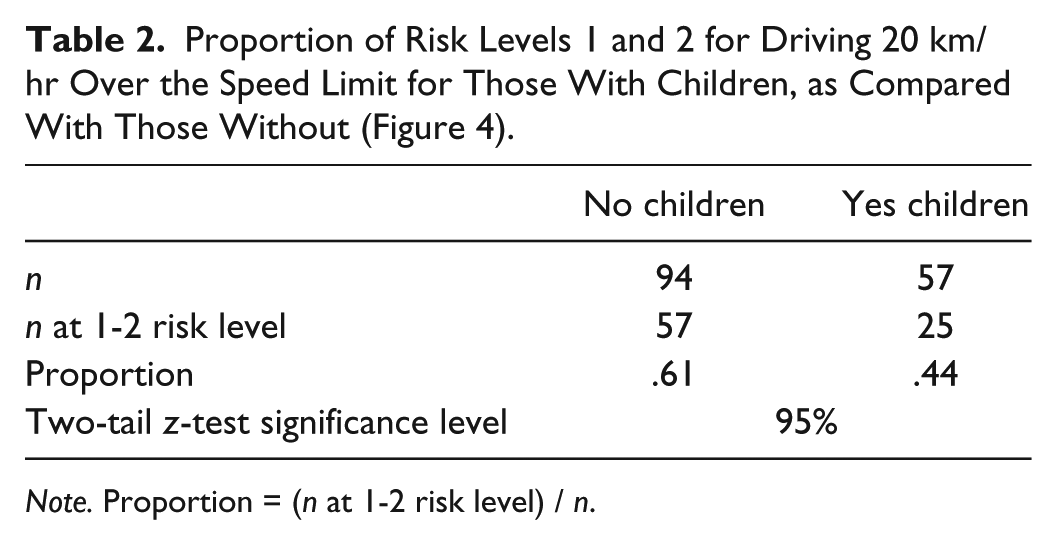
Note. Proportion = (n at 1-2 risk level) / n.
Gender is known to play a role in risk perception (Gustafsod, 1998), and this survey supports that finding (Figure 5 and Table 3). For the groups that do not believe in guardian spirits (the two solid lines), there is no difference between females and males, who both view the activity as less risky than the belief group. The group that does believe in guardian spirits shows a bias toward being more risk averse, particularly if they are female. The difference in means between the population subgroups are again, not significant. However, the difference in proportion of the 1 to 2 risk levels as compared with the 3 to 5 risk levels, between females who believe and those who do not, is significant at a 90% confidence level, whereas the difference between females who believe and males who do not is significant at a 95% confidence level.

Level of perceived risk associated with driving 20 km/hr over the speed limit in normal conditions.
Proportion of Risk Levels 1 and 2 for Driving 20 km/hr Over the Speed Limit for Males and Females, Subdivided by Belief and No Belief (Figure 5).

Note. Proportion = (n at 1-2 risk level) / n.
This result and the comments by interviewees on the question of willingness to engage in risk-taking behavior do not support the initial working hypothesis that, in general, a belief in guardian spirits is associated with decreased risk perception and therefore an increase in risk-taking behavior. If there is a cause and effect relationship between these two factors, it may be that the dominant one is that those who feel more at risk are more likely to believe in guardian spirits.
Discussion
There were a number of themes that emerged from the survey. With respect to the question, “What does the word risk mean to you?” the four themes of (a) potential to harm, (b) lack of control, (c) positive and negative outcomes, and (d) subjective responses were identified.
For the first theme of potential to harm, typical phrases used were life threatening, threat, danger, and harm. It was the most common response. Harm could be understood to have physical, emotional, or psychological dimensions.
The second theme of lack of control, though not as frequent as the first one, was still common. Typical words used were no control, not knowing, taking a chance, gamble, or outside my control. In some cases, the lack of control seemed to result from a deterministic worldview, whereas in others it was the result of a decision to give it up.
The third theme appeared in about half as many surveys as the second one, and used words such as danger and opportunity, good or bad, negative or positive, or chance of reward.
The final theme only appeared in a few responses and used phrases such as makes you nervous, out of comfort zone, and causes fear. It was interesting to note that although the interviewees were answering questions based on their current status, a number indicated that their risk-taking behaviors have lessened significantly following the birth of their children.
In response to the question, “Do your religious or spiritual views influence your willingness to participate in risky behaviour? If so, how?” there were four main themes identified: (a) lack of control, (b) prevention, (c) morality, and (d) authority.
Those within the lack of control theme (discussed by Slovic, 2000) expressed fatalistic attitudes, such as what happens is “up to God” who will “keep you safe” and will “support and protect you.” One noted that “when I feel spiritually connected I feel like I can take more risks,” while another said that “if I am serving God then I am protected physically.” This was the most common theme.
A secondary theme was that of being protected from taking risks, or that beliefs resulted in decisions not to take risks. For example, “God guides me away from this” or that “beliefs discourage me from engaging in risky behavior.”
The third and much less common theme of morality was based upon either avoiding or engaging upon behaviors required by ethical codes, which could reduce or increase risk-taking. Comments such as “not want to cause harm to others,” “moral code,” “principles of good and bad,” or the “Golden Rule” were used.
Finally, some based their comments upon the authority of church, by noting that they had to “follow the rules” or “respect authority.” The importance of this in terms of determining people’s behaviors has been noted by Haidt (2007).
The vast majority of people who interact with their spirit do it through prayer, meditation, or some ritual. One interesting response indicated that it was through his daily actions, as a way of “paying it forward,” so that the spirit would intervene for him in times of need. Other responses included precognitive dreams and a “little man inside my head.” Many communed on a daily or weekly basis, though some just in times of need. One responder indicated that he tossed a coin to make decisions, with the understanding that the guardian spirit would determine the outcome of the toss. Generally, it was a one-way communication, though one responder indicated having long conversations with the spirit.
The question “How does the belief in spirit intervention influence your perception of risk and your risk-taking behavior?” had five main themes. Of about equal importance are the three themes: (a) protection, (b) punishment, and (c) no effect. A fourth theme present was (d) ethics, and a fifth theme mentioned by a few people was (d) guidance.
The protection theme was based upon the notion that the guardian spirit will protect you in times of need, and that therefore one could take greater risks. Phrases supporting this view were “will take risks,” “don’t need to know all the facts,” “believing that the risk will pay off,” “don’t worry about things; if I live well God has a plan for me,” “feel lucky,” and feel “more secure.”
The punishment theme is rooted in the idea that the spirit will punish you for taking risks. One respondent said that he “avoids risky behavior because the spirit will punish me in the future.” Words such as “fear,” “avoidance,” and “take less risk” were present. “How great is your want in the face of the probability of censure, punishment or ridicule.”
A number of people simply stated that this belief did not affect their risk behaviors.
Some noted that their decisions are based on “conscience,” “God’s purpose,” or “what is right,” and thus there could be either a positive or negative risk outcome, depending upon the situation.
Three people noted that the spirit provides “guidance” to help you think through the problem or to give a “gut feeling.”
One interesting interview brought up a variation of the guardian spirit interaction, that being the possession of people by demons. This interviewee is a minister who performs exorcisms, and claims to have experienced many interactions with both angels and demons. Future research might explore the dark side of supernatural interactions.
It became clear after completing the interviews that notions of guardian angels or spirits were more subtle and nuanced than originally realized by the authors. In retrospect, it would have been useful to include a question asking interviewees to explain their concept of guardian spirit and to further explore their general risk perceptions.
Conclusion
The purpose of this research was to investigate relationships between a belief in guardian angels or spirits on risk perception and risk-taking preferences. Clearly, these beliefs are related to the risk perceptions of some people, and possibly their risk-taking behaviors as a result. Because 68% of those who believe in guardian spirits indicated that it affected their risk-taking behavior, 45% believe that their spirit watches over and protects them, and because of the significance of the statistical relationship between belief in guardian spirits and risky driving, it seems reasonable to assume a cause and effect relationship between risk perception and belief. However, cause and effect are complicated and unclear. In some cases, beliefs are associated with an increase in risk-taking behavior, but this was not the dominant theme. The stronger correlation was that people who believe in guardian spirits are more likely to be risk averse, particularly if they are female or have children. It may be that people who view the world in a riskier way are more inclined to have a belief in personal guardian spirits.
A number of themes emerged in terms of how people perceive risk-taking. Some, such as the theme of protection, were expected, whereas others such as punishment were unanticipated. The range of contexts within which people view their relationship with guardian spirits in terms of risk is complex and subtle, and requires further study.
Footnotes
Acknowledgements
We would like to acknowledge the assistance of Josh Bowen for his help with the initial literature review and questionnaire construction.
Declaration of Conflicting Interests
The author(s) declared no potential conflicts of interest with respect to the research, authorship, and/or publication of this article.
Funding
The author(s) received no financial support for the research and/or authorship of this article.