




Abstract
Many teaching strategies have been used to promote the development of critical thinking skills, among which the most frequently used are group discussion, concept mapping, and analytical questioning. The study aims to explore learners’ voice and learning experience in the pedagogical contributions of these strategies to the development of critical thinking skills in Chinese EFL (English as a Foreign Language) learners. One full university class was chosen as the sample in the instruction of critical thinking skills and to take part in a learner voice survey, among which 15 participants were chosen by purposeful sampling for semistructured interviews. The instruction of critical thinking was embedded in an English reading class by using the three teaching strategies, during which four interviews were conducted for each critical thinking skill. After the instruction of critical thinking skills was completed, all participants were surveyed with the learner voice questionnaire. The results show that participants thought the three teaching strategies could improve critical thinking skills. Each teaching strategy made unique and specific contributions to the development of critical thinking skills. These findings have pedagogical implications for using these teaching strategies in the instruction of critical thinking skills in Chinese EFL learners.
Keywords
Introduction
The instruction of critical thinking has been an endeavor to develop people into individuals who are independent enough to think critically. Education administrators and employers have taken critical thinking as an essential outcome of tertiary education (Barnett & Francis, 2011; Davies, 2011; Niu, Behar-Horenstein, & Garvan, 2013); thus, instructors attempt to employ a variety of specific teaching strategies to cultivate critical thinking in tertiary education. Among the most, frequently used strategies are group discussion, concept mapping, and analytical questioning (Lee et al., 2012; Lin, Han, Pan, & Chen, 2015; Qatipi, 2011; Savage, 1998; Tiruneh, Verburgh, & Elen, 2014; Walker, 2003). Different teaching strategies produce different effects on the development of critical thinking skills due to the interplay of various factors in tertiary education; for instance, learners, teaching and learning settings, and curriculum (Pithers & Soden, 2000). For different learners with different learning styles in different educational contexts, empirical studies have reported the positive effects of group discussion (Hayes & Devitt, 2008; Hudgins & Edelman, 1986; Schindler & Burkholder, 2014), concept mapping (Khodadady & Ghanizadeh, 2011; Lee et al., 2012; Wang & Liao, 2014), and analytical questioning (Alexander, Commander, Greenberg, & Ward, 2010; Barnett & Francis, 2011) on the development of critical thinking skills. However, learners’ voice and learning experiences are seldom reported in these studies when exploring the effectiveness of teaching strategies in the improvement of critical thinking skills. This study, with a focus on the learners’ voice, addresses how the three teaching strategies enhance critical thinking skills in a Chinese EFL (English as a Foreign Language, the phenomenon that English teaching and learning takes place only in the classroom as a subject in educational settings) context and aims to explore their effectiveness and unique contributions in the improvement of critical thinking skills.
Research Background
Group Discussion
Group discussion in the study refers to “a unique way for open, critical, and free discussion and deliberation, in terms of evaluating ideas or views or beliefs, broadening one’s scope or making available all the relevant evidence or comparing and judging all the relevant evidence” (Ikuenobe, 2002, p. 381). The concept of group used here refers to only a micro group in a classroom setting. Ikuenobe (2002) suggested that group discussion involves three types of critical thinking processes: group thinking, individuals-in-the-group thinking, and an individual’s thinking in the group. It also has two sets of functions: “examining evidence to determine the reasonableness of an idea or a view or conclusion or a belief,” and “engendering critical thinking, analysis, multiple perspectives and synthesizing perspectives” (Ikuenobe, 2002, p. 385).
Several studies have examined the effect of group discussion on critical thinking development. Hudgins and Edelman (1986) conducted a study for the duration of 6 weeks to examine the effect of group discussion on critical thinking development. They chose 10 classes in five primary schools in the United States as a sample. The results showed no significant increase in children’s critical thinking ability in the experimental group compared with the control group. The difference was negligible. Hudgins and Edelman explained that this nonsignificant increase was due to the short study period of 6 weeks, and posited that increased lessons and lengthened discussion may bring about significant improvement of children’s critical thinking.
Hayes and Devitt (2008) carried out a study with participants from various majors in a college in the United States over the duration of 16 weeks. The results showed that group discussion in small classes could significantly improve participants’ critical thinking skills more than in large classes. Another important finding is that nonnative English speakers show a significant improvement of their critical thinking skills, which is not found for native English speakers, although native English speakers have higher scores for critical thinking skills in both pretests and posttests compared with nonnative English speakers. Hayes and Devitt explained that native English speakers have higher scores because of their higher reading ability. In addition, the reason why nonnative English speakers show significant improvement of critical thinking skills while native English speakers do not is that familiarity with new terminology and frequently practicing group discussion aids in their development of critical thinking skills. The findings indicated that group discussion might benefit nonnative English speakers more than native English speakers in the development of critical thinking. For Chinese nonnative English speakers, the studies by Fung (2014) and Fung and Howe (2014) revealed that Confucian values have a certain effect on students’ behavior when they work together, and that group discussion is more effective than whole-class instruction in the development of critical thinking skills.
Concept Mapping
Concept mapping is also found to be effective in the development of critical thinking. Novak (1998) considered concept mapping as a tool to represent meaningful structures for a concept or a set of concepts. The procedure of concept mapping involves, according to Novak, identifying the focus question and most important concepts associated with the question, and ordering the concepts from the general at the top to the specific below and cross-linking them. Concept mapping can be used to represent logical relations in a complex argument such as chain and extended arguments, or among several arguments. Therefore, concept mapping is useful for promoting various critical thinking skills, such as interpretation, analysis, and synthesis (Vacek, 2009). Empirical evidence relating to the effect of concept mapping on the improvement of critical thinking can be found in the study conducted by Wilgis and McConnell (2008). There is a 2-day treatment intervention in the study with only one treatment group of graduate nurses in the United States. Concept mapping was employed as both a teaching strategy and a way to evaluate critical thinking. The results indicated that concept mapping is effective in accelerating participants’ critical thinking ability to synthesize and prioritize information, make appropriate plans, and make judicious decisions.
Convincing and persuasive empirical evidence is offered in the study by Lee et al. (2012). The study used a quasi-experimental design in a 2-year program and was conducted with nonnative English speakers majoring in nursing. The results indicated that, although there is a nonsignificant decrease of critical thinking in both groups, participants in the experimental group perform only inference and deduction in five critical thinking skills significantly better than those in the control group and show higher growth rates of inference and deduction. Lee et al. (2012) explained that the decrease of critical thinking for participants in both groups is due to regression.
Khodadady and Ghanizadeh (2011) carried out a study to investigate the influence of concept mapping on EFL learners’ critical thinking ability. Thirty-six EFL learners at upper intermediate and advanced levels were chosen and randomly assigned to treatment and control groups. Treatment intervention consisted of concept mapping after reading each text and the formulation of required postreading activities during a 3-month session. The results revealed that concept maps significantly foster EFL learners’ critical thinking ability in reading classes. The study suggests that concept mapping, as a teaching strategy, is effective for the improvement of critical thinking in EFL learners.
Analytical Questioning
Questioning is often used by educators as an effective teaching strategy to foster critical thinking. Ikuenobe (2001) thought questioning to be an open-ended process of inquiry, which is necessary for critical thinking. It is a rigorous process, which aims to open up issues about the reasonableness of a belief, evaluate evidence and counterevidence, and determine reasonableness. The process of questioning can help us to critically reflect on our own beliefs and those of others, and detect the strengths and weaknesses of such beliefs. Ikuenobe (2001) distinguished two types of questioning: fact-finding questioning for information seeking and analytical questioning for critical analysis. It is analytical questioning that “requires one to explore, explicate, examine, clarify, dissect, reflect on and relate issues or ideas,” and “helps to elicit the reasoning behind an idea in order to fully unpack it and make it accessible and understandable, such that the reasonableness of the idea may be evaluated and determined” (p. 335). Asking correct and critical questions can stimulate and direct critical thinking and push us forward toward the continuous exploration of opinions, insights, and judgments (Browne & Keeley, 2007).
To examine the effect of questioning on the development of critical thinking, various studies have been conducted. Alexander et al. (2010) performed a study to explore the effect of a “4-question teaching technique” on the enhancement of critical thinking in online discussion. Twenty-four participants from a university in the southern United States were chosen to participate in online discussion forums. There were three asynchronous discussion forums with topics about three different case studies on behaviorism, social cognitivism, and metacognition. The first forum was conducted during the second week of the course. The second and last forums were conducted at the middle and end of the course, respectively. The results indicated that the four-question technique has a positive role in improving participants’ critical thinking. The same effective results are found in another study by Barnett and Francis (2011). The difference is that written questions, not oral ones, are used in the study. The results revealed that those participating in quizzes which contain written analytical questions perform significantly better than those participating in quizzes which do not contain such questions. As with EFL learners, the study conducted by DeWaelsche (2015) revealed that higher-level questions are useful to the development of Korean EFL learners’ critical thinking skills.
Previous studies have proved the positive effects of group discussion, concept mapping, and analytical questioning on the development of critical thinking. However, mostly, each study explores only one of the three strategies rather than all three together, and employs quantitative research techniques. Few studies have been conducted to explore the three strategies when used together with Chinese EFL learners who have been nurtured in Confucian culture and developed a Chinese style of learning, and to listen to Chinese EFL learners’ voice and their learning experiences. In this study, the three teaching strategies were collaboratively used and qualitative research techniques were employed as the main research method. It aims to explore the specific contributions these teaching strategies made to the development of critical thinking skills in Chinese EFL learners by listening to their voice and learning experiences. Thus, it intends to answer the following research questions:
Method
Research Design
The present study employed a mixed research design of quantitative and qualitative techniques to collect and analyze data, and amalgamate findings. The choice of research methods was guided and determined by the research questions. The confirmative research question (RQ1) requires quantitative techniques and the explorative research question (RQ2) requires qualitative techniques. A Likert-type 4-point scale in the learner voice questionnaire was employed to collect quantitative data for answering the confirmative research question, whereas open-ended questions in the questionnaire and semistructured interview were used to collect qualitative data for answering the explorative question.
Participants
The sample in the present study was selected from Tongling University in China, where the researcher works as an English teacher. In the university, English is taught as a foreign language to English majors and non-English majors. The study was conducted with English majors.
Fifty freshmen in one class, aged 18 to 20, were chosen as the sample. There were 45 female and five male participants. They began to learn English when they were in the third grade of elementary school and continued to learn it until they graduated from high school. As a result, the participants had studied English as a foreign language for at least 9 years before they obtained admission to the university. Each participant received an informed letter that described the purpose of the research and the use of the collected data. Only data for which written consent was obtained were included in the study.
Instruments
There were two instruments employed in the study. One was learner voice questionnaire. The other was semistructured interview.
The questionnaire was developed by the researcher. It consists of two formats: multiple-choice items using a Likert-type 4-point scale and open-ended questions. The Likert-type 4-point scale aimed to elicit participants’ opinions on the effectiveness of teaching strategies and the open-ended questions aimed to elicit participants’ opinions on the contributions made by the teaching strategies. The reason why a 4-point rather than a 5-point scale was used is that Chinese EFL learners have a tendency to be modest in evaluating the teaching strategy used by the teacher, to show respect for the teacher. Therefore, they tend to choose undecided in a 5-point scale if possible. To avoid such a tendency, the 4-point scale was employed. In constructing the questionnaire, suggestions from peers and experts were incorporated, resulting in some rewording and revisions before the questionnaire was piloted. Reliability analysis indicated that the questionnaire had a coefficient α of .83, more than .70, which means that the questionnaire is reliable. A factor analysis showed that two items had lower factor loadings of 0.19 and 0.30, respectively, less than 0.40. Therefore, they were omitted. After the instruction of critical thinking skills was finished, the questionnaire was administered to all participants.
Semistructured interviews were conducted after each critical thinking skill was taught. In total, there were four critical thinking skills. Therefore, semistructured interviews were conducted 4 times. The guiding questions for the interview were planned in advance. Fifteen participants were chosen for interview by purposeful sampling according to their performance in class, that is, above average, average and below average performance, each with five participants. Their performance ranking was determined by whether participants actively participated in class activities and their performance in the tasks assigned by the teacher in class. Each of them was interviewed for about 20 min. The four forms of semistructured interview had similar formats for the guiding questions and probes.
Treatment
The instruction of critical thinking skills was embedded in an English reading class in one semester over 16 weeks. Three major teaching strategies—group discussions, concept mapping, and analytical questioning—were implemented during the instruction. There are four critical thinking skills: interpretation, analysis, synthesis, and evaluation. Normally, the instruction of critical thinking skills in the reading class began with the presentation of reasoning knowledge related to the skills. The teacher presented the concepts, principles, and processes of the skills with some examples offered. In the examples, participants were coached on how to ask analytical questions they could use in group discussion and how to use concept mapping to clarify the logical relations of complex arguments.
After participants had learned the required knowledge, they had to apply it in identifying, analyzing, synthesizing, and evaluating the arguments in a reading text. First, the teacher asked the participants analytical questions or assigned them tasks to perform, such as identifying, analyzing, synthesizing, and evaluating arguments in reading materials. Second, participants could discuss the assignments in groups with their classmates. Third, participants presented their discussion, and for complex arguments, they could use concept mapping to show the logical relations on the blackboard. The three teaching strategies were employed collaboratively and the order of their employment was not rigorously followed.
Results
There were two types of data: quantitative data collected from the Likert-type scale of the questionnaire and qualitative data elicited from the open-ended questions of the questionnaire and the interviews. The audio-taped interviews were transcribed before analysis. Quantitative data were analyzed using description and frequency analyses, whereas qualitative data were analyzed using content analysis.
Analysis of Quantitative Data From the Questionnaire
Description analysis and frequency analysis were performed to examine whether participants agreed on the Likert-type items which elicited participants’ opinions on the effectiveness of teaching strategies in the development of critical thinking skills using mean and percentage statistics. For frequency analysis, the options “strong agreement” and “agreement” were combined into “agreement” and similarly, “strong disagreement” and “disagreement” were combined into “disagreement.” The results are presented in Table 1. The criteria proposed by Akkakoson (2013) were used to determine a cutoff point for equal interval between levels; a cutoff point of .75 (3 / 4 = .75) was set in a 4-point Likert-type scale. Therefore, the criteria for mean value are 1 to 1.75 as strong disagreement, 1.76 to 2.50 as disagreement, 2.51 to 3.25 as agreement, and 3.26 to 4.00 as strong agreement.
Statistical Result of Participants’ Opinions on Teaching Strategies.

As Table 1 shows, generally, among the three items which elicit participants’ opinions on the effectiveness of group discussion in the development of critical thinking skills, the mean value for Item 5 was 3.36, meaning participants strongly agreed that the strategies of discussion were generally effective. The mean values for Item 2 and Item 8 were, respectively, 2.84 and 3.06, which means that, specifically, discussion on questions asked by the teacher and on argument in a reading text could help students to develop critical thinking skills. This finding was corroborated by a higher percentage of agreement than that of disagreement: 94% for Item 5, 94% for Item 8, and 72% for Item 2. The higher percentage of agreement for Item 5 (94%) means that almost all participants thought that group discussion helped them considerably with the development of critical thinking skills. The percentage of agreement for Item 2 (72%) is lower than for Item 8 (94%), which means that, in comparison with discussion on questions asked by the teacher, participants might be more active in discussion on argument in a reading text in which participants discuss the structure and components of an argument.
For Items 1, 4, and 6, mean values were within 2.51 to 3.25, showing that participants agreed that they enjoyed using concept mapping to show logical relations among components of arguments in a reading text and thought that concept mapping was effective in developing critical thinking skills. This finding was corroborated by frequency. The percentage of agreement was higher than that of disagreement for Item 1 (85%), Item 4 (90%), and Item 6 (58%), respectively. However, the percentage of agreement for Item 6, in which close to half of the participants (42%) did not like to use concept mapping to show the relations among components of an argument, was lower than that for Item 4 and Item 1. This indicates that it might not be a simple task for participants to discover an argument in an authentic reading text and analyze and map the logical relations among its components because arguments are intertwined with some rhetoric devices and nonargument elements. It requires commitment and persistence.
Among Items 3, 7, and 9, which elicited participants’ opinions on the effects of analytical questioning on the development of critical thinking skills, the mean values for Items 3 and 7 were, respectively, 3.32 and 3.28, which indicates that participants strongly agreed that analytical questioning, in particular, in recognizing and analyzing arguments in a reading text, could help considerably in their development. The finding was corroborated by higher percentages of agreement: 100% for Item 3 and 94% for Item 7. However, the mean value for Item 9 (M = 2.46) shows that participants did not actively participate in questioning or challenge the answers to questions asked by the teacher. They tended to accept the answers given by the teacher or their classmates. The percentage (54%) of agreement, which shows that close to half of the participants (46%) did not like to argue with others, whether the teacher or their classmates, on their answers to questions asked by the teacher, reinforces this finding.
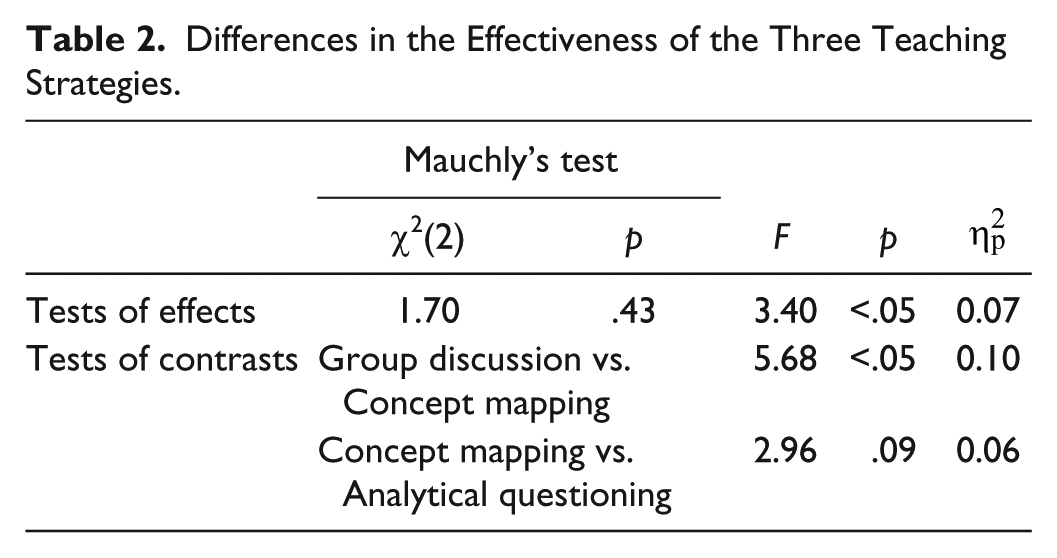
To examine whether there were significant differences among participants’ opinions on the effectiveness of the three teaching strategies, repeated-measures ANOVA was performed. The results are presented in Table 2. As seen, there were significant differences among participants’ opinions on the effectiveness of the three teaching strategies in the development of their critical thinking skills, F(2, 98) = 3.40, p < .05. The effect size estimate shows that in general, teaching strategies had a medium effect on development,
Differences in the Effectiveness of the Three Teaching Strategies.
Analysis of Qualitative Data From the Questionnaire
Results from the open-ended questions of the questionnaire indicated specific contributions of the three strategies to the cultivation of critical thinking skills. Participants responded that group discussion could assist them in improving their critical thinking skills, because in discussion, they could exchange ideas with each other about their own and others’ thinking. By comparing their thinking with others’, they could discern the strengths and weaknesses of others’ and at the same time, the defects of their own. As a result, inspired by others’ thinking, their own thinking could be improved and expanded. In addition, participants stated that they could explore the issues discussed from different perspectives and thus gain deep insights into them.
Through concept mapping, they could obtain clear ideas of statements in one paragraph presenting a complex argument, and then the deep understandings of the logical relations among these statements. As a result, it was conducive to discovering a complex argument such as a chain or extended argument. It was also conducive in distinguishing argument from nonargument such as explanation, description, and summary, because it made the relations among components of a complex argument clear. Therefore, concept mapping could help improve their critical thinking skills. As for analytical questioning, it could encourage them to think independently about questions and thus, it could help them gain deep understandings of the issues questioned. Therefore, independent thinking was improved.
The results showed that, during the development of critical thinking skills, the three teaching strategies made unique contributions. Group discussion could help students discover the strengths and weaknesses of others’ thinking and their own, and explore issues from alternative perspectives; concept mapping could be conducive in clarifying complex arguments; and analytical questioning could encourage independent thinking. These findings were corroborated by the findings gained from the analysis of interview data.
Analysis of Qualitative Data From Interviews
For group discussion, interviewees reported that they could exchange their ideas freely if the teacher did not stand by, through which they could find the strengths of others’ ideas and the defects of their own. Therefore, they could notice weaknesses in their own ideas and improve them. Before they expressed ideas, they had to think about them, and thus, discussion could improve their independent thinking. By discussion, participants could obtain deep insights into the issues discussed and deep understanding of the concepts used. As a result, most participants actively participated in discussion in class. An excerpt showing the contributions of group discussion is as follows (pseudonyms used for privacy throughout):
. . .
Do you think discussion is better than questioning?
I don’t mean that. It is mainly because we can exchange ideas when in discussion. And then, we can notice, we have different ideas from others. Then, we have more confidence in answering the questions. (WQQ/I-5)
So, these teaching strategies can help you differentiate arguments from nonarguments and find arguments in a reading text, can’t they? (WQQ/I-5)
Yes.
What help?
It becomes easier than before to find arguments. (WQQ/I-5)
. . .
For concept mapping, interviewees reported that, when required to use a concept map to illustrate the logical relations among components of a complex argument, they had to think about the logical relations first and then use the map to show the relations. Initially, they had no ideas about the logical relations of components of a complex argument in one paragraph of a reading text. As concept mapping was often used in the class, they eventually gained clear ideas about the logical relations. By concept mapping, interviewees could improve their deep understandings of the rhetorical structure of a text. It also improved their independent thinking. However, some interviewees reported that, although they could use concept mapping to show the logical relations among components of a complex argument, it was not so easy to successfully achieve. Sometimes they could make mistakes, because they could not easily obtain deep understandings of the logical relations among the components of a complex argument. Similarly, other interviewees reported that, if the relations were not so complicated in a complex argument, they could use concept mapping to show the logical relations. This implies that the successful implementation of concept mapping requires deep understandings of the logical relations among components of a complex argument, and in turn, concept mapping could result in deep understandings of the logical relations, by which critical thinking skills were improved. The following excerpt indicates the contributions made by concept mapping:
. . .
Do you think concept mapping is helpful to the improvement of critical thinking skills?
Of course. I think drawing a map to show logical relations is pretty good for the understandings of logical relations among components of a complex argument in one paragraph. (WCL/I-6)
. . .
For analytical questioning, interviewees reported that, when the teacher asked them questions, they needed to think about these questions and prepare the answers. As a result, questioning improved their independent thinking. In addition, these questions were mostly related to interpreting, analyzing, synthesizing, and evaluating arguments in a reading text. Therefore, it could assist in the improvement of critical thinking skills. An excerpt showing the contributions of questioning is as follows:
. . .
Participation in class activities is helpful to your independent thinking?
Independent thinking, of course, because you asked us questions.
So, in what aspect is it helpful?
Because, I may be required to answer the questions, I need to think over the questions, thinking over how to answer the questions (ZX/I-2).
. . .
Interview results revealed how the three teaching strategies positively affected the development of critical thinking skills in their unique ways. Group discussion could facilitate the development of critical thinking skills by detecting the strengths and weaknesses of thinking, concept mapping by clarifying complex logical relations, and analytical questioning by improving independent thinking.
Discussion
Through engagement in discussion and debate, participants’ critical thinking skills were improved, which corroborates the finding reported in previous empirical studies (Fung, 2014; Fung & Howe, 2012, 2014; Hayes & Devitt, 2008). This research expands on previous studies by voicing the unique contributions of group discussion to the development of critical thinking skills. In group discussion, conflicting viewpoints and arguments are brought together and thus participants are pushed to examine their own views and available evidence and to find various rationales to support and validate them to convince others (Bucy, 2006; Ikuenobe, 2002). At the same time, participants are required to make logical judgments about the reasonableness of their partners’ views and beliefs through reflecting and evaluating evidence. In struggling against counterevidence, asking for clarification and strong opposition challenged by conflicting views and beliefs, participants can refine their arguments and improve their critical thinking. This echoes the argument that “peer dialogues generated a significant change in student ability to produce high quality argumentation” and “through engaging in argumentation, participants will improve their thinking skills” (Sionti, Ai, Rosé, & Resnick, 2011, pp. 30-31). As Ikuenobe (2002) claimed, group discussion is a process of analyzing, evaluating, and synthesizing multiple perspectives and therefore, engenders critical thinking.
It was also found that if the teacher stood by, Chinese EFL learners could not express their ideas freely and willingly and exchange ideas with each other openly, which confirms the findings reported by Fung (2014) and Fung and Howe (2014). Confucian values affect Chinese learners’ behaviors. When Chinese EFL learners are nurtured in Confucian culture, Confucian culture shapes their learning styles and they are found to be reluctant to criticize articles written by authoritative scholars, and engage in classroom discussion and debate (Atkinson, 1997; Turner, 2006). The finding also implies that in a learner-centered learning and teaching context rather than a Confucian traditional teacher-centered context, participants are willing to engage in discussion and debate, through which their critical thinking skills are improved.
This research has demonstrated that concept mapping promoted the development of critical thinking skills, which confirms the findings of previous studies (Khodadady & Ghanizadeh, 2011; Lee et al., 2012; Rosen & Tager, 2014; Wilgis & McConnell, 2008). Chinese EFL learners reported how concept mapping promoted the development of critical thinking skills. Concept mapping facilitated the deep understanding of propositions underlining statements in one paragraph of a reading text and logical relations among these statements by visually organizing and representing content, echoing the claim that concept mapping is an effective tool to facilitate learning in a meaningful manner (Novak, 1998; Novak & Cañas, 2008). The mapping process is a visual illustration of thought processes, by which information is interpreted, analyzed, synthesized, and assimilated in a meaningful manner (Vacek, 2009). As Wilgis and McConnell (2008) argued, “cognitive processes in doing concept mapping resembles thinking patterns” (p. 120). The process of concept mapping begins with identifying the major viewpoint or belief and then associated evidence in one paragraph or several paragraphs. Afterward, cross-links are used to help us see the logical relations among them. The hierarchical structure of a complex argument is represented in a good map and cross-links are searched for and characterized, which are important in the facilitation of critical thinking (Novak & Cañas, 2008, p. 2). However, creating a concept map is a creative thinking process which can be challenging for participants who are accustomed to rote learning shaped by Confucian culture. This can result in mistakes and difficulties in creating concept maps, such as those experienced by Chinese EFL learners as reported in interviews, because, as Novak and Cañas (2008) discovered, it is hard for participants to understand the relations among concepts or sets of concepts, that is, components of a complex argument.
Analytical questioning was found to be effective in the development of critical thinking skills, in agreement with earlier findings in previous studies (Alexander et al., 2010; Barnett & Francis, 2011; DeWaelsche, 2015). Different from previous studies, it was also found that analytical questioning facilitated the development of critical thinking skills through inquiring into the reasoning behind components of an issue and thus obtaining a deep understanding of the issue or different ways to look at the issue (Ikuenobe, 2001). Those analytical questions pertaining to interpretation, analysis, synthesis, and evaluation in the study were used to explicate and clarify ideas or views expressed in a text, to dissect and reflect on them, and to relate them to evaluate the reasoning behind them. Analytical questioning is virtually a process of critical thinking in that it seeks to explore implicit meanings, inferences, underlying assumptions, and justifications (Ikuenobe, 2001, p. 335). Therefore, analytical questioning, as an indispensable part of classroom teaching, is an effective tool to improve critical thinking skills, in particular for those who are reluctant to challenge ideas or views expressed by authoritative scholars. The finding shows that analytical questions could encourage Chinese EFL learners to critically think through and rethink ideas or views in a text written by authoritative writers, and to interpret, analyze, synthesize, and evaluate the reasoning behind those ideas or views. This could assist them considerably in developing critical thinking skills (Elder & Paul, 1998).
Conclusion and Limitations
The teaching strategies of group discussion, concept mapping, and analytical questioning were found to effectively improve critical thinking skills in Chinese EFL learners. In different aspects, these teaching strategies contributed to the facilitation of critical thinking skills. Group discussion can bring together conflicting views and arguments, which pushes participants to analyze and evaluate others’ views and arguments and to validate their own. Concept mapping can visually represent the organization and structure of a complex argument in a text after it is interpreted, analyzed, synthesized, and evaluated, and improve participants’ deep understandings of the logical relations of a complex argument, thus, improving their critical thinking skills. Analytical questioning can be used to interpret, dissect, and analyze, and reflect on and relate ideas or views expressed in a text to explore and evaluate the reasoning behind them, by which critical thinking skills can be improved. These findings have implications for effectively using the three teaching strategies in developing critical thinking skills in Chinese EFL learners.
However, the findings in this study are generated by mainly analyzing qualitative data and thus cannot be generalized. Lack of a control group decreases the validity of the findings. Another limitation concerns the interviews/interviewees. As Chinese students whose learner behaviors have been shaped by Confucian culture, participants were reserved and unwilling to answer open-ended questions. The researcher had to use closed questions and probing questions to elicit students’ responses on whether the three teaching strategies positively affected the development of critical thinking skills. If the semistructured interviews mostly employed open-ended questions to elicit learners’ responses to the effect of these strategies on the development of critical thinking skills, a deeper understanding would be gained. Future research also needs to consider comparing the effectiveness of the three teaching strategies by using an experimental design with different groups, each implementing one strategy, which will result in unambiguous findings.
Footnotes
Declaration of Conflicting Interests
The author(s) declared no potential conflicts of interest with respect to the research, authorship, and/or publication of this article.
Funding
The author(s) received no financial support for the research, authorship, and/or publication of this article.