




Abstract
The intelligence of success, emotional intelligence, is said to be different in males and females. The present study was attempted to determine whether students from different genders are different in emotional intelligence and its related components in Iran. The Bar-On Emotional Quotient Inventory was distributed among 455 undergraduate university students majoring in English. These English majors were selected through availability sampling from Allameh Tabatabaee University, Khatam University, and Shahid Rajaee Teacher Training University in Tehran. They completed the inventory in 30 to 45 min and a MANOVA was run on the results of the questionnaire. Results showed that there was no significant difference between the genders on their total score measuring emotional intelligence, but the genders did tend to differ in emotional self-awareness, interpersonal relationship, self-regard, and empathy with females scoring higher than males. Self-regard, a component where males usually score higher, has yielded different results in this study which can open new avenues of research.
Introduction
Emotional intelligence (EI) has proven to be a significant influence in different areas of everyday life (Fernández-Berrocal, Cabello, Castillo, & Extremera, 2012). It is defined as the capacity to process emotional information accurately and efficiently (Salovey & Mayer, 1990). This processing includes the capability to perceive, assimilate, understand, and manage emotions. Jordan and Troth (2002) defined EI as a construct that involves the individual’s capacity to monitor and control their own and others’ emotions, their ability to distinguish between positive and negative effects of emotions, and the capability to use emotional information to monitor thinking and actions. Even though everyone is emotionally intelligent, studies have shown that females demonstrate a higher degree of EI than males do (Joseph & Newman, 2010; Patel, 2017). The present study has been designed to look at this difference, both as a measure of overall EI and its components.
EI is defined as “the subset of social intelligence that involves the ability to monitor one’s own and others’ feelings and emotions, to discriminate among them and to use this information to guide one’s thinking and actions” (Salovey & Mayer, 1990, p. 189). They further stated that mental processes related to EI are “appraising and expressing emotions in the self and others, regulating emotion in the self and others, and utilization of emotions in adaptive ways” (p. 190). As stated by Salovey and Mayer (1997), the drawback to this model was that it had overlooked thinking about emotion. Therefore, the model was revised and Mayer and Salovey (1997) presented a Four-Branch Model of EI. In this model, EI is defined as involving the ability to perceive accurately, appraise, and express emotion; the ability to access and/or generate feelings when they facilitate thought; the ability to understand emotion and emotional knowledge; and the ability to regulate emotions to promote emotional and intellectual growth. (p. 10)
Emotions facilitate thinking by directing attention to changes, such as work that needs to be done and time that is running out. For example, homework that needs to be completed for the next day or a book that needs to be studied before the exam. Another way in which emotions can assist thought is generating feelings on demand so that one knows how ones colleagues, classmates, opponents, or competitors are feeling. Emotions may aid in considering numerous perspectives and lead to creativity (Mayer & Salovey, 1997). Moreover, EI is a construct that involves an individual’s ability to monitor their own and others’ emotions, to distinguish between the positive and negative effects of emotions, and to use emotional information to regulate thinking and actions (Jordan & Troth, 2002). In the four branch model, problem solving used by people was incorporated into the different branches. In 2016, a set of principles were used to guide the theorizing of EI, and it was located among broad intelligences. In this model, EI is considered a hot broad intelligence. “Cool intelligence relates to impersonal knowledge, whereas hot intelligence has to do with matters that are highly affective; they make our blood boil or chill out hearts” (Mayer, Caruso, & Salovey, 2016, p. 292). The new model (Mayer et al., 2016) defines EI as “the ability to reason validly with emotions and with emotion-related information, and to use emotions to enhance thought” (p. 296). These abilities involve identifying emotional content, facilitating thinking, understanding meanings of emotions, and managing emotions (Mayer et al., 2016). Mayer et al. (2016) put forth another Four-Branch Model comprising the branches: perceiving emotion (with seven abilities), facilitating thought using emotion (five abilities), understanding emotions (eight abilities), and managing emotions (six abilities). In this model, new abilities were added, an ability from the original model was divided into two separate abilities, and a number of abilities from the previous model were kept intact. On the whole, the 16 abilities of the previous model increased to 26 abilities: fine-tuning EI.
EI is complicated encompassing 26 abilities and therefore influenced by many factors. One factor affecting EI is gender. This effect may be due to both social and biological factors. Socially, females are known to have greater EI than males (Singh, 2002; Ryff, Singer, Wing & Love, 2001). Petrides and Furnham (2000) described gender as a social process where some activities are more masculine or feminine. There are traits desirable for one gender but not the other; assertiveness is a typical male characteristic whereas empathy is a desirable female characteristic (Siegling, Furnham, & Petrides, 2015). One reason for the existence of such dissimilarities may be that males and females are socialized differently (Duckelt & Raffali, 1989; Sandhu & Mehrotra, 1999). In the socializing process, schools, peers, parents, and/or the media encourage females to be cooperative, expressive, and attuned to their interpersonal world, whereas males are led to be openly competitive, independent, and instrumental (Petrides & Furnham, 2006). Consequently, through experiences in childhood, females learn to give more value to nurturance and interpersonal interconnectedness than males do (Gunkel, Lusk, Wolff, & Li, 2007). On the contrary, from a biological perspective, Fernández-Berrocal et al. (2012) claimed the female biochemistry is more suitably adapted to the individual’s own and other’s emotions as a vital factor for survival. In female brains, certain areas of emotional processing are larger than the corresponding areas in males (Baron-Cohen, 2003) besides males and females are different in cerebral processing of emotions (Craig et al., 2009) giving rise to the differences in EI.
The difference between males and females where overall EI was concerned was inconsistent in various parts of the world. Overall, EI and gender was found to have a mean correlation of .17 with females scoring higher than males and females possessing higher emotional and interpersonal skills than males in the United States (Van Rooy, Alonso, & Viswesvaran, 2005). A study carried out in Tamil Nadu, India, found that in medical graduates, females have higher EI than males (Chandra, Gayatri, & Devi, 2017) and females had higher mean EI scores among Sri Lankan medical undergraduates (Ranasinghe, Wathurapatha, Mathangasinghe, & Ponnamperuma, 2017). In Delhi, 10th graders, the EI of female students was demonstrated to be higher in comparison with their male counterparts (Joshi & Dutta, 2014), but in Iran, Zohrevand (2010) found lower EI in 17-year-old 11th grade school females compared with males from six different districts in Iran: Ardebil, Kordestan, Khouzestan, Golestan, Tehran, and Isfahan. In Iran, Domakani, Mirzaei, and Zeraatpisheh (2014) found that females have greater overall EI and are better at interpersonal skills, adaptability, and pragmatic knowledge than males. The overall EI scores of females was significantly higher than males (Craig et al., 2009; Harrod & Scheer, 2005; Schutte et al. as cited in Petrides & Furnham, 2000). Studies showed differences between genders in both types of EI measures: ability and trait. Nikoopour and Esfandiari (2017) found a significant difference in the trait EI of English as a Foreign Language (EFL) teachers in Iran, but there was no significant difference in their spiritual, cultural, and social intelligence. Spanish adults showed that the total ability EI score as well as scores on the four EI branches were affected by gender, where ability EI was higher in females than males (Cabello, Sorrel, Fernández-Pinto, Extremera, & Fernández-Berrocal, 2016).
However, in some cases, no clear difference in EI has been found between the genders (Aquino, 2003; Bar-On, 1997; Bar-On, Brown, Kirkcaldy, & Thome, 2000; Brackett & Mayer, 2003; Brackett, Rivers, Shiffman, Lerner, & Salovey, 2006; Brown & Schutte, 2006; Depape, Hakim-Larson, Voelker, Page, & Jackson, 2006). In a study carried out in the United Kingdom, Arteche, Chamorro-Premuzic, Furnham, and Crump (2008) could not find a significant relationship between overall EI and gender in a sample of employees. In a study carried out in Myanmar, no significant difference was found between the EI of male and female teachers (Myint & Aung, 2016). It is interesting to note that males and females are statistically similar in believing that there is a need for learning how to be impolite, not save an interlocutors face, at times. Both genders are prepared to learn how to be impolite in a foreign language and they believe it is necessary (Ahmadi & Heydari Soureshjani, 2011).
Another avenue to explore to discern the differences between the genders in EI is the components of this intelligence. Arteche et al. (2008) found that females had higher scores on the interpersonal facet than males. In addition, females outscore males highly on empathy, emotional skills, and emotional-related perceptions (Craig et al., 2009) and on perception of emotions, such as decoding facial expressions (Kafetsions, 2004). Dunn (2002) claimed that females display better empathy, social responsibility, and interpersonal relationship than males.
One of the differences between the EI of the genders is in their expression of emotions. Naghavi and Redzuan (2011) stated that females are mostly expected to be more expressive, whereas males were taught to abstain from expressing feelings as a manly model. Females were better at expressing their emotions and slightly better at predicting consensus feelings than were males (Mayer & Geher, 1996). Naghavi and Redzuan (2011) claimed that parents talk to their daughters about emotion and give them more information about feelings and females learn to name their emotions quicker than males. Mothers use more emotion words with females when they tell stories and display more emotion when interacting with females which may create a predisposition to more emotions for the females (Bechtoldt, 2008). For males, the expression of emotions has not been emphasized; therefore, they are afraid of and do not know how to name their own and others’ emotions. Jakupcak, Salters, Gratz, and Roemer (2003) ascertained that males have a greater fear of emotions and tend to show less emotions than females. Brody, Hall, and Stokes (2016) claimed that males more frequently express negative emotions (e.g., anger, aggression, and frustration). Research illustrates that males are more prone to expressing high-intensity positive emotions (e.g., excitement) and females are more prone to expressing low or moderately intense positive emotions (e.g., happiness) as well as sadness (Else-Quest, Hyde, Goldsmith, & Van Hulle, 2006; Perry-Parrish & Zeman, 2011; Schultz, Izard, & Bear, 2004; Zhou, Eisenberg, Wang, & Reiser, 2004). In addition, females are at an advantage in the perception of emotions and demonstration of social skills and EI, but exhibit more hesitation about feelings and decisions, and place less importance on the intellect (Mayer & Geher, 1996; Wong & Law, 2002).
Females, also, place greater attention on their emotions than males do (Fernández-Berrocal, Extremera, & Ramos, 2004; Salovey, Mayer, Goldman, Turvey, & Palfai, 1995), are more emotional (Grewal & Salovey, 2005), and are more skillful at dealing with and understanding their emotions, while males are more competent at regulating impulses and withstanding pressure (Sanchez-Nunez, Fernández-Berrocal, Montanes, & Lattore, 2008). Nasir and Masrur (2010) found male students had higher scores in stress management on the Emotional Quotient Inventory. A study carried out in Andalusia, Spain, on 12- to 15-year-olds found females have greater perceived attention to emotions, lower ability to clearly perceive their emotions, and less skill in repairing negative emotional states (Gomez-Baya, Malesdoza, Paino, & Matos, 2017). A study on Canadian university students found that in expression and recognition, and caring and empathy scales, females had an advantage, but the males had the benefit in the control of emotions. In the same way, females gained significantly higher scores on the ability model (Day & Carroll, 2004). Females exhibit more dexterity at guiding and managing emotions, of both self and others. Occasionally, females exhibit superiority at emotional attention and empathy, whereas males display higher emotion regulation (Bindu & Thomas, 2006; Goldenberg, Matheson, & Mantler, 2006).
Another gendered area is work where males have more requests and demands (Reiff, Hatzes, Bramel, & Gibbon, 2001). In traits seen as related to effective leadership, males show slightly more assertiveness and females show higher levels of integrity than males (Franke, Crown, & Spake, 1997).
In addition, studies carried out in Africa, East Asia (Singapore, China, and Japan), Europe, and the United States have nearly all shown male overestimation and female underestimation of their EI (Brackett & Mayer, 2003; Brackett et al., 2006; Lumley, Gustavson, Partridge, & Labouvie-Vief, 2005; Zhang & Gong, cited in Petrides, Furnham, & Martin, 2004). In a study conducted on police officers in Ibadan, Nigeria, males scored significantly higher than female police officers (Olugbemi & Bolaji, 2016) on a self-report measure. British participants also displayed that females underestimate their emotional skills, whereas males tend to overestimate them (Szymanowicz & Furnham, 2013).
As research shows EI as “the ability to reason validly with emotions and with emotion-related information, and to use emotions to enhance thought” (Mayer et al., 2016, p. 296) may be different in males and females, and if this difference exists, it lies in different facets of EI. This inquiry is designed to investigate EI in Iranian university students using the Bar-On Emotional Quotient Inventory (EQ-i). This choice was made because EQ-i is a comprehensive self-report measure of EI (Bar-On, 1997, 2000; Dawda & Hart, 2000). The researchers hypothesized that there would be no difference between the EI of male and female university students in Iran.
Method
Participants
The questionnaire was distributed among 600 students who were available to the researchers. These were BA and MA students of Teaching English as a Foreign Language (TEFL), English Literature, and Translation in three universities in Tehran, Iran: Allameh Tabatabaie University, Khatam University, and Shahid Rajaee University. The researchers went to these universities and collected the data. Out of the 600 questionnaires handed out, 509 questionnaires were fully completed and used in the study. There were 57 outliers that were omitted from the study. Therefore, the analysis was done on 452 of the participants; 260 of these were female and 192 were male.
Instrumentation
A personal data sheet collected information about the participants’ name and gender.
EQ-i
The instrument used in this study was the EQ-i with an overall correlation of R = .69 (Bar-On, 2013). Ciarrochi, Forgas and Mayer (2001) described EQ-i as follows.
It consists of 12 EI subscales, which include Emotional Self-Awareness (“It is hard for me to understand the way I feel”), Assertiveness (“It’s difficult for me to stand up for my right”), Self-Regard (e.g., “I don’t feel good about myself”), Independence (e.g., “I prefer others to make decisions for me”), Empathy (e.g., “I am sensitive to the feelings of others”), Interpersonal Relationship (e.g., “People think that I’m sociable”), Social Responsibility (e.g., “I like helping people”), Problem Solving (e.g., “My approach in overcoming difficulties is to move step by step”), Reality Testing (e.g., “It’s hard for me to adjust to new conditions”), Flexibility (e.g., “It’s easy for me to adjust to new conditions”), Stress Tolerance (e.g., “I know how to deal with upsetting problems”), and Impulse Control (e.g., “It’s a problem controlling my anger”). In addition to the subscales, the EQ-i contains three factors that are considered “facilitators” of EI (Bar-On, 2000), which include happiness (e.g., “It’s hard for me to enjoy life”), optimism (e.g., “I believe I can handle tough situations”), and self-actualization (e.g., “I try to make my life as meaningful as I can”). The EQ-i measures the components of EI and the sum total will be overall EI of the participants. EQ-i also contains four validity indicators that indicates whether participants are responding honestly or distorting their replies to appear favorably or unfavorably to the person administering the test.
The EQ-i used in this study was a Persian version. It was translated and modified by Samooei (2001). The scoring of this inventory was done on an item basis following the guide provided by the EQ-i inventory. The questionnaires were distributed and the participants completed them in 30 to 45 min. A Cronbach’s alpha of .939 demonstrates the internal reliability of the questionnaire. The construct validity of the EQ-i was analyzed through confirmatory factor analysis yielding a root mean square error of approximation (RMSEA) of .04 demonstrating the validity of the instrument.
Results
The answer to the research questions was found by running a MANOVA between the components of the EI of males and females. The participants (N = 452) are 30 times the number of dependent variables (N = 15); therefore, the assumption of sample size has been met. Univariate and multivariate outliers, the assumptions of normality and outliers are checked. A matrix of scatterplots was generated between each pair of variables (males and females) and proved the existence of a linear relationship between variables. The assumption of multicollinearity and singularity has been satisfied simply because the correlation among all dependent variables is below .6 and the total score is not entered in MANOVA. Table 1 shows that the assumptions of homogeneity of variance and equality of error are satisfied.
Box’s Test of Equality of Covariance Matrices.

Note. df = degree of freedom.
Table 2 demonstrates how all the components of EI but one, “assertiveness,” have met the assumption of the equality of error variance. Therefore, a more conservative alpha level (ρ = .01) was set.
Levene’s Test of Equality of Error Variances.

Note. df = degree of freedom; PS = problem solving; HP = happiness; IN = independence; ST = stress tolerance; SA = self-awareness; ESA = emotional self-awareness; RT = reality testing; IR = interpersonal relationship; OP = optimism; SR = social responsibility; IC = impulse control; FL = flexibility; SRE = self-regard; EM = empathy; AS = assertiveness.
Table 3 illustrates that males and females do not show a statistically significant difference in their overall EI. This result is similar to previous findings (Aquino, 2003; Arteche et al., 2008; Bar-On, 1997; Bar-On et al., 2000; Brackett & Mayer, 2003; Brackett et al., 2006; Brown & Schutte, 2006; Depape et al., 2006; Myint & Aung, 2016).
Multivariate Tests.
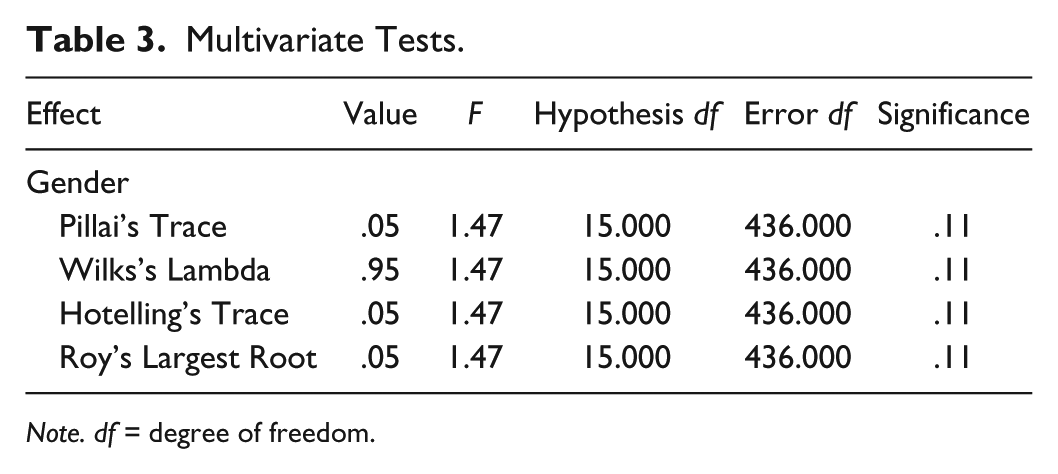
Note. df = degree of freedom.
To further investigate any difference between males and females in terms of the components of EI, Tests of Between-Subjects Effects were examined. Based on EQ-i, 15 different dependent variables were investigated so the alpha level was set to .003 to decrease the chance of error.
The results as illustrated in Table 4 show the differences between males and females in emotional self-awareness, F(1, 450) = 4.148, ρ < .05,
Test of Between-Subjects Effects.

Note. PS = problem solving; HP = happiness; IN = independence; ST = stress tolerance; SA = self-awareness; ESA = emotional self-awareness; RT = reality testing; IR = interpersonal relationship; OP = optimism; SR = social responsibility; IC = impulse control; FL = flexibility; SRE = self-regard; EM = empathy; AS = assertiveness.
In this study of university students in Tehran, Iran, females have significantly outscored the males at understanding the way they feel (self-awareness), feeling good about themselves (self-regard), being sensitive to others feelings (empathy), and being sociable (interpersonal relationship). The participants in this study all knew the English language as they were students studying different majors of English at university, and learning this language may have had a role in their EI. In addition, the females most probably came from families that value their daughters and sent them to university so that they can learn a profession and later hold a job, and the females themselves may be trained or willing to take over masculine roles showing why the males did not score higher on the usual components in which males are stronger at. Another reason may be the instrument of the study which was a self-report measure, and males in Iran are taught from a very young age to suppress their emotions.
Previous studies on the components of EI have shown differences between the EI of males and females. Females score higher than males on empathy (Arteche et al., 2008; Bar-On, 1997, 2000), interpersonal relationships (Arteche et al., 2008; Bar-On, 1997, 2000; Craig et al., 2009; Dunn, 2002), and social responsibility (Bar-On, 1997, 2000; Dunn, 2002), whereas males scored higher on self-regard, stress tolerance, and optimism (Bar-On, 1997, 2000). Similar to previous studies, female university students in Iran also outscore males on empathy and interpersonal relationships. However, their emotional self-awareness and self-regard is also higher than their male counterparts showing the fact that they are more conscious of their emotions. This may also be due to the fact that females are socialized differently and cooperation, expressiveness, and awareness of interpersonal relationships is what is expected (Petrides & Furnham, 2006). However, the male students in Iran did not score higher on the male components of self-regard, stress tolerance, and optimism (Bar-On, 1997, 2000). A remarkable discovery of the present study is that contrary to the findings of Bar-On, in this study, females scored higher than the males on self-regard. Accordingly, the results show that the female university students demonstrated similar results to that of the other parts of the world but the male students did not. One reason could be that Iran is said to be undergoing social change, and females are gaining more power and their life is changing as they are getting access to education and jobs, whereas males have not yet been able to adapt to this change and are living lives similar to the previous generations where emotions were not valued.
The results of this study show that males and females in Iran are not different with regard to overall EI; however, they are different in a number of components of EI meaning females scored higher on emotional self-awareness, interpersonal relationships, self-regard, and empathy. The main limitation of the study is an unequal proportion of males and females and the disadvantages of using a questionnaire. Another point to consider is that the participants of the study come from three universities in the capital city. Despite these limitations, this study can advance the literature on gender differences by posing additional questions. The present research gives rise to the question of why Iranian males differ from comparable participants in other countries and why in a component like self-regard where males are better than females, the participants of this study exhibit the opposite result. More surprisingly, contrary to males, why do females display characteristics similar to females in other parts of the world. Such findings can help enrich the lives of both males and females and assist them to live emotionally intelligent lives each in their own way.
Footnotes
Declaration of Conflicting Interests
The author(s) declared no potential conflicts of interest with respect to the research, authorship, and/or publication of this article.
Funding
The author(s) disclosed receipt of the following financial support for the research, authorship, and/or publication of this article: This research was funded by Shahid Rajaee Teacher Training University under contract no. 27698.