




Abstract
This study reports on an investigative study about using practice-based approach in business English curricula with 74 English-majors and 58 non-English majors using two stage surveys. The study found that the English-major participants had stronger oral communication needs whereas the non-English-major participants had stronger needs to develop reading and writing skills in business English. Both the groups reported improvements in practice abilities, as well as changes in beliefs about the workplaces, and enhanced understanding of workplace affairs. Most English-major and non-English-major participants reported positive experiences through the practice-based approach. Both the English-major and non-English-major participants reported following the similar learning processes of previewing, preparing for business presentations, in-class learning, group work, practice-based tasks, review and reflection. Most participants had positive comments about all elements in the teaching materials and teaching activities, as they enriched the curriculum and developed practice abilities and communicative competence.
Keywords
Introduction
The practice-based approach, which derives from vocational education and training pedagogy, focuses on developing practice abilities needed by the real-world workplaces, including knowledge and soft skills. Wieczorek (2020) suggests that the current business English curriculum should develop not only language skills, but also “business knowledge and soft skills” (p. 57), which could bring challenges to business English teachers. Moreover, business English teachers have varying perceptions and attitudes of “English as a lingua franca” and “English as a native language” (Si, 2019, p. 269), which may accordingly influence their teaching practices.
The key objective of a business English curriculum is to develop competence in business practice, which includes “general business competence” (office skills, information search, public speaking and etiquette) and “professional business competence” (negotiation, international trade practice, e-ecommerce, marketing, human resources and finance management) (Wang et al., 2015, p. 299). However, previous studies have indicated that the practice-based approach had problems in teaching material design, teaching activities development and teacher development, which were ineffective in developing practice abilities (Gao, 2014).
This study aims to address the problems in the design and implementation of practice-based approach in business English curricula, which focus on developing both general business competence and professional business competence (Wang et al., 2015, p. 299), by comparing the perspectives of two student groups, China’s English majors and non-English majors. The study has three research objectives:
To investigate business English practice ability learning needs of English-major and non-English-major participants in the Chinese university;
To identify the practice ability learning outcomes in the business English courses in the Chinese university;
To understand how the practice-based approach improves business English learning experiences in the Chinese university from learners’ perspectives.
Literature Review
Business English Teaching and Learning
In business English teaching and learning, good practices should be based on needs analysis, technological input and holistic curriculum development. A comparative study of the development of English language ability in business programs across the UK, the US, Canada and Australia identified multiple good practices, including “curricular elements for developing language skills” as well as assessment and evaluation processes both upon graduation and after graduation (Andrade et al., 2019, p. 36).
Recent trends in the innovation of business English curricula have included the adoption of technologies such as internet dictionaries (Fuertes-Olivera, 2014), moodle (Breeze, 2014) and wiki platforms (Rodríguez-Arancón and Calle-Martínez, 2014), to enhance learners’ practice abilities significantly.
Studies have been conducted to examine email task design for pre-experience learners, which are beyond typical textbook learning and may help prepare learners well for the real-world workplaces (Albers et al., 2020). In the context of Hong Kong (China), communication needs of Hong Kong working professionals are identified and teaching materials are designed based on the email samples collected from the real-world workplaces (Evans, 2012, 2013).
In the Chinese context, one study examines the communicative needs and curriculum development for English-major undergraduates in the Chinese context (Xie, 2016a). Another study investigates the communication needs of Master of Business Administration students and curriculum development suggestions in the Chinese university context (Xie & Chen, 2019). However, there have been few comparative studies on business English teaching and learning addressing the unique needs and experiences of both English-major and non-English-major undergraduates.
Using Practice-Based Approach in Business English Teaching and Learning
The practice-based approach has been applied in both the leadership development and business English literature. In the educational leadership development context, which has important implications for business English curriculum development, one study indicates that educating using practice-based approach means following the “social norms” of different professions in various social contexts, including “greeting a friend or addressing a student assembly” (Wilkinson, 2021, p. 5). Thus, there are distinctive requirements for practicing appropriately in various social contexts.
In the business English teaching context, the practice-based approach focuses on different performance areas, required in the workplace contexts. There are two approaches. One is to subdivide the key performance areas into “skills, language functions, grammatical and lexical components.” The second is to learn from simulations of the real-world workplace communications or the samples gathered from the business contexts. The key performance areas in the business context can be categorized into “meetings and discussions, giving information, telephoning, business correspondence and socializing” (Ellis and Johnson, 2002, p. 89).
In other categories, the key spoken performance areas can be categorized into “socializing, small talk, speaking on the telephone, presentations, meetings and negotiating” (Frendo, 2005, p. iii) and the key written performance areas include “business writing, correspondence, contracts, reports, CVs, agendas and writing for the internet” (Frendo, 2005, p. iv). The practice-based approach could include “simulations, role plays and case studies” (Frendo, 2005, p. 54).
Moreover, the work of Basturkmen (2006) in New Zealand has recommended output-based strategies as important types of practice-based approach, which require learners to complete more language production tasks and encourage learner communication. This helps to fill in learners’ practice ability gap. The more recent work of Bargiela-Chiappini and Zhang (2013) has called for business English curricula to address the gap between research and practice. The design and development of practice-based approach in business English curricula should be based on professional discourse, gathered from workplaces.
Recently, previous studies such as that by Xie (2023a) explores the use of simulations for developing negotiation skills and practice abilities. Other studies by Xie (2023b, 2023c) investigate the use of simulations for developing business English and business correspondence writing skills. It can be seen that the practice-based approach such as simulations has been a core pedagogy in business English teaching and learning. However, there has still been limited comparative study, to address the differences between English major and non-English major undergraduates in using practice-based approach.
Review of China Context Cases of Practice-Based Pedagogical Innovations
In the Chinese context, the previous studies present cases of practice-based teaching innovations. One study indicates that the practice-based teaching in the business English curricula has such problems as unclear curriculum objectives, disconnection from real workplace contexts and limited generalizability across geographical regions. The coping strategies include incorporating clear course systems, enhancing practice-based approach and improving teacher qualities (Liang, 2020). Another study also indicates problems in business English practice teaching, such as outdated practice teaching approach, old-fashioned coursebooks and lack of high-quality teaching professionals. The solutions include to link the industry demands with practice-based teaching objectives, innovate business practice-based teaching approach, improve the in-school professional skills development platforms and enhance the out-of-school internship base (Tao, 2022).
Moreover, one study applies the production-oriented approach in practice-based business English teaching from the perspectives of “teacher, textbook and pedagogy” (p.139), integrating the concepts of “learning-centeredness, learning-using integration” and the teaching processes of “driving, enabling and evaluating” (Li, 2021, p. 139). Another study constructs the multi-dimensions of practice-based teaching framework, which incorporates the practice content of “business English translation, negotiation, planning, integrated learning and thesis project,”“online and offline practice,” as well as “qualitative, quantitative, formative and summative assessment” (Yan, 2020, p. 67). A case study conducted in the Nanjing Xiao Zhuang University explores various models of university-enterprise cooperation, by offering in-school practice training, out-of-school training and online corporate training (Zhu, 2023). Another study applies the linguistic economic perspectives in constructing the practice-based approach in a business English curriculum. The curriculum incorporates “presentation, reading and role-play” (Zhao, 2021, p. 38). It also includes developing the practice modules such as “pronunciation, English speaking, debating, and translation practice” (p. 38), and teaching practice and simulation-based training.
These China context studies have presented actual cases of using practice-based approach in various business courses, based on business English theories. However, the previous studies in the Chinese context have not been based on empirical investigation, particularly about the impact of learners’ disciplinary backgrounds on the application of the practice-based approach in business English curricula.
Methodology
In summary, there has been limited first-hand comparative research which addresses using practice-based approach in business English curricula, for students from different disciplines, through comparative empirical investigations. This study addresses this important research gap. This study follows both qualitative and quantitative paradigms, as both numerical and non-numeric information is needed. The study follows second language research principles and uses two-stage surveys as the data collection instruments, containing both rating and open-ended questions. The data collection process, participant profiles and data analysis procedures used are presented in the following sections.
Practice-Based Interventions in Business English Curriculum
To address the needs, challenges and preferences in teaching and learning, practice-based business English curricula have been designed for English-major and non-English-major participants, based on real world cases and examples.
The business English curriculum for English-major participants was developed based on Further Ahead: A communication skills course for Business English (Jones-Macziola, 2021). The main themes included understanding people, socializing, introducing companies, jobs (including writing job advertisements), work and play issues, understanding transportation infrastructure, international trade, making arrangements, banking and services and statistics etc. Various reading, listening, writing and speaking tasks were designed, which aimed to develop English-major participants’ business practice abilities. Role play tasks were often designed, based on the information files in the coursebook. Moreover, a case study about companies was designed, so that English-major participants could work in small groups to complete problem-solving group tasks, consisting of reading, listening, writing and oral discussion exercises.
The business English curriculum for non-English-major participants was designed based on Market Leader: Intermediate business English course book 3 (Cotton et al., 2020). The main themes included understanding brands, understanding organizations (including organizational structure), developing advertising strategies, understanding money and finance issues, international trade, human resources, understanding business ethics and leadership. Theme-based reading, listening, writing and speaking tasks were designed with practice ability development orientation. Moreover, theme-based group tasks were also incorporated and implemented, which develop participants’ comprehensive problem solving and team work skills.
In both the English-major and non-English-major business English curricula, video resources and English news were used as additional inputs. These were drawn from the China state media China Daily and CGTN.
In addition, both English-major and non-English-major participants also needed to organize themselves on business English news sharing sessions, on China related business issues. The participants reported on topics related to Chinese global companies, including case stories on companies such as Huawei, Xiaomi, Tencent and Alibaba and other topics such as Chinese cosmetic brands, success stories of Chinese leaders, Chinese mobile payment innovations and practical job interview strategies. These sessions opened the minds of both the teachers and students.
Data Collection
Two-stage surveys are the data collection instruments. The first stage survey (see Appendix A) was administered in September 2023, in the first week of the business English courses for the English-major and non-English-major participants. There were 10 questions, adapted from Mu and Yu (2023, p. 10), Chan (2021, p. 12) and Frendo (2005, p. 18). The questions mainly focused on practice-oriented needs in the business English curriculum, including the participants’ communication experience with workplace professionals, their major challenges when preparing for the professional workplaces and the coping strategies, difficult communicative tasks and genres, their practice-based business English learning needs and their priorities in practice-based learning etc.
The second stage survey (see Appendix B) was administered between December 2023 and January 2024, in the final week of the business English courses for English-major and non-English-major participants. There were nine questions adapted from Tsai (2018, p. 10), and Mu and Yu (2023, p. 10). There were both rating and open-ended questions, about the impact of the practice-based approach in the business English curriculum, the participants’ feelings about the practice-based approach in the business English courses, outcomes of practice ability development, whether there were changes in beliefs about the workplace and changes in understandings about business issues, their overall practice-based learning process and their evaluation of practice-based learning materials and activities etc.
Though in the study context, ethical approval was not required as a survey-based study according to university ethical regulations, this study followed second language research ethics. The participants were assigned numerical identifiers to protect participant and institutional identities. Participants’ consent was obtained prior to the study and they were assured that the study would bring improvements in the business English curriculum.
Participants
In this study, there were 74 English-major participants (N = 74) and 58 non-English-major participants (N = 58). Participants’ average age was 19 years old, ranging from 18 to 21 years old. Among the English majors, there were 11 male (14.8%) and 63 female (85.1%) participants. Among the non-English majors, there were 11 male (18.9%) and 47 female (81%) participants. All of the participants were in their second year of study. The non-English-major participants came from the schools of law, internet of things, digital media, business, medicine and ideological and political education. The finance (29.3%) and accounting (29.3%) programs in the school of business accounted for a majority of participants. Other programs included artificial intelligence (5.1%), computer science (1.7%), digital media (3.4%), industrial design (1.7%), social work (3.4%), ideological and political education (6.8%), microelectronics (5.1%) and law (8.6%). As more than half of the non-English major participants were from the finance and accounting programs, it was expected that they would show greater interests in the business English curriculum and exhibit more positive perceptions about practice-based approach. The participants’ demographic information is summarized in Table 1.
Demographic Information.
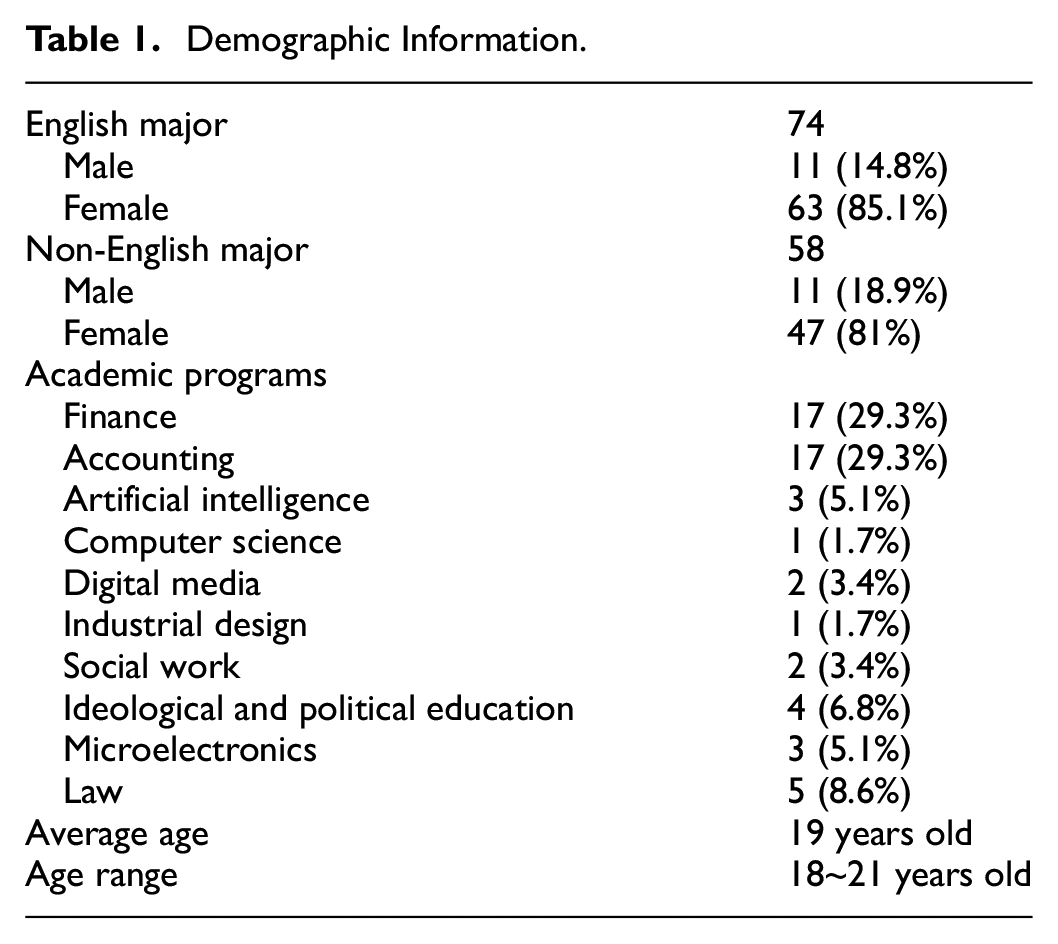
For previous test scores, 66 (89%) English major participants passed College English Test-Band 4 (CET-4). One English major participant also passed College English Test-Band 6 (CET-6). For the non-English-major participants, 53 (91%) passed CET-4. One non-English-major participants passed CET-6. The College English Test-Band 4 and Band 6 were designed by China College English Advisory Committee to evaluate non-English-majors’ English language proficiency in the Chinese university context.
For business English level, the majority of English major participants considered themselves at the beginner level. Around 2.7% considered themselves at the lower intermediate level and 1.3% considered herself at the higher beginner level. For non-English-major participants, also the majority of them perceived themselves at the beginner level. About 6.8% perceived themselves at the higher beginner level. Around 1.7% considered herself at the lower intermediate level and around 3.4% perceived themselves at the intermediate level.
The English majors and non-English-majors self-perceived English levels are shown in Table 2, in a rating of 1 to 5, where 1 is the lowest level while 5 is the highest level. An Independent samples T-test was conducted to compare the English levels of English majors and non-English-majors using SPSS 21, the results of which are shown in Table 3. The Sig value (two-tailed) was .509 (>.05), which showed that there were no significant differences between English-major and non-English-major participants in their self-perceived English levels. All of the means were over 2. However, both English-major and non-English-major participants rated reading skills at the highest means, with 3.08 for English majors and 3.05 for non-English-majors, with standard deviations at over 0.71. It can also be seen that listening skills had the lowest means, with English majors at 2.41 and non-English-majors at 2.19, with standard deviation at 0.85. This showed that the participants were not confident in their English listening skills.
Self-Perceived English Levels of English-Major and Non-English-Major Participants.

Independent Samples T-Test Results for English Levels of English-Major and Non-English-Major Participants.

Data Analysis
For rating questions, means and standard deviations were calculated and shown in tables. To compare the differences between English majors and non-English majors, independent samples T-tests were conducted using SPSS 21. For the open-ended questions, the major themes were identified and their frequencies and the percentages of the participants who mentioned them were calculated and presented in different figures. The typical quotes were selected, to demonstrate the unique insights of English majors and non-English-major participants. The typical quotes were made in Chinese and then translated into English by the researcher. These provided unique insights for this study.
Results
Business English Practice Ability Learning Needs of English-Major and Non-English-Major Participants in the Chinese University
The English major and non-English-major participants’ business English learning needs are shown in a rating scale of 1 to 5, where 1 is the least needed and 5 is the most needed. The means and standard deviations are shown in Table 4. An independent samples T-test was conducted using SPSS 21 and the Sig. value (two-tailed) of .477 (>.05) meant that there were no significant differences in the business English learning needs of English major and non-English-major participants. The details of the independent samples T-test are shown in Table 5.
English-Majors and Non-English-Major Participants’ Business English Practice Ability Learning Needs.

Independent Samples T-Test Results for Practice Ability Learning Needs of English-Major and Non-English-Major Participants.

For English-major participants, “socializing with business partners and /or customers” had the highest mean of 4.22 (SD = 0.90). This was followed by “dealing with customers, suppliers” and “speaking on the phone” over 4, with standard deviations between 0.94 and 1.02. “Chairing meeting” had the lowest mean of 3.36 (SD = 1.12). These results showed that the English-major participants preferred to develop oral communication skills in specific business contexts.
For non-English-major participants, “reading reports” had the highest mean of 4.37 (SD = 0.59). This was followed by “writing reports” and “dealing with emails” over 4, with standard deviations at 0.63 and 0.78. “Dealing with visitors” had the lowest mean of 3.17 (SD = 1.11). These results revealed that the needs of the non-English-major participants were focused on business English reading and writing in specific business contexts. Thus, the English-major and non-English-major participants had differentiated practice ability learning needs.
Most of the English-major participants lacked adequate contact with professionals in different workplaces. More than 12% of the English-major participants had contacts with professionals. This limited contact included performing translation in companies, communicating with IETLS teachers, helping with human resources professionals in recruitment and contact with finance professionals, general managers, social media design professionals, apparel designers and sales people.
Most of the non-English-major participants also lacked sufficient contact with professionals in the workplaces. More than 18% of non-English-major participants had contact with workplace professionals. These included law professors, corporate designers, mentors and professors in the university, business professionals, internship colleagues, foreign customers and finance professionals from Huatai securities etc.
English majors’ challenges in preparation for the future workplaces are shown in Figure 1. More than 41% mentioned lack of professional knowledge and competence as well as confidence and experience in the language environment. Participant 1 mentioned “core competence in science and technology and finance theories.” Participant 2 mentioned lacking knowledge about concepts relevant to the market, skills in dealing with workplaces and confidence in working in companies. Participant 3 indicated “her lack of positioning as she did not have work experience and qualities.” Participant 4 said “lack of language environment, as she could not understand the native speaker customers’ English and would miss the key information about the customers.” Participant 5 reflected “it would take her some time to adapt to the workplace, which would have different cultures and work styles. She may be used to it.” Participant 7 added “she needed to have more knowledge and skills about the products.”

English majors’ challenges in preparation for the future workplaces.
More than 36% of the participants mentioned that they lacked communication skills such as oral communication, listening and socializing. Participant 8 said “the intonation is different in English speaking. She was not confident in speaking English and she could not catch the words in a fast speed.”
Other challenges included lack of employment information (16.2%), professional qualifications (2.7%), challenges of ChatGPT (8.1%), lack of problem-solving skills (2.7%), lacking of reading skills (1.3%), professional vocabulary (9.4%), competence and pressure in the workplace (2.7%), lack of written communication skills (1.3%) etc. It can be summarized that English-major participants’ challenges were related to various practical contexts. These findings presented to the teachers the focuses of business English curricula, which they should address in the subsequent teaching practices.
The English majors’ coping strategies for challenges of the future workplaces can be seen in Figure 2. More than 33% hoped to improve professional knowledge. This included being more professional, to learn and practice professional knowledge (Participant 10). Over 27% of participants hoped to improve professional English skills. Participant 11 added this included “learning more business English, reading relevant books and improving personal abilities. She wanted to learn more workplace English vocabulary, expressions and spoken English as well as have more reading and watch videos. She wanted to learn the right ways of using in English in workplace communication.” Participant 12 hoped to improve her spoken English and have the courage to improve communication. She also wanted to learn more professional terminologies and have more opportunities to communicate with foreigners. More than 18% of the participants hoped to obtain certificates such as BEC Higher, teaching qualifications, accounting certificates and translation certificates, in addition to learning book knowledge.

English-major participants’ coping strategies for the challenges of the future workplace.
Other coping strategies mentioned by the English-major participants included taking relevant courses (10.8%), improving confidence to face challenges (9.5%), participating in various activities (4.1%), learning from communicating with other experienced professionals (8.1%), using practice-based approach such as simulation (2.7%), career planning (1.3%) and internship (10.8%). Overall, the coping strategies mentioned by this group of participants can be addressed by both business English teachers and learners themselves.
For the non-English-major participants, the challenges in preparation for the future workplaces are shown in Figure 3. For the non-English-major participants, more than 46% mentioned lacking communication skills, for the workplaces, including dealing with socializing in English and human-to-human communication. More than 29% also mentioned lacking professional language skills including professional vocabulary. Participant 13 said “when he used English, he cannot follow if it was too fast and cannot understand. He also lacked knowledge about business writing standards.” Another over 29% mentioned lacking professional knowledge and practice. Participant 14 said “her major challenge was technology problem. As a computer major, the most important was the technology and she could not understand a lot of technologies.”

Non-English-major participants’ challenges in preparation for the future workplaces.
Other challenges mentioned by this group included information processing and literature reading (8.6%), competition and pressure of the workplace (6.9%), obtaining professional certificates such as The Association of Chartered Certified Accountants (ACCA) and Chartered Financial Analyst (CFA) (5.2%), lack of employment information (5.2%), lack of experience in the workplace (3.4%), inadequate professional qualifications (3.4%), personality and motivation problems (3.4%), no internship experience (1.7%) and integrating theory and practice (1.7%) etc. It can be seen that the challenges were discipline specific and related to academic learning.
The non-English-major participants’ coping strategies for the challenges of the future workplace are summarized in Figure 4. More than 58% of the participants hoped to improve their English skills, especially the English communication skills. More than 29% hoped to improve their professional knowledge such as the technology. Participant 15 mentioned “learning professional skills and workplace knowledge.”
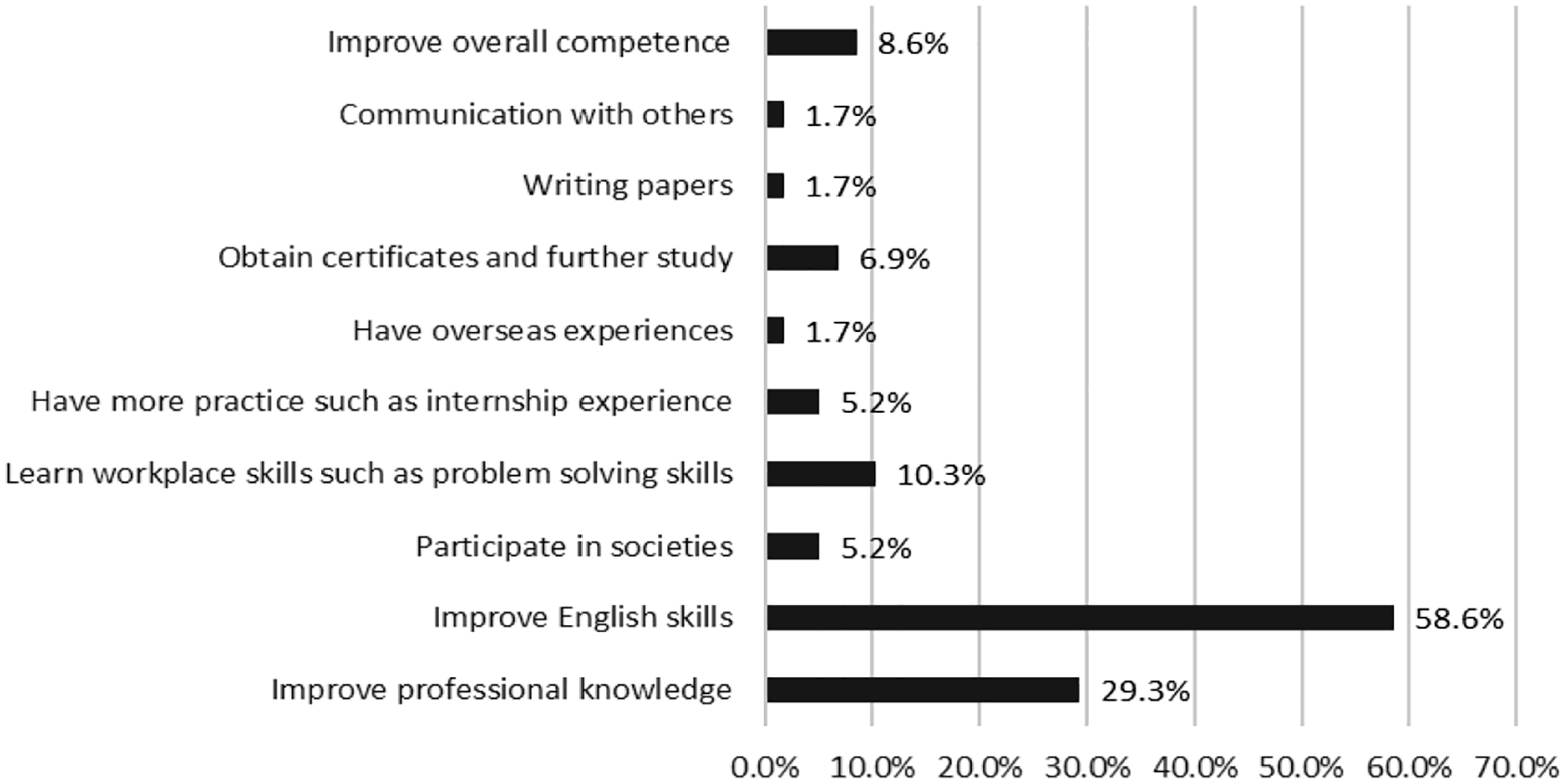
Non-English-major participants’ coping strategies for the challenges of the future workplace.
Other strategies mentioned by this group included improving overall competence (8.6%), communication with others (1.7%), writing papers (1.7%), obtaining certificates and further study (6.9%), having overseas experiences (1.7%), having more practice such as internship (5.2%), learning workplace skills such as problem-solving skills (10.3%), participating in university societies (5.2%) etc. For example, participant 16 mentioned she hoped to solve problems and use resources to cope with the problem. Analyzing the problems would also be important. It can be summarized that enhancing professional communication skills related to academic and workplace contexts would be important for the non-English-major participants.
About communicative tasks and genres English major participants found difficult to handle in the professional workplaces, more than 45% mentioned various English communication tasks, including socializing, dealing with contracts, cross-cultural communication and formal context communication. Participant 16 mentioned “communication with the boss about reducing salaries or treatment as well as job rotation.” Participant 17 mentioned “spontaneous oral communication without texts.” More than 24% of the English-major participants mentioned making oral or written reports, including making technological or product reports. More than 14% of the participants mentioned negotiation. Participant 18 said “negotiation needs market analysis abilities as well as the way to deal with tasks.” In summary, the tasks and genres that they would find difficult were mostly productive and practical.
Other difficult tasks and genres mentioned by this group included professional terms (5.4%), making phone calls in English (1.4%), dealing with unfamiliar affairs (1.4%), reading academic articles (1.4%), interpreting (1.4%), reading science and technological texts (2.7%), reading news of international trends (1.4%), marketing or product promotion (4.1%), import and export (1.4%), creative and professional work (5.4%), literature, contract or professional or legal text reading (9.5%), interpreting charts of data or surveys (6.8%), chairing meetings (4.1%) and letter writing (5.4%)etc.
About communicative tasks and genres the non-English major participants found difficult to handle in the professional workplaces, more than 46% of non-English-major participants indicated English communication in the professional workplaces was difficult to handle. Participant 19 mentioned “communication with the superiors were difficult, as she cannot match with the mind of the superiors.” More than 27% of these participants mentioned various business English writing tasks, including letter, email, press release, news, memo, composition, proposal, sales writing and editing. Participant 20 especially mentioned news writing which requires professional terminologies for communication. Overall, the non-English-major participants’ difficulties were centered on practical oral and written communication activities.
More than 20% of the non-English-major participants also mentioned oral or written reports or presentations. More than 15% of the participants mentioned professional terminology or content, such as the communication in the medical context (Participant 21). Other difficult communicative tasks or genres included English literature reading and paper writing (3.4%), making phone calls in English (1.7%), English meeting and discussion (6.9%) and negotiation (10.3%) etc.
For the English-major participants’ priorities of practice-based learning, more than 71% of the participants mentioned improving English and communication skills including vocabulary, listening, reading, writing and speaking, also based on the course-based tasks. Participant 22 mentioned “learning business English terms and developing English communication skills, as well as reading business English articles and enhancing listening skills.” More than 14% mentioned improving professional and business English knowledge. Over 9% also mentioned integrating with practice. Participant 23 said “applying book knowledge into practice.” These findings showed that the English-major participants’ priorities in practice-based learning were related to enhancing professional communication and knowledge.
The other priorities included improving their emotional quotient and overcoming shortcomings to enhance overall capacity (9.5%), obtaining certificates (4.1%) and reading relevant business English news (2.7%) etc.
For the non-English-major participants’ priorities of practice-based learning, more than 81% of non-English-major participants mentioned improving English skills, including reading, writing, speaking and oral communication. For example, participant 24 said “improving English writing skills and enhancing fluency of spoken English.” Participant 25 mentioned “enhancing English vocabulary, understanding culture and language skills as well integrating speaking and listening skills.” Over 8% of non-English-major participants mentioned improving professional knowledge, including “knowledge in the specific contexts.”
More than 8% of the non-English-major participants mentioned enhancing positive mindset to achieve overall development. More than 5% also mentioned improving teamwork and practice-based abilities. Participant 26 said “enhancing individual and team’s capacities as well as gaining abilities in practice and reflection.” Overall the priorities of the non-English-major participants were mostly related to enhancing language ability, although a few of them mentioned the development of practice ability.
Practice Ability Learning Outcomes in the Business English Courses
The practice ability learning outcomes are self-reported by English-major and non-English-major participants, shown in Table 6. An independent samples T-test has been conducted to compare the differences of the means in practice ability learning outcomes of English-major and non-English-major participants. The Sig. value (two-tailed) was .005 (<.05) (Table 7). This showed that there were significant differences between the English-major and non-English-major participants on the impact of practice-based approach on the business English learning outcomes. Statistically, it can be seen that all of the means of the learning outcomes of English-major participants were higher than the non-English-major participants, except reading skills, in which the non-English-major participants reported better learning outcomes.
Practice Ability Learning Outcomes of English-Major and Non-English-Major.

Independent Samples T-Test Results for Practice Ability Learning Outcomes of English-Major and Non-English-Major.

The highest improvement reported by the English-major participants was in their business-context sentence patterns (M = 4.74, SD = 0.51). This was followed by their improvement in business communication skills (M = 4.61, SD = 0.66) and vocabulary (M = 4.56, SD = 0.72). They reported their lowest improvement in leadership skills (M = 4.08, SD = 0.93).
The highest improvement reported by the non-English-major participants was in their reading skills (M = 4.40, SD = 0.73). This was followed by improvement in their vocabulary (M = 4.39, SD = 0.80) and teamwork skills (M = 4.37, SD = 1.02). The non-English-major participants also reported their lowest improvement in leadership skills (M = 3.93, SD = 1.02). The result regarding teamwork skills could be explained by the fact that the business English curriculum for the non-English-major participants incorporated many group tasks, improving their teamwork abilities. However, both the curricula lacked leadership development activities. This finding suggests that teachers should integrate more leadership development activities for both English-major and non-English-major students into their curricula.
More than 81% of the English-major participants considered that the business English curriculum improved their practice abilities. More than 17% of the English-major participants improved teamwork and practice abilities in a problem-based context. These improvements mainly occurred due to the group tasks and case discussions in the business English curriculum.
More than 37% of the English-major participants improved their oral communication skills. In this regard, English-major participant 27 mentioned “role plays, conversations and business communication simulation.” English-major participant 28 added “the conversation practice and the sentence patterns and questions in the communication.” English-major participant 29 mentioned she learnt how to communicate with foreigners, which helped in the actual communication.
More than 25% of the English-major participants improved their business English writing skills. English-participant 30 said “she improved her writing efficiency through learning letter and email writing. She learned how to communicate her own ideas more efficiently and briefly.” Participant 31 also mentioned designing the questionnaires, which was impressive.
Over 13% of the English-major participants reported improvements in vocabulary and sentence patterns. This included “professional business terms and official expressions used in international communications with the customers” (Participant 32).
Other improvements of practice abilities were reported in English reading (6.75%) such as teacher-led news reading comprehension, business etiquette (2.7%), English ability generally (4.05%), listening skills (1.35%) and business knowledge (5.4%; e.g., information about companies).
In contrast, more than 94% of the non-English-major participants also considered that their practice abilities have been improved through the business English curriculum. More than 37% of participants reported improvement of language and practice ability in the group task and case discussion. Participant 33 mentioned that “the group work has cultivated her communication abilities, group labor division and practice abilities. Through group work, she can gain knowledge and skills outside the books.”
More than 27% of the non-English-major participants enhanced oral communication, socializing and practical skills, such as the rules of business conversations. Over 31% of non-English-major participants enhanced their business writing skills. This could be achieved through solving business and workplace problems in course assignments which could develop her practice abilities (Participant 35). Participant 36 mentioned that she learnt how to write business emails and this, combined with group-based business simulation activities could develop her practice abilities.
Other practice ability developments have been found in group presentation (13.7%), translation (3.4%), business knowledge (3.4%; e.g., knowledge regarding finance, money and corporate operation), business English vocabulary and sentence patterns (13.7%), listening skills (6.8%), information search skills (1.7%) and reading skills (3.4%). In summary, both the English-major and non-English-major participants exhibited significant improvements in practice ability, as confirmed by most of the participants.
For the English-major participants, more than 62% agreed that the business English curriculum changed their beliefs about the workplaces. These participants became more confident about working in the business contexts. Participant 37 commented that initially she thought the workplaces were dull and difficult to enter. However, after the business English curriculum she thought business English was tactful and interesting. Participant 38 also agreed that she was fearful and not interested in the workplaces. After the business English courses, she expected to enter the workplace and experience the magical interpersonal relationships. She could embrace the workplace challenges and improve herself.
The English-major participants also had better knowledge about the workplaces. Participant 39 commented that she realized that business management structure was not only pyramid but also matrix. Participant 40 mentioned that she found business English related information could be everywhere in her daily life, such as the Meituan takeaway ordering platform and Huawei mobile phones with a history of getting bigger.
In comparison, more than 51% of the non-English-major participants expressed changes in their beliefs about the workplaces and the business contexts. This could be achieved through learning career success stories (Participant 40). Non-English-major participants also had better understandings about the workplace culture (Participant 41). There was not only competition but also cooperation in the workplaces (Participant 42). Participant 44 mentioned that learning English and Chinese was both important and she would continue to learn English knowledge in the future work. It can be seen that greater proportions of English-major participants than non-English-major participants changed their beliefs and perceptions of the workplaces.
More than 81% of the English-major participants expressed better understandings about the workplace affairs. More than 31% of the English-major participants especially enhanced business knowledge and process understandings. These included “cross-cultural business process aspects, including, cases, communication and problem-solving techniques” (Participant 45). Another 31% of the English-major participants enhanced understandings about the business communication process. These included professional vocabulary. Participant 46 mentioned that “in the videos, she could observe the foreign workplace operations. This helped her to understand how to deal with business affairs, people and emergencies.” Moreover, over 17% of the participants learnt to solve problems. These included how to maintain communication during flight delays (Participant 47). Participant 48 mentioned that “she had vague concepts about the business problems. Now she seemed to understand how to deal with communication with customers and how to write simple letters with clear subjects in a straightforward way”.
Comparatively speaking, more than 98% of non-English-major participants had better understandings about the workplace issues. More than 39% of non-English-major participants improved their business and case knowledge. These included “knowledge about the workplace, stories of famous business people and outstanding corporate culture” (Participant 48). Participant 49 had more understandings about various brands. Over 25% participants enhanced understandings about the workplace problems and how to solve the problems. Over 10% of the participants had improved their business English level and business communicative competence. Participant 50 mentioned improvements in “communication and business etiquette, memo writing, negotiation and consultation.” Other improvements were found in knowledge about the workplace (5.1%) and thinking and horizon (1.7%). In this context, greater proportions of non-English-major participants than English-major participants expressed better understandings of workplaces.
Improvement of Business English Learning Experiences Through Practice-Based Approach in Business English Curriculum From Learners’ Perspectives
Around 83% of the English-major participants reported positive experiences in the business English curriculum. For the contributing factors, more than 25% mentioned improvement in business English skills, business communicative competence and practice abilities contributed to the positive experiences. Participant 51 mentioned “role play, which developed her oral communicative competence.”
More than 24% of English-major participants thought that the rich and appropriate course content brought positive experiences. Participant 52 mentioned that “in every session, teachers prepared reading materials, listening practice, role plays, oral talks, videos, which enriched the course content.” Participant 53 mentioned that “the course modules are very clearly divided. In each session, she could learn new sentence patterns and skills.” More than 16% of the English-major participants praised the good teaching practice which contributed to positive learning experiences. Participant 54 said that “the teacher had solid knowledge and delivered a large amount of business knowledge and listening, speaking, reading and speaking information. In addition, it is encouraged that every student actively participated in the class, from group work to answering questions.”
More than 14% of the English-major participants especially thought that the improvement in business knowledge made the learning experiences enjoyable. The business knowledge was relevant to corporate information and banking information etc. Other factors included various practice-based tasks (12.1%) embedded mostly in after-class assignment such as writing tasks and enriched study life and generating interest (6.7%).
More than 96% of non-English-major participants reported positive experiences in the business English teaching and learning processes. For the contributing factors, more than 32% mentioned that they improved comprehensive business English skills and practice abilities. These included oral communication skills in particular, through class-based interactions (Participant 55). Participant 56 mentioned reading skills improvement, including marketing, which enhanced her expression abilities.
More than 24% of the participants mentioned good teaching practices. Participant 57 had the following descriptions:
The class-based translation practice enhanced my translation and speaking skills. I would make preparations by making annotations in the sentences. The open-ended questions and answering can enhance my thinking skills (Participant 57).
Participant 58 also commented that “there were very good class interactions and students could step on the stage to make presentations.” Participant 59 commented that “the teacher was very patient and she liked the teaching approach, as the teacher often interacted with the students.” Participant 60 said “the class atmosphere was very lively. The teacher made the delivery in a good order and logic. She could complete the tasks easily.”
More than 18% of these participants mentioned rich and useful course content. Participant 62 said “it was very new and fresh learning experiences, through which, he could develop business communication skills.” Over 17% of participants also said there were business knowledge inputs. Other factors included case-based discussion and group presentation (12%), innovative practice-based tasks (12%) which “enhanced practice and problem-solving abilities” (Participant 62, Translation) and news sharing (3.4%). It can be summarized for both English-major and non-English-major participants, the design and implementation of good practice-based teaching activities and materials contributed to the positive experiences in business English curriculum.
For English-major participants’ practice-based learning processes, only over 8% of English-major participants would preview the course content prior having classes. More than 64% of English-major participants had in-class practice and learning, for example, listening, reading, speaking (role plays). Participant 63 mentioned that “in-class learning would include accumulation of knowledge points, to expand the knowledge scope and vocabulary. She could then apply what she learned in class into practice.” Participant 64 also mentioned “role play in simulated contexts after acquiring the basic vocabulary and sentence patterns.” Participant 65 mentioned “linking words and sentences while selecting sentences to use in practice to finally form business mentality.”
More than 13% of English-major participants were impressed with the group-based learning activities such as preparing for presentations together with their classmates. Participant 67 mentioned “group based oral practice. They would work together in groups to explore the industry and companies.” Participant 68 mentioned that “group members explored the new business topics together and made the presentations in class.”
More than 28% of the English-major participants also had after-class learning, such as writing tasks. Participant 70 mentioned that “after learning a part of the course content, she would complete the relevant assignments. She would need to check a lot of materials, which brought rich experiences.”
More than 27% of the English-major participants would review course content and apply the knowledge in daily life. Participant 71 mentioned that “she would link the business information in the daily life with the book knowledge.” Participant 72 mentioned “she could learn business related expressions and vocabulary in practice and use them in practice. She could analyze the features of various businesses and learn to view problems critically and holistically.”
For the non-English-major participants’ practice-based learning processes, more than 13% would preview the course content and prepare for business presentations. Participant 73 said “she would first analyze sentences and make preparations for the class. Through preparing for presentations, she had better understandings about business English.” Participant 74 also mentioned previewing words, articles and relevant cases.
More than 74% of them had in class skills-based learning, news sharing, practice and making presentations. Participant 73 said “she would highlight the new words raised by the teacher.” Participant 75 described the process as “accumulating words, listening practice, reading practice and in-class comprehensive expressions.” Participant 76 said “she would first learn business English words and then modularized business English knowledge. She could also practice her speaking skills in class.” Participant 77 mentioned “learning through news reading and the application of business English. Through the coursebook based learning, she also increased her understandings about the business world.” Participant 78 also described the “teacher-led multidimensional learning of business English knowledge.”
More than 31% of the non-English-major participants had after-class practices, including writing and memorizing words. Over 29% of non-English-major participants mentioned the case-based group work, including group-based discussion and case writing. Over 24% of non-English-major participants had reviewing, summarizing the learning content and applying into practice. Participant 79 mentioned comprehensive review and integration. Participant 78 also concluded that “her practice abilities have been improved significantly.” Over 3% non-English-major participants had mentioned learning through regular quizzes. It can be seen that for both the English major and non-English major participants, more practice-based learning happened in class and less after class. We suggest that business English teaching should incorporate more after-class activities to better motivate self-directed learning.
More than 83% of English-major participants commended the practice-based learning materials of the course, including the textbook, PPTs, audio and video materials, business news were very good and helpful for their business English learning. Over 27% mentioned that the teaching materials expanded their knowledge scope. Participant 80 mentioned that “more department related materials can be added, including finance-accounting, administration-administrative management.” More than 24% of English-major participants mentioned the various benefits of news sharing. Participant 81 mentioned that “news sharing increased her understandings about the business environment. The learning materials are rich and provided a large amount of information.” More than 16% of the English-major participants liked the PowerPoint slides of the course. Participant 84 said these were very clear and rich in knowledge. Participant 85 said the PowerPoint slides covered a lot of content, including coursebook based knowledge and expanded content. Over 13% of English-major participants liked the coursebook, as it was scientifically designed. More than 17% of English-major participants also appreciated the video and audio resources as the information contained was very meaningful and engaging. Overall, more than 13% the English-major participants improved their business English skills, such as vocabulary and over 6% thought that the class became more interesting through various course materials.
More than 93% of the non-English-major participants commented that the business English materials were very useful, rich and practical. More than 41% of non-English-major participants improved their business English skills learning and knowledge scope. Participant 85 commented that “the learning materials were rich, combining visual and audio inputs, which made practice-based learning easier.” Over 18% non-English-major participants appreciated the news sharing activities. Participant 86 mentioned “news sharing made class more interesting and novel, close to the needs of the times.” More than 15% non-English-major participants liked the PowerPoint slides as they were very clear and brief, which enhanced the classroom efficiency. More than 13% of non-English-major participants also liked the various video and audio resources, as they were relevant to the course materials and made the class more interesting, while improving their listening skills. Over 12% non-English-major participants also commended the coursebooks, as they kept in pace with the times. There were also 3% of the non-English-major participants mentioned the additional after-class reading materials, as they also helped to accumulate the vocabulary. These findings suggest that comprehensive learning materials are key to enhancing practice ability learning outcomes in business English curricula.
For the practice-based learning activities of the course, including English conversations, making phone calls in English, role plays, business presentations and business writing, over 81% English-major participants had positive experiences and comments. More than 47% improved problem-solving skills, communicative competence and applied the knowledge to practice. Participant 87 said “she had a practice opportunity which made her smoother in practice. The teacher’s feedback and correction made her reflect on her performance.” Participant 88 added that “I could timely apply the theoretical knowledge in practice and strengthen the knowledge and practice.” Participant 89 said “they were all based on practice. Initially, it was based on the templates. But these were fundamental for business English practice and through simple conversations, she could understand the business trends.”
Over 20% of the English-major participants agreed that these activities enriched the curriculum and made the class more interesting that they would try again. More than 22% of the English-major participants improved their oral communication and presentation skills, through activities such as role plays and business presentations. Around 18% of the English-major participants enhanced their written communication skills, through various writing tasks.
For the non-English-major participants, over 93% had positive comments and experiences about the various teaching activities. More than 34% mentioned that the teaching activities were rich and enriched the curriculum. Over 32% improved their oral communication skills in particular. Participant 90 said “her conversational abilities were improved and she understood the basic workplace conversation rules. Role plays made her understand the division of labor in the business context.” Participant 91 mentioned that “she was able to use business terms to make presentations.” More than 27% improve their written communication skills. Participant 92 mentioned that “in writing, she changed many styles and got in touch with many workplace writing types.” Participant 93 mentioned that “she strengthened her writing abilities and could have templates for writing in her future work. She felt being immersed in the workplace contexts.” More than 24% improved their communicative competence and application abilities comprehensively. Over 6% non-English-major participants improved teamwork in the group work contexts and over 1% said she needed to have regular review of course content after class. It implies that the design and implementation of various teaching activities are key to enhancing practice abilities for both the English major and non-English major participants.
Discussion
Business English Practice Ability Learning Needs of English-Major and Non-English-Major Participants in the Chinese University
Though statistically there were no significant differences in the business English learning needs of English-major and non-English-major participants, comparatively speaking, English-major participants had stronger needs in oral communication skills development while non-English-major participants needed to develop business English reading and writing skills in specific contexts. These differences in needs may have been due to the differences in the business English curricula developed for the two groups. The findings provide different and unique profiles of English-major and non-English-major participants, compared with the previous comparative study by Xie (2021).
The results showed that both English-major and non-English participant did not have sufficient contacts with the professional workplace and this brought challenges and difficulties in developing professional communication skills, knowledge and practice abilities, which both the groups hoped to improve. Thereby both groups would prioritize learning related to enhancing professional communication, language, knowledge and practice ability development. The findings of challenges, difficulties and learning priorities were in line with the key performance targets (Ellis and Johnson, 2002; Frendo, 2005) of practice-based approach in business English curriculum.
Practice Ability Learning Outcomes in the Business English Courses
For self-assessment of the practice-oriented learning outcomes, statistically there were significant differences between English-major and non-English-major participants. These differences were particularly evident in the development of their reading skills. More non-English-major participants than English-major participants improved their reading skills. Moreover, most English-major and non-English major participants considered that the curriculum improved their practice abilities, including communication and teamwork. This study therefore provides empirical evidences of the usefulness and effectiveness of an enriched business English curriculum reinforcing the findings of Zhao (2021).
More English-major participants than non-English-major participants changed their belief about the workplaces. And the majority of the two groups had better understandings about the workplace. This study is providing additional empirical evidences of pre-experience learners on the basis of previous study of Albers et al. (2020) about better preparing learners for the world of work through enriching the curriculum by the practice-based approach.
Improvement of Business English Learning Experiences Through Practice-Based Approach in Business English Curriculum From Learners’ Perspectives
The majority of the two groups reported positive learning experiences. The contributing factors were related to enhancing in business communication skills, practice abilities and good teaching practices, including teamwork and group presentation. Thus, these findings build upon previous research on good practices in the business English teaching process (Andrade et al., 2019; Xie & Chen, 2019).
Both the two groups had followed the similar process of pre-class, in-class and after-class learning and preparations, though they invested more learning time in class. These learner-centered learning activities ensured the effectiveness (Xie, 2016b) of the practice-based approach in improving learning outcomes.
Both groups also had positive perceptions of the various rich teaching materials and activities, as they not only expanded the knowledge scope and improved learning, but also developed practice abilities, such as teamwork and problem solving. These results of this study are providing additional evidences for good practice teaching materials and activities development on the basis of Xie (2021) also in a comparative study of English majors and non-English majors in the Chinese university context. This study also provides solutions to the problems in teaching materials and approaches identified by Tao (2022).
Conclusion
This study reports on an investigative study about using practice-based approach in business English curricula with 74 English-majors and 58 non-English majors using two stage surveys. The study focuses on the participants’ business English practice learning needs, practice ability learning outcomes and improvement of business English learning experiences through practice-based approach.
The study shows that English-major participants had stronger oral communication needs while non-English-major participants needed to learn business English reading and writing skills. However, both English-major and non-English-major participants did not have adequate contact and experiences with professionals and they faced challenges and difficulties in professional communication. They prioritized English communication and language skills learning. The English-major participants reported better self-assessment of practice ability learning outcomes in all dimensions than non-English-major participants, except reading skills. Both the English-major and non-English-major participants reported improvement in practice abilities, as well as changes in beliefs about the workplaces and understandings about the workplace affairs. Most English-major and non-English-major participants had positive experiences through practice-based approach, thanks to improvement in business English skills, business communicative competence, and practice abilities, rich and appropriate course content, good teaching practice, improvement in business knowledge and various practice-based tasks. Both the English-major and non-English-major participants followed the similar learning processes of preview, preparing for business presentations, in-class learning, group work, practice-based tasks, review and reflection. Most English-major and non-English-major participants had positive comments about all elements in the teaching materials and teaching activities, as they enriched the curriculum and developed practice abilities and communicative competence.
This study may have important theoretical contributions to the development of practice-based pedagogical theories in business English teaching and curriculum reforms based on empirical cross-group comparative investigations. It demonstrates the current status and impact factors of applying practice-based approach in the unique business English curriculum in the Chinese context. It also informs practice to carefully design and implement the practice-based business English curriculum, to address the unique learning needs, challenges, priorities and difficulties of different learner groups with distinctive disciplinary backgrounds. This study contributes to the development of good practices of practice-based business English curriculum. For policy development, the study provides first-hand case data for policy adaptations to suit local conditions. The limitations of the study lie in that the study was conducted in only one university context, which may not have extensive generalizability. However, the research process can be replicated in other educational and cultural contexts. At the time of reporting the research, the English-major and non-English-major participants were still in their third-year study of their undergraduate programs. Future longitudinal tracking studies should be conducted to examine the sustained outcomes of practice abilities development in their professional career after their graduation. Future research could also further explore the application of the practice-based approach in different education settings, by implementing more reforms and adaptations, which ultimately enhances students’ practice abilities.
Footnotes
Appendices
Acknowledgements
The authors would like to express heartfelt thanks to the participants for their helpful contributions to the study. The authors are also grateful for the expert comments from editors and reviewers for revising this article.

Ethical Considerations
Though ethical approval is not required in the research context, this study follows second language research ethical standards.
Consent to Participate
Participants’ consent has been obtained and they are assured that the study bring benefits to English teaching and learning.
Funding
The author(s) disclosed receipt of the following financial support for the research, authorship, and/or publication of this article: This work was funded by China Tao Xingzhi Research Association Teacher Education and Development Committee 2024 Fourteenth 5-Year Plan Teacher Education and Development Project and University Business English Classroom Interaction Research (ZTHJS2024206) and Jiangnan University Educational Reform Project fund: An Exploration of the Application of Generative AI in Improving College English Teaching Quality (JGZX240717).
Declaration of Conflicting Interests
The author(s) declared no potential conflicts of interest with respect to the research, authorship, and/or publication of this article.
Data Availability Statement
To protect the privacy and confidentiality of the participant identities, the data are not publicly accessible.