




Abstract
In light of pedagogical innovation, this study reports a two-stage survey with 172 participants from English-major and non-English-major programs on their needs of production-oriented approach and perceptions of effective implementation strategies in business English courses at a Chinese university. The results of the study suggest that while the two student groups used different learning methods, both valued communication with native speakers. While the two groups had different needs in business English reading, writing, and speaking activities, they also preferred listening to business news broadcasts. The two groups liked learning in case studies and case-based methodology. Based on the needs, a production-oriented teaching procedure is designed. For teaching activities, the students preferred simulation and role-play. As to their favorite teaching and learning materials, English-majors mentioned English news reading and videos, whereas non-English-majors liked theme-based reading materials. For curriculum adaptation and post-course practice, they suggested using communicative activities and more recent cases. The majority of the groups considered the teaching activities, materials, and activities as effective. Based on the different needs and perceptions, effective and tailored implementation strategies for a production-oriented approach in business English courses for the two student groups at this Chinese university context are suggested. Informed by production-oriented pedagogical theories, the results of the study may have significant implications for business English teaching reform and theoretical development in Chinese universities as well as other cultural and education settings in further innovating and refining the teaching and learning process.
Keywords
Introduction
English-major and non-English-major undergraduates have varied disciplinary study focuses. Previous studies have investigated the differences between the two groups on their perceptions of English as an international language in the Korean context (Lee & Lee, 2019), their motivation to learn English in Vietnamese higher education (Ngo et al., 2017), their attitudes toward the English Graduation Benchmark in the technology university context (Lai & Tu, 2020), whether English majors are inferior to other liberal arts majors in critical thinking abilities (Wen et al., 2010), and whether English majors are inferior to other majors in critical thinking competence (Wen et al., 2014). Previous studies have also reported on the challenges of cultivating the competencies of “language use, organization, cooperation, research and work” through English-major programs (Wen, 2014, p. 125). For non-English-major students, college English courses also cannot effectively cultivate the English communicative competence required in research and workplace contexts (Cai, 2018, p. 3). And until now, there are still few studies on developing an effective teaching and learning process to enhance English communicative competence and comprehensive abilities of both English and non-English-major undergraduates in the Chinese context. To address the concerns and challenges of English teaching effectiveness in the Chinese context, it is worth exploring learning needs and teaching innovation by comparing the two different groups of English-major and non-English-major undergraduates.
Traditionally, business English teaching has adopted such methods as role-play and simulation (M. Ellis & Johnson, 2002, p. 218). Moreover, business English teaching theories have been kept innovative and current by adopting pedagogy from different disciplines, such as business management, communicative competence development, skills development, and many other areas (Xie, 2016).
In light of the research and teaching contexts, this study aims to empirically investigate the implementation strategies of the newly developed production-oriented approach in business English courses by also comparing the perceptions of both English-major and non-English-major undergraduates in the Chinese university context. By incorporating the production-oriented theories and process in business English teaching, this study aims to seek pathways based on empirical evidence to enhance the effectiveness of business English teaching in the Chinese university context and pedagogical innovation. In the current context, there has been a dearth of empirical research on implementing a production-oriented approach in business English teaching based on students’ needs and perceptions. Therefore, the article has the following two main objectives:
To understand the different needs of using a production-oriented approach in business English teaching of both English-major and non-English-major undergraduates;
To seek pathways of pedagogical innovation using a production-oriented approach based on the perceptions of English-major and non-English-major undergraduates.
The results of the study may have significant pedagogical implications for maximizing teaching effectiveness and facilitating production-oriented theoretical development for Chinese universities and other educational settings in the global environment.
Literature Review
The Theories of the Production-Oriented Approach for English Language Teaching in the Chinese University Context
Wen (2015, 2018a) and her research team developed the production-oriented approach for English as a foreign language teaching in the Chinese context. The production-oriented approach follows the principles of “learning-centeredness, learning-using integration and whole-person education” (p. 4). The production-oriented teaching procedure follows “output-driven, input-enabling activities and teacher-student collaborative assessment” (p. 6). In comparison with the traditional task-based teaching, which is student-centered, the production-oriented approach focuses on the learning process and is learning-centered. The production-oriented approach may better suit the Chinese university teaching context, which also emphasizes the teacher’s roles in the teaching and learning process (Deng, 2018). Moreover, Wen and Bi (2020) compare the production-oriented approach with task-based learning and teaching and find great differences in teaching units, syllabus, and teaching process. The production-oriented approach focuses on the stages of driving-enabling-evaluating which emphasize the teacher’s roles, whereas task-based learning and teaching marginalize the roles of teachers.
Moreover, Wen (2017b) indicates the need to further develop suitable teaching materials and the standards to evaluate the effectiveness of the materials. In implementing the production-oriented teaching process, teachers can “select, reorder, revise and supplement” (p. 20) the teaching materials. The standards of material evaluation in this context should align with the output goals, teaching effectiveness, and learning outcomes.
For evaluation or assessment, Wen (2016) proposes that the teacher and students should collaborate in various stages while implementing the production-oriented approach. In the stages of before-class, in-class, and after-class, the evaluation process could combine “teacher-guided evaluation, peer assessment and students’ self-assessment” (p. 37).
Moreover, Widdowson and Seidlhofer (2018) comment on the production-oriented approach, which was initiated for the Chinese teaching context. They are concerned that the success of transition of input reading and listening activities to speaking and writing outputs will require empirical evidence, though previous research has supported the effectiveness of the teaching approach. The pragmatic context has played important roles in helping with this transition.
Moreover, more recently, the production-oriented approach has been widely applied in various cultural settings (Hennequin et al., 2018) including Korea’s reading-to-write class context (Yin, 2019) and pre-service teacher education in the international environment (Polio, 2017). Moreover, in the international context, R. Ellis (2017) has commented on the production-oriented theory and suggested modifications in assessment, social interaction, and material evaluation so that it can be better applied in other cultural contexts. Schaller-Schwaner (2018) further evaluates that the production-oriented approach generates new spaces of pedagogical adaptations for teachers who might work in either monolingual or multicultural environments. These prior studies show that the production-oriented approach originally developed in the Chinese context has now been applied or well accepted in different cultural settings.
Review of Previous Studies on Implementing the Production-Oriented Approach in Business English Teaching in the Chinese University Context
In the Chinese context, based on production-oriented theories, the study of L. X. Zhang and Zhang (2018, p. 128) has revealed that in business English teaching, output abilities are influenced by the factors of “creativity awareness, peers, writing and translating factors, motivation, individual differences and spoken output factors.” However, the study has found that “low motivation, low teacher attention and inadequate business vocabulary” constrain the business English writing output. The study of Peng (2019) revealed that using the production-oriented approach can overcome the drawback of separating learning and language use, which enhances teaching efficiency.
In another Chinese context, Y. Zhang (2018) applied the production-oriented approach in teaching business English writing. The production-oriented business English teaching process can be divided into output-driven speaking activities, input-enabling reading activities, and teacher-student collaborative evaluation. More recently, Fan (2019) also applied the production-oriented teaching model in the international business correspondence course, which encourages the development of practice ability and the integration of learning and application of knowledge. Moreover, Z. S. Li and Deng (2019) applied the production-oriented approach in foreign trade spoken English teaching, with positive learning outcomes in various spoken English activities, such as conversations.
In the context of vocational education, Y. J. Xie (2017, p. 92) has applied the production-oriented approach to teaching business English writing. The teaching process can consist of “warm-up, output-motivating, input-enabling, multi-dimensional assessing and feedback.”
Although previous studies focused on the application of production-oriented approach in business English teaching (H. Y. Li, 2018), most of them were based on personal reflection. While the production-oriented teaching theories have been developed in the Chinese context, the research team also claimed that there is not adequate empirical research in various teaching and cultural contexts for implementing this approach, which can in turn refine the theories and prove its effectiveness.
Research Questions
This study aims to address the gap in the literature and mainly focuses on an empirical investigation of the production-oriented approach in business English courses in the Chinese university context. It addresses the following two research questions:
Method
Due to practical research constraints, Wen (2017a, p. 2) and her team have developed the dialectical research method, which specifies the research process in assessing the effectiveness of the production-oriented approach. First, a central research problem is to be identified. Then, it is investigated in the practical teaching context. The theoretical framework for the production-oriented teaching approach can then be refined based on practice. In this research design framework, the frequent data collection methods include “teaching process observation, surveys, interviews and reflective diaries, and documentary research including syllabus, assignments, oral and written tasks etc.” (p. 7). The data analysis process can follow both quantitative and qualitative paradigms. Wen’s (2018b) study refines the dialectical research method and develops the dialectical research paradigm. The research process of identifying the research problem, investigating in practice, and refining in theory can be repeated for numerous rounds (called N rounds in the paradigm).
Following this research design paradigm, this study investigates the perceptions of English-major and non-English-major participants of the production-oriented approach in the Chinese university context, which requires both qualitative and quantitative information (Brown, 2014). The main research instruments of surveys also follow the research design framework to gather in-depth information about the needs, the effectiveness, and implementation process of the production-oriented approach in business English teaching. The participant information, data collection, and analysis process are described in the following sections.
Data Collection
This study uses two-stage surveys as the research instruments. The Stage 1 survey (see Appendix A) was administered to both the English-major and non-English-major participants in a public university in East China in January 2019, at the first sessions of business English courses. The Stage 1 survey consists of six questions, including multiple choice questions, rating questions, and open-ended questions. The survey questions were adapted from Nunan (1988, p. 14). The Stage 1 survey investigates participants’ business English levels, their learning needs in business English reading, writing, listening, speaking and translation skills, their language learning method, the favorite business cases, and the preferred teaching methodology. The Stage 2 survey (see Appendix B) was administered to the same groups of English-major and non-English-major participants in May 2019, at the last sessions of business English courses. The Stage 2 survey consists of 14 questions, including rating and open-ended questions. The survey questions were adapted from Dudley-Evans and St John (1998, p. 142) and Xie (2016, p. 249). The Stage 2 survey investigates participants’ perceptions of the production-oriented approach in business English courses. The investigation mainly focuses on their perceptions of group work and pair work, teaching activities, teaching methods and teaching materials, best aspects of the course, suggestions for repeat courses and follow-up activities, as well as their personal learning gains and improvements in the business English communicative competence. The researcher asked the participants to answer the survey questions to the best of their knowledge. The survey response rate is 100%. The survey questions were adapted based on research instruments used in previous studies such as Xie (2016), which generated important and meaningful results, ensuring the reliability and validity of the research instruments for this study. Moreover, the survey questions were translated into Chinese, which were double-checked and verified by another senior Chinese researcher. This ensures the accuracy of the survey questions, which can be better understood by the participants. This study follows research ethical principles of second language research (Dörnyei & Taguchi, 2011, p. 80). Though in the Chinese research context institutional approval is not required, prior to the investigations, participants’ consent was obtained. They were assured that the study outcomes will help improve their business English learning effectiveness. To protect the confidentiality of the identities of the university and participants, pseudonyms were used for the study.
Participants
There are 172 participants in the study, which is based on convenience sampling, as the researcher is also the lecturer of these business English courses. Participants’ average age is 20 years old, with an age range of 18 to 21 years old. Of these participants, 32 are male and 140 are female. They consist of English major (N = 83; third year, 48.3%) and non-English-major undergraduates (N = 89; second year, 51.7%, from computer science, internet of things, electronics, design, finance, business administration, Chinese, and nursing programs). Participant profiles are presented in Table 1.
Participant Profiles.

To understand participants’ prior business English learning experiences, they self-assessed their business English levels. Around 39% were beginners, most of whom are non-English-major undergraduates. Around 22% perceived themselves as intermediate learners, most of whom are English-major undergraduates. Over 12% were categorized as low intermediate learners and over 8% as high beginners, including both English-major and non-English-major participants. Around 3% grouped themselves as high intermediate learners, most of whom are English majors. One English major, who passed the Business English Certificate Higher test, ranked herself as advanced business English learner.
To understand their English language competence comprehensively, participants also reported their prior English test results. Around 57% have passed College English Test (Band-4), mostly non-English-major participants. Around 39% have successfully completed Test of English Major (Band-4). They are all English majors. Over 11% also took College English Test (Band-6), most of whom were English-major participants. Around 3% attended the IELTS (International English Language Testing System), all English-major participants. Other tests with English majors included Business English Certificate Vantage (1.2%), Business English Certificate Higher (1.7%), and Advanced Interpretation Test (1.2%).
Data Analysis
The participants provided their responses in Chinese, which were translated into English by the researcher. For multiple choice questions, the frequencies of the answers and their percentages of English-major and non-English-major participants were calculated and presented comparatively in different figures.
For open-ended questions, the participants’ responses were read several times, analyzed, and grouped by themes, which were the main items listed in the figures. The frequencies of the themes and their percentages of English-major and non-English-major participants were also calculated and presented in figures.
Besides, the best quotes (Guest et al., 2012) to the open-ended questions were selected by the researcher to provide useful insights into the research questions.
For rating questions, the means and standard deviation of both English-major and non-English-major participants’ responses were calculated and presented in the respective figures.
Results
The Needs Analysis Results of Applying the Production-Oriented Approach in Business English Teaching in the Chinese University Context
The participants’ usage of business English learning methods is summarized in Figure 1. More than 86% of non-English-major participants and over 75% of English-major participants used reading as the business English learning method. The non-English-major participants had a higher proportion in reading. More than 28% of non-English-major participants and over 24% of English-major participants used writing as the learning method. Non-English-major participants had a slightly higher proportion. More than 41% of non-English major participants and over 65% of English-major participants used listening. Around 39% of non-English-major participants and over 60% of English-major participants used speaking. English-major participants used more listening and speaking as the methods to learn business English. More than 32% of non-English-major participants and over 42% of English-major participants also used translation and interpreting as the method to learn business English. The English-major participants also had a higher percentage in this category. In developing the production-oriented approach, the non-English-major participants should have more reading and writing activities, whereas English-major participants should have more listening, speaking, and translation and interpreting activities.

Usage of business English learning methods.
The participants’ most important business English learning routes are shown in Figure 2. Over 43% of English-major participants and more than 32% of non-English-major participants considered talking to English speakers the most important. The English-major participants particularly hoped to stay in an English learning environment and communicate with native English speakers. The non-English-major participants considered it a fast and better route. Although it may be difficult, it is real-world communication. Over 29% of non-English-major participants and 22% of English-major participants also suggested studying English books as the most important learning route. Over 10% of non-English-major participants and over 9% of English-major participants also suggested videos, movies, and TV as the learning routes. More than 6% of non-English-major participants and more than 7% of English-major participants used Apps often. One participant from the non-English-major group and one participant from the English-major group suggested using games. One participant from the non-English-major group suggested regular review as the important route. One participant from the English-major group suggested that having classes was the most important learning route. All theses imply that the teaching focus should be on enhancing learners’ abilities in real-world communication. English books are also important learning resources for both English-major and non-English-major participants.

The most important English learning routes.
Participants’ most important reading texts in learning the language are shown in Figure 3. Around 31% of non-English-major participants and more than 10% of English-major participants considered the newspaper as the important reading text. Over 31% of English-major participants and only 11% of non-English-major participants wanted to learn from English novels. Over 20% of non-English-major participants and over 21% of English-major participants hoped to read more journal articles. Around 10% of English-major participants also valued trade correspondence, whereas none of the non-English-major participants mentioned it. Over 6% of non-English-major participants mentioned English contracts and online industrial reports, whereas only one participant from the English-major group, respectively, mentioned them as important in learning. Over 5% of non-English-major participants and over 6% of English-major participants also mentioned magazines. One participant from the non-English-major participants and one participant from the English-major group mentioned advertisements as important to learn. One English-major participant also liked public speech texts, and one non-English-participant liked simple stories. Hence, for the non-English-major participants, teachers should use more newspaper articles and journal articles as the texts for them to study. For English-major participants, teachers should use more English novels and journal articles as the learning texts.
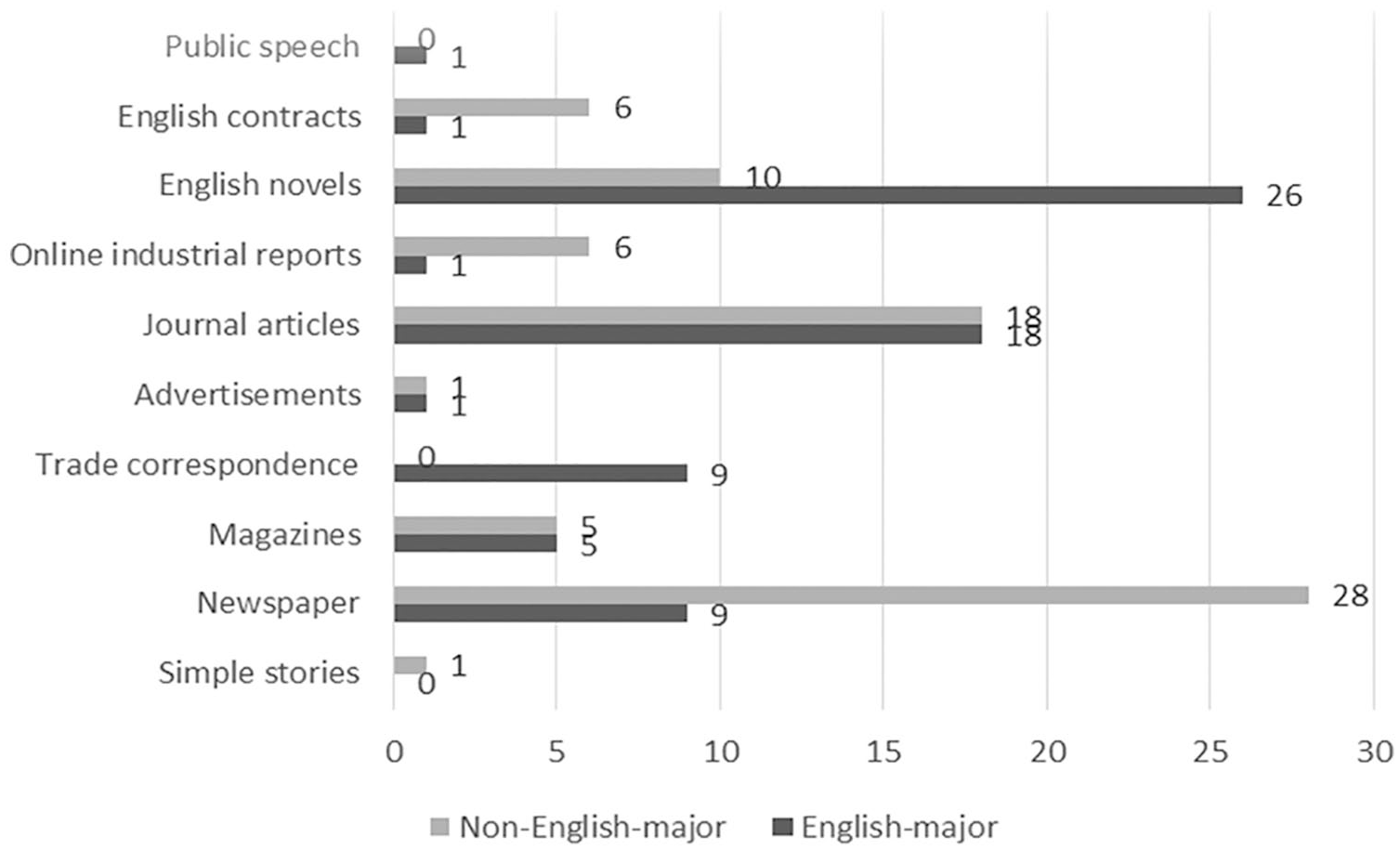
The most important business English reading texts for learning.
The participants’ most important business English writing types for learning are displayed in Figure 4. Over 44% of English-major participants and about 24% of non-English-major participants needed to learn business letter writing. Over 28% of non-English-major participants and over 14% of English-major-participants hoped to learn business report writing. More than 16% of English-major participants and over 11% of non-English-major participants considered it important to learn business contracts. Over 16% of English-major participants and 10% of non-English-major participants hoped to learn business email writing. Around 4% of non-English-major participants and one English-major participant considered it important to learn business meeting notes. Over 3% of non-English-major participants mentioned business memos and over 2% of non-English-major participants mentioned press releases, whereas none of the English-major participants mentioned them. One non-English-major participant also mentioned research papers and another one mentioned argumentative writing. In summary, the English-major participants’ most important business English writing type is the business letter, whereas for the non-English-major participants, business report writing is the most important.
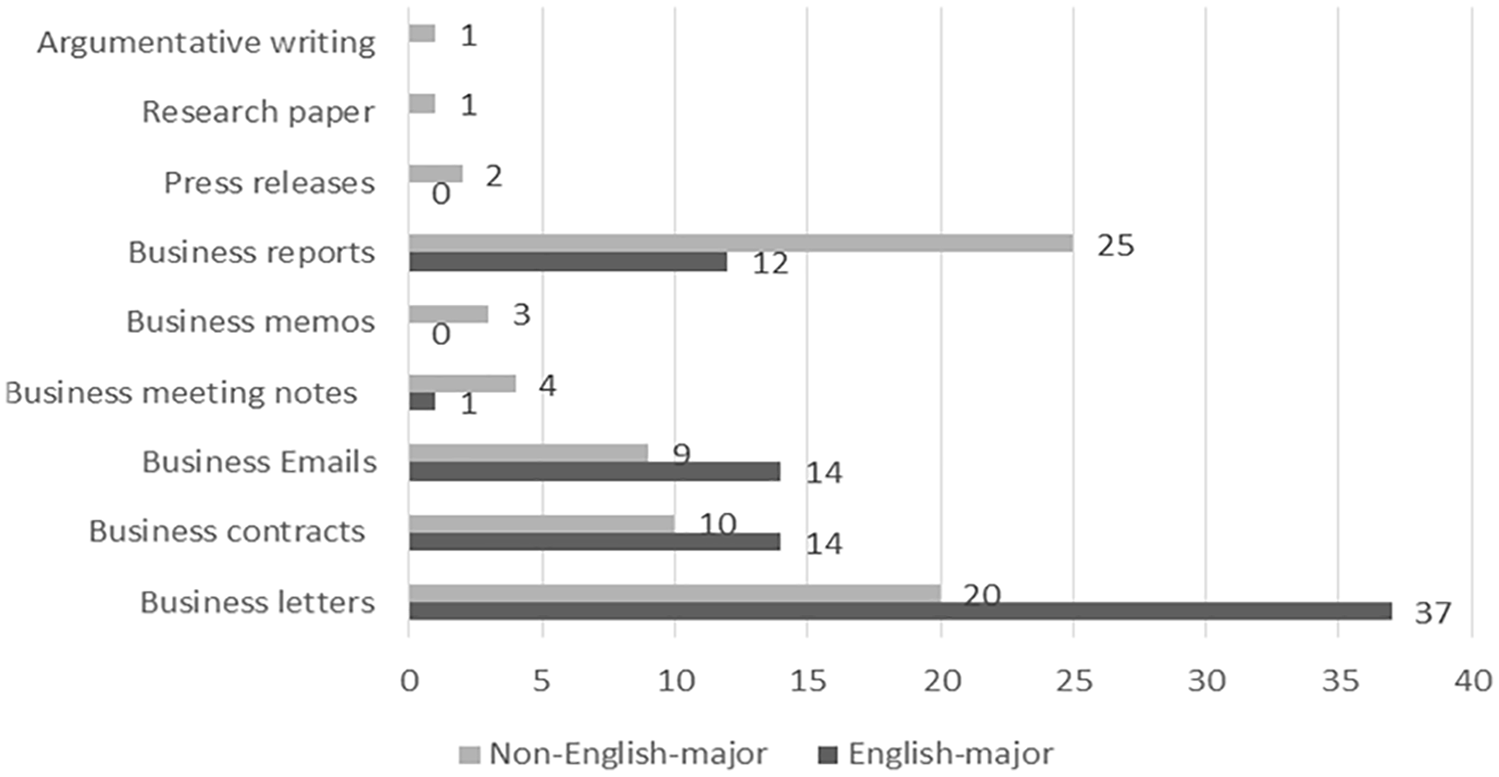
The most important business English writing types for learning.
The participants’ most important oral business communication skills for learning are presented in Figure 5. Over 21% of non-English-major participants and over 26% of English-major participants need to improve their ability in oral expression. The non-English-major participants particularly needed to be able to “communicate in their own academic field” (Translation, Non-English-major participant 1). The English-major participants have more specific needs, including “the ability to communicate with international trade companies” (Translation, English-major participant 1), “local way to speak” (English-major participant 2), “interview and job oral English” (Translation, English-major participant 3), and “native way of English communication” (Translation, English-major participant 4).

The most important oral communication skills for learning.
Moreover, around 23% of non-English-major participants and 14% of English-major participants mentioned business conversation as the most important oral communication skill to learn. More than 20% of non-English-major participants and over 7% of English-major participants emphasized business socializing. Over 10% of non-English-major participants and around 3% of English-major participants also mentioned business presentation. The non-English-major participants have stronger needs in improving business conversation, socializing, and presentation skills than English-major participants.
However, around 10% of English-major participants needed to improve business interpretation skills, some of whom also specifically indicated simultaneous interpretation skills, whereas none of the non-English-major participants mentioned it. Over 8% of English-major participants and over 3% of English-major participants also needed to learn business negotiation skills. More than 4% of English-major participants and only one non-English-major participant mentioned business meetings. More than 3% of English-major participants and over 2% of non-English-major participants also mentioned the need to improve business English terminology. To summarize, the English-major participants have stronger needs in business interpretation, business negotiation, and business meetings skills, which are advanced business communication areas. Therefore, the teacher should differentiate the teaching content when designing the curriculum.
The participants’ most important listening resources and skills to learn are shown in Figure 6. Around 27% of non-English-major participants and 33% of English-major participants mentioned business news broadcast, which is the largest group. Over 20% of non-English-major participants and over 9% of English-major participants mentioned the needs to understand business English listening materials. Around 17% of non-English-major participants and around 13% of English-major participants mentioned business videos. Over 11% of non-English-major participants and around 13% of English-major participants particularly mentioned the needs to listen, understand, and respond to the content. Furthermore, the English-major participants also voiced the need to interpret the content immediately. The participants had the following comments: I hope to understand the international trade terms in business news. (Translation, English-Major Participant 5) I hope to understand after listening to it once and respond quickly to most of the content. (Translation, English-Major Participant 6) I hope I can understand the content when it is speaking fast. (Translation, Non-English-Major Participant 2)
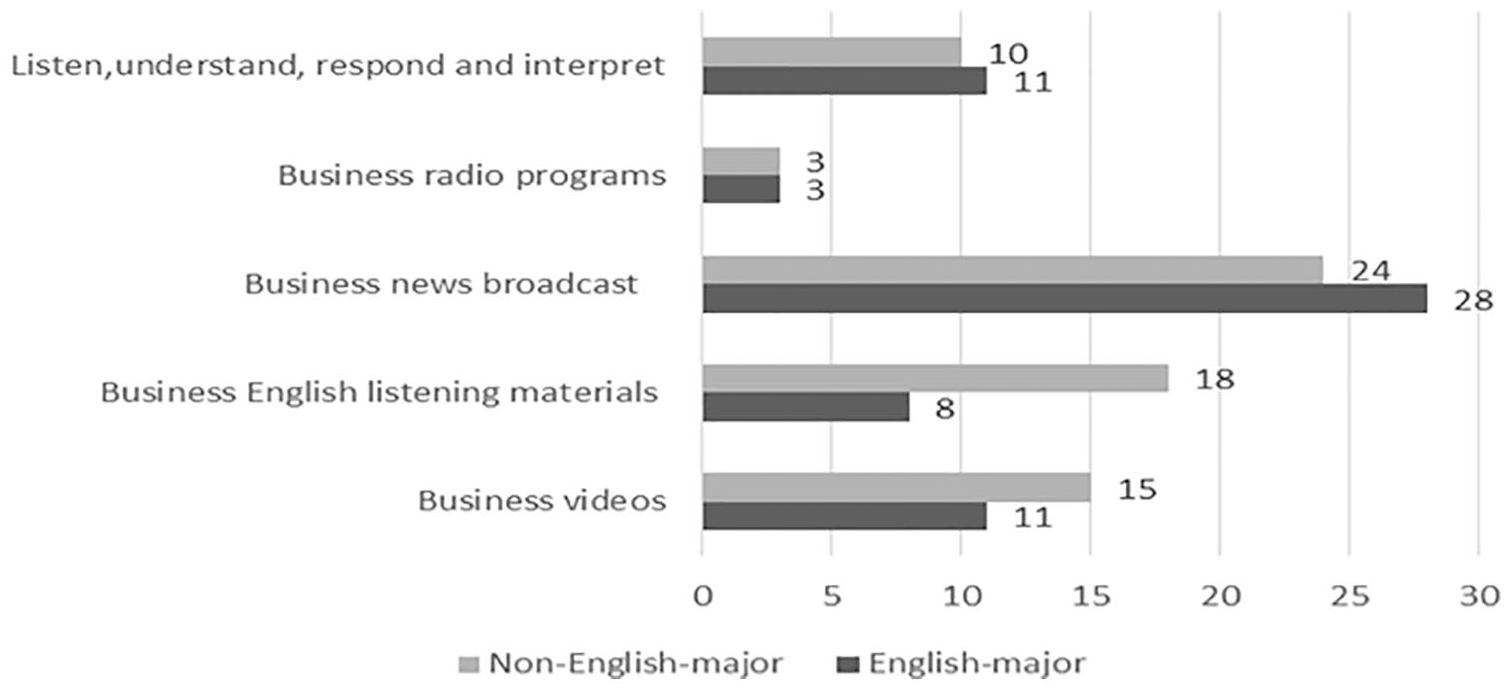
The most important listening resources and skills to learn.
Around 3% from non-English-participants and over 3% from English-major participants also mentioned the needs to understand business radio programs. In summary, the listening materials should concentrate on business news broadcasts. For the English-major participants, teachers should also design listening and interpreting tasks to meet their learning needs.
The participants’ perceptions of how to learn English best in different settings are outlined in Figure 7. Over 58% of non-English-major participants and over 61.4% of English-major participants considered it good to learn business English using different case contexts, which is the largest group. Over 58% of non-English-major participants and over 37% of English-major participants considered it good to learn business English in class. Over 47% of non-English-major participants and over 59% of English-major participants considered it good to learn in pairs. Over 58% of non-English-major participants and over 53% of English-major participants considered it good to study alone. More than 39% of non-English-major participants and over 44% of English-major participants considered it good to learn outside class. Over 48% of non-English-major participants and over 44% of English-major participants seldom learn business English in small groups such as the project group. Therefore, it is better for both English-major and non-English-major participants to learn in case contexts. For non-English-major participants, it is also better to have whole-class activity. For English-major participants, it is better to design pair activities, individual tasks, and out-of-class tasks. Less than half of the participants did not adopt the group learning methods, which should not be the focus of task development.

How to learn business English in different contexts.
The participants’ preferences of business English teaching methods are shown in Figure 8. Over 59% of English-major participants and around 50% of non-English-major participants preferred case-based teaching, which is the largest group. The participants gave the following explanations: I hope to have more case examples. (Translation, English Major Participant 7) I hope the teacher to analyze the case in the teaching and this is more acceptable. (Translation, Non-English-Major Participant 3) Students can have more demonstrations in case-based teaching. (Translation, Non-English-Major Participant 4)
Over 45% of English-major participants and over 29% of non-English-major participants preferred practice-based teaching. A higher proportion of the English-major participants preferred to have more business practice. The participants gave the following suggestions: I like to summarize knowledge through practice. (Translation, English Major Participant 8) I hope to have more opportunities to develop my abilities. (Translation, Non-English-Major Participant 5)

Preferences of business English teaching methods.
Over 16% of non-English-major participants and 6% of English-major participants preferred project-based teaching. The non-English-major participants preferred the project-based approach in a higher proportion than the English-major participants. One English major participant also raised using video and exercises in teaching. One non-English-major participant preferred one-on-one teaching for more tailored guidance, and another non-English-major participant mentioned having a more relaxing atmosphere.
Types of business cases preferred by English-major participants are shown in Figure 9. Over 28% of English-major participants preferred cases relevant to Chinese companies, including Alibaba, Tencent, Xiaomi, Huawei, ofo, JD, Lenovo, NetEase, and so on. Over 20.5% hoped for more cases relevant to multinational companies, including Apple, Microsoft, Zara, Enron, P&G, KFC, Starbucks, Coca-Cola, PepsiCo, McDonald’s, Morgan, Samsung, Benz, and so on. English-major Participants 9 and 10 had the following observations: Corporate history, such as the luxury brands and E-commerce and the analysis of the success factors (market, economy). (Translation, English-Major Participant 9) Cases such as Enron are attractive. Or the cases are about investment bank or fund etc. (Translation, English-Major Participant 10)

Business cases preferred by English-major undergraduates.
Around 13% of English-major participants hoped to have more negotiation and conflict resolution cases. Over 3% of English-major participants hoped to have more cases including business letters. English-major Participant 11 had the following comment: I hope to understand the specific language use in the business letters. (Translation, English-Major Participant 11)
Over 2% of English-major participants hoped to have cases informing about electronic companies, advertising, banking, and international trade, respectively. English-major Participant 12 had the following observation: I hope the teacher can introduce our familiar companies and their requirements to international trade participants, the job tasks and the work scenarios. It can be helpful for us if we want to choose our work. (Translation, English-Major Participant 12)
Over 1% of English-major participants hoped to have cases about food companies, job interview, and joint venture. For example, English-major participant 13 had the following comment: I hope to have job interview English conversations and self-introduction. (Translation, English-Major Participant 13)
The types of business cases preferred by non-English-major participants are shown in Figure 10. More than 29% of non-English-major participants preferred business cases relevant to multinational companies, such as Microsoft, Wal-Mart, Chanel, Space-X, Kraft, Ikea, Arthur Andersen, Apple, Amazon, Sony, Infineon, P&G, Facebook, Big Four, Google, IDEO, and so on. Over 19% of non-English-major participants preferred Chinese company cases, such as Alibaba, Huawei, Tencent, Baidu, Southwest Airlines, Xiaomi, and so forth. Due to academic profession differences, compared with the English-major participants, the preferences of the non-English-major participants are mostly for technical companies, particularly international companies. The non-English-major participants had the following comments: Hua Wei, IKEA etc. They are mature brands. I am also interested in the emerging companies, such as smart city, new energy automobiles and new materials. (Translation, Non-English-Major Participant 6) I want to know how design companies cooperate with famous companies, such as IDEO. (Translation, Non-English-Major Participant 7) I want to know close-to-life company and business cases, such as Alibaba. (Translation, Non-English-Major Participant 8)

Business cases preferred by non-English-major undergraduates.
Over 5% of non-English-major participants hoped to have cases relevant to negotiation and conflict resolution. More than 4% of non-English-major participants hoped to have marketing cases. Around 3% of non-English-major participants wished to have cases relevant to business practice simulation. Non-English-Major Participants 9 and 10 had the following comments: I hope to have practical business conversation examples so that I can have various situational dialogues. (Translation, Non-English-major participant 9) I hope to have simulation of business daily talks and presentations etc. (Translation, Non-English-Major Participant 10)
More than 2% of participants wished to have finance cases. Non-English-Major Participant 11 had the following comment: I hope to have financial reports and financial market information. (Translation, Non-English-Major Participant 11)
Also, over 1% of participants desired cases relevant to business etiquette, public relations, business culture, job interview, advertising, and international trade, respectively.
The Procedures of Applying the Production-Oriented Approach in Business English Teaching
The process of applying the production-oriented approach in business English teaching is shown in Figure 11. The design and implementation of business English teaching closely reflect student needs in English communication and learning. The teaching process was constructed based on the study of W. J. Zhang (2016, p. 108). The teaching process consisted of mainly business theme-based course design and corporate case analysis activities.

Applying the production-oriented approach in business English teaching procedures.
Sub-task 1, which is business theme-based learning, was conducted between January and May 2019, covering various learning units of the course. The themes include trade, brand, leadership, organization, employment, ethics, advertising, and money. For each theme, there is open-ended oral discussion as output-driven activities. For example, in trade, students are asked to discuss their views of the current international trade issues, such as the Belt-and-Road Initiative in China and China’s current import and export status. In brand, students are asked to discuss their favorite brands and marketing strategies. These output-driven oral discussion activities are relevant to the major themes and knowledge of the course. The input-enabling activities are reading and listening materials relevant to the theme, such as video on China’s trade and logistic system, China’s latest news reading including trade news, economy news, and retailing news. There are also listening activities such as listening to the major types of trade barriers. There are also reading text analyses including the latest articles from the Financial Times. The comprehensive writing tasks integrate business and trade knowledge, such as to write a trade inquiry letter based on the knowledge learnt in the course.
For non-English-major participants, the corporate case analysis activities were implemented from January to May 2019. The themes are relevant to different units, such as helping a coffee company regain market share. The output-driven activities include case oral report and group discussion. The input-enabling activities include audio listening and case background reading. There is a problem-solving case in writing for assessment. For English-major participants, the trade case analysis activities were implemented in April 2019. The output-driven activities include oral discussion. The input-enabling activities include corporate background and trade website reading. Comprehensive trade letter writing activities are based on prior reading and oral discussion tasks.
Suggestions for Implementing the Production-Oriented Approach in Business English Teaching in the Chinese University Context
At the Stage 2 survey, both the English-major and non-English-major participants suggested various output-driven and input-enabling activities for business English courses, as shown in Figure 12. Over 38% of non-English-major participants and more than 42% of English-major participants, which are the largest groups, suggested simulation activities, including role-plays. The simulation should integrate workplace scenarios, such as “checking the contract” (Translation, Non-English-Major Participant 12) and “formal business dressing” (Translation, Non-English-Major Participant 13). English-Major Participant 14 suggested simulating foreign trade scenarios and writing business letters. The implication is that simulation activities should be used often in both groups.
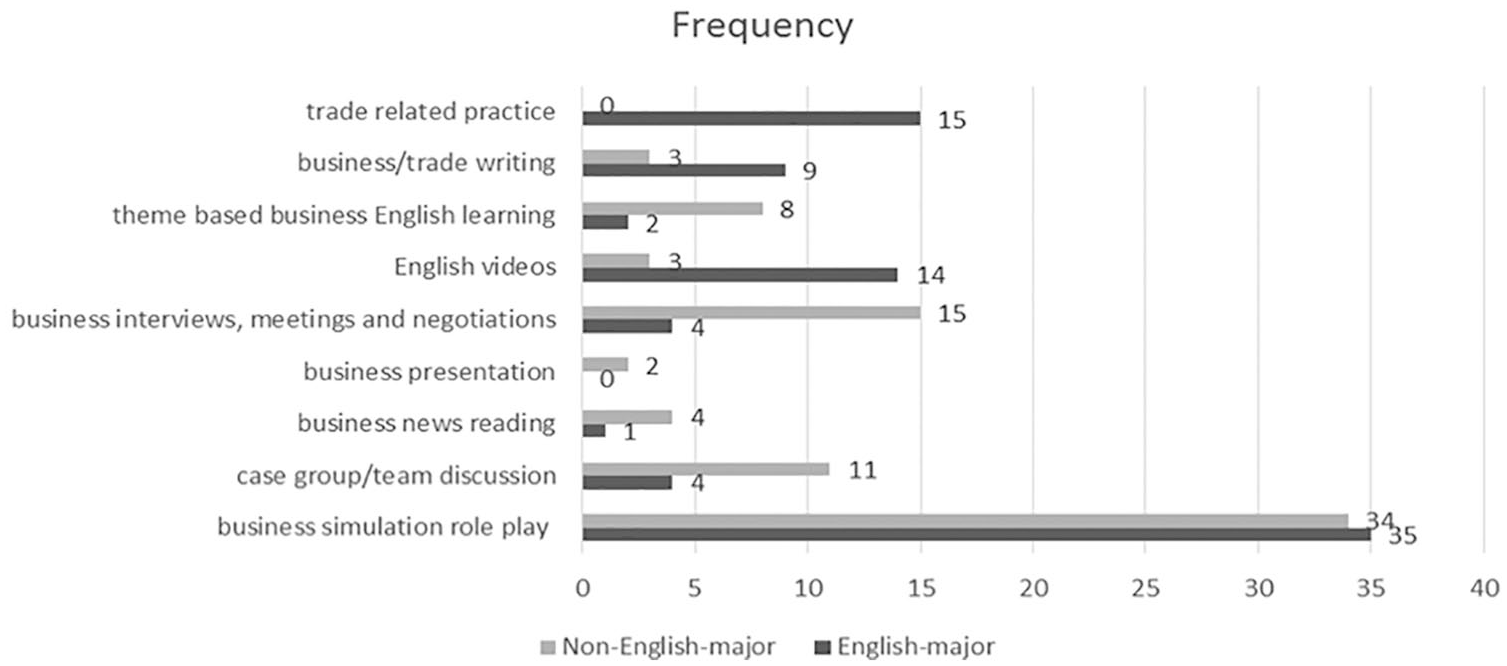
Suggested output-driven and input-enabling teaching activities for business English courses.
Over 18% of English-major participants suggested more trade-related practice. English-Major Participant 15 had the following concrete explanation: The practice process should be relevant to trade. It should include some learning involving trade documents such as real bill of lading. (Translation, English-Major Participant 15)
Over 16% of non-English-major participants suggested having some business interviews, meeting and negotiation activities, all as output-driven activities. More than 16% of English-major participants suggested having English videos throughout the course, as input-enabling activities. Over 12% of non-English-major participants and over 4% of English-major participants suggested having case group/team discussion. The participants had the following observations: The group activities could include introducing the product and plan, multi-people meeting for decision-making. (Translation, Non-English-Major Participant 14) We could have separate group activities, playing the roles of importer and exporters. We could have some practice of handling complaints, purchasing and product dispatch. The students could have one-on-one practice, representing different companies. (Translation, English-Major Participant 16)
Over 4% of non-English-major participants and over 1% of English-major participants recommended business news reading. It could include “the current political and economic affairs, such as trade war and the classical cases in the world” (Translation, Non-English-Major Participant 15). Other suggested output-driven activities include business/trade writing and business presentation. Additional input-enabling activities include theme-based business English learning, relevant to specific topics covered in business English courses.
Participants’ suggested best-practice input and output activities are shown in Figure 13. Over 24% of non-English-major participants and more than 22% of English-major participants suggested simulation activities. The English-major and non-English-major participants made the following comments: We could build up simulation environment and let students engage in the environment. (Translation, English-Major Participant 17) We could have more information on workplace English, with training in writing, to simulate the workplace atmosphere. (Translation, Non-English-Major Participant 16) We could have classroom simulation, such as job application topics. We could have students attend job interview simulation, to have first-hand experience. (Translation, Non-English-Major Participant 17)

Best-practice input and output activities for business English courses.
More than 26% of English-major participants and over 17% of non-English-major participants wanted to have more exercises and practice. The English-major and non-English-major participants had the following observations: We could increase practice, to integrate business scenarios into the classroom. (Translation, English-Major Participant 18) We should get in touch with real foreign trade work, not confined to classroom teaching. (Translation, English-Major Participant 19) We could have some corporate visit and practice. (Translation, English-Major Participant 20) Only through practice can we have real understanding. We could have practice-based teaching. (Translation, Non-English-Major Participant 18) Different targeted training, in vocabulary, reading and oral discussion. (Translation, Non-English-Major Participant 19)
More than 16% of non-English-major participants and over 3% of English-major participants hoped to organize some communicative and presentation activities. Participants had the following explanations: I hope to have autonomous learning, to let students present course-related content themselves. (Translation, English-major participant 21) To actively communicate with others and improve the thinking. We should have day-to-day learning. (Translation, non-English-major participant 20) We should improve students’ presentation skills and provide more presentation opportunities. (Translation, non-English-major participant 21)
Both the English-major and non-English-major participants also suggested group work, case study, playing and making English videos, learning relevant knowledge, and English news reading as best-practice input and output activities for business English courses. Although simulation activities were most required, participants’ preferences for input and output activities were diverse.
Participants’ favorite teaching and learning materials are shown in Figure 14. More than 34% of English-major participants and more than 11% of non-English-major participants preferred English business news reading and videos, which included those offered by the Financial Times online portal and trade-related videos. More than 25% of non-English-major participants suggested that they preferred theme-based reading materials, relevant to different business themes. More than 22% of English-major participants also liked trade letter and document samples, which are sometimes considered “real” (Translation, English-Major Participant 22). More than 23% of non-English-major participants also liked case materials. More than 8% of English-major participants also preferred trade vocabulary. Over 7% of non-English-major participants preferred writing files. More than 3% of English-major participants preferred business knowledge learned in the course. It should be “up-to-date” (Translation, English-Major Participant 23). It could include materials relevant to import and export (Translation, English-Major Participant 24). Participant 25 had the following explanation: It includes supplementary materials of business English correspondence knowledge, such as L/C, B/C. We could have direct understanding about it. (Translation, English-Major Participant 25)

Participants’ favorite teaching and learning materials for business English courses.
More than 5.6% of non-English participants also preferred the corporate introduction. Non-English-Major Participant 22 had the following comment: The brand and advertising expanded the horizon. And we got more knowledge about international brand. (Translation, Non-English-Major Participant 22)
Other materials preferred by English-major participants include sentence translation (3.6%), learning platform (1.2%), and writing file (1.2%). The materials preferred by non-English-major participants include listening (2.2%), grammar files (3.3%), additional materials (4.4%), and business dialogue (2.2%). In summary, business news-related materials were most welcomed by the two groups of participants, though other types needed were diverse.
Participants’ perceptions of group work are shown in Figure 15. Over 67% of English-major participants and over 60% of non-English-major participants considered the group work as interesting. Over 25% of non-English-major participants and around 10% of English-major participants considered the group work as very interesting.

Participants’ perceptions of group work.
Participants’ perceptions of pair work are shown in Figure 16. Roughly 60% of English-major participants and over 60% of non-English-major participants considered the pair work as useful activities. More than 29% of non-English-major participants and over 19% of English-major participants considered pair work as very useful activities.

Participants’ perceptions of pair work.
Participants’ perceptions of best sessions in business English courses are shown in Figure 17. More than 60% of English-major participants and over 14% of non-English-major participants considered reading and writing sample analysis and vocabulary explanation as the best parts. English-Major Participant 26 especially mentioned the “professional terms, knowledge and business letter analysis.” More than 56% of non-English-major participants and more than 2% of English-major participants praised the case study discussion. Non-English-Major Participants 23 and 24 had the following comments: I think it is the case group discussion. It enabled us to quickly understand the unit’s content and improve the spoken English and team work ability. It is interesting. (Translation, Non-English-Major Participant 23) Case study and writing practice. It was helpful for the document formatting and information processing ability. (Translation, Non-English-Major Participant 24)
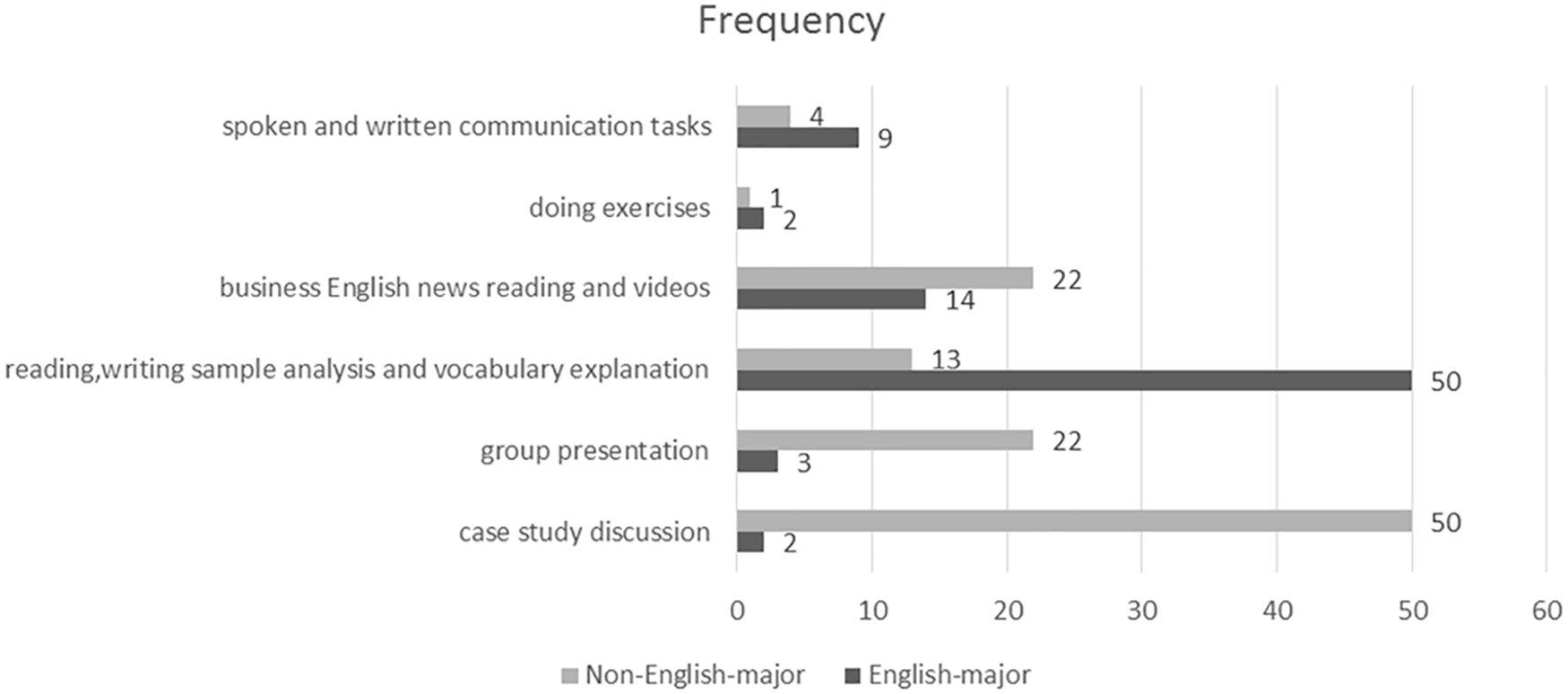
Participants’ perceptions of best sessions in the business English courses.
More than 24% of non-English-major participants and more than 16% of English-major participants considered business English news reading and videos as the best sessions. Non-English-Major Participant 25 and English-Major Participant 27 especially praised the “current reading materials” and videos. More than 24% of non-English-major participants and over 3% of English-major participants praised the group presentation. More than 10% of English-major participants and over 4% of non-English-major participants praised the spoken and written communication tasks. Non-English-Major Participants 26 and 27 had the following observation: Lots of communication, including spoken and written communication. Diverse teaching methods. (Translation, Non-English-Major Participant 26) Written tasks. There is the usage of learnt vocabulary. (Translation, English-Major Participant 27)
More than 2% of English-major participants and more than 1% of non-English-major participants praised doing exercises, which include “after class online and offline practice” (Translation, English-Major Participant 28).
Participants’ suggestions for curriculum adaptation are shown in Figure 18. More than 14% of non-English-major participants and over 13% of English-major participants, which are the largest groups, suggested more communicative activities in groups and between teacher and students should be organized. Participants had the following comments: The group discussion report should be in the form of dialogue, to engage more students. (Translation, Non-English-Major Participant 27) Students should be encourage to communicate in English, to cultivate their interest in English. (Translation, Non-English-Major Participant 28) The students should be guided to join in some English activities, such as public speaking contest. To have more communication with foreign teachers, better native speakers from Europe or America. (Translation, Non-English-Major Participant 29) The class can add some highly interactive activities (role play or in-class feedback). (Translation, English-Major Participant 29)

Participants’ suggestions for curriculum adaptation.
More than 13% of English-major participants and over 6% of English-major participants suggested more up-to-date cases, news, and learning resources should be provided in class. Non-English-Major Participant 30 suggested using “the latest cases.” English-Major Participant 30 suggested using “online cooperative learning resources.” Non-English-Major Participant 31 had the following comment: For business topics, students are not familiar. The discussion is better based on cases. (Translation, Non-English-Major Participant 32)
More than 10% of non-English-major participants and over 8% of English-major participants suggested having more simulation and practice activities. Non-English-Major Participant 33 suggested “more practical application of business English.” Non-English-Major Participant 34 hoped to have more business simulation activities. English-Major Participant 31 also hoped to have more “hands-on practice and business simulation.” More than 6% of English-major participants and more than 3% of non-English-major participants suggested having more tailored guidance in writing and speaking. Participants had the following explanations: We should focus on speaking and writing. It is better to have improvement step for personal writing with feedback. (Translation, non-English-Major Participant 35) We should have assignment feedback and explanations. We should also have peers’ best practice articles to appreciate. (Translation, English-Major Participant 32) The instruction can include the detailed steps for writing different business letters and the special usage. (Translation, English-Major Participant 33) We could have some peer assessment. It is easier for improving personal trade letter writing abilities. (Translation, English-Major Participant 34)
More than 5% of non-English-major participants and more than 2% of English-major participants suggested more business knowledge be introduced into the curriculum. More than 2% of non-English-major participants and more than 1% of English-major participants suggested more presentation activities. More than 1% of non-English-major participants and more than 1% of English-major participants suggested more workplace onsite visits. English-Major Participant 35 suggested “going outside the classroom and have 2-3 professional lectures.”
Participants’ suggestions for post-course practice are shown in Figure 19. More than 20% of English-major participants and over 4% of non-English-major participants suggested various simulation and authentic writing activities. Non-English-Major Participant 36 suggested “simulated meetings.” English-major participants also had the following comments: More practice-based training. Business letter writing should be aligned with real cases. Examples of current news should be used in business letter writing practice. (Translation, English-Major Participant 36) We have simulated business conversations. Role play is more real and interesting. (Translation, English-Major Participant 37)
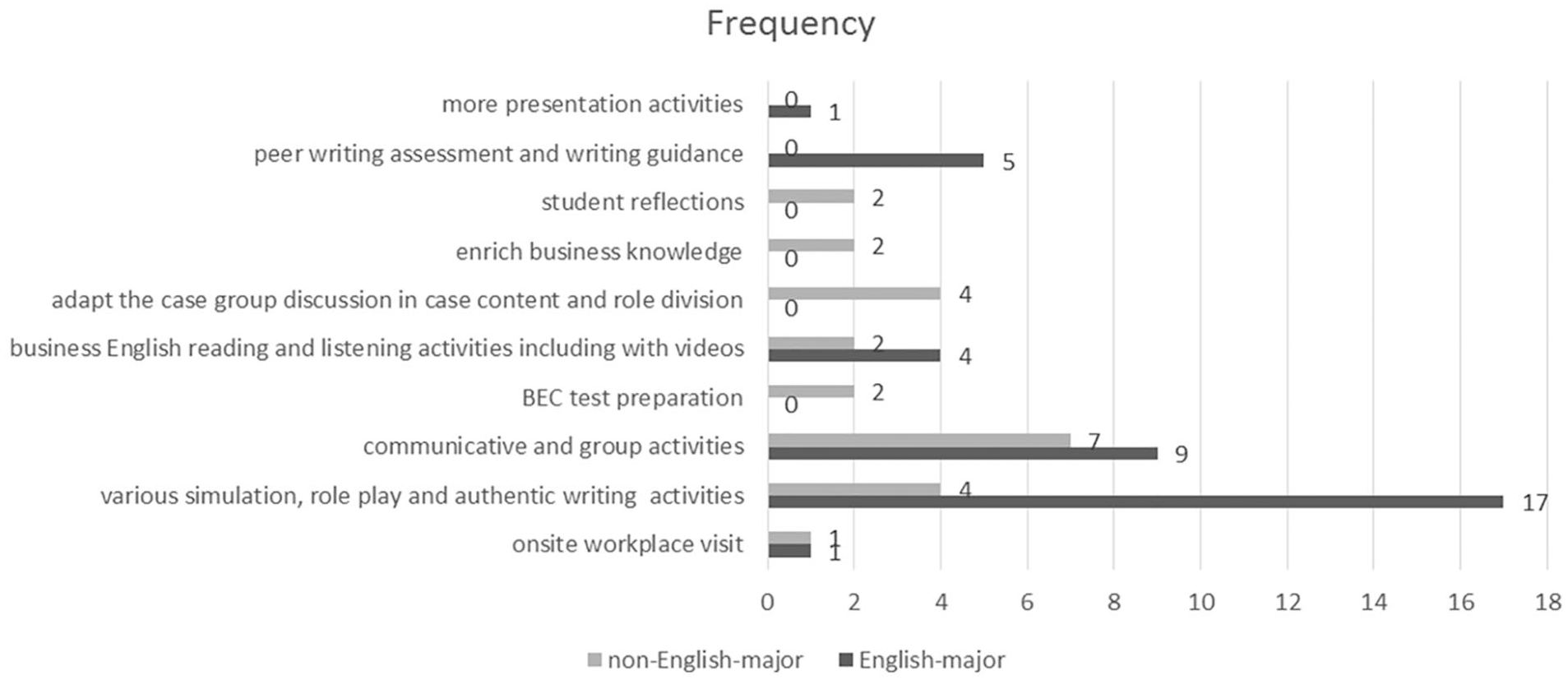
Suggestions for post-course practice.
More than 7% of non-English-major participants and over 10% of English-major participants suggested more communicative activities. Non-English-Major Participant 37 suggested, “small group discussion, simulated forum, simulated business operation and setting up companies.” English-Major Participant 38 suggested, “cooperating with student societies and have inquiry activities based on topics.” More than 6% of English-major participants suggested peer writing assessment and writing guidance. English-Major Participant 39 suggested, “we could have more feedback to student assignments and offer improvement advice. Students can have peer assessment and share the writing experiences.” Over 4% of English-major participants and over 2% of non-English-major participants suggested more reading and listening activities including with videos. English-Major Participant 40 commented, “adding more videos to activate the classroom and attract students’ attention.” Over 4% of non-English-major participants suggested adaptation in case group content and role division. Non-English-Major Participant 38 suggested that “the case content should be more authentic.” Non-English-Major Participant 39 suggested, “making students join in as many as possible.” More than 2% of non-English-major participants also suggested having student reflections, enriching business knowledge (“after class,” suggested by Non-English-Major Participant 40, and “adding more case content rather than only text,” suggested by English-Major Participant 41), and helping in Business English Certificate Test preparation. More than 1% of English-major participants and over 1% of non-English-major participants suggested having onsite workplace visits. English-Major Participant 42 suggested that the “school could arrange internship or training in the workplace.” More than 1% of English-major participants mentioned having more presentation activities. Although post-practice suggestions are widely ranged, simulation-related activities are the most needed.
More than 89% of English-major participants and over 89% of non-English-major participants considered the teaching activities as effective and very good. For the English-major participants, English-Major Participant 43 emphasized that “the teaching content is diverse and current.” English-Major Participant 44 understood, “business letter writing and format.” English-Major Participant 45 emphasized the “importance of learning writing samples and technical terms.” English-Major Participant 46 commented that the teacher and students had a good relationship. For the non-English-major participants, Participants 41 and 42 mentioned that “students need to spend time after class to achieve learning outcomes.” Non-English-Major Participant 43 mentioned that “the class enabled students to understand workplace English and to analyze problems from different perspectives.” Non-English-Major Participant 44 observed that “the case study was lively and effective. They have applied the knowledge flexibly. But to communicate fully in English was low in efficiency as the group members were not able to communicate in English fully.” Non-English-Major Participant 45 had “gained a lot in text processing and writing planning.”
More than 89% of English-major participants and more than 88% of non-English-major participants considered the teaching methods as suitable, effective, and efficient. English-Major Participants 47 and 48 hoped to have “more practice.” English-Major Participant 49 hoped to have detailed guidelines on writing. English-Major Participant 50 considered the “detailed learning of business vocabulary and trade writing as effective and suitable.” English-Major Participant 51 hoped to have more teaching videos. Non-English-Major Participant 46 hoped the teacher could “engage students more actively.” Non-English-Major Participant 47 hoped the teacher could have “higher requirements on vocabulary.” Non-English-Major Participant 48 suggested “the group can be smaller and group discussion time could be longer.” Non-English-Major Participant 49 suggested there could be “more information on daily English and English literature as the students were not from the business programs.”
More than 90% of English-major participants and more than 88% of non-English-major participants considered the teaching materials as enough and effective for achieving the learning outcomes. English-Major Participant 52 indicated the need to “synthesize systemically the knowledge.” English-Major Participant 53 suggested adding some “BEC test materials.” English-Major Participant 54 considered the teaching materials “as comprehensive and rich, which has good guiding effects.” English-Major Participant 55 indicated that “the letter samples can help the writing of correspondence autonomously.” Non-English-Major Participant 50 considered the teaching materials as rich and adequate to reach learning outcomes. Non-English-Major Participant 51 said, “it became more convenient for me to review because I confined knowledge point that teacher taught in class in the teaching materials.” Non-English-Major Participant 52 suggested the materials be more recent and up to date and introduce the emerging industries. Non-English-Major Participant 53 suggested, “more explanations of grammar are needed.”
In summary, the adoption of the production-oriented approach achieved satisfaction in the aspects of teaching activities, teaching methods, and material selection.
In the Stage 2 survey at the end of business English courses, both the English-major and non-English-major participants reported on their improvement in various communicative and learning competence areas, shown in Figure 20. For the non-English-major participants, learner autonomy had the highest mean of 3.6. The standard deviation was 0.81. As to the English-major participants, business English language use had the highest mean of over 3.67. The standard deviation was 0.71. Moreover, it is worth noting that for all of the competencies, the means were equal to or more than 3, which indicated an intermediate level of improvement.

The improved competence.
The participants’ personal gains in the course learning process are shown in Figure 21. More than 66% of English-major participants and over 33% of non-English-major participants, which were the largest groups, have improved their business English writing and reading skills. The participants had the following explanations: I have improved the written business English communicative competence and learnt the basic business communication mode. (Translation, Non-English-Major Participant 54) I have had better knowledge about business correspondence and have learnt how to write trade letters. (Translation, English-Major Participant 56) I have learnt how to write trade letters in different contexts and am able to apply it in different areas. (Translation, English-Major Participant 57)

The personal gains in the course learning process.
More than 54% of English-major participants and more than 33% of non-English major participants have improved their vocabulary, especially business and trade terms and their usage. One participant had the following observation: I have learnt some professional terms and understood the international trade process. (Translation, English-Major Participant 58)
Over 28% of non-English-major participants and more than 25% of English-major participants had a better understanding of business knowledge. Participants 55 and 59 had the following comments: I had more business knowledge and learnt more international cases. (Translation, Non-English-Major Participant 55) I have learnt various writing methods and modes for business letters. I have deeper understandings of business knowledge. This would be helpful if I work in foreign trade in the future. (Translation, English-Major Participant 59)
More than 20% of non-English-major participants and over 2% of English-major participants indicated that they have improved their business communicative competence. More than 7% of non-English-major participants have improved their teamwork abilities, especially through case group discussion. More than 4% of non-English-major participants have improved their presentation skills. One participant had the following comment: I have prepared English PPT. This is the first time and it has gained useful experiences and lessons. I have little knowledge with business topics. Only through preparation can I know what to talk about. (Translation, Non-English-Major Participant 56)
Over 2% of non-English-major participants and over 1% of English-major participants have also improved their autonomous learning abilities. Over 2% of non-English-major participants and over 2% of English-major participants have increased their interest and confidence in business English use. For English-major participants, other personal gains included improvement in translation skills (1.2%). For non-English-major participants, other personal gains included making new friends (2.2%).
Discussion
The Needs of English-Major and Non-English-Major Undergraduates for Using the Production-Oriented Approach in Business English Courses in the Chinese University Context
This study shows that by comparing proportionally between the two groups, the non-English-major participants preferred reading and writing tasks in business English learning, whereas the English-major participants favored speaking, listening, translation, and interpretation tasks. The English-major participants preferred more output activities. They also preferred talking to English speakers and reading English books. While implementing the production-oriented approach in business English courses, teachers should make adaptations. As Frendo (2005, p. 16) indicates for business English teaching, the process of analyzing needs for different groups is “unique” for different teaching contexts. Understanding the specific communication and learning needs of English-major and non-English-major participants helps the teacher to address their needs thoroughly in implementing the production-oriented approach. The results of the study also provide empirical evidence as mentioned in Widdowson and Seidlhofer (2018) for designing appropriate output and input activities to enhance students’ language competence.
For reading materials, English novels are the most needed for the English-major participants. For the non-English-major participants, the most needed are newspapers. Both the English-major and non-English-major participants also valued reading journal articles. For writing texts, the English-major participants most valued business letters, whereas non-English-major participants most valued business reports. For oral communication, the English-major participants most valued learning oral expressions, whereas the non-English-major participants most valued business conversations. English majors tended to have stronger needs in advanced oral communication skills, such as interpretation, negotiation, and meeting. For listening, both groups found that business news broadcasts were more popular. When designing and adapting the materials while implementing the production-oriented approach, the study of Bi (2019) suggests that content of the teaching materials should be in line with the students’ level of English and serve different purposes for cultivating multiple competencies. For this study, the teacher designed the teaching materials based on the needs and English proficiency of the students, which confirms the study results of Bi (2019). The results of the study also echoed the suggestions of Wen (2017b) to revise and tailor the materials for the production-oriented approach based on learner needs.
For how to learn business English in different settings, the largest group of the English-major and non-English-major participants preferred learning in the case context. Therefore, for teaching methodology, the largest group of the English-major and non-English-major participants favored case-based teaching. Among the English-major participants, they most liked cases about Chinese companies. In the non-English-major participants, they most favored cases about multinationals. The results of the study are in line with the previous study of Xie (2017, 2020), which confirms the importance of incorporating interesting and latest business cases in business English teaching for both the English-major and non-English-major participants, to link the classroom with the real world of business.
Effective Implementation Strategies for Using the Production-Oriented Approach in Business English Courses for English-Major and Non-English-Major Undergraduates in the Chinese University Context
For output-driven and input-enabling activities for business English courses, most English-major and non-English-major participants suggested simulation and role-play activities, which are typical of output tasks. In the aspect of best-practice input and output activities for business English courses, most English-major participants suggested more exercise and practice, to connect with the real world of business. Most non-English-major participants suggested simulation activities. Moreover, participants’ needs are diverse in the areas of output and input activities. M. Ellis and Johnson (2002) also stress that role-play and simulation could be similar types of business English teaching methodologies. While the design of role-play could be based on ready-made materials, the development of simulation materials could also be based on students’ workplace input. In this study, the participants are from the pre-experience group and they rely on the business English teacher to provide information on the world of work, which means the teacher plays a major role in the design of simulation activities. Moreover, the results of the study provide a more diverse choice for designing more output-driven and input-enabling activities, which extend the results of previous studies in the Chinese context (L. X. Zhang & Zhang, 2018; Y. Zhang, 2018).
As to their favorite teaching and learning materials, most English-major participants favored English news reading and videos. Most non-English-major participants preferred theme-based reading materials. This difference in preference for teaching materials may be because of different focuses of the business English courses. Bi (2018, p. 35), in her study on developing materials for implementing the production-oriented approach, also indicates that the teacher plays an important role in selecting and adapting teaching materials, which should incorporate the consideration of the “content, students’ English level and cognitive process.” The teacher can also adapt the materials in light of their effectiveness. For this study, while the business English teacher selects the materials based on students’ preferences and needs, the business English teacher should also consider students’ learning styles and English proficiency level so that the teaching materials are more effective and suitable.
With group work, around two thirds of the English-major and non-English-major participants considered it interesting. In pair work, around two thirds of English-major and non-English-major participants considered it useful. As to participants’ perceptions of best sessions in business English courses, most English-major participants preferred reading, writing sample analysis, and vocabulary explanation. Most non-English-major participants preferred case study discussion. Moreover, around 89% of English-major and non-English-major participants highly praised the teaching activities, teaching methods, and teaching materials as effective and suitable. The results of the study confirm the validity and effectiveness of the production-oriented teaching theories (Wen, 2015).
In regard to curriculum adaptation, most English-major participants suggested more up-to-date business cases, news, videos, learning resources, and communicative activities. More non-English-major participants suggested more communicative activities such as public speaking and dialogues. In post-course practice, most English-major participants suggested various role-play, simulation, and authentic writing activities. Most non-English-major participants suggested communicative and group activities, such as group discussion. The study also showed that the need for simulation is the greatest despite the variety of activities mentioned by the two groups. In the study of Yang (2015), a micro-lecture is designed, incorporating video resources and visual materials in college English class, at the output-driven stage while implementing the production-oriented approach. Yang’s (2015) study shows that through designing, reflecting, and adapting processes, teaching activities could be refined. The results of the study also confirm those of previous research.
The majority of participants considered the teaching activities, methods, and materials as effective. The participants also reported on their improvement in various competencies. Most English-major participants had improvements in business English language use, whereas non-English-major participants had improved their learner autonomy. Most English-major and non-English-major participants improved their business English reading and writing skills, whereas non-English-major participants also mentioned gains in business English vocabulary. This again may be because of the different business English teaching focuses. The study of Wang et al. (2015) suggests that for business English curriculum, the competencies of “language use, cross-cultural communication, business practice, critical thinking and learner autonomy” are essential. The results of the study also support the suitability of using the production-oriented approach in business English courses.
Based on the results of the two-stage surveys, effective strategies for implementing the production-oriented approach can be suggested. Curriculum adaptations are needed when designing the curriculum for English-major and non-English-major participants based on the analysis of their needs and perceptions. For English-major participants, the effective strategies are synthesized in Figure 22. For non-English-major participants, the success strategies are integrated in Figure 23. The business English teacher needs to make appropriate adjustments in designing the teaching activities, methods, and materials under the broad framework of production-oriented teaching theories (Wen, 2018a). Moreover, the current study is based on only one round of business English teaching, with the learning and teaching process refined. However, while the production-oriented theory evolves, multiple rounds of the teaching and learning process need to be investigated to gather more insightful empirical evidence. And empirical investigation can probe into the implementation process based on different units (Wen & Bi, 2020).

Effective implementation strategies of the production-oriented approach for business English courses for English majors in the Chinese university context.

Effective implementation strategies of the production-oriented approach for business English courses for non-English majors in the Chinese university context.
Conclusion
This study reports a two-stage survey study with 172 participants from both the English-major and non-English-major programs on their need for a production-oriented approach and perceptions of effective implementation strategies in business English courses. The English-major and non-English-major participants use different learning methods. And both of the groups like learning business English in a case context with a case-based teaching methodology. Based on the different needs, a production-oriented teaching procedure was developed. The majority of the two groups considered the teaching activities, methods, and materials as effective and suitable. For improvement in the various competencies, most English-major participants improved business English language use, whereas most non-English-major participants enhanced their learner autonomy. Based on the different needs and perceptions, effective and tailored implementation strategies for a production-oriented approach in business English courses for this Chinese university context were developed. While both of the groups preferred more practice, simulation, and cases, they had different preferences for the content of the cases. Adaptations have to be made during the course design phase by the business English teacher.
This study provided empirical evidence for the specific needs of China’s English-major and non-English-major undergraduates for business English courses and their perceptions of effective implementation strategies. The results of the study can refine the production-oriented approach teaching theories with tailored implementation frameworks and enhance teaching effectiveness. The results of the study can also facilitate understanding the implementation strategy for the production-oriented approach in pedagogical innovation, which could meet students’ needs and improve their various competencies in business English learning. This study may have significant implications for business English teaching and theoretical development in Chinese universities as it provides unique empirical cases for using the production-oriented approach. The study also informs business English teaching practice and theoretical development in other cultural and education settings.
A limitation of the study is that it was conducted in only one university context. However, the research process can be replicated in other cultural settings.
Future research may enhance the understanding of using the production-oriented approach in business English teaching by conducting N-cycle action research and using other data collection procedures suggested by the theoretical framework, such as reflective diaries and interview.
Footnotes
Appendices
Acknowledgements
The authors would like to express heartfelt thanks to the participants for their helpful contributions to the study. The authors are also grateful for the expert comments from editors and reviewers for revising this article.
Declaration of Conflicting Interests
The author(s) declared no potential conflicts of interest with respect to the research, authorship, and/or publication of this article.
Funding
The author(s) disclosed receipt of the following financial support for the research and/or authorship of this article: This work was funded by 2019 Jiangsu Higher Education Institution Philosophy and Social Science Research Project (2019SJA0776) and 9th China Foreign Language Education Research Fund (ZGWYJYJJ2018B14).
