




Abstract
The construction industry has significant impacts on the environment. Abound the efforts to induce a greater green implementation in the construction project, it has been argued that the usage of green building materials in construction projects can help to minimize the production of waste and greenhouse gas (GHG) emission. This article’s objective is to identify the degree of compliance with the green building materials criteria by wood and cement manufacturers. The green building materials criteria were conceptualized as part of the sustainability movement in which the term green is used to refer to a clean environment and unpolluted atmosphere. To verify the compliance of the manufacturers through the green building materials criteria, a questionnaire survey supported by an interview was conducted. The results show that most Malaysian green manufacturers complied with the green criteria, which converged all three principles including environmental impact, resource management, and recycling implementation. This article provides a basis upon which existing and new manufacturers can produce green building materials thoroughly in accordance with the listed criteria. Clearly, the manufacturers’ compliance with the green building materials criteria has several impacts on the development of the construction industry such that a green building material production process will stimulate a balanced ecosystem and prevent an environmental catastrophe.
Keywords
Introduction
The increase in population has created a demand for the development that has led to speedy urbanization and caused damages to surrounding areas. The catastrophe created by these construction projects enormously affected the environment through, for example, the waste production and greenhouse gas (GHG) emission. These issues have garnered much attention among researchers, professionals, and practitioners in the construction sector because they are against the fundamental concept of sustainable development, which focuses on balance between environmental, social, and economic elements. Most authors noted that the production of building materials has contributed to the environmental catastrophe (Gupta & Kumar, 2010; Lehmann, 2013; Yuan, 2013), a portion of this originates from wood usage and cement production. Yeheyis, Hewage, Alam, Eskicioglu, and Sadiq (2012) stated that wood had become major element of construction waste in Canada. In Australia, an estimated 20% to 30% of construction waste is added to landfills (Craven, Okraglik, & Eilenberg, 1994). Turkey produces nearly 38 million tons of waste (Ozturk, 2005) and approximately 180 million tons of waste is generated in European countries (Vefago & Jaume, 2013).
In Malaysia, a similar situation has occurred. For example, the construction site in Batu Pahat, Johor, contributed 50% of the wood waste in 2011 (Nagapan, Ismail, Asmi, & Adnan, 2013). Furthermore, Lachimpadi, Pereira, Taha, and Mokhtar (2012) noted that timber elements represented the highest sources of construction waste from two of eight construction sites in Klang Valley, Kuala Lumpur. Wood has become a major choice in conventional construction due to its function as the structural support in buildings. However, due to the phenomenon of rotting, wood cannot be used repeatedly and usually ends in a landfill. The Malaysian construction industry released nearly 32.2% of CO2 emissions in 2010, a portion of this originates from the cement production process (International Energy Agency [IEA], 2012).
These situations have triggered governments around the world to implement green development in construction projects. Simcoe and Toffel (2014) discussed government efforts in implementing the green movement in which government procurement affects the private sector demand. Utilizing the U.S. Green Building Council’s Leadership in Energy and Environmental Design (LEED) standard in green building is one effort that has been introduced. The Green Public Procurement (GPP) establishment in various countries such as Denmark, Germany, and Sweden derives environmental benefits and stimulates the demand for green products (Testa, Annunziata, Iraldo, & Frey, 2016). In the research conducted by Zhang, Wu, and Shen (2015), several efforts by governments have been identified, for example, Building Research Establishment Environmental Performance Assessment (BREEAM) in the United Kingdom, Green Building Challenge in the United States, and Hong Kong Building Environment Assessment Method (HK-BEAM) in Hong Kong.
Furthermore, one means of addressing the problem is through the usage of green building materials in construction projects. It has a very clear and significant impact of the amount of waste produced with the development of the construction industry. Understanding from the building materials production stage will minimize the aftereffect from cradle to grave and yet derogate the amount of waste produced. Many approaches have been made by the government such as introducing the 3R program (Agamuthu, Santha, Fauziah, & Dennis, 2011), enacting a green policy (Ahmad Fariz, 2010), and executing the eco-labeling standard (Ahmad Fariz, 2010) as a medium for green certification of the product. In addition, the Malaysian government has enforced the utilization of green construction approaches in government projects such as energy consumption initiatives in public and industrial buildings (Kristensen, Khalid, & Tang, 2005).
As the green movement is still considered to be in its early phase (Papargyropoulou, Padfield, Harrison, & Preece, 2012), the Ministry of Energy, Green Technology and Water (KeTTHA) has been mandated to execute and enforce green practices in the country. The ministry has collaborated with a few organizations such as the Malaysian Green Technology Corporation (MGTC), Malaysian Green Building Council (MGBC), and Scientific and Industrial Research Institute of Malaysia (SIRIM) Berhad in fostering the green movement; this has led to the establishment of the National Green Technology Policy (NGTP) and to carbon footprint labeling (SIRIM LCA Team, 2013). It was important for the production of green building materials to be endorsed by green certificates. Green certificates are the important element that differentiates between a self-claimed product and a product that undergoes a bona fide green process.
Although these efforts and approaches have been introduced by the government, the problem of environmental degradation remains. Implicitly, the problem is due to the production of building materials themselves, in particular, wood and cement-based products, which do not comply with the green building materials criteria. Green building materials production is the first step in the green building production cycle. Wood and cement feature several criteria associated with the environmental spectrum such as recycled content, natural resources, energy efficiency, and renewable resources (Kim & Rigdon, 1998; Spiegel & Meadows, 2010). Certain manufacturers have claimed that they produced green products; however, compliance with the green building materials criteria is in doubt. Because the spectrum of environmental protection had been widely spread, manufacturers must be well-prepared and organized to cling to this industry (Lee, Kang, Hsu, & Hung, 2009). However, in catering to the demand in a construction project or of the captive users, the manufacturers compete in producing greener building materials without stressing the important parameters in green building materials criteria.
Most studies focus more on building material assessment (Ali & Al Nsairat, 2009), the impact of building materials on the environment (Woolley, Kimmins, Harrison, & Harrison, 2002), the life cycle of building materials (Saiz, Kennedy, Bass, & Pressnail, 2006), green building materials selection (Akadiri & Olomolaiye, 2012; Castro-Lacouture, Sefair, Flórez, & Medaglia, 2009), and barriers to green building materials implementation (Hoffman & Henn, 2008). Previous studies have also addressed the green building materials assessment (Li, Wang, Wang, & Zhang, 2012), rating system, implementation in building, impact on environmental assessments (Cheng, Lin, & Hsu, 2015; Gall, Darling, Siegel, Morrison, & Corsi, 2013), innovation (Chang, Huang, Wu, & Chang, 2015; Chen, Wang, & Jhou, 2013), and comparison with conventional building materials (Cheng et al., 2015). Identifying the degree of manufacturer’s compliance with the green building materials criteria has not yet occurred.
Although studies on green building materials have been rigorously conducted, the issues on environmental problems such as pollution, GHG emission, and improper waste management still persist. Thus, this article aimed to identify the compliance degree of the green manufacturers of wood and cement-based products with the green building materials criteria. Because the production of green building materials is the utmost important step leading to green building formation, assessing the fundamental criteria compliance by the green manufacturers helps to stimulate the green construction industry and a greener environment and helps to foster the green building materials production. Practically, this research helps the stakeholders in the construction industry to select the right green building materials, assists the user in buying high quality green building materials, and triggers a better manufacturing process. Understanding the fundamentals of green building materials production in theory may lead to innovative research and development (R&D) activities in the manufacturing industry as well.
The first section of this article discusses the research objectives, followed by the criteria and principles of green building materials based on the literature and government procurement. The third section delineates the life cycle of building materials. Next, the methodology is discussed, which consists of the data collection and the analysis involved. The last section elaborates on the findings, which then answer the research question raised earlier.
Research Objectives
Green building materials had drawn an attention among the construction industry players such as developers, contractors, and manufacturers. In producing a truly green building materials, the manufacturers should consider several parameters theoretically and practically. Each stage in the life cyle of the building material starting from extraction of raw material until the waste disposal, should follow standardized procedures to call it as green building material. However, the compliance of the buiding materials with the green principles and criteria through each of production itself specifically focusing on wood and cement-based products have not yet been discovered. Previous researches have focused on the life cycle issues such as the impact of building materials production on the environment (Esin, 2007) and the implementation of 3Rs concept in demolition process (Sabai, Egmond, Cox, Mato, & Lichtenberg, 2009). In Malaysia, the assessment tools have been provided to recognize the material and yet the growth of green building materials was still low. The SIRIM Eco-Label certification only used to verify the materials as an environmental friendly products. Thus, this will lead to the question of whether the manufacturers comply with the green principles and criteria in the process of producing green building material. Hence, this article’s objective is to identify the degree of compliance with the green building materials criteria by wood and cement manufacturers.
Criteria and Principles of Green Building Material
Green building materials are sustained by its name and verified by eco-labeling certification; in addition, the green building materials production process should follow the right criteria to ensure that the material is genuinely produced in accordance with the green process. Certain scholars noted that green building materials originate from the green manufacturer concerned with the green practices implemented by their management (Deif, 2011). The green practices in the company and the production of green building materials are interrelated because the green manufacturers apply practices such as the elimination of sources of waste and the reduction of energy consumption (Deif, 2011). These manufacturers should also similarly implement green practices when producing the green building materials product. The green manufacturer that executes the concept of green in its company is more sensitive to the elements and criteria used in making their products. To certify the building material as green, the green manufacturer is obliged to follow certain criteria that relate to nature and human health. In Malaysia, green manufacturing companies need to follow the criteria noted in the NGTP and the SIRIM eco-label standard to produce green products. However, before moving to the practical compliance, it is important to examine the criteria noted in the theory used as the baseline for all requirements.
For deeper understanding, the term green building criteria is defined holistically by various scholars. U.S. Green Building Council defined green building criteria as countermeasure of making the building sustain toward the environmental changes and human health effect (Kriss, 2014). The authors mentioned that to identify the green criteria of the building, a few parameters should be considered such as energy usage, indoor environmental quality, material, and selection. On the contrary, Olanipekun, Xia, and Nguyen (2017) compiled the term green building as product of a minimum environmental footprint, clean, and resource-efficient measures in the whole life cycle of the building with regard to balance ecosystem and users’ well-being. In addition, Steinemann, Wargocki, and Rismanchi (2017) mentioned that the current trend of defining the green buildings is through the green building certification such as Building Research Establishment Environmental Assessment Methodology (BREEAM) and LEED. In Malaysia, Green Building Index (GBI) is implemented to define and categorize the green buildings. In Malaysian context, green building focused on resource efficiency in terms of energy, water, and materials and reducing building impact on human health and environment during building’s life cycle (GBI, 2017). In general, green building is defined universally, in which the main concern is to promote sustainability of available resources through an efficient management of the present and aftereffect of the building to the environment and people.
Previous scholars (Kim & Rigdon, 1998; Kubba, 2010) listed several criteria to be used to evaluate green building material (GBM). The green criteria possessed several similarities although certain scholars have added a few more criteria. Table 1 shows that certain scholars agreed that local materials are part of the important criteria to clarify the product as a green. Kim and Rigdon (1998) noted that using local materials could reduce the energy consumption used in transportation and minimize the GHG emissions. For instance, the utilization of local materials requires fewer transportation processes because it involves short distance transfers. Using local materials could also minimize the effort of importing the material, and this supports the economic growth of local trade. Other green criteria noted by previous authors are depicted in Table 1.
Summary of the Green Criteria of Building Material by Various Authors.

Note. PP = pollution prevention; RE = resource efficiency; RC = recycled content; EM = embodied energy; NR = natural resources; LM = local material; EL = eco-label; EE = energy efficient; WC = water conservation; TO = toxicity; RC & RU = recyclability and reusability; RR = renewable resources.
For the purpose of this study, classification of the criteria into principles is necessary because some manufacturers listed the major criteria and some listed the subcriteria. Examining the definition of the principle, Blengini and Carlo (2010) defined it as a guideline used to provide a general view on one issue. Thus, if one interprets the criteria as principles, one may view the green building materials criteria as a general perspective. The criteria listed by the scholars as shown in Table 1 were regrouped into three major principles, which are as follows: (a) environmental impact (P1), (b) resource management (P2), and (c) 3R implementation (P3).
These principles were developed by researchers based on the definition of each criterion that matches the principle. For example, the natural resources criterion is one of the resource management activities (Holling & Meffe, 1996); thus, this criterion is classed into P2. The combination of the green criteria with the green principles provides a strong foundation for green building materials. The principles and criteria used to evaluate the green building materials during the production process are shown in Table 2.
Classification of GBM Criteria Listed by Previous Scholars Into the Principles.

GBM = green building material.
Furthermore, the government of Malaysia gazettes the green policy to enhance the usage of green technology and accelerate the production of green product in the country. The NGTP is viewed as an economic booster, which at the same time is conducive to sustainable development (Roslina, 2012). In 2014, the usage of green technology contributed RM5 billion to the Gross Domestic Product (GDP), and it is expected to achieve RM70 billion by 2030 (MStar, 2014). The NGTP, established in 2009, aligns with the establishment of the KeTTHA, which is responsible for green enforcement in Malaysia. KeTTHA has collaborated with the green authority within the country to ensure that green practices are well implemented and aligned with the goal and objectives of the NGTP. SIRIM Berhad was part of the green authority responsible for the verification of green products. There are 37 criteria documents used to evaluate green products. Table 3 shows an example of the criteria in the SIRIM eco-label standard documentation used by the SIRIM authority to evaluate wood and cement-based product. From the criteria noted in Table 3, much emphasis has been placed on carbon release during the production process. The production of building material emits certain quantities of chemicals and gasses such as carbon monoxide, sulfur oxide, and nitrogen oxide (Safiuddin, Mohd Zamin, Salam, Islam, & Hashim, 2010). The emission of gasses should be in accordance with the Environmental Quality Act (EQA; 1974). Verifying green products with green certificates could possibly help reduce the quantity of carbon emission released into the atmosphere. The emphasis on the issues of carbon release shows that the government of Malaysia considers the reduction of the energy consumption by the manufacturing industry, which currently depends on the usage of fossil fuel, to be a serious concern.
SIRIM Eco-Label Criteria for Wood and Cement-Based Products.

Source. SIRIM eco-label standard documentation.
Note. SIRIM = Scientific and Industrial Research Institute of Malaysia; NGTP = National Green Technology Policy; EQA = Environmental Quality Act; GHG = greenhouse gas.
Life Cycle of Building Material
The overall impact on the environment is significantly related to the life cycle of a building material. Many approaches raised by previous scholars are related to reducing the impact. Some of the initiatives involve using technical tools such as life cycle assessment (LCA) tools, which take into account the energy used, material consumption, and waste production during the production process, to measure the impact on the environment (Curran, 1996). Mungcharoen, Sridowtong, and Saibuatrong (2010) proved that the use of recycled material as a substitute in the product makes it more sustainable than using virgin material. Huntzinger and Eatmon (2009) evaluated the impact of the life cycle process of four types of cement product and found that the use of natural pozzolans such as rice husk in the cement production reduces the GHG emissions and minimizes the environmental impact. There were also other studies that used other technical method such as relative index (RI) analysis (Akadiri & Olomolaiye, 2012) and genetic algorithm (GA) analysis (Zhou, Yin, & Hu, 2009) to discover the optimum criteria for selecting sustainable material.
The selection of raw material is a very crucial step in which the raw material selection involves a complex process that leads to high intensity energy use to produce it (Amponsah, Lacarriere, Jamali-Zghal, Le, & Corre, 2012). The impact from the product could be minimized if the main focus is considered during the material selection. Thus, the center point has looked at the life cycle of building material. The life cycle process was adopted from the studies done by Kim and Rigdon (1998) and Ortiz, Castells, and Sonnemann (2009), where the green criteria is incorporated into each stage of the life cycle process. Figure 1 shows that the life cycle is divided into three phases known as the (a) pre-use phase, (b) use phase, and (c) post-use phase. The pre-use phase is dominant in the environmental damages (Kim & Rigdon, 1998). This is the phase where many impacts could affect the environment in a serious way. Examining the early phases of the life cycle process will ensure that the building material is produced in an environmentally benign manner. Although the impact may not be zero, compliance with the green requirement helps reduce the energy consumption and minimize the wastage during the production process. The 3R (recycle, reduce, and reuse) elements operate in the closed-loop cycle, which will help to reduce production waste (Sassi, 2008) and to hinder the exploitation of natural sources. The compliance with the green criteria and appliance of the 3R element to the life cycle process cause less stress on the environment and reduce the impact on human health.

Life cycle of building materials.
Method
The census population that represents the entire population was used because there are a limited number of manufacturing companies in Malaysia that produce green building materials. The survey technique and the interview approach were used to obtain data from the Malaysian top management of green manufacturing companies that specialize in wood and cement-based product. The data from these two sources help to strengthen the findings and provide better understanding on the particular topic. A total of 72 respondents were selected, and 21 completed the survey form; furthermore, five companies were involved in the semistructured interview session, which is shown in Table 4. Despite the small number of respondents, the survey questionnaire used has a reliable measure of Cronbach’s alpha with an average of ≈0.6-0.9; it is supported by the expertise endorsement.
Distribution of Respondents Based on the Type of Product.
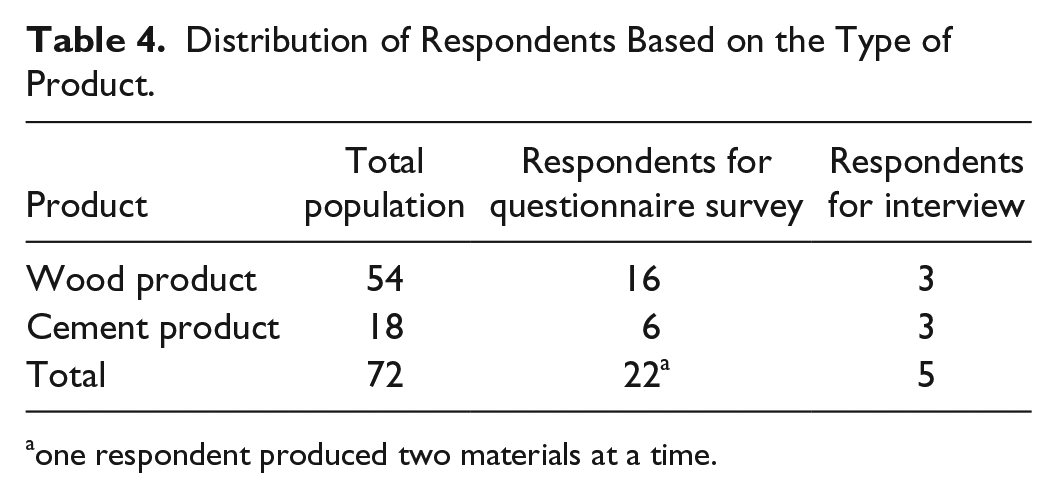
one respondent produced two materials at a time.
The questionnaires were distributed to the respondents directly one-to-one and collected after they had answered all the questions. As for the interview, the respondents were called through mail or direct call and were asked for their permission to undergo an interview. The questionnaire was divided into two main sections: Part A and Part B. Part A covers the information on the green manufacturer company and consists of three subsections: (a) background of the company, (b) management of the company, and (c) barriers faced by the green manufacturer. In Part B, the manufacturers were asked their opinion on the principles of green building materials. Meanwhile, for the interview, the questions were divided into two sections: The first section represented the functions of the authorities and second section consisted of questions on the criteria of green building material development. An example of the questionnaires and interview questions and answers is shown in the next section.
The Likert-scale type, with ratings from 0 (not at all) to 5 (very high), was utilized to ascertain the greatest and the least compliance with green criteria applied by the green manufacturer during the production process. Several techniques were used to evaluate the survey data; these were an SPSS statistical analysis package, matrix data analysis, and percentage compliance. The survey data were first analyzed based on the mean value score. The rank mean score was adapted from the study conducted by Alston and Miller (2002) and rearranged to be suitable for this study: (a) 0-1.00 = not implemented at all, (b) 1.00-1.49 = very low implementation, (c) 1.50-2.49 = low implementation, (d) 2.5-3.49 = medium implementation, (e) 3.5-4.49 = high implementation, and (f) 4.5-5.00 = very high implementation. The criteria scored as 3.5 and above were selected as the criteria most implemented by green manufacturers.
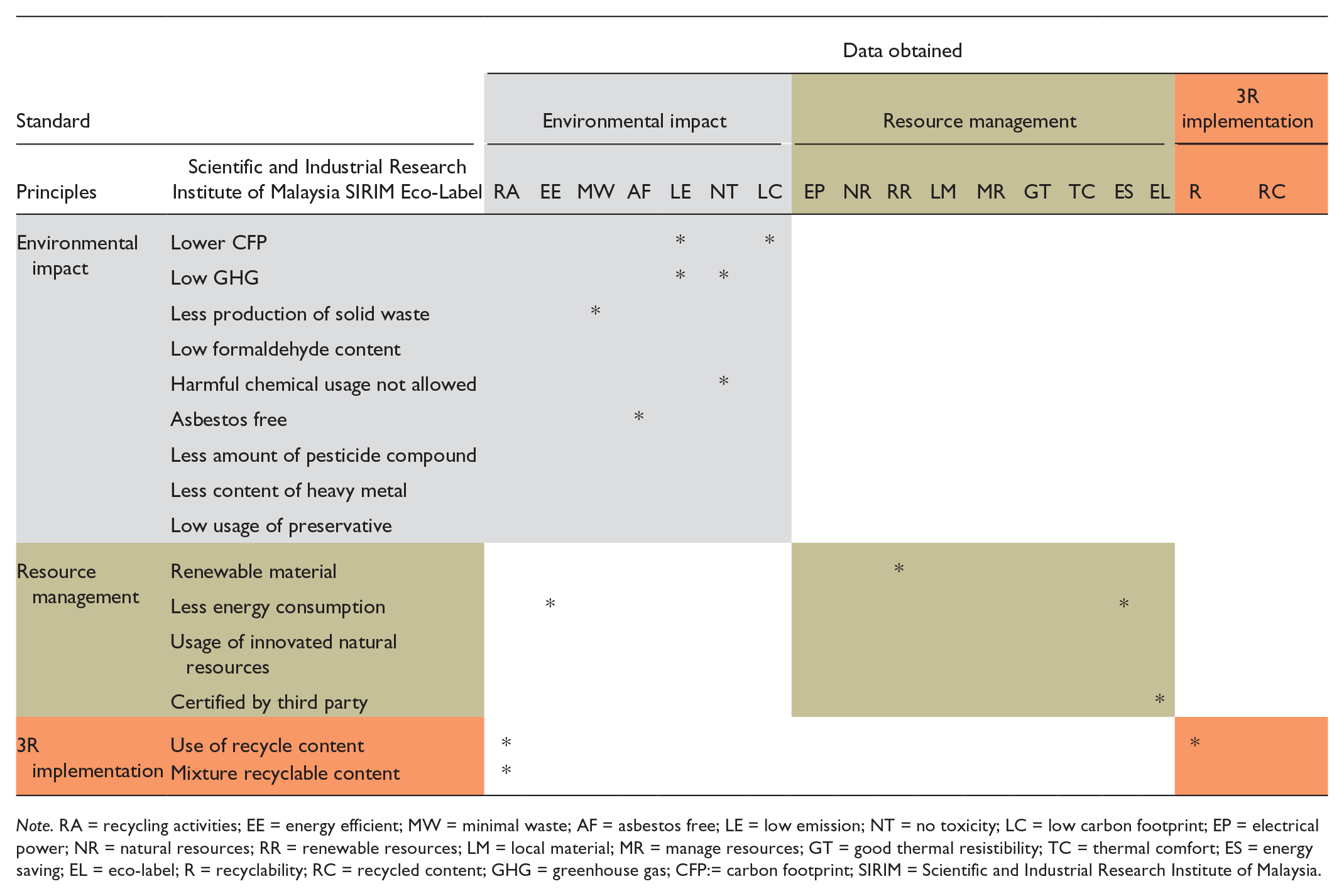
The matrix data analysis was used to identify the greatest compliance between the data obtained and the criteria noted in the previous study and the SIRIM eco-label. The criteria with the highest degree of compliance were calculated based on the percentage of compliance, which used the basic mathematical formulation as shown in Figure 2. The interview data were interpreted and organized using the content analysis technique and the thematic approach. The raw data from the interview session were first coded into a script and managed under important topics, which were then organized based on thematic forms.
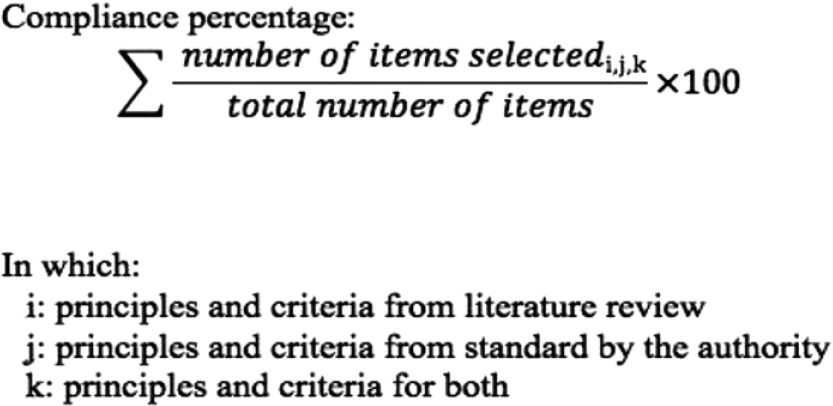
Calculation of compliance percentage.
Data Survey
Based on the questionnaires and interview made, a few findings reflected the objectives targeted were found. From the questionnaires, the respondents were asked on their profile and their opinions on the principles of green building material. The researcher categorized the green manufacturer into three levels: (a) high level, if the manufacturer fulfills all the requirement of green listed companies in Part A and complies with the principles and criteria of green in production process in Part B; (b) medium level, if the manufacturer fulfills 50% requirement in Part A and complies with certain green principles and criteria in Part B; and (c) low level, if the manufacturer does not fulfill part requirement in complying in Part A and Part B, respectively. For example, the respondents were asked to provide information on the ways they produced their building materials based on three main principles which were the environmental impact, resource management, and 3R implementation. The scale was rated from 0 (not at all) to 5 (very high). From the items listed in the environmental criteria, the highest degrees of choice from the respondents are the reduction of environmental impact through recycling activities and the efficient usage of energy. The mean value for these two items is near to the value of 3.5, and, as such, it can be classified as a high degree of implementation. Thus, these two criteria were considered as very important criteria that the company had to comply to be called a green company. Marked by correspondence with the data from the interview, one of the manufacturers mentioned that their products are green in terms of zero emission. Thus, based on the data, the manufacturers were scored using mean value scoring system mentioned earlier to be classifying as full compliance or vice versa.
Findings and Discussion
The identification of the most important green criteria of building material was determined using the mean value, and this is presented in Table 5. The information gathered from the interview session was included in the analysis in addition to the questionnaire survey data. The findings show that the most selective criteria in P1 are the reduction in the environmental impact through recycling activities and the efficient use of energy. The interview data shown in Table 6 elucidated that the energy saving criteria are the ones most frequently noted by the interviewees, and they believed this to be the best element to describe their green building materials. For resource management principles (P2), the electrical power usage, the natural resource elements, the renewable resources, and the local materials were the important criteria that needed to be considered in the production process. The implementation of 3R element principles shows that the recyclability criteria are preferred by the green manufacturing companies that represent the value of 3.45.
Mean Value of Green Manufacturer Compliance.

Note. EI = environmental impact; PP = pollution prevention.
The Interview Data of Green Manufacturers.

Note. AAC = autoclaved aerated concrete; IBS = industrialised building system.
In relation to the data obtained, the dispersion of the criteria compliance with the green building materials noted by the SIRIM eco-label and the previous studies clarifies the similar and different levels of importance of the data. For instance, the following has been noted in the SIRIM eco-label criteria document for fiber-cement product: the fiber cement shall contain of not less than 15 percent of recycle content. In the survey data, recycled material has the second highest mean value in P3, whereas in the interview data, this criterion is also noted by two of five manufacturers. One of the interviewees stated that the company is using recycled materials as 20% of the total materials in the production process for autoclaved aerated concrete (AAC). The recycled material criteria are essential elements to produce the green building material. This finding aligns with the findings of previous scholars in which the building material produced with the recycled content provides a better strength, improves the product performance (Garg & Jain, 2014), minimizes the usage of natural resources (Saghafi & Hosseini Teshnizi, 2011), and reduces GHG emissions and waste production (Kubba, 2010; Mungcharoen et al., 2010).
As noted by Spiegel and Meadows (2010), the green building material should exhibit less CO2 emission and should minimize the impact on the environment. Even the SIRIM eco-label standard documentation emphasized reducing the carbon release to the atmosphere during the production process. However, the survey data show contradictions in what had been gazetted. The carbon release ranked in 10th place in P1, whereas one of the respondents noted reduction in carbon emissions during the interview session. Manufacturer E noted that by replacing the main elements such as clinker with alternative materials such as pulverized fuel ash (PFA), CO2 emissions could be reduced. The finding was also supported by Aranda Usón, López-Sabirón, Ferreira, and Llera Sastresa (2013); in their study, the usage of alternative materials could minimize the wastage, reduce energy consumption, minimize costs, and preserve natural resources.
In addition, the authority noted that less than 20 manufacturers had enquired about the eco-label certification. The survey data elucidated that eight of 21 manufacturers had applied for eco-labeling, and this criterion is ranked as high as 10th place, with a mean value of 2.62; this is not a preferable criterion among the manufacturing companies. However, during the interview session, Manufacturer B described this criterion as a main focus that the company was targeting. The company had targeted achievement of the green certificate within and outside the country to the extent possible. As noted by Zimmerman (2005), green certificates help a company compete in the green market with more competitive options. The certificate also helps to protect consumers from environmental fraud.
The compliance with the previous study and with the SIRIM eco-label standard criteria was studied to observe the pattern of the most implemented criteria. The matrix data analysis used to indicate the cross section between the data is presented in Appendices A and B. The degree of compliance had been determined based on the total number of criteria complied with in the previous study and the SIRIM eco-label. From Appendix A, the green manufacturer complied with 10 of 13 green criteria noted by previous scholars, which results in 76.9% compliance, whereas 66.7% complied with the SIRIM eco-label criteria.
Considering the information gathered from the survey and the interview, the green building materials criteria are tabulated in Table 7. As noted earlier, the criteria of the environmental impact principle featured two criteria: pollution prevention and toxicity. However, the findings expanded to include specific criteria: minimum wastage, no toxicity, and a low carbon footprint. Of the eight criteria listed in the resource management principle, five criteria are selected to determine the green building materials. In the literature, 3R implementation is listed as one principle of GBM. The depiction of the finding shows that one R is selected, which is the recycle criteria.
Principles and Criteria of GBM.

GBM = green building material.
Thus, the principle is refined to a 1R implementation. The criteria are more specific to two materials: wood and cement-based products.
Conclusion
In recent years, the environmental issue is a topical issue that has been debated, and this includes the emergence of the green building materials issue. The main issues that the construction industries are confronted with are the pollution and waste production. This study’s objective was to identify the compliance of the wood and cement-based product manufacturers throughout the green building materials life cycle with the green building materials criteria. Although current practices on green building materials in this country remain in the low levels, introducing these efforts and approaches may help develop better material production methodologies. Extensive understanding on the green production of building materials helps to stimulate the green development as well. If the manufacturer complied with each criteria in the green building materials principles, the building materials would pass through a green production process. However, there are several implications identified. Malaysian green building materials industry has not yet witnessed uniform and objective quality system and construction firms such as developers, manufacturers, and suppliers practice their own developed standard. Certain manufacturers did not fully comply with the criteria listed in the literature and the SIRIM eco-label documentation. From the list of green manufacturers in Malaysia, less than 20 manufacturers are certified by SIRIM. Although green certification is one of the important elements to identify green manufacturers, certain manufacturers refuse to acknowledge the importance of applying for green certification. To address this problem, the government of Malaysia should enforce a mandatory requirement for manufacturers to certify using green label certification. Greener construction had become popular trend among developer and construction industry practitioners. The government should strictly enhance the green standard and policy which relates to the environment while fostering green practices in the country. The initiatives in terms of financial support, green education, and program and other efforts related to green could be used to promote the green concept as well as to increase the knowledge and awareness among the people. Furthermore, understanding on the green building materials and commitment from the manufacturers will ameliorate the current position of green material production to better level. However, this study has concentrated solely on wood and cement-based products only. Rigorous studies are suggested for future research work to better understand all the types of building materials’ manufacturers.
Footnotes
Appendix A: Analysis of data and literature review

| Literature review | Data obtained |
||||||||||||||||||
|---|---|---|---|---|---|---|---|---|---|---|---|---|---|---|---|---|---|---|---|
| Environmental impact |
Resource management |
3R implementation |
|||||||||||||||||
| Principles | Criteria | RA | EE | MW | AF | LE | NT | LC | EP | NR | RR | LM | MR | GT | TC | ES | EL | R | RC |
| Environmental impact | Pollution prevention | * | * | * | |||||||||||||||
| Toxicity | * | * | |||||||||||||||||
| Resource management | Resource efficient | * | |||||||||||||||||
| Natural resources | * | ||||||||||||||||||
| Local material | * | ||||||||||||||||||
| Water conservation | |||||||||||||||||||
| Eco-label | |||||||||||||||||||
| Renewable resources | * | ||||||||||||||||||
| Embodied energy | |||||||||||||||||||
| Energy efficient | * | * | * | ||||||||||||||||
| 3R implementation | Recycled content | * | * | ||||||||||||||||
| Recyclability | * | * | |||||||||||||||||
| Reusability | |||||||||||||||||||
Note. RA = recycling activities; EE = energy efficient; MW = minimal waste; AF = asbestos free; LE = low emission; NT = no toxicity; LC = low carbon footprint; EP = electrical power; NR = natural resources; RR = renewable resources; LM = local material; MR = manage resources; GT = good thermal resistibility; TC = thermal comfort; ES = energy saving; EL = eco-label; R = recyclability; RC = recycled content.
Appendix B: Analysis of data and SIRIM standard
| Standard | Data obtained |
||||||||||||||||||
|---|---|---|---|---|---|---|---|---|---|---|---|---|---|---|---|---|---|---|---|
| Environmental impact |
Resource management |
3R implementation |
|||||||||||||||||
| Principles | Scientific and Industrial Research Institute of Malaysia SIRIM Eco-Label | RA | EE | MW | AF | LE | NT | LC | EP | NR | RR | LM | MR | GT | TC | ES | EL | R | RC |
| Environmental impact | Lower CFP | * | * | ||||||||||||||||
| Low GHG | * | * | |||||||||||||||||
| Less production of solid waste | * | ||||||||||||||||||
| Low formaldehyde content | |||||||||||||||||||
| Harmful chemical usage not allowed | * | ||||||||||||||||||
| Asbestos free | * | ||||||||||||||||||
| Less amount of pesticide compound | |||||||||||||||||||
| Less content of heavy metal | |||||||||||||||||||
| Low usage of preservative | |||||||||||||||||||
| Resource management | Renewable material | * | |||||||||||||||||
| Less energy consumption | * | * | |||||||||||||||||
| Usage of innovated natural resources | |||||||||||||||||||
| Certified by third party | * | ||||||||||||||||||
| 3R implementation | Use of recycle content | * | * | ||||||||||||||||
| Mixture recyclable content | * | ||||||||||||||||||
Note. RA = recycling activities; EE = energy efficient; MW = minimal waste; AF = asbestos free; LE = low emission; NT = no toxicity; LC = low carbon footprint; EP = electrical power; NR = natural resources; RR = renewable resources; LM = local material; MR = manage resources; GT = good thermal resistibility; TC = thermal comfort; ES = energy saving; EL = eco-label; R = recyclability; RC = recycled content; GHG = greenhouse gas; CFP:= carbon footprint; SIRIM = Scientific and Industrial Research Institute of Malaysia.
Declaration of Conflicting Interests
The author(s) declared no potential conflicts of interest with respect to the research, authorship, and/or publication of this article.
Funding
The author(s) received no financial support for the research, authorship, and/or publication of this article.