




Abstract
This study investigates conflict management climate as perceived by the owners and contractors significantly affect trust and relationship quality in the Nigerian construction industry. This empirical study also assesses trust as a mediator between conflict management climate and relationship quality. Data gathered from 426 owners and contractors employees in the Nigerian construction industry were used to verify the abovementioned relationships via structural equation modeling. The results show that conflict management climate significantly predicted trust and relationship quality. Trust significantly predicted relationship quality and partially mediates the relationship between conflict management climate and relationship quality. This study contributes to theory within this research by showing trust and relationship quality is significantly affected when owners and contractors are aware of the conflict management climate. The study offers important practical implications for managing conflict management between owners and contractors in the construction industry. Insights into future research directions are also documented.
Introduction
With an increasing social economic development, a large number of construction projects are currently been undertaken and many have been implemented in Nigeria in recent times. These projects are very crucial in both social development and the national economy. Construction projects involve several project participants such owners, contractors, project managers, and site engineers, among others. These project participants interact with one another by forming a dynamic system with interrelated relationships that need effort to manage information, resources, and schedules (Harmon, 2003). The project participants also perform an important function in terms of the success of a project (Meng, 2007). Among the interactions between the project participants, the relationship between owners and contractors is the most important (Meng, 2012). The diverse nature of construction projects unavoidably generates different conflicts (De Dreu & Weingart, 2003). If these conflicts are left unmanaged, they could lead to deterioration of the relationship among project participants, particularly between owners and contractors. Such deterioration in relationship may hinder the progress of the projects (Y. Q. Chen et al., 2014). Thus, managing conflicts effectively is an important pathway in enhancing the relationship quality between owners and contractors (Xu & Ren, 2010).
Conflict management methods are the behavioral styles utilized by projects stakeholders when conflicts arise (Wu et al., 2017), and conflict management is a crucial antecedent of relationship quality between owners and contractors in the construction projects (Jelodar et al., 2015b). It is vital to note that conflict management is important not only in reducing the adverse impacts of conflict, but also in enhancing positive outcomes (Rahim, 2002). However, Thomas and Kilmann (1974) posited that effectiveness of conflict management relies on the need of a particular conflicting situation and the efficiency of application. Furthermore, it is not just the conflict itself but the way it is managed that gives climate its importance in measuring the consequences after conflict (Robbins, 1978). Jung and Yoon (2018) described conflict management climate as “a comprehensive notion regarding organizational conflict management by combining organizational situational elements and perception of each member in organizations.” Hence, conflict management climate is an index that gives fairness and measures patterns of interaction in organizational conflict management evaluation among the parties involved (Rivlin, 2001). Climate is very crucial in the construction industry because relationships between owners and contractors are mostly viewed as adversarial and confrontational (Y. Q. Chen et al., 2014). Such confrontational relationship can affect project performance and make it harder to accomplish project goals (Jelodar et al., 2015b; Meng, 2012). If both parties perceive a climate focused on satisfying their individual and collective goals, a good relationship can be fostered between them. With the aim of ensuring positive outcomes, conflict must be managed appropriately (Jehn & Bendersky, 2003). Thus, managing conflicts via specific solutions could have a distinct impact on the failure or success of a construction project.
Relationship quality is considered in general as a monitoring tool or a measure of relationship status which is of great importance to the assessment of vital relationships (Jelodar & Yiu, 2012). Regardless whether such a relationship is at interpersonal or interorganizational level, trust will affect relationship quality (Jelodar et al., 2015b; Yeung et al., 2012). In construction projects, adversarial relationships are depicted by mistrust and suspicions (Larson, 1997), and the perception regarding how conflict is managed is likely to deteriorate the situation further (Tjosvold et al., 2016). This revitalizes the idea of trust in strengthening better relationships between the two parties (Zapata et al., 2013). Hence, it cannot be overemphasized that trust is vital for developing sustainable working relationships in construction projects (Meng, 2012; Yeung et al., 2012). Trust has a vital influence on both interpersonal and intergroup behaviors (Golembiewski & McConkie, 1975). When parties adopt an approach that is based on fairness and equality where shared responsibilities are recognized, trust is enhanced with a greater chance of attaining higher relationship quality (A. P. Chan et al., 2003; Ling et al., 2014; Palaneeswaran et al., 2003). Thus, it is reasonable to infer that trust may mediate the relation between conflict management climate and relationship quality. Furthermore, investigating conflict management, trust and their influence on relationship quality in construction projects should be given special attention due to adversarial nature of the industry (Jelodar & Yiu, 2012). Despite the importance, empirical research is scarce especially in the context of Nigerian construction industry. Kolawole and Anigbogu (2004) emphasized that it is crucial for project managers to pay sufficient attention to conflict management and the potential effects, but this study failed to offer empirical data in evaluating their impact. The study of Ogunbayo (2013) focused on the leadership function of project managers in project management. To further the existing literature and bridge this gap, this article examines whether trust and relationship quality are effectively managed in terms of the perception of owners and contractors regarding conflict management climate at the interorganizational level in the context of the Nigerian construction industry.
Theoretical Background
Conflict Management Climate in the Construction Industry
Climate is conceptualized to determine group-level attitudes (Glick, 1985; Pousette et al., 2008). It is also utilized to clarify intergroup differences that occur in subgroups at organizational and interorganizational levels within an industry (Lee & Harrison, 2000; Zohar & Luria, 2005). Thus, climate is important and should be given more attention because it is closely associated with performance and satisfaction in organizations (Pritchard & Karasick, 1973). Conflict management refers to the knowledge about conflict as a whole, its causes, and the conflict handling behaviors with the main objective of managing conflict (Caputo et al., 2018). Conflict management climate is the comprehensive conception that conflict management includes an appropriate process to manage conflict (Rivlin, 2001). Consequently, a strong conflict management climate refers to the conception that conflicts are fairly and generally managed, and that there is fairness in general procedures for distributing responsibilities and burdens among parties involved (Rivlin, 2001).
In this study, we adapted (Rahim, 1983) five behavioral conflict management methods. The dimensions of conflict management climate consist of compromising, integrating, dominating, avoiding, and obliging. This framework distinguishes conflict management methods on the basis of two dimensions: Concern for self relates to the extent that a party attempts to fulfill its own interests and concern for others relates to the degree that a party attempts to fulfill the interests of another party. In this context, compromising occurs when both parties seek a solution to a conflict by the provision of a mutually acceptable decision (Tsai & Chi, 2009). Integrating occurs when both parties seek a solution to a conflict by considering the interests of all parties (Caputo et al., 2018). Dominating occurs when a party uses its power and authority over the other party to make it accept its interests (Giritli et al., 2014). Avoiding occurs when a solution to a conflict is pursued by avoiding confrontation with the other party (Caputo et al., 2018). Obliging occurs when both parties direct their efforts to highlight agreements rather than disagreements (Verma, 1998).
While studies on conflict management climate are scarce in the construction industry, research on conflict situations in the context of international construction shows that interdependent parties are likely to use integrating, whereas independent parties are likely to use avoiding and compromising styles (Ilban & Giritli, 2008). In addition, their results indicated that self-concept appears to be a good predictor for integrating, avoiding, and compromising conflict behaviors in the construction context. Studies on conflict management in construction projects in Sri Lanka identified that dispute resolution is time-consuming, adversarial to stakeholder’s relationship, and expensive (Abeynayake & Weddikkara, 2012). However, conflict management has gained more focus as a result of efforts to save time and money (Heenkenda & Chandanie, 2012). Also, a previous study on interpersonal relationship in the construction industry pointed out that appropriate conflict management strategies are positively related to interpersonal relationships (R. J. Burke, 1970). Lu and Wang (2017) examined the impacts of conflict management strategies on relationship quality among owners and contractors in the context of Chinese construction industry; they reported that integrating and obliging are positively associated with relationship quality. Where time is a constraint, dominating may be a suitable style to adopt (Rahim, 2010). Dominating may also be useful when one party has particular expertise. This implies a decision is made rather than avoiding all considerations between the owners and contractors. Furthermore, it has been suggested that avoiding can be utilized when conflicts occur inside the construction environment but are not related to construction projects (Gunarathna & Fernando, 2014). These previous studies have indicated that each conflict management strategy can be adapted to a certain situation and they all have one thing in common: They examined differing conflict management strategies and their potential effects. Research on conflict management in the construction industry has primarily focused on the choice among the five conflict handling behaviors on different outcomes: levels of task conflict and relationship quality (Lu & Wang, 2017), performance (Prieto-Remón et al., 2015), and construction dispute (Tsai & Chi, 2009). Hence, in building and advancing the existing body of knowledge, the current study will investigate whether the effect of conflict management methods in relation to trust and relationship quality maybe narrowed down to a specific bandwidth of conflict management climate, that is, the perceived quality that conflict management involves a proper process to effectively manage conflicts between the owners and contractors. Thus, this research focuses on using conflict management climate in enhancing trust and relationship quality between owners and contractors because relationships among construction stakeholders can affect performance and overall project success.
Conflict Management Climate, Trust, and Relationship Quality
Conflict is an everyday part of working in organizations and doing business (Tjosvold et al., 2014). Conflict is key characteristics of interorganizational relationships and in the event when organizations are unable to manage conflict an adversarial relationship is likely to occur due to conflict (Lumineau et al., 2015). In addition, conflict climate pertains itself with perceived atmosphere of interpersonal or intergroup relationships surrounding conflict and its management (Lowe, 2014). This suggests that conflict management climate is the perceived atmosphere determining how the involved parties manage conflicts. In the realm of interactions, conflict management can produce constructive and destructive results (Dyer et al., 2006). Effective conflict management can be described as an intentional response to conflicts using proper solutions together with constructive communication (Caldas et al., 2016). Such response focuses on minimizing negative outcomes and maximizing positive results (Dwyer et al., 1987).
Trust may be defined as a psychological state which relies on the positive discretion of both parties, where one project participant believes the other party is sincere and undertakes no moral risk practice (Lau & Rowlinson, 2009). As a vital indicator of interorganizational interactions, it impacts several other factors such as project performance during the interaction process. In the construction industry, trust creates an appropriate working environment by encouraging owners and contractors to ardently take responsibilities, thereby minimizing delay and enhancing project quality (Jiang et al., 2016; Wu et al., 2017). Interorganizational trust is particularly crucial in the construction industry due to different combinations of organizations involved in a construction project (Laan et al., 2011). It also reduces the risk of conflicts by giving project teams the confidence to execute and deliver projects successfully, which is vital for attaining maximum benefits and relationship in construction projects (Manu et al., 2015). Thus, trust provides parties with the confidence to open up to each other on the understanding that the shared information will not be exploited (Zaheer & Zaheer, 2006).
Relationship quality is a concept that has been used previously in relationship marketing to show the magnitude and depth of a relationship (Shemwell & Cronin, 1995) as well as its capacity to endure (Barnes & Howlett, 1998; Paulin et al., 2000). The concept of relationship quality was recently introduced into the construction industry to evaluate the status of relationships between owners and contractors in construction projects (Jelodar et al., 2015b). Relationship quality relies on the nature of change in communication, commitment, and trust among contracting partners in construction projects (A. P. Chan et al., 2004; Hu et al., 2013). Hence, for monitoring and controlling construction projects, relationship quality can help assess the state of the relationship. This is important because relationship state may have an impact on project performance and objectives (Jelodar et al., 2015a; Meng, 2012).
Relationship Between Conflict Management Climate and Trust
Generally, climate has proven to be a reliable antecedent that promotes positive attitude and increased performance in organizations (Mathisen et al., 2004; Griffith, 2006). Furthermore, effective management of conflicts allows acceptable solutions to be reached for all the parties involved and entails building up trust (Lewicki et al., 2006). Most recently, Najam et al. (2018) argued that trust may be enhanced by organizational climate for conflict management and the perception of the parties involved. This infers that there is a close association between conflict management climate and trust. Similarly, Einarsen et al. (2018) posited that when a strong conflict management climate is perceived, parties will act constructively toward resolving conflicts thereby reducing further escalation and trust may be enhanced. Research has suggested that when organizations choose cooperative conflict management methods (compromising, integration and obliging), trust is enhanced (Ndubisi, 2011). Ndubisi (2007) argued that avoiding confrontation with the other party by focusing on handling conflicts and circumventing potential origin of conflicts by managing them before they manifest may lead to improved trust together with loyalty among parties. It has also been suggested that dominating may be suitable for emergencies when time is pressing, where quick, decisive actions are needed and the parties involved are in support and aware of this approach (Kilmann & Thomas, 1977; Rahim, 2010). As both parties are aware and in support, it may contribute to an enhanced trust between the owners and contractors. Hence, in line with the existing literature and advancing past empirical studies, the present study examines whether conflict management climate is related to trust in construction projects. Therefore, we hypothesize that
Relationship Between Trust and Relationship Quality
Trust has become an important relational component in construction (Meng, 2012), and the building up of trust between organizations is depicted as a function of the duration of the relationship (Bresnen & Marshall, 2000). Trust is immensely positive on relationship quality between parties and has a tendency to restrain opportunistic behavior by fostering better relationships (Cox & Thompson, 1997). A positive outcome can be expected when the integrity of a party (owner or contractor) can be confidently relied upon (Morgan & Hunt, 1994). Tjosvold et al. (2016) pointed out that among parties, trust is very important in facilitating open-minded discussion which can lead to enhanced relationships and collective beneficial resolutions. It has also been pointed out that complexity and uncertainty are inherent and defining features of construction projects (C. M. Burke & Morley, 2016). Developing trust is crucial in maximizing relationship quality, particularly where risk and uncertainty are prevalent (Schlenker et al., 1973). Furthermore, studies indicate that trust increases the expectation of relationship continuation (Jap & Anderson, 2003) and acts as a trust as the glue that keeps relationships intact (Lewicki & Wiethoff, 2000). Between project stakeholders, trust is vital for successful sustainable relationships (Cheung et al., 2011). Based on this, we hypothesize that
Relationship Between Conflict Management Climate and Relationship Quality
Conflict management climate is extremely important and hugely influential in sustaining relationships (Jelodar & Yiu, 2012). Conflict management will affect relationships (Gardiner & Simmons, 1992; Jelodar et al., 2015b). In project management, when assessing the factors affecting relationships, the function of climate as a determinant of sustainable relationships within organizations has been highly documented (Fleming & Koppelman, 1996; Lopes & Flavell, 1998). Conflict cannot be understood without reflecting on relationships (Coleman, 2003). Managing both functional and dysfunctional conflicts is crucial for building sustainable long-term relationships (Toms, 2006). Previous studies have suggested that when a strategy is focused on fairness and equality in which joint responsibilities are embraced and all project participants involved feel cared for and valued, long-term relationships are likely to be built leading to enhanced relationship quality (A. P. Chan et al., 2003; Jelodar et al., 2015b; Ling et al., 2014). Effective control and management of construction conflicts can be beneficial and often have a positive influence on relationship quality among construction stakeholders (Jelodar et al., 2015b). Integrating and relationship quality have a positive association (Lu & Wang, 2017). Obliging is positively associated with relationship building (R. J. Burke, 1970). Compromising entails making sacrifices by both parties while maintaining the relationship (Lussier, 2010). Dominating involves the use of power over the other party to enhance organizational decisions (Lussier, 2010). When power is conducted in a manner that creates opportunities and motivations for the other party such that the other party is unlikely to deny itself of a powerful ally, the party can have an the appropriate motivation to develop a greater relationship (Harper & Bernold, 2005; Larsson, 1997; Palaneeswaran et al., 2003). When parties try to resolve conflicts by avoiding confrontation, the main advantage is that relationship between the parties is maintained (Lussier, 2010), which is beneficial to relationship quality. Furthermore, in construction projects, conflict management will affect relationship quality, thereby leading to variations in relationship quality between the owners and contractors. Thus, empirical research is needed to indicate how they affect each other (Jelodar & Yiu, 2012). Therefore, we hypothesize
Theoretical Model
The proposed theoretical model and the relationships in this study are detailed in Figure 1.
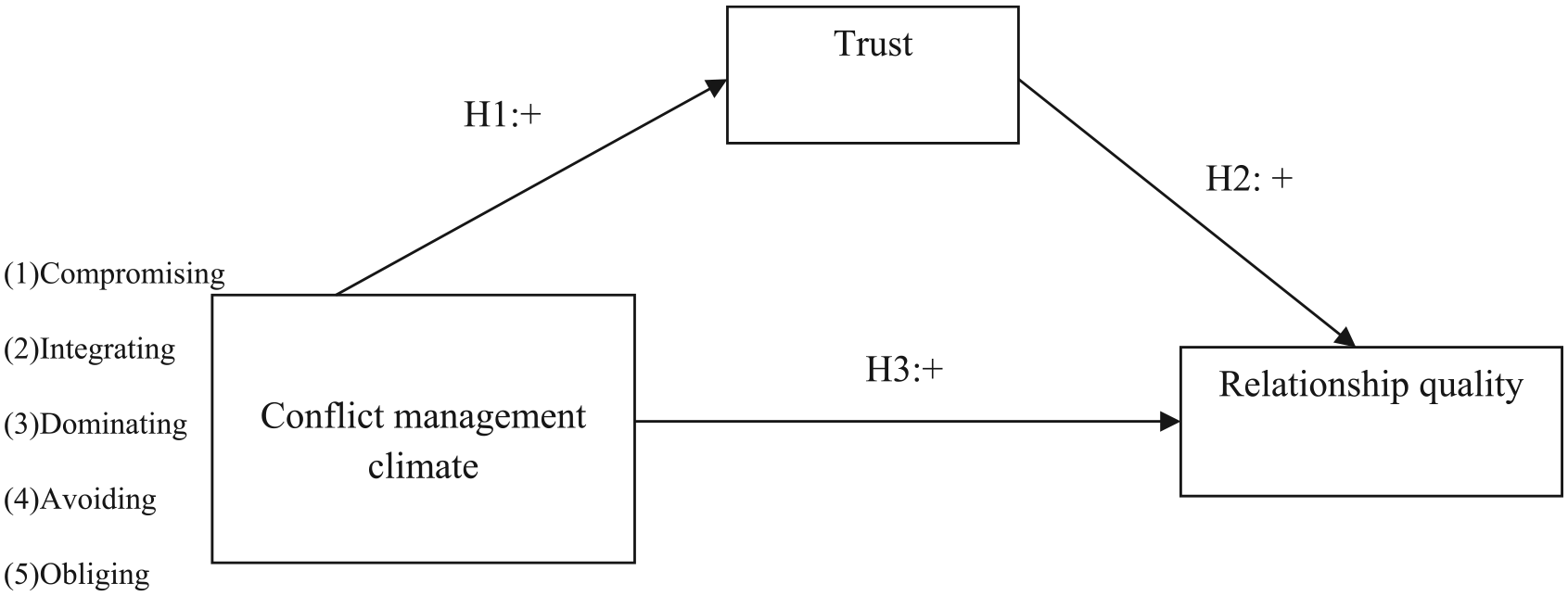
Conceptual framework.
Method
Sample and Procedures
Respondents of this study were the employees of the owners and contractors engaged in construction projects. A questionnaire survey of owners and contractors was administered to these employees in Lagos and the Federal Capital Territory (FCT) in Nigeria to achieve the research objectives. These two states were chosen because they represent the core of construction activities in Nigeria (see Adams, 1997; Ugochukwu & Onyekwena, 2014). The respondents were asked to complete the questionnaire in accordance with their past experience on previously completed projects. The respondents were important personnel in construction projects. They included project managers, site engineers, and professional engineers, among others. They had the ability to assess conflict and its management, trust, and relationship quality at the interorganizational level. They had direct involvement in resolving project conflicts as well as essential knowledge about the relationship between both parties. The first part of the questionnaire survey helped to gather the demographic information of the respondents and the project types. In the second part, using a 5-point Likert-type scale (ranging from 1 = strongly disagree to 5 = strongly agree), the respondents were asked to rate the variables. Simple random sampling was adopted, which is deemed to be efficient, accurate, and appropriate as it gives better information with a given sample size (Apipalakul & Kummoon, 2017). A total number of 641 questionnaires were distributed to the respondents individually; 426 valid responses were recovered, producing a response rate of 66%. In comparison with the norm of 20% to 30% in most questionnaire surveys administered in construction (Zhao et al., 2015), our response rate was considered effective.
The characteristics of the respondents are shown in Table 1. Around 71% of the respondents had more than 5 years working experience and large proportion were masters’ degree holders. This suggests respondents had sufficient experience and education and were qualified for the survey. The majority of the respondents were from the contractors’ side with a total of 344 (80.8%), whereas 82 (19.2%) were from the owners. In terms of gender, 376 (88.3%) respondents were male and 50 (11.7%) were female.
Respondents’ Characteristics.

Measurement Items
The five dimensions of conflict management climate were measured using (Morris et al., 1998) compromising style (three items), integrating style (three items), dominating style (three items), avoiding style (three items), and obliging style (three items). All were adopted from the study of Jung and Yoon (2018) and they are of high factor loadings. Trust was measured through six items adopted from Wu et al. (2017). Relationship quality was measured through six items concerning the relationship between the parties. The first four items were measured from Kumar et al. (1995), and the last two items were measured from Williams et al. (2015) adopted from the study of Lu and Wang (2017). For control variables, past experience will influence the relationship quality between the owners and contractors (Laan et al., 2011), where past experience is a dummy variable with value of 1 and 0 contrary. Project type may influence the owner relationship with the contractor (Trada & Goyal, 2017).
Analysis and Results
Statistical Package for the Social Sciences (SPSS) software Version 20 and AMOS 20.0 were utilized for data analysis. SPSS 20.0 analyzes the characteristics of the respondents, descriptive statistics (mean, standard deviation, skewness, and kurtosis), correlation (relationship among constructs), and regression analysis. AMOS 20.0 was used for confirmatory factor analysis (CFA) to test the construct validity and reliability of the observed variables. Structural equation modeling (SEM) was used to test the hypotheses and mediation analysis.
Common Method Bias
Consistent with Podsakoff et al. (2003), Harman’s one-factor test was used to check whether a single factor accounted for the majority of the total variation of all measurements. The results show that the largest factor of all seven factors with an eigenvalue greater than one accounted for 39.834%, thus suggesting method bias is not a major concern in the current study (Mat Roni, 2014).
Measurement Model
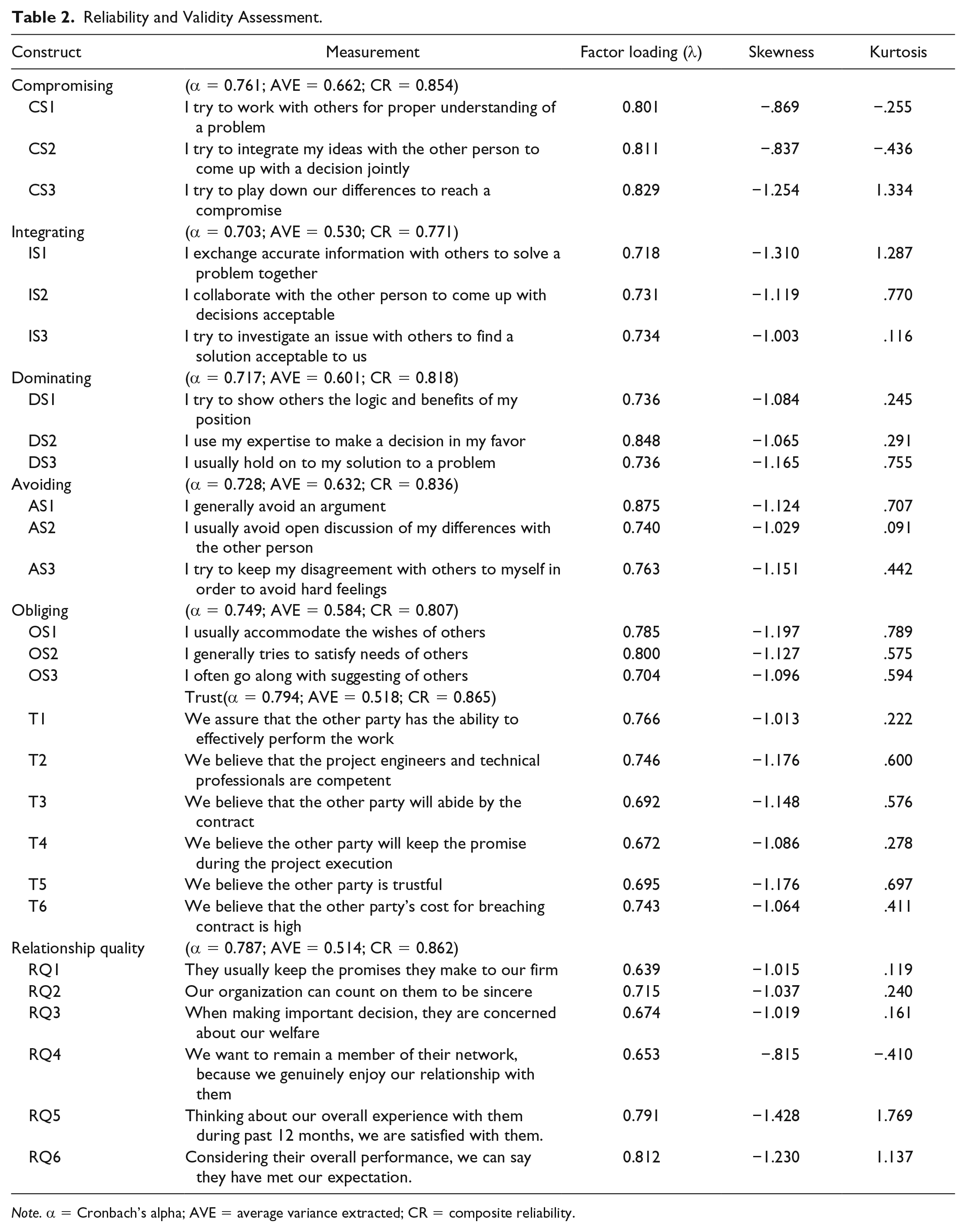
With regard to data distribution, Lei and Lomax (2005) suggested that both skewness and kurtosis indexes should not exceed |2.3|. It can be seen in Table 2 that the skewness ranged from 0.837 to 1.428 and kurtosis ranged from 0.091 to 1.769. Hence, all items fall within an acceptable range showing that the data collected can be said to be normally distributed.
Reliability and Validity Assessment.
Note. α = Cronbach’s alpha; AVE = average variance extracted; CR = composite reliability.
Reliability refers to the consistency of the measurement items. Cronbach’s alpha was calculated to check the reliability of each construct. The reliability results of all constructs range from 0.703 to 0.794 as shown in Table 2. They are all upward of threshold of 0.70, thereby showing the internal consistency of the research constructs (Chin, 1998).
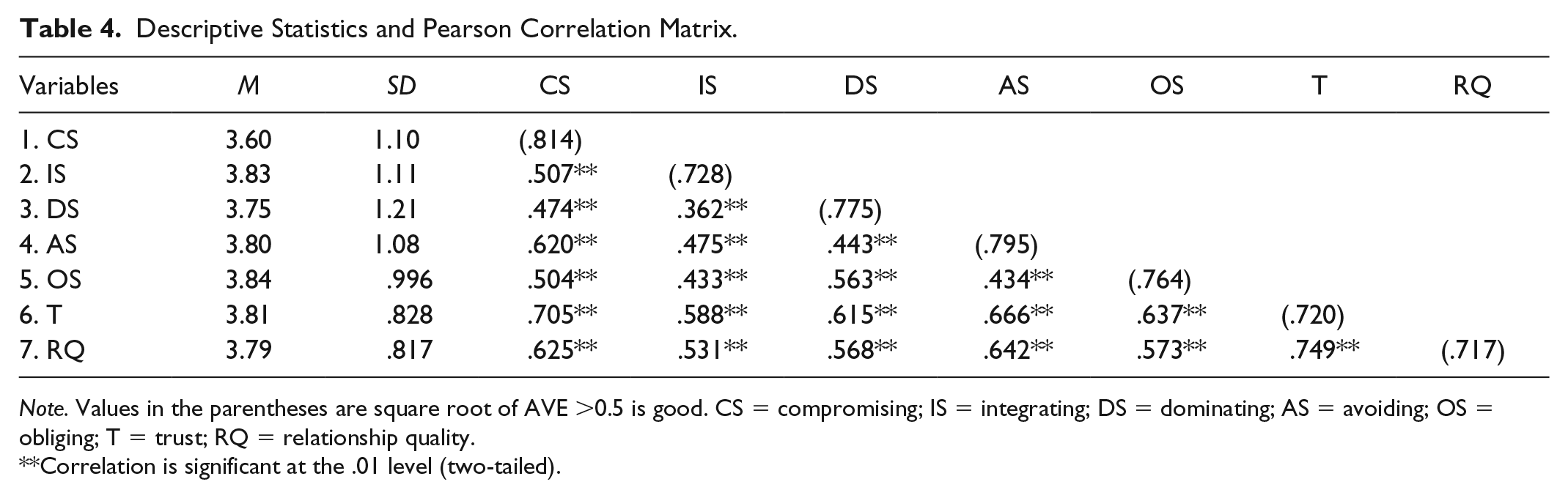
Validity refers to the extent that measurement items capture the underlying variable. To check whether validity is ensured, we estimated convergent and discriminant validity. To ensure convergent validity, all item loadings should be more than 0.6, the composite reliability of each construct should be upward of 0.7, and the average variance extracted (AVE) from each construct should be larger than 0.5 (Fornell & Larcker, 1981). As can be seen from Table 4, all factor loadings ranged from 0.639 to 0.875, composite reliability for each latent variable is above the acceptable range (0.771–0.865) and AVEs are larger than the critical range (0.514–0.662). These results demonstrate that all the latent variables show satisfactory convergent validity. To check discriminant validity, which refers to distinguishing constructs, the square root of an AVE was compared with the absolute value of correlation coefficients of other latent variables. As for discriminant validity, Fornell and Larcker (1981) suggested that the square of AVE for each construct of the model should be larger than its correlations with all other constructs. The AVEs of most of the constructs is greater than the surrounding correlations, showing further evidence of discriminant validity (Table 4). Also, the variance inflation factor (VIF) values for correlation between all the observed variables were below 5. This is below the maximum acceptance level of VIF 10, indicating no multicollinearity clouded the results (Hairs et al., 1998).
Table 3 shows the results of the CFA summary of the research model presented in this study (conflict management climate, trust, and relationship quality). The estimates show that the adopted research model (χ2/df = 2.07, goodness of fit index [GFI] = 0.940, adjusted goodness fit index [AGFI] = 0.915, comparative fit index [CFI] = 0.960, normed fit index [NFI] = 0.926, incremental fit index [IFI] = 0.960, Tucker–Lewis index [TLI] = 0.949, root mean square error of approximation [RMSEA] = 0.05) provides a better fit than the alternative models. The adopted model is a second-order construct measurement. F. F. Chen et al. (2005) pointed out that when theoretical backgrounds are solid, the second-order measure can be adopted where it provides a more parsimonious and interpretable model than the alternative models. This benefit was valuable in that adopted model was more closely related with certain concept than the alternative models.
Model Fit Summary of Confirmatory Factor Analysis.

Note. CMIN/df = relative/normal chi square; GFI = goodness of fit index; AGIF= adjusted goodness fit index; CFI = comparative fit index; RMSEA = root mean square error of approximation; NFI = normed fit index; TLI = Tucker–Lewis index; IFI = incremental fit index.
Furthermore, Table 4 shows that the mean score for each construct under conflict management climate ranged between 3.60 and 3.84. The mean results show obliging (M = 3.84; SD = .996) and integrating (M = 3.83; SD = 1.11) are the highest conflict management climate constructs, followed by integrating. Avoiding (M = 3.80; SD = 1.08) and dominating (M = 3.75; SD = 1.21) follow next. The lowest ranked conflict management climate is compromising (M = 3.60; SD = 1.10). Also, the mean value results show that for trust (M = 3.81; SD = 0.828) and for relationship quality (M = 3.71 SD = 0.817). This indicates that the respondents’ perception levels lean toward the positive end of the 5-point Likert-type scale.
Descriptive Statistics and Pearson Correlation Matrix.
Note. Values in the parentheses are square root of AVE >0.5 is good. CS = compromising; IS = integrating; DS = dominating; AS = avoiding; OS = obliging; T = trust; RQ = relationship quality.
Correlation is significant at the .01 level (two-tailed).
SEM
SEM was utilized to test the hypothesized relationships. Table 5 shows the standardized path coefficient and p values of the relationships. The structural model fit of the research model was good (χ2/df = 2.07, GFI = 0.940, AGFI = 0.915, CFI = 0.960, NFI = 0.926, IFI = 0.960, TLI = 0.949, RMSEA = 0.05).
Summary of Structural Parameter Results (Hypothesis Testing).

Note. GFI = goodness of fit index; AGIF = adjusted goodness fit index; CFI = comparative fit index; NFI = normed fit index; IFI = incremental fit index; TLI = Tucker–Lewis index; RMSEA = root mean square error of approximation.
p < .05. ***p < .001.
The relationship between conflict management climate and trust was validated as predicted in Hypothesis 1 (β = .868 and p < .000). This result reveals that conflict management climate has a significant positive relationship with trust between the owners and contractors.
Relationship between trust and relationship quality was validated as predicted in Hypothesis 2. The results show that (β = .186 and p < .05). This supports the prediction of this study, revealing that trust has a significant positive relationship with relationship quality between the owners and contractors.
Furthermore, Hypothesis 3 predicted a positive direct relation between conflict management climate and relationship quality. Results reveal that (β = .649 and p < .000), indicating that conflict management climate has significant positive relationship with relationship quality between the owners and contractors. In addition, the study examined the effect of conflict management climate on relationship quality using regression analysis in Table 6. Results show that all five dimensions of conflict management climate significantly affected relationship quality: compromising (β = .182, p < .001), integrating (β = .266, p < .001), dominating (β = .215, p < .001), avoiding (β = .185, p < .001), and obliging (β = .120, p < .01). The first model from the regression analysis examined the impacts of the control variables on relationship quality. The findings indicate that project type significantly influence relationship quality among the owners and contractors. On the contrary, past working experience has no significant effect on relationship quality.
Regression Analysis.

p < .05. **p < .01. ***p < .001.
Hypotheses 1 to 3 have all been validated. Mediation analysis is conducted to check whether conflict management climate influences relationship quality through trust. We adopted Baron and Kenny’s (1986) four-step mediation analysis. The first step showed that conflict management climate positively and significantly predicts trust. The second step indicated that trust significantly and positively predicts relationship quality. The third indicated that conflict management climate significantly and positively predicts relationship quality. In the fourth, with introduction of trust as a mediator, the direct effect between conflict management climate and relationship quality remained significant. Thus, we have a partial mediation. The Sobel test for trust as mediator was significant (z = 3.254 and p < .001), thus supporting the mediation effect as shown in Table 7. The mediation result indicates that trust partially mediated the relationship between conflict management climate and relationship quality.
Mediation Analysis.

p < .001.
Discussion
Our study tested the influence of conflict management climate on trust and relationship quality in the Nigerian construction industry. First, the findings show conflict management climate has a significant positive effect on trust. This result is aligned with previous studies (Ndubisi, 2011; Sahoo & Sahoo, 2019). The consistencies of this pattern of results could imply that owners and contractors tend to build trust when they perceive that parties take measures to minimize the adversarial effect of conflicts in construction projects when applying conflict management strategies. The observation shows that it is vital for owners and contractors to establish a project working environment that features mutual trust. Second, trust was found to be a positive and significant predictor of relationship quality. This shows that trust is crucial and fundamental for building long-term relationships between owners and contractors. This result substantiates with earlier studies (Black et al., 2000; Jelodar & Yiu, 2012). The discovery of a positive relationship between trust and relationship quality in the context of the Nigerian construction industry shows that such relationship is not limited to the Western context. The observation shows that owner–contractor relationship quality is enhanced when they behave in a trustworthy manner. Third, conflict management climate has a significant positive relationship with relationship quality. This is aligned with previous studies (Euwema et al., 2007; Munduate et al., 1999; Sheldon & Fishbach, 2011) in that parties should not adopt a single approach in managing conflict but rather a combination of various actions. This confirms that combination of behaviors contributes to effective results. The observation shows that conflict management climate is an important determinant of relationship quality and an important relationship builder in the construction context. It is vital that owners and contractors put in place an effective conflict management as the perceived quality of the procedure involved in conflict management affects relationship quality. Fourth, trust partially mediates the relationship between conflict management climate and relationship quality.
The present study demonstrates the potential significance of conflict management climate in construction industry. The theoretical implications of the current article are based on the strong evidence of the role of climate on the management of interorganizational conflict between owners and contractors as well as examination of the relationship between trust and relationship quality, thus enriching conflict management research theory in construction projects. By examining the perceptions of owners and contractors regarding conflict management climate in relation to trust and relationship quality, this study deviates from and goes beyond the norm in most conflict management research with regard to the appropriate choice among the five conflict handling behaviors when dealing with construction project conflicts (Gunarathna & Fernando, 2014; Lu & Wang, 2017; Prieto-Remón et al., 2015; Wu et al., 2017). Particularly, recall that complexity and uncertainty are inherent and defining features of construction projects (C. M. Burke & Morley, 2016). This calls for more nuanced research approaches with the potential to effectively manage conflict and enhance trust and relationship quality in the construction industry. This study provides empirical evidence that conflict management climate as perceived by the owners and contractors improves trust and it is a key driver of relationship quality at the interorganizational level in construction projects. Although there have been studies on the impact of conflict management on trust, attitudes, and commitment (K. W. Chan et al., 2008; Ndubisi, 2011; Sahoo & Sahoo, 2019), these studies were conducted in other industries outside construction and were concerned with individuals rather than the interorganizational level. To the best of our knowledge, the present study is significant as the initial empirical study verifying conflict management climate relations with trust and relationship quality in the construction industry, particularly in Nigeria. The current article is substantial as a result of the observation of the positive roles of conflict management at the interorganizational level in dealing with the highly documented adversarial nature of the construction industry, thereby extending conflict management climate theory in the construction industry. This is accomplished by systematically examining the effect of climate on conflict management, thus providing an insight that the perceived conflict management climate enhances trust and relationship quality among stakeholders in construction projects. The current study offers partial support for trust as a mediator in the causality between conflict management climate and relationship quality. The current study also contributes significantly to the existing body of knowledge in conflict management theory and relationship quality in Nigeria.
Conclusion
The contributions of the present study are important and highly significant to construction stakeholders in achieving construction project objectives. The present study provides essential knowledge about the potential relevance of conflict management climate in construction projects. Effective management of conflicts in construction project requires an awareness of climate and perceived conflict management climate contributes to an enhanced trust and is a key determinant of relationship quality in construction projects. This study has the potential to serve as a reliable reference for project members in evaluating conflict management in the construction industry. Thus, the present study offers a new as well as a meaningful insight which extends the comprehension of conflict management in construction projects.
Practical Implications
In recent times, the Nigerian construction industry has been characterized by huge investments. The outcome of the current study presents important practical implications for stakeholders in the construction industry in Nigeria. An important contribution of the present article is that it shows that the effect of climate in managing conflict management strategies may be narrowed down to a specific bandwidth of conflict management climate in the construction industry. The current study substantiates that owners and contractors may experience an enhanced trust as well as relationship quality is significantly influenced when they are aware of conflict management climate. Hence, the present study creates a practical strong point in formulating the standards of conflict management by focusing on procedures to effectively manage conflicts in construction projects. The diverse nature of the construction industry unavoidably generates conflicts. Owners and contractors should engage more in problem-solving and reconciliation when disputes and conflicts develop. This can be achieved by the application of procedures that boost the experience of conflict management. In other words, conflict management should focus on a process whereby both parties can easily provide comments and clarity on issues so as to facilitate the process of sharing ideas and suggestions rather than pinpointing individuals’ faults. More focus should also be given to conflict management climate in ensuring a productive work environment where a trust-based relationship can be established. This can help in fostering better relationships toward achieving the challenging goals of construction projects and in dealing with the problem of adversarial relationship in construction projects. This study suggests the importance of establishing a conflict management climate for promoting trustworthy behavior and enhancing relationship quality in the construction industry. This can be used as a monitoring tool for relationship quality and such indicator on relationship quality could contribute to an increased project performance. This is because relationship quality can help owners and contractors assess the state of their relationship before conflict has a harmful effect on the overall project success and objectives. In addition, the development of good relational interaction skills has been prevented by fragmentation in construction projects (Jelodar et al., 2015a), thus training as well as educating project team members may be needed to achieve long-term relationships in achieving goals of the projects.
Limitations and Directions for Future Research
Despite the accomplishments of the present study, there are some limitations that future research should take note of. First, the sample was limited to the Nigerian construction industry; thus, generalizations to other industries and other national cultures are needed in future research. Second, the study was limited to selected states in Nigeria. Future studies could broaden their scope to other regions across the country. Furthermore, they could also suggest of other dimensions of relationship quality as mediators between the conflict management climate approach used in this study and relationship quality can be the focus of future studies. Finally, relationship quality as a concept was only recently applied in the construction industry; more studies should be carried out to improve its effectiveness and rationality in construction projects.
Footnotes
Author Contributions
Both authors contributed equally in structuring, researching, analyzing, and drafting the research paper.
Disclaimer
The research paper expresses the authors’ views.
Declaration of Conflicting Interests
The author(s) declared no potential conflicts of interest with respect to the research, authorship, and/or publication of this article.
Funding
The author(s) received no financial support for the research, authorship, and/or publication of this article.
