




Abstract
The recent debate on innovation within an organizational setting has shifted focus toward discussing whether innovation is being adopted or being created. This shift is due to the failure of many innovation efforts and the fact that for each innovation creation or innovation adoption, different skills, resources, and cultures are needed to encourage each innovation. The objective of this article is to explore the type of innovation implemented by the construction participants. A conceptual model of innovation creation and innovation adoption was developed using four criteria: by justification of new ideas, by purposes, by activities involved, and by nature. Face-to-face questionnaires were conducted with developers, consulting firms, and contractors in Penang, Malaysia. The data were analyzed using descriptive analysis. Factor analysis was used to classify the innovation creation and innovation adoption. The results show that the construction participants in Malaysia are categorized as an innovation adopter. This result provides better understanding about the type of innovation implemented by the construction participants, in particular the contractors and the consulting firms. The results could also be used as a foundation for conducting future research to identify appropriate skills, knowledge, culture, and resources for such innovations.
Introduction
The construction industry has been criticized because of its low productivity and quality in comparison with other industries. One of the main reasons for this situation is because the industry suffers from a lack of innovation (Winch, 2003). However, the importance of innovation has been recognized by industry peers. Damanpour and Schneider (2009) point out that innovation is commonly perceived as a basis of organizational change, growth, and effectiveness. Pérez-Luño, Cabrera, and Wiklund (2007) add that innovation is vital to achieve competitive advantage and to ensure survival. It is not surprising that there are abundant studies which concentrate in searching for strategies that will help the organizations to be innovative.
The construction industry accounts for about 15% of the national product of most nations (Seaden & Manseau, 2001). According to Blayse and Manley (2004), the higher the levels of innovation in the construction industry, the greater the likelihood that it will increase its contribution to economic growth. In addition, at the bottom line, engineering and construction firms need to innovate to win projects and to improve the financial results of these projects. Development and effective use of new technology can provide important competitive advantages for engineering and construction firms. These advantages stem from distinctive technical capability, improvements in operations, and image as a technically progressive company (Blayse & Manley, 2004).
The recent debate on innovation within an organizational setting however, has shifted to focus on whether innovation is being adopted or being created because of the failure of many innovation efforts (Winch, 2003). From the perspective of a particular innovation, the firm that generates and implements a novel idea is known as the innovation creating organization, whereas the organizations that later adopt the innovation are considered to be the innovation adopting organizations. Innovation creating organizations are distinguished from innovation adopting organizations for a particular innovation because they successfully initiate, develop, and disseminate new products, technologies, and services (Damanpour & Wischnevsky, 2006). It should be noted that one organization may serve as the innovation creating organization for one innovation and as an innovation adopting organization for others (Gambatese & Hallowell, 2011). Scholars have come to realize that different skills, resources, and cultures are needed to encourage each innovation (Pérez-Luño, Wiklund, & Cabrera, 2011). Suitable strategies and well-planned systems are vital to enable the organization to excel in their innovation endeavor (Popadiuk & Choo, 2006). Therefore, it is important to distinguish between the two innovations.
The literature review show that innovation has been defined in many ways. For example, it is defined as a “process that involves the generation of new ideas or practices within an organization” (Wan, Ong, & Lee, 2005); “an idea, practice or an object that is perceived as new by an individual or other unit of adoption” (Roger, 2004); “the actual use of a non-trivial change and improvement in a process, product, or system that is novel to the institution developing the change” (Slaughter, 2000). These scholars tend to define innovation as being adopted and created synonymously. However in actual fact, most organizations tend to modify and imitate (Damanpour & Wischnevsky, 2006) what others have already created (Pérez-Luño et al., 2011). There is a risk if organizations focus too much on following others or on innovation adoption. Kambil, Eselius, and Menteiro (2000) warn that innovation adoption may give a fast solution to a problem, but it is only a temporary way out because sooner or later the organization has to face their competitors which are more advanced. In contrast, innovation creation can lead to new and better solutions to business and customer problems which go beyond finding new solutions to problems (Mostafa, 2005). A few studies also prove that innovation creation would lead to better performance (Langerak & Hultink, 2008; Zhou, 2006). Nevertheless, to implement innovation creation, organizations need to embark on R&D and ensure that within a reasonable time the new product generated through innovation creation can enter the market (Zhou, 2006). While implementing innovation creation is not an easy task, a few studies revealed that being a pioneer will not necessarily result in competitive advantage and better profit (Szymanski, Kroff, & Troy, 2007; Zhou, 2006).
To date, the literature strongly suggests that there is insufficient knowledge regarding whether the construction industry is implementing innovation creation or innovation adoption. As most scholars define innovation as being adopted and created synonymously, a new classification of innovation is crucial to match with the skill, resources, and culture in the organizations so as to encourage innovation in the industry. Most innovation studies devoted their efforts to identifying success factors and the hindrance toward innovation (Cooper & Kleinschmidt, 2007; Hauser, Tellis, & Griffin, 2006; Yusof & Shafiei, 2011) or identifying innovative and non-innovative organizations (Winch, 2003; Yusof, Sibly, & Osman, 2012). Very few attempted to differentiate innovation according to its type. One such effort is by Lim and Ofori (2007), but they classified innovation in the construction industry according to the benefits from consumer demand, costs, and intangible benefits. We argue that the notions of innovation creation and innovation adoption are two distinct phenomena that are facilitated by different circumstances. The present article aims to differentiate innovation according to its type and investigate whether the Malaysian construction participants are more innovation creators or adopters. The results will deepen our understanding on the classification of innovation in the construction industry from the perspective of innovation creation–adoption put forward by Damanpour and Wischnevsky (2006). The practical contribution of this article is that the results would help in the selection of appropriate strategies of innovation, which would significantly contribute to the success of innovation efforts in the construction industry. Specifically, the understanding of whether those in the industry are innovation creators or innovation adopters is vital to identify appropriate skills, knowledge, culture, and resources for such innovation.
Theoretical Background
Innovation in Construction Industry
When companies perform new or existing activities in a new way, this is often considered to be innovation. In other words, innovation involves a “change in routine” (Nelson & Winter, 1982, p. 128) and the “carrying out of new combinations” (Schumpeter, 1934, p. 65). Innovation has been seen in relation to new products, new processes, new raw materials, new forms of organization, and new markets. Slaughter (1998) defines innovation in construction industry as the “actual use of a non-trivial change and improvement in a process, product, or system that is novel to the institution developing the change” (p. 1).
The construction industry has several specific features which are likely to affect how innovation is or can be achieved. The construction market is somewhat peculiar because it faces certain aspects of regulation. The government has an especially dominant influence on this market. Due to technical regulations, the quality for a major part of the production is strictly determined. In particular in social housing, but also in civil engineering, these technical regulations and licenses (national and local) have a dominant influence. Environmental regulations are of growing importance. The regulations in the construction industry lead to limited opportunities for product variation and innovation (Blayse & Manley, 2004; Pries & Janszen, 1995). Organizational features also have an impact; the project organization is arguably both an innovation hindrance and driver (Slaughter, 2000; Winch, 1998). Also, the lack of long-term relationships (Dubois & Gadde, 2000, 2002) and integration in the supply chain (Akintoye, McIntosh, & Fitzgerald, 2000) are pointed to as inhibiting innovations. The complexity of the construction process itself is yet another complicating factor (Gidado, 1996; Miozzo & Dewick, 2004). The industry involves many actors and interactions at multiple levels, which means that the innovation process needs to engage a set of different actors with different economic logics (Bygballe & Jahre, 2009).
Innovation Creation and Adoption
It can be useful to distinguish between innovation adoption and creation as different skills, resources, and cultures are needed to encourage each innovation (Pérez-Luño et al., 2011). The research related to identifying criteria for innovation creation and adoption at organizational levels is very limited. Most studies address the criteria and characteristics of innovation as a unitary concept. In general terms, innovation creation is about introducing a new product or service ahead of other competitors (Kerin, Varadarajan, & Peterson, 1992), whereas innovation adoption is about adopting ideas from the competitors (Naranjo-Valencia, Jiménez-Jiménez, & Sanz-Valle, 2011). Kong-Seng and Yusof (2011) described innovation creation as involving generation of new ideas, transformation of new products, technology or services and their implementation. The idea is generated in a continuous process of information gathering from various sources, particularly the clients, together with an ever-challenging entrepreneurial vision (Urabe, 1988). Innovation creation may result in a new outcome to an organizational population (Damanpour & Schneider, 2008), while the adoption of innovation may result in the assimilation of product, service, or technology new to the adopting organization (Damanpour & Wischnevsky, 2006).
Both innovation creation and adoption have also gone through a different process as they are delivered by one organization and used by another. Damanpour and Wischnevsky (2006) suggest that the innovation creation process includes recognition of opportunity, research, design, commercial development, and marketing of the product/services. Once innovation is diffused and transferred to the potential adopters, the adoption process begins. Damanpour and Schneider (2008) proposed that innovation adoption involved two main processes which include initiation and implementation. Initiation is associated with the decision to adopt and the implementation process consists of all the activities and actions of adopting innovation (Damanpour & Schneider, 2008). Based on the process, an innovation creating organization is characterized as depending more heavily on its technological knowledge and market capabilities to develop and commercialize innovations, whereas an innovation adopting organization relies more on its managerial and organizational capabilities to select and assimilate innovations (Damanpour & Wischnevsky, 2006).
Criteria of Innovation Creation and Adoption
The literature review shows that one of the criteria for differentiating between innovation creation and innovation adoption is justification on the degree/level of newness. Song and Montaya-Weiss (1998) suggest that creation of a new product consists of technology that is new in the industry, makes significant changes and impacts on the industry when first introduced, and is new to the market. Ravichandran (2000) later proposed that innovation creation consists of an unseen, unknown, and uncertain character, whereas innovation adoption shows familiarity and similarity.
Due to the difference between innovation creation and adoption, both serve different purposes and functions. In the early research, Duncan (1976) suggests that innovation creation merges the new and existing knowledge in a new way, which results in an invention. Drucker (1985) further proposes that innovation creation is intended to contribute to an organization’s effectiveness and competitiveness by creating a new opportunity or by making use of an existing opportunity in a new way. On the other hand, the adoption of innovation is intended to contribute to the organization’s effectiveness and competitiveness by changing the adopting organization, so that it can adapt to new conditions in its external environment (Damanpour & Wischnevsky, 2006). Innovation adoption is also meant to solve problems by adapting existing knowledge to the identified problems (Pérez-Luño et al., 2007). Zhou (2006) stated that innovation creation plays an important role as a fundamental element toward sustainable development, whereas innovation adoption introduces an improved product to be able to identify the potential market.
In relation to the activities involved, most scholars from technology/science-based studies concur that R&D is a fundamental activity that leads to successful innovation (Czarnitzki & Thorwarth, 2012; Filippetti & Archibugi, 2011; Hollenstien, 2003; Rogers, 2003). The significant difference between both innovation creation and innovation adoption is in the approach and frequency of the R&D activities involved. For example, innovation creation involves intensive R&D activities by the organization and collaboration with external sources of knowledge such as universities and suppliers to create innovation that is new to the market (Filippetti & Archibugi, 2011; Hollenstien, 2003). However, not all innovation is the result of R&D activities. Innovation adoption organizations appear to be non-existent toward R&D activities and weak in collaboration with external sources of knowledge (Arundel, Lorenz, Lundvall, & Valeyre, 2007; Hollenstien, 2003). They imitate others. For example, the rapid industrialization in Japan, Korea, and Taiwan in the 1960s and 1970s stemmed largely from imitation (reverse engineering) of foreign technologies (Kim & Nelson, 2000). The process does not require investment in R&D as the organizations are not required to generate new knowledge. What they need is to identify the potential market needs, to search for relevant information, to have effective interactions between technical members, and a good strategy to market the product (Kim & Nelson, 2000).
Innovation creation and adoption also demonstrate distinct criteria. As innovation creation is about introduction of new products into the market, by nature it is associated with a slow market acceptance, a longer time frame, higher costs, and uncertainty due to the unpredictable market and demand (Song & Montaya-Weiss, 1998; Zhou, 2006). On the other hand, innovation adoption, by nature, is associated with lower market uncertainties as adoption only requires the extension of existing knowledge which has been proved a success in the market by the creator (Pérez-Luño et al., 2011).
Innovation involves a wide scope and can be found in many forms. It is not a linear process moving from one stage to another. It is a complex process that may happen in no particular order. It is difficult to identify the boundaries and to determine where one innovation stops and where another innovation begins. However, it is possible to differentiate and categorize both innovation creation and adoption based on their criteria and characteristics. The literature reviews identified four main criteria (by justification of a new idea, by purposes, by activities involved, and by nature) to differentiate both types of innovations. These four criteria are used to classify the Malaysian construction companies.
Method
This research employed a multi-stage data collection. The first stage involved a literature review to identify various definitions and criteria of innovation creation and innovation adoption from different industries and disciplines. From this, several concepts and criteria, that are applicable to the construction industry, were outlined and the questionnaire was formulated. 20 items were used to measure innovation creation and innovation adoption (see Appendix). Among the 20 items, 5 items (Adoption 4, Adoption 10, Creation 2, Creation 8, and Creation 9) were negatively worded. These items were then transformed to their actual meaning before performing the factor analysis. All the items were measured with a 6-point Likert-type scale ranging from 1 = strongly disagreed, 2 = disagreed, 3 = slightly disagreed, 4 = slightly agreed, 5 = agreed, and 6 = strongly agreed. Neutral answer, neither agreed nor disagreed, was avoided to ensure respondents make their stance and show their preference.
The second stage involved a questionnaire survey administered face-to-face with the top management of the developer, consultant, and contractor firms operating in Penang, Malaysia. The state of Penang was chosen as a case study because it is the most active state in Malaysia in terms of construction activities. Purposive sampling is used as the targeted respondents were obtained randomly from the list of members of housing developer associations, contractor associations, and professional bodies (Board of Architects Malaysia, 2013; Board of Engineers Malaysia, 2013) and they work in firms that operate in Penang. A total of 870 firms were identified, and the survey forms were distributed to all firms. Several steps were taken to increase the response rate following the suggestions of previous researchers (see, for example, Ryu, Couper, & Marans, 2006; Zagorsky & Rhoton, 2008). These steps included ensuring that the survey took less than 10 min to complete, respondents were given a ballpoint pen, reminder calls and follow-up visits were arranged for non-responses. One hundred thirty-six firms returned the questionnaires, and all were usable for analysis.
The data were analyzed using descriptive analysis. Prior to the analysis, the data were submitted to factor analysis to ensure the items are measuring what they are supposed to measure and for internal consistency. The following described the results of the descriptive and factor analysis.
Profile of Respondents
The male respondents contributed 40.0% and female respondents 60.0% of the returned questionnaires (Table 1). The majority of the respondents are Malay (75.2%), followed by Chinese (16.2%) and Indian (7.6%). There are 67 respondents with bachelor degrees which contribute to 64.4% of the total respondents who answered the questionnaire. These are followed by 18.3% of respondents who hold diplomas and 12.5% of respondents who hold PhD degrees. With regard to the respondent’s position in the firm, there was a total of 27.9% holding managerial positions, followed by 23.1% holding senior roles and the assistant managers’ positions recorded at 19.2%. The respondents with less than 10 years industry experience dominate the survey (57.1%).
Profile of Respondents.

Profile of Respondents’ Firms
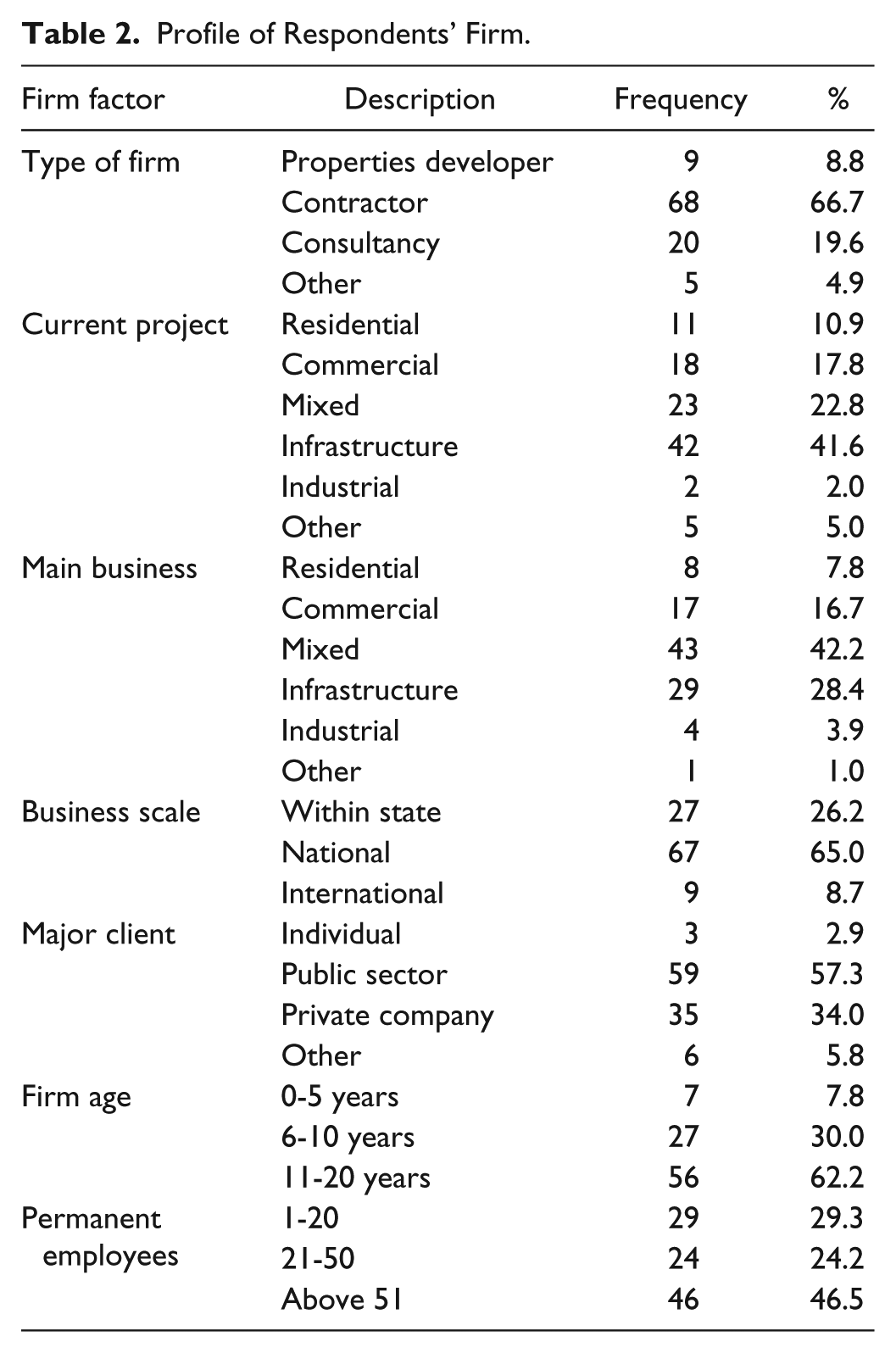
The distribution mainly focuses on contractors (66.9%), consultancies (19.6%), and property developers (8.8%). The main business of 42.2% of respondents’ firms is mixed, followed by infrastructure (28.4%), commercial (16.7%), residential (7.8%), and industrial (3.9%). In addition, the majority of the respondents’ firms work in national scales (65.0%) and their major clients are the public sector (57.3%). About 62.2% of the respondent firms’ age is between 11 and 20 years. This gives an indication that in Malaysia overall construction firms have established and experienced service providers. 30.0% of the firms have been established between 6 and 10 years. The remaining are 7.8% below 5 years. In terms of the number of employees in the firm, the data explained that 53.5% of the firms have numbers of permanent employees below 50. The breakdowns are 29.3% below 20 employees and 24.2% between 21 and 50 employees. The remaining respondent firms’ size is 46.5% for above 51 permanent employees (Table 2).
Profile of Respondents’ Firm.
Results
Factor analysis was performed to test which items are loaded to the two dimensions: innovation creation and innovation adoption. Table 3 shows the results of Kaiser–Mayer–Olkin (KMO) and Bartlett’s tests. The KMO which measures the sampling adequacy is 0.704, above the minimum acceptable value of 0.6 (Tabachnick & Fidell, 2001). The Bartlett’s Test of Sphericity was significant (p < .05), supporting the factorability of the correlation matrix (Pallant, 2005). Varimax rotation was used to explore the dimensionality in the data set. Two components emerged with a cumulative variance of 53.79%. We named these two components as innovation creation and innovation adoption. Four items were dropped due to the low factor loading. The eliminated items appear in italics in the Appendix. In all, 16 items with factor loadings greater than 0.5 (Hair, Black, Babin, & Anderson, 2010) were retained. Cronbach’s alpha (an index of reliability) was also performed on each component. Table 3 reveals that for both components Cronbach’s alpha is above .6 and supports the internal cohesiveness of the items forming each component (Hair et al., 2010).
Factor Analysis—Rotated Component Matrix.

Note. Extraction method: principal component analysis; rotation method: Varimax with Kaiser Normalization.
Next, we performed the descriptive analysis of the retained items and computed the total mean scores for innovation creation and innovation adoption. Table 4 shows the results of the analysis. The analysis indicates that the total mean score for innovation creation is 3.56 and total mean score for innovation adoption is 4.05. Paired-sample t test was conducted to determine whether there is a significant difference between mean scores of innovation creation and innovation adoption among construction firms in Malaysia. The result revealed that the innovation adoption mean is significantly higher than innovation creation (p < .001). It means that innovation adoption is the dominant practice among Malaysian construction firms. The highest score of innovation adoption items belongs to Adoption 10, “We always refer to the existing design in the market when we design,” with a mean score of 4.43, followed by Adoption 6, “It has been a culture to adapt a well-known design” (M = 4.34), and Adoption 2, “We usually introduce a familiar and well-known design to the client” (M = 4.32). The lowest score is Adoption 9, “Whenever there is a new designed product introduced by other design firm, we would try to imitate their design” (M = 3.65).
Mean Scores for Innovation Creation and Innovation Adoption.

In contrast, the Malaysian construction industry does not show a strong tendency toward innovation creation with only two items—Creation 2 and Creation 7 which are “slightly agreed” within the questionnaire “compete to be the first to introduce new design ahead of other design firms” and “tried to impress the client with their novel and ‘dare-to-try’ design.” The remaining items (Creation 10, Creation 6, Creation 3, Creation 8, and Creation 9) in the innovation creation statements are “slightly disagreed” that their firms have a very strong linkage with the universities and research centers, invest heavily in R&D for new ideas and technology, design to surprise the market, aim to be the first to introduce a new design, and are a pioneer of any new idea as their main intention.
Discussion
The results show that adopting innovation is the dominant practice among most of the construction participants (developers, consulting firms, and contractors) in Malaysia. They are more comfortable adopting existing designs in the market that are in line with current demand and introducing a familiar and well-known design to the client rather than being the first to introduce a new design or being a pioneer of any new idea and design to surprise the market. These results confirmed Pérez-Luño et al.’s (2011) study that reveals more than half of Spanish firms are innovation adopters. For these firms, the purpose of innovation is only a tool to assist them to do things better rather than an end-product. The findings also show that it has been a strong culture in Malaysian construction firms to adapt to a well-known design, which influences their decision to introduce familiar and well-known designs to clients. This criterion reflects a study by Ravichandran (2000) that proposed innovation adoption demonstrates familiarity and similarity in terms of its justification.
In relation to activities, the findings demonstrate that most Malaysian construction firms prefer to make modifications based on the existing/proven successful products in their business strategy and are open to the idea of imitating designs from the market to minimize the uncertainty of their products. They are comfortable being a creative imitator instead of a design pioneer. Most of them do not invest in R&D to develop new ideas and technology. Part of the reason is the difficulty of patenting new ideas in construction, and partly the nature of the construction industry itself that is always constrained by cost, time, and the requirement for a fast solution to a problem.
The results also show loose linkages between industry (the construction firms) and universities and research centers. Gan and Salter (2000) suggested that design, engineering, and construction are project-based firms. They behave differently from a “normal” organization. Technical support and problem solutions are carried out through project-specific tasks within a short time period. The process in which universities and research centers produce their research results takes a long time that is contrary to the nature of the construction industry. At the same time, it requires a critical number of technically qualified staff to create new ideas, which does not apply to construction organizations (Gann, 2001).
Based on the findings, it can be reflected that adopting innovation is dominant practice among most of the Malaysian construction firms because they are very much influenced by the niche market in which they operate, limited resources, and the nature of the construction business which is organized with multiple layers of sub-contracting and very few direct employees.
Conclusion
The present article aimed to explore the type of innovation implemented by the construction industry. Specifically, it attempts to answer whether the construction participants are innovation creators or adopters. Knowing whether the construction industry is an innovation creator or an innovation adopter could be used as a reference point for the industry; namely the contractors, consultancy firms, and property development firms, who want to develop appropriate innovation. The result of this study will provide basic information for the Construction Industry Development Board, the respective professional bodies and the government, to identify appropriate strategies and resources to encourage and support innovation in the construction industry. This study suggests that majority of the Malaysian firms in construction industry are more innovation adopters than innovation creators. Therefore, managers of these organizations need to acquire the necessary knowledge and skills to establish a positive environment for innovation adoption and its implementation (Egbu, 2012). Specifically, managers are expected to have the ability to gain information on the best competitor and learn how the competitors succeed in implementing innovation. The knowledge gained from competitors can help managers to make decisions about choosing innovation that is less risky or complex and that will have the highest impact on its reputation in the industry and on profitability (Damanpour & Schneider, 2009).
The present study focuses on the type of innovation implemented by the construction industry. More work is needed to identify an appropriate organizational environment, skills, and resources to facilitate innovation adoption rather than innovation creation in the industry. Pérez-Luño et al. (2011) stressed the need for a separate theoretical model to explain innovation adopter strategies to acquire external knowledge and implement it in their processes. In addition, Kong-Seng and Yusof (2011) suggested a model which can help to identify organizational cultures that can be the drivers for innovation adoption. Naranjo-Valencia et al. (2011) have gone further and point out that hierarchical culture can help to expedite innovation adoption. Studies that focus on these areas would deepen our knowledge on factors which predict innovation adoption, which in turn brings benefits to the construction industry.
Footnotes
Appendix
Measurement Scales
| Innovation adoption | |
|---|---|
| Adoption 1 | We are the creative imitator instead of a design pioneer. |
| Adoption 2 | We usually introduce a familiar and well-known design to the client. |
| Adoption 3 | For us, innovation is just a tool for getting things better, rather than an end-product. |
| Adoption 4 | We do not make modification based on the existing/proven succeed products. |
| Adoption 5 | We are imitating designs from the market to minimize the uncertainty of our products. |
| Adoption 6 | It has been a culture to adapt a well-known design. |
| Adoption 7 | As long as the design/product meets the client’s criteria, proposing something extraordinary/beyond the expectation would not be necessary. |
| Adoption 8 | We only introduce a design when it showed a potential demand. |
| Adoption 9 | Whenever there is a newly designed product introduced by other design firms, we would try to imitate their design. |
| Adoption 10 | We never refer to the existing design in the market when we design. |
| Innovation creation | |
| Creation 1 | We believe that being innovative is about being able to make amendment to the existing products of other firms. |
| Creation 2 | We do not compete to be the first to introduce new design ahead other design firms. |
| Creation 3 | We design to surprise the market rather than to please the market. |
| Creation 4 | We design based on the potential demand. |
| Creation 5 | When we design, the introduction of high degree of newness product comes before the consideration of potential market denial. |
| Creation 6 | My firm invests heavily in R&D for new idea and technology. |
| Creation 7 | In any chances, we tried to impress the client with our novel and “dare-to-try” design. |
| Creation 8 | We do not aim to be the first to introduce a new design. |
| Creation 9 | We would never want to be the pioneer of new product. |
| Creation 10 | My firm has very strong linkages with the universities and research centers. |

Declaration of Conflicting Interests
The author(s) declared no potential conflicts of interest with respect to the research, authorship, and/or publication of this article.
Funding
The author(s) disclosed receipt of the following financial support for the research and/or authorship of this article: This study is a research funded by Ministry of Education Malaysia under Fundamental Research Grant Scheme (FRGS; Grant Number 203/PPBGN/6711254). The support is greatly acknowledged.